

Summary
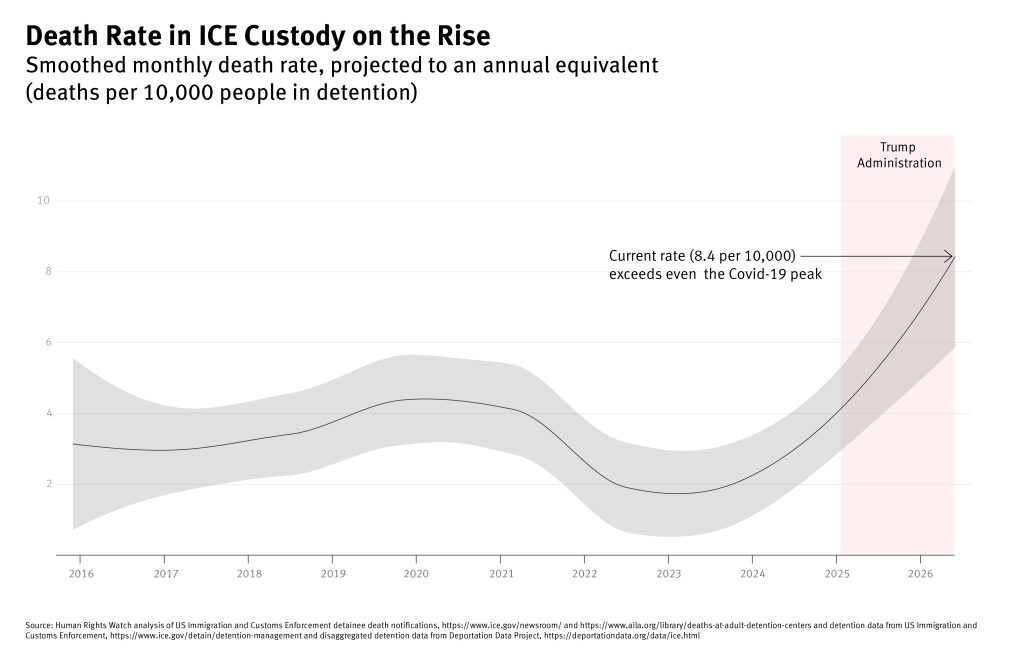
In the 500 days between President Donald Trump’s inauguration on January 20, 2025 and June 4, 2026, 52 people died in Immigration and Customs Enforcement (ICE) custody in the United States. The mortality rate of deaths in ICE custody is at its highest level in over a decade and has more than doubled since Trump’s second term began. The rate is nearly four times that of the Biden administration, and more than two and a half times as high as that of the first Trump administration. The current trend-level rate is now even higher than during the Covid-19 pandemic. Urgent action is needed to address this crisis and prevent further deaths.
The second Trump administration launched an aggressive campaign to expand immigration detention, pushing the number of people held to a record high of over 71,000 people in January 2026. The surge in deaths is much worse than what one would expect even considering the much higher number of people in detention. Deaths in ICE custody have increased at a rate disproportionate to the growth in the detained population. January 2025- January 2026 saw an approximately 140 percent increase in the annual mortality rate compared to the prior year.
Methodology
This report draws on two overlapping bodies of analysis. The statistical analysis covers all 52 deaths in ICE custody over the first 500 days of the second Trump administration, from January 20, 2025 to June 4, 2026, and compares the mortality rate with data spanning the past two decades. The medical and human rights analysis focuses on the 39 deaths reported in the first 12 months of the second term, from January 20, 2025 to January 19, 2026, the period for which case documentation was available at the time of review. Medical experts from Physicians for Human Rights assessed the clinical circumstances preceding each death and the adequacy of care described in available documentation, including supplementary medical records in two cases. Human Rights Watch conducted interviews with family members, attorneys, and former cellmates of the deceased.
Findings: Deaths in ICE Detention Indicate Violations of ICE Policy and International Human Rights Law
Under international human rights law, the state has an obligation to respect and ensure the right to life. When a government detains a person, it has a heightened obligation to protect their rights, and to this end must provide adequate health care and other protections. In the case of a death in custody, the government should also provide all relevant information to the family, including medical reports and investigations into the death.
Failure to Ensure Transparency and Public Accountability for Deaths
ICE policy requires public disclosure of a death of a person in custody within 48 hours and more detailed public reporting of the facts and circumstances surrounding the death within 30 days. Physicians for Human Rights found that, in all 39 cases, the government did not publicly provide sufficient information about the circumstances of death or about the medical care provided in detention to support a definitive clinical assessment. The available documentation was often scant, but it was nonetheless sufficient to identify serious concerns about the care provided.
The lack of medical information in published government records, including about medical care requested and provided, severely limits external medical expert review. The government has systematically failed to report deaths in custody in a timely and comprehensive way, and to be transparent about the medical care provided during detention.
The family of one man who died in ICE custody in 2025 has been trying to access additional records on his case. His mother is desperate to know more about the care he received and the conditions he was held in before his death, and wants access to any available surveillance footage. “What I want is for them to investigate,” she told Human Rights Watch.
Evidence of Inadequate or Delayed Care
Based on available information, Physicians for Human Rights medical experts had a high suspicion of inadequate or delayed health care in several of the 39 deaths that occurred during the first year of the current administration, raising serious concerns that the deaths may have been preventable.
Examples of the types of circumstances and clinical details that raise concerns that a death may have been preventable include: worsening respiratory symptoms without intervention until the person was found unresponsive; people who did not have more frequent medical evaluations when they had known hypertension and worsening symptoms such as headaches; individuals who died from sepsis and had known risk factors for sepsis (such as an immunocompromised state or indwelling central venous catheter) but no blood cultures drawn or antibiotics given when febrile; cases where contradictory medical instructions were given to patients; and delays in starting cardiopulmonary resuscitation (CPR) for persons found unresponsive.
In one case, Maksym Chernyak, a 44-year-old man from Ukraine, suffered a stroke in detention. Despite having clear signs of an emergency including seizure-like movements and non-reactive dilated pupils, detention facility staff failed to ensure appropriate emergency medical care. Delays in getting him to higher level medical care almost certainly contributed to his death.
In another case, Ismael Ayala-Uribe, a 39-year-old Mexican citizen, reportedly died from cardiac arrest that PHR assessed likely arose from overwhelming septic shock. His repeated attempts to obtain appropriate medical help for an infected abscess were recurrently mishandled.
Santos Banegas Reyes, a 42-year-old Honduran citizen, was “cleared for detention within two hours of arrival” despite being identified during medical intake as being in active alcohol withdrawal. ICE’s reporting on Banegas Reyes fails to identify why he was not sent to a hospital for care or, at a minimum—as would be the standard of care for someone with unknown risk of future severity of withdrawal and thus with potential to progress to life-threatening withdrawal—observed more closely within the detention center’s medical unit. He was found unresponsive in his cell during morning count the day after his arrival and was declared deceased shortly after.
The facts of these and other cases suggest that the United States is failing to meet its obligations to respect and ensure the right to life and to ensure adequate health care in detention.
In addition to such cases, the high number of people who died by apparent suicide in detention is also a serious concern. According to ICE records, seven people died by apparent suicide from January 20, 2025 to January 19, 2026. This compares to one reported death by suicide in 2024. In a custodial environment, the state has significant capacity to monitor wellbeing and safety, and to prevent and respond to attempted suicide. The high number suggests that the state may be failing to adequately respond to the risk of suicide.
Poor Conditions of Detention including Inadequate Staffing and Gaps in Health Care
The dramatic rise in the rate of deaths in detention is a foreseeable outcome of the Trump administration’s immigration policies and practices. Drawing on Physicians for Human Rights and Human Rights Watch’s decades of experience documenting deaths in detention and patterns of abuse in immigration detention, this report finds that the high numbers of deaths in 2025-2026 are likely fueled by both long-term systemic problems as well as new changes implemented by the second Trump Administration.
Long-term concerns about US immigration detention include poor conditions in detention facilities, such as unsanitary facilities and inadequate food, which contribute to illness and disease. They also include sub-standard health infrastructure and services in detention centers, which contribute to poor quality and delayed medical care for individuals with physical or mental health conditions or a health emergency. There has long been inadequate staffing at detention centers to ensure proper monitoring and responsiveness to individuals in detention, and inadequate and delayed publication of information about detainee deaths, undermining public accountability.
The second Trump administration has exacerbated these problems and created new ones, including:
- Restrictions on legal immigration pathways and the expansion of mandatory detention have swept more people into custody and prolonged their confinement.
- Soaring detention numbers since January 2025 expose more people to poor detention conditions and lead to more crowded facilities, which in turn worsens sanitation concerns and further strains the provision of health care. This report found that most of the 39 deaths occurred in facilities that had significantly elevated population levels in the two weeks leading up to the deaths (as compared with the previous three-year average population in these same facilities);
- The second Trump administration dismantled or rendered ineffective oversight mechanisms for Department of Homeland Security (DHS), ICE’s parent agency, which were flawed but important mechanisms for preventing and investigating deaths in custody; and
- Changes to the system for processing claims for offsite health care for detained immigrants raise concerns about gaps in health care and coverage.
Violations of ICE Policy, UN Standards, and UN Human Rights Treaties
The United States has obligations to protect the lives and health of those in its custody. The deaths of people in US immigration detention raise concerns that the United States has violated the International Covenant on Civil and Political Rights (ICCPR), which protects the right to life and obligates states to take steps to safeguard the lives of those in custody. The mistreatment of people in immigration detention contravenes the UN Standard Minimum Rules for the Treatment of Prisoners (Mandela Rules), which, among other things, call for prompt access to medical care and prohibit delays in emergency response, as well as ICE standards on medical care and suicide prevention. Those ICE standards include the requirement that people in detention be able to communicate urgent needs to staff and receive timely responses. Poor detention conditions and the failure to provide adequate medical care can also amount to violations of the prohibition against cruel, inhuman, or degrading treatment of the ICCPR and the Convention Against Torture (CAT), treaties ratified by United States, as well as the guarantee of humane treatment for people deprived of their liberty under the ICCPR.
Conclusion
For the United States to meet its human rights obligations and prevent more deaths in ICE custody, immediate action is needed to reduce the numbers of people in detention and to improve overall detention conditions, including by using detention only as a last resort. The government should ensure competent medical and mental health screening at intake, ensure adequate medical staffing and resources to those detained equivalent to that available in the broader public community, including mental health care, guarantee uninterrupted access to offsite care, and conduct periodic health assessments. The government should also provide remedies to the families of people whose death resulted from violations of US human rights obligations, restore independent oversight of DHS, and mandate transparent, comprehensive, and timely reporting of deaths and the conditions and decisions that led to them. State and local governments, private detention operators, and UN human rights bodies all have a role to play in upholding these standards.