
On November 10, 2025, just after 4:00 p.m., we uploaded our final written submissions on behalf of eight survivors of post-election sexual violence to Kenya’s Supreme Court digital filing system. The moment felt both heavy and hopeful, marking the next step in a twelve-year legal journey that has made its way up to the Supreme Court.
Watching the confirmation message appear on my screen felt like exhaling after holding my breath for far too long. After eighteen years, survivors of sexual violence that occurred during the 2007–08 post-election chaos might finally see justice, while the rest of the country begins to grasp the violence of this crime.
The suffering did not end when the fighting stopped
The 2007-08 post-election violence in Kenya was one of the darkest chapters in our history: more than 1,333 lives lost, nearly 663,000 people displaced, thousands were sexually assaulted, mutilated, beaten, or tortured. Homes were burned. Families were torn apart. Communities were shattered.
And for women and men who survived sexual violence, the suffering did not end when the fighting stopped. The persistent lack of accountability for these violations continues to stand in the way of healing of the individuals affected and the country as a whole.
“My daughter keeps asking about her father,” a survivor once told me. “What do I tell her if even my country refuses to acknowledge what happened?” Her words sit heavy on my chest.
“My daughter keeps asking about her father,” a survivor once told me.”What do I tell her if even my country refuses to acknowledge what happened?” Her words sit heavy on my chest.
I joined PHR long after these courageous survivors first walked into court in 2013. But working closely with them over the past year, listening to their stories, and accompanying them through setback after setback, I have come to understand the weight of the injustices we are asking this country to confront.
On March 8, 2026, as people around the world mark International Women’s Day (IWD), these survivors are one step further in their fight for justice; their struggle the embodiment of this year’s theme: Rights. Justice. Action. For ALL Women and Girls.
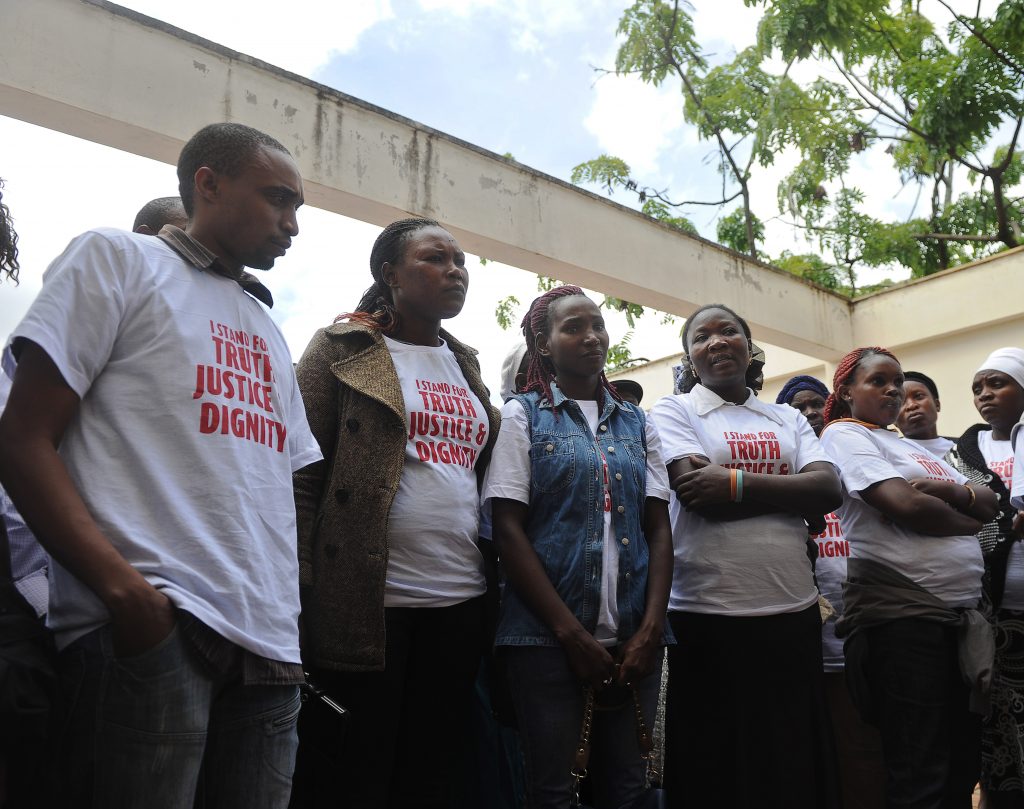
The Supreme Court
How can it be that both the High Court and the Court of Appeal held that four of our plaintiffs, each of whom was violated by a non-state actor, were not entitled to compensation because they had not filed police reports during the unrest? Can the law really punish them for surviving?
Of the eight survivors in our case, the courts compensated only four. Three of these women were violated by state actors. The fourth, although violated by a non-state actor, managed to report her case at a police station despite the chaos. The remaining four, who faced the same violence but had no safe way to report it, were denied compensation.
Our appeal asks the Court a simple but deeply consequential question: Should survivors of sexual violence be denied justice simply because it was too dangerous, or impossible, for them to report it at the time?
During the post-election unrest, roads were blocked by militia groups. Police stations were deserted or had become sites of violence themselves. Survivors in our case even recounted seeing police officers — the very people they were supposed to report their ordeals to — committing brutal sexual assault.
In that environment, leaving your home to report a violation was not just unrealistic. It was life-threatening.
The Waki Commission and countless affidavits from survivors of sexual violence during that period paint the same picture: a country engulfed in fear, uncertainty, and total breakdown of law and order. Survivors were not choosing to hide in silence but to stay alive, seeking medical care only when they could do so safely. They found shelter where they could. They carried their trauma quietly until they were able to bring this case to court.
A painful and discriminatory distinction
The courts created a dangerous hierarchy:
– those who could report, and those who could not;
– those deemed credible enough for justice and those deemed invisible.
Almost two decades later, we are preparing for another general election. The children conceived through rape eighteen years ago are now young adults, many sitting for their final high school exams. Next year they will be old enough to participate in the same democratic process that failed their mothers. Two generations are now owed justice.
Kenya’s legal and moral obligation
Kenya’s obligation to protect, investigate, and remedy violations is grounded in the 2010 Constitution and reinforced by every major human rights treaty we have ratified, including the International Convention on Civil and Political Rights (ICCPR) , Convention on the Elimination of All forms of Discrimination Against Women (CEDAW), the Protocol to the African Charter on Human and Peoples’ Rights on the Rights of Women in Africa also commonly referred to as the Maputo Protocol.
Our clients are not asking for charity. They are asking for the rights the Constitution already promises them.
In their affidavits, the survivors said: “These violations are ongoing for as long as we remain unseen, unheard, and uncompensated.”
Standing on the right side of history
On this International Women’s Day, we must ask what “Rights. Justice. Action” truly look like.
It begins with recognition, a formal acknowledgment from the highest court that terrible crimes were committed, and that the State’s failure to protect them constituted a further grave violation of their rights.
Reparations will also be critical. For eighteen years, survivors have carried the weight of medical expenses and lost livelihoods, on top of the enduring psychological trauma.
Action must then go further. Precedent set. Sexual violence is a crime. The fact that the perpetrator is a non-state actors or the absence of a police report must never again be used as a means for the State to evade its responsibility to prevent sexual violence during times of unrest, or to allow for impunity afterward.
Suzanne Kidenda, PHR’s Interim Head of Office, captured this perfectly as we filed the submissions when she said: “After twelve exhausting years in court, this is the survivors’ last shot. We hope justice will not only be done but be seen to be done.”