
On June 6, 2025, demonstrators began to assemble outside of the Metropolitan Detention Center in Los Angeles in response to accelerated federal raids targeting suspected undocumented immigrants, catalyzing a series of mass protests across the country to denounce U.S. immigration policy.
Both protesters and journalists alike were met with crowd-control weapons (CCWs) by federal law enforcement, marking the beginning of a surge in reckless, indiscriminate, and dangerous uses of CCWs to police immigration-related assemblies.
As a result, the sometimes life-threatening health consequences of weapons such as tear gas, pepper spray, stun grenades, and kinetic impact projectiles (so-called “rubber bullets”) are again in the spotlight.
Drawing on four decades of Physicians for Human Rights (PHR) research on the health and human rights harms of CCWs, a team of PHR experts have documented injuries from these weapons and identified the prominent role certain lesser-known CCWs have played in policing U.S. protests throughout 2025 and 2026.
First, scattershot impact projectiles used by the Los Angeles Police Department (LAPD) are tools of collective punishment on assemblies rarely seen in the United States. Their inherent tendency to strike unintended targets means that police can use them against anyone attending a protest – often without accountability. These weapons can be directly linked to the nearly 100 journalists shot with less-lethal weapons during the anti-ICE protests in Los Angeles from the summer of 2025.
A second weapon rising in use in protest settings are powder blast dispersion rounds – often referred to by the trade name “Muzzle Blast” rounds. These chemical irritant weapons were once largely confined to correctional facilities, but recently they have found their way onto the streets in the hands of the United States Border Patrol (USBP). Video footage shows these weapons being direct fired at very close range at protesters’ faces, which greatly increases their hazard.
Lastly, there is growing concern over the chemical obscurants (“smoke grenades”) that have been used sporadically in a crowd-control context, contributing to misinformation and exacerbating fears of harm from CCWs during protest.
This PHR visual investigation spotlights these three novel weapons, unpacks their health hazards, and analyzes how U.S. law enforcement agencies abused these weapons during immigration protests from June 2025 to the present. Shooting journalists, misusing weapons on protesters, and exploiting fear and misinformation all have a chilling effect on constitutionally-guaranteed rights of free speech and assembly. Taken together, these incidents illustrate a national pattern in which public dissent is increasingly met with escalating violence. The fear and harm resulting from increasing use of novel crowd-control weapons at the hands of both federal and local law enforcement demonstrates the need for public disclosure around the weapons used in order to ensure their use complies with internal protocols, international standards, and constitutional guarantees to freedom of assembly.

Navigate the visual investigation by using the table of contents at top of page
WEAPON: 37mm multiple projectile (“scattershot”) rounds
AGENCY: Los Angeles Police Department
DATE: June 2025
MISUSE: Indiscriminate use against journalists
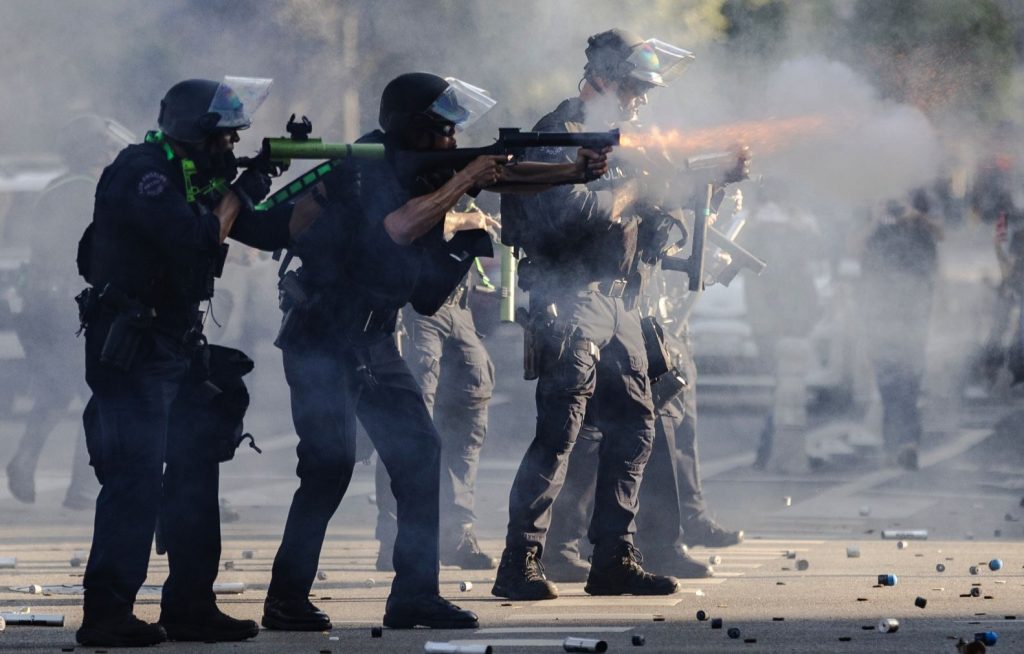
When reviewing the Los Angeles Police Department’s (LAPD) policies on use of force for crowd-control, one document stands out as unusual: Use of Force Directive no. 12, regarding the use of the “37mm Less-Lethal Launcher.” While the title generically references a 37mm grenade launcher designed to fire a variety of crowd-control projectiles, the document specifically refers to its use when paired with a type of kinetic impact projectile (KIP, often generically referred to as a “rubber bullet”) infrequently seen in the United States – a “scattershot” kinetic impact projectile that fires five polymer projectiles simultaneously in an expanding cone from the muzzle of a civilian grenade launcher.
The risks of scattershot KIPs are underrecognized in the United States as their domestic use is largely restricted to correctional facilities, not protests. Most KIPs used for crowd-control in the United States are “target-specific,” meaning they are intended to be used against a single individual when there is an imminent risk of harm to people around them. Scattershot KIPs, by contrast, are designed to spread out to hit as many people as possible. The imprecision built into these weapons therefore makes them inherently indiscriminate, and unsuited for use in crowd-control.
Click below to reveal more:
+ Weapon details
The LAPD’s classification of scattershot projectiles is unusual: whereas most American police protocols specify KIPs be used to target single individuals engaged in assault or violent conduct, LAPD protocols permit them to be used against multiple individuals. This means there are circumstances in which scattershot KIPs may be used not only against lone individuals, but rather shot in the general direction of a “hostile crowd:”
“The 37mm Less- Lethal Launcher disperses five foam baton rounds toward the ground in front of a hostile crowd once an unlawful assembly has been declared. It is not to be fired directly at individuals, and only authorized for use by specially trained personnel.”
The description and dimensions of the LAPD’s scattershot munition is consistent with Defense Technology product 1178, the “37mm Multiple Foam Baton Round.” This weapon is marketed as “ideal for correctional and jail facilities where engagement distances may be limited by walls or barriers.” These weapons are designed for smoothbore 37mm launchers and possess no mechanism – such as fins or spin – to stabilize them in flight. Therefore, upon leaving the muzzle, the projectiles are aerodynamically unstable and will disperse randomly from the initial point of aim. Defense Technology highlights the weapon as being particularly imprecise; the company notes that after 30 feet “the lightweight foam batons may move off target,” and the use of black powder versus smokeless powder as a propellant in the 37mm variants “will usually disperse the foam projectiles in wider patterns.”
+ Hazards and Health Effects
Previous work by PHR highlighted the danger of scattershot projectiles in crowd-control settings. As scattershot munitions are designed to spread out over distance it is impossible to predict the exact trajectory of each projectile, making it exceedingly difficult to avoid impacts to bystanders or the parts of the body most sensitive to injury from kinetic impact projectiles, such as the head, neck, chest, or genitalia. In our 2023 systematic review of CCW injuries recorded in peer-reviewed scientific and medical literature, 82 percent of all recorded injuries from KIPs came from scattershot munitions and 96 percent of all ocular injuries from KIPs originated from scattershot rounds.
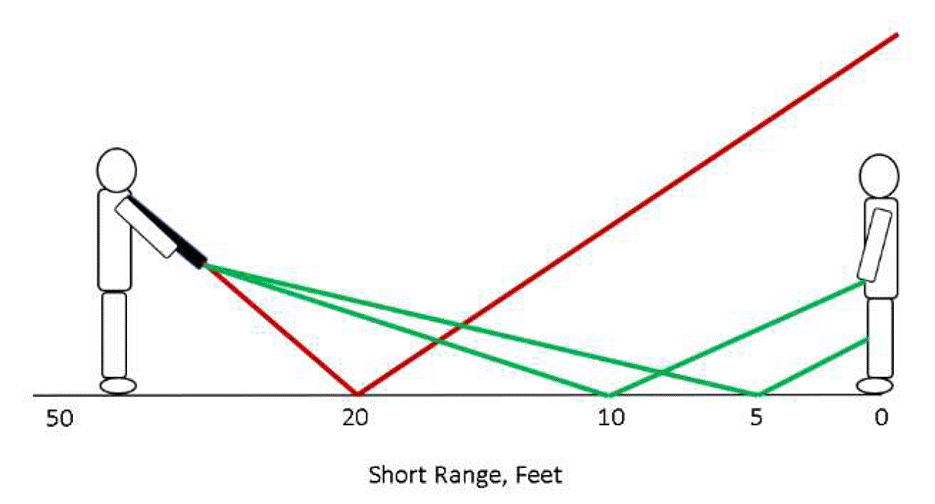
The LAPD’s 37mm scattershot rounds carry similar hazards, and were responsible for partially blinding a man celebrating the Los Angeles Dodgers’ 2020 World Series win. The risk of unintended injury is further exacerbated by the LAPD’s policy to skip-fire these rounds, wherein the rounds are fired at the ground 5-10 feet in front of targeted individuals. This method somewhat moderates the speed of the projectiles at the price of greatly complicating the geometry of shots to ensure projectiles do not strike sensitive parts of the body. Furthermore, any projectile that fails to impact the target will continue towards bystanders, potentially at the height of the torso and head.
Image from LAPD UOF Directive No. 12 “37mm Less-Lethal Launcher,” demonstrating one acceptable scenario of skip-firing foam baton rounds per LAPD protocols (green lines). Note that any projectiles that fail to hit the target will continue traveling upward, potentially affecting the torso or head of any individual standing behind the target.
UN guidance on crowd-control weapons notes that the inaccuracy introduced by skip-firing presents an unacceptable risk of injury. Furthermore, LAPD officers are often seen firing these weapons parallel to the ground, directly at individuals, and therefore against department protocol. In assemblies, where people are moving and the situation is dynamic, each firing of these munitions will put bystanders and unintended individuals at high risk.
While federal and local police agencies’ use of impact projectiles has harmed many civilians, journalists stand out as a particularly affected group in California. As of the date of publication of this report, the Freedom of the Press Foundation’s U.S. Press Freedom Tracker notes that 155 out of 233 (67 percent) recorded incidents of police assaults against journalists nationwide since June 1, 2025, occurred in California. Of these 155, some 99 (64 percent) were journalists who were either shot or shot at by police with less-lethal kinetic impact projectiles. This is a noteworthy finding given that journalists have special statutory protections in California; California Penal Code § 409.7(a)(2) mandates that peace officers must not “intentionally assault, interfere with, or obstruct” journalists at work.
When law enforcement uses inherently imprecise weapons against a crowd, it is all but inevitable that bystanders will get hurt. We highlight three cases of journalists who were shot by LAPD 37mm scattershot rounds in downtown Los Angeles:
- On June 8, Sergio Olmos (reporting for Calmatters) was struck by a stray projectile fired against a demonstrator spraying a police officer with liquid;
- On the same date, Lauren Tomasi (reporting for 9News Australia) was shot by a 37mm projectile while broadcasting live in front of a crowd;
- One day later, Jeremy Lindenfeld (reporting for Capital & Main) was shot in the abdomen by a 37mm projectile while retreating from police.
+ Analysis
The domestic use of scattershot weapons is most notable in Los Angeles, but their use is widespread in other forms or contexts. The related “Stinger” or “Sting-ball” rounds, which fire masses of pellets, were used during the 2014 Ferguson unrest, the 2020 George Floyd protests, and within the past year in Los Angeles and Chicago. Internationally, similar rounds known colloquially as “rubber buckshot” were used in Chile during 2019 protests, used broadly against crowds as opposed to individuals, resulting in hundreds of cases of full or partial blindness. More troubling still is the use of metal birdshot, penetrative by design, against protesters in Kashmir throughout the 2010s, and in Iran earlier this year.
Scattershot kinetic impact projectiles cause a “double-whammy’ law enforcement violation when used in crowds. On the one hand, their imprecision makes unintended impacts almost certain. On the other hand, the “accidental” nature of these impacts greatly complicate efforts by victims of these weapons to seek redress, as courts often heavily favor law enforcement in cases of unintentional harm. In other words, imprecision both causes the problem of innocent persons being impacted by these weapons, but also serves as a shield for police to avoid repercussions for the effects of the problems these weapons generate.
In the ongoing federal lawsuit Los Angeles Press Club v. City of Los Angeles, the City repeatedly claimed that journalists’ claims lacked merit as the cited incidents – including those of Olmos and Tomasi – demonstrated that police were instead targeting other individuals. The journalists were therefore not intentionally targeted, and California law dictates only that police “shall not intentionally assault” (emphasis added) members of the press. However, in issuing a preliminary injunction, a judge determined that the mentioned incidents ran afoul of California PC 13652(b)(4)’s directive that “projectiles shall not be aimed indiscriminately into a crowd or group of persons.” In other words, scattershot weapons were used indiscriminately. However, the injunction stopped short of completely restricting their use in protests.
The failure to limit the use of scattershot munitions in protests reflects the misconception that adherence to protocols, improvements in tactics, or remedial training can manage the hazards of scattershot weapons. The imprecision built into the design of scattershot rounds means that they are inherently indiscriminate, and therefore the hazard posed to bystanders is not something that can be corrected – as long as these weapons exist in crowd-control, bystanders will be at high risk of becoming victims of stray rounds.
These cases highlight the inescapable risk of inherently indiscriminate scattershot KIPs. Their deployment against crowds cannot be rationalized as crowd-control under any reasonable interpretation of international standards and cannot be considered legal, even under existing frameworks that already inadequately regulate less-lethal munitions. The LAPD is unique in the United States for its extensive use of scattershot KIPs for crowd-control. This habit flies in the face of not only international guidelines but also domestic convention, which heavily favors crowd-control weapons capable of targeting individuals. The LAPD’s continued use of technology unsuited for crowd-control creates an unusually hazardous protest environment. The net effect is to create an environment in which all assemblies are overshadowed by the constant threat of police violence that can affect anyone, regardless of the legal guardrails designed to protect nonviolent assembly.
WEAPON: Powder blast dispersion rounds (“Muzzle Blast” rounds)
AGENCY: United States Border Patrol (USBP)
DATE: October 2025
MISUSE: Extremely short range
On October 23, 2025, Reverend Jorge Bautista was shot with a 40mm grenade launcher at a protest in Oakland, California. Images from the incident show the pastor enveloped in a cloud of orange smoke after a USBP agent shot at his face from about three feet away. In addition to the smoke, a solid projectile is seen ricocheting after apparently striking Bautista in the chin, leading some to speculate he was shot with a “Pepperball” round.
On the very same day, some two thousand miles away, Enrique Bahena was shot at close range with an identical 40mm grenade launcher by an agent of the USBP’s Border Tactical Unit (BORTAC) in the Little Village neighborhood of Chicago. Bahena caught the incident on video, showing that the agent shot from less than five feet away. In addition to suffering from the irritant, he was struck by a projectile in the throat, leading to initial speculation that he was also hit by a Pepperball round.
The Oakland incident was widely publicized and became the public’s first introduction to a chemical irritant weapon rarely seen outside of U.S. jails and prisons: powder blast dispersion rounds, commonly referred to as “Muzzle Blast” rounds. These munitions are designed to be fired from grenade launchers, which typically fire a wide variety of projectiles, although the Muzzle Blast round is not technically a projectile. Instead, it discharges a plume of pulverized CS (tear gas compound) or OC (pepper agent) in a cloud that extends up to 30 feet in front of the shooter from the muzzle of the weapon. These munitions have been used much less frequently in protests than conventional chemical irritant delivery systems (aerosol grenades and liquid sprays), although the USBP appears to favor powder blast for crowd-control – including five varieties for “Crowd Management” in a 2026 procurement document for $50 million worth of less-lethal specialty munitions.
Open-source footage has shown USBP agents using these rounds in an alarming way: by shooting directly at the face from very close range. In addition to the incidents highlighted above, in one noteworthy incident from Minneapolis an agent was seen firing at least four rounds in this manner in under five minutes. This new trend exposes nonviolent protesters to unusually severe risks from an otherwise low-risk weapon, and illustrates the consequences ambiguous guidelines from manufacturers and police agencies can create.
Click on the headings below to reveal more
+ Weapon details
Both 37mm and 40mm powder blast dispersion cartridges consist of a payload of pulverized chemical agent mixed with fillers such as magnesium oxide and silica. This compound is retained by plastic or fiber discs known as “wads” and sealed into a cylindrical case along with a primer and propellant, either black powder for 37mm rounds or smokeless powder in the case of 40mm rounds. The cartridge is fired when the primer is struck by the launcher’s firing pin, igniting the propellant and driving the powder payload down the barrel of the launcher.
Defense Technology, one of the major manufacturers of these munitions, advertises them as “an excellent device for deploying chemical laden powder at close ranges for indoor or outdoor operations. The 40mm Muzzle Blast round provides instantaneous emission of chemical agent directly at or on riotous, non-compliant subjects close to the police line or within confined spaces.” These weapons are dangerous when fired indoors or in confined spaces where lack of egress and limited air flow are associated with higher dose exposures and therefore, more injuries.
+ Hazards and Health Effects
Powder blast dispersion munitions pose two major health concerns: 1) traumatic injuries, especially at close ranges, and 2) chemical injury from the irritant cloud. Similar to other hybrid weapons (Pepperballs, water cannons with irritant), the combination of projectile/firing and chemical can result in potentiated injuries.
The high-velocity incandescent particles emitted by these weapons can cause both thermal and traumatic injury to the skin, respiratory tract, and eyes. Powder, wadding, debris, and incandescent material leaving the muzzle of the launcher can exceed 200 mph. Traumatic injury results primarily from the high velocity ejection of the wadding and other cartridge materials. At close range (up to five feet), they have hit individuals, causing contusions, abrasions, and lacerations. The “blast” at the muzzle comes from the pyrotechnic burning at high temperatures to aerosolize the powder. The manufacturer’s materials data safety sheet notes the risks of fire, explosion, and burns from the explosive device. The wadding and the other material being projected out of the muzzle of the weapon can cause skin burns.
Beyond the close range traumatic concerns of Muzzle Blast rounds, the chemical irritant in Muzzle Blast rounds – powderized OC or CS – carries injury risks similar to other forms of irritant deployment. Skin, eye, and respiratory pain and injuries are most common but according to our decades long research into chemical irritants, all body systems can be affected. Respiratory irritation presents as sneezing, coughing, a burning sensation in the throat, constriction of the airway, and difficulty breathing. Skin exposure causes redness, pain, swelling, itching, burning, dryness, and dermatitis. Eye exposure may result in tearing, pain, temporary blindness, and blepharospasm. When powder is ejected at close range and high speed, it can be driven into the delicate surface of the eye, making decontamination particularly difficult. The powdered form of OC and CS used in these rounds is also poorly studied, and may – according to the manufacturer – provide a faster, more immediate respiratory effect compared to some other formulations, a claim that warrants serious concern.
+ Analysis
The Defense Technology Model 6042 Muzzle Blast CS round has been identified as the likely munition involved in a series of point-blank discharges in Minneapolis by ICE officers. While Defense Technology’s specification sheets do not identify the many hazardous uses of these models of weapon, other manufacturers of powder blast dispersion rounds take pains to identify circumstances of improper use. Some of these guidelines establish clear guidelines that sensitive parts of the body (such as the head) must not be targeted. CBP’s Use of Force policy expressly forbids intentionally targeting the head with what they classify as “Less-Lethal Specialty Impact and Chemical Munitions,” although it is unclear if this policy applies to the non-projectile Muzzle Blast rounds.
| Mfgr | ALS | Arwen Less-Lethal | Combined Tactical Systems | Defense Technology | NonLethal Technologies | Sage Control Ordnance | Sage Control Ordnance |
| Model | ALS12CS | AR-6-CS | 4630 | 6042 | MP-40MB-CS | K06CS | K046CS |
| Type | 12 ga CS Muzzle Blast | 37mm CS Muzzle Blast | 40mm CS Muzzle Blast | 40mm CS Muzzle Blast | 40mm CS Muzzle Blast | 37mm CS Muzzle Blast | 40mm CS Muzzle Blast |
| Minimum range | 0 m | 0 m | 3 m | n/s | 5 m | 0.9 m | n/s |
| Maximum range | 10 m | 15 m | 9 m | 9.1 m | 9 m | 9.1 m | 9.1 m |
| Special considerations | Serious injury or death may occur if the product is misused or in rare or unexpected instances. | n/s | n/s | n/s | Do not aim directly at personnel when discharging. | Extreme care should be exercised never to shoot directly at a human torso as the expulsion closure cap could cause serious injury. | Under no circumstances should the impact of the end cap be above the waist of a perpetrator. |
Table showing various manufacturers’ specifications for common powder blast dispersion rounds in the United States.
In spite of Defense Technology’s apparent belief that these weapons pose no safety concerns, there is legal precedent from Canada finding short-range use of powder blast dispersion rounds at the face as unethical and sanctionable. In a 2015 protest in Canada, Naomie Tremblay-Trudeau was shot in the face at very close range with a Muzzle Blast round by an officer of the Quebec City Police Service. She suffered from facial lacerations and a severe contusion on her chin. A Defense Technology certified trainer established during police ethics hearings that these weapons should be aimed at the belt line and that a one-meter separation from the muzzle and a person must be respected at the time of firing, although the tribunal also found that Defense Technology’s specification sheet failed to adequately inform users of the hazards inherent to these weapons.
Powder blast dispersion weapons carry serious health risks. When fired at close ranges, they have resulted in facial, eye and neck injuries from the wadding and other traumatic impacts. Even at longer ranges, the chemical irritant can cause significant pain and harm, exacerbated by excessive use in enclosed spaces with limited egress. Several cases (including one in Canada and several in the United States over recent months) demonstrate that shots to the face at extremely close range to be the most dangerous possible method of deploying these weapons. And yet, we are seeing USBP use this method more frequently in our analysis.
USBP’s accelerating use of powder blast dispersion weapons is additionally concerning for the lack of guidelines concerning their use. While details on USBP’s training of these weapons is not public, their pattern of use in the most dangerous way possible defies both convention and practical assessments of risk. This trend adds to the litany of demonstrably unsafe uses of crowd-control weapons that has characterized DHS’ response to protests since 2025.
WEAPON: Chemical obscurants
AGENCY: US Customs and Border Patrol (CBP)
DATE: January 2026
MISUSE: Use of weapon outside protocol
On January 21, 2026, at Mueller Park in Minneapolis, a group of USBP agents, including Commander-At-Large Greg Bovino, was seen deploying grenades that emitted clouds of bright green smoke at protesters. As civilians dispersed down the sidewalk, one video captured a man saying to bystanders, “the green stuff is super carcinogenic.”
Evidence on the ground suggests the “green stuff” was neither carcinogenic, nor possessed health effects considerably worse than common chemical irritants used for policing protests. These chemical obscurants – more commonly known as “smoke grenades” – are often misunderstood, due in no small part to their unclear role in crowd-control. The widespread misinformation that naturally arises from this ambiguity can compound the chilling effect these visually striking weapons already have on assemblies.
Click the headings below to reveal more
+ Weapon Details
Chemical obscurants are used by the military to hinder the aiming of incoming projectiles, hide movements of vehicles or personnel, or send messages via smoke signal. While they have seen limited use in protests, their exact purpose often remains unclear. Smoke may be used to hide personnel subject to thrown objects. Smoke can also be used as a wind indicator, which could assist the deployment of chemical irritant munitions in crowd-control.
Since 2020, DHS agents have been confirmed to have used two types of chemical obscurants for policing assemblies: dyed pyrotechnic signaling smoke or, more infrequently and only in 2020, HC smoke.
The bright colors produced by certain police smoke grenades are characteristic of pyrotechnic signaling smoke. The material safety data sheet for Defense Technology’s pyrotechnic obscurant “Saf-Smoke” line reveals that they are made up of components shared by the U.S. military’s M18 signalling smoke grenades, being largely composed of nitrocellulose (dye), potassium chlorate (oxidizer), sugar (smoke), and terephthalic acid (TA; smoke). Upon ignition, the oxidizer helps to volatilize the solid combustible components, dispersing them as smoke; the addition of dyes or colorants can modify the appearance of the smoke.
Used canisters collected in Minneapolis in early 2026 correspond to signaling smoke grenades manufactured by Defense Technology, Models 1067 and 1017G. These grenades come in a variety of colors, including green. They are similar to smoke grenades recovered from protest sites outside the Portland, Oregon ICE facility in July 2025.
A different chemical obscurant was also used in 2020 protests: at least 25 ‘HC smoke’ grenades, produced under the “Maximum HC Smoke” moniker by Defense Technology. Upon ignition, elemental aluminum, hexachloroethane (HC), and zinc oxide react to generate zinc chloride vapor, which condenses to produce a thick grey-white smoke. Defense Technology’s HC smoke formulation is similar to the type C HC composition used in the US military’s AN-M8 HC white smoke hand grenade.
These weapons were also used sporadically during the 2020 George Floyd protests by local agencies, such as the Denver Police Department and the Washington State Patrol. During the 2020 protests in Portland, Oregon, at least 25 HC smoke canisters were deployed by DHS agents between July 16-29. More recently, the City of Portland received reports of HC smoke being used during protests in 2025, although these uses have not been confirmed.
+ Hazards and Health Effects
The combustion products of pyrotechnic (sucrose or TA-based) smoke grenades are modestly irritating but not particularly hazardous to health, similar to common pyrotechnics such as fireworks.
On the other hand, HC smoke, specifically zinc chloride, has long been known to be very hazardous to human health. A 2016 medical literature review found 31 studies documenting 376 patients who suffered from acute zinc chloride smoke exposure since 1942, of whom 23 died. Fatalities were all tied to acute lung injury from zinc chloride, either from direct irritation of the mucosal membranes or systemic inflammation as a result of heavy metal toxicity. Several components of HC smoke are known or suspected carcinogens, including arsenic, cadmium, hexachlorobenzene, and hexachloroethane. Concerns about carcinogenicity were sufficient to compel the U.S. Army to replace the AN-M8 HC smoke grenade with the M83 TA grenade for training purposes beginning in 2000. As of 2023, use of the AN-M8 is “restricted to outside the continental United States operational use only or until stockpile depletion.”
The 2020 protests in Portland, where law enforcement used HC smoke, saw a qualitative surge in unusual symptoms among demonstrators, including gastrointestinal upset, shortness of breath, a burning sensation, and neurological changes. Some of these are consistent with reported symptoms from the medical literature of patients suffering from acute exposure to zinc chloride smoke.
There is a pervasive belief that obscurant smoke has a ‘multiplicative’ effect on any chemical irritants used alongside the smoke. Defense Technology’s specification sheets allude to using the smoke “to ‘piggy back’ chemical agent” or as a “carrying agent (multiplier) for smaller OC, CN or CS munitions.” This combination was used in the controversial deployment of chemical irritants on protesters on I-676 in Philadelphia in 2020. Obscurant smoke’s use as a “carrying agent” is referenced in police manuals as increasing the range of CS gas or to “multiply the effects [of CS] up to 4 times the normal amount.”
It is unclear by what mechanism obscurant smoke would enhance either the range or effectiveness of CS smoke. We are unaware of empirical studies that evaluate either the effects of smoke on dispersion or any potential synergistic effects of smoke used alongside chemical irritants, although such effects cannot be discounted given CS’ inflammatory effect on the respiratory system.
+ Analysis
The primary concern with the use of chemical obscurants in crowd-control is the apparent lack of guidelines and regulations governing their use. CBP’s Use of Force policy makes no mention of smoke or chemical obscurants. Since they are not necessarily classified as irritants, it is unclear which, if any, protocols are used to determine appropriate deployments of these munitions. This is especially concerning given the lack of clinical or population-based studies on the potential health effects of mixing smokes with irritants, a tactic recommended by some police policies.
Secondarily, chemical obscurants have been repeatedly – and erroneously – conflated with chemical weapons far more dangerous than either CS or OC, generating a psychological “chilling effect” in excess of the apparent physical impacts of these weapons. Green smoke and HC smoke have been erroneously conflated on social media ever since an article from 2020 misidentified white-grey HC smoke as being green.
On occasion, green colored smoke has been inaccurately associated with chlorine gas or the obsolete chemical irritant adamsite, or DM, likely due to seeming parallels between unusual effects experienced by protesters. In Portland beginning on the night of July 25, 2020, a subjective increase in vomiting was accompanied by both the use of CS gas in tandem with both green obscurant smoke and HC smoke. The CDC NIOSH website lists adamsite as being a “vomiting agent” and lists its solid color as “light green to yellow,” although it notes that in gas form it is canary yellow to colorless. The NIOSH website fails to note that adamsite – as the M6/M6A1 CN-DM grenade – was obsoleted from U.S. military chemical stockpiles in 1970, and adamsite weapons are not currently in production by domestic manufacturers.
The association between green smoke and adamsite has persisted into 2026, in part due to artificial intelligence. Queries to Grok, x.com’s AI assistant, about the green smoke used in Minneapolis resulted in repeated claims by Grok that it was adamsite. In one case, Grok referenced the CDC’s website, presumably associating the “light green to yellow” color of solid adamsite with green signaling smoke. In another response, Grok both claimed green smoke to be adamsite and apparently hallucinated nonexistent reports by PBS and NBC that confirmed this association.
Some chemical obscurants used are toxic, carcinogenic, and arguably more dangerous than common chemical irritants used for crowd-control, while others are far more benign. However, a characteristic of their use has been the vast degree of misinformation about both the identification of these weapons and their association with negative health impacts. Based on our analysis, the confusion of obscurants with far more hazardous substances contributes to an environment of fear surrounding chemical irritants, adding to the chilling effect of their use in protests.
Based on our analysis, the confusion of obscurants with far more hazardous substances contributes to an environment of fear surrounding chemical irritants, adding to the chilling effect of their use in protests.
Furthermore, the lack of regulations around smoke obscurants in the United States context allows for potentially unlimited use and potential abuse. Manufacturers advertise obscurants on the civilian market as aids to crowd-control, either to intimidate through the psychological effect of smoke, or to allegedly heighten the negative effects of tear gas. These potential uses underscore that law enforcement agencies may be encouraged to use obscurants for purposes outside the safe policing of assemblies.
Prior work
Through its prior work including Lethal In Disguise, a seminal series of reports detailing the health harms of commonly used crowd-control weapons, Physicians for Human Rights has identified patterns of risk that emerge from crowd-control weapons:
1. Crowd-Control Weapons that are Inherently Indiscriminate
Imprecise weapons are inherently indiscriminate. When used for crowd-control, weapons such as scattershot KIPs or chemical irritants affect not only participants in assemblies but also bystanders, journalists, legal observers, and medics.
2. The Presumption that Crowd-Control Weapons are Non-Lethal, Not Less-Lethal
Weapons labeled as non-lethal are subject to fewer controls and regulations than weapons recognized as lethal. Law enforcement may not be properly trained in safe use of these less-lethal weapons. Moreover, law enforcement may quickly resort to these weapons without exhausting other deescalation techniques. Meanwhile, these weapons can cause serious injury or even death, particularly when misused.
3. The Unregulated Proliferation of Crowd-Control Weapon Technology
The appearance of novel weapons used to police protest is a symptom of the “trickle-down” effect of militarized technology. These weapons often have their roots in the policing of prisons or in military crowd-control, where – rightly or wrongly – they may be held to a lesser standard of hazard mitigation.
Legal Framework for Recommendations
The principles, statutes, and norms governing police use of force are laid out at the international, national, and local levels. Although international standards are not always considered binding within the United States, this report utilizes them as the foundation for recommendations, as they codify the same principles underlying lawful use of force by law enforcement at the local, state, and federal level.
Broadly, the International Covenant on Civil and Political Rights (ICCPR) – an international treaty ratified by the United States – recognizes the right to life, to freedom from torture or ill treatment, and the rights of assembly and expression. The ICCPR applies to all levels of government, including national, state, and local officials. The UN Basic Principles on the Use of Force and Firearms by Law Enforcement Officials (the “Basic Principles”) articulate universal standards regarding use of force that ensure these rights are protected. The 2020 United Nations Human Rights Guidance on Less-Lethal Weapons in Law Enforcement (the “UN Guidance”) provides specific recommendations on lawful and unlawful uses of CCWs by category, which forms the basis for this report’s final recommendations.
The United States does not have federal standards for the use of crowd-control weapons specifically. However, courts in the United States evaluate law enforcement’s use of force through the lens of the Fourth Amendment of the Constitution of the United States. The standard is whether the officer’s use of force was objectively reasonable. The Supreme Court of the United States has noted that several factors to be included in the assessment of the reasonableness of a particular use of force: (1) “the severity of the crime at issue,” (2) “whether the suspect poses an immediate threat to the safety of the officers or others,” and (3) whether the suspect “is actively resisting arrest or attempting to evade arrest by flight.” Graham v. Connor, 490 US 386 (1989). Additionally, the First Amendment of the Constitution of the United States affirms the right to peaceful assembly, extending to peaceful protest.
Finally, some states and local jurisdictions place specific restrictions on the types and use of chemical irritants, kinetic impact projectiles, or stun grenades for crowd-control.
Recommendations
Prohibit use of scattershot kinetic impact projectiles
Section 7.5.6 of the UN Guidance establishes that “multiple projectiles fired at the same time are inaccurate and, in general, their use cannot comply with the principles of necessity and proportionality.” This visual investigation’s analysis is in line with this conclusion, and furthermore demonstrates the indiscriminate use of scattershot KIPs runs afoul of the Basic Principles of precaution and discrimination. As PHR recommended in our landmark report Lethal in Disguise. Scattershot KIPs have no legitimate role in crowd-control and must be forbidden in these contexts.
Limit use of powder blast dispersion munitions
This study highlights the risk of injury from the use of powder blast dispersion rounds against the head at close range. Within this context, solid components of these munitions turn them into de facto projectiles, and they must be treated as such. Shots to the head are unlawful per section 7.3.6 of the UN Guidance, and this visual investigation’s recommendations follow PHR’s recommendation in Lethal in Disguisein calling for this use to be explicitly prohibited by law, by manufacturer recommendations, and by police use of force protocols.
Ban HC smoke and evaluate and restrict use of other chemical obscurants
Chemical obscurants in crowd-control require clear guidelines on how they are to be used, as well as the rationale for their use. The lack of information on potential synergistic effects of chemical obscurants paired with irritants is a concern, given the ongoing use of these weapons together. In line with UN Guidance section 7.2.3, PHR encourages additional testing to evaluate any toxicological evidence of the hazards of aerosolized chemical cocktails.
While pyrotechnic smoke has no evidence of long term health risks, HC smoke, which has been used in protests in the United States in 2019 and 2020, carries significant long term risks of lung injuries, metabolic issues, and cancers. These well-known risks mean HC smoke is unfit for use in crowd-control per section 7.2.5 of the UN Guidance. Furthermore, the UN Chemical Weapons Convention stipulates that only “riot control agents” are permitted for use for civilian policing and defines these agents as those that have transient effects, “disappear within a short time following termination of exposure,” and do not cause any significant long term injuries. HC smoke does not fall under this definition and must be banned from the policing of assemblies.
CCW design must comply with international laws and standards
Any weapon approved for use in crowd-control must be designed in a manner that ensures they meet legitimate objectives in public law enforcement, separate from their use in prisons or war. CCWs must, in their design, offer a level of force that is proportional and discriminate, while aiming to minimize harm. This standard applies not only to government entities, but also manufacturers of CCWs. All safety datasheets and relevant information regarding health risks must be made publicly accessible by weapons producers. This includes all medical studies and the names of experts who contributed to the safety analysis, with indication of those who received compensation for promoting the product.
State actors must ensure CCWs are subject to strict independent testing
Manufacturers should not be solely responsible for evaluating potential health hazards and generating guidelines of use for new and existing CCWs. The burden of testing falls upon not only police, but also fiscal and oversight apparatus at relevant levels of government. Testing should consider, among other things, legality, level of accuracy, risk of lethality, risk of serious injury or disability, level of pain inflicted, lifespan, and reliability against malfunctions. Testing of any CCW should also include a legal review to determine whether the use of a CCW would be prohibited by any rule of international or domestic law.
Protocols outlining the lawful use of CCWs must be in line with international standards and applicable domestic law
Regulations governing the use of CCWs must encompass any and all weapons to be used in the context of crowd-control. Protocols must include rules governing proportional use, appropriate contexts in which they may be used, acceptable vs. unacceptable modes of deployment, known and potential health hazards, consequences of misuse, and reporting standards.
State actors and law enforcement must create systems of accountability for the use and misuse of CCWs
Law enforcement officials should record and report any usage of CCWs, including the model of CCW deployed, distance from the target, duration of deployment, the number of CCWs of each type used, and documented or reported injuries. All cases of deaths, injuries, and suspected misuse of CCWs should be investigated by an entity independent of the unit or department involved. In the evident that there is evidence of unlawful conduct, the responsible officers and their commanders should be held liable and subject to administrative disciplinary measures and/or criminal prosecution.
Suggested Citation: Physicians for Human Rights. “Tools of Repression: How U.S. Law Enforcement Escalated the Use of Three Weapons To Crack Down on Immigration Protests.” May 2026
Weapons factsheets developed in partnership with the International Network of Civil Liberties Organizations (INCLO)