Blog

Impact of Landmines on Burma's children

A 14-year-old victim of landmine in Burma

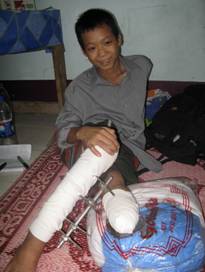
Kyan Khen (Photo: Richard Sollom/PHR)

Fourteen-year-old Kyan Khen* unwittingly triggered a landmine that took his left leg, and severely injured his right, while tending to his four buffalo in a rice field just across the Burmese border in Karen state in October 2009. His family fled to Thailand several years earlier, but young Kyan Khen regularly made the journey back into Burma to farm. While the villagers had been warned that the fields nearby were strewn with landmines, they thought this particular field was safe. Kyan's shattered body proves otherwise.

I recently interviewed Kyan Khen at the Mae Tao Clinic. He bears a new prosthesis replacing his left leg, while his right recovers from the steel rod the surgeons inserted to stabilize the badly fractured bones in the correct alignment so that the leg will have a chance to heal and become weight-bearing faster. Kyan Khen cannot yet walk, and while he has an easy smile, his aunt relates how he often feels pain in his non-existent left foot and stares down in disbelief that it is gone. Such phantom limb pain is common among recent amputees.His story is in many ways a success, thanks to the Mae Tao Clinic in the Thai border town of Mae Sot, which provides lifesaving treatment, healthcare and counseling services to Burmese refugees. Founded and run by Dr. Cynthia Muang—herself a stateless person whose precarious status in Thailand imperils the clinic’s future—the Mae Tao Clinic added a prosthetics fabrication facility for landmine survivors and amputees in 2001.

Yet Kyan Khen faces a long recovery and a bleak future, because, as an amputee, he is unlikely to be seen as a productive member of society. Kyan Khen had wanted to attend secondary school and asked his mother if he could pursue studies, but she said he was getting too old and that she would instead send his younger brother. Without other prospects, Kyan Khen was left to tend to his buffalo to help provide for his family. This is not unusual. In many societies, children are responsible for tending livestock and often follow them into remote areas in search of new grazing lands, placing them at greater risk of encountering landmines. Now, without an education, his long-term disability severely compromises his ability to garner an income.

Landmines in Burma claim hundreds of casualties each year—one of the many devastating effects of the ongoing conflict between the Burmese military junta and Burma’s ethnic minorities. Karen State, where Kyan Khen is from, is one of the most heavily mined areas in Burma, according to the International Campaign to Ban Landmines (ICBL), and the casualties are on the rise. One estimate has 721 Burmese civilian mine casualties in 2008, up from 243 in 2006, although exact numbers are unattainable. Worldwide figures suggest that in 2008, 41% of all civilian landmine casualties were children. While many of the wounded die, the majority of landmine victims survive (88% in Burma in 2008), but are left permanently maimed. Moreover, they require immediate medical attention and long-term rehabilitation.

As a child, Kyan Khen faces even greater complications from a landmine injury than an adult. Children’s smaller stature increases the relative proximity of their vital organs to the source of explosion, and makes them less able to compensate for large amounts of blood loss; consequently, the injuries they sustain are often more severe than they are for adults. Even after a blast to the limb, the long bones that remain continue to grow, and maintaining that growth potential in the epiphyseal growth plate is critical. This is especially true for the youngest survivors, whose bones may be less than half the length of their adult potential. If the distal growth plate, which contributes 75% of total femur growth, is damaged, the stunted limb growth further complicates prosthetic needs for children.

Child mine survivors’ bones tend to grow faster than the surrounding soft tissue and sometimes this causes skin breakdown in the area. Consequently, children who suffer landmine injuries to their limbs may require multiple re-amputations and require new prostheses every six months because of these growth patterns. So Kyan Khen could need 10 replacement prostheses before he turns 20. By contrast, adults need prosthetic replacement every three to five years.

In Burma, where the annual per capita income is less than $200 USD, landmine survivors and their families are almost all too poor to afford prostheses and rehabilitation on their own. Even when produced locally, each new prosthetic device the Mae Tao Clinic fits and manufactures costs $15 USD – a bargain when compared with the cost of a prosthetic limb in the US, which can run as high as $1,875. Even so, the medical costs for young landmine survivors can be prohibitive, especially in Burma where the availability of prosthetics and medical care is acutely limited. In this respect, Mae Tao Clinic is an oasis of free surgical and post-operative care, prosthetic devices, and rehabilitation for landmine survivors.

Still, the healing hand of this clinic would never have been necessary if it weren’t for the barbarous use of these indiscriminate anti-personnel munitions. Worldwide, most victims are civilians (61% in 2008), and after landmines have served their military function those that remain undeployed are rarely thoroughly cleared. Burma is second only to Afghanistan in terms of land mine incidents in Asia, but while military groups and villages have undertaken sporadic mine clearance, no systematic humanitarian de-mining program exists in Burma.

Like Burma, the United States is not a signatory to the 1997 Mine Ban Treaty, or Ottawa Treaty. The International Campaign to Ban Landmines (ICBL), for which Physicians for Human Rights shared the 1997 Nobel Peace Prize, put an end to the use of landmines within reach by bringing global energy to the treaty efforts. However, bringing that end to fruition requires focused attention to mine clearance and more stringent compliance with treaty obligations to discourage any production, use or transfer of anti-personnel mines.

US accession to the Ottawa Treaty would send a powerful, albeit long-overdue moral message, that it renounces this outdated weapon that indiscriminately targets civilians and children like Kyan Khen. Right now there is unprecedented momentum that could result in the Obama Administration joining the Mine Ban Treaty. Read more about this trend in PHR’s landmine blog series and urge President Obama to sign the Mine Ban Treaty today.

Kyan Khen’s new prosthetic leg and smile are testament to the hope that clinics like Mae Tao provide to survivors. But what he and countless other children around the world need is for the United States and other hold-out countries to ban landmines all together.

*For his protection, Kyan Khen’s real name is not used in this article.

Blog

Comprehensive Immigration Reform and Moral Imperatives

At the center of the national debate over immigration policy are conflicting opinions about what is best for our national economic interests, but perhaps more interestingly, differences of opinion over our social and ethical obligations. President Obama waded into this debate with his Thursday speech, following a week of meetings with key stakeholders, on comprehensive immigration reform.The President’s speech attempted to breathe new life into efforts to pass a major immigration bill in the current session of Congress. In calling such efforts “a moral imperative,” President Obama also brought human rights principles into play as a factor in immigration reform.As the President pointed out, newcomers to America are woven into the fabric of our society, and to suddenly lose them—for example, to the mass deportations some?policy makers?would advocate—would tear apart our communities and dramatically disrupt our economy. Likewise, the physical and emotional health of individuals depend on families working and living together, and to forcibly separate a family member devastates those left behind in every way imaginable. The American Psychological Association, for example, has found that breaking up families leads to significantly heightened risk of psychological distress, poor physical health and developmental delays in children.Today, an estimated 5 million US citizen children have at least one undocumented parent living in constant fear of forcible separation from his or her family. At least 100,000 parents of children born and raised in this country—and likely far more—have been deported in just the past ten years. It is easy to imagine why such interference with family life and unity in the absence of extraordinarily strong justification would be considered a human rights violation. The suffering and declining well-being, in both physical and psychological terms, of children who lose their parents to immigration enforcement is heart-breaking.For example, Jocelyn, a young woman who testified at a recent Congressional briefing on immigrant families, wrote of the experience of losing her mother to deportation,

We need her and we miss her so much…My brother Alex no longer plays sports…[My brother] Tony became very rebellious after my mother left.? He used to be very calm…Ever since my mother left, it is very difficult to manage it all…I would like to tell the lawmakers…that by their inaction and indecision, they can destroy a family that once stood united.

In his speech, President Obama has laid out a commitment to addressing the needs of families like Jocelyn’s and the plight of millions of other vulnerable immigrants including children, survivors of persecution and sick and mentally ill noncitizens routinely housed in immigration detention centers. The President faces a tough challenge ahead, however, in negotiating with those whose foremost concern is closing borders and limiting migration to this country, as well as assistance to those who do come to America. Comprehensive immigration reform may well exclude measures we need to protect the human rights of at-risk immigrants—for example, the granting to Immigration Judges of discretion to weigh the importance of family unity against security concerns in deciding whether to deport a mother or father—unless advocates are coordinated and vocal in the coming months.Physicians for Human Rights will lead the medical community in working to ensure that health and human rights principles are embraced and advanced in forthcoming immigration reform legislation. Stay tuned here on our blog and watch our website for further news and join us in this effort.

Other

Toolkit for Using Round 10 of the Global Fund (Updated)

Including 2011 Anti-Stigma Guide

UPDATE July 2011: Now includesEnsuring Equality: A Guide to Addressing and Eliminating Stigma and Discrimination in the Health Sector (pdf), 2011 health system strengthening addition to Global Fund Round 11.

To support applicants in including health systems strengthening interventions in their proposals, PHR and the Health Workforce Advocacy Initiative, an international civil society-led coalition supported by the Global Health Workforce Alliance, in collaboration with Health Systems 20/20, have developed this Health Systems Strengthening Toolkit for Global Fund Round 10 Proposals. A reference guide (pdf) on the Global Fund’s support for health systems strengthening provides a basic orientation on why and how to use the Global Fund to support health systems strengthening.

Continue reading in English, or see this page in French or Spanish.

The current funding round of the Global Fund to Fights AIDS, Tuberculosis, and Malaria provides applicants with an excellent opportunity to secure funds for critically needed health systems strengthening. The Global Fund is committed to supporting health system strengthening interventions that are necessary to overcome health system constraints to improved outcomes in combating any or all of its three priority diseases. Applicants should review the exact criteria in the Global Fund's Guidelines for Proposals for Round 10, which launched on May 20, 2010. The Guidelines are available on the Global Fund's website, TheGlobalFund.org.

PHR strongly encourages countries to take advantage of this opportunity, using Round 10 to overcoming fundamental human resource and other health system constraints to successful and sustained scale-up of HIV, TB, and malaria interventions, including as appropriate, by using Round 10 to fund portions of national health workforce strategies.

The Global Fund also encourages health system strengthening activities that, in the process of improving outcomes for HIV, TB, and/or malaria, will also improve women’s and children’s health. This Round, the Global Fund is also giving special emphasis to community systems strengthening, which can include support to civil society organizations engaged in advocacy, health promotion and monitoring, and service delivery aimed at developing more equitable and accountable health systems. The Global Fund encourages an integrated, cross-cutting approach to health system strengthening that can contribute to achieving the Millennium Development Goal (MDG) on AIDS, malaria, TB, and other major diseases and to achieving the MDGs focused on improving women’s and children’s health.

This toolkit includes more detailed information on how to use the Global Fund to support health systems strengthening, key opportunities that the Global Fund presents, technical support providers to assist applicants in developing proposals, background information on health systems and the health workforce, as well as information on community systems strengthening. The toolkit also includes PHR's Guide to Using Round 10 of the Global Fund to Fight AIDS, Tuberculosis and Malaria to Support Health Systems Strengthening. Information is also available to support countries in developing approaches to their health workforce and health systems that are grounded in human rights.

Health Systems Strengthening Toolkit for Global Fund Round 10 Proposals


Frequently Asked Questions on the Global Fund and Health Systems Strengthening

  1. Health Workforce Advocacy Initiative & Health Systems 20/20. May 2010. Global Fund’s Support for Cross-Cutting HSS Interventions: A Reference Guide (pdf) (French) (Spanish).

    This document provides an orientation to the Global Fund to Fight AIDS, Tuberculosis and Malaria and its support for cross-cutting health systems strengthening (HSS). It answers such questions as why to use to Global Fund to support HSS, what activities the Global Fund will support and has supported in the past, what factors contribute to successful proposals, and where to find information needed for developing HSS-related proposals.


Overview of Health Systems Strengthening in the Context of Global Fund

  1. Eric A. Friedman (Physicians for Human Rights). May 2010. Guide to Using Round 10 of the Global Fund to Fight AIDS, Tuberculosis and Malaria to Support Health Systems Strengthening (pdf) (French) (Spanish).

    The Global Fund holds much potential for advancing health systems strengthening (HSS) efforts in the international community, including supporting cross-cutting HSS interventions that benefit more than one of the Global Fund’s three target diseases. This Guide provides information on how to use the Global Fund to support HSS, key opportunities that the Global Fund presents for HSS, advice on developing a strong HSS-related proposal, and more. It is intended for use by Country Coordinating Mechanisms (CCMs), other people and organizations involved in proposal development, and governmental and non-governmental health system advocates who are encouraging their countries to use the Global Fund to support HSS.

  2. Global Fund to Fight AIDS, TB and Malaria. November 2007. Strategic Approach to Health Systems Strengthening: Decision Point GF/B16/DP10 (pdf) (French) (Spanish).

    This document, from the Global Fund Sixteenth Board Meeting, outlines the Board’s decision to provide funding for health systems strengthening actions within the overall framework of funding technically sound proposals focused on HIV/AIDS, tuberculosis and malaria.

  3. World Health Organization. 2010. The Global Fund and Health System Strengthening: How to Make the Case, in a Proposal for Round 8, 9 and 10? Working Draft (pdf) (French).

    This brief paper summarizes some critical points that proposals with HSS activities should make to have a strong chance of success. Country examples from Tanzania, Malawi, Kenya, and Rwanda illustrate credible lines of argument.

  4. Global Fund to Fight AIDS, TB and Malaria. May 2010. Excerpts on Health Systems Strengthening from Guidelines for Proposals – Round 10 (pdf) (French) (Spanish).

    The Guidelines are an official Global Fund document to support proposal development. Portions that focus on HSS (as well as the Technical Review Panel’s review criteria) are included here. Applicants should be sure to review the full Guidelines for Proposals (pdf), not only those excerpts included here.

  5. Global Fund to Fight AIDS, TB and Malaria. May 2010. The Global Fund’s Approach to Health Systems Strengthening (HSS): Information Note (pdf) (French) (Spanish).

    This information note includes an explanation of HSS in the context of the Global Fund’s mandate. Applicants are encouraged to incorporate responses to health system constraints and gaps within their proposals. The information note provides direction for applicants on how to clearly include HSS interventions in proposals and how to develop strong requests for funding. It also explains the different ways in which HSS cross-cutting interventions can be included and provides some lessons from the Technical Review Panel on HSS-related proposals.

  6. Global Fund to Fight AIDS, TB and Malaria. February 2009. Monitoring and Evaluation Toolkit: HIV, Tuberculosis and Malaria and Health Systems Strengthening, 3rd Edition (pdf) (French) (Portuguese).

    This is the HSS piece of The Global Fund’s full Monitoring and Evaluation Toolkit. This HSS section presents select process, output, and outcome indicators for HSS, and descriptions of these indicators.


Background on Health Systems Strengthening

  1. World Health Organization. 2007. Everybody’s business: strengthening health systems to improve health outcomes: WHO’s framework for action (pdf).

    This document provides valuable background information on health systems, as it seeks to promote a common understanding of health systems and what constitutes health system strengthening. It defines and explains six building blocks of health systems, and provides insights into major health system challenges and opportunities. It also provides a framework for WHO’s own current and increasing role in improving the performance of health systems.

  2. Paul Hunt. January 2008. Promotion and protection of all human rights, civil, political, economic and cultural rights: Report of the Special Rapporteur on the right of everyone to the enjoyment of the highest attainable standard of physical and mental health (pdf).

    The right to the highest attainable standards of health provides important guidance on developing an effective and integrated health system. There is an increasing acknowledgement that strong health systems are essential to a healthy and equitable society. Taking into account good health practices as well as the right to the highest attainable standards of health, this report identifies general approaches to strengthening health systems. These approaches should be applied consistently and systemically across a set of "building blocks," which together constitute a functioning health system.


Community Systems Strengthening and the Global Fund

  1. Global Fund to Fight AIDS, TB and Malaria. May 2010. Community systems strengthening: Information Note (pdf) (French) (Spanish).

    Community systems strengthening (CSS) encompasses activities to develop and sustain key populations and communities, and community organizations and networks, in their efforts to design, deliver, and monitor and evaluate services aimed at improving health outcomes. As the information note explains, along direct health service delivery, CSS is “aimed at increased community engagement (meaningful and effective involvement as actors as well as recipients) in health and social care, advocacy, health promotion and health literacy, health monitoring, home-based and community based care and wider responses to ensure an enabling and supportive environment for such interventions.” Ensuring the role of communities and strengthening the capacity and reach of civil society organizations is a critical component of countries’ responses to three diseases and other health issues. CSS will help ensure the responsiveness of health systems to people’s needs, provide a continuity of care between health facilities and communities, enable health systems to better reach marginalized populations, and strengthen the accountability of health systems. The Global Fund is placing a high priority on CSS in Round 10. This information note provides a basic overview of community systems strengthening and related terminology, explains its importance and the core components of CSS, and offers advice on how to incorporate CSS into Global Fund proposals.

  2. Global Fund to Fight AIDS, Tuberculosis and Malaria. May 2010. Community Systems Strengthening Framework (pdf) (French) (Spanish).

    This framework aims to define and explain core areas of CSS, which should assist in the process of determining what resources are needed to strengthen community action. The framework also explains the importance of CSS, the strategies that underlie a CSS approach, and the connections between CSS and health systems. The framework includes a comprehensive discussion on indicators for CSS activities. Summary versions of an earlier draft of this document are available through the International HIV/AIDS Alliance.

  3. Global Fund to Fight AIDS, TB and Malaria and International HIV/AIDS Alliance. September 2008. Civil society success on the ground: community systems strengthening and dual-track financing (pdf).

    This report aims to increase understanding of the range of ways in which the Global Fund can support – and has supported – civil society activities, including those of community-based organizations. To outline the many different models of community systems strengthening, this report includes case studies from civil society organizations in Cambodia, India, Mongolia, Peru, Senegal, Somalia, Thailand, Ukraine and Zambia. All nine case studies examine HIV grants, but the examples have broader applicability. For instance, examples address processes of civil society engagement in the Global Fund, providing services to marginalized populations, and partnership development. The report also addresses topics including civil society activities to integrate HIV services with sexual and reproductive health services.


Human Resources for Health (HRH)

  1. Maggie Cooper & Eric A. Friedman (Physicians for Human Rights). August 2008. The Right to Health and Health Workforce Planning: A Guide for Government Officials, NGOs, Health Workers and Development Partners (pdf) (French) (Spanish part 1) (Spanish part 2); and Health Workforce Advocacy Initiative. November 2009. Incorporating the Right to Health into Health Workforce Plans: Key Considerations (pdf) (French).

    The health workforce, improved health outcomes, and human rights are inextricably linked. Not only is a strong health workforce needed for improved health and fulfilling human rights, but human rights are needed to develop the workforce that can lead to overall better health. The guide explains why it is necessary to ground health workforce planning in human rights, and how to develop a plan that does just that. The Key Considerations document is a practical, easy-to-use tool that succinctly lays out the many connections between the health workforce and the right to health. Health and other government ministry officials, civil society, health workers, and development partners can use these documents as they develop or revise health workforce plans. The strategies they contain can also inform interventions, approaches, and priorities in health workforce development that can be incorporated into Global Fund proposals.

  2. Health Workforce Advocacy Initiative. 2008. Guiding Principles on National Health Workforce Strategies (pdf) (French) (Spanish).

    The guidelines are intended primarily for the policymakers and other people involved in developing and evaluating these plans, including ministry of health officials, health workers, civil society advocates, development partners, and technical advisors. What should these plans – which should be country-developed and country-led – contain? How should they be developed to give them the best chance of significantly improving health outcomes and moving countries as rapidly as possible towards universal access to essential health interventions? The guidelines should serve as overarching principles that will promote the success of health workforce plans, while ensuring that they are consistent with human rights.

  3. Global Health Workforce Alliance. 2010. Human Resources for Health: Good Practices in ‘Country Coordination and Facilitation’ (CCF) (draft) (pdf).

    This document provides good practices in the process of bringing together all stakeholders to develop country-level alliances on human resources for health, and describes key areas to be addressed by and functions of such alliances. These mechanisms, which exist in many countries in various forms (such as Human Resources for Health Working Groups), have a critical role in developing the consensus, strategy, and political will needed for resolving critical shortages and other weaknesses in the health workforce. Members of these mechanisms should actively engage in assessing how the Global Fund can be used to support the health workforce, and in developing health workforce interventions to be included in Global Fund proposals. Annex 1 provides a valuable list of key stakeholders.

  4. Ummuro Adano & James McCaffery (Capacity Project). October 2008 (UPDATED July 2011). Global Fund Round 11 Opportunity to Build Human Resource Management Capacity: the central pillar in health systems strengthening initiatives (pdf)

    Many countries do not have adequate capacity to manage their current health workforce, let alone to effectively manage increased numbers of health workers and new funding for human resources, or to effectively develop and implement health workforce strategies and policies. Round 10 of the Global Fund provides an opportunity to build human resource management capacity to enable countries to effectively use expanding funds for the health workforce and to successfully implement health workforce strategies and policies at the national, district, and facility levels. This short document outlines ways in which the Global Fund can be used to build this capacity.


Country Specific Examples

  1. (Based on) Lesotho Country Coordinating Mechanism. 2008. Summary of Cross-Cutting Activities from Lesotho’s Proposal from Round 8 (pdf) (French) (Spanish).

    This is a short summary of the cross-cutting health systems strengthening activities that Lesotho included as part of its Round 8 HIV/AIDS proposal. This summary illustrates ways that HSS activities can be integrated into proposals. The Technical Review Panel has recommended this proposal for approval.

  2. Physicians for Human Rights. 2010. Summaries of cross-cutting HSS sections of 3 successful Round 9 Global Fund proposals: Eritrea, Tanzania, and Cambodia (pdf).

    This document summarizes the cross-cutting HSS sections of successful Round 9 proposals from Eritrea, Tanzania, and Cambodia. Eritrea submitted one of the few Round 9 proposals, and the only one with a cross-cutting HSS section, that the Technical Review Panel gave its highest rating. Tanzania included a particularly ambitious set of health workforce interventions. Cambodia included important community system strengthening interventions and measures to strengthen maternal health services.

  3. Health Workforce Advocacy Initiative. 2010. Examples of the Global Fund and Health Workforce Strengthening: Rounds 5 and 8 (pdf) (French) (Spanish).

    This one-page document provides a highlights of ways in which Malawi (Round 5), Lesotho (Round 8), Mozambique (Round 8), and Zambia (Round 8) have used the Global Fund to strengthen their health workforces.

  4. Health Workforce Advocacy Initiative. 2010. Global Fund Round 9 Proposals with Successful Cross-Cutting HSS Sections (pdf).

    This document lists the 17 successful Global Fund proposals from Round 9 that included cross-cutting HSS sections, and lists the health systems areas covered in each interventions. Reviewing past proposals can provide an understanding of the HSS support countries have sought from the Global Fund and how successful proposals make their cases. However, reviewing successful proposals from other countries does not remove the necessary work of applicants to determine their own health system needs for improving AIDS, TB, malaria, and other health outcomes, and to undertake the analysis and consensus-building exercises to develop strategies that will work in their particular contexts to build equitable, accountable, and effective health systems.

*Please see reference #4 for additional country examples from Tanzania, Malawi, Kenya, and Rwanda.


Technical Support

  1. Health Workforce Advocacy Initiative. 2010. Technical Support for Health Systems Strengthening Global Fund Round 10 (pdf) (French) (Spanish).

    This document lists organizations and agencies that are able to provide technical support for developing HSS-related proposals. It includes several organizations able to provide support for developing proposals with community systems strengthening activities as well.

Additional Website References

In addition to the materials included in the toolkit, the following websites are additional references to support inclusion of health systems strengthening activities in Round 10 proposals.

  • Human Resources for Health (HRH) Action Framework

    The HRH Action Framework has been developed as an initiative of the Global Health Workforce Alliance (GHWA) and represents a collaborative effort between the U.S. Agency for International Development (USAID) and the World Health Organization (WHO). The HRH Action Framework provides a way to comprehensively conceptualize and address the health workforce by engaging in six main areas (Human Resource Management Systems, Leadership, Partnership, Finance, Education and Policy). The website provides links to numerous tools in these areas to support country action.

  • Support for the Global Fund Round 10 call on health system strengthening (HSS) – specific resources on HSS

    This WHO website lists a number of resources that provide helpful technical guidance for preparing health system strengthening (HSS) activities as part of a proposal to the Global Fund, Round 10.

  • WHO and UNAIDS resource kit for writing Global Fund HIV proposals for round 10 – includes several HSS resources

    This resource kit was jointly developed by WHO and UNAIDS to provide specific guidance in planning for and writing Global Fund HIV proposals for Round 10. The kit is primarily intended for use by WHO, UNAIDS and other UN staff and consultants as they support country teams in developing Round 10 HIV proposals. The resource kit consists of technical guidance notes, reference documents, practical tools for proposal development, Global Fund Round 10 forms and guidelines, and Aidspan guides and other resources.

  • The Aidspan Guide to Round 10 Applications to the Global Fund – Volumes 1 and 2

    This guide provides extensive information to support Global Fund applicants, including guidance on filling out the Round 10 proposal form. Note that Volume 1 of Aidspan’s guide to Round 8, available through the same website, includes an extensive analysis of the strengths and weaknesses of proposals submitted in previous rounds of funding.

Blog

Sudanese Doctors Released! Thanks for Your Advocacy

Many thanks to the more that 800 of you, from more than 30 countries (including Burma, Iran, Italy, Ivory Coast, Ireland, Israel and Iceland), who urged the Sudanese government to release members of the Doctors' Strike Committee who were detained in early June.We got great news on Friday, June 25: after protracted negotiations between the Committee and the government, the doctors have been released. The Committee ended the strike after Government promised to release the doctors and the Ministry of Health agreed to follow the 2003 agreement regarding salaries and working conditions.Check out this article from the Sudan Tribune for more details. The Tribune reports two doctors may have been tortured during their time in detention; PHR urges the government of Sudan to investigate this alleged crime and to ensure the detained doctors have access to medical care.PHR will continue to follow this case and keep you posted on any new developments. Thanks again for your advocacy. Thanks to the voices of many, Dr. Alhadi Bahkeit, Dr. Ahmed Alabwabi, Dr. Ashraf Hammad, Dr. Mahmoud Khairallah, Dr. Abdelaziz Ali Jame, and Dr. Ahmed Abdullah KhalafAllah are free.

Blog

URGENT New York Anti-Torture Legislation: Tell Your Senator to vote YES Today

The New York State Senate is expected to vote imminently on whether or not to pass a groundbreaking anti-torture bill, known as the Duane-Gottfried bill, which would prohibit health professional participation in torture.Call your Senator right now and urge them to vote for Senate Bill 4495.With your support, PHR has been working for years to stop torture by US forces. Especially important to us is ending the use of the healing professions to design, supervise, and implement a regime of abuse intended to break the bodies and minds of detainees.This bill is the first of its kind in the nation and will establish accountability for health professionals who engage in torture or ill treatment of detainees.Your advocacy has gotten the bill this far. Call your Senator today and make sure the bill is passed.It is easy. Call the New York Senate Switchboard at (518) 455-2800 and ask to be connected to your Senator. Find your Senator here. Then, follow this script:

Hi, my name is ___ and I am calling from (town), (state). I am calling to urge Senator ____ to vote for Senate Bill 4495. I support New York’s ground-breaking effort to prohibit health professional involvement in torture and believe this bill will be a model for all other states. I hope Senator ____ will vote yes on S4495 today.

If the bill passes, New York would be the model for all other states on ending health professional complicity in torture. Taking action will take 2 minutes, and could change history. The vote is happening very soon: call right now!P.S. Check out?today’s powerful New York Times editorial, which cites PHR’s latest report, Experiments in Torture, to make the case in support of the bill.?You can read the Senate and the State Assembly bills and see for yourself how they can help stop torture and hold perpetrators accountable. Call now and?tell 6 friends to do so as well.

Blog

NY State Legislature to Vote on Bill Prohibiting Doctor Participation in Torture

UPDATE: New York State residents should call their state Senators TODAY to urge them to vote for Senate Bill 4495. In all likelihood when the sun is up we will see the New York Senate vote on whether or not to pass a groundbreaking anti-torture bill, known as the Gottfried Bill, which would prohibit health care professional participation in torture. PHR has been working for years to stop torture by US forces. Especially important to us is ending the use of the healing professions to design, supervise, and implement a regime of abuse intended to break the bodies and minds of detainees.In its editorial for June 25, the New York Times elaborates on the importance of the Gottfried Bill in light of PHR’s latest report, Experiments in Torture.

The International Committee of the Red Cross and Physicians for Human Rights have presented persuasive evidence that the Bush administration used medical personnel to help shape and justify the Central Intelligence Agency’s “enhanced interrogation” techniques. There is no evidence, so far, that medical personnel conducted the torture. Doctors, psychologists and physicians’ assistants helped determine how far a harsh technique — waterboarding, prolonged sleep deprivation, shackling in stressful positions — could go without killing or inflicting extreme pain.They helped plan how various methods could be used in combination, calibrated the levels of pain and monitored the proceedings. Their involvement was apparently intended to provide legal cover for interrogators who, if they were ever prosecuted, could always argue that medical professionals monitored and judged their techniques as safe. The notion of doctors and other health professionals using their knowledge in any way to abuse prisoners is horrifying.Bills to hold health professionals accountable have been introduced in both houses of the Legislature.The Assembly’s bill, which has 45 co-sponsors and could be voted on as soon as Friday, would bar all health professionals licensed in New York from participating, directly or indirectly, in torture or other abuses no matter where they happen. They would have a duty to refuse to participate in torture and also to report abusive practices to appropriate authorities. Violators could be convicted of misdemeanors and subjected to professional misconduct proceedings that could lead to censure and suspension or revocation of a license.

This bill is the first of its kind in the nation and will establish accountability for health professionals who engage in torture or ill treatment of detainees. The Times observes, importantly, that

if interrogation materials are kept classified, it could be difficult for state licensing boards to ascertain what role health professionals might have played — and for accused professionals to defend themselves. It would be far better to conduct investigations and mete out punishments at the national level.

If the Office of Human Research Protections investigates evidence of illegal human subject research and experimentation in response to the complaints filed by PHR, our partners and thousands of individual Americans, we could, in fact, set the stage for truth and accountability on a national scale. Let us today establish the bright line of non-participation of health care professionals in torture and improper treatment of prisoners? If the bill passes, New York would be the model for all other states on ending health professional complicity in torture.

Blog

Breaking News: Sudanese Doctors Released

We have heard from sources close to the situation that all of the recently detained doctors in Sudan have been released. Their release was conditioned on an end to their strike. We hope to have more details soon.

Blog

British Medical Association Condemns Government Targeting of Doctors in Sudan

The British Medical Journal (BMJ) reports that the British Medical Association (BMA) has criticized the Government of Sudan for its ill treatment of striking doctors.

A BMA spokesman said that it will be writing to the Sudanese authorities "to express serious concerns about potential violations of the fundamental rights of doctors in the Sudan."He said, "Sudanese doctors have been peacefully demonstrating in support of their basic employment rights, and the BMA is extremely worried about reports of maltreatment and summary arrest." He added that the BMA will be calling for the immediate release of the incarcerated doctors and seeking confirmation that any injured doctors will be given any medical attention they may need.

The BMJ also spoke with PHR's CEO, Frank Donaghue, who said:

The harassment and arrest of Sudanese doctors and medical students in Khartoum violates the fundamental rights of peaceful assembly and freedom of expression and is yet another example of the disregard for the health and wellbeing of the people of Sudan by the authoritarian government of Omar el Bashir.

In an earlier blog post, here on?Health Rights Advocate, Sarah Kalloch gave some of the background to this story:

n early June, six leading Sudanese doctors were arrested by the Sudanese Government’s National Security and Intelligence Services (NISS) and detained without charge for their membership in the Doctors’ Strike Committee, which has called for improvements in salaries and working conditions.The violence against the Doctors’ Strike Committee members is escalating. Yesterday, another committee member, Dr. Hisham Abdulgani, was reportedly arrested while leaving Khartoum hospital after meeting with several consultants and government officials who had invited him to discuss a peaceful resolution to the dispute. Just today, NISS agents reportedly entered the house of another Committee leader, Dr. WalaEldin Ibrahim, and his wife, mother and children were questioned as to his whereabouts.

Read the rest of Sarah's post to learn more and take action.

Blog

Update on Sudanese Doctors

Jehanne Henry, Sudan researcher for Human Rights Watch, has said that the arrests [of the doctors] were part of a general clampdown on the opposition following President al Bashir's recent victory in elections that were neither free nor fair.

The targeting of doctors is clearly related to the government’s post-elections crack-down. Once the National Congress Party declared victory in April, it went on to further restrict civil liberties by arresting political opposition leaders, journalists and human rights activists and preventing their freedom of movement.

She said the doctors were now being targeted “because they, too, present a threat to the ruling party,” adding:

This pattern of oppression yet again confirms the elections did nothing to promote the democratic transformation envisioned in Sudan’s 2005 Comprehensive Peace Agreement.

PHR has learned that Dr. Hisham Abdulgani, who was arrested leaving the Khartoum hospital meeting aimed at resolving the doctors' dispute, has subsequently been freed. The other doctors remain in custody.Please email the Sudanese Government today and urge them to release these doctors immediately and unconditionally and to provide any medical attention they may need.

Blog

Sudan Doctors Arrested: Demand Their Release

In early June, six leading Sudanese doctors were arrested by the Sudanese Government's National Security and Intelligence Services (NISS) and detained without charge for their membership in the Doctors' Strike Committee, which has called for improvements in salaries and working conditions.The violence against the Doctors' Strike Committee members is escalating. Yesterday, another committee member, Dr. Hisham Abdulgani, was reportedly arrested while leaving Khartoum hospital after meeting with several consultants and government officials who had invited him to discuss a peaceful resolution to the dispute. Just today, NISS agents reportedly entered the house of another Committee leader, Dr. WalaEldin Ibrahim, and his wife, mother and children were questioned as to his whereabouts.Take action now. Email the Sudanese Government today and urge them to release these doctors immediately and unconditionally and to provide any medical attention they may need.In 2003, doctors came together to demand better working conditions from the Government of Sudan. After a brief strike, the government accepted a 12-point agreement with the physician activists, which included a salary increase.Seven years later, that agreement has yet to be implemented. Doctors formed a new Doctors' Strike Committee in early 2010, and held a series of strikes that ended when the government agreed to implement the agreement in April 2010. However, Sudan's Ministry of Health then withdrew the agreement in mid-May, and the Doctors' Committee called a meeting for June 2, to decide next steps. Before the meeting could be held, several doctors were arrested, one severely beaten.On June 2, doctors and medical students from the University of Khartoum organized a protest to demand the release of their colleagues.?Officers of the NISS attacked the peaceful protesters, badly injuring several of them. During the first week of June, more doctors were arrested, and other members of the Doctors' Strike Committee were forced into hiding. There are reports that some of the doctors have been severely beaten.Today, the doctors remain on strike until their colleagues are released, and medical students have been assigned to cover hospital duties across Sudan. At least seven doctors are in prison, and are at risk of abuse or torture. Other doctors and their families continue to be threatened.The Sudanese medical system is in crisis. The Doctors' Strike Committee is negotiating with the Sudanese Government for their colleagues' release.Your voice can make a difference. Take action today.Email the Embassy of Sudan and the Sudan Mission to the UN, and call on the Government of Sudan to release the six doctors detained in early June: Dr. Alhadi Bahkeit, Dr. Ahmed Alabwabi, Dr. Ashraf Hammad, Dr. Mahmoud Khairallah, Dr. Abdelaziz Ali Jame, Dr. Ahmed Abdullah KhalafAllah, as well as Dr. Hisham Abdulgani, immediately and unconditionally. And demand the government peacefully resolve talks with the Doctors' Strike Committee so that physicians can return to work and the health of all Sudanese can be promoted and protected.

Get Updates from PHR