
Blog

Refugees in America: Faces and Stories Behind the Refugee Protection Act

A 29-year-old mother of three from the Republic of Congo who was arrested, detained, accused of anti-government activities because of her ethnicity, tortured and raped repeatedly by military officers for more than a year before escaping and finding her way to the US to seek asylum. A Nepalese nurse who was kidnapped at gun point and forced to treat injured Maoist rebels, only to be subsequently accused by his own government of complicity with the rebels and detained and tortured on that basis. A gay man from Mexico who was kicked out of school, shunned by his family, beaten by a mob in his hometown and sexually assaulted by the police who should have protected him.

Each of these people is an actual asylum seeker in the US who overcame great odds and dangers to seek safety from persecution in the United States.

The 30th anniversary this year of the passage of the Refugee Act of 1980 is an appropriate time to pause and reflect on who asylum seekers are and why we should care about them, as Patrick Giantonio, Executive Director of Vermont Immigration and Asylum Advocates, said in his testimony at the Senate Judiciary Committee’s hearing on the Refugee Protection Act on May 19. It is also the time to re-examine what more must be done to ensure the protection and healing of survivors of torture and abuse who seek safe haven in the US.

The Refugee Protection Act is a bill that would make a number of needed reforms to the laws governing granting of asylum and resettlement of asylees and refugees. Among its important provisions discussed at the May 19?hearing are elimination of an arbitrary filing deadline for asylum claims of one year after entry into the US and changes that would mitigate the overbroad interpretation of the law that excludes from the country persons who allegedly have provided “support” to terrorists. (For more detailed information about the Refugee Protection Act of 2010, see PHR's statement from the May 19 hearing.)

Since it was enacted in 1996 as a misguided solution to fraud in the US asylum system, the one year filing deadline has led to denial of the asylum claims of hundreds, if not thousands, of legitimate asylum seekers for reasons that pale in comparison to the degree of danger the individuals would confront if returned to their home countries. People miss the one-year deadline for a plethora of reasons, including ignorance of the law, lack of counsel (indigent asylum-seekers are not provided with free counsel) and post-traumatic stress due to torture suffered in the country of persecution.

A technicality of which very many survivors of persecution are not aware should not prevent consideration of the merits of their claims.Many other effective practices are in place to root out and prevent fraudulent claims, including DHS’s forensic testing of documents and security investigations on asylum seekers. Instead of an important tool to combat fraud, the deadline serves to bar deserving survivors of severe human rights violations, and it burdens the Immigration Court system by requiring additional adjudication of complex issues, including whether an individual qualifies for an exemption to the deadline.

Who are the victims of the one year filing deadline?? They include a Burmese student who fled to the US after being jailed for several years for his pro-democracy activism. When he arrived in the United States, the student did not know anyone here. He did not speak English, and did not know about the availability of asylum, which he only learned of several years later when he met other Burmese refugees who explained the process. Even though the Immigration Judge who heard his case found that he faced probable future persecution in Burma, this student was denied asylum because he had not met the filing deadline.

Another casualty was a Senegalese woman who fled forced marriage and female genital mutilation (FGM) planned by her parents. Four years after arrival in the US, the woman attempted to change her parents’ minds so that she could safely return home, to no avail. She applied for asylum after four years in the US, when she learned that her younger sister had been forced to undergo FGM. Again, even though a judge who heard her case found it compelling, she was denied protection solely for having failed to file for asylum within one year of coming to the US.

Unreasonably broad interpretation of the ban on admission of people who have provided so-called “support” to terrorists likewise has prevented large numbers of deserving asylum seekers from winning protection in the US. As currently implemented by DHS, “supporters of terrorism” include a multitude of individuals whom no rational person would deem a security threat, such as health professionals,who treat anti-government rebels brought in to their clinics and hospitals, and villagers who are threatened with death unless they give food, water, shelter, or money to guerillas. The US government’s definition of a “terrorist organization” is also overbroad and encompasses any group of people engaged in any kind of armed resistance, even those whose cause our country clearly supports, such as organizations fighting genocide in Darfur.

The authority granted by Congress to immigration officials three years ago to exempt sympathetic cases from the terrorism support bar has been implemented far too slowly, as nearly 7,000 people currently remain in limbo awaiting further consideration of their cases. There is a better way to identify and exclude terrorist sympathizers while ensuring that victims of persecution are not mislabeled as threats. Immigration authorities can use existing policies that deny immigration relief to serious criminals and people who have persecuted others, while appropriately limiting application of the “terrorism supporter” label to those who voluntarily undertake intimidating or coercive measures on behalf of known, designated terrorist organizations. Until immigration authorities implement this change, the US will see more and more people come into harm’s way because of policy on material support to terrorism. Among those who have already fallen victim are a Bangladeshi man denied a green card, because he took part in his country’s 1971 struggle for independence, and a Congolese girl kidnapped by rebels at age 12, who eventually became an advocate against use of child soldiers, but was nonetheless flagged as a “material support” case because of her unwilling involvement with anti-government fighters.
Blog

Celebrate World Refugee Day: Pass the Refugee Protection Act of 2010!

This weekend—on June 20—people around the globe will celebrate World Refugee Day.Supporting the Refugee Protection Act of 2010 is an excellent way to honor the struggle of the millions of people worldwide who have been forced to flee their homes and countries in fear of persecution, torture, or death.Call your Senators today and encourage them to co-sponsor the Refugee Protection Act of 2010. (Instructions are below.)After fleeing horrors in their own countries, asylum seekers arriving in America may be faced with unjustified challenges and barriers that undermine their health and violate their human rights. The Refugee Protection Act re-orients our laws to provide support for traumatized people who have escaped persecution, like the Rohingya of Burma or the Darfuris of Sudan.Read the act here (PDF) and learn more about it on PHR’s blog. Among its most important provisions, the Act will:

  • end the mandatory jailing of asylum seekers who arrive in the US without a valid visa or travel documents;
  • impose minimum standards on immigration detention facilities that will prevent substandard conditions and abuses that have led to the avoidable death or injury of far too many immigrants;
  • eliminate arbitrary administrative requirements, such as the rule that requires traumatized people to apply for asylum within a? year of arrival in the US.

To pass the Act, we must recruit more Senators as co-sponsors. And you can help.It is easy:? call the Capitol Switchboard at (202) 224-3121. ?Ask for your Senator’s office.? Below is a sample script you can use; feel free to add your own experiences and ideas, and those of your community:

Hello.? My name is [your name] and I’m a constituent of Senator [Senator’s name]’s from [your home city or town].? I’m calling to ask the Senator to co-sponsor the Refugee Protection Act of 2010, bill number S. 3113. Refugees come to the US to find peace and safety for their families because of our reputation as a champion of international human rights.? The Refugee Protection Act of 2010 ensures that the United States will remain a refuge and place of healing for those in danger.

Call your Senators today and tell them to join Senators Patrick Leahy (D-VT),?Carl Levin (D-MI), Daniel Akaka (D-HI), Richard Durbin (D-IL) and Roland Burris (D-IL) as a co-sponsor of this bill.P.S. Want to learn more about PHR’s refugee and asylum work? Check out our blog series here.

Blog

PHR Statement to US Senate in Support of The Refugee Protection Act of 2010

In honor of World Refugee Day tomorrow, we are posting our statement made last month to the US Senate, in support of the Refugee Protection Act of 2010. —EH

STATEMENT FOR THE RECORD FROM PHYSICIANS FOR HUMAN RIGHTS

US Senate Committee on the Judiciary
Senator Patrick Leahy, Vermont, Chairman, Presiding
“Renewing America's Commitment to the Refugee Convention: The Refugee Protection Act of 2010”

May 19, 2010—Physicians for Human Rights (PHR) is pleased to support the goals and swift passage of the Refugee Protection Act, S. 3113. The Act extends and creates key protections that guarantee that US law respects the human rights of vulnerable, persecuted persons who seek our assistance. PHR particularly supports adoption of the following vital reforms contained in the legislation:

  • Section 3—Elimination of the one-year deadline for filing for asylum, which is particularly pernicious for survivors of torture and trauma;
  • Section 4—Amendments to “material support to terrorism”-related provisions to eliminate applicability to individuals whose activities were coerced or performed under duress;
  • Section 6—Grant to the Attorney General the authority to appoint counsel for incompetent and severely mentally-ill noncitizens in removal proceedings, as well as for other individuals when representation would promote efficient Immigration Court adjudications;
  • Section 8—Elimination of mandatory detention of arriving asylum seekers which harms the health of those who are traumatized, instituting a preference for parole of asylum seekers who demonstrate a credible fear of persecution;
  • Section 9—Creation of community-based alternatives to detention programs based upon case-management models that meet the needs of immigration enforcement as well as former detainees;
  • Section 10—Codification of enforceable minimum immigration detention standards, including the right to free, comprehensive, timely medical screening and care.

As an organization that mobilizes health professionals to advance human rights, dignity, and justice, Physicians for Human Rights has long had a particular interest in protecting the health and safety of survivors of persecution and other immigrants in held in detention in the US. Health professional members of PHR have evaluated the mental and physical health of detained and non-detained indigent asylum seekers and torture survivors through PHR’s Asylum Network since 1992.

In the course of its work with victims of persecution and torture, PHR has developed very serious concerns about the expansion of immigration detention for individuals in deportation (“removal”) proceedings.

The scope and quality of immigration detention health care has not kept pace with the expansion of detention. Since the early 1990s, the number of noncitizens detained daily by the Immigration and Naturalization Service/Department of Homeland Security has grown from about 6,000 to 33,000, due to laws that mandate detention of broad classes of people without regard to their individual circumstances.

Among these detainees are a significant number of survivors of trauma who seek protection. According to a recent report by Human Rights First, over 48,000 asylum seekers were detained during the six-year period from 2003 to 2009. While the average length of stay in detention for all noncitizens is 30 days, the last available figures on the average length of detention for asylum seekers and torture survivors, whose detailed claims for relief require extended administrative adjudication, range from 47 to 109 days depending upon the procedural status of the asylum claim. The ACLU has recently identified immigrants with mental illnesses who were held in detention for as long as 5 years.

PHR is gravely concerned about ongoing harm to health and human rights posed by serious flaws in the immigration detention health care system. These problems have been spotlighted over the past three years in reports by human rights organizations and investigative journalists. Shortcomings also have been uncovered by the US Department of Homeland Security’s Office of Inspector General, as well as DHS’s own staff. Health problems in immigration detention include:

  • Treatment and preauthorization protocols that place procedural and substantive barriers to obtaining care for chronic and emerging conditions.
  • Impaired quality of care from a system that requires health professionals to take into account multiple non-medical considerations in approving or denying requested interventions, including whether an individual is likely to be deported in the near future.

Detention health care must promote detainee health, not rapid deportation. Numerous high-profile cases over the past several years demonstrate the urgent need to reform immigration detention health care to focus on conserving or restoring health, instead of merely maintaining a noncitizen in a fit state to be deported.

Detainees who have endured needless suffering through the current system’s “treat for deportation” philosophy include Hiu Lui Ng, who was accused of faking illness, refused a wheelchair, and dragged to a vehicle in shackles as he deteriorated rapidly from terminal cancer that attacked his back and spine.

A number of families have even lost loved ones to avoidable deaths through this system, including the family of Francisco Castaneda, a Salvadoran detainee whose cancer could have been found and treated a year sooner if detention health officials had responded to providers’ orders for a biopsy.

Alternatives to detention should be the rule, not the exception. PHR’s report From Persecution to Prison: The Health Consequences of Detention for Asylum Seekers (2003) found that the mental and physical health of asylum seekers progressively declined the longer they were in detention. Particularly vulnerable people suffer acutely in an environment that is designed for a punitive purpose. In recognition of this fact, survivors of persecution and torture must not be subjected to detention in prison-like facilities unless they present an articulable danger to public safety and security.

US law must focus on protection of the most vulnerable. In the three decades since enactment of the Refugee Act of 1980, US policy toward immigrant survivors of human rights abuses has suffered serious erosion. PHR believes that particularly vulnerable individuals should not be excluded from applying for asylum by procedural bars.

The one-year deadline for applying for asylum after entering the US unjustly prevents legitimate asylum seekers from obtaining the protection to which they are entitled.

A large number of noncitizens who miss the one-year application deadline do so because of after-effects of the trauma that caused them to flee to the US in the first place. Many others who miss the deadline are unaware of their ability to petition for asylum—a particular problem among LGBT applicants—or receive bad advice from unlicensed immigration law advisors.

Victims of violence should not be treated as perpetrators by operation of US law. The gradual expansion of anti-terrorism law since the 1990s has resulted in thousands of asylum seekers being at risk of exclusion from US protections, even when no rational person would deem the particular individual to be a terrorist.

Applications for US protection that are currently “on hold” due to allegations that a person supported terrorists include the matter of a Colombian doctor who, on one occasion, treated three wounded guerillas brought to the emergency room where he was on duty. Thereafter he was threatened by rebels at gunpoint for having complied with a law requiring him to report suspicious injuries to the government. Forced to flee to the US for his safety, his asylum claim may be barred due to the overly-broad application of material support exclusion provisions.

PHR Supports the Refugee Protection Act’s Restoration of Human Rights Principles to US law.

Human rights principles affirmed in both US domestic law and treaties to which the US has adhered direct that:

  • Persons with a well-founded fear of future persecution or torture may not be endangered by forcible return;
  • Individuals may not be arbitrarily incarcerated; and
  • Detained individuals must be treated humanely and with respect for their dignity.

In addition, the UN High Commissioner for Refugees has declared in Guidelines for implementation of the Refugee Convention and Protocol that:

Where there are monitoring mechanisms which can be employed as viable alternatives to detention, (such as reporting obligations or guarantor requirements) … these should be applied first [before detention] unless there is evidence to suggest that such an alternative will not be effective in the individual case.

PHR supports the Refugee Protection Act because it would effect faithful implementation of these human rights obligations of the US.

By eliminating unnecessary bars to obtaining asylum and providing for the possibility of government-provided counsel in the most compelling cases, the Refugee Protection Act would make significant strides in ensuring that the US never violates the central principle of non-refoulement. The Act’s expansion of parole and community-based secure release programs will help guarantee that vulnerable survivors of abuses are not unnecessarily or arbitrarily detained while their cases are pending, and that they receive assistance with complying with immigration proceedings that maintains and respects their dignity and humanity.

Creation of legally-binding detention standards will for the first time meaningfully prevent substandard medical care and other conditions of confinement that have caused the impermissible suffering, and even death, of far too many immigration detainees.

The Refugee Protection Act contains reforms that are essential to ensuring that the US meets its human rights obligations in welcoming, processing, and resettling asylum seekers. PHR urges the Senate to swiftly enact S. 3113.

Blog

Justice and Freedom for Haitian Earthquake Survivors in America

Six months after the January 12 earthquake in Haiti, refugee advocates in Florida and around the country continue to ask themselves how defenders of justice should respond to the incarceration of a group of Haitian earthquake survivors for doing nothing more than following orders from American military personnel.In the days following the devastating earthquake, Haitians found themselves at Port-au-Prince’s airport for a variety of reasons. Some were sent there by emergency medical responders in hope of evacuation for further care. Some wanted to help US Marines and others handling incoming supplies, or came looking for basic necessities to sustain themselves and their families. Some, like 18-year-old Eventz Jean-Baptiste, believed they would starve if they remained in the country and were in desperate search of a means of escape.Among the many Haitians ushered by Americans onto military transport planes in those first chaotic days were a number of individuals with no claim to legal entry into the US. While our country’s immigration laws are notoriously complex, they are far more accessible and understandable to Marines and other officials clearing people for evacuation than to traumatized Haitians. Nonetheless, those officials who exercised complete control over access to flights put urgent need before immigration guidelines in clearing Haitians for travel.If sending injured and shell-shocked undocumented Haitians to Florida on military planes was a mistake, justice would dictate that those responsible for the mistake—those who directed individuals onto the planes—should bear the repercussions. Instead, upon arrival in the US, numerous Haitian earthquake survivors found themselves immediately shuttled into the immigration detention system, charged with being deportable and denied access to even basic mental health services.The New York Times reported on the shock and dismay experienced by Haitians, and their families, who found themselves in immigration detention after what most thought, understandably, was a legal passage to the US. Virgile Ulysse, for example, uncle of two of the detainees, described his nephew crying to him on the phone, and bemoaned the fact that

[e]very time I called immigration, they told me they will release them in two or three weeks, and now it’s almost three months . . . it’s very terrible.

It is understandable that the US government does not want to treat the airlifted Haitians in a way that induces large numbers of Haitians who are receiving some international assistance in their homeland to risk their lives in the hope of achieving a new life in the US. In the 1990s, when numerous refugees headed to the US in rickety craft fleeing widespread Haitian civil unrest, many perished on the open seas. In hope of avoiding a similar mass exodus and deaths, US law is providing temporary legal protection only to Haitians who were in the US as of the date of the earthquake, not to Haitians who flee thereafter.At the same time, the situation of individuals who were as good as ordered to the US by Marines is uniquely compelling. As Americans we can no doubt all recall the horrifying images from post-Katrina New Orleans of people in frantic survival mode, trying to escape by waiving at planes from rooftops or floating on makeshift rafts. As witnessed firsthand by the co-author of this post, Dr. Chida, the destruction in Haiti is exponentially more severe than was the aftermath of Katrina, and nearly five months later Haitians remain very much in survival mode themselves. Many people are still living in tents or on the streets, for example, which leads to widespread instances of heat stroke and other serious exposure-related illness. Those who would not condone the neglect or disparagement of New Orleans residents in the wake of disaster there must now react with compassion and understanding to the circumstances in which Haitian survivors have found themselves as a result of their parallel desperation.For the airlifted Haitians, moreover, detention in prison-like detention centers is not the only alternative, and far from the best one. Research undertaken in 2003 by PHR and the Bellevue/NYU Program for Survivors of Torture showed that detention harms the mental and physical health and well-being of all immigrants, but particularly the health of those who have come to this country after enduring significant physical and psychological trauma. The longer individuals in the PHR/Bellevue study were in detention, the worse were the symptoms they displayed of serious anxiety, depression and PTSD. Imagine, with this fact in mind, how terrifying it was for individuals who had just survived the horror of the earthquake—many of whom were trapped in collapsed buildings themselves, or witnessed the deaths of loved ones—to be imprisoned upon arrival, shut up inside vast buildings with no way out.Worse yet, surviving the earthquake was just one of the many traumas these people confronted: some left behind equally needy younger siblings for whom they are responsible; one suffered a miscarriage; and some of the detained survivors are asylum seekers who have endured severe domestic abuse. Members of PHR’s Asylum Network, including the co-author of this post, are providing forensic exams in support of these individuals’ requests for safe haven.As of last month, most of the survivors who were the subject of the New York Times’ reporting have finally been freed from detention under safeguards to ensure that they continue to respond to immigration authorities. Nonetheless, there remains no justification for the nearly three months of incarceration they suffered at significant cost to the US government, as the Administration has for the foreseeable future suspended deportations of Haitians and cannot hold individuals in civil immigration detention indefinitely, with no immediate prospect of return. The timing of actions, moreover, creates significant suspicion that only bad publicity finally brought about their release.Noncitizens who have not committed a crime should not be subjected to treatment like criminals under any circumstances, most of all where, like these Haitians, they arrived in the US in a time of great confusion and are medically and psychologically vulnerable.US Immigration and Customs Enforcement (ICE) must take better advantage of the laws and regulations that allow, or even encourage, the agency to release on parole, bond, or other safeguards people like these survivors who pose no threat to the community. For the minority for whom release is inappropriate, ICE must develop and ensure the timely and routine use of secure alternatives to detention that provide the support and assistance that refugees need in order recover and thrive while their immigration status is worked out.

Blog

Experiments in Torture: Action and Media Recap

Last Monday, June 7, PHR released Experiments in Torture: Human Subject Research and Experimentation in the “Enhanced” Interrogation Program to immediate, overwhelming response.Upon release of the report, PHR issued a statement and held a press conference. In the first 24 hours, PHR received over 467 press mentions. Major press covering the story on day 1 included the New York Times, Nature, Associated Press, Agence France-Presse, Mother Jones, Huffington Post, Washington Independent, Scientific American and Alternet. The report was featured on the front page of the Daily Kos and Boing Boing—two of the most heavily trafficked blogs on the internet—as well as on the prestigious legal affairs blog, Balkinization, on the highly influential blog Hullabaloo, and on numerous other notable blogs, including, Firedoglake (multiple bloggers), Religion Dispatches, The American Prospect, On Faith (Washington Post) and Political Animal.

News of the report also ran on numerous major network local TV and radio news shows around the country.

PHR editorial in the New York Times

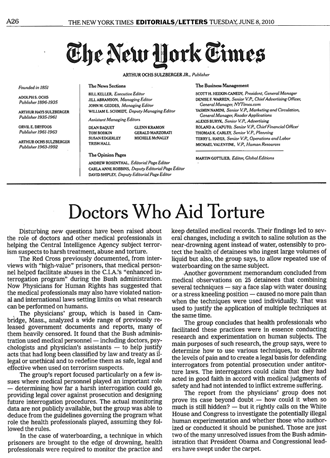
On Tuesday, June 8, PHR's report was the subject of the lead editorial of the New York Times. Day 2 coverage also included The Nation, New York Observer, LA Times, New Scientist, Inter Press Service and fulsome treatments by bloggers Andrew Sullivan (at The Atlantic) and Glenn Greenwald (at Salon.com), who are both widely read and highly influential for new media and mainstream news, alike.

On Wednesday, PHR, along with 9 other groups submitted a formal complaint to the Office of Human Research Protections (OHRP). We issued a new statement and held another press conference—and attracted a new round of press coverage, with at least 200 press outlets covering the story, including wire stories on AFP and AP and detailed reporting on The Great Beyond blog from Nature.com.

Our OHRP complaint was co-signed by Amnesty International USA, Bill of Rights Defense Committee, Center for Constitutional Rights, Center for Victims of Torture, Human Rights Watch, International Rehabilitation Council for Torture Victims, National Religious Campaign Against Torture, Network of Concerned Anthropologists and Psychologists for Social Responsibility.

Anyone can file an OHRP complaint, so we've opened ours to the public in cooperation with a number of our partner organizations. If you haven't signed on yet, please do.

Also on Wednesday, the office of Senator Dianne Feinstein (D-CA), who is chair of the Senate Intelligence Committee, released a statement to blogger Jeff Kaye: "the findings of the new report from Physicians for Human Rights will be considered," Feinstein said, in the Committee's review of the CIA detention and interrogation program.By the end of the week on Friday, PHR was mentioned nearly 900 times in press source and had over 9000 total downloads of Experiments in Torture. The report authors have been interviewed numerous times for print, radio and TV. We've posted a few of their appearances on The Torture Papers.

A number of outside academic experts have spoken supportively on the record about PHR's evidence and the allegation of experimentation, including, Olivier Ribbelink, researcher at the Asser Institute in The Hague; Jonathan D. Moreno, a professor of medical ethics at the University of Pennsylvania; Paul Root Wolpe, director of the Center for Ethics at Emory University in Atlanta, Georgia; and Nancy Berlinger, a research scholar who studies clinical ethics at The Hastings Center in Garrison, New York.

Many thanks to all who have blogged, reported, tweeted, signed onto the OHRP complaint, sent our links to colleagues and otherwise responded to the pressing nature of our findings in Experiments in Torture.Stay tuned for more developments.

(Cross-posted on The Torture Papers)

Blog

Did the CIA Experiment on People? Demand an Investigation!

PHR's new report, Experiments in Torture, has sent shock waves through the conscience of America this week. This report reveals evidence indicating that the Bush administration may have conducted illegal and unethical human experimentation and research on detainees in CIA custody.This research, if proven to have occurred, could violate the Geneva Conventions, The Common Rule, the Nuremberg Code and other international and domestic prohibitions against illegal human subject research and experimentation.?Not only are these alleged acts gross violations of human rights law, they are a grave affront to America's core values.Elected officials have failed in their duty to investigate potential CIA wrongdoing. It's time to get the experts involved.Join PHR as we file a complaint with the Office of Human Research Protection, demanding an investigation into these alleged abuses.Physicians for Human Rights, together with Amnesty International, the Bill of Rights Defense Committee, the Center for Constitutional Rights, the Center for Victims of Torture, Human Rights Watch, the International Rehabilitation Council for Torture Victims, the National Religious Campaign Against Torture, and Psychologists for Social Responsibility, has filed a complaint based on evidence of? CIA experimentation with the Office of Human Research Protection (OHRP). The complaint demands that OHRP launch a full investigation into possible human experimentation by the CIA.The OHRP, which is part of the US Department of Health & Human Services, is responsible for ensuring that federally funded research involving human subjects complies with scientific and human rights-based regulations. OHRP has a long history of sanctioning powerful institutions that violate US law protecting human subjects in research.Take action now by joining the OHRP complaint. Anyone world-wide can officially join the complaint just by signing the petition. You will add your name to a list of thousands of people calling for justice. You will not be asked to come to court, nor will you need to take further action. By signing your name, you will have demanded an official investigation into deeply disturbing allegations of illegal CIA experimentation on detainees.The integrity of America's commitment to human rights and rule of law stands in the balance. Sign on to the OHRP complaint today.(Cross-posted on The Torture Papers)

Blog

June 12, 2010: Global Day of Action for Iran

Physicians for Human Rights joins numerous international NGOs, including Amnesty International, Human Rights Watch, and Reporters Without Borders, in supporting United4Iran’s Global Day of Action on June 12, 2010. June 12?events will be occurring in over 70 cities around the world. Go to?12June.org for more information.June 12?marks the one year anniversary of Iran’s disputed election, which was followed by a government crackdown that saw an increase in arbitrary arrests, torture, and politically motivated use of the death penalty. The Global Day of Action calls attention to Prisoners of Conscience in Iran, and demands their unconditional release.Since last year’s elections, the human rights situation in Iran has only grown worse.?PHR continues to highlight the case of Drs. Kamiar and Arash Alaei, Iranian doctors who have been held by Iranian authorities since June 2008. After being imprisoned without charge for six months, the Doctors Alaei were convicted and sentenced for the charges of being in “communications with an enemy government” and “seeking to overthrow the Iranian government.” Kamiar was given a three year prison sentence, while Arash was sentenced to six years.The Iranian government used the doctors’ travel to international AIDS conferences as a basis for the charge. Iran cannot continue to imprison medical professions for doing their job. By equating public health diplomacy with treason, the Iranian government poses a threat to all Iranians working for scientific knowledge.Stand with PHR and the international community to tell the world that “Treating AIDS is not a crime." Visit iranfreethedocs.org for more information on the Alaeis. And on June 12, please help us remember and defend those in Iran jailed for their humanitarian work.

Blog

Frank Donaghue Discusses Experiments in Torture

PHR's CEO Frank Donaghue provides an overview of our new report, Experiments in Torture: Human Subject Research and Experimentation in the “Enhanced” Interrogation Program, available at http://phrtorturepapers.org.

Blog

Sudanese Doctors Assaulted by Security Forces

On June 2, Sudanese security forces reportedly attacked medical personnel participating in a peaceful protest march through Khartoum, organized by students of the School of Medicine of Khartoum University. Reuters news service reported that doctors, while peacefully protesting the arrests of Dr Walaa Alden Ibrahim and Dr Alhadi Bakhiet, were beaten by security officials armed with sticks.Dr Ibrahim and Dr Bakhiet were arrested on June 1, then re-arrested following public statements made by the doctors, detailing the conditions of their arrests and alleging torture at the National Intelligence and Security Services head offices in Khartoum.The June 2 demonstration was disrupted by the arrival of security officials, who reportedly beat and arrested many of the medical personnel participating, and prevented doctors from the Khartoum Teaching Hospital from joining the demonstration. The African Center for Justice and Peace Studies has reported that six medical students were charged under Article 77 of the Sudanese Criminal Code 1991, banning "public noisiness" – in contravention of freedom of expression, guaranteed under Article 39(1) of the Sudan Interim National Constitution.As a membership organization of health professionals, Physicians for Human Rights calls for the release of the detained doctors, and condemns the torture and arrest of medical students involved in the organization of the peaceful protest.

Blog

Congratulations to Steven Reisner, PhD, Beacon Award Winner

Physicians for Human Rights? is proud to announce that PHR advisor Steven Reisner, PhD, received the Beacon Award at the New York State Psychological Association’s annual conference in May 2010.The Beacon Award is given annually to a psychologist whose leadership or advocacy has established a guiding light for the profession of psychology. Dr. Reisner's ongoing dedication to ending the participation of psychologists in interrogations where torture and abuse occur has been just such a guiding light for the profession and the nation. His leadership has ranged from influencing APA policy change through his work with the Coalition for an Ethical Psychology to founding the New York Campaign against Torture.Dr. Resiner has contributed significantly to the work of PHR as Advisor on Ethics and Psychology and has provided important leadership to PHR's Campaign Against Torture, which works to end health professional complicity in torture worldwide. We are honored to have such an influential and accomplished health professional as a part of our team.The official citation from the New York State Psychological Association is below. PHR salutes Dr. Reisner for his commitment to ending torture and and defending human rights and medical ethics.

The Beacon Award is presented to a psychologist whose leadership or advocacy has established a guiding light for the profession of psychology. This year NYSPA is honoring Dr. Steven Reisner for his leadership in the protest against the participation of psychologists in interrogations where torture and abuse occur. He helped found the Coalition for an Ethical Psychology and was a key leader in the fight to change APA policy on this issue. He was active in organizing and leading protests at APA conventions in 2007 and 2008, and in 2008 he ran for the APA presidency on this issue. An eloquent spokesperson upholding the ethical tradition of the profession of psychology, his clear and decisive articulation of principle helped bring about the passage of the APA referendum on psychologists and torture and the subsequent change in APA policy. He continues to be active as a founding member of the New York Campaign against Torture.Dr Reisner is a psychoanalyst in private practice in New York City. He is Clinical Assistant Professor at NYU Medical School and a faculty member of the NYU Psychoanalytic Institute. He has been active in a therapists' network to treat survivors of torture and was education director and clinical supervisor for the International Trauma Studies Program in New York City. He has given talks and written numerous articles on trauma and the use of drama and the arts in its treatment.

Get Updates from PHR