Blog

Celebrate Mother's Day, Support CEDAW!

We know that women and girls around the world face violence and discrimination daily. We also know that CEDAW, the Women’s Treaty, helps women and girls to go to school, own and inherit property, take part in public life and fight violence. We need?Senate action on the CEDAW Treaty (the Convention on the Elimination of All Forms of Discrimination Against Women) to give the US greater clout to help women worldwide win these basic rights.This Mother’s Day, Physicians for Human Rights is working with dozens of national partners to ensure that we ratify CEDAW now. CALL or EMAIL your Senators TODAY to ask them to celebrate Mother’s Day by showing?their support for the CEDAW Treaty.While we celebrate our own mothers and grandmothers today, let’s stand together for women and girls around the world.?Ask your Senators to support CEDAW today.For more information on CEDAW, check out past PHR blog posts, and the Women's Treaty working group.

CALL your Senators!

Dial: (202) 224-3121, and ask for your Senators' offices.Don't know who your Senators are? Find out!Use our sample script:

Senator XXX,I am calling on Mother's Day to urge you to celebrate mothers in America and around the world by supporting CEDAW's ratification in Senate.Your support is critical to the success of CEDAW ratification in the United States. CEDAW is the most comprehensive international treaty on women's rights, setting universal standards on the equal political, economic, civil, social, and cultural rights of women. CEDAW ratification in the United States would strengthen domestic law that ensures and protects women's equal rights as well as illustrate the United States' commitment to serve as a credible global leader in honouring the equal rights of women!As your constituent, I call upon you to celebrate mothers and celebrate CEDAW by supporting its passage in Senate.Sincerely,[Insert Name Here]

Send a CEDAW Mother's Day Call to Action EMAIL to your Senators!

Click on the Web Form link for your Senators and copy/paste this email template!

Dear Senator:Here is a suggested checklist to help you celebrate Mother’s Day this year:

  • Buy flowers
  • Buy Chocolates
  • Ratify the CEDAW Treaty

Actually, you can skip the chocolates. This Mother’s Day, the best present would be for the US Senate to ratify CEDAW, the landmark international agreement that affirms fundamental human rights and equality for women and girls. Officially called the Convention on the Elimination of All Forms of Discrimination Against Women, it provides a practical blueprint to open opportunities for women and girls in all areas of society.Around the world, CEDAW can be used to ensure primary education for girls; improve maternal health care; pass laws against domestic violence; and allow women to own and inherit property. But lack of United States ratification weakens the voice of the United States on human rights issues.Promoting and protecting human rights is fundamental to America’s core values. Under the leadership of Presidents Reagan, Bush and Clinton, the U.S. ratified similar treaties on genocide, torture, race, and civil and political rights. This Mother’s Day, show your support for women by showing your support for CEDAW.Mothers in the U.S. and around the world will thank you!Sincerely,[Insert Name Here]

Blog

Preparing for MINURCAT's Departure (Continued)

(This blog post picks up from one written last week.)Contrary to the agreement of UN and Chadian officials that the United Nations Mission in the Central African Republic and Chad (MINURCAT)? has “served its purpose,” the BBC reported news of clashes between the Popular Front for National Resistance (FPRN) and Chadian security forces over the weekend. Unofficial reports from the area reference heavy losses of both troops and vehicles sustained by the Government of Chad (GoC)—raising concerns about the possibilities for continuation of humanitarian operations in the area.The Secretary-General’s speech yesterday continued to maintain that improved relations between Chad and Sudan would allow for a significant reduction of military troops in the volatile Eastern Chad border region; the speech did not respond directly to concerns from human rights groups regarding the financial and logistical components of the new security arrangement. More than 200,000 Darfuri refugees are dependent upon humanitarian operations by international and domestic NGOs for food, shelter, and medical care in the region.Outlining the proposals advocated in his report, Secretary-General Ban Ki-moon?recommended the MINURCAT mission’s military component in Chad now be reduced from 3,300 troops to 1,400 troops. In context, the remaining military troops would represent only 38 percent of the troops initially authorized by the UN as necessary to securing the displaced refugee population and humanitarian operations in Eastern Chad. (Even before this withdrawal, the MINURCAT deployment never approached its full authorized deployment of 4,900).As noted previously, over the past year the region has remained among the most hazardous operating environments currently sustaining humanitarian operations. The disruption of humanitarian operations this weekend was not the first such occurrence. Multi-week suspensions of operations by agencies such as the International Committee of the Red Cross (ICRC) and the World Food Programme (WFP) in November-December and May 2009.Without sufficient security in the area, NGOs are unable to provide services ranging from food distribution—a particular concern ahead of the rainy season; water and sanitation projects—vital to control the spread of disease among overcrowded and vulnerable refugee populations; and medical services, including mobile clinics serving rural populations.The continued absence of a military capable of securing the area and deterring further attacks could threaten not only the refugee community, but the ability of the humanitarian NGOs to continue to operate in the area.In addition to these concerns, the recommendations of the Secretary-General’s report increase the informal role of the D_tachement int_gr_ de s_curit_ (DIS)—formed to provide security in the refugee camps and surrounding areas but increasingly relied upon to provide escorts to many UN agencies and some NGO convoys. The under-deployment of the MINURCAT military component, and its lack of troop-strength capable of providing military escorts, increased the role of the DIS (UN-trained Chadian police); this has diverted the focus of the force away from providing security to camp residents, including protection to women gathering firewood and animal feed and to those travelling to market of farming areas.Along with replacing the lost 1,400 MINURCAT troops—the Government of Chad must also scale up the capacity of the Gendarmerie Nationale national police force of Chad in order to take over the security escorts required by humanitarians—a challenge considering the lower levels of operational and human rights training provided to this force.Human Rights groups urged the Secretary-General to consider the security of NGO operations, as well as the need for consultation and transparency with refugee communities and humanitarian agencies on the ground. It is vital that the final recommendations, to be adopted by the UN Security Council later this month, are revised to include these concerns.In sum, the Secretary-General’s recommendations advocate for the withdrawal of 1,400 troops by 15 July (leaving only 1,900 international troops in Chad until 15 October 2010, when they are planned to cease all operations and commence their final withdrawal), while the Government of Chad must source the necessary financial and logistical resources to secure a volatile region hosting in excess of 200,000 Darfurian refugees, whilst sustaining renewed attacks from militia groups possibly associated with the Government of Sudan.

Blog

China Lifts HIV Travel Ban

For too long the United States had in place a federal law prohibiting those infected with HIV from entering the US —_ unless special permission was given. Scientific evidence, even calls by sitting and past Surgeon Generals, did nothing to reverse the law.This situation persisted until early January 2010 when the US government took the final administrative steps to remove the HIV travel ban. The ban was a painful reminder of the stigma and discrimination often directed at those who are (or are suspected of being) HIV positive.Today marks yet another twist in the saga. Surprisingly, China, too, has now turned a page and joined a long and growing list of nations that will no longer bar those infected with HIV from entering its borders. For China, criticized by international groups and governments for its appalling record on human rights, this is certainly a positive step forward in the struggle for the rights of people living with HIV/AIDS.While we should take a moment to acknowledge and applaud China’s actions, we must all stand vigilant and monitor the implementation of this new policy to ensure China’s intentions match its rhetoric.We, too, should be mindful that many countries continue to restrict the “entry, stay and residence of people living with [or suspected of living with] HIV.” These are appalling restrictions that require continued international attention and action toward removing these discriminatory policies and mounting a truly effective global response to the HIV/AIDS pandemic.

Blog

Arizona's New Immigration Law Imperils Human Rights

In 2009, J-H- was an asylum seeker living in Phoenix, Arizona. J-H- is a survivor of female genital cutting (FGC) in her African homeland. As a victim of and activist against FGC, J-H- was targeted and violently attacked in her country, and her home was burned to the ground. Fearing for her life and safety, J-H- fled to the US without good immigration documents, and with almost no material possessions.In Arizona, J-H- was fortunate to find a volunteer lawyer who helped her apply to the federal government for asylum. Physicians for Human Rights was able to find a physician from our Asylum Network who was willing to evaluate J-H- in support of her claim to legal protection in the US.Concern for people like J-H- is why Physicians for Human Rights strongly opposes Arizona’s Senate Bill 1070, signed into law April 23, 2010.SB 1070 will require all state and local law enforcement personnel in Arizona to detain an individual and verify immigration status whenever they develop reasonable suspicion that the person might be in the US illegally. The law also makes it a crime to be an undocumented immigrant or to seek work while one is undocumented in Arizona.The legislation imperils the human rights of US citizens, legal immigrants and the undocumented, including people like J-H- who have suffered horrible human rights abuses and are working to obtain legal status in the US.Human rights principles are universally applicable and protect everyone throughout Arizona and the US, not only those who have legal status. These include the right to be treated without discrimination by law enforcement, the right to be free from arbitrary arrest and imprisonment, and the right to seek asylum from persecution.SB 1070 threatens these rights through the methods it prescribes for carrying out immigration enforcement. It is difficult to imagine what obvious, visible signs might trigger police suspicion that one is undocumented or an immigrant aside from hallmarks of race and national origin. The law is likely to create arbitrary discrimination based on these factors. Uncertainty around what could create reasonable suspicion of illegality means that anyone in Arizona can anticipate being subjected to police intrusion and an identity check at any moment.Past experience with campaigns of immigration raids has shown that legally present immigrants and US family members are more reluctant to take part in civic activities, visit family members, or seek medical help for which they are legally entitled if doing so exposes them to potential questioning and arrest. If SB 1070 had been in force last year, fear of accessing community services may have prevented J-H- from seeking the legal help she needed to obtain asylum in the US. A life of fear and insecurity could have added to the physical and mental suffering she endured due to FGM.Arizona has sent an important message that immigration laws must be reformed on the federal level.?Although federal immigration policies have many serious flaws, immigration authorities take seriously the need to meet the health needs of highly vulnerable immigrants like J-H- if they are arrested for immigration violations. In contrast, states like Arizona do not have the resources or capacity to appropriately treat immigrant survivors of human rights abuses while their legal cases are pending.PHR calls upon Arizona to repeal its harmful legislation. We call upon Congress to act rapidly to pass comprehensive immigration reform that values freedom from discrimination and the rights of migrants to seek legal protections from human rights abuses.

Blog

Global HEALTH Act National Call-in Day: How Your Organization/School Can Participate

As of today, the global health community has secured seven co-sponsors for the Global HEALTH Act: Reps. John Conyers (MI), Lynn Woolsey (CA), Raul Grijalva (AZ), Keith Ellison (MN), John Garamendi (CA), Fortney Pete Stark (CA) and Diane Watson (CA).PHR wants to double this number —?and double it again. To gain more support for the GHA, PHR is organizing a Global HEALTH Act National Call-in Day on May 12th, International Nurses Day.So far, more than 15 organizations have pledged to participate. We'd love more. If your organization/school/workplace is interested in taking part, contact us at ghacallinday[at]phrusa[dot]org.And checkout the Call-in Day toolkit (doc), which contains all the information you'll need to organize a great call-in day. GHA National Call-in Day Toolkit (122.5 KiB, 4 hits)UPDATE, May 11: The Global HEALTH Act has garnered two?new co-sponsors: Reps. Jesse Jackson, Jr. (IL) and Eleanor Holmes Norton (DC).UPDATE, May 17: Four more co-sponsors have been added:?Sam Farr (CA), Maxine Waters (CA), Bobby Rush (IL), and James McGovern (MA).

Report

Hospital Staff Upholds International Medical Ethics During Unrest in Bangkok

Two PHR researchers report from Thailand that actions by anti-government protesters – who first blockaded and later forcibly entered and searched a major hospital in central Bangkok in April 2010 – were a gross violation of humanitarian principles. The report also expresses grave concern over the failure of Thai security forces to provide adequate protection to medical personnel and patients.

Blog

Preparing for MINURCAT's Departure: the Post-Peacekeeping Reality in Eastern Chad

Next week, the UN Secretary-General’s report on the future of the United Nations Mission in the Central African Republic and Chad (MINURCAT) peacekeeping force in Eastern Chad will be released, outlining the withdrawal of peacekeeping troops in the Chad-Sudan border region visited by PHR researchers in 2008. The report Nowhere to Turn: Failure to Protect, Support and Assure Justice for Darfuri Women, released by PHR in June 2009, outlined urgent human rights issues in Eastern Chad, including food insecurity, camp infrastructure, access to health and psychosocial care, and security for refugee families. Among the disturbing findings of our investigation was a 50% rate of rape or sexual assault reported by women interviewed by the PHR medical team.Since the time of PHR’s investigation, a number of security threats and human rights issues have been recorded?— via international media reporting on hijackings and kidnappings of humanitarian aid workers, and reports such as that released by the Institute of Studies on Conflicts and Humanitarian Action (IECAH) on the continued need for the peacekeeping force.Many large-scale infrastructure issues remain, such as the weak Chadian legal system, drought and food shortage, and the continued operation of militarized rebel groups in the area, as well as auxiliary practical issues such as low phone coverage (a key issue for reducing attacks against refugees and humanitarians, as emergency phone calls allow for MINURCAT forces to be alerted to security problems). The recent dispute over the continued presence of the MINURCAT force has detracted focus from these problems, which need to remain at the forefront of the diplomatic and humanitarian agenda in Chad. (Despite ongoing needs in Eastern Chad, the Chadian Government opposed the MINURCAT mission’s renewal in January 2010.)The withdrawal of MINURCAT transfers responsibility for the security of refugees and humanitarian operations to the Government of Chad?(GoC)?— a significant challenge for a state with low material wealth and incomplete infrastructure. So, what can be done, given the limitations of the current circumstances?First, it is important to remember that the continued existence of the 200,000 Darfurian refugees in Eastern Chad relies on the efforts of humanitarian aid workers and UN staff on the ground: managing the refugee camps, distributing WFP rations and shelter items, and providing emergency medical care. Humanitarian agencies have continued to operate in Eastern Chad despite increasingly frequent security threats to NGOs and personnel, and rely on police escorts in order to operate in the Phase IV security environment. The current system of police escorts for NGO convoys must be taken over by the Chadian police force, and it is particularly important that NGOs are not obliged to pay or provide other compensation for the new security arrangements, and that the?GoC?accept responsibility for ensuring the security of the humanitarian operations.Secondly, refugee communities and the humanitarian actors working with refugees must be consulted and kept informed of the transition and departure of MINURCAT and how the?GoC?will continue MINURCAT’s security and protection activities. In order to ensure this takes place, the GoC should immediately establish a dialogue and consultation forum with refugee communities and humanitarian workers, and the international community should remain engaged in the transition process to ensure that this takes place.Thirdly, it is of utmost importance that the MINURCAT withdrawal not be allowed to disrupt the humanitarian operations in Eastern Chad and/or detract from refugee security and protection. The continued monitoring of the human rights situation on the ground, and a specific focus on the security and protection needs of refugees, is paramount. The numbers of the civilian police force should be increased as the military component is phased out, and measures must be taken in the recruiting process to improve the conduct of police officers, sensitize police to human rights and gender issues, and dramatically raise the number of women police officers.The disappointing withdrawal of the MINURCAT force?— before the benchmarks of withdrawal have been met (see the Secretary-General's?December 2008 reports) — should not distract the UN Security Council or the international community from addressing the ongoing problems affecting the Darfurian refugee population in Eastern Chad. The reduction of arms, sexual and gender-based violence and human rights abuses (demilitarization of camps) must remain a key priority, along with assisting the voluntary and safe return of communities. In addition to resolving security issues on a community level, it is vital that widespread problems, such as the capacity and training of national law enforcement agencies, judiciary and prison systems, are addressed, and that the Chadian military assigns a quick reaction force to take over from MINURCAT’s civilian component.

Blog

Maternal Mortality: A Right to Health Approach Will Ensure Integrated Services and Save Lives

The article Maternal mortality for 181 countries, 1980-2008: a systematic analysis of progress towards Millennium Development Goal 5, released in The Lancet last week, records a global reduction in maternal mortality rates. A reduction is certainly welcomed. At the same time, whatever the exact reduction – be it indicated by these figures or from the soon to be released U.N. figures – the reduction is not enough. The remaining deaths are largely avoidable, and progress in reducing maternal mortality has been slow.We know that discrimination (including discrimination against HIV+ women), lack of education, poor nutrition and lack of access to reproductive health services, family planning, ante-natal care, skilled birth attendants, effective referral systems and emergency obstetric care lead to maternal death. These are human rights issues.A human rights approach – a right to health approach to maternal mortality – would provide a dynamic model that can be applied in diverse contexts, as outlined by Paul Hunt, UN Special Rapporteur on the Right to the Highest Attainable Standard of Health (2002-2008), in?Supplementary Note on the UN Special Rapporteur's Report on Maternal Mortality in India (doc).?This model is concerned with factors/issues such as:

  • The well being of women and newborns being at the centre of all maternal health services and facilities;
  • A sufficient number of skilled birth attendants, providers of back-up emergency care, and technical senior managers in maternal health;
  • Equality and non-discrimination: maternal health services and facilities that are accessible (in law and fact) to all, including women living in poverty, indigenous and minority women, those with disabilities, and adolescents;
  • Transparency, with privacy: public access to all relevant health information (but not at the expense of confidentiality), such as the amount of public funds devoted to maternal health;
  • Information: for example, so that women know the importance of skilled care at birth, and have the freedom and means to access that care;
  • Accountability (such as through maternal health audits), with the cause of each maternal death being determined and corrective action taken to prevent avoidable deaths in the future;
  • Maternal health facilities that are culturally appropriate and provide sexual and reproductive health services and education, family planning, ante-natal care, skilled birth attendance, and referral to/availability of emergency obstetric care;
  • Women’s participation in policymaking, implementation and accountability;
  • A maternal health strategy (integrated into the comprehensive national health plan) that is based on an up-to-date maternal health situational analysis informed by suitably disaggregated data, and promotes the integration of services, for example HIV/AIDS, ante-natal care, and PMTCT.

(See also the PHR report?Deadly Delays Maternal Mortality in Peru. A Rights-Based Approach to Safe Motherhood and accompanying video.)The Lancet paper confirms what we all know about important indirect causes of maternal death (pre-existing conditions aggravated by pregnancy and childbirth) – if you are pregnant and HIV positive, in the absence of ARVs, you are more likely to die.In the U.S., the Obama Administration’s Global Health Initiative seeks to improve coordination and integration of programs and increase women’s access to care. This is laudable. However, within the Initiative it is essential that funding for ARVs not be scaled back or flatlined, but rather continue to receive significant annual increases. In the presence of discrimination against women in many countries, including PEPFAR countries, the risk that pregnant HIV positive women will not receive the necessary ARVs is too great. The Administration must not curtail its commitment to PEPFAR in the process of implementing the Initiative as access to ARVs will help save these women’s lives.

Blog

Representative Barbara Lee on the Global HEALTH Act

You are not the only one encouraging your Congressperson to co-sponsor the Global HEALTH Act.?Representative Barbara Lee sent a letter to all her Congressional colleagues last week, urging them to support the bill. Check out her letter below. It outlines the four ways that the Global HEALTH Act will assist with the development and implementation of Obama's landmark Global Health Initiative. The Act will provide strategy, consistency and a greater emphasis on health workforce and health systems — all key to making foreign health policy that supports the right to health.Her letter includes a list of organizations from across the globe that support the Global HEALTH Act — including PHR. Organizations are continually being added to this list, and we encourage you all to contact your Congressperson and urge them to co-sponsor this bill, which will revolutionize foreign health aid and save lives.

Blog

Uganda's Health Workforce Crisis: A Conversation with Mitterand Kiirya

The health workforce crisis in Uganda is immense. Uganda is reportedly losing at least 1,400 skilled professionals each year, and there are only 29,000 medical personnel in a country of 31 million people. Consequently, the health system is suffering, and most often the blame falls on health workers, as they are on the frontline and seemingly represent the health sector. In the past eight months, since I’ve been in Uganda, media coverage of the health system has almost always focused on the negative aspects of health workers, further demonizing a field that is made up largely of hard working people.

 Recent Ugandan headlines include:

Rioters attack Mityana hospital (New Vision, Aug 21, 2009)

12 Health workers held over drug theft (New Vision, Jan 11, 2010)

Health officials remanded over theft of government drugs (Daily Monitor, Mar 11, 2010)

These news stories reflect the public’s negative perception of health workers, who are almost always associated with being unqualified, incompetent, rude, corrupt, and thieves. Furthermore, personal stories shared with me about using the health system are most often about being ignored and mistreated — not about receiving good care by caring health workers.For those of us advocating for health workforce development, the negative image of health workers makes it more difficult to garner support and foster dialogue. We should honor the truth of people’s experiences with health workers and the health system, but the problem is complex and there are many underlying factors that need to be addressed. Health workers are overworked, underpaid, and lack proper resources and equipment. Yet the majority of health workers still show up to work and perform their duties. If they didn’t, the health system would completely collapse. At the same time, we should expect and demand a standard of care from our health workers.

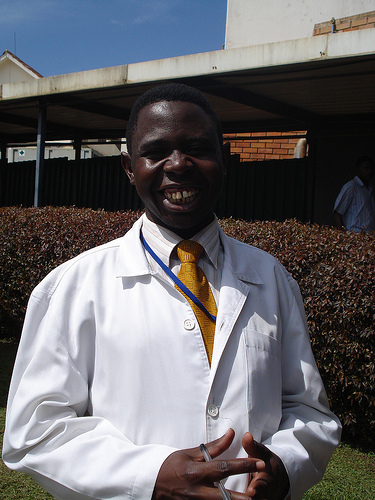
Uganda nurse Mitterand Kiirya

Ugandan nurse Mitterand Kiirya (Physicians for Human Rights)

Given the complexity of the issue and the lack of easy answers, I wanted to highlight one health worker who I feel exemplifies the notion of a dedicated and ethical health worker. Mitterand Kiirya is a research nurse for the Antiretrovirals for Kaposi’s Sarcoma (ARKS) study at the Infectious Disease Institute (IDI) at Mulago Hospital, the largest national referral hospital in Kampala, Uganda. For the past 2_ years, he has been working with HIV-positive patients who have Kaposi’s Sarcoma. Previously, Mitterand worked at Uganda Cares, an antiretroviral access initiative in Masaka.

I first heard about Mitterand through my roommate, a U.S. medical student working with him at IDI. She would often talk about his dedication, and how he would invite her to join him on visits to the countryside 6–7 hours away from Kampala to check in on his patients in their homes. This was not part of his duties, but something he did on his own time. But most of all, she would always talk about how he inspired her to be a good doctor, because he always put the patient first. And, despite all the challenges he faced, he always remained positive and managed to smile and make people laugh everyday.

Here are some highlights from a recent conversation I had with Mitterand:

Why did you want to become a nurse?

It was from watching my mother. She is a mid-wife in my village, Namugong, Kaliro [in the Eastern part of Uganda]. I watched her passion for her patients. How she cared for them, wanting to alleviate their pain. What I saw was that she tried to understand the patient, and I wanted to do the same thing.

What does it mean to understand your patient?

Well…before seeing the doctor, the patient has a lot of anxiety, especially when they are referred from place to place. So I try to sit and talk to them before they see the doctor, prepare them to receive what the doctor will tell them.

What do you see as the role of the nurse?

As a nurse, I try to reverse what was impossible, and make it possible. I try to bring a message of hope and new life, especially with my patients who are HIV-positive. If you haven’t even given the message of assurance, then it’s the equivalent of not having come to work that day. People have encouraged me to further my studies, and become a doctor. I have thought about it a lot, but I don’t want to lose the contact with my patients, which I think happens sometimes with doctors. So, right now, I’m staying a nurse, staying with my patients.

You often see that nurses, or health workers in general, get discouraged by their work environment. What do you think about this?

Yes, I do see some of my colleagues who are not working. But what I try to do is motivate them. Remind them about the ethical requirements of our profession, but also try to serve as an example for them too. But, I tell them that “ we are here to serve our profession, give the service and think about the quality of your services, the quality of your service should determine your cost”. But you must work hard.

I know the system is broken. Infrastructure is inadequate, and the environment is making it difficult. We are losing the confidentiality of the patient, because we are sharing spaces with only curtains to divide, and sometimes not even that. I am always trying to improvise to keep the patients alive.

How do you stay motivated?

I have love for the patients. That is what motivates me. Be their friend, we need to be there first for the patients.

Tell me about the award you received from Alicia Keys.

When I was working at Uganda Cares in Masaka, she contributed ARVs and general support for HIV-positive children. She found me at Masaka, working as a nurse, she was told through my director, my medical director, Dr. Bernard Okongo. He introduced me as a hardworking nurse, who was dedicated with total love for his profession. I received an award and took a picture with her. It was a big ceremony held in Masaka.

I felt very…actually felt humbled really, for the public to appreciate my contribution and my profession, I felt humbled. I felt so humbled. In this country, what de-motivates people, you can serve, but failure to appreciate your service is another big issue. If the services we are offering are appreciated, the level of our service would be so high.

Thanks Mitterand for speaking with me.

No, I say ‘thank you’ to you, because you are listening to me. Everyday, I am here for others, listening to them, and having to hold back my pain. But it’s nice that I can talk and you listen to me.

Speaking with Mitterand is always inspiring, and I know he is not the exception. From my experience in Uganda, I have witnessed the dedication of health workers throughout the country, ranging from district health officials to field doctors and nurses and community health workers. Further, I have seen administrators, Ministry of Health officials and policymakers who are also working tirelessly to improve the health of the population. I think it’s important for us in advocacy to re-frame the issue of health workers, by highlighting the positive aspects of their work and recognizing them for it, so that the media and general public can better understand them and the complexities of the Human Resources for Health issue. And we need health workers to also speak out and show their commitment and concern for the health of the population, because in the end, we are all working towards a collective goal to ensure the right to health for all.

Get Updates from PHR