Blog

Women in Darfur: One Year On

Last Thursday marked the end of General Gration’s first 12 months as US Special Envoy to Sudan—an event that closely followed the one year anniversary of the Government of Sudan’s expulsion of humanitarian organizations in March 2009.

In the course of the past 12 months, the humanitarian community and UN Country Team in Sudan have made significant efforts to rebuild programming disrupted by the expulsion of 13 international and 3 Sudanese NGOs — efforts that have been encouraged by the US Envoy’s office. Now one year on, however, the loss of specialized programming continues to challenge NGOs and UN agencies working on the ground.

As PHR and numerous other organizations pointed out in a public letter (pdf) to Secretary of State Hillary Clinton last November, multi-sectoral programming addressing the vulnerability and needs of women and girls has been affected seriously by this disruption in programs and services. But broader efforts to re-establish programming lost in the expulsions have been unable to rebuild the base of gender expertise in the humanitarian community prior to 2009.

The range of women-specific concerns spans all areas of humanitarian programming in Darfur: specialized health needs; different levels of education; cultural issues concerning sanitation and hygiene services; and, not least, the widespread incidence of sexual violence across Darfur. There is an urgent need to improve the coverage of relief distribution to target women effectively, expand programming into rural areas, and encourage the mainstreaming of gender concerns by NGOs and UN agencies.

Even prior to the expulsions, the breadth and consistency of women-focused programming had suffered a number of setbacks in 2008, including the closure of many women’s centers, the suspension of psycho-social programming in some instances and increasing obstacles for NGOs to communicate with other agencies. In order to remedy this, we need strong sector coordination and the commitment of sufficient resources to the UN lead agency for Gender-based Violence (UNFPA) to implement the strategic plan designed to address these issues.

In response to this urgent crisis of treatment and services, PHR has issued a briefing paper to the Special Envoy’s Office: Action Agenda for Realizing Treatment and Support for Women and Girls in Darfur, outlining the conditions of this crisis and immediate actions needed to realize both responsive and proactive programming to reduce the vulnerability of women and girls in Darfur and provide support to survivors. The paper outlines the need for a commitment from the US Government to expend the necessary resources for women and girls in Darfur and to establish a consistent message in the Special Envoy’s diplomatic relations.

Over the past 12 months, a number of humanitarian sectors — water, sanitation, shelter — have been restored and rebuilt, yet vital services such as psychosocial support, medical and legal outreach and livelihoods support for women and girls remain devastated by the impact of the expulsions. It is the duty of the Special Envoy’s office to ensure that US engagement in critical events, such as the upcoming Sudan elections and the continuing Darfur Peace Accords, does not divert attention from the unmet needs of women and girls any longer. By March 31, 2010, General Gration should announce his office’s strategy to address the following:

  • US Government support for humanitarian programming to reduce the vulnerability of women and research to establish a recommended service provision model that can be replicated in under-served communities.
  • US Government funding for sector coordination to the UN lead agency for Gender-based Violence in Darfur, UNFPA. This funding commitment will allow for UNFPA strategic planning to increase treatment and support and facilitate broader initiatives to reduce vulnerability to violence.
  • US Government use of diplomatic leverage to ensure that the Government of Sudan take responsibility for managing and acting on information received through the Tripartite Reporting Mechanism and institute a Rapid-Reporting mechanism between State and Federal bodies of the Humanitarian Aid Commission (HAC).
  • US Government encouragement of troop-contributing and police-contributing countries to boost deployment of the UNAMID peacekeeping force; the provision of outstanding equipment, in particular military helicopter assets, remains critical to increasing the mobility and operational impact of the mission in a volatile security environment. A commitment is also needed to boost the number of female troops and police sent by police- and troop- contributing countries.
  • US Government promotion or development of a multi-year funding mechanism for relief, early recovery and emergency projects through the 2010-2012, pre-election to post-referendum period, for projects to mitigate the risks of sexual and gender-based violence should complex emergencies arise in Sudan and to provide the necessary treatment and support for survivors.

As the largest donor to the humanitarian operations in Darfur, and as a key diplomatic player engaged with the Government of Sudan, the US Government has the opportunity to assure that the urgent needs of women and girls in Darfur are met. The US Special Envoy’s office represents the political and diplomatic interests of the American people and has the ability to commit both the diplomatic and financial resources of the US Government to address the needs of survivors, and prevent further violence.

Physicians for Human Rights invites all individuals and organizations who wish to see these recommendations become a reality to contact the Envoy’s Office and ask for a plan by March 31st 2010.

>> Read More: Action Agenda: Realizing Treatment and Support for Women and Girls in Darfur (pdf)
    Blog

    Important Components of the Global HEALTH Act

    We are just three weeks away from World Health Day (April 7) and the official launch of advocacy for the Global HEALTH Act of 2010. And we have now heard that Representative Barbara Lee will be introducing the bill in the coming days! Now more than ever we need you to be ready on April 7 to email or call your Congressperson urging him or her to co-sponsor this bill.Since the beginning of March, though this blog you’ve learned about the purpose of the Global HEALTH Act , garnered some great facts about the health workforce crisis, seen one of the many ways in which health systems can be measured and watched four health workers at Mbagathi Hospital talk about the challenges they face on a daily basis.Today’s post takes a closer look at some very important components of the Global HEALTH Act. But first, it is important to congratulate Representative Lee on the development of a bill that heralds a new way of working to strengthen and improve the health systems of developing countries, and the delivery of health services to the whole of the population in those countries. The bill calls on President Obama to develop a comprehensive US Global Health Strategy (the Strategy) that harmonizes and aligns all health-related US foreign assistance, and seeks to ensure that equity, non-discrimination, participation and accountability are embedded in the Strategy and, to the greatest extent possible, in the national health strategy of each country receiving direct assistance.This is a comprehensive bill, and it is not possible to review it here completely. Hence we have selected a few specific examples for you of how the bill advances the right of everyone to the enjoyment of the highest attainable standard of health:Equity and non-discrimination: An objective of the Strategy is to ensure that there is access to quality health services for poor, vulnerable or marginalized populations. Equity and non-discrimination permeate the bill. These issues are to be principal considerations in the construction or rehabilitation of health facilities, in the distribution of health services and health workers, and in the provision and distribution of medical, pharmaceutical and laboratory supplies. The ability of women and youth to use health services without fear, violence, discrimination or other mistreatment is one of the many principles that the President is called upon to encourage countries to include in their national health strategies.Participation:?There is a concern with participation throughout the bill. First, the Strategy itself is to be developed in consultation with all manner of individuals, groups and organizationsfrom executive agencies administering US foreign assistance, to US embassies and country missions, to civil society and nongovernmental organizations?in developing countries, to international organizationsand other donor nations. At the developing country level, the bill calls on the President to encourage countries receiving direct assistance to ensure meaningful participation in developing their national health strategies. This participation is to include the poor, vulnerable, or marginalized populations, as well as nongovernmental organizations, in program and budget decisions as well as in the implementation, monitoring and evaluation of the country’s national health strategy. Hence, the bill makes a direct link between equity, non-discrimination, participation and accountability.Accountability: The accountability process enables the government to identify what is working and what is not – to explain what it has been done and why – and to provide to individuals and communities the opportunity to understand how the government has discharged its obligations. Where mistakes have been made, accountability requires redress. It is a process that includes monitoring, mechanisms, remedies, and participation. The bill makes clear that the Strategy should have each of these components. The Strategy itself is to be monitored and evaluated for effectiveness. To allow this to take place, the Administration is to establish indicators to monitor the Strategy and provide annual reports to Congress. The bill authorizes the President to provide assistance to developing countries to improve the delivery of health services in those countries. The activities that have been authorized include direct support to civil society and nongovernmental organizations to monitor and evaluate their country’s health system. The President is also called upon to encourage countries to include in their national health strategies the development and implementation of sustainable legal frameworks that engage the whole of the population to monitor and enforce policies related to health. Ensuring there is a legal requirement to enable people to participate in monitoring and to enforce policies is essential for government accountability.The bill’s consistent focus on equity, non-discrimination, participation and accountability indirectly promotes the incorporation of a human rights approach to health into the Strategy. If the Strategy is developed and implemented, it will provide –?in time –?the proof that adoption of this approach improves health outcomes and the processes to achieve those health outcomes. This bill is to be applauded. It is essential that it obtain a large number of co-sponsors to demonstrate significant support for this legislation, which will help move this bill towards final passage. This is not only for the benefit of the populations in the countries receiving direct assistance but also for the benefit of the US. This bill has the potential to do more for the credibility of the US in the arena of human rights and global health than anything that has gone before.On April 7 BE READY to email your representative –?PLEASE!

    Blog

    Medicine Used for Harm in US Torture

    Salon.com's Mark Benjamin recently covered PHR's analysis of US government torture and interrogation policy documents, declassified since President Obama took office. In his review of documents, PHR Medical Advisor Scott Allen, MD, found alarming evidence of bad applications of scientific knowledge and gross ethical misconduct by medical personnel in interrogations of terror suspects in US custody.

    Interrogators pumped detainees full of so much water that the CIA turned to a special saline solution to minimize the risk of death, the documents show. The agency used a gurney "specially designed" to tilt backwards at a perfect angle to maximize the water entering the prisoner's nose and mouth, intensifying the sense of choking—and to be lifted upright quickly in the event that a prisoner stopped breathing.The documents also lay out, in chilling detail, exactly what should occur in each two-hour waterboarding "session." Interrogators were instructed to start pouring water right after a detainee exhaled, to ensure he inhaled water, not air, in his next breath. They could use their hands to "dam the runoff" and prevent water from spilling out of a detainee's mouth. They were allowed six separate 40-second "applications" of liquid in each two-hour session—and could dump water over a detainee's nose and mouth for a total of 12 minutes a day. Finally, to keep detainees alive even if they inhaled their own vomit during a session—a not-uncommon side effect of waterboarding—the prisoners were kept on a liquid diet. The agency recommended Ensure Plus.

    In a New York Times Op-Ed on February 28, former PHR President Len Rubenstein and Stephen Xenakis, who has advised PHR, noted several examples in the documents of opinions by the CIA's Office of Medical Services providing professional opinions that harsh tactics did not inflict severe pain or suffering and could therefore be authorized without implicating interrogators in torture.

    According to Justice Department memos released last year, the medical service opined that sleep deprivation up to 180 hours didn’t qualify as torture. It determined that confinement in a dark, small space for 18 hours a day was acceptable. It said detainees could be exposed to cold air or hosed down with cold water for up to two-thirds of the time it takes for hypothermia to set in. And it advised that placing a detainee in handcuffs attached by a chain to a ceiling, then forcing him to stand with his feet shackled to a bolt in the floor, “does not result in significant pain for the subject.”The service did allow that waterboarding could be dangerous, and that the experience of feeling unable to breathe is extremely frightening. But it noted that the C.I.A. had limited its use to 12 applications over two sessions within 24 hours, and to five days in any 30-day period. As a result, the lawyers noted the office’s “professional judgment that the use of the waterboard on a healthy individual subject to these limitations would be ‘medically acceptable.’”

    The op-ed also noted one occasion on which "a medical corpsman ordered intravenous fluids to be administered to a dehydrated detainee even as loud music was played to deprive him of sleep." Rubenstein and Xenakis reiterated PHR's longstanding call for a full investigation of health professionals' involvement in US interrogations and for accountability for such glaring violations of a doctor's core ethical obligation to "first do no harm."PHR's analysis shows an even deeper corruption of the medical role in examples where not only did doctors authorize harsh treatment, they used their medical expertise to modify interrogation tactics so as to prolong them and increase stress and harm suffered by detainees. In Mark Benjamin's Salon.com article, Dr. Allen said:

    This is revolting and it is deeply disturbing. The so-called science here is a total departure from any ethics or any legitimate purpose. They are saying, "This is how risky and harmful the procedure is, but we are still going to do it." It just sounds like lunacy. This fine-tuning of torture is unethical, incompetent and a disgrace to medicine.

    In 2006, the American Medical Association, American Psychiatric Association and World Medical Association all adopted ethical guidelines that make it unethical for their members to participate in interrogations of detainees. Regrettably the American Psychological Association has yet to adopt this standard, and the Department of Defense and CIA still call on health professionals to play an active role in interrogations, without holding these "consulting," "monitoring" or "advising" health professionals to traditional ethical standards.In light of this conflict and ethical and legal violations it has led to, PHR has been working with The Center for Constitutional Rights, The New York Coalition Against Torture (NYCAT) and The Bellevue/NYU Program for Survivors of Torture to support?New York State legislation, sponsored by New York State Assemblyman Richard Gottfried, that would make health professional participation in torture and improper treatment of detainees a violation of the violators' professional licenses. This law would offer clear and absolute protection against the misuse of medical and psychological knowledge and expertise in interrogations, and it would protect individual health professionals against the pressure to engage in harmful interrogation practices.?Please show your support for the Gottfried Bill standards. It is our hope that similar standards can be adopted nationwide.The US government and the health professions cannot fulfill their obligations to the rule of law and medical ethics if we settle only for reform without accountability. Assemblyman Gottfried has compiled a remarkable, eight page list of references to medical professionals contributing to "enhanced interrogation techniques." This document can serve as a roadmap for the investigation of health professionals who authorized torture and used their medical expertise to calibrate and increase harm.

    Blog

    Podcast of PHR Investigator Just Back from Bangladesh

    [display_podcast]

    We are persecuted by the Burmese government, so we came here for peace, but now we are persecuted by the Bangladeshi government.

    A 25-year-old female refugee from Arakan State, Burma, said this to me while I was investigating conditions at Kutupalong unofficial camp, Bangladesh three weeks ago.Listen to the SBS radio podcast in which I describe the plight of the Rohingya, a Muslim minority population from Burma, who are now Stateless and Starving in Bangladesh.

    Blog

    Burmese Refugees Starving to Death – Act Now

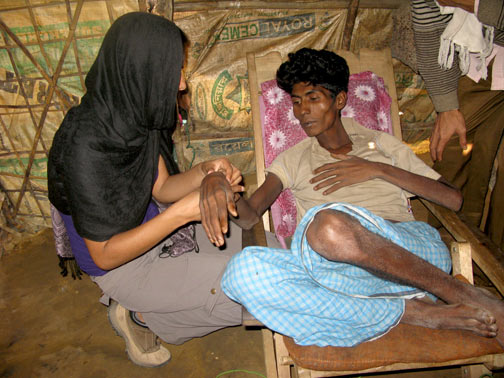
    Doctor examines a Burmese refugee in a makeshift camp

    PHR investigator Parveen Parmar, MD examines a 25-year-old refugee at Kutupalong unofficial camp. He suffers from chronic malnutrition and had not eaten any food for two days: “Now I am dying. No one brings food to this camp. What will my wife and child do when I die?” (Physicians for Human Rights)


    As you read this blog post, a humanitarian crisis is unfolding. Tens of thousands of Burmese refugees are in danger of dying from starvation and disease in Bangladesh.

    Women and children, driven from Burma and now forced into makeshift camps in Bangladesh, need your help.

    Take Action Now: Tell the Bangladeshi Embassy in Washington DC to stop deporting the refugees back to Burma and to stop blocking food aid to this vulnerable population.

    PHR investigators conducted an emergency health assessment last month in the makeshift Kutupalong camp in southeastern Bangladesh, just across the border from Burma. What they witnessed was shocking. PHR investigators found camp conditions among the worst they had ever seen, with 30,000 Rohingya refugees housed in ramshackle huts made of twigs and ripped plastic, denied food aid, and living beside open sewers.

    Almost 20% of the children surveyed showed signs of acute malnutrition. They need food immediately. The Bangladeshi government must provide aid to these refugees.

    Email the Embassy today.

    This week, PHR released an emergency report based on our field assessment, entitled Stateless and Starving. This emergency report has garnered major media coverage around the world—from the Boston Globe to the Associated Press; the BBC to Agence France Presse; the New York Times to Voice of America.

    Now you need to sound the alarm and let the Bangladeshi government know the world will not stand by while they violate the rights of Burmese refugees. Send an email to the Bangladeshi Embassy today—and tell 6 friends to do the same. The lives of thousands of Burmese refugees hang in the balance.

    Blog

    Video Spotlights Lives of Four Kenyan Health Workers

    We're just a month away from World Health Day (April 7th) and the official launch of advocacy for the Global HEALTH Act of 2010.?So far this month, through this blog you've learned about the Global HEALTH Act and gotten some great facts about the health workforce crisis (and how many people are waiting in line for an I-Pad — impressive!).?Today's post includes a few more resources that highlight the impact of Africa's health workforce shortage. Check them out and share with colleagues.PHR made the following video in collaboration with our Kenyan partner group, the Health Rights Advocacy Forum. In this 6-minute video, four health workers at Mbagathi Hospital talk about? the challenges they face every day — and why they stay and practice medicine in their home country. This moving video can be shown on campus or at your workplace to stimulate discussion and urge people to take action.

    For more personal stories, check out?Africa's Health Care Worker Crisis: Views from the Ground, a PowerPoint presentation that outlines six main drivers of the health workforce crisis in Africa and explores these challenges through the eyes of four Ugandan medical student leaders. Feel free to use this to make a presentation on campus or in your community, or use facts from it to drive home the need for action.And watch our slideshows of?Dr. Fred Katumba and Clinical Officer Jane Byarugaba following them through a typical day as they provide health care to the rural poor in Southwestern Uganda. Dr. Katumba's work has propelled Lyantonde District to #2 out of more than 90 districts in terms of health outcomes — a phenomenal accomplishment and testament to Dr. Katumba, his staff, and the millions of hard-working health professionals who help communities realize the right to health every day.

    Blog

    Stateless and Starving Burmese Refugees in Bangladesh

    Physicians for Human Rights has found that in recent months Bangladeshi authorities have waged an unprecedented campaign of arbitrary arrest, illegal expulsion, and forced internment against Burmese refugees. Critical levels of acute malnutrition and a surging camp population without access to food aid will cause more deaths from starvation and disease if the humanitarian crisis is not addressed.

    What do health and human rights advocates do when they come across egregious abuses by a government, like PHR did three weeks ago in Bangladesh?

    • Phase 1: Conduct in-depth interviews with survivors, corroborate their testimonies, and speak off-the-record with every humanitarian worker and government official on the ground.
    • Phase 2: Design an emergency household survey to measure malnutrition and food insecurity in the population.
    • Phase 3: Take photos. Lots of them. One out of 50 may be good enough for print. (And don’t forget to get informed consent!)
    • Phase 4: Analyze the qualitative and quantitative data to ensure a robust report, write like mad, and pitch it to the media. With a little luck, they may bite.

    Associated Press broke the story last night, appearing minutes later in the New York Times. Other coverage has followed in numerous outlets, including the Boston Globe, AFP, and BBC.

    >> Read all about it: Stateless and Starving: Persecuted Rohingya Flee Burma and Starve in Bangladesh

    Post script: A BIG thanks to my colleague, Dr. Parveen Parmar, whose emergency-physician calm in the field made all the difference in completing this emergency assessment.

    Blog

    Human Resources for Health Index

    To promote and protect the Right to Health, a health system must be of good quality, equitable, integrated, responsive, effective, and accessible to all. The capacities of health systems can be measured in many ways. No matter how they are measured, the disparities between countries’ health systems are tremendous, and these differences are a matter of human rights. It’s evident that these disparities have a significant – and at times, astonishing – impact on health outcomes:

    Approximate number of Washington, DC residents: 600,000


    Population size of Ethiopia: 80.7 million

    Ratio of doctors in Washington, DC to doctors in Ethiopia: 2:1

    Number of countries the World Health Organization identified as having severe shortages of health workers: 57

    Number of times quarterback Jay Cutler spoke the phrase “you know” during a televised interview within five minutes: 57

    Vehicles recalled by Toyota in October 2009 for faulty floor mats: 4.3 million

    Number of missing health workers in 57 severe shortage nations: 4.3 million

    Of the 57 shortage nations, percentage of which are in Africa with severe health worker shortages: 69

    Ratio of physicians to total Liberian population (2007): 1:21,000

    Ratio of physicians to total U.S. population (2009): 1:386

    Percent increase in number of health workers required to address African nation shortages: 140

    Temperature in Celsius degrees for the boiling point of aspirin: 140

    Additional health workers (doctors, nurses, midwives) required to alleviate severe health workers shortage in South East Asia region: 1.2 million

    Minimum number of new health workers the US government has committed to train and help retain in the 2008 PEPFAR legislation: 140,000

    Number of applications currently available for Apple’s new iPad: 140,000

    Number of health workers in Africa the Japanese government has promised to train by 2013: 100,000

    Amount of funding G8 nations have jointly agreed to commit to addressing the health worker shortage: $0

    Blog

    Global HEALTH Act About to Be Introduced: How YOU Can Help

    Fact: Washington, DC, with a population of fewer than 600,000, has about twice as many physicians as do the over 80 million residents of Ethiopia. For almost a decade, PHR has been a world leader on building human resources for health. What does that mean? We advocate to governments and funders around the world to help increase the number of health workers in developing countries so they can help communities realize the right to health.We have a MAJOR opportunity to advance health workforce capacity coming up in April. Congress will be introducing a new bill, the Global HEALTH Act, which would provide $2 billion dollars for developing countries to build their health workforce capacity.On World Health Day, April 7, we’ll ask you to send an email to your Congressperson urging him or her to co-sponsor this bill. Until then, we’ll be posting 1-2 blog posts a week about the Global HEALTH Act so you can learn more.To start off, we've created this fact sheet with some important information about the Global HEALTH Act, which you can download, read, and share with colleagues: [download id="21"]Check out excerpts below to learn more about the bill. And spread the word: doctors, nurses, pharmacists and other health workers around the world—and the communities they serve—will thank you!

    Global HEALTH Act of 2010

    The Global HEALTH Act of 2010 responds forcefully and comprehensively to health systems that are broken, with the health workers who are at the core of these systems often missing. At the bill’s own core is a new Global Health Workforce Initiative to support a comprehensive approach to meeting their health workforce needs, including developing and implementing national health workforce plans. The Initiative would initially include at least 12 countries, with the bill authorizing $2 billion over five years to help countries recruit, train, retain, equitably distribute, and increase the effectiveness of their health workforce.What else does the bill do? The Global HEALTH Act:

    • Requires development of a comprehensive US global health strategy through a broad consultative process, with specific indicators and benchmarks to ensure progress and accountability, and addressing laws and policies that may undermine global health programs.
    • Authorizes assistance to improve health service delivery and promote effective national health strategies in developing countries.
    • Ensures that the US global health strategy addresses the role of local civil society in holding their governments accountable and how the United States will support meaningful civil society involvement in national health decision-making.
    • Establishes policies that all health workers in US global health programs should have safe working conditions and access to health care, and be trained on women’s rights, and stigma and discrimination, and people’s right to access health services.
    • Sets improving health services for marginalized populations as an overarching US global health objective, and encourages countries to similarly address equity within their own health strategies.
    Report

    Stateless and Starving

    Persecuted Rohingya Flee Burma and Starve in Bangladesh

    Bangladeshi authorities have waged an unprecedented campaign of arbitrary arrest, illegal expulsion, and forced internment against Burmese refugees who have fled persecution in their home states. In this emergency report, PHR presents new data and documents dire conditions for these persecuted Rohingya refugees in Bangladesh.

    Get Updates from PHR