Blog

In Syria and Yemen, Hospitals Are No Safe Haven

A child in Yemen and a child in Syria. Separated by hundreds of miles, they share the experience of warfare – in Syria, a conflict that has churned along for over six years, in Yemen, a war that’s intensified since 2015. Children in both countries share an uncertain future, with the ever-present specter of illness, trauma, and death.

Both countries are on the verge of a total collapse of their respective health systems. But this is not a byproduct of warfare. It is an intentional tactic utilized by parties to the conflict in both countries, emblematic of the deterioration of international laws and norms that are designed to protect hospitals and health care workers in times of war.

A Saudi-led intervention in Yemen has decimated civilian infrastructure, including medical facilities and personnel. The destruction of airports, roads, and ports has led to perilous shortages of medicine, equipment, and staff. Compounding the suffering, there have been at least 160 attacks on health professionals and hospitals in the past two years. Less than half of the country’s medical facilities are still functioning.

In Syria, that country’s government and its Russian allies have waged an all-out assault on the health care system, targeting hospitals and doctors in an effort to inflict maximum suffering in opposition-held areas. While opposition and Islamic State fighters are also complicit in hospital attacks, Syrian government forces and their Russian allies are responsible for more than 90 percent of the 454 medical facility attacks that Physicians for Human Rights (PHR) has documented since 2011.

We have documented these attacks on hospitals and clinics, doctors and medics, pediatric wards and maternity hospitals. The deliberate or reckless destruction of health care is a war crime with devastating impact. Not only do these strikes kill those who are trained to provide care in times of conflict; they also kill untold numbers of people who will die of preventable deaths without access to routine and emergency care.

In addition to bombing health facilities and personnel, parties to both conflicts have cut off supplies of food, medicine, and vital medical equipment. Since last August, Yemen’s main international airport has been closed and seaports have been attacked. Now the country is on the brink of famine, and health professionals are struggling to treat the injured and dying without sufficient medicine and supplies.

In January, one Yemeni doctor told Watchlist on Children and Armed Conflict that he sees patients who travel hundreds of miles, past checkpoints and along dangerous roads, because local hospitals have run out of blood, oxygen, and other critical supplies. “But it’s the cases of malnutrition we have seen,” he said, “where children are suffering the most.”

In Syria, too, life-saving aid has been intentionally blocked from reaching civilians, particularly in areas under siege. Last year, PHR documented dozens of preventable deaths from malnutrition and lack of medical aid in the besieged town of Madaya, including young children. After an April chemical weapon strike in the northern town of Khan Sheikhoun, where aid is in short supply, health professionals there didn’t have the necessary supplies to treat victims.

“After all these years, we have become accustomed to death,” a Syrian doctor told Physicians for Human Rights. “But when you see children injured, it is hard.” Indeed, in the hours after the attack, social media carried images of young children, struggling to breathe and foaming at the mouth.

“More than one member of our staff cried,” said the Syrian doctor. “We are always doing our best, but we couldn’t provide any help.”

A year ago today, the UN Security Council – unable to come to a consensus about how to stop the bleeding in Syria or Yemen – issued a resolution reasserting core tenets of international law: that medical personnel and facilities are protected and that humanitarian aid must flow freely.

Since that time, these attacks have continued with impunity. The pace is relentless, and accountability seems distant. Warring parties in both countries have powerful allies on the Security Council. Russia has not only covered for the crimes of Syria, Russian forces have also carried out these crimes alongside the Syrian military. Meanwhile, the United States and the United Kingdom have turned a blind eye to Saudi atrocities, fueled by American- and British-supplied weaponry.

The United Nations needs to lead the charge against these heinous attacks. The World Health Organization must systematically document strikes against medical facilities and personnel; the UN Security Council must convene regular briefings on conflicts experiencing such attacks; and the Security Council must mandate prompt, impartial investigations into all reported attacks to ensure that perpetrators will be held accountable for these egregious violations of international law.

An entire generation of Syrian and Yemeni children will carry the mental and physical scars of these conflicts. War crimes trials and transparency and naming and shaming cannot erase those wounds. But they will send a signal to those who act with an utter disregard for international law and human rights: the world is watching. And justice must come.
Blog

In the Crosshairs, Syria’s Doctors Are Still Saving Lives — and Bearing Witness

At a hospital in the Syrian town of Khan Sheikhoun, Dr. Zakariya had just started an early morning shift when dozens of patients began streaming in. It was a scene of chaos: patients struggling to breathe, vomiting, convulsing, foaming at the mouth, and losing consciousness.

He said he knew right away that the attack was chemical. “I treated more than 50 patients,” he told researchers at Physicians for Human Rights (PHR). “And I saw ten people who died.”

Before daybreak on April 4, 2017, Syrian military aircraft launched an airstrike on a residential neighborhood of Khan Sheikhoun in the country’s northern Idlib province. The deadly payload included a nerve agent–likely sarin–that injured hundreds and killed at least 80. Sarin and related nerve agents are among the deadliest chemical weapons and are illegal under international law. Even in small doses, sarin can severely disrupt the nervous system. It is odorless, colorless, and tasteless. It can kill in moments.

Dr. Zakariya (his name has been changed for his safety) and his colleagues scrambled to discard contaminated clothing and wash patients as soon as they arrived, fearful of exposing themselves to the chemicals. They administered atropine, cortisone, and oxygen, but the hospital–built into a cave to protect it from airstrikes–could not handle so many casualties. “We were underequipped and unprepared for an attack of such a scale,” one nurse told PHR. “We provided initial treatment and dispatched the injured throughout the region.”

In recent weeks, fighting in Syria’s northern Idlib province has intensified, all the more cruel because civilians from other regions have been forced to relocate there. As we’ve seen throughout more than six years of conflict, the Syrian government and its allies have placed not just civilians in the crosshairs, but the country’s entire medical infrastructure.

Days before the chemical attack in Khan Sheikhoun, PHR confirmed two attacks on medical facilities in nearby Hama province. Immediately after the chemical strike in Khan Sheikhoun, as Dr. Zakariya and his colleagues were treating patients, their hospital came under fire as well.

In Syria, attacks on hospitals, clinics, maternity wards, pediatric centers, and field hospitals have become a horrific weapon of war. PHR has documented 454 attacks on 310 separate medical facilities, as well as the deaths of 796 medical personnel–all of which are violations of international law and constitute war crimes. Well over 90 percent of those attacks were carried out by Syrian government forces and their Russian allies.

Because of the meticulous work of researchers at PHR and other organizations, those attacks have made headlines throughout the world. But why are health professionals specifically being targeted?

First, attacking Syria’s medical personnel and infrastructure is a method of terrorizing the entire population. When you kill a health professional, you also kill the countless patients she or he could’ve treated. You make conditions for life immensely challenging. In Khan Sheikhoun, the region’s medical facilities were already woefully underresourced. Health professionals had fled. Nearby clinics had been destroyed. So when a chemical agent was dropped on the town, the chances for surviving such an attack were much reduced.

Second, targeting doctors, nurses, medics, and other health professionals is a way of silencing those who’ve been on the front lines of every human rights crisis that has unfolded in Syria. Health professionals have treated fellow Syrians who have been maimed, shot, and bombed. They’ve treated patients who have been victims of chemical weapons attacks and torture. They have heroically documented these attacks, and as observers of atrocities, their testimony can be powerful– but it can also put them at immense risk.

We defend doctors not just because they provide care; we defend them because they are some of the world’s best human rights advocates. That’s why organizations like PHR train health professionals to document evidence of torture and ill-treatment, to tend to the physical and emotional effects of conflict, and to use their voices to call for justice and accountability.

That’s the story of the dozens of Syrian doctors and nurses who Physicians for Human Rights trained to collect and report evidence of sexual violence and torture. And those Syrian colleagues are part of a global network of medical professionals who are standing up against oppression and using their skills to address human rights violations.

Syrian health professionals–and indeed health professionals around the world–put their lives on the line every day, bearing witness to atrocities in the hopes that someday justice will come. The least we can do is call for their protection, amplify their voices, and ensure that once this awful conflict ends, the evidence they have gathered can be used to hold war criminals to account. We owe them that much.

Blog

On the Front Lines of a Chemical Attack

This article includes graphic scenes of injury and death.

As soon as he arrived on the scene, Bashar – a first responder with the Syrian Civil Defense or White Helmets – knew that this attack was unlike anything he had ever encountered.

“Normally when we go to a strike location, there are body parts scattered and blood,” Bashar told Physicians for Human Rights (PHR). We’re withholding his full name to protect his identity. But this time he saw people without clear injuries writhing on the ground. “Their eyes were turning white. They were foaming from the mouth and convulsing. It looked like people were struggling against death. They were resisting death.”

On April 4, just before daybreak, Syrian government aircraft launched an assault on the town of Khan Sheikhoun in an opposition-held area of Idlib province. The payload included a chemical agent, reportedly sarin – among the most deadly toxins in existence. It is colorless, odorless, and tasteless, and its use is banned under international law.

Bashar was one of a group of health professionals PHR interviewed in the hours and days after the attack. For more than six years, health professionals have been on the front lines of some of the most gruesome war crimes committed in Syria. As PHR has documented, both medical facilities and personnel have come under relentless fire – we’ve counted 454 attacks on 310 separate facilities as well as the deaths of 796 medical personnel as of October 2016. 

The testimony of Bashar and his colleagues – along with a medical and forensic analysis of photos and videos – paints a vivid picture of the chaotic, terrifying hours that followed the Khan Sheihkoun attack. And it contributed to PHR’s conclusion that a chemical compound like sarin – a deadly material whose use in warfare is universally banned – was unleashed on a residential neighborhood of a small Syrian town.

GRAPHIC FOOTAGE In their review of this footage, PHR medical experts concurred that people appeared to show oral and nasal secretions and frothing, agonal (gasping) breathing, and severe respiratory distress — symptoms consistent with exposure to a nerve agent such as sarin.

Bashar was one of the first to tend to victims in Khan Sheikhoun. With limited supplies, he began loading patients into his vehicle to take them to the nearest clinic. He could only drive a short distance before his vision began to blur. He told PHR he felt “an indescribable exhaustion as if I hadn’t slept in a year.” Before losing consciousness, he radioed his colleagues to transport his patients to the nearest medical facility. He awoke later that evening but is still recovering from nerve damage.

“To definitively prove the evidence of a particular chemical agent, you need biological or environmental samples,” said PHR’s director of programs, Dr. Homer Venters. He was part of PHR’s medical review team that concluded a chemical agent was used in Khan Sheikhoun. “But observing patients and interviewing doctors and first responders can help narrow likely causes. In this case, we could clearly see symptoms like foaming at the mouth, dilated pupils, and respiratory distress – symptoms that, taken together, and without indications of other trauma, are consistent with exposure to an organophosphate like sarin.”

Health professionals interviewed by PHR said they encountered similar symptoms as patients began streaming into their emergency wards. Hazem, a nurse whose full name we’re withholding to protect his identity, said he and his colleagues took precautions to protect themselves and prevent further exposure.

 “First we had to undress the patients and wash them. We provided them with atropine, cortisone, and oxygen,” he told PHR. “We are under-equipped and were unprepared for an attack of such scale.”

GRAPHIC FOOTAGE PHR medical experts reviewed footage showing multiple patients with respiratory distress. Those experts agreed that, in the absence of other traumatic injury, those patients had likely been exposed to a nerve agent like sarin.

Hazem and his colleagues did their best to provide initial treatment, but, for more urgent cases, they needed to send patients to other nearby facilities that were better equipped. As fighting in Idlib province has intensified in recent weeks, hospitals in the region have been attacked repeatedly, and life-saving drugs and equipment are in short supply. The week before the Khan Sheikhoun attack, PHR documented two strikes on medical facilities in nearby Hama province. 

Dr. Zakariya, an orthopedic surgeon at the Khan Sheikhoun hospital who asked that we not use his real name, also scrambled to see as many patients as possible. “I treated more than 50 patients,” he told PHR. “And I saw ten people who died.” Dr. Zakariya was overwhelmed by the fact that the chemical strike took place in a largely residential neighborhood of the town, meaning that many of the victims were related to one another. Around midday, as he and his colleagues offered whatever treatment they could, the hospital shook. It had come under fire.

“The hospital was targeted while I was in surgery treating an injured person from another strike,” said Dr. Zakariya, who nevertheless continued operating. “After we completed the surgery, the hospital was targeted by yet another airstrike that rendered the hospital out of service. The hospital has been closed ever since.”

GRAPHIC FOOTAGE Video inside the Khan Sheikhoun hospital after an airstrike targeted the facility. The clinic — built into a cave for protection — was treating patients from the April 4 chemical strike when the attack took place.

The hospital staff are still working to restore the facility, an increasingly urgent task as fighting nearby escalates. One of the hospital’s board members told PHR that he and his staff are stretched to their limits. “The medical staff live under indescribable circumstances,” he told PHR. “Sometimes we cannot go home or see our families for weeks. We are exposed to great risks. There is no safety for us and no comfort.”

Blog

Hama’s Medical Facilities Under Attack

As fighting in Syria’s Hama governorate intensified over the last week of March, Physicians for Human Rights (PHR) reported that at least two Hama medical facilities came under attack during the last seven days of the month. The two facilities — a hospital in Latamneh and a medical point in Kafar Naboudah — together serve tens of thousands of people in a region of Syria that has come under increasing bombardment as opposition forces mount a major offensive in Hama governorate. Both attacks violate international law, in that they are either intentional attacks on medical facilities or indiscriminate attacks on civilian-populated areas.

“Hospitals have become scenes of total devastation and destruction throughout this conflict,” said PHR’s lead Syria researcher Elise Baker. “What we’re seeing in Hama governorate is an extension of a gruesome pattern of attacks against medical facilities and personnel across the country. As we’ve seen throughout the conflict, as fighting intensifies and the need for medical care grows, hospitals and other medical facilities come under increasing attack. These attacks are a merciless and illegal approach to warfare that amount to war crimes.”

https://phr.org/resources/a-map-of-attacks-on-health-care-in-syria/

On March 25, the Latamneh surgical hospital — a facility built into a cave to protect it from airstrikes — was hit by multiple barrel bombs. While the attack only caused minor structural damage to the facility, multiple sources inside the hospital testified that at least one of the bombs, which landed inside the hospital, contained a chemical agent. The hospital’s coordinator told PHR that the attack began around 3 p.m. local time and that chemical exposure led to the death of one of the hospital’s doctors, Dr. Ali Ahmed Darwish.

“Our hospital is underground, and the room that was hit is located off the main entrance. Eleven people fainted from the chemical gas. Symptoms included yellowish complexion, red and burning eyes, shortness of breath, and vomiting. A doctor and a technician fainted while performing surgery.”

Anonymous hospital staff member

“After viewing video and images of affected individuals at Latamneh, their apparent symptoms are consistent with exposure to a chemical attack,” said Dr. Homer Venters, PHR’s director of programs. “The suffering inflicted by such attacks can be immense. Exposure to certain types of chemical gas can cause severe pulmonary damage, chemical burns in the respiratory system, burning and blistering on exposed skin, and in some cases death. The use of such weapons is inhumane, illegal, and unconscionable.”

https://youtu.be/dR2WNY479mU
PHR’s director of programs reviewed this and other images of apparent victims of the strike on the hospital at Latamneh. PHR uses a variety of open-source information and contacts in Syria to verify attacks on medical facilities.

Early in the afternoon on March 28, a medical point in nearby Kafr Naboudah — located just 10 miles from Latamneh — came under rocket fire. The shelling caused moderate damage to the facility and injured one medical worker. Staff were forced to close the facility and have since relocated to a new underground location farther from the front lines.

“One of the rockets hit the emergency room where I was present, and I was hit by shrapnel in the leg. Today we moved locations as the zone we were in came under fire and we were afraid we would be targeted again.”

Kafr Naboudah facility staff member

“Even in the heat of battle, parties to a conflict are required to protect medical facilities and personnel, no matter what,” said PHR’s Baker. “There is no justification for these ongoing attacks on hospitals and doctors. Every party to the Syrian conflict — and all those who support fighters on the ground or in the skies — are responsible for stopping this egregious assault on health care. And it is up to world leaders to ensure those who carry out these attacks will be held accountable.”

As of October 2016, PHR has documented 433 attacks on 297 separate medical facilities, as well as the deaths of 786 medical personnel.

Blog

Justice Denied for Türkiye’s Doctors

Three judges sat on a raised platform in front of the courtroom. On the wall behind them were the words “Adalet Devletin Temelidir.” Justice is the foundation of the state.

In that courtroom in Şirnak, a town in Türkiye’s restive southeast, no justice would be done that day.

On March 13, I traveled to Şirnak as part of a delegation of doctors, lawyers, and supporters from Türkiye and around the world to witness the trial of Dr. Serdar Küni. A well-known doctor from the region, Dr. Küni is on trial for treating patients during the unrest last year in his hometown of Cizre. From the back row of the courtroom, I saw Dr. Küni’s face appear on a video monitor.

He sat in a prison cell in Şanlıurfa prison, more than 180 miles from the courtroom. His lawyer appeared next to him on the video screen. He smiled and waved at his friends, colleagues and family who had come to support him. His two teenage daughters and two of his brothers sat in the front row. The mood in the court room was confident, hopeful. The lawyers representing him were sure they would win his case and that Dr. Küni would go home to his family that same day.

Instead, during Dr. Küni’s 90-minute hearing, I witnessed just how severely the rule of law in Türkiye has eroded.

Three of the four witnesses brought by the prosecution testified on camera from places where they themselves were imprisoned, and alleged torture while in custody. One showed a gaping hole in his mouth where he said his teeth had been knocked out during interrogation. Another told the court that an explosive vest was strapped to him, and that interrogators threatened to detonate it if he didn’t sign a statement providing evidence against Dr. Küni. All four witnesses withdrew their statements against Dr. Küni in open court.

Despite their stunning testimonies, the court sent Dr. Küni back to prison, where he has languished since October. He’ll remain imprisoned until his second hearing scheduled for April 24.

Dr. Küni is well-known and respected in the Kurdish-majority town of Cizre and has practiced emergency medicine and primary care in the Bişeng Public Health Center for 12 years. He is a former president of the Şirnak Medical Chamber and regional representative for the Human Rights Foundation of Turkey, a distinguished national organization that treats torture survivors, works to prevent torture, and supports the ethical obligations of health personnel, especially in situations of conflict.

During the unrest in Cizre starting in July 2015, Dr. Küni treated the wounded and sick. In response, the Turkish authorities accused him of being part of a terrorist organization, arrested him, and threw him in prison. But Dr. Küni has committed no crime. The Turkish authorities have failed in their duty to protect doctors providing medical treatment to the wounded and sick in situations of violence. Treating patients, no matter who they are, is not a crime. Doctors in conflict situations are considered neutral parties and are afforded crucial protections, a principle enshrined in Turkish and international law.

When asked by the court to identify himself, Dr. Küni said, “I have always treated all people and supported their health. I have never violated medical ethics. I have never discriminated among my patients. I have respected the doctor-patient relationship. I have opposed torture. The indictment against me makes it seem like my health center was a secret place. But it is an institute of the state.”

In 2015 and 2016, as violence between Kurdish fighters and Turkish security forces roiled the southeast, curfews and roadblocks prevented the sick and wounded from accessing health care. Turkish officials and sometimes opposition fighters cut off water and electricity, stopped ambulances from reaching patients, and occupied hospitals, using them as staging grounds for attacks.

During the trial, Dr. Küni’s lawyer submitted PHR’s 2016 report, Southeastern Türkiye: Health Care Under Siege, which documented these extensive violations of medical neutrality and underscored the imperative to respect health professionals’ ethical duties to treat the sick and wounded in such circumstances.

When a doctor like Serdar Küni is jailed for practicing medicine according to the highest standards of the profession, both his individual rights are violated and his patients harmed. By persecuting medical professionals for doing their duty, trust and confidence in the entire practice of medicine is eroded in Türkiye and around the world. It is crucial for the world medical community to raise the alarm and step up our advocacy in the defense of our embattled Turkish colleagues.

Blog

Surrendering the Health Care High Ground

For more than thirty years, we at Physicians for Human Rights (PHR) have maintained that the ability to obtain essential curative and preventive medical care is indeed a human right protected by international humanitarian law. That right is most starkly threatened in situations of military or political conflict. But today in the United States, as legislators consider replacing the Affordable Care Act (ACA), the right to health care is threatened by politics. Whether intentionally carried out for military ends, used as a tool of political oppression, or done with crass indifference, restricting health care access is an egregious violation of human rights.

Here are a few instances where PHR has documented the assault on the right to health care:

    • In Syria, PHR has documented 423 attacks on medical facilities and the deaths of 782 medical personnel. These attacks were either intentional or indiscriminate such that they constitute war crimes, and 90 percent of these strikes were carried out by Syria’s government and its Russian allies. Doctors and patients were the indented targets, a profound violation of medical neutrality.
    • In Myanmar’s Rakhine state, PHR showed last year that security forces routinely extort and impede medical carefor members of the Rohingya ethnic group. Those who refuse to pay bribes are barred from passing through checkpoints, and consequently from receiving health care. More than half of the Rohingya people surveyed by PHR said that restrictions on movement affected their ability to travel to a clinic.
    • In southeastern Türkiye, in an effort to crackdown on Kurdish fighters, government forces have destroyed medical facilities, barred emergency vehicles from reaching the wounded, and punished doctors for attempting to treat those harmed in the ongoing conflict. PHR reported that this crackdown caused the deaths of at least 338 civilians between August 2015 and April 2016.

Less recognized, however, is that the United States is in grave danger of joining this assault on the right to receive effective health care, sliding back to a time when millions were left without insurance. This month Congressional Republicans unveiled the American Health Care Act (AHCA), a replacement for the ACA. While the initial proposal maintains some key protections, it also contains provisions that will disproportionately affect poor and elderly patients.

Specifically, after 2020 the bill will significantly reduce the number of people eligible for Medicaid, affecting at least 40 percent of all children in the United States whose care, in one way or another, is tied to government insurance programs. In addition, since subsidies will be replaced by tax credits based on age rather than income, older Americans will see costs skyrocket.

For example, under the initial proposal, a 64-year-old earning $26,500 a year would see current $1,700 premiums increase to $14,600. While the bill continues to undergo revisions, the Congressional Budget Office initially estimated that the new law would increase the number of uninsured by 24 million people by 2026. A full repeal without replacement would drive 32 million Americans into having no health coverage whatsoever. Such a dramatic drop-off would disproportionately impact people of color, the elderly, and people living in poverty.

Regardless, both the proposed bill or a full repeal are deeply flawed because, as the American Medical Association summarizes, “we cannot support the AHCA as drafted because of the expected decline in health insurance coverage and the potential harm it would cause to vulnerable patient populations.” One of the objections by those who oppose assistance in paying for health insurance is that this would constitute a new “entitlement.” This is, in effect, an announcement that the United States Federal government has no stake in the health of its population. As one commentator has noted this is not America first; it is families last.

From a human rights perspective, the consequences of proceeding with either the AHCA or an ACA repeal would violate the principles of international humanitarian law cited above. Of course, there is no moral equivalence between a deliberate, direct, and intentional destruction of human life in medical facilities and the decision to restrict the ability to receive health care — even if the latter is on a scale that suggests blatant disregard for human life.

But policies that eliminate access to care by making it unaffordable for millions of Americans is a violation that shows callous disregard for citizens’ welfare. It is not as dramatic as bombing a hospital, but that is little comfort to a single mother phased out of Medicaid, or a town where the community health center or rural hospital shuts down leaving people without accessible quality care. While one is barbaric, the other is heartless, and both constrain the right to obtain essential medical care.

Over fifty years ago, as a doctor in the Mississippi Delta, I vividly remember desperately sick black patients being turned away from segregated ambulatory facilities, and black mothers giving birth in parking lots of hospitals that would not admit them. Eradicating Jim Crow laws that permitted such monstrous cruelty is something the United States rightly celebrates. It was the sort of sociopolitical development that gave Americans a moral high ground to denounce illiberal governments or authoritarian dictatorships that intentionally target civilians and doctors.

While the current Congressional proposal is not as harmful as an outright repeal, making health insurance more expensive for poor and elderly patients and reducing quality of care across the board would be a departure from core values and human rights standards — values that have made the United States exceptional. If Americans condemn the actions of Syrian President Bashar al-Assad in one breath and then advocate revoking health care in the next, this country may not be so exceptional after all.

PHR’s ongoing focus at this point is not to specify every detail of the health care decisions that confront us; it is, rather, to draw attention to a parallel process of exclusion and denial of care in the current debate. It is essential that we maintain our focus on the preservation of an essential human right protected by international humanitarian law.

This blog was co-authored by Abe Nelson, Dr. Geiger’s research assistant who made substantial contributions to this effort.

Blog

Syria's Slow-Motion Slaughter

Last month, the only dialysis center in Douma – a besieged town east of the Syrian capital, Damascus – ran out of supplies and was forced to close. Within two weeks, two of its 30 patients had died of kidney failure. They succumbed to a chronic illness, but the Syrian government contributed to their deaths. Last year, the Syrian government repeatedly withheld humanitarian aid from Douma, whose nearly 150,000 residents have been under siege by Syrian government forces since 2013.

As the conflict in Syria drags into its seventh year, the suffering of civilians grows only more immense. The latest round of peace talks in Geneva yielded little progress, and the United Nations Security Council – the body meant to ensure international peace and security – remains paralyzed. Meanwhile, bombings continue on a daily basis and nearly four million people remain trapped without basic life-sustaining supplies in Syria’s besieged and hard-to-reach areas.

Food and infant formula, pain relievers, malnutrition treatment kits, antibiotics, IV fluids, and even antibacterial soap are in dangerously short supply or nonexistent in cities and towns across Syria. These very supplies are stockpiled in UN warehouses in Damascus and Aleppo – in some cases only a short drive from besieged communities – but Syrian authorities will not allow their delivery. In fact, throughout the conflict, Syrian authorities have systematically blocked or stripped vital food and medical supplies from UN aid convoys in order to ensure the prolonged suffering of civilians.

The Syrian government’s routine denial of aid and the resulting civilian deaths are nothing new. Such slow-motion deprivation is a well-established weapon in the government’s arsenal. Last year, Physicians for Human Rights (PHR) and the Syrian American Medical Society reported on dozens of deaths from malnutrition and starvation in the besieged town of Madaya. Afterward, under international pressure, Syria’s government agreed to a more streamlined aid delivery process that they and the UN said would increase aid deliveries. 

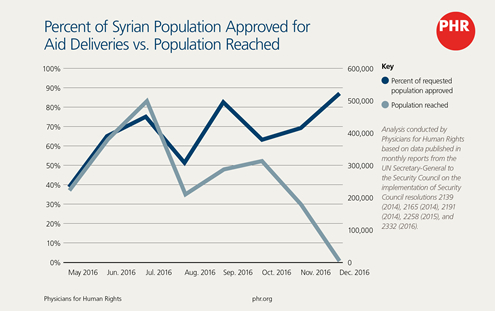
But, as we show in a new PHR report released this week, that aid delivery process has failed to guarantee help for civilians in need. Instead, it has provided a smokescreen for Syrian officials to deceive the world. The new process gives the government the ability to maintain the farce of approving deliveries and appearing cooperative, when, in reality, Syrian authorities later block approved deliveries or only allow insufficient amounts of aid to be delivered. By last December, just 6,000 Syrians received aid under the new delivery process – less than one percent of the population the UN was given permission to reach.

annual report graphic

“We now end up in this complete, hopeless bureaucratic quagmire of having to seek facilitation letters, permits, security permits,” Jan Egeland, the UN’s special advisor on Syria said in January. “The way it is now, it cannot continue.”

Yet it continues. The result is suffering and death. And, cruelly, the women and men positioned to help, to treat the many people exposed to this immense degradation – the doctors, nurses, medics, pediatricians, dentists, and pharmacists – have targets on their backs. Since 2011, 782 medical workers have been killed, more than 90 percent by Syrian government forces and their Russian allies. They have been tortured, kidnapped, shot, and shelled. Many have fled while others have stayed behind, placing the lives of their patients ahead of their own.

“The obstacles were everywhere,” Dr. Rami Kalazi, a neurosurgeon who worked in eastern Aleppo city until last summer. “Massive bombardment everywhere, direct targeting of health facilities, a huge shortage of medical equipment and supplies, especially modern diagnostic devices, a demand for ambulances, a huge lack of medicines, a huge gap in medical experts, very few well-equipped ICUs, few beds in ICUs and wards – besides the enormous number of casualties. Could you imagine the circumstances that physicians in Syria are working under?”

Dr. Rami

It’s impossible to imagine. And there are few answers beyond an insistence that all parties to the conflict in Syria end the sieges and halt attacks on hospitals and medical personnel. But the UN must also assert the authority granted under both international law and Security Council resolutions. It’s time to stop asking for permission to deliver aid. The UN’s humanitarian affairs arm should notify Syrian authorities of deliveries but not wait for approval, as it already does with cross-border aid deliveries.

Each time the Syrian government obfuscates, throws up hurdles, or strips aid from convoys, the UN must document these incidents and report them publicly in real time. The UN must speak out, unequivocally, against the Syrian government’s war crime of depriving civilians of food and medical care. In the meantime, those providing care must be protected.

“My duty as a physician and to humanity is to help prevent crimes against civilians,” said Dr. Mohammed, a surgeon from Aleppo who prefers not to use his real name. “If the world fails to protect doctors and civilians, such silence will affect the entire world. And such crimes will be repeated elsewhere.”

Report

Access Denied: UN Aid Deliveries to Syria’s Besieged and Hard-to-Reach Areas

As the conflict in Syria enters its seventh grueling year, Physicians for Human Rights calls attention to the Syrian government’s continued practice of deliberately and illegally manipulating UN humanitarian access to millions of people trapped in besieged and hard-to-reach areas of the country. By arbitrarily limiting, restricting, and denying aid deliveries, Syrian authorities are purposely subjecting vast numbers of civilians to profound suffering, and to slow, painful deaths by starvation and lack of medical care.

In the case of Madaya – where 40,000 residents have been trapped by government forces since July 2015 – deprivation of food, medical aid, and other vital necessities has resulted in widespread preventable deaths and needless suffering from untreated effects of malnutrition, chronic health conditions, infectious diseases, and traumatic injuries.

To end this misery, the Syrian government and all other parties to the conflict must lift all sieges and ensure that UN and nongovernmental humanitarian agencies can immediately carry out unhindered and sustained humanitarian aid deliveries to all in need through the most direct routes.

Other

PHR Appeals for Release of Imprisoned Iranian Doctor

PHR sent this letter to the Supreme Leader of Iran expressing our deep concern over the imprisonment of Dr. Ahmadreza Djalali on false charges.

March 1, 2017

Office of the Supreme Leader Ayatollah Sayed ‘Ali Khamenei
Islamic Republic Street
Tehran, Iran

Your Excellency,

I am writing on behalf of Physicians for Human Rights (PHR) with urgency and great concern for the health and welfare of a distinguished and respected medical doctor, Ahmadreza Djalali. Dr. Djalali is an Iranian citizen who resides in Sweden. He was arrested during his last visit to Tehran in April 2016 while attending workshops on disaster medicine to which he had been specificlly invited by the University of Tehran and Shiraz University. The 45-year-old expert in disaster and emergency medicine has been detained in Evin prison since that time without a formal charge or a fair trial.

Based on information PHR has received from credible sources, Dr. Djalali was taken before Branch 15 of the Revolutionary Court in Tehran on January 31, 2017, and, without his lawyer present, told by the presiding judge that he was accused of “espionage” and could face the death penalty.

In December 2016, Iranian authorities reportedly put Dr. Djalali under intense pressure to sign a statement “confessing” to be a spy for a “hostile government”. When he refused to sign, they indicated he would be charged with “enmity against God” (moharebeh), which carries the death penalty. In protest, Dr. Djalali began a hunger strike on December 26, 2016 and started refusing fluids on February 24. We are gravely concerned that his health has deteriorated since, putting his life at grave risk.

Dr. Djalali has taught in universities in Belgium, Italy, and Sweden. His many friends and colleagues have great admiration for his expertise, his teaching and mentoring abilities, and his important contributions to the field of humanitarian response to disasters. His colleagues indicate that they never knew him to speak critically of Iran or the Iranian government.

I respectfully implore you to ensure Dr. Djalali’s immediate release unless he is charged with a recognizable criminal offense, in line with international law and standards. We are concerned that he appears to have been targeted for peacefully exercising his rights to freedom of expression, association, and assembly. I also appeal to you to ensure that Dr. Djalali has access to a qualified health professional who can provide health care in compliance with medical ethics, including the principles of confidentiality, autonomy, and informed consent.

Pending Dr. Djalali’s release, it is critical that he be protected from any punishment for exercising his right to peacefully protest his imprisonment by deciding to take up a hunger strike, and that he not be subjected to prolonged solitary confinement, which may amount to torture.

PHR also notes that Dr. Djalali has the right under Iranian law to have the lawyer of his choice represent him. We strongly urge you to ensure he has access to his family, including communication with his wife in Sweden.

As the Persian New Year approaches, my colleagues and I ask you to honor the tradition of mercy and compassion at the time of Nowruz, and release Dr. Djalali from detention so that he can continue his humanitarian work and be reunited with his family.

Sincerely,

Kerry J. Sulkowicz, MD
Chair of the Board of Directors
Physicians for Human Rights

cc: Head of the Judiciary, Ayatollah Sadegh Larijani
President Hassan Rouhani

Blog

Trump’s Torture Stance Is Anti-American

President Donald J. Trump continues to insist torture “absolutely works,” a jagged departure from fact, law, and morality. Within days of his inauguration, the White House was already circulating a draft executive order to reopen CIA “black sites” and review currently approved interrogation practices, presumably with a view to fulfilling Trump’s campaign promises to bring back waterboarding and a “hell of a lot worse.”

Public outcry has forced the new administration to walk back some of the interrogation provisions, although it still calls for the continued use of the prison at Guantánamo Bay, Cuba. But one wonders where Trump gets his conviction about the supposed usefulness of torture in the first place – certainly not from his Secretary of Defense, CIA Director, or Attorney General, who have all rejected a U.S. return to torture. Indeed, the consensus of military, intelligence, and foreign policy experts is that torture does not provide anything close to accurate intelligence, and, in fact, harms national security.

More to the point, torture is anathema to civilized nations, and it is absolutely prohibited under U.S. and international law, without exception. The question of whether or not torture “works” is a misdirection, as if it could somehow be justified if it were shown to be effective. It cannot, and the question itself is an exercise in moral disengagement. It overlooks the fact that torture is antithetical to the United States’ values and identity.

The country’s first president and the drafters of the U.S. Constitution championed basic principles of human dignity and prohibited the infliction of cruel and unusual punishments. Centuries later, President Ronald Reagan reinforced this commitment when he signed the UN Convention against Torture in 1988.

Trump’s position on torture is fundamentally ahistorical – he fails to recognize that torture has been condemned throughout history because of its moral and legal futility. The Unites States’ leaders have forbidden the use of torture since its earliest days because it puts Americans in harm’s way. Any normalization of torture by the current U.S. leadership will put the country on par with enemies that have no moral center; if Trump allows torture, the United States becomes the very evil it purports to be fighting.

The Bush administration’s decision to use torture as a weapon of war after 9/11, in contravention of American laws, values, and military doctrine, has been deeply damaging to democracy and to the country’s reputation as a nation built on law. And while President Obama rightfully ended the CIA program and Congress enacted laws to reinforce the ban on torture, no one who carried it out has been held to account. And Guantánamo – a site and symbol of U.S. torture – remains open.

So it should come as no surprise that torture advocates, who have never had the law or facts on their side, recognize the current moment as an opportunity. Perhaps if President Trump read the Senate torture report or listened to his national security advisors, he would have a better understanding of why the United States cannot be a nation that tortures. Torture has always been and always will be illegal, immoral, and counterproductive. Executive orders, and even tweaks to federal law, do not change this fact.

As we at Physicians for Human Rights have shown time and time again, all forms of torture inflict severe and lasting physical and psychological harm. This damage is not limited to victims; it extends to perpetrators as well. As the global standard for torture investigations, the Istanbul Protocol, states: “Torture is a profound concern of the world community. Its purpose is to destroy deliberately not only the physical and emotional well-being of individuals but also, in some instances, the dignity and will of entire communities.”

The United States’ repudiation of torture is one of the most important ways the country has historically distinguished itself from its enemies. Yet President Trump would like the American public to believe that torture is suddenly a policy option, a justifiable tool for intelligence, or a valid weapon of war. He is mistaken. And if we start debating torture’s effectiveness, we’ve ceded the accepted convention that, first and foremost, it is harmful and wrong.

Get Updates from PHR