
Blog

A New Low: Stealing Family Heirlooms in Exchange for Protection

This post originally appeared in The Huffington Post.

The refugee crisis in Europe has shown the very real limits to the social coherence and solidarity that seemed to form the basis for the European Union until now. But even within the climate of hostility against asylum seekers in Europe, Denmark stands apart as one of the worst aggressors.

First, the Danish government took out advertisements in Lebanese newspapers stating that it had cut social benefits to refugees by almost 50 percent, and that family reunification would be out of the question for now.

Then, the government announced it would go back on its (measly) promise to resettle 1,000 refugees, and declared plans to further cut funding for refugee integration, criminally charge asylum seekers for asserting their protection needs, and increase criminal charges for begging.

Included in these proposals–many of which have been adopted–is a provision allowing authorities to confiscate asylum seekers’ jewelry (exempting engagement and wedding rings and watches) to offset the cost of providing them shelter. This proposal appears to still be under discussion.

From the international legal perspective, these measures place Denmark in breach of its obligations to shelter and provide for those in need. The 1951 Refugee Convention gives anyone who manifestly fears for his or her safety at home the right to seek protection elsewhere. It also prohibits safe countries, such as Denmark, from returning refugees to a place where they might be tortured, targeted for killing, or put through something even worse. Physicians for Human Rights has an intimate understanding of the situations the majority of refugees in Europe are fleeing in Syria, Afghanistan, and elsewhere. Without belaboring the point, let’s just say these countries are far less than safe.

Denmark’s new provisions also appear to violate the rights to integrity, dignity, and personal property, all enshrined in the Danish Constitution — though in a country where political leaders have protested the obligation to provide shelter even for the stateless, the existence of legal imperatives may not be much of a deterrent to this kind of callous policy-making.

In fact, the public debate in Denmark is more focused on how the country is being invaded by undeserving “migrants” looking for an easy life than about the security crises that are causing people to flee in the first place. Despite the fact that news media report daily on the conflicts and collapse of the rule of law in Afghanistan, Iraq, Libya, and Syria — just to mention a few — the thousands who flee are somehow still seen as resource-poor individuals trying to move their families to a place with better social benefits.

This conflation of migration and refugee flows is common. Most mainstream media, in Europe and around the world, continue to refer to the people flooding into Europe as “migrants,” despite ample evidence to the contrary. In an October New York Times article about a four-year-old boy who had been abducted from a refugee camp, and subsequently found dead, the problem was summarized as one related to “migrant children.” Yet, a child abducted from a refugee camp might reasonably be assumed to be, well, a refugee.

And then there is the puzzling notion, propagated in online commentary and punditry, that refugees in Europe already have money and should not be entitled to social assistance in Europe. It is certainly true that compared to the millions who can’t afford to leave, the hundreds of thousands of people who make it to Europe probably were the wealthier ones in their country of origin. But rather than proving refugees in Europe to be mercenary, this information does just the opposite: when the need to leave is shared by everyone, not just the poor, you know a country is unsafe.

Of course, Denmark is not alone in its active discouragement of asylum seekers. This summer, Hungary constructed a razor wire fence on its border with Serbia to deter refugees from passing through the country. Slovenia threatened to do the same, but settled on daily quotas for entry instead. However, in early November, Slovenian television reported that the government had purchased a border fence. And in November, the European Union agreed to pay Türkiye €3 billion for assistance in returning refugees to Syria at the Türkiye-Syrian border.

To be sure, some European governments — notably Germany and Sweden – have declared a willingness to welcome a larger number of refugees. This is laudable and should serve as inspiration for better policies everywhere. Instead, however, the initiatives and openness of these governments are being undermined by the institutionalized inhumanity displayed by their neighbors. Indeed, the toxicity with which many European governments are treating asylum seekers challenges the very idea the European Union was set up to protect: that everyone is better off when inequalities are less pronounced.

This latest Danish bill which would to strip asylum seekers of the last thing that reminds them of the home they would prefer not to have left in the first place — their grandmother’s necklace, a friendship ring reminding them of happier times — is not only illegal, it is inhumane. I have never been more ashamed to be Danish.

Editor’s Note: This article has been updated to reflect the status of the proposed provision regarding confiscation of valuables.

Blog

A Grave on the Road to Justice in Rwanda

A generation has grown up without knowing about the genocide in Rwanda. The killing fields there are now recorded in history books, and college students sometimes stare blankly when told that in the space of three months in 1994, almost a million people in this small east African country were slaughtered by their fellow citizens in a frenzy of politically-motivated mass killing. The fact that the world failed to stop this mass atrocity weighs heavily on the many of us who were active in human rights during that decade.

As the International Criminal Tribunal for Rwanda (ICTR) wraps up its dockets in Arusha, Tanzania on December 14 and hands over cases to other processes, we reflect on landmark “firsts” accomplished by the tribunal: the first international prosecution for the crime of genocide, and the first conviction for rape and sexual violence as forms of genocide.

For our team of forensic scientists at Physicians for Human Rights (PHR), providing physical evidence to the Rwanda tribunal also meant firsts: opening the largest single grave ever exhumed to date for forensic purposes; deploying experts from more than a dozen countries to conduct the investigation; and experiencing the pathos of watching exhumed bodies receive blessings in a church before laying them out for forensic evaluation on benches built for prayer.

There were hundreds of potential sites and graves to investigate in Rwanda, but the PHR team, under the leadership of senior forensic advisor Dr. William Haglund, was directed to a mass grave near the Roman Catholic Church and Home St. Jean in the parish of Kibuye, above Lake Kivu in the northwest of the country. The killings here were investigated in connection with the indictment of the parish’s former prefect, Clemont Kayishema, a trained medical doctor whom the tribunal would eventually sentence to life in prison for the crime of genocide.

Kibuye Grave in Rwanda
Archaeologists map and unearth the Kibuye mass grave.

Dozens of mass graves were located near churches, because Tutsi villagers fleeing slaughter by Hutus often found sanctuary in churches and stadiums. The one examined by the PHR team had been dug by a resident who returned to the town after the killings: “With the aid of a Chinese bulldozer from a road-building project, and assisted by prisoners from the local prison, he had a grave dug behind the church and they pitched bodies into it for three days straight,” said Haglund.

PHR experts mapped the landscape, buildings, and rooms. They used forensic photography and meticulously documented and collected skeletons scattered over the landscape. Ultimately, the forensic team uncovered and examined the remains of more than 450 people. Many of the bodies were not yet skeletons; 70 percent were women and children. Nearly 140 were the bodies of children and infants. Members of the forensic team soberly referred to certain areas of the grave as “nurseries.” Unearthing the tiny bodies of babies swaddled onto their mothers’ backs was gut-wrenching to the team.

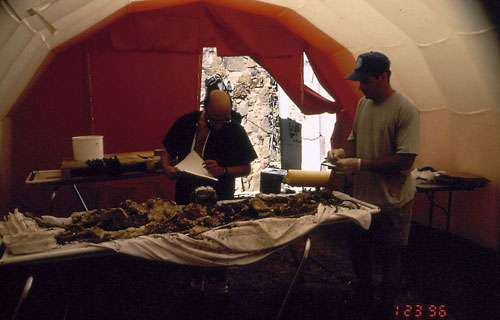
Pathologists and autopsy assistants arrived to determine the cause and manner of death. Even these medical doctors, accustomed to documenting death by violence, were overwhelmed by the proof of human cruelty before them.

Pathologists at Kibuye Grave
Pathologists work to determine cause and manner of death in autopsy tent at Kibuye grave.

The evidence for the tribunal was stark: machete wounds to the back of the neck, legs, and heels, and, most powerfully, the sheer percentage of women and children – who most certainly could not have been combatants, as claimed by the accused. With no available medical records of the victims, and lacking survivors for DNA collection, identification of the remains was not even contemplated.

All those who participated in this excruciating scientific undertaking in the service of justice came away changed. They knew they had participated in an historic project for forensic science and for the international rule of law. Most reported to us that their work on the Kibuye grave was a defining moment of their professional careers.

But they also left Rwanda with the burden of work left undone: the dozens of unexamined graves, and the inability of survivors to retrieve loved ones or bury their remains with dignity. Our experts were also sobered by the contrast between the scarce resources in Rwanda and the vast sums spent in their own countries on a single homicide investigation.

As the wheels of justice continued to grind at the ICTR, Rwanda also pursued its own methods of traditional justice and reconciliation, in attempts to patch together a nation ripped apart by demagoguery, ethnic animosities, and extreme violence. Sadly, impunity is still the norm in the Great Lakes region of Africa, as lawlessness, corruption, and mass atrocities continue to threaten Rwanda’s neighbors in Burundi and the Democratic Republic of the Congo, in particular.

During 21 years and 5,800 days of proceedings, the ICTR brought indictments against those most responsible for the Rwanda genocide: the tribunal indicted 93 individuals, arrested 83 of them and heard the testimonies of more than 3,000 witnesses. While imperfect, the court has set important precedents in the prosecution of war crimes, crimes against humanity, and genocide.

The International Criminal Court was created after the ICTR and the other ad hoc tribunals, with the purpose of addressing mass crimes globally. As that court in The Hague struggles to fulfill its overwhelming mission and justice eludes victims from Syria to Sri Lanka, we must hope that lessons learned from Rwanda can serve as an example of what can be done to deliver justice for mass crimes committed in Africa and around the world.

Blog

The Shamefully Unfinished Story of the CIA Torture Program

This post originally appeared on the ACLU’s Speak Freely blog.

One year ago, the Senate Intelligence Committee released part of its massive report documenting the brutality and lawlessness of the CIA torture program. It exposed the Bush administration’s legal sleight of hand to justify the illegal detention and torture of terror suspects after 9/11. It also exposed the deep complicity of health professionals in this program, despite their ethical duty to “do no harm.”

Yet 12 months later, those who designed, ordered, and carried out this deliberate and systematic effort to destroy human beings remain – shamefully – unaccountable for their crimes. It’s time for that to change. In a report released today, Physicians for Human Rights demands that the torturers be charged, the investigation into their crimes fully disclosed, and redress and reparations brought to their victims.

The sordid story of the U.S. torture program began in the wake of the 9/11 attacks. Under the guise of national security, the government decided that international humanitarian laws and our own strictures against the use of torture did not apply, and the Bush administration turned to military psychologists James Mitchell and Bruce Jessen to develop an interrogation program based on the exploitation and abuse of CIA captives.

Mitchell and Jessen proposed that they could break down detainees so completely through mental and physical cruelty that they would become incapable of resisting interrogators. Human beings need a sense of control over their own bodies and minds and a sense of order or certainty in their lives. Mitchell and Jessen designed techniques calculated to destroy both of these things.

Many have chosen to focus on the graphic details in the Senate torture report and whether they were “authorized.” Yet “authorization” of torture cannot make it lawful. What’s more, a focus on individual techniques risks distracting us from the larger reality: The methodology that Mitchell and Jessen designed went beyond a set of techniques. Complete psychological destruction was the goal, and prolonged isolation, sleep deprivation, sensory deprivation and overload, forced nudity and sexual humiliation, and waterboarding were means to this end.

Harm was consciously embedded in the design and execution of the CIA program, and Mitchell, Jessen, and the other health professionals who participated in this regime betrayed their professional ethics and surrendered their humanity. All health professionals, including mental health specialists, have an ethical duty to do no harm; by their flagrant violation of this fundamental tenet, those who took part in the CIA’s torture program deeply compromised their integrity.

Torture is unequivocally forbidden under U.S. and international law, and all states have an obligation to investigate and prosecute those who commit this crime. Yet the U.S. government’s continued failure to end the impunity it granted to those who ordered, designed, and operationalized the torture program sends a message that torture is not just permitted in certain circumstances — it is actively encouraged. In fact, the CIA paid Mitchell and Jessen millions for their work designing the torture program: $1 million each, $81 million to their consulting company, and, most tellingly, a legal indemnification agreement worth $5 million.

In September, the ACLU filed a civil suit against Mitchell and Jessen on behalf of three detainees who were subjected to their torture methods. The case is a crucial step in bringing to light much that remains shrouded in secrecy in the name of national security. But civil litigation can never replace full accountability or provide full redress for the victims.

Torture degrades us all. Torture inflicts profound, sometimes irreparable harm to the victims, their families, and communities. It degrades the perpetrators and debases the professionals that participate in or fail to stop the abuses. And it corrupts democratic institutions and processes by destroying confidence in the justice system.

Torture is a universally prohibited crime – one so fundamentally incompatible with the rule of law that inaction is simply not an option. Accountability is critical to obtain justice for the victims, to restore trust in the rule of law, and to pursue a mechanism of prevention so that these human rights violations are not repeated.

Report

Truth Matters: Accountability for CIA Psychological Torture

On December 9, 2014, the U.S. Senate Select Committee on Intelligence released the executive summary, findings, and conclusions of its 6,700-page report on the CIA’s post-9/11 torture program. The Senate torture report documents the abuses that followed the development of a comprehensive program of detainee torture by CIA personnel with the help of psychologists James Mitchell and Bruce Jessen. As the Senate torture report reveals, the operational goal of Mitchell and Jessen was to destroy human beings using methods and practices long recognized and clearly manifest as torture.

One year later, transparency and accountability – let alone redress to victims – remain stalled. Torture is absolutely prohibited under U.S. and international law, and the United States’ failure to reject impunity has come at a very high cost. CIA torture has damaged the lives of its victims, the integrity of health professionals who were complicit in these crimes, the integrity of democratic institutions, and hard-worn norms prohibiting torture and other cruel, inhuman, or degrading treatment or punishment.

The United States has an obligation under international law to conduct speedy, transparent investigations into allegations of torture in CIA detention centers, and, where evidence is found amounting to individual criminal responsibility, to prosecute alleged perpetrators in a court meeting international fair trial standards. It is crucial to ensure that those heading the chain of command responsible for authorizing torture are held to account.

The U.S. government must end the cover-up of torture and ill-treatment, and honor its obligation to investigate and prosecute those responsible. Read our briefing paper and recommendations calling for accountability here.

Report

Enhancing a Regional Response to Crimes of Sexual Violence

Regional Roundtable Discussion Summary

Read the report

Lisez le rapport en français

The Program on Sexual Violence in Conflict Zones at Physicians for Human Rights (PHR) convened a three-day regional roundtable discussion between February 25 and 27, 2015 at the Lukenya Getaway in Athi River, Kenya. This report provides a summary of the discussions that took place during the roundtable (without attribution to specific participants) in order to capitalize on the ideas and lessons learned from stakeholders in the Democratic Republic of the Congo (DRC) and Kenya who are so actively engaged with efforts to end impunity for sexual violence in their respective communities, as well as with PHR’s training and advocacy program.

The purpose of the gathering was to bring together colleagues from the medical, law enforcement, and legal communities in the DRC and Kenya who partner with our program. This was the first such regional gathering to take place in East Africa to bring together these professionals, including doctors, nurses, police officers, lawyers, magistrates, judges, government officials, civil society activists, journalists, academics, and sexual violence survivors.

During the roundtable, participants exchanged ideas in a series of interactive plenary sessions and smaller working groups to share, brainstorm on, and problem-solve the challenges of supporting survivors of sexual violence, and to plan for a regional response to improve ways to prosecute and hold accountable those who commit these crimes.

Blog

Courageous Refugees, Cowardly Politicians

This post originally appeared in The Huffington Post.

I came to Europe this week to bear witness to the overwhelming numbers of children, women, and men searching for safety and a future far from the bombs that have devastated their homes in Syria. I joined the Nobel Women’s Initiative to meet with some of these courageous refugees and listened to their stories about why they undertook treacherous journeys to leave the country they love.

Little did we know that the shocking events in Paris and the subsequent rash of shameful responses would make our trip even more pressing. This is especially true back in my home country and native state of New Jersey, where Governor Chris Christie has said his state would not even admit a “5-year-old orphan” from Syria. These positions are known to many of the refugees I met far from the shores of the United States. I can’t explain such utter ignorance, but I tell them that these politicians don’t represent my values or those of many other Americans. I realize these words offer little comfort to offset the pain inflicted by vicious hate speech.

In the Serbian, Croatian, and Slovenian transit camps we visited, thousands of desperate families huddle while they hope for an end to their harrowing escape from the Syrian government’s barrel bombs and brutalities by the Islamic State (IS). I am horrified and ashamed to learn that seemingly overnight, a number of U.S. politicians are turning their backs on Syrian refugees. So far, about 30 governors and some members of U.S. Congress have asserted that Syrian refugees are not welcome. Even worse, some have disgracefully argued that we should apply religious tests to refugees seeking safety in the United States.

But from here it is clear that we must urgently increase, not decrease, refugee resettlement. At a time when these courageous individuals need the world’s protection the most, many politicians are using the Paris attacks for political gain, introducing hateful policies they don’t even have the authority to implement.

The attacks in Paris were horrific, and were clearly meant to terrify innocent civilians. Fear has unfortunately become the norm for most civilians in Syria, where President Bashar al-Assad’s bombs have been raining down on their neighborhoods, ambulances, and hospitals for the last four and a half years. Despite all this, they have been rebuilding their hospitals and schools, they do their best to protect themselves from shelling by their own government, and try to resume life with some kind of normalcy.

Since early 2011, Physicians for Human Rights (PHR) has been documenting war crimes in Syria, including atrocities against hospitals and health professionals, the vast majority of which are being carried out by the Assad government. By the end of October of this year, there had been 329 attacks on health facilities in Syria and 687 health professionals had been killed – some by bombs that targeted their hospitals and ambulances, some shot to death. More than 157 were executed or tortured to death. In eastern Aleppo city alone, 95 percent of the doctors have fled, been detained, or killed. Just as with all terror campaigns, these shocking attacks target civilians in an overwhelming show of force and brutality. It is this relentless, systematic violence that is driving entire families to make the dangerous trip to Europe, forcing many to risk drowning.

What the Assad government is doing against its own people constitutes war crimes and crimes against humanity. Rather than providing a safe haven for those fleeing unbearable circumstances and bringing the perpetrators to justice, many politicians are fanning the flames of racist ideology.

The refugee crisis in Europe is driven by two elements: the unimaginable brutality of Assad’s regime and IS, and the failure of most governments to provide refugees with safe passage and a home. By forcing desperate people onto the so-called “migrant trail,” where they make dangerous crossings by sea, face gross exploitation by smugglers, and travel on foot through fields and cities seeking safety, we leave refugees at risk of death, illness, and violence. We help foster chaos and uncertainty instead of security and freedom.

We know that refugee processing is already one of the most arduous means of entry into the United States. There is no need for additional study or investigation of Syrian refugees, and claims to the contrary are meant to cause needless delay and obfuscation. What is required is a show of compassion and understanding, especially from a country of immigrants.

During my travels, I saw extraordinary examples of leadership among politicians and civil society. Despite being unprepared for the sudden surge of refugees flooding their borders, some governments – at least at the moment – are keeping their borders open, while scores of volunteers distribute donated food and basic supplies, and NGOs work around-the-clock to provide critical services.

Mean-spirited threats to bar Syrian refugees or Syrian Muslims from entering the United States are not only shameful, but ill-informed and damaging, and pander to the worst elements of American politics. True leaders do not take part in dangerous incitement and discrimination, but speak up against it and take steps to stop it.

Photo Credit: Igor Pavicevic for Nobel Women’s Initiative

Blog

Glass Half Full in Myanmar

Last Sunday evening, I was in midtown Yangon, outside the headquarters of Nobel Peace Prize winner Aung San Suu Kyi’s political party, the National League for Democracy (NLD). I was at a rally with 5,000 other people watching counts from Myanmar’s election announced on a big screen TV. Families, teenagers, elderly people, and groups who would have been afraid to participate in such a rally a few years ago, were there, waving flags, singing NLD songs and cheering wildly as precinct after precinct went to candidates from NLD. It was apparent early on that NLD was sweeping the election, and today the landslide is official.

Having documented ongoing human rights abuses in Myanmar (also known as Burma) for the last five years, I tend to be cynical about change in the country. I have a “glass half empty” attitude, wary of positive spins on democracy and progress touted by individuals, investors, and governments whose top priorities don’t necessarily include human rights. My work regularly brings me to groups and individuals suffering under severe and often overlooked human rights abuses in the country. But Sunday night, amidst the crowd of regular Burmese people openly excited for their future, I forgot my cynicism and had an honest feeling that the glass was half full.

Four days later, writing in the less festive environment of a Yangon tea shop, I still feel that the glass is half full. But only half.

The NLD victory and the fact that the military has not intervened (as it did in the 1990 vote) is surely a positive sign, but in a lot of ways the hardest work remains to be done. The Myanmar constitution ensures that, no matter which political party controls the government, the military still has ultimate power. This is problematic not only for democracy, but also because the military is the perpetrator of so many human rights violations in the country – and these violations will likely continue despite an NLD-led government. For example, in the last five years Physicians for Human Rights (PHR) has documented forced labor in Karen state, torture and extrajudicial killing in Kachin state, and government forces that stood idly by while nationalist extremists slaughtered Muslims and burned their homes in Rakhine state and massacred schoolchildren in central Myanmar – events which resulted in over 100,000 displaced persons.

Today, fighting continues in Kachin and northern Shan states. On election day, the military shot and killed two civilians in Shan state. The election euphoria was clearly absent in the Kachin capital city Myitkyina, where people are more concerned about peace than politics. If the elected government cannot control the military then these violations will not stop.

The military, government ministries it controls, and businesses working with it are major drivers of land confiscation. PHR estimates that at least 100,000 people have lost their land to dams, special economic zones, and agricultural and other development projects since the dictatorship ended in 2011. These land confiscations are driving people into poverty.

Buddhist nationalism also remains a major threat to human rights, and one that the NLD has been reluctant to address. No Muslims were elected to Parliament, in part because most were banned from running by the Union Election Commission, but also because a lot of parties including the NLD refused to let Muslim party members run. This disenfranchisement is particularly acute in Rakhine state, where over a million Rohingya were banned from voting and Rohingya members of Parliament were forbidden from running for re-election. Nationalism enables systematic abuses of the Rohingya and is driving flight and trafficking.

Given the long list of ongoing human rights abuses, it is easy to be pessimistic about Myanmar’s future; but here’s why I think the glass is half full.

Even if the NLD is ushered into a non-democratic government structure in which the military remains dominant, the most recent election resulted in widespread popular engagement in politics. The space to discuss these issues, as well as to engage the government on a few types of human rights abuses, is slowly expanding.

PHR’s partners have engaged government agencies on land confiscation issues to attempt to get fair compensation for displaced persons. We are not yet close to calling this a victory, but at least we are able to sit at the table and discuss the issue with the government. A poll of political parties suggests that land confiscations are the issue that parties are most concerned about. The current Parliament opened a committee to investigate land taken from farmers. Although it has limited powers, it seems to be a small step toward justice for affected people. Civil society groups have engaged the government on LGBTI rights, and the government has had limited talks with ethnic armed groups on how best to deliver health care and education. None of these things would have been possible five years ago, and I feel that it represents the very beginning of engaging the Myanmar government in a human rights dialogue.

The moral arc of Myanmar might be starting to bend toward justice. But the momentum is just starting. We need to continue to document abuses and engage the government, and use this opportunity to bring rights dialogue into the mainstream in the country. This means continuing to support civil society organizations to document abuses and their impacts on people, and then push the government to remedy them. The human rights abuses that have defined the old Burma will not stop with the election of the NLD. But we now have more opportunity to engage the government to develop a culture of human rights in Myanmar.

Report

Annual Report 2015

The Physicians for Human Rights (PHR) 2015 Annual Report provides a comprehensive overview of our work between July 2014 and June 2015 (PHR’s fiscal year).

Working with medical and scientific evidence and courageous human rights defenders around the world, PHR in 2015 fought to end torture by the U.S. government, launched our Forensic Training Institute, and trained an international cohort of doctors, nurses, lawyers, police officers, and judges to document and prosecute cases of sexual violence. Together with our volunteers and partners, we supported thousands of asylum-seekers, survivors of rape in war, and persecuted medical professionals, and stood with a U.S. Navy nurse who refused to force-feed Guantánamo detainees. Our globally-respected Syria Mapping Project produced irrefutable evidence of the Syrian government’s relentless destruction of Syria’s medical system. With our world-class investigators, profound commitment to justice, and belief that scientists and medical personnel can uniquely contribute to the defense of human rights, PHR works to end torture and ill-treatment, protect medical workers, secure justice for victims, and ensure that those who violate human rights are held accountable.

Report

Aleppo Abandoned

A Case Study on Health Care in Syria

The Syrian government’s ongoing assault on health care is one of the most egregious the world has ever seen. PHR has documented the deaths of 687 medical personnel and 329 attacks on medical facilities from the beginning of the conflict through October 2015.

This report focuses specifically on the state of health care in eastern Aleppo city – the city hit hardest by such attacks – and tells a story of courage and resilience in the face of tremendous human suffering and loss. PHR’s findings illustrate that unlawful attacks on health have significantly degraded Aleppo’s health care system; more than two-thirds of the hospitals no longer function and roughly 95 percent of doctors have fled, been detained, or killed. However, the remaining medical personnel have persevered and manage to provide health care in the midst of a horrific war, despite minimal access to equipment and medication.

This report also points to the failure of the international community to stop these violations. The UN Security Council has failed to do its duty for more than four years, and, as a result, hundreds of Syrian medical personnel and thousands of their patients have lost their lives. Health workers in Aleppo understand the UN Security Council’s failure all too well. They live with the reality of disappeared colleagues and hospital attacks every day. Yet they have not given up hope, and they continue to ask for one simple thing: an end to the attacks on hospitals, medical personnel, patients, and civilians.

PHR chose Aleppo as a case study because it illustrates what a dedicated and resilient medical community can achieve in some of the worst circumstances. The story of Aleppo exemplifies the ingenuity and resolve of the many Syrians who have chosen to stand up for human rights and international law rather than surrender to tyranny.

Get Updates from PHR