
Statements

The Crisis in Syria Turns Four

Civil Society Organizations Call for Renewed Push on Restraint of Security Council Veto Use

Ahead of the four-year anniversary of the crisis in Syria, Physicians for Human Rights and partner organizations call on permanent members of the UN Security Council to refrain from using their veto power when confronted with a crisis in which civilians are at impending risk of atrocity crimes. Despite displaying fleeting unity on resolutions on the removal of chemical weapons and the delivery of humanitarian aid, the four vetoes cast by Russia and China on most Security Council resolutions pertaining to Syria point to that body’s powerlessness to uphold their Responsibility to Protect when the veto is used. Such blatant inaction by the UN organ chiefly responsible for maintaining international peace and security has exacted catastrophic consequences on the people of Syria by delaying and hindering early and subsequent international action.

A refusal by the Permanent Members to use their veto when the Security Council is facing the most daunting of challenges—that of responding to mass atrocities—would mark a historic step for the Council, both in terms of upholding its Responsibility to Protect and in preserving its legitimacy as the primary organ responsible for maintaining international peace and security. Read the full statement here.
Report

Doctors in the Crosshairs: Four Years of Attacks on Health Care in Syria

The consequences of the international community’s failure to protect Syrians from systematic and repeated violations of both human rights and humanitarian law have been devastating. Yet, one in particular stands out: the erosion of the long-established principle that neither militaries nor armed groups can target medical workers and the health care system for attacks.

Since 2011, the Syrian government has systematically violated this principle and is using attacks on medical workers and facilities as a weapon of war. It began when the government interfered with and compromised health care services by arresting injured protesters in emergency rooms, but quickly escalated into bombing hospitals in opposition-held areas and detaining, torturing, and executing doctors who were adhering to medical ethics by treating the wounded regardless of their political beliefs. The doctors who have risked their lives to remain in Syria and treat the injured have been decimated by Bashar al-Assad’s forces, which consider it a crime punishable by death to provide medical treatment to “the other side.”

As we approach the fifth year of the conflict, at least 610 medical personnel have been killed, and there have been 233 deliberate or indiscriminate attacks on 183 medical facilities. The Syrian government is responsible for 88 percent of the recorded hospital attacks and 97 percent of medical personnel killings, with 139 deaths directly attributed to torture or execution.

These numbers are conservative given difficulties in reporting during a war. But one thing is certain, these attacks are deliberate and have a cascading effect on the health of Syrians.

Blog

Overcoming Obstacles to Prosecuting Rape in Kenya and the DRC

This past week, Physicians for Human Rights (PHR) wrapped up a three-day roundtable discussion in Nairobi, Kenya, where we brought together 45 of our colleagues from both the Democratic Republic of the Congo (DRC) and Kenya to discuss successes, challenges, and new opportunities created by our innovative Program on Sexual Violence in Conflict Zones. Among the attendees were leading doctors and nurses with expertise in conducting forensic examinations of rape victims, distinguished judges, police officers who specialize in sexual violence investigations, lawyers and advocates who support victims through court proceedings, and survivors who have become advocates.

When PHR began this program four years ago, we were responding to a critical gap in access to justice for survivors of sexual violence – particularly in places where mass atrocities or war crimes were being committed. We recognized a need for a link between the medical response of treating survivors and the legal response of prosecuting perpetrators.

For almost 30 years, PHR has used its expertise in forensic medicine and science to support prosecutions of the most serious crimes. We do this work out of a deep conviction that as long as there is impunity, these crimes will continue and proliferate; out of a commitment to the rule of law; and because we understand that achieving justice is a significant part of healing and recovery, for both individual victims and society.

We are all too aware that prosecutions for the crime of rape – everywhere in the world – are among the most difficult, if not the most difficult, cases. While our colleagues in Kenya and the DRC have remained dedicated to ending widespread impunity for rape, they struggle with how to appropriately bring about justice for victims.

PHR’s program has developed and expanded beyond our early vision and is succeeding in creating a new model for collaboration among doctors, nurses, social workers, police officers, lawyers, and judges. We have developed a collaborative and interactive training curriculum, stimulated critical connections between professionals at the local level, supported the creation of standardized and more effective medical evidence forms, provided technical assistance and equipment to rapid response teams, trained hundreds of specialists, and developed mentoring relationships.

However, our goal is an ambitious one, and we face numerous challenges every day: survivors are often unable to reach medical and legal assistance in a timely manner; equipment for care and for conducting investigations is lacking; too many victims cannot afford their legal or medical fees; there are not enough professionals who are properly trained in conducting forensic exams or carrying out comprehensive criminal investigations; and too many prosecutions are halted, even when evidence is collected and submitted to the judicial system. Within our own network, doctors and lawyers have also received threats as they pursue prosecutions and speak out against these atrocities.

During the roundtable, our dedicated colleagues demonstrated a passion for improving their work and overcoming such obstacles. As the discussions went on, I realized that a key reason for our program’s success so far is our model of local, cross-sectoral collaboration, which enables us to break down the barriers that prevent accountability, including the hurdles survivors face in accessing the legal system; the disconnect between doctors and police, and doctors and lawyers – all of whom normally operate in silos and use different languages in their work; and the obstacles between urban and rural areas, public and private sector institutions, and between men and women.

The roundtable discussions demonstrated that our colleagues in Kenya and the DRC face similar hurdles and that by working together, they can implement creative solutions in order to successfully prosecute rape – and other countries can learn from their model.

In the next few years – with commitment, hard work, courage, and strong communication across these burgeoning networks – we can make a lasting impact in the long struggle for justice in the face of the most brutal assaults on human rights and dignity.

Other

Syria's Medical Community Under Assault

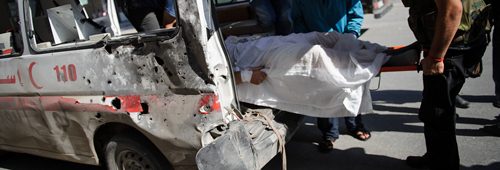
Damaged Ambulance in Syria

Latest Fact Sheet as of February 2015

This fact sheet illustrates the destruction of medical facilities, loss of medical personnel, and resulting health consequences, since the war began in Syria in 2011.

Latest Facts and Statistics

  • Approximately 212,000 people remain in besieged areas, 185,500 of whom are besieged by government forces.
    • In December, food was delivered to only 1.2 percent of the besieged population (2,544 people), while non-food items reached 1.2 percent (2,540 people) and medicines 0.6 percent (1,280 people).
    • An escalation in armed violence in and around Yarmouk camp has prevented UNRWA from successfully completing a distribution of life-saving humanitarian aid for the 18,000 besieged civilians since December 6, 2014.
  • Access to medical supplies and equipment continues to be restricted by insecurity and constraints imposed on humanitarian operations by parties to the conflict.
    • On December 11, the WHO delivered medical supplies and medication to opposition-controlled Madaya, however Syrian government officials prohibited the delivery of desperately needed injectable medicines and surgical supplies.
    • On January 1, the Syrian Arab Red Crescent delivered polio vaccinations and insulin to besieged, opposition-controlled Douma. Other medication, including injectable medicines and surgical supplies for 17,950 treatments, were denied.
  • Physicians working in opposition-controlled areas often cite fuel as their number one need. After the U.S.-led coalition started its bombing campaign in eastern Syria and targeted oil refineries run by the self-declared Islamic State (IS), the price of oil increased significantly, placing further strain on hospitals.
  • In January, IS closed the Syrian Arab Red Crescent office in Raqqa, along with offices of several other small local charities, and appropriated its warehouse and equipment.

Previous Versions
Fact Sheet as of October 2014
Fact Sheet as of July 2014
Fact Sheet as of May 2014
Fact Sheet as of March 2014
Fact Sheet as of January 2014

Other

Letter to President Obama on Rejecting Request to Return CIA Torture Report

The new chairman of the Senate Select Committee on Intelligence, Richard Burr, requested that the executive branch return all copies of the CIA torture report to the committee. Physicians for Human Rights (PHR) and partner organizations sent this letter to President Obama urging him to reject Senator Burr’s request. We called on the president to direct all relevant agencies and departments in his administration to review the full report and adopt internal reforms to eradicate torture and cruel treatment from official U.S. policy. The full letter can be found here.

Blog

Closing Guantánamo Is Imperative, But Not Enough

During President Barack Obama’s State of the Union address on Tuesday, he reaffirmed his commitment to closing the notorious prison at Guantánamo Bay:

Since I’ve been president, we’ve worked responsibly to cut the population of Gitmo in half. Now it is time to finish the job, and I will not relent in my determination to shut it down. It is not who we are. It’s time to close Gitmo.

President Obama has repeated this promise many times, but it is worth reflecting on the progress made so far. Six years ago, on his second day in office, he signed an executive order to resolve the status of all 242 Guantánamo detainees and to promptly close the prison. Currently, Guantánamo’s population stands at 122 detainees, its lowest level since the prison first opened in January 2002. Some 40 men have been transferred in the last 18 months, half of these occurred in December 2013 and January 2014 alone.

The improved pace of transfers is encouraging and must continue. Of the 122 remaining men, 54 are approved for release, meaning that the relevant national security agencies (Department of Defense, Office of the Director of National Intelligence, Central Intelligence Agency, Joint Chiefs of Staff, Department of Homeland Security, Department of Justice, and Department of State) have unanimously agreed that the detainees pose no security risk justifying their continued detention. Another 10 detainees are being or have been prosecuted, while the remaining 58 men are eligible for further review.

This means that most of the men still at Guantánamo will never be charged with a crime, despite having been there for a decade or longer. Closing the prison is therefore critical to ensuring that the United States complies with its obligations under international human rights law, as well as its longstanding commitment to justice. But this is only part of the solution. The underlying problems of indefinite detention and abusive treatment of prisoners will persist if the remaining detainees are simply transferred to federal “supermax” prisons – where solitary confinement and other inhumane practices are routine.

The medical literature provides compelling evidence that even brief periods in solitary confinement have severe psychological and physical effects on individuals, as detailed in a 2013 Physicians for Human Rights report, Buried Alive. These include anxiety and depression, insomnia, hypertension, extreme paranoia, panic attacks, psychosis, post-traumatic stress disorder (PTSD), and increased risk of self-harm or suicide. This trauma is exacerbated if the person has previously undergone torture and ill-treatment, as many Guantánamo detainees have.

The recently released report on CIA torture by the U.S. Senate Select Committee on Intelligence sheds new light on what many of the 119 men who were held in CIA custody endured even before their arrival at Guantánamo, including waterboarding, sleep deprivation, solitary confinement, shackled stress positions, extreme temperatures, forced nudity, diapering, and sexual assault in the form of rectal rehydration or rectal feeding. Currently, 29 detainees from the CIA’s torture program remain at Guantánamo. In addition, the public record is replete with evidence of the systemic torture and ill-treatment inflicted at Guantánamo by U.S. military personnel, including health professionals.

This regime of institutional cruelty is perhaps clearest in the force-feeding of detainees protesting indefinite detention through hunger strikes. The World Medical Association recognizes force-feeding as a form of “inhuman and degrading treatment” that is ethically and clinically unacceptable. Rather than address these violations, the Obama administration continued to force-feed but stopped publicly releasing any information about the hunger strikes. Even worse, it is now considering punishing a Navy nurse who refused to force-feed detainees – despite the American Nurses Association’s repeated statements that his decision to abstain complies with professional and ethical standards.

As the UN Special Rapporteur on Torture and numerous authorities have made clear, force-feeding violates the prohibition against torture and ill-treatment, as do indefinite detention and solitary confinement. The United States must address not only the “psychological scar on our national values” that Guantánamo represents, but also the ongoing violations that will only continue if detainees are simply warehoused in federal prisons.

In the face of political pressure to keep Guantánamo open, fueled in part by misinformation, the Obama administration must ensure that all 122 detainees are charged, tried, or immediately released, as justice requires. This represents a moral, legal, and security imperative. Indefinitely detaining men who have committed no crime betrays American values, undermines efforts to fight terrorism, and destroys the ability to advance democracy and respect for human rights worldwide. Or as the commander-in-chief noted on Tuesday: “As Americans, we respect human dignity, even when we’re threatened…We do these things not only because they are the right thing to do – but because ultimately, they make us safer.”

Blog

Documentation Vital to Ending Attacks on Health Care Workers

2014 was a distressing year for health care workers in conflict areas around the world, as attacks on medical professionals and facilities were carried out in numerous countries. As these attacks continue, they must be appropriately documented in order to increase available information, raise awareness, and find appropriate solutions that facilitate accountability and ultimately prevent future violence.

In the past year, polio vaccination teams in Afghanistan, Nigeria, and Pakistan have all been under threat. In Pakistan, these teams lost at least 42 people, including polio workers, UN staff, NGO personnel, and police escorts, between January and November 2014. An additional 18 people were injured and 19 kidnapped. Health care workers were also under attack in eastern Ukraine, Gaza, and regions of Iraq held by the self-declared Islamic State – all areas where hospitals have been bombed. In South Sudan and Central African Republic, medical facilities were looted and destroyed, and patients and civilians executed.

In a positive step – which reminded the international community just how appalling and widespread attacks against health care have been – the UN General Assembly passed a resolution in December calling for the protection of medical workers and facilities from violence. Among other recommendations, this call to member states and other concerned parties stresses cooperation and coordination between relevant institutions in efforts to collect “data on obstruction, threats and physical attacks on health workers.” While disturbing statistics on violations against medical workers surfaced in 2014, the numbers are likely underreported due to challenges in documentation and research. This resolution, therefore, comes at a crucial time and illustrates how multiple actors, ranging from local and national structures to international institutions, must work together in order to better document attacks.

The targeting of health care in Syria has reached egregious proportions as well. Physicians for Human Rights (PHR) has documented 86 attacks on 69 medical facilities and the deaths of 178 health care workers in 2014 alone. At PHR, a significant portion of our investigative work entails researching open source information on attacks on health care. Social media provides a lot of initial data on Syria, which informs our more in-depth research and corroboration of attacks. However, in Sub-Saharan Africa, reports on social media have been scarce, due to sparse access to technology.

An important question around documentation of attacks on health care is who is responsible for detailing these atrocities. A November 2013 conference convened by the John Hopkins’ Center for Public Health and Human Rights concluded that as many parties as possible – ranging from international institutions and human rights organizations to health ministries and NGOs – should actively participate in the process of documenting attacks against health care. Interestingly, the first witnesses of these attacks are often the medical service providers themselves. Therefore, they also have a critical role to play in taking an early account of the nature of such attacks against facilities, patients, or personnel before secondary witnesses arrive on the scene.

This nonetheless introduces some significant concerns. Would health care workers lose their neutrality if they assume this specific duty? Would they come under added danger? Would they have the necessary expertise, resources, and time to document, while also completing their primary medical duties on the frontlines?

As to the possible loss of neutrality, merely documenting experiences and events would not subject a doctor to a charge of bias. If an armed group carries out an attack against a medical facility, pointing out this fact is not an act of partiality. And while recording attacks alone will likely not put medical workers in danger, the dissemination of that documentation must be completed with extreme caution, and personnel’s safety must be prioritized.

On the frontlines, health care workers who are often eyewitnesses to extreme violence need support in documenting such attacks. Health ministries, particularly in peace time, must train medical workers in the techniques of documentation. Mechanisms for reporting violations must be established and strengthened so they can function during conflicts. International assistance from UN bodies and the International Committee of the Red Cross (ICRC) –monitored by civil society and right groups – is crucial, especially when national governments are sometimes the perpetrators. The World Health Organization and the ICRC must maintain and improve access points with local health care providers so documentation and information can be transmitted through these conduits should health care be in danger.

During present-day armed conflicts, medical professionals are – deliberately or indiscriminately – made victims of recurrent attacks. It is imperative to train health care professionals on how to document assaults against them and their facilities in order for them to continue providing lifesaving care on the frontlines. With training, the establishment of structures through which proper documentation can be completed and transmitted, and national and international instruments of support, local medical facilities have a greater chance of reporting attacks on health care. Civil society, media, governments, and international institutions play equally important roles in ensuring that such violations are brought to light and that such violence is eventually prevented altogether.

Blog

A Crime against our Humanity

Speaking on the subject of gender-based violence last spring, then executive director of UN Women, Michelle Bachelet, aptly stated, “We have broken the silence, and we realize, at the last, that a violation of one person’s human rights, of women’s rights, is a violation for all.” Today, the 65th annual celebration of Human Rights Day, we must reflect on the need to treat sexual violence as a pressing human rights concern. Though often categorized as a niche issue, advocates, including the Program on Sexual Violence in Conflict Zones at Physicians for Human Rights, have long called attention to the wider effects of sexual violence on not only individuals, but also whole communities. As Bachelet asserts, sexual violence is a humanity question; therefore, the burden of responsibility lies on all of us.

In the broader discussion around gender-based violence, the word gender has generally denoted women, rather than encompassing the word’s full scope. Rape, in its countless contexts, is considered a women’s issue instead of a human issue despite its vast impacts on men and women alike. Data shows that rape is used rampantly as a weapon of war against men as well – a fact often forgotten or underreported. In 2010, 22 percent of men in eastern Congo reported experiencing conflict-related sexual violence, as compared to 30 percent of women. In the study of a concentration camp in Sarajevo in 2004, 80 percent of male prisoners reported having been raped. Even when men are not the direct targets, the use of sexual violence against women as a weapon of war affects not only individual victims, but the entire community and the familial bonds essential to a society’s cohesion. However, the literature and discourse around male experiences of sexual violence is limited, often reduced to a passing reference.

Male survivors are not just overlooked in armed conflict; looking at sexual violence in the U.S. military, an estimated 53 percent of sexual assault cases in 2012 involved male victims. Within the transgender community, estimates of sexual victimization in the United States range from 40 to 66 percent. Activists addressing rape and assault in the military, on college campuses, and beyond have highlighted the need for a more inclusive discourse on sexual violence. At Tufts University, where I’m currently studying, rising student activist John Kelly is calling for understanding and recognition of experiences within the LGBTQ community, including male survivors. The conversation is continually expanding to the benefit of all survivors, reframing the issue outside its traditional – and perhaps inaccurate – niche.

Addressing the experiences of male survivors, however, is only one piece of this work: as we acknowledge men as victims, we must also call on them to be advocates. UN Women’s He For She campaign, which launched this fall, calls for a movement that “brings together one half of humanity in support of the other half of humanity, for the benefit of all.” As we emphasize sexual violence as a human rights issue, we must call on men to take a stand not only for themselves, but also for their female counterparts.

As highlighted by Secretary of State John Kerry in his remarks at the Global Summit to End Sexual Violence in Conflict in London this summer, sexual violence “ought to be personal for every man, woman and child on earth, because it degrades and defiles the very idea of civilization.” He further stated, “[a]cts of sexual violence demean our collective humanity.” As we grapple with the fact that sexual violence in conflict zones affects men, women, and children alike, we must remember that this violence is a reflection of broader structural gendered violence present outside of war.

Regardless of a victim’s gender, sexual violence is a crime against an individual’s humanity. The responsibility falls on all of us to combat that violence for as long as it pervades our societies and institutions. On this Human Rights Day, as we conclude the 16 Days of Activism Against Gender-Based Violence, the notion of these issues as human issues is critical to a meaningful, comprehensive understanding of the battle we face – and the way we must face it: together.

Blog

The Lasting Effects of Sexual Violence

I remember my feelings of shock and helplessness after learning about traumatic fistula, which – in addition to its debilitating physical symptoms – leads victims to be shunned and isolated from their communities. Traumatic fistulas are common in conflict and post-conflict settings, and are often the result of violent rape coupled with deliberate damage, including the insertion of sharp objects. When I first read about this condition, I thought of the countless women who not only endured terrifying sexual violence, but who continue to suffer long after, physically and emotionally. There is a dire need for increased, direct medical services for these women to repair their fistula and treat other health consequences of rape.

Dr. Denis Mukwege of Panzi Hospital in the Democratic Republic of the Congo (DRC) – a dear partner and colleague of Physicians for Human Rights (PHR) – rightfully highlights that those who are raped suffer its consequences for long after the sexual assault takes place. In an interview with the New York Times, Dr. Mukwege says, “To treat women for the first time, second time, and now I’m treating the children born after rape. This is not acceptable.” To successfully combat endemic sexual violence, medical, legal, and law enforcement professionals must work together to ensure that survivors not only receive justice, but can live without fear of repeated attacks on themselves or their families. The reoccurrence of sexual violence can only end once perpetrators know that their crimes will be documented, prosecuted, and punished.

As a student of public health, I recognize the need for a more streamlined, community-level approach to ending brutal rape in conflict. We must first end the culture of impunity that allows crimes of sexual violence to go unpunished and encourages perpetrators to rape again. As an intern with the Program on Sexual Violence in Conflict Zones at PHR, I am proud to be a member of a team that is working to build local capacity for the forensic documentation of such violent crimes. By training over 650 individuals from the health care, legal, and law enforcement communities in DRC and Kenya, PHR is enabling these professionals to work together to more effectively collect, document, and utilize evidence that can lead to successful prosecutions. Ensuring accountability helps individual victims feel a sense of justice (including the receipt of reparations, which can help attain necessary services, such as fistula repair surgery), but it also impacts the entire community and region by deterring perpetrators from carrying out additional acts of violence.

As the international community draws much-needed attention to violence against women through its 16 Days of Activism against Gender Violence this month, it is essential that we continue to raise awareness of the widespread use of sexual violence in conflict, and continue the fight for justice and accountability. Only then can we prevent additional suffering.

Blog

Will Bahrain Get Away with It Again?

As the Bahraini authorities continue to violate human rights and target rights defenders, the United States should leverage the re-admission of U.S. Assistant Secretary of State for Democracy, Human Rights, and Labor Tom Malinowski to Bahrain as an opportunity to ask the Bahraini government to fulfill their international human rights obligations.

Earlier this week, human rights advocate, Maryam al-Khawaja, was tried in absentia and sentenced to one year in prison. The government’s targeting of al-Khawaja appears to have started in response to her participation in pro-democracy protests in 2011. This past August, she was arrested at the airport – on charges of insulting the king and assaulting a police officer – while trying to enter Bahrain to visit her ailing father in prison. During the prosecutor’s interrogation, she was not allowed to speak to her lawyer. She was also denied access to medical care, despite requesting it.

Al-Khawaja’s sentencing is just one example of many, demonstrating how the Bahraini government targets and continues to violate the rights of activists and other individuals.

There is a long list of human rights defenders under attack by the government – many of whom participated in pro-democracy protests that began in 2011, during which the Bahraini government violently suppressed demonstrations, indiscriminately used tear gas as a weapon, and injured (and even killed) protesters. Maryam’s own sister, Zainab, has been detained numerous times, and was only just released in mid-November; she is due to be sentenced this week for “insulting Bahrain’s king by tearing up his picture.” Their father, Abdulhadi, is serving a life sentence on terrorism charges related to the same 2011 protests. Nabeel Rajab, founder of the Bahrain Center for Human Rights, was jailed in 2012 for two years and is again on trial for “tweets posted on his Twitter account that denigrated government institutions.”

And the list goes on. Even medical professionals have not been spared. Doctors who were fulfilling their professional and ethical duties of providing unbiased care to protesters during pro-democracy demonstrations were persecuted and punished. This is in direct contradiction to the principle of medical neutrality – an international standard that requires governments to not interfere with the functioning of health services during times of conflict or unrest.

Unfortunately, the Bahraini government remains unmoved, indifferent to the outcry of its own citizens, and under little to no pressure from the international community to end these ongoing violations. The United States, for example, has a long history of giving Bahrain a free pass on human rights violations, since the U.S. Navy’s Fifth Fleet operates – and wants to maintain – a base in the country’s capital of Manama. Apart from suspending some arms sales and assistance after Secretary Malinowski was expelled from Bahrain in July 2014, the U.S. government has not taken enough concrete steps to stop the abuse of protesters, the targeting of medical professionals treating demonstrators, or the persecution and detention of top human rights defenders.

Perhaps this is not surprising, with the recent police response to the Ferguson protests in the United States itself. However, if the U.S. government wants its citizens and the international community to take seriously the U.S. commitment to so-called American values of freedom and liberty, it cannot continually turn a blind eye to oppression at home or abroad – especially in countries considered close allies.

With Secretary Malinowski having regained access to Bahrain, the U.S. government should take the opportunity to promote human rights by asking its ally to: respect freedom of expression, freedom of assembly, and the rights of protesters and human rights defenders; safeguard the ethical and professional responsibilities of medical professionals to provide unbiased care; ensure that medical facilities are not militarized and that all patients receive appropriate treatment regardless of political affiliation; and to have independent investigations when any of these rights are violated and ensure that perpetrators are held to account.

Will U.S. representatives seize this opportunity? We sure hope so.

Get Updates from PHR