Blog

Syria’s Forgotten Civilians

As atrocities committed by the self-declared Islamic State (IS), also called ISIS or ISIL, dominate media headlines, we must not forget the civilians who have been suffering since long before IS gained a stronghold in parts of Syria and Iraq. We must remember the people whose lives James Foley, Steven Sotloff, and David Haines were working to improve. Syrians have been struggling through the worst humanitarian crisis of our time, living without “the security and dignity and freedom that is the birth right of every human being.” President Barack Obama claims to fight “for the security of the country, and the region, and for the entire world,” but we must recognize that U.S. actions will likely serve only a select few. Meanwhile, Syrian civilians face further misery, as their homes are bombed by the U.S. government and its allies.

The U.S.-led military intervention was sparked by the deplorable and highly public beheadings of two American journalists and a British aid worker. However, these atrocities are, as President Obama knows well, a small drop in a very bloody bucket. Syria’s civil war is well into its fourth year, with more deaths and human rights abuses occurring each day. Just last year, President Obama expressed his desire to intervene in response to the Syrian government’s use of chemical weapons against its own people. However, Bashar al-Assad’s government has continued to use chemical agents, with the most recent reports surfacing just this week. These and other appalling violations have been eclipsed by the media craze surrounding IS; justice for crimes committed by the Syrian government is, unfortunately, not on the radar. In light of just how much blood has been shed, I am horrified to see how our president let the viral, confrontational, and manipulative nature of these select atrocities guide his decision-making, especially when comparable atrocities committed by the Assad regime have drawn no real response.

For the Syrian people, our intervention may be at best too little, too late, or at worst an ill-advised decision that tips the scales in favor of Assad and his macabre regime. For me, the recent military action is a bitter reminder that my country places a far greater value on the lives of two Americans than it does on the lives of the tens of thousands of innocent Syrians. Nevertheless, with the world’s eyes on Syria – however fleetingly – we must take the opportunity to highlight the atrocities Assad and his security forces continue to commit and get away with.

The flagrant disregard for centuries-old international humanitarian law, by all actors in this conflict, has resulted in the deaths of 560 medical professionals and 195 attacks on hospitals. The lives of millions of Syrians, both at home and in neighboring countries, are plagued by insecurities on a daily basis – to a level that we cannot even begin to imagine. Doctors, nurses, journalists, and everyday heroes in Syria are risking their lives to fight for the freedom, justice, and dignity that the U.S. government claims to promote.

As the United States goes to war to avenge American deaths and preempt potential future attacks on U.S. soil, it is necessary to think realistically about whom the government’s actions actually benefit. Let us recognize the consequences of making courtesy phone calls to the Syrian regime as we help them in their battles against IS. Let us understand the humanitarian impact our actions have on Syrian civilians and how we might inadvertently contribute to their death toll, overwhelm their already devastated hospitals, and drive more people to join the very extremist groups that we are fighting. Most importantly, as the United States fights for “freedom,” “justice,” and “security,” let us remember that Syrians began protesting to achieve these same goals three and a half years ago – and nearly 200,000 deaths later, these rights have never seemed further away.
Blog

Justice Must Precede Development

The Office of the U.S. Trade Representative recently announced two new solar energy power plants slated for construction in the Mandalay region of Burma. One of these projects, funded by a U.S. private equity fund, is to be completed in the district of Meiktila, where a series of human rights violations were committed against Muslims last year.

While investment in Burma’s infrastructure is welcome, support for development without also addressing accountability and reconciliation perpetuates impunity for perpetrators of human rights violations. Actors both in and outside of Burma bear the responsibility of ensuring that development does not supersede justice for victims of abuse.

In March 2013, groups of armed men from the majority Buddhist population reportedly set fire to more than 1,500 homes, destroyed more than a dozen mosques and three madrassas, and killed more than 100 people among the minority Muslim population in and around Meiktila. Following this violence, Physicians for Human Rights (PHR) conducted a field investigation, and – based on interviews with eyewitnesses – found that various human rights violations had occurred after an alleged killing of a Buddhist monk at a gold shop on March 20, 2013.

In the days that followed, armed groups of Buddhists burned down an Islamic boarding school, attacked women and children seeking refuge in a residential compound, and massacred unarmed Muslims. Eyewitnesses reported that Muslims were forced to eat pork and pray in the Buddhist manner; they were assaulted with sticks, pipes, bricks, stones, knives, and swords; and others were murdered – some being burned alive. Meanwhile, police stood by, doing little or nothing to intervene, in violation of Burma’s own penal code, as well as the UN Code of Conduct for Law Enforcement Officials.

PHR corroborated witness testimony with several other forms of documentation, including visual verifications of locations of reported human rights violations; reviews of photographic, video, and satellite evidence; and physical and psychological evaluations of survivors. Despite this evidence, those who organized these crimes in Meiktila have not been held to account.

More than a year later, the U.S.-based ACO Investment Group and the Burma Ministry of Electric Power have made an agreement to develop two large solar-energy plants in the region. The project is valued at $480 million and is considered by the U.S. government to be a “responsible investment.” However, before the U.S. government invests in Burma in the name of development, it must first prioritize accountability for crimes that have gone unaddressed.

Other

Prepared Remarks – Health Care & Violence: The Need for Effective Protection

Physicians for Human Rights (PHR) attended and presented at the high-level debate, Health Care & Violence: The Need for Effective Protection, at the 69th session of the United Nations General Assembly on September 25, 2014. The debate was co-chaired by the president of the International Committee of the Red Cross and the director-general of the World Health Organisation, and moderated by the UN under-secretary-general for humanitarian affairs. The event brought together representatives of states, international organizations, and the humanitarian community to discuss concrete measures that states can take to build a comprehensive protective environment, where access to and delivery of health care are safe, and to enhance the ability of health systems to face crises.

At the debate, UN Deputy Secretary-General Jan Eliasson and UN Under-Secretary-General for Humanitarian Affairs Valerie Amos both thanked PHR for our documentation of attacks on medical facilities and personnel throughout the Syrian conflict. Here are PHR’s prepared remarks for the debate.

Blog

Fear, Trust, and Attacks on Ebola Workers

As health workers fan out across the Ebola-stricken areas of Guinea, Liberia, and Sierra Leone, they are facing a battle on two fronts: fighting Ebola and addressing the fears, rumors, and myths of those at risk of Ebola. Sadly, those fears, rooted in a lack of understanding of a deadly disease never seen before in these countries and a long history of corruption and mistrust of government, has led to health workers being attacked and killed.

Last week, in a ghastly incident, armed men in the Guinean community of Wome attacked and killed eight members of a health team that also included local officials and journalists. Two members of the delegation are also reported missing, and a local official of the Red Cross Society of Guinea was seriously injured. A few days later, in Sierra Leone, a group of youths attacked a team of health workers trying to bury the bodies of five Ebola victims; the team could only complete their task when police arrived to protect them. In other cases, hospitals have been attacked and looted.

While we don’t know the precise motives for the recent attacks, we do know how complicated it can be to protect health workers, who need security but also education and understanding among the community they are serving. To prevent such attacks, governments must do more to educate people about Ebola and must recognize that when the response restricts people’s rights, particularly through the use of quarantines, governments will likely face resistance and even violence. Any Intervention must be instituted with justification, oversight, or support (such as food and access to health care) for those affected.

As thousands succumb to Ebola, quarantines and national lockdowns, such as the one implemented over the past weekend in Sierra Leone, may exacerbate animosity toward health workers and undermine efforts to build confidence in the health care system. Absent that trust, people in need of health care may not only fail to seek treatment, but may also actively avoid being identified as in need of treatment. Military, police, and health workers in hazmat suits can easily appear threatening to people who have emerged from decades of brutal wars. The sheer terror of the presence of an invisible, unfamiliar, and deadly virus like Ebola has the potential to put at risk the very individuals who have come to join the battle against the disease.

Physicians for Human Rights and the Safeguarding Health in Conflict Coalition echo the call by the International Federation of the Red Cross on governments and communities to “respect and protect humanitarian and health personnel working to reduce the impact of this disease and to prevent it from spreading further.” As the long-delayed global response scales up in the coming days and weeks, we urge national and international leaders to allocate necessary resources to implement massive education and information campaigns to explain their actions, in ways that are socially and culturally acceptable, to communities living with understandable fear and suspicion. Community leaders must be engaged in this effort as they are vital to the creation of the trust in and cooperation with health workers that is so crucial to combatting the epidemic.

Blog

The United States and Its Unafraid Ally, Bahrain

It is welcome news that human rights defender Maryam al-Khawaja was released from detention in Bahrain yesterday. She was arrested at the Bahrain International Airport on August 30, en route to see her ailing father, who is serving a life sentence in prison and is currently on a hunger strike. Despite her release, the charges against her of assaulting a female officer and a policewoman at the airport remain in place – charges the Bahraini government hopes will silence her voice and prevent further unwanted attention on the dire human rights situation in the country.

Maryam participated in the anti-government protests in 2011, which called for greater freedom and equality for the majority Shia population in the country. I had the honor of meeting Maryam a few months ago when she was in New York. Her passion for human rights and justice is ever-more present in person. Coming from a family of activists, Maryam has been the victim of harassment and death threats for her important work in promoting accountability and justice. Having stood up against oppression on the frontlines of protests, she serves as an inspiration to many of us working on human rights issues around the world.

The United States, a long-time ally of the al-Khalifa regime currently governing Bahrain, is in a unique position to pressure the country to change its policies. The United States must take concrete action to condemn the Bahraini regime for its ongoing human rights violations, such as the persecution of activists, and urge it to prioritize human rights and engage in a dialogue with the opposition. The United States has recently experienced some tension with its ally, with the expulsion of U.S. Assistant Secretary of State Tom Malinowski and the denial of entry to U.S. Representative James McGovern, but it has not yet taken any real steps against the government of Bahrain. Continued inaction by the U.S. government leaves the regime under the impression that the world will stand by and allow for impunity regardless of its egregious violations of human rights.

Unfortunately, the detention of and charges against Maryam are just the latest in a pattern of human rights abuses committed by the Bahraini government. Physicians for Human Rights (PHR) has been documenting widespread government abuses since 2011 when the anti-regime protests originally began. As illustrated in this PHR report, the government of Bahrain indiscriminately used tear gas as a weapon, resulting in the maiming, blinding, and, at times, killing of protesters.

As the stories from doctors who have been persecuted in Bahrain illustrate, the regime has also flagrantly violated the principle of medical neutrality – which allows medical workers to provide unbiased care – in its persecution of health care workers, who were simply abiding by their professional and ethical duties of providing health care without discrimination. The government has continually suppressed dissenting voices and anyone that assists those unaligned with the current regime. The government also militarized the health care system and obstructed access to medical care.

Maryam’s own father, Abdulhadi al-Khawaja, has suffered immensely at the hands of the regime. Having taken part in anti-government protests, he received a life sentence after his arrest in April 2011. The Bahrain Center for Human Rights cites an unfair trial and says that he has been tortured during his detention.

In the lead up to Maryam’s trial next month, the U.S. government should take this opportunity to pressure the Bahraini regime to drop the charges against her and stop the targeting of human rights activists and health professionals. To facilitate concrete change in a country plagued by rights violations, the United States should urge Bahrain to engage in genuine negotiations with the opposition. Persistent oppression of Bahrain’s population will only lead to additional unrest and upheaval, and as we have seen in Syria and Iraq, repeated crackdowns on a population can be catastrophic.

If the United States wants to be taken seriously in the Middle East, it cannot continue to pick and choose which country leaders it urges to support human rights. The U.S. government must push for rights to be respected across the region, and not turn a blind eye when it is convenient and advantageous to its interests.

Blog

What Did President Obama Leave Out of His Speech on the Islamic State?

In two weeks, President Obama will chair a session of the UN Security Council. This timing is especially relevant given his recent speech on the self-declared Islamic State (IS), also called ISIS or ISIL, and the actions that the United States will take against the group. He pledged to use the UN session as a method to mobilize the international community around what “…the United States will do with our friends and allies to degrade and ultimately destroy the terrorist group known as ISIL.”

IS is a terrorist organization perpetrating what amounts to mass atrocities, war crimes, and – some argue – crimes against humanity, genocide, and ethnic cleansing.

They have committed grave breaches of international law including the laws of war, which govern conduct during hostilities. IS, along with others committing similar crimes, must be prevented from engaging in additional abuses and be held accountable for these crimes.

It is, however, important to keep in mind where these abuses are happening.

On the same turf that IS operates – lest we forget – other actors are committing mass atrocities, while enjoying full impunity.

Since the onset of the conflict in Syria, many international human rights organizations, including Physicians for Human Rights (PHR), have documented human rights abuses perpetrated by multiple parties to the conflict, including the Syrian regime. As the head of state in Syria, Bashar al-Assad is ultimately responsible for the vicious methods his regime has employed to crush dissent, including rape, murder, the destruction of civilian infrastructure far from military targets, and the use of enforced disappearance.

These are just some of the tools that Assad has used in his commission of large-scale repression. Countless people perceived as anti-government have been targeted by his forces, taken, and held incommunicado at secret detention facilities. Many suffer torture and other forms of ill-treatment and are oftentimes killed. This represents just one example of how the conflict has left families forever broken, facing profound loss and significant psychological trauma.

In his plan to take down IS, President Obama did not mention how the United States and other countries plan to concurrently address the amounting crimes being perpetrated by the Syrian state and other armed opposition groups.

The story of “Dr. B” and many other doctors working in Syria tell a very grave tale.

Alarmingly absent from President Obama’s address was acknowledgment of the immense challenges facing medical professionals attempting to treat victims of the conflicts in Syria and Iraq, including victims of IS’s horrific actions. PHR has been documenting the systematic and widespread attacks against health care in Syria, which can be seen in this interactive map.

Medical professionals, in accordance with the principle of medical neutrality, must exercise non-discrimination in their treatment of patients. This means that anyone – regardless of their race, religion, gender, sexual orientation, gender identity, or affiliation with any government or non-state actor – receives treatment.

Doctors have personally told PHR about being targeted while treating patients in Syria. Dr. B explained to PHR that he and his colleagues live in constant fear of attack, always anxious that another rocket will fall and demolish their hospital and all those inside. Dr. Abo Mayar, another doctor working in Syria said: “I am not afraid of death – but I am afraid I will lose my hands, and all my work is within my hands.”

We should all be concerned that the international community, in their effort to eliminate IS, may fail to address the crimes perpetrated by all parties to the conflicts in Syria, Iraq, and elsewhere. The international community must protect those risking their lives to provide treatment for all.

President Obama has another opportunity to address these issues at the upcoming UN Security Council session. If he doesn’t, I strongly urge other members of the Security Council to raise these issues at that time.

The international community must not exercise discrimination in their obligations to prevent and respond to the human rights abuses being committed in these countries, and perpetrators must be held accountable for the commission of such crimes. The international community must also specifically ensure that any operation against IS allows health professionals caring for the injured to safely do their job.

Multimedia

Five Places President Obama Should Visit While in Burma

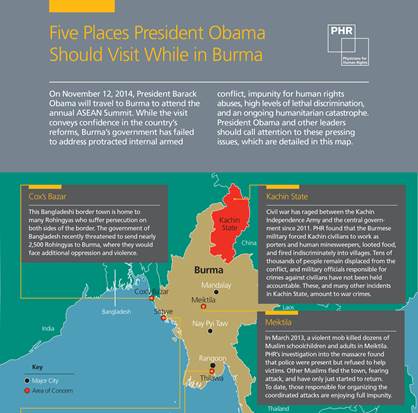
On November 12, 2014, President Barack Obama will travel to Burma to attend the annual ASEAN summit. While the visit conveys confidence in the country’s reforms, Burma’s government has failed to address protracted internal armed conflict, impunity for human rights abuses, high levels of lethal discrimination, and an ongoing humanitarian catastrophe.

President Obama and other leaders should call attention to these pressing issues, which are detailed in this map.

Five Places President Obama Should Visit While in Burma

Blog

The Role of First Responders in Attaining Justice

In the first half of 2014, nearly 3,000 people have fallen victim to sexual violence in the Democratic Republic of the Congo (DRC), according to the medical group Heal Africa, which treats survivors of sexual violence in the eastern part of the country. In a recent statement, the United Nations condemned the Islamic State for the “barbaric acts of sexual violence” being committed against minorities in Iraq. As violent conflicts continue to dominate world headlines, these reports serve as a stark reminder of the prevalence of sexual violence in conflict.

Behind these headlines are the first responders, like those working for Heal Africa, who support survivors every day by serving the immediate medical and safety needs of victims. The Program on Sexual Violence in Conflict Zones at Physicians for Human Rights (PHR) works to assist such first responders in conflict by helping them promote justice for survivors and accountability for perpetrators in an effort to prevent future abuses.

In the DRC and Kenya, PHR’s program provides training for doctors, police officers, lawyers, and judges on how to collect and document forensic medical evidence and preserve it for future use in court. Two members of PHR’s delegation at the Global Summit to End Sexual Violence in Conflict, which took place in London this past June, spoke about the training PHR provides. A police officer and a doctor from Nakuru, Kenya, stated that they are now able to coordinate their efforts across sectors and provide more comprehensive support for survivors of sexual violence. The doctor currently travels twice a week to court to present medical evidence that bolsters the case of a survivor – a case that was investigated and built by the police officer. PHR’s trainings foster collaboration between professionals in order to achieve justice in difficult environments and in places that suffer from weak judicial systems.

Given the number and scale of the violent conflicts around the world, we must remember victims of sexual violence and keep international attention on and devote resources to this important issue. The London Summit, where representatives from 123 countries and well-known names such as Angelina Jolie and U.S. Secretary of State John Kerry demanded that it was #TimeToAct to end sexual violence in conflict, was a promising start. But the work must continue. Their call to action is increasingly significant in light of conflicts in Iraq, Syria, and Gaza, as well as longer-standing ones, such as in the DRC. Many survivors of sexual violence in conflict continue to suffer without reparation; it is vital that governments and other international actors invest in the legal, judicial, police, and health systems to achieve comprehensive justice.

Statements

International Cooperation and Assistance in the Context of the Ebola Outbreak in West Africa

The outbreak of the Ebola virus in West Africa has now hit four countries: Guinea, Liberia, Nigeria, and Sierra Leone, along with several suspected cases in Senegal. This outbreak demands a concerted, coordinated, and urgent response to save lives and prevent the spread of infection within the currently affected countries and beyond. All those who respond must conduct their activities with the utmost respect for the human rights of individuals and communities, while adhering to best public health practices.

The failure of the international community to respond with the urgency that this health crisis demands means that medical workers and others who work with Ebola patients are at greater risk of infection themselves.

This statement provides in-depth analysis on the obligations of the international community and the immediate and long-term actions it must take in light of the Ebola outbreak.

Blog

New Evidence Emerges of Mass Rape During Post-election Violence in Kenya

This post originally appeared on Women Under Siege.

A study by Physicians for Human Rights published today in the peer-reviewed online publication PLOS One has found that the pattern of sexual assault perpetrated during the period following the contested 2007 presidential elections in Kenya is consistent with the patterns of mass rape documented in conflict settings elsewhere. The study provides indisputable evidence to support the claims being advanced in legal processes under way in Kenya and at the International Criminal Court: that crimes against humanity of mass rape did take place during that time.

Kenya endured significant atrocities in the post-election period (December 2007 to February 2008), including murder, ethnic cleansing, and rape. While the violence affected many regions, the experience in the western Rift Valley was particularly brutal. The media reported on hundreds of cases of sexualized violence during that time, and the Commission of Inquiry on Post-Election Violence (Waki Commission) affirmed these allegations. Yet few comprehensive medical studies using rigorous scientific methods have been undertaken to measure the prevalence of sexualized violence cases in the various communities affected. The absence of such data is significant as the International Criminal Court in The Hague seeks to prosecute high-level individuals who allegedly played a role in these crimes, including Kenya’s current President Uhuru Kenyatta and Deputy President William Ruto.

In an attempt to establish the patterns of mass rape during the post-election violence, Physicians for Human Rights conducted a study of 1,600 medical records from three health care facilities in the Rift Valley from 2007 to 2011. The researchers set out to determine how often patients seeking medical care and treatment reported characteristics of sexualized violence during the three-month post-election period, as compared to other times during the specified five-year period. The objective of the study was to identify whether there had been a systematic rise in sexual assault cases following the post-election violence. In addition to quantitative analyses, the team also conducted qualitative in-depth interviews with clinicians at the three health care facilities. The researchers compared findings to studies from other conflict settings, including the Democratic Republic of the Congo and Darfur.

PLOS One, an international online publication featuring reports of original research within the fields of science and medicine, published the complete findings of PHR’s study, which was the first to use a major medical record review to illustrate systematic differences in the reported cases. For example, the study showed that relative to the entire period of Kenyan rapes that were measured, the post-election period demonstrated systematic differences in the medical records of survivors of sexual assault. The findings in survivor cases suggest that the pattern of perpetration changed drastically during the post-election period and was distinct from non-post-election violence rapes. The study exposed new systematic patterns of sexual assault during the post-election period in Kenya in addition to finding that mass rape had taken place during that time. While it is not possible to generalize the numbers of rapes that took place during the post-election period, the study definitively showed that there was a very pointed, time-specific change in the way rape occurred that perfectly correlated with the post-election period…

Read the full article on Women Under Siege.

Get Updates from PHR