In a letter to Somali President Hassan Sheikh Mohamud, two PHR medical advisors who are experts in sexual violence evaluations urge him to void the use of unscientific medical evidence used to convict a Somali woman of making a false claim of having been gang-raped by soldiers. Both the woman and a journalist who interviewed her have been sentenced to a year in prison.
A Congolese Hero is Welcomed Home
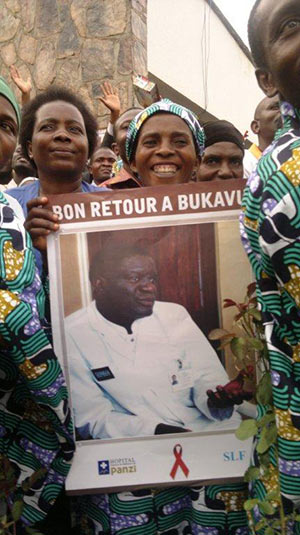
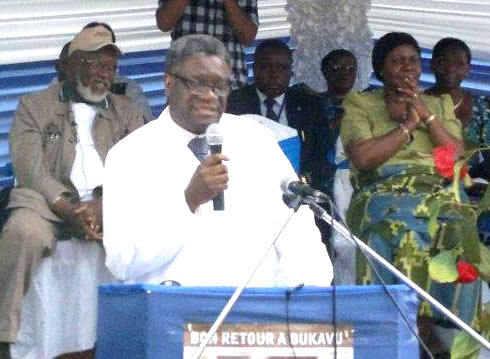
In October, 2012, Dr. Denis Mukwege, founder and medical director of Panzi Hospital in the Democratic Republic of Congo, and renowned gynecological surgeon who has treated thousands of victims of sexual assault and brutal rape, was the target of an assassination attempt in his home in Bukavu. His family was terrorized, and his trusted aide and guard, Joseph Bizimana, was murdered while defending Dr. Mukwege. After the attack, the Mukwege family left the DRC and took refuge in Belgium, and then in the US for several weeks. His absence from Panzi was keenly felt, and his return the cause of much joy. PHR’s DRC Coordinator, Caroline Dauber, describes his homecoming.
>> Lire le message en français
Hundreds of people are waiting on the tarmac of the Kavumu airport, sixty kilometers from the town of Bukavu, South Kivu Province. They are all waiting for one man. He is not a president, he is not a rock star, he is not an actor. He is the "messiah of women," the Representative of the Women of South Kivu said later. A doctor, in repairing women's bodies and souls, heals the population.
As he arrives on the tarmac, four children welcome Dr. Mukwege, the Director of Panzi Hospital, with flowers. With this shy voice of the Congolese people, they thank him for coming home to his family. His gaze scans the crowd of hundreds of people who have come to welcome him. He can’t quite grasp what is happening. Yesterday, he brought the voice of the victims of misery and violence to American and European government officials. Today he’s with his people once again.
Then, the doctor reaches the airport exit where the Congolese authorities are waiting. He greets each person one by one. Modestly and simply, he exchanges a few words with each of them. But the gratitude of the people is stronger. Hundreds of "mamas" outside the airport are playing drums and singing. Streamers with welcome messages are floating everywhere. The crowd rushes forward. Everyone wants to touch the man who has cured a member of their family at least once. They want to cry with him. This time, it’s not because of the horror they have suffered, but because of their joy at his return. They never doubted that one day he would return. They never doubted that he would not abandon his family, the Congolese people. Then the Panzi Hospital team who wore red ribbons throughout his exile as sign of their anticipation of his return could take them off: "Our doctor is with us."
Making his way through the crowd and before getting into the car that will take him to the hospital, he salutes the hundreds of women, children, and men who had offered their small harvest to help pay for his airline ticket. In the car with his wife, they shed a few tears. "If this is not love … What is love?"
The weapons in this country do not have as much weight as the actions of the population. Today, the population is acting. They have come to protect their doctor. The worldwide reputation of this man is not due to his speeches to world leaders but because of his actions for the people. All cheer the one who kept the sense of humanity to treat and restore their status as human beings. From Kavumu airport to Panzi Hospital, for more than sixty kilometers, the road is lined with groups of hundreds of people waiting to see their doctor. Reaching his domain at Panzi: there’s no need for an escort -the population now provides the security.
In private, in the car, Dr. Mukwege and his wife pray. They pray for this moment. That moment when the people showed their gratitude. That moment when a page of the history of South Kivu is written with a key word: "No more." No more war, no more violence, no more rape. They ask for peace and for security. With forgiveness and dignity, Dr. Mukwege returns to the Democratic Republic of Congo to write with the people the next chapter of its history.
En Français:
Des centaines de personnes attendent sur le tarmac de l’aéroport de Kavumu, à soixante kilomètres de la ville de Bukavu, Province du Sud-Kivu. Tous attendent un homme. Il n’est pas un président, il n’est pas une rock star, il n’est pas un comédien….c’est le « messie des femmes », comme le dira plus tard, la Représentante des femmes du Sud-Kivu. Un médecin qui, en réparant le corps des femmes, répare leurs âmes et ainsi soigne le peuple.
Arrivé sur le tarmac, quatre enfants accueillent Docteur Mukwege, Médecin Directeur de l’Hôpital de Panzi, avec des fleurs. Et par leur voie timide du peuple congolais, le remercient de rentrer chez lui, auprès des siens. Son regard se perd dans la foule des centaines de personnes qui sont venues lui souhaiter la bienvenue. Il n’en revient pas. Hier encore il portait la voix de ces victimes de la misère aux représentants des gouvernements américains et européens. Aujourd’hui, il est de nouveau avec eux.
Alors qu’il regagne la sortie de l’aéroport, les autorités congolaises ont fait le déplacement. Il salue une à une chaque personne. Dans la pudeur et la simplicité, il échange quelques mots avec chacun d’entre eux. Mais la gratitude de ce peuple est plus forte. Les centaines de « mamans » à l’extérieur sonnent les tambours et font trembler leur voix. Des banderoles flottent partout. La foule se précipite. Tous veulent toucher l’homme qui a soigné, au moins une fois, un membre de leur famille. Ils veulent pleurer avec lui. Cette fois, non pas à cause de l’horreur qu’ils ont subi, mais par joie de son retour. Ils n’ont jamais douté qu’un jour il reviendrait. Ils n’ont jamais douté qu’il n’abandonnerait pas sa famille : le peuple congolais. Alors, l’équipe de l’Hôpital de Panzi qui portait un ruban rouge dans l’attente, peuvent désormais le jeter à terre : « Notre docteur est avec nous ». Ils n’en ont plus besoin.
Se frayant un chemin dans la foule, avant de monter dans le véhicule qui l’amènera chez lui, à l’hôpital, il salue la centaine de femmes, d’enfants, d’hommes qui avaient fait don de leur maigre récolte pour payer son billet retour. Dans la voiture, accompagné de son épouse, ils laissent échapper quelques larmes. « Si ça n’est pas de l’amour…c’est quoi l’amour ?». Les armes de ce pays n’ont pas autant de poids que les actes du peuple. Aujourd’hui le peuple a agit : il est venu protéger son docteur. A bien y réfléchir, la réputation mondiale de cet homme ne vient pas de ses discours auprès des grands de ce monde mais de ses actes pour le peuple. Tous acclament celui qui a gardé l’humanisme nécessaire pour les soigner et rétablir leur condition d’êtres humains. De l’aéroport de Kavumu à l’Hôpital de Panzi, pendant plus de soixante kilomètres, le trajet est ponctué de groupes de centaines de personnes ayant attendu pour voir rentrer leur docteur. Dans son fief, à Panzi : plus besoin de l’escorte, la population assure désormais sa sécurité.
Dans l’intimité, à bord du véhicule, Docteur Mukwege et sa femme prient. Ils prient par gratitude de cet instant. Cet instant où le peuple a manifesté sa reconnaissance. Cet instant où une page de l’histoire du Sud-Kivu s’est écrite avec un maître mot : « plus jamais ». Plus jamais de guerre, plus jamais de violence, plus jamais de viols. Ils réclament la paix et la sécurité. C’est dans le pardon et avec dignité que Docteur Mukwege rentre en République Démocratique du Congo pour écrire avec le peuple son histoire.
Anti-Torture Update: Take Action to End Torture
January 11, 2013, marks the 11th anniversary of the day detainees were first brought to the Guantánamo Bay detention facility. Today, 166 men are still held there in indefinite detention. Since 2002, many Guantánamo detainees have suffered human rights violations, including such torturous “enhanced interrogation techniques” as sensory manipulation, sleep deprivation, and prolonged solitary confinement. Most have not been charged with any crime, and none know when, or if, they will leave the prison, even though 55 of the men have been cleared for release or transfer.
Our government keeps Guantánamo open: The National Defense Authorization Act 2013 (NDAA) recently passed by Congress and signed by President Obama does little to shut down the Guantánamo prison, though the president had promised to close it almost four years ago. Certain provisions in the NDAA make it nearly impossible to use government funds to transfer detainees out of Guantánamo, so the facility is likely to stay open indefinitely despite President Obama’s signing statement criticizing these provisions.
Take action:
- Join PHR and a coalition of like-minded organizations in the January 11 Day of Action Against Guantanamo.
- In Washington, DC: Meet at the steps of the Supreme Court at noon and march with 166 people in orange jumpsuits to the White House, reminding President Obama of his promise to shut down Guantánamo. The march will be followed by an interfaith prayer and policy briefing at 2:30 pm at New York Avenue Presbyterian Church (1313 NY Ave. NW).
- In your local community: stand against torture by joining or organizing a solidarity action or protest.
We're halfway there: The Senate Select Committee on Intelligence (SSCI) recently adopted a report on its three-year investigation into the CIA's use of “enhanced interrogation techniques” at Guantánamo and other military detention facilities in Afghanistan and Iraq during the Bush administration. The adoption of the report is a victory for everyone who is against torture. Now, the report needs to be declassified so it can put to rest the claim that torture is a useful interrogation technique and can also lead to the creation of safeguards to help prevent torture from occurring. Senator John McCain has urged the report's declassification “so that all Americans can see the record for themselves” to “finally close this painful chapter for our country.”
Take action:
- It is critical that the SSCI report be made public! Sign PHR’s petition urging President Obama to push for declassification of the report.
Landmark ruling recognizes use of torture: The recent ruling in the case of Khalid El-Masri — a German national mistaken for an Al Qaeda terrorist and detained and tortured by the CIA — in the European Court of Human Rights is yet another win for the anti-torture community. The court is the first to rule that some CIA interrogation practices were tantamount to torture.
Torture, glorified: The recently released film “Zero Dark Thirty” is a blatant glorification of torture. Senators Diane Feinstein (D-California), John McCain (R-Arizona), and Carl Levin (R-Michigan) co-authored a letter to Sony Pictures stating their “deep disappointment with the movie” and labeling it as “factually inaccurate,” since information leading to the capture of Osama Bin Laden was not obtained from “CIA detainees subjected to coercive interrogation techniques.” We need to do all we can to fight the acceptance of torturous practices as useful methods of interrogation, as it seems many Americans still support such techniques. An informal survey last year found that 41 percent of Americans said “United States should torture prisoners captured in the fight against terrorism,” an increase from a similar poll in 2007.
With your help, we’ve taken small steps toward shining a light on torture that has been committed in our names. But, we must continue our work together to restore our human rights values. Take action today to help prevent torture in the future!
Examining Asylum Seekers
A Clinician's Guide to Physical and Psychological Evaluations of Torture and Ill-Treatment
The United States is the largest recipient of asylum claims among industrialized nations. Victims of persecution and torture who come to the United States may apply for asylum, withholding of removal, and protection under the UN Convention against Torture (CAT) in order to remain in the US legally and rebuild their lives.
They must prove they were persecuted or tortured, or have a well-founded fear of future persecution or torture. For most of them, only a forensic medical examination can document the physical and mental scars left by torture, beatings, sexual violence, slavery, and more.
Physicians for Human Rights has been providing pro bono medical evaluations for asylum seekers and others fleeing persecution for more than 20 years. The results are compelling – more than 90% of confirmed case outcomes are positive, meaning that the applicant was granted the right to live, work, and begin healing in the US.
Clinicians can assist asylum seekers and others seeking protection in the United States by providing objective documentation of their physical and psychological injuries and trauma. This documentation becomes evidence that can corroborate the asylum seeker’s narrative of persecution. This manual is a tool for clinicians to use in assisting their evaluation and documentation of asylum seekers’ histories.
Obama 2.0: Will Plans for immigration Reform Address Needs of the Most Vulnerable?
There is a broad consensus that our immigration system is in desperate need of an overhaul. Comprised of a hopelessly complicated patchwork of laws enacted in response to events like the 1993 World Trade Center bombings and the 9/11 attacks, the immigration system creates narrow pathways for some immigrants to come to or remain in the United States, while making it almost impossibly hard for others, including many fleeing torture and persecution.
Now, with the presidential election behind us and Republicans recognizing that their support for harsh immigration policies cost them the vote of the fastest-growing ethnic group in the country, it looks as though comprehensive immigration reform may be just around the corner.
President Obama has been laying the groundwork by stating that after dealing with the budget, his next major effort will be enacting immigration reform. Republican Senators who had been prepared to work on immigration reform during the last term are dusting off their old proposals. And a group of prominent Republicans have started a PAC aimed at giving cover to Republican lawmakers who want to support immigration reform but fear reprisals.
Achieving meaningful immigration reform will be no small feat. And many different facets of the immigration system will need significant attention. But a few relatively simple changes could have profound effects on some of the most vulnerable immigrants — asylum seekers and immigration detainees.
The US accepts more asylum seekers — those who flee persecution and torture in their home countries — than any other country in the world. Our devotion to protecting victims of human rights abuses is laudable. But while we accept tens of thousands of asylum seekers, we bar many others for unnecessary or trivial reasons.
To ensure that we abide by our legal obligation to give asylum to victims of persecution and torture, any truly comprehensive immigration reform bill must:
-
Repeal the one-year bar
Immigrants are barred from applying for asylum if they submit their applications more than one year after arriving in the US. This arbitrary and unnecessary “one-year bar” (pdf) has prevented tens of thousands of asylum seekers with otherwise valid claims from gaining protection in the US. It does nothing to deter fraud in the asylum system, and adds to the cost of adjudicating asylum claims. Several bills (pdf) have already been introduced in Congress that would eliminate the one-year bar, and the Obama administration has publicly stated that it favors repeal.
-
Material support bar
Asylum seekers who have provided “material support” (pdf) to terrorists are barred from receiving asylum. Although perhaps well-intentioned, the material support bar is too broad, and does not include a definition of what constitutes “material support.” Until recently, for example, health professionals who provided medical care to wounded people who happened to be affiliated with terrorist organizations could be denied asylum.
Congress must either eliminate the material support bar or ensure that it is written narrowly so that asylum seekers who have provided support unknowingly, incidentally, or under duress are not erroneously denied asylum.
-
End Expedited Removal
The Expedited Removal process gives Customs and Border Protection (CBP) agents at the border the power to turn away immigrants seeking to enter the US without proper documentation. While giving CBP agents this power is problematic enough, when applied to asylum seekers who are forced to flee their countries and arrive at the US border with no documentation, it risks returning thousands of legitimate refugees to countries where they will be persecuted, tortured, or even killed.
Though the Expedited Removal process has safeguards meant to ensure that asylum seekers are allowed to enter and apply for asylum, studies have shown that they are insufficient. And even if asylum seekers are allowed to enter, most are immediately thrown into immigration detention centers pending the outcome of their cases.
Immigration Detention
While the way we treat asylum seekers is abysmal, our immigration detention system is a national embarrassment. No package of immigration reforms will be truly comprehensive unless it begins the process of dismantling immigration detention. At the very least, Congress must:
-
Improve conditions of immigration detention
The vast majority of immigration detainees are held in conditions that are indistinguishable from those in prisons and jails, in spite of the fact that the purpose of immigration detention is not to punish. Indeed, many detainees have never been convicted of a crime, and many others are asylum seekers who were tortured in prisons in their home countries. Detainees are subjected to frequent abuse and harassment, substandard medical care (and a near-total lack of mental health care), and prolonged and unnecessary solitary confinement.
Congress must direct US Immigration and Custom Enforcement (ICE) to enact a set of civil detention standards that will be binding on detention facilities, and end the use of prison-based immigration detention.
-
Reduce funding for immigration detention & increase funding for alternatives to detention
Immigration detention costs over $2 billion a year — an average of around $160 per detainee per night, or about $5 million per night, much of which goes to line the pockets of executives at private prison corporations. Alternatives to detention (ATDs) (pdf) cost as little as 14 cents a day, and have been repeatedly shown to be effective in ensuring that immigration detainees appear in court and comply with removal orders.
If Congress is serious about saving money, shifting funding from detention to ATDs would go a long way, with the added benefit of allowing immigrants to remain with their families and communities pending the outcome of their cases. At the same time, Congress must end “mandatory detention,” in which certain immigrants are not permitted to be released from detention until their cases have been decided.
-
Increase funding for immigration courts to reduce backlog
Immigration courts are hopelessly backlogged; hundreds of thousands of immigrants, including many detainees, are funneled through only a couple hundred judges each year. This backlog means that many detained immigrants spend long periods in immigration detention at taxpayer expense, and that many non-detained immigrants spend years wondering whether they will be allowed to remain in the United States. Clearing this backlog should be a top priority for Congress, which should immediately increase funding for the immigration courts so that they can hire more judges, clear out their backlogs, and adjudicate cases quickly.
-
Improve access to counsel for people in removal proceedings
Immigrants have the right to be represented by counsel in immigration court — but not at government expense. Immigration judges spend countless hours walking immigrants through their options in court, further stalling an already slow process. Federally-funded Legal Orientation Programs (LOPs) provide legal information to immigration detainees in 25 detention facilities around the country — a small fraction of the over 250 facilities that hold detainees. Mentally ill immigrants, illiterate immigrants, immigrants with limited or no English proficiency, and even immigrant children are forced to represent themselves in court.
Congress should at the very least dramatically increase funding for the Legal Orientation Programs, while providing money to begin widespread piloting of a system of appointed counsel for immigrants, and particularly immigration detainees.
It is a testament to the complexity of the immigration system that the reforms listed above are only the tip of the iceberg. But by chipping away at the barriers to asylum and by reforming the deplorable immigration detention system, Congress can demonstrate its commitment to ensuring that the US lives up to its desire to be an exemplar of human rights for the rest of the world.
Massachusetts Supreme Judicial Court Limits Solitary Confinement
The Massachusetts Supreme Judicial Court yesterday ruled that holding an inmate for 10 months in solitary confinement with only periodic informal review of his custody was unlawful. The inmate, Edmund LaChance, was originally placed in solitary confinement after throwing a cup of pudding on another inmate. Though initially sentenced to only seven days in solitary, LaChance remained there for the next 10 months.
The court said that while LaChance was in solitary, he was allowed to exercise in an outdoor cage one hour a day, five days a week; given two non-contact visits a week; permitted two books a week; and denied the opportunity to participate in educational, religious, vocational, or rehabilitative programming. His wrists and ankles were shackled at all times when he was outside his cell.
In concluding that this 10-month term in solitary was unreasonable, the court noted that, in addition to restrictions on his recreation and access to visitation and programming, LaChance did not have an effective mechanism for contesting his placement in solitary. Though his custody was reviewed periodically, the court wrote, “None of these reviews entailed giving LaChance notice of the proceedings, much less an opportunity to speak on his own behalf or to test the purported basis for his continued confinement.”
While stopping short of prohibiting the use of solitary confinement, the court’s ruling firmly establishes that inmates are entitled to a mechanism for challenging their placement in solitary. The court also noted that prison officials often skirt regulations limiting the time inmates can spend in solitary confinement by giving them a classification that allows unlimited consecutive sentences in solitary — in effect, confining them in solitary indefinitely.
Though this ruling directly affects criminal inmates only in Massachusetts, the court’s reasoning applies equally to the tens of thousands of inmates across the country, as well as to immigration detainees and others who are kept in solitary, often despite never having been convicted of a crime. As opposition to the use and abuse of solitary confinement grows, the Massachusetts court’s ruling in LaChance is a ray of hope for those struggling to end solitary confinement around the nation.
Capitol Hill Briefing Spotlights Bahrain’s Lack of Progress in Bolstering Human Rights
Nearly one year after the Bahrain Independent Commission of Inquiry released a report recommending legal and policy changes to improve human rights in that country, the kingdom’s regime has failed to live up to its pledge to implement those changes, according to panelists at a Congressional briefing Wednesday.
In some ways, in fact, the human rights situation is worse now than when the report was released last November, said PHR Deputy Director Rick Sollom, one of the panelists.
Several medics are serving prison sentences stemming from their medical treatment of pro-democracy protesters. The Government of Bahrain has not responded to demands by PHR and other human rights groups that it release the medics and allow other professionals dismissed from their jobs for political reasons to return to work. The Bahraini authorities continue to target protesters and those who may be aligned with them with physical attacks and the rampant misuse of toxic chemical agents.
The Congressional briefing was hosted by Americans for Democracy and Human Rights in Bahrain, which released a report detailing the regime’s lack of progress in implementing human rights reforms.
Congressman Keith Ellison (D-MN) expressed his support for human rights defenders in Bahrain. He condemned the Bahraini government’s recent act of stripping citizenship from political dissidents and urged the Obama Administration to take a stronger stance against human rights violations in Bahrain. PHR thanks Representative Ellison and other Congressional leaders for their support.
Medicine Meets the Law: When a Psychological Evaluation Means the Difference between Asylum and Deportation
When people make the decision to escape the torture and persecution they’ve suffered in their home countries by fleeing to the US, many have no idea that they have only one year from the time they arrive to apply for asylum.
This “one-year bar” (pdf) to asylum – which violates our international obligations to accept asylum seekers – prevents thousands of refugees every year from receiving the protection they need. Though the Obama administration has announced its support for repealing the one-year bar, efforts to overturn this harmful and unnecessary provision have met with obstruction in Congress.
But the one-year bar is not absolute; if asylum seekers can show that circumstances in their home countries have changed since they left such that they now need to apply for asylum, even after living more than one year in the US, or that extraordinary circumstances prevented them from filing an application within one year of their arrival, the government may still grant them asylum.
The “extraordinary circumstances” exception, while broadly written, has been interpreted narrowly by the government. But advocates have long argued that psychological trauma caused by torture and persecution can have such a detrimental effect on asylum seekers that it can amount to an exceptional circumstance that keeps them from applying for asylum within one year of their arrival.
Aside from asylum seekers’ reluctance to describe the worst thing that has ever happened to them to a government official, many also suffer from post-traumatic stress disorder (PTSD) or other psychological trauma that makes them unable to begin the complicated asylum process.
Recently, the University of Connecticut Law School’s Asylum and Human Rights Clinic won an important victory at the Board of Immigration Appeals (BIA) on behalf of an asylum seeker who had been subjected to female genital cutting as a child. Although she came to the US in 2000, “A.C.” did not apply for asylum until 2005.
During that period, she experienced significant pain when having sexual relations with her husband. Though the pain was later diagnosed as resulting from the genital cutting she underwent as a child, she had been raised to believe that genital cutting was a normal and harmless procedure. This unexplained pain, in addition to three difficult pregnancies, caused her great stress. Only in 2005 did she become aware of the harm caused by female genital cutting, which prompted her to immediately apply for asylum. A psychological evaluation conducted after she submitted her application revealed that A.C. suffered from PTSD.
A.C. was initially denied asylum by the immigration judge and the BIA. The Second Circuit Court of Appeals in New York, NY, then remanded her case for a new hearing, at which the immigration judge again found that she had not met the “extraordinary circumstances” exception to the one-year bar. But six years after A.C. initially applied for asylum, the BIA held (pdf) that her PTSD, combined with other effects of the female genital cutting she suffered, excused her late filing, and she was granted asylum.
A.C.’s case illustrates the byzantine procedures asylum seekers have to navigate once they decide to seek protection in the US. But it also stands as an important reminder that psychological trauma can be at least as debilitating as physical harm.
As more lawyers use forensic psychological evaluations of asylum seekers to argue that psychological trauma prevented them from applying for asylum within one year, advocates are hoping that cases like A.C.’s will point the way toward a broader definition of “extraordinary circumstances.” But until the one-year bar is repealed, survivors of persecution and torture will continue to be unjustly denied asylum based on this arbitrary deadline.
Obama’s Trip to Burma an Opportunity to Press for Substantial Reforms
President Obama is choosing an odd time to make history as the first US president to visit Burma. Ethnic violence continues to devastate Rakhine State in western Burma, conflict rages in northern Kachin State, and military officials responsible for some of the worst violence in the country continue to thrive in a climate of impunity. Obama advisor Samantha Power noted that his administration is “clear-eyed about the challenges Burma faces.” The president’s trip there later this month gives him the chance to prove her right.
The trip to Burma provides President Obama with a crucial opportunity to press its government to end the widespread violence against ethnic minorities, increase humanitarian access to conflict zones, reform its military, release remaining political prisoners, and establish accountability mechanisms for perpetrators of heinous crimes. This is not the time to merely announce more rewards for reformists in Burma’s government; instead, he needs to press for these necessary advances that will benefit all people of Burma.
Actions speak louder than words: If the US government is truly serious about ongoing human rights violations in Burma, then President Obama should visit displaced civilians in Myitkyina, Kachin State, and around Sittwe in Rakine State in border areas. He could even observe the progress made and difficulties still faced in ceasefire talks in Karen State. Far too many international delegations limit their trips to Rangoon at the cost of marginalizing the problems that are ongoing in ethnic states and simplifying the politics of Burma. It is time for the US to take the lead in addressing problems in ethnic areas in Burma.
The Obama administration’s policy of engagement with Burma’s leaders has not yielded the kind of rewards the people of Burma deserve. Nearly a year after Secretary of State Hillary Clinton visited the country, human rights violations persist and structural problems, including widespread disregard for the rule of law, remain.
For decades, pro-democracy activists, human rights defenders, and political opposition leaders have made significant sacrifices to move Burma in the direction of reform. The people of Burma are watching: If President Obama is truly “clear-eyed” about the ongoing problems in Burma, he should make sure that he supports their efforts and not only those of the government.
Standing in Solidarity with Medical Colleagues and the People of South Kivu
>> Lire le message en français
Today, we at Physicians for Human Rights stand in solidarity with our medical colleagues and the people of South Kivu in the aftermath of the chilling and brazen attack against Dr. Denis Mukwege and his household last Thursday.
We have learned that the city’s residents, women’s organizations, and key institutions are unified in silent protest today, having declared a ville morte, or a general shutdown, to express their anger at the assault on a leader and healer for thousands of victims of the vicious reign of terror and sexual violence that persists in eastern Congo.
Our colleagues and the people of Bukavu – the schools and universities, the shopkeepers and all the hospitals, the gas stations and markets – have collectively demanded a thorough investigation into the murder of Dr. Mukwege’s trusted aide and guard, Joseph Bizimana. They have asked for an end to the impunity for the crimes that shatter daily life in their country and threaten the tremendous efforts of a generation that has hoped for change and worked for a functioning system of justice, the proper delivery of health care and sustenance, and an end to years of conflict and the despoliation of the environment.
But even as this shutdown occurred, more violent deaths and injuries were reported in Walungu, Katana, and Uvira in South Kivu.
When those who have dedicated their lives to the healing of their people and their country are persecuted, thousands of lives are at risk and we are all incalculably diminished.
We are honored to share the following statement issued yesterday by the Medical Society of South Kivu as their message for this day of grief and grievance, and we join in their call for an end to impunity for perpetrators of atrocities in the DRC.
30 October 2012
Dear Colleagues, Friends, People of Good Will
Greetings!
It was a close call and almost became a monumental tragedy for our medical community, but also for Bukavu, South-Kivu, the Democratic Republic of the Congo, and the entire world.
The attempted assassination of Dr. Denis Mukwege on October 25th around 7:30 pm took place at his home in Muhumba-Ibanda, Bukavu. There were several gunshots; his bodyguard was shot dead. Dr. Mukwege himself miraculously emerged safe. The President of the Regional Medical Society, Professor Dr. Munyanga, was away from Bukavu at the time. Two members of the Regional Council of the Sud-Kivu Medical Society immediately arrived at the scene and on behalf of the entire medical community of Sud-Kivu offered comfort and support their colleague, left for dead by the assailants.
The Medical Society of Sud-Kivu has two words to express our collective response: INDIGNATION AND APPREHENSION.
INDIGNATION that such an event could take place at the home of our internationally renowned colleague who is so instrumental to the survival of our population, where doctors understand better than anyone the difficult conditions of life here.
APPREHENSION because doctors feel threatened. Most of us doubt that this attack could have been simply a robbery. If this could happen to someone who is among the most exemplary of doctors, living in one of the most secure neighborhoods in the town, what could happen if other medical colleagues in general are now targeted?
Is this incident linked to the conflict in the East with M23 militias?
Is this part of a plan to demoralize the doctors or the intellectual elites of the area?
Unfortunately, these are merely questions, but we do not have answers!
As “problem solvers” who respond to the needs of our patients, we refuse to wait for remote answers.
We demand that the appropriate authorities carry out a thorough and professional investigation, and that those responsible for these crimes be brought to justice.
On Behalf of the Regional Council of the Medical Society of South-Kivu
~ Dr. Xavier Mampengu Yanga Yongo, Secretary
~ Dr. DieuDonné Kalumuna Mudekereza Chikuru, Vice-President
(Translated from the French original by Susannah Sirkin and staff of the Program on Sexual Violence in Conflict Zones. See also the statement of the International Campaign to Stop Rape & Gender Violence in Conflict, endorsed by PHR.)
En Français:
Aujourd’hui, nous les Médecins pour les droits de l’homme (PHR) sommes solidaires avec nos collègues médecins, et la population de Sud-Kivu au lendemain de l’attentat effroyable contre le Docteur Denis Mukwege et son foyer, jeudi dernier.
Nous avons appris que les résidents de Bukavu et les institutions clées se sont unis en manifestation silencieuse aujourd’hui, et ont déclaré Bukavu ville morte. Cette fermeture générale est leur façon d’exprimer leur colère contre la tentative d’assassinat d’un leader mais aussi d’un médecin qui a soigné des milliers de victimes du règne de la terreur qui existe actuellement dans l’est du Congo.
Nos collègues et le peuple de Bukavu – les écoles et les universités, les commerçants, tous les hôpitaux, les stations-service et les marchés ont collectivement demandé une enquête complète et immédiate sur l'assassinant de Mr Joseph Bizimana, l’aide et garde de Dr. Mukwege. Ils ont demandé la fin à l’impunité des crimes qui détruisent leurs vies et menacent les efforts d’une génération qui a espéré le changement, qui a travaillé pour un système de justice fonctionnel, pour la bonne livraison des services de santé, pour la fin des années de conflit et de a spoliation de l’environnement.
Cependant, le jour meme de la fermeture, plus des morts et blessures violentes ont était rapporté en Walungu, Katana et Uvira en Sud-Kivu.
Nous avons l’honneur de transmettre cette déclaration, message issu de la Société Médicale de Sud-Kivu en ce jour de chagrin et grief, et de nous joindre avec eux en lançant l’appel à la fin de l’impunité pour les responsables des atrocités en RDC.
Quand ceux qui se sont dévoués à aider les autres et leurs communautés sont ciblés, des milliers des vies sont en jeu et nous sommes tous infiniment plus démunis.