Report

Massacre in Central Burma

Muslim Students Terrorized and Killed in Meiktila

This report details the results of a PHR investigation into the March 20 and 21, 2013, attacks on Muslim students, teachers, and residents in the Mingalar Zayyone quarter of Meiktila, a small town in central Burma.

A two-person team from PHR conducted 33 interviews about the attacks, which resulted in the deaths of at least 20 children and four teachers. The report details the attacks by the Buddhist mobs, provides evidence that local police officers were complicit in the crimes, and lists policy recommendations for the Burmese government and the international community.

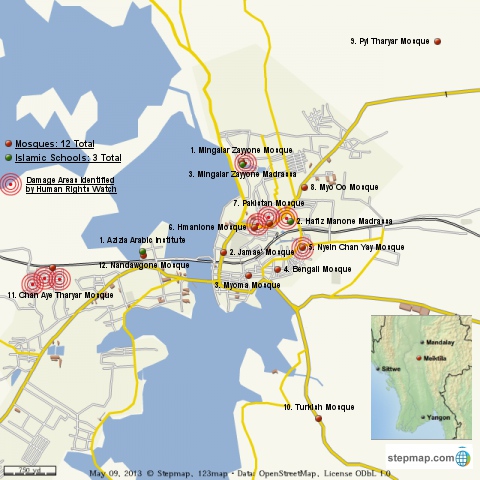
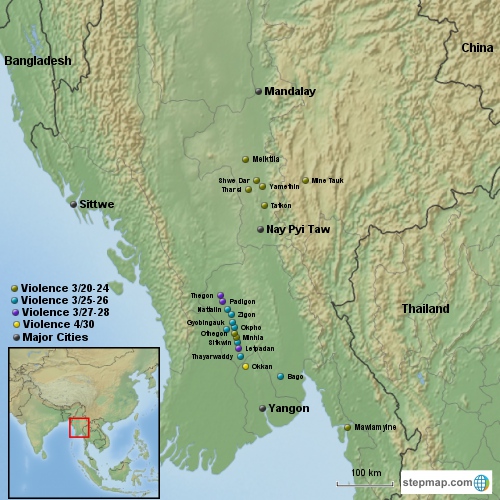
The below map, which includes photographs of the destroyed mosques and Islamic schools in Meiktila, is also in the report. A second map, showing locations of the anti-Muslim violence, also follows.

Map 1: PHR-Verified Destruction of Mosques and Islamic Schools in the City of Meiktila, Burma, 20-23 March, 2013. This map contains original PHR photos; clicking on each point will reveal a photo of the damaged structure.
Meiktila Destruction HRW Data
Map developed at StepMap

StepMap

PHR-Verified Destruction of Mosques and Islamic Schools in the City of Meiktila, Burma, 20-23 March 2013

Map 2: Anti-Muslim Violence in Burma, March–April 2013. This map was produced using information from publicly available media sources.
Conflict in Myanmar March-April Topo
Map developed at StepMap

StepMap

Anti-Muslim Violence in Burma, March–April 2013
Blog

Failing to Heal: Hunger Strikes in Guantánamo and the Role of Medical Professionals

Almost every medical school student takes an oath upon graduation based on the classic 4th century BC text named after the “father of medicine,” Hippocrates. It is worth recalling the ancient commitment to the central tenet of the classic oath regarding the sick: “I will keep them from harm and injustice.” This commitment is echoed in the contemporary international medical principle of beneficence, which mandates that the modern physician be an advocate for the patient’s interests, from the perspective of both immediate medical services and the necessary protective environment in which those services are provided.

In a recently released bipartisan and comprehensive report on detainee treatment at the detention facility in Guantánamo Bay (GTMO), Cuba, the Constitution Project’s Expert Task Force devotes a whole chapter to the spectacular failure of medical professionals in GTMO to protect detainees from harm or injustice. Beginning with the troubling reflections of US Navy Capt. Albert Shimkus, the former detention center’s chief medical officer, the report demonstrates in great detail the willingness of medical personnel at GTMO to participate in a deliberate attempt to misrepresent the cruel realities in the detention facility by proffering a false reality. Capt. Shimkus’ official claim was that prisoners at GTMO “never had it so good,” with first-rate medical care and balanced nutritious meals.

Although the regular medical services provided no doubt did meet appropriate professional standards, psychologists, psychiatrists, and physicians were also actively engaged in a much darker aspect of GTMO: the often brutal interrogations of detainees. Medical professionals were complicit in torture by helping to refine practices euphemistically called ”Enhanced Interrogation Techniques,“ by monitoring medical ”redlines” during the interrogations, and by providing interrogators and their superiors with the moral fig leaf that a doctor was monitoring the situation. Officials in charge of interrogation policy could rely on the involvement of doctors to claim that any abuses were not really all that bad. This dichotomy of conflicting responsibilities of Department of Defense medical professionals ensured a ”Jekyll and Hyde” reality for detainees, which negated any real therapeutic relationship as demanded by the Hippocratic Oath and by medical ethics. The same medical professionals who monitored interrogation of detainees were also responsible for regular health care of those same people. By accepting these detrimentally opposing roles, healers could inevitably no longer be healers.

The absence of a trusting relationship between detainees and health professionals was further exacerbated by another Kafkaesque reality that GTMO detainees find themselves in – a regime of indefinite detention. Dozens of people remain in GTMO without criminal charge and with no hope of ever leaving the facility. The US government has cleared for release some 86 of the 166 prisoners currently in Guantánamo, many of whom have been awaiting their freedom for many years. Physicians for Human Rights (PHR) has documented the severely detrimental health impacts this complete uncertainty and inability to determine one’s own fate has on detainees. The US government knows full well that many detainees have never had any hostile intentions toward the United States, and that they should have never been held at GTMO in the first place. The only reason they are still there is the inconvenient fact that no acceptable third country is available to take them off our hands. This result is hardly surprising, given that the United States brought the detainees to GTMO despite international criticism, and US lawmakers ensured that not a single one of them could be released into the United States. In recognition of the futility of a diplomatic ”Mission Impossible” along the lines of, “Please take some GTMO detainees off our hands, while we in the US will take none, thank you very much,” the office charged with the closure of GTMO was closed itself.

Imagine the combined impact of all of these factors on the detainees at GTMO. The utter desperation of being at the complete mercy of a seemingly unaccountable authority that declares one thing and does another has had deadly consequences. In acts of complete desperation, detainees have resorted to harming themselves, as is evidenced by the seven suicides and several waves of hunger strikes at GTMO.

As media reports indicate, as many as 130 prisoners could now be on a hunger strike. And what is the US government’s response to this ongoing crisis? Force feeding. As experts at PHR have clearly demonstrated, force feeding can amount to torture. The international medical community has authoritatively addressed the issue of treatment of hunger strikers in the Declaration of Malta by the World Medical Association, and the US government should strictly follow those guidelines and procedures. The Declaration of Malta has one important recurring theme and precondition, though, which the current system in GTMO simply cannot meet – a trusting and respectful relationship between the hunger striker and his doctor.

If the past is not to be prologue for more abuses, the current administration must do three things immediately to act responsibly during this crisis:

  1. Independent medical professionals need to have full and unfettered access to the hunger strikers, so that they can credibly implement the Malta Declaration without the practice of force feeding.
  2. The administration must immediately address the issue of indefinite detention in GTMO and elsewhere. The administration should actively find ways to repatriate or relocate those individuals cleared for release and should charge all those who are not cleared.
  3. For this purpose, the administration must immediately appoint a high-ranking government official of international stature to the currently vacant position of Special Envoy for the Closure of Guantanamo, and widely publicize this appointment at the detention facility and abroad.
Blog

Stained Glass Transparency: Bahrain’s Latest Obfuscation of International Human Rights Accountability

Bahrain has again indefinitely postponed a visit by the UN’s special rapporteur on torture, the latest in a series of attempts to deter human rights observers from scrutinizing the kingdom’s dismal human records record. The government told the rapporteur, Juan Méndez, that his visit could be “immensely damaging” to the Bahrain National Dialogue, an initiative that should welcome such a visit if it truly seeks to promote reform. This disappointing development follows the recent release of the US State Department’s report that criticized Bahrain for its ongoing human rights violations.

The State Department cited local and international NGO reports, including those from Physicians for Human Rights (PHR), which documented torture and other forms of ill treatment on the part of Bahraini security forces, as well as the government’s crackdown on human rights defenders. These practices have continued and show no signs of stopping nearly 18 months after a government-commissioned report documented systematic use of torture and abuse against detainees. While Bahrain is desperately trying to present a sense of normalcy – such as by hosting the Formula One Grand Prix earlier this week – its failure to correct its human rights record only demonstrates the dire need for an independent investigation.

Bahrain’s decision to cancel Méndez’s visit, which was scheduled for next month, is of great concern. The government must put an end to its policy of shutting out independent investigators. Researchers at international human rights organizations, including PHR, have been denied entry despite repeated attempts to investigate ongoing abuse. When PHR has been able to conduct research in the country, we have found evidence of systematic violations against peaceful protesters and those who stand up for them.

Last year, PHR released a report on the Bahraini authorities’ indiscriminate use of toxic chemical agents against civilians. PHR highlighted many of the subjects also included in the State Department’s report, such as law enforcement officials’ failure to minimize harm against protesters. Because the government has still not held a single high-level official accountable for instituting a policy and culture of brutality against its own citizens, we remain skeptical of Bahrain’s claims that its human rights record has improved. The same people are still in power, the same policies are still in place, and the “National Dialogue” has served as a convenient veneer for the Bahraini government while crackdowns against protesters continue.

While PHR welcomed last month’s acquittal of 21 of 23 medics accused of misdemeanors, we remain cautious about progress in a place where acquittals of human rights activists have recently been overturned. Moreover, human rights violations continue to be perpetrated in an environment increasingly hostile to external observation, a movement hidden in the shadow of the doctors’ acquittal. Bahrain’s Parliament is considering a draft law that would essentially erase the ability of NGOs to operate independently by requiring government approval of any NGO activities within its borders. Human rights defenders, including medical professionals who were harassed, arrested, convicted, and sentenced just for aiding protesters or exercising their basic rights, have not yet received any reparation. Many still languish in prison.

With the cancellation of Méndez’s visit and other significant limitations on independent NGO activity, Bahrain is at great risk of becoming a stained glass state, projecting an image that is pretty to look at, but masking the atrocities taking place within. Without independent investigations needed to shine a light on the internal situation, any human rights accomplishments made through the current process will be brief and insincere at best.

Blog

A Dark Day for Human Rights in Burma

On April 22, the European Union lifted all sanctions against the Burmese government except for an arms embargo. An EU press release stated: “In response to the changes that have taken place and in the expectation that they will continue, the Council (of Ministers) has decided to lift all sanctions with the exception of the embargo on arms.”

While it is important to recognize reforms in Burma — including the release of political prisoners, the loosening of media controls, and greater freedom for Burma’s key pro-democracy political party — the international community has been overzealous in signaling its approval. By lifting almost all sanctions, the EU has lost the ability to press Burma’s leaders to continue human rights reforms.

The reforms undertaken so far are not sustainable; for example, although political prisoners have been released, the very laws that prohibited their activism remain on the books. The same military that is responsible for heinous human rights violations under the previous regime still wields significant control over large swaths of the country, and there is no internal effort to hold perpetrators of serious abuses to account. Any assumption that initial reforms will continue without international pressure ignores the fact that the situation in Burma is getting worse.

The EU is choosing to focus on positive reforms while overlooking increased violence and backsliding on commitments to reform. Although Burmese leaders have moved closer to democracy by allowing greater political freedoms, the country still suffers from widespread oppression and conflict. Ceasefire agreements between the Burmese government and the Kachin Independence Army broke down in January, and renewed conflict now pervades much of Kachin State. Hundreds of political prisoners are still detained. Ethnic violence, displacement, and discrimination continue to occur throughout Arakan State and Mandalay Division.

The Rohingya, for example, are members of an ethnic minority group that is denied official recognition and citizenship by the Burmese government. Rohingya are considered “one of the largest stateless groups in the world” by Refugees International. Without official citizenship, Rohingya find it difficult to obtain health care, education, and employment. Not only has the Burmese government refused to recognize the Rohingya and provide access to basic services, but pro-democracy leaders who have long fought for human rights have also publicly supported discrimination against the group. Long-simmering ethnic discrimination erupted into brutal violence last year. A Human Rights Watch report, released the same day the EU lifted sanctions against Burma, found that government authorities and local Arakanese groups had engaged in “a campaign of ethnic cleansing against Rohingya Muslims in Arakan State since June 2012.” This account matches findings from PHR researchers, who recently documented violent attacks against Muslims in western Burma as well as other parts of the country.

From March 20 to 28, anti-Muslim violence occurred throughout Mandalay Division in central Burma. Riots left at least 43 dead and over 12,000 displaced. PHR uncovered a possible massacre of at least 32 students that occurred during the anti-Muslim riots in Meiktila. BBC has released video footage of police standing by while Muslims were killed and their homes burned.

In the wake of such extreme violence, neither the EU nor the United States has demanded an investigation or proper accountability mechanisms. During the previous military regime, the international community would have pressed for the Burmese government to end the violence and take all necessary steps to ensure that such acts do not happen again. Political reforms are important, but no progress on that front should prevent the international community from speaking out for civilians under attack.

By congratulating the Burmese government, the EU is ignoring the human rights abuses still occurring throughout much of the country. With the lifting of EU sanctions, much of the motivation behind the Burmese government’s reforms has now disappeared. Without strong pressure from the international community, the future of human rights in Burma remains uncertain.

Report

Buried Alive: Solitary Confinement in the U.S Detention System

Solitary confinement is a generic term used to describe a form of segregation or isolation in which people are held in total or near-total isolation. People in solitary confinement are generally held in small cells for 23 hours a day and rarely have contact with other people. Solitary confinement has historically been used to control and discipline detainees in a variety of settings, including federal and state prisons, local jails, and immigration and national security detention facilities. Unlike incarcerated prisoners, immigration and national security detainees are held not as punishment for a crime but as a preventive measure. Indeed, it is unlikely that these detainees will ever be charged with a crime.

For these people, solitary confinement then becomes entirely punitive, with dire consequences for their mental and physical health. Immigration and national security detainees are particularly likely to be held in isolation for prolonged periods because their precarious legal status makes them less able to challenge their conditions of confinement, including placement in isolation.

A review of the medical literature on solitary confinement provides convincing evidence that isolation has severe psychological and physical effects. These effects are exacerbated if the person has previously been subject to torture and abuse, as is often the case with many immigration and national security detainees.

Even relatively short periods in solitary confinement can cause severe and lasting physiological and psychological harm. Moreover, in many cases, the resulting harm rises to the level of torture or cruel, inhuman, and degrading treatment, in violation of domestic and international law. The unequivocal position of Physicians for Human Rights is that solitary confinement should not be used at all in immigration and national security detention.

Blog

UN Commission on the Status of Women Affirms International Dedication to Ending All Forms of Violence Against Women

United Nations member states ended the 57th session of the Commission on the Status of Women (CSW) by adopting agreed conclusions that affirmed international dedication to ending all forms of violence against women.

The adoption of this statement from the CSW has been reported as a significant success by the international community. And in some respects, it is.

One week ago, opposition from governments including Russia, the Holy See, Iran, and Egypt was threatening the likelihood that agreed conclusions would even be adopted at the end of the session. These and other states were opposed to language that recognized women’s autonomy from their partners, reproductive and sexual rights, and same-sex relationships. They insisted on hiding behind the terms “religion,” “culture,” and “sovereignty” to shirk their moral and legal obligations to end violence against women within their own countries. Egypt’s government delegation went so far as to claim that the conclusions of the CSW would “lead to the complete disintegration of society,” sparking protests among women’s rights groups in Egypt and worldwide. Several governments reportedly objected to the word “gender” in any part of the document. Many refused to recognize that rape can occur in the context of marriage or other partner relationships.

Groups including PHR pushed back strongly against pressure from these pernicious actors to oppose elements of the concluding statement and even the rollback of pre-existing protections for women. PHR pressed for the direct reference to accountability mechanisms, including the International Criminal Court (ICC), and prepared a statement to the CSW that called for a multi-sectoral approach, drawing upon the health, legal, law enforcement, and judicial sectors to promote accountability for crimes of sexual violence. Thankfully, references to the ICC and other justice mechanisms are key parts of the final CSW agreed conclusions.

The adoption of the agreed conclusions prompts a sigh of relief rather than exuberance. The “no-brainer” consensus that violence against women demands a concerted and comprehensive response can hardly be considered a successful conclusion to the widely touted international forum dedicated to this urgent global crisis; agreement on these basics should have been the starting point of this year’s CSW. Instead, dismayingly, the debate over each element of the CSW conclusions has demonstrated that ending violence against women – an international imperative that should be a universal goal – is still controversial.

This means that our work is not over. PHR and our allies, including the International Campaign to Stop Rape and Gender Violence in Conflict, will continue to press for binding accountability mechanisms and strong political leadership as well as dramatically increased human and financial resources to more effectively combat the scourge of sexual violence.

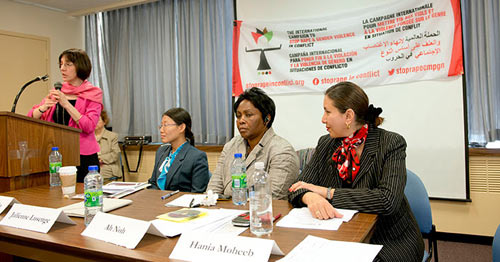
Susannah Sirkin at CSW 57

Susannah Sirkin moderating a side-event panel at the 57th Session of the UN Commission on the Status of Women. Julienne Lusenge, Solidarité Féminine Pour la Paix et le Développement Intégral, Ah Noh, Women’s League of Burma, and Hania Moheeb, Egyptian journalist and activist are listening.
Blog

PHR Joins Coalition to Arrest Sudanese President Omar al-Bashir

Four years ago today, the International Criminal Court (ICC) issued an arrest warrant for Omar al-Bashir, President of Sudan, on seven counts of war crimes and crimes against humanity including killings, rape, and torture. On July 12, 2010, Bashir was also charged with three counts of genocide.

PHR investigated the violence in Darfur for which Bashir and others were responsible. The Sudanese government’s attacks on civilians took hundreds of thousands of lives and displaced several million people from their homes. In PHR’s reports Darfur: Assault on Survival and Nowhere to Turn: Failure to Protect, Support and Assure Justice for Darfuri Women, PHR documented the devastating effects of violence on lives and livelihoods as well as the pervasive nature of rape and other forms of sexual violence and the long-term impact of such abuse. Although such extreme violence has lessened in Darfur, Bashir continues to commit grave human rights violations in other parts of Sudan, including Blue Nile and South Kordofan.

The indictment of Bashir is a first step to holding him accountable for mass atrocities, but because the ICC does not have an independent police force it is incumbent upon countries to use their own initiative to arrest Bashir and others with outstanding arrest warrants from the Court. The whereabouts of Bashir are known — and he regularly visits other countries without fear of arrest. Other countries’ shirking of their legal duties to arrest Bashir emboldens him to continue his campaigns against civilians.

PHR and other human rights groups have joined together to campaign for Bashir’s arrest, which would be a first step to providing a measure of justice to his victims. The coalition of organizations is tracking Bashir’s travels, calling upon heads of state to arrest Bashir when he appears on their territory, and urging the United Nations, the United States, and other influential actors to sanction those that give sanctuary to Bashir and his cronies. See BashirWatch.org for more information.

Blog

Hopes at UN for Galvanizing the World to Eliminate Violence Against Women and Girls

PHR is hoping that the 57th session of the United Nation's Commission on the Status of Women (CSW), an international forum that has dedicated this session to the elimination and prevention of all forms of violence against women and girls, will galvanize efforts around the world to achieve that goal.
 
Members of the International Campaign to Stop Rape and Gender Violence in Conflict, a coalition of organizations dedicated to eliminating the scourge of rape, are addressing United Nations delegations to promote comprehensive and effective solutions to violence.
 
As a key part of the International Campaign, PHR is building momentum to implement innovative approaches to promoting accountability for crimes of sexual violence. The PHR delegation is sharing information about its programs in the Democratic Republic of Congo and Kenya that build connections between the medical and legal communities to bolster local prosecutions of sexual violence.

Here is PHR's oral statement to the CSW:

On behalf of Physicians for Human Rights, an international organization that uses medicine and science to document mass atrocities and advocate for accountability, I am honored to present the following statement at the 57th session of the Commission on the Status of Women. For more than two decades, Physicians for Human Rights has investigated, reported on, and advocated to stop sexual violence and press for accountability in the conflicts in former Yugoslavia, Liberia, Sierra Leone, Sudan, Kenya, the Democratic Republic of Congo, and elsewhere. We have trained health professionals from many countries in forensic methods for documenting these crimes and supporting survivors.

Although justice and accountability efforts are critical, they should not obscure or replace the importance of comprehensive support for survivors and prevention of such atrocities in the first place. Widespread rape has profound consequences for the physical, psychological, and social well-being of survivors and also threatens the community, as these crimes rupture social cohesion and stability.

Mass rape in war occurs at the extreme end of a continuum of violence that is enabled by cultures of impunity and discrimination. Whether sexual violence exists in conflict or peacetime, accountability for these crimes is hampered by the stigma felt by victims, lack of access to medical care and psychosocial support, inadequate or non-existent forensic medical evaluations, and weak and fragile local police and judicial systems. These obstacles to accountability allow impunity to persist, signaling to perpetrators that the world will let them get away with their crimes. Survivors of sexual assault deserve much better from the international community and from their own governments. Members of the Commission on the Status of Women should prioritize strengthening local accountability mechanisms in order to properly address past crimes as well as to prevent future attacks.

Bolstering accountability for sexual and gender-based violence should not be the responsibility of any one sector or profession and should not be left to the legal community alone. We are convinced that eliminating sexual violence will only be successful through committed collaboration across the health, legal, law enforcement and judicial sectors. The decision to pursue prosecution is a decision for the survivor of violence; and for those who bravely come forward in this pursuit the system must be responsive to their needs. It is unconscionable for us to proclaim an end to impunity in the halls of the United Nations, while at the same time abandoning the victims of these mass crimes to unresponsive, unsafe, and under-resourced systems of justice.

Physicians for Human Rights’ pioneering programs are improving local access to justice for survivors of sexual violence in the Democratic Republic of Congo, Kenya, and elsewhere by bringing medical and legal professionals together to successfully prosecute offenders. In the past year, we’ve seen that training and collaboration has resulted in new medico-legal networks that are advancing best practices to properly collect forensic evidence of sexual violence. We’re inspired by the recent use of such evidence to obtain convictions.

But justice does not end with prosecutions. We now need to strengthen the delivery of the reparations that are often awarded by courts but rarely, if ever, delivered. Survivors need financial remedies, health care, psychosocial support, and skills training as well as social and economic reintegration. They need a chance for a hopeful future and a life with dignity. This more comprehensive understanding of justice will truly enable survivors of sexual violence to rebuild their lives, families, and communities. Physicians for Human Rights and our colleagues have documented a strong desire for justice from victims of sexual violence and their communities, and we have witnessed the healing power that legal accountability mechanisms provide for survivors.

In order deliver a meaningful response to survivors of sexual violence and to prevent future crimes, the international community must commit to a dramatically scaled-up global response. Our declarations about this crisis at the CSW must be matched by deeds: Political will at the highest levels and an investment of human and financial resources commensurate with the crisis.

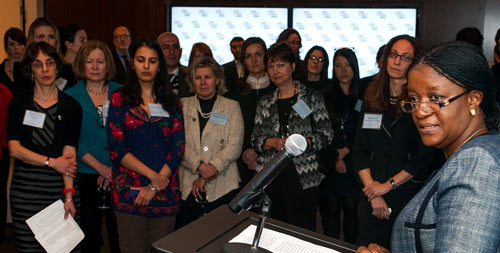
Zainab Hawa Bangura addresses the gathering

Zainab Hawa Bangura, Special Representative of the UN Secretary General on Violence Against Women in Conflict, addresses the gathering at a PHR-hosted reception on the occasion of the 57th session of the UN Commission on the Status of Women, March 7, 2013.
Report

Libyan Human Identification Needs Assessment and Gap Analysis

The identification and repatriation of individuals killed and “disappeared” during the recent conflict in Libya and the previous regime of Colonel Muammar Qaddafi constitute one of the most urgent challenges facing the interim government of Libya. The legitimacy of any future government will be based in part on the way in which these identifications and repatriations, as well as any truth-seeking efforts, are conducted.

Since 2011, PHR has collaborated with the Libyan Ministry for the Affairs of Families of Martyrs and Missing (MAFMM), the Libyan Prosecutor General’s Office (PGO), the Ministry of Interior (MoI), and the UN Support Mission in Libya (UNSMIL) to enhance forensic human identifications.

The “Human Identification and Repatriation of Remains Needs Assessment and Gap Analysis Report” is the result of a request to PHR by the MAFMM, the PGO, and the nongovernmental civil society organization “Free Generation Movement – Mafqood.”

Statements

PHR Joins Letter Urging UN Member States to Support Women’s Rights

Coalition Urges 57th UN Commission on the Status of Women to Pave the Way for Accelerated Action

The International Campaign to Stop Rape & Gender Violence in Conflict today has urged the 57th United Nations Commission on the Status of Women to conclude the session with a strong communiqué that will pave the way for accelerated action to end gender violence. Physicians for Human Rights is one of 11 signatories of the letter, a pdf copy of which can be downloaded here.

The Campaign's press release calling on the UN member states to not allow a minority of governments to weaken global efforts to address gender violence can be read here.


The text of the letter is included below:

March 13, 2013

Dear Delegate,

We, the International Campaign to Stop Rape & Gender Violence in Conflict, call on you as a member state taking part in the 57th United Nations Commission on the Status of Women, to uphold international obligations towards women’s rights and conclude the session with a strong communiqué that will pave the way for accelerated action to end gender violence.

Members from the International Campaign to Stop Rape & Gender Violence in Conflict, including Nobel Peace Laureate and Campaign Co-Chair Jody Williams, joined allies in New York last week to call on member states for strong action to stop rape in conflict.

As negotiations towards a final outcome enter the second and final week, we are alarmed that a number of states are using the Commission to reverse hard-won progress the global community has made in the past couple of decades to eliminate violence against women.

At a very minimum, the Commission on the Status of Women must uphold the universally agreed-upon language on women’s rights including CEDAW, the General Assembly’s Declaration on the Elimination of Violence Against Women (1993), the Beijing Platform for Action (1995), and UN Security Council Resolution 1325 (2000).

The Campaign is deeply concerned about efforts to remove reference to language specific to these international agreements on women’s rights from the Commission’s final documents. In particular, certain states adamantly claim that religious or cultural traditions should take precedent over ending violence against women. As an international Campaign with members in more than 125 countries, we stress that religion or culture must never be used as an excuse to perpetuate gender violence.

Furthermore, we are concerned that some states are again making sexual and reproductive rights a point of contention, and equally disturbing, are objecting to language that will define rape to include forced sexual acts with a partner.

Gender violence is a global epidemic, ranging from domestic violence to systematic rape in conflict. To end a UN Commission intended to address gaps in current responses to gender violence with weakened global cooperation to end violence against women, sends a message to perpetrators that they can continue their crimes with impunity. Survivors deserve more from the international community.

It is imperative that the international community reaffirm its commitment to women’s rights. We remind you that current discussion of new targets for when the Millennium Development Goals expire in 2015 is ongoing, and the statement from the Commission will impact this process.

We urgently call on member states of the Commission to show strong leadership to prevent violence against women and rape in conflict, to protect women and girls from violence, including through provision of needed psychosocial and medical services, and to provide survivors with access to comprehensive justice mechanisms including prosecution of perpetrators.

In order to advance both national and international justice mechanisms to address serious crimes of gender violence, we call on you to support the adoption of an amendment proposed by Liechtenstein that would further justice for survivors by supporting the complementary and necessary work of the International Criminal Court.

As thousands of women and survivors of gender violence have gathered in New York for this historic moment as the United Nations prioritizes ending violence against women, and millions more around the globe watch intently, we hope you will listen to our collective call for action and emerge with a final statement that provides a clear path of action to end the epidemic.

Sincerely,

Jody Williams

Nobel Peace Prize, 1997
Co-Chair, International Campaign to Stop Rape & Gender Violence in Conflict
Chair, Nobel Women’s Initiative

Autonomous Women's Center, Serbia
Association for Women’s Rights in Development
Catholics for Choice
Fonds pour les Femmes Congolaises, Democratic Republic of Congo
Global Fund for Women, United States
Human Rights Watch, United States
Infoteka, Bosnia & Herzegovina
JASS Just Associates
Liga de Mujeres Desplazadas, Colombia
Observatorio Genero Democracia y Derechos Humanos, Colombia
Physicians for Human Rights, United States
Solidarité Féminine pour la Paix et le Développement Intégral, Democratic Republic of Congo
Sonke Gender Justice, South Africa
V-Day
Women's League of Burma
Women’s International League for Peace and Freedom
Women’s Media Center’s Women Under Siege Project
Women's Network Croatia
World Pulse
 

Get Updates from PHR