
Blog

Secretary Clinton's Visit to Burma Must Highlight Ethnic Abuses

From a quick glance at this week’s newspapers, it seems likeBurma has made significant progress in its path to democracy and has turned acorner on its sordid history of oppression and human rights abuse. Worldleaders from Asia to North America are applauding the Burmese government’srecent advances, and President Obama used the changes as motivation to sendSecretary of State Hilary Clinton to Burma. She will be the first U.S.Secretary of State to visit the country in 50 years, and her visit may signalincreased willingness on the part of the U.S. government to engage with Burmeseleaders. Secretary Clinton should use her trip as an opportunity to lay out aconcrete roadmap to bring to an immediate end Burma’s ongoing human rights violations and to establish accountabilityfor past atrocities.

While Indonesia’s Foreign Minister said that he is notfocusing on Burma’s past when considering that government’s fitness for thechairmanship of the Association of Southeast Asian Nations (ASEAN), the UnitedStates needs to be an unequivocal voice for human rights  in the international community. The ambiguousapproach the Obama Administration had taken through the first months of itstenure has utterly failed, and it is crucial that the United States applies thelessons learned from the previous unconditional engagement approach. The worldshould not forget that the heinous attacks of the Burmese government on ethnicminorities are not relics of Burma’s past but a practice that persists eventoday. Local groups have been documenting attacks on ethnic communities, whichhave continued unabated during the government’s announcements of progress.These attacks take place in rural areas of Burma, far from the eyes ofmainstream media, embassy officials, and visiting dignitaries.

Over the last 12 months the Burmese Army destroyed orrelocated 105 villages, displacing 112,000 people, according to the Thai-Burma Border Consortium. Most of these villages were in ethnicareas. The Kachin Women’s Association of Thailand is callingfor the release of four women held as sex slaves by the Burmese Army in KachinState, northern Burma. A Physicians for Human Rights (PHR) investigatordocumented war crimes committed by the Burmese Army in Kachin State inSeptember, and just this month Christian Solidarity Worldwide reportedthat in Kachin State the Burmese Army fired into a church, tortured the pastor,and forced 50 members of the congregation to porter military supplies. If theinternational community applauds the Burmese government for incrementaladvances while ignoring its systematic violence against ethnic groups, thegovernment will have a free pass to continue its violations with impunity.

There have been some recent changes in Burma, and theyshould be recognized. The government changed its restrictions on politicalparty participation, and now the previously barred National League forDemocracy, the party of Nobel Peace Prize laureate Aung San Suu Kyi, willregister and operate within the national political system. The government also releasedapproximately 200 political prisoners in October 2011 and established anational human rights commission.

These acts, while beneficial, do not sufficiently addressthe rampant human rights violations that continue in the country. Last month’srelease of some political prisoners is a welcome advance, for example, but this“reform” is not permanent. The prisoner release was not accompanied by athorough revision of Burma’s penal code, which continues to restrict freeexpression and political activity. And while the creation of the human rightscommission, for example, is an essential first step to monitoring violationsand protecting human rights, the real test is yet to come. It is too early totell whether the domestic human rights body will be an independent andefficient vehicle for human rights protection in the country.

Even more dismaying is Burma’s indication that it is usingannouncements of releases of prisoners solely to curry favor with theinternational community. Last week, when ASEAN was deciding whether to allowBurma to take the chairmanship of the regional body in 2014, there was chatterabout a pending release of political prisoners. The regional body may have usedthis apparent willingness to change to support its decision to grant Burma thechairmanship. When ASEAN made its decision to offer the chairmanship to Burma,the government then chose not to go forward with the prisoner release, althoughthey did move some prisoners from one facility to another. While there is stilltalk of a release in the near future, even casual observers can see that someof the recent announcements of change coming from the Burmese government arehollow attempts to gain political concessions. Secretary Clinton and the restof the Obama Administration should not fall into this trap and instead focus onongoing human rights violations in the country.

Secretary Clinton has an opportunity to call attention toattacks on ethnic groups during her upcoming visit. She will have the chance toamplify the voices of people who have long suffered at the hands of the Burmesegovernment, including minority women who have been attacked by the Burmesemilitary. Secretary Clinton has been a longtime advocate of women’s rights, andshe should continue to combat violence against women wherever it occurs – evenif it occurs against a backdrop of political concessions.


Multimedia

Released Iranian AIDS Doctors Share their Story

On November 9, 2011 Physicians for Human Rights welcomed brothers Doctors Arash and Kamiar Alaei to the National Press Club in Washington, DC for one of their first joint public appearances since their release from Evin prison in Tehran, Iran.

The doctors are renowned Iranian physicians and HIV/AIDS leaders detained in June 2008 by Iranian authorities without charges or trial. They were held in Tehran’s notorious Evin prison for more than six months.

Then, on December 31, 2008, the brothers were tried in a one-day, closed-door trial as conspirators "working with an enemy government” to overthrow the government of Iran. On January 19, 2009, the Alaeis were convicted—Kamiar was sentenced to three years in prison and Arash was sentenced to six.

The Alaeis’ real “crime”? Traveling the globe and liaising with other health workers to find solutions to the HIV/AIDS pandemic. The government used the doctors’ travel to international AIDS conferences as a basis for their imprisonment that has harmed Iran’s ability to be a worldwide medical leader and protect the health of its people.

Following a massive global campaign spearheaded by PHR, Kamiar was quietly released after over two years of detention in late 2010. His brother, Arash, was recently released as well, and has just arrived in the US to join Kamiar and continue his studies and critical public health work.

Blog

Report Card: GOP Candidates on Waterboarding

Atthe recent Republican debate, the presidential candidates were asked if waterboardingis torture. Their answers were shocking, in more ways than one. Even if RonPaul and Jon Huntsman hadn’t blown the curve, everyone else would have failedthe human rights test miserably. Their grades would not have earned them any goldstars:

  • HermanCain:  F-
  • MittRomney:  F-
  • MichelleBachmann:  F
  • RickPerry: F
  • RonPaul:  A+
  • JonHuntsman:  A+

HermanCain and Mitt Romney come in dead last because both candidates do not believethat waterboarding is torture – for the record, waterboarding is torture and itis illegal under domestic and international law. Someone who does not know orrespect the law on this important issue does not deserve to be a leader in thefree world.

MichelleBachmann and Rick Perry fair only slightly better because, while neither candidatewas willing to take the position that waterboarding is not torture, both are willingto use it. Bachmann stated that it is “very effective” and Perry certainlyimplied as much with his impassioned defense of it: “For us not to have the ability to extract information to save ouryoung people’s lives is a travesty. This is war. And I am for [using anytactics] … and I will be for it until I die.”

Sadly, Perry and Bachmann havenot been doing their homework. Top military officers, suchas General David Petraeus, who now runs the C.I.A., have stated that such formsof torture are useless for gathering reliable intelligence. In fact, theseforms of torture have been called detrimentalto the security of American forces as well as the nation’s reputation.

Ron Paul and Jon Huntsman deserve top honors for their willingnessto speakout loud and clear, perhaps to the dismay of their own party. “Water boardingis torture,” said Ron Paul, “it’s illegal under international law, and our law.It’s also immoral.”  PHR gives JonHuntsman extra credit for giving the best explanation:

"We diminish ourstanding in the world and the values that we project, which include liberty,democracy, human rights and open markets, when we torture…We should not torture. Waterboarding is torture. We dilute ourselves downlike a whole lot of other countries. And we lose that ability to project valuesthat a lot of people in corners of this world are still relying on the UnitedStates to stand up for them."

Following the debate, we heardcommentary from other important quarters. Here are their grades:

  • PresidentObama:  A
  • John McCain:  A
  • Rep. Allen West(Fl): F-

PresidentObama, who banned waterboarding in 2009, said twice in the aftermath thatwaterboarding is torture and “contrary to American’s traditions” and “ideals.”McCain gets a good grade as well for tweeting his disappointment in the GOPcandidates and stating that “waterboarding is torture.” It is not easy to dothe right thing in the face of opposition. Indeed, Obama knows a little too well the pressures of appearing toughon national security and were we to give him a grade on accountability fortorture, for example, he would be no better than a below-average student.  Lastly, Representative Allen West gets afailing grade and should report to detention immediately. He reportedly statedthat waterboarding is legal and useful, and “Furthermore, in the movie ‘G.I.Jane,’ Demi Moore was water boarded.” This last comment is more absurd than thefirst. Performing a dangerous and illegal practice on people is neverjustified, and certainly not on the basis of a Hollywood movie.

Waterboardingis torture and it is illegal and ineffective. And, it is un-American.


Blog

Guatemala Elects Former Military General Accused of Torture, Genocide

Last Sunday, former military general Otto Perez Molina, was elected to be Guatemala’s next president. Mounting evidence of PerezMolina’s participation in crimes against humanity and genocide during Guatemala’s internal armed conflictraises the question of how the international community will respond to the newhead of state.

Perez Molina served as a commanding military officer in theIxil region of the Quiche department in the mid- 1980s. Under his leadership,the Guatemalan military carried out a brutal counterinsurgency campaign thatescalated into genocide of the Maya Ixil people. As National Director of MilitaryIntelligence during the 1990s, Perez Molina is also implicated in torture and forceddisappearances.  He allegedly ran asecret torture center on the Mariscal Zavala military base while on the CIA’spayroll during this time.

Perez Molina has not only denied participating in war crimesbut has publically claimed that genocide in Guatemala did not occur. These denialsfly in the face of a 1999 UN Truth Commission report that the Guatemalan armycarried out daily acts of torture and terror in the Ixil region, and razedbetween 70 and 90 percent of the indigenous villages there.

The election of Perez Molina represents an unfortunate backwardsstep for Guatemala, who has struggled to implement rule of law and transitionto democracy since the Peace Accords were signed in 1996. Civil society andhuman rights organization are strongly concerned because Perez Molina’s administrationwill have the power to support or block on-going reforms of the judicialsystem, state collaboration with the UN International Commission AgainstImpunity in Guatemala (CICIG), and precedent setting human rights cases.

Of particular concern is how Perez Molina will respond tothe on-going prosecution of military officials for crimes committed during theconflict. These prosecutions have languished for over a decade due to pervasiveimpunity in Guatemalan courts and flawed investigations, but have made small strides forward recently under theleadership of Guatemala’s first female Attorney General Claudia Paz. PerezMolina is not a named defendant in the domestic cases, however, the UN Special Rapporteuron Torture and the Spanish National Courts are currently investigating the rolehe playing during the worst years of state repression.

It remains to be seen how the international community willtreat Guatemala’s new head of state. If the US embassy’s congratulatorystatement is any indication, the US will certainly not be leading the effort tohold Perez Molina accountable for the crimes committed under his command.  Before the international community engages indiplomatic relations with Perez Molina, it must develop an effective system forresponding to atrocities committed by State agents and apply universaljurisdiction where states have no functioning judiciary of their own.

Blog

Private Prison Companies Lobby Against Immigration Reform for Their Own Profit

The recent news that the US government deported nearly 400,000 immigrants in the past year has been met with an outcry byimmigrants and advocates around the country who witness the destruction tofamilies and communities caused by these deportations. But one group has beenquietly cheering on the push to detain and deport more immigrants than everbefore. The private corrections industry, led by Corrections Corporation ofAmerica and the Geo Group, has ramped up its lobbying effort at both thenational and local levels to ensure that its detention facilities are used todetain more and more immigrants.

Immigration and Customs Enforcement (ICE), the agency withinthe Department of Homeland Security responsible for running the sprawlingsystem of immigration detention facilities, spends nearly $2 billion annually on detention operations. While only 6% of stateprisoners and 16% of federal prisoners are housed in private prisons, almost half of all immigration detainees are housed in privately-run detention centers, mostlyby CCA and Geo.

With each detainee costing between $122 and $166 per nightto detain, it is easy to see why these for-profit companies fight for tougherimmigration laws and the increased use of immigration detention. In 2009, forexample, CCA spent $1.98 million lobbying the federal government on issuesrelated to private prisons. And in a recent SEC filing, Geo candidly noted that “Our growth depends on our ability tosecure contracts to develop and manage new correctional, detention and mentalhealth facilities … Immigration reform laws which are currently a focus forlegislators and politicians at the federal, state and local level also couldmaterially adversely impact us.”

In addition to lobbying against immigration reform efforts,the private prison industry has been actively involved in crafting laws that would dramatically increase the number of detained immigrants.CCA, for example, is a member of the American Legislative Exchange Council(ALEC), an organization that brings together state legislators and privatecorporations to craft policy. The language of SB 1070, the Arizona immigration law that aims to identify and arrest allundocumented immigrants in Arizona, was largely written in a December 2009 ALECmeeting after its main sponsor, state Senator Russell Pearce, presented hisideas to an audience that included CCA employees. These employees helped turn theseideas into model legislation at the ALEC meeting, and the legislation was laterco-sponsored by 36 Senators, two-thirds of whom were either ALEC members orpresent at the meeting where SB 1070 was created. Thirty of these co-sponsorsreceived donations from private prison contractors in the months after SB 1070was introduced.

The decision to detain someone in an immigration detentionfacility, like the decision to sentence a criminal to a prison term, shouldnever have any connection to the profit goals of corporations like CCA and Geo.The fact that their business models depend on increased detention, which inturn depends on blocking meaningful immigration reform and instituting harsherimmigration laws, makes them much more than a neutral provider of services tothe government. The private prison lobby has consistently shown its ability andwillingness to use its considerable resources to advocate for policies thatserve its bottom line at the expense of the civil and human rights ofimmigrants.


Blog

Join PHR as Released Iranian AIDS Doctors Share their Story

Please join Physicians for Human Rights in welcoming brothers Doctors Arash and Kamiar Alaei to Washington, DC for one of their first joint public appearances since their release from Evin prison in Tehran, Iran.

November 9, 2011,
2:30-4:00 p.m.
National Press Club
Washington, DC

The doctors are renowned Iranian physicians and HIV/AIDS leaders detained in June 2008 by Iranian authorities without charges or trial. They were held in Tehran’s notorious Evin prison for more than six months.

Then, on December 31, 2008, the brothers were tried in a one-day, closed-door trial as conspirators "working with an enemy government” to overthrow the government of Iran. On January 19, 2009, the Alaeis were convicted—Kamiar was sentenced to three years in prison and Arash was sentenced to six.

The Alaeis’ real “crime”? Traveling the globe and liaising with other health workers to find solutions to the HIV/AIDS pandemic. The government used the doctors’ travel to international AIDS conferences as a basis for their imprisonment that has harmed Iran’s ability to be a worldwide medical leader and protect the health of its people.

Following a massive global campaign spearheaded by PHR, Kamiar was quietly released after over two years of detention in late 2010. His brother, Arash, was recently released as well, and has just arrived in the US to join Kamiar and continue his studies and critical public health work.  

Learn more at IranFreeTheDocs.org.

To RSVP please email: events@phrusa.org.

Blog

Dr. Mohammed Ahmed Abdullah Eisa Delivers Lecture at SUNY Downstate Medical Center’s School of Public Health

On September 22, PHR Sudan Program Fellow Dr. Mohammed Ahmed Abdullah Eisa delivered a lecture titled “Human Rights and Health” at the SUNY Downstate Medical Center’s School of Public Health in Brooklyn, New York. The lecture was part of the Scholar Rescue Fund’s Hite Chair Scholar Lecture Series, which appointed Dr. Mohammed to be a visiting academic fellow.

Dr. Mohammed is a physician and professor of medicine from el-Fasher University in Darfur, Sudan, where he has worked extensively to treat and rehabilitate victims of torture and sexual violence. In his SUNY lecture, Dr. Mohammed provided graduate students with a broad overview of human rights and the responsibility of the international community to provide humanitarian assistance to victims of both natural and man-made disasters.

Dr. Mohammed summarized the major international human rights treaties, as well as the frequency with which they are violated. He noted that over half of the world’s governments practice torture, and that the vast majority of casualties in armed conflict are typically civilians.

Speaking from his experience treating victims of human rights abuse in Darfur, Dr. Mohammed described the harsh realities of life in Sudan and his efforts to inform the world about conditions in his country. Citing unpublished data from a medical clinic in Darfur, Dr. Mohammed noted that nearly half of the 325 patients treated between 2003 and 2006 had suffered gunshot wounds, and that evidence of sexual abuse was widespread.

Dr. Mohammed told his audience that improving access to education is one of the most effective ways to fight conflict, particularly in places like Darfur, where 70% of children lack access to schooling. Dr. Mohammed ended his talk by calling on the public health students to use their education and positions to increase access to health and education in communities across the globe.

Statements

Mourning the Untimely Loss of Dr. Paul Epstein

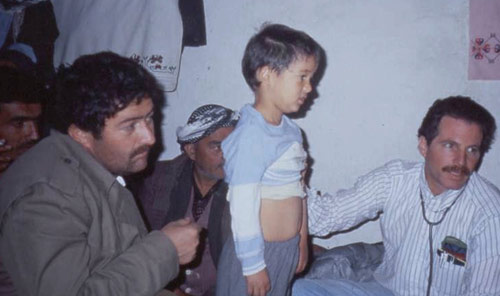
PHR mourns the untimely loss of Dr. Paul Epstein, one of our pioneering medical activists, former Board and executive committee member. Paul joined PHR's Board in 1987 soon after the organization's launch, and participated in several landmark assessments, including the excessive use of tear gas in Seoul, South Korea; landmine injuries in Mozambique (which contributed to the growing campaign to ban the weapon); and the plight of Kurdish refugees following the Persian Gulf War.
 
Paul was also a leading voice for the under-served refugee and immigrant populations in Massachusetts, providing crucial primary care services to the Portuguese community in east Cambridge, where he served for many years as the lead physician in the East Cambridge Health Center.
 
For several generations of medical students and young professionals, he was a model of the physician activist, caring for the individual, one patient at a time, and at the same time crusading for the world so that we might leave behind us a chance for the health and well-being of entire populations and of the planet itself.
 
His knowledgeable and daring voice inspired countless health professionals and activists to campaign for basic human rights, to ban landmines, to prevent disease, and to preserve the planet. We will always remember opening up the paper and reading yet another important piece from Paul—he will be sorely missed.

Dr. Paul Epstein with Kurdish Refugees, 1991

Dr. Paul Epstein investigating human rights violations among Kurdish refugees in 1991.
Report

Under Siege in Kachin State, Burma

In September 2011, PHR conducted an investigation in Burma’s Kachin State in response to reports of grave human rights violations in the region. PHR found that between June and September 2011, the Burmese army looted food from civilians, fired indiscriminately into villages, threatened villages with attacks, and used civilians as porters and human minesweepers.

Key human rights findings of the report include:

  • The Burmese army forced Kachin civilians to guide combat units and walk in front of army columns to trigger landmines.
  • The Burmese army regularly pillaged food and supplies from civilians.
  • The Burmese army fired automatic weapons directly into a civilian village, striking non-military targets.
Read the Under Siege in Kachin State, Burma Executive Summary (pdf)
Read the Under Siege in Kachin State, Burma Executive Summary in Burmese (pdf)

Statements

New Medical Neutrality Exemption to “Material Support” Bar to Asylum is Applauded

Physicians for Human Rights commends Secretary of Homeland Security Janet Napolitano’s decision to create an exemption to the “material support” bar for health professionals who have provided medical assistance to wounded combatants. The decision is a major victory for health professionals who were forced to provide health care to alleged terrorists during armed conflict. Previously, medical professionals forced to provide care to members of terrorist organizations, some under the threat of torture or death, were denied asylum in the US.

For years, PHR has been at the forefront of an effort to include an exemption for health professionals to the “material support” bar. PHR has advocated on behalf of those affected by the bar; those fleeing persecution yet denied asylum because they complied with internationally-recognized ethical duties to treat anyone who is ill or wounded.

In 2006, PHR drew attention to the issue by submitting an amicus brief in support of a Nepalese healthcare worker. The healthcare worker was denied asylum after being forced at gun point to treat a member of a Maoist guerrilla group. PHR has also written literature on the topic, submitted a statement to the Senate subcommittee on Human Rights and the Law, educated members of Congress, briefed DHS, and conducted advocacy on the Hill.

DHS’s sweeping interpretation of the material support bar squarely conflicted with internationally-accepted principles of medical ethics and humanitarian law and contradicted health care providers’ ethical duty to treat anyone in need,regardless of the person’s political affiliation. Denial of humanitarian protection to these health professionals also clashed with US policy which supports medical neutrality and the protection of health workers in war.

About Physicians for Human Rights

Physicians for Human Rights (PHR) is an independent organization that uses the integrity of medicine and science to stop mass atrocities and severe human rights violations against individuals. We are supported by the expertise and passion of health professionals and concerned citizens alike.

Since 1986, PHR has conducted investigations in more than 40 countries around the world,including Afghanistan, Congo, Rwanda,Sudan, the United States, the former Yugoslavia, and Zimbabwe:

  • 1988 First to document Iraq’suse of chemical weapons against Kurds
  • 1996 Exhumed mass graves in the Balkans
  • 1996 Produced critical forensic evidence of genocide in Rwanda
  • 1997 Shared the Nobel Peace Prize for the International Campaign to Ban Landmines
  • 2003 Warned of health and human rights catastrophe prior to the invasion of Iraq
  • 2004 Documented and analyzed the genocide in Darfur
  • 2005 Detailed the story of tortured detainees in Iraq,Afghanistan and Guantánamo Bay
  • 2010 Presented the first evidence showing that CIA medical personnel engaged in human experimentation on prisoners in violation of the Nuremberg Code and other provisions

Get Updates from PHR