Last month President Obama released his detailed budget for Fiscal year 2010. Unfortunately, his budget falls short of what is needed to reach goals outlined in the? President's Emergency Plan for AIDS Relief (PEPFAR) reauthorization bill PHR members helped pass last year.We need your help to make sure Congress and President Obama fulfill their commitment to fight AIDS and other global health crises. This month PHR members are meeting with their member of Congress during their July 4th recess to ask for full PEPFAR funding.Meeting with your Member of Congress is really easy, and we've developed a guide to help you through the process. You can download the guide here and a sample meeting request letter here.We also have some talking points you can use during the meetings, to tell your Members of Congress why funding PEPFAR is so important, and some stories from the field of our partners in Uganda. Download them here, and here.Failing to keep our promise to fight AIDS would be "recipe for chaos." We are hearing from our colleagues on the ground, including?Ugandan HIV/AIDS pioneer Peter Mugyeni, MD, that PEPFAR clinics are already having to turn away patients medically eligible for treatment.With health professional advocacy we can ensure the US keeps its commitments to fight global AIDS.
Perilous Medicine
The Legacy of Oppression and Conflict on Health in Kosovo
This report details the detention, torture, prosecution and killing of Kosovar Albanian physicians by Serbian forces during the 1998-99 war which took place during the decade-long exclusion of the majority of Kosovar Albanian physicians from the state health system.
New Yorker: Former APA President Worked with CIA and on Board of Mitchell and Jessen
Perhaps the most interesting revelation in Jane Mayer’s latest New Yorker article on the CIA and US torture policy comes as an aside, towards the end. Ongoing investigations by PHR and others, including investigative journalists, are discovering disturbing connections between American Psychological Association officials involved in developing the ethics standards governing psychologists’ participation in interrogations and those involved in overseeing and facilitating the Bush administration’s CIA and US military programs of torture. Firedoglake blogger Marcy Wheeler has honed in on the passage in her coverage of Mayer’s piece:
In April, Panetta fired all the C.I.A.’s contract interrogators, including the former military psychologists who appear to have designed the most brutal interrogation techniques: James Mitchell and Bruce Jessen. The two men, who ran a consulting company, Mitchell, Jessen & Associates, had recommended that interrogators apply to detainees theories of “learned helplessness” that were based on experiments with abused dogs. The firm’s principals reportedly billed the agency a thousand dollars a day for their services. “We saved some money in the deal, too!” Panetta said. (Remarkably, a month after Obama took office the C.I.A. had signed a fresh contract with the firm.)According to ProPublica, the investigative reporting group, Mitchell and Jessen’s firm, which in 2007 had a hundred and twenty people on its staff, recently closed its offices, in Spokane, Washington. One employee was Deuce Martinez, a former C.I.A. interrogator in the black-site program; Joseph Matarazzo, a former president of the American Psychological Association, was on the company’s board. (According to Kirk Hubbard, the former head of the C.I.A.’s research and analysis division, Matarazzo served on an agency professional-standards board during the time the interrogation program was set up, but was not consulted about the interrogations.)
Mayer notes, parenthetically, that she has learned from the CIA’s Kirk Hubbard that former American Psychological Association president Joseph Matarazzo sat on the CIA’s professional-standards board at the time when psychologists James Mitchell and Bruce Jessen were developing an interrogation program for the CIA, based on the US military’s SERE training program. Much more remains to be known about the involvement of Mitchell and Jessen, as well as other psychologists, including former senior APA officials, such as Matarazzo. In order to fully understand how psychology and psychologists were used to design, supervise and legitimize a regime of physical and psychological torture, a commission of inquiry, supported by the Administration and authorized by the Congress, is the best way to answer these outstanding questions. In the meantime, investigative reporting by Jane Mayer and others will have to continue asking and answering these questions in lieu of a formal process of accountability for abuses that rise to the level of war crimes.More needs to be known regarding Matarazzo’s role in the CIA, but immediately troubling is that while he was serving on the Agency’s professional-standards board, he was also sitting on the board of Mitchell and Jessen’s firm. According to a 2007 report by the Spokesman Review, public records show that Matarazzo was “one of five ‘governing people'” in the Mitchell Jessen firm.” This is a conflict of interest not unlike the ones we saw for some members of the PENS task force of civilian and military psychologists whom the APA assembled in 2005 to [E]xamine whether our current Ethics Code adequately addresses [the ethical dimensions of psychologists’ involvement in national security-related activities], whether the APA provides adequate ethical guidance to psychologists involved in these endeavors, and whether APA should develop policy to address the role of psychologists and psychology in investigations related to national security. (Report of the Presidential Task Force on Psychological Ethics and National Security [PDF])
PHR has called for the APA to launch an investigation of potential conflicts of interest between the APA and the military and national security community regarding use of psychologists in illegal interrogations. Matarazzo’s service on both the board of Mitchell, Jessen & Associates and on the CIA’s professional-standards board must be part of any such inquiry.
Single Greatest Medical-Ethics Scandal in American History
Jane Mayer has published a new article in the The New Yorker today on US torture policy. Mayer's article centers around her interview with Leon Panetta, the new director of the Central Intelligence Agency, under the Obama administration. The article provides an overview of the Obama Administration's approaches towards and retreats from pursuing accountability for those involved in overseeing and facilitating the Bush administration's CIA and US military programs of torture. Near the article's close, Mayer quotes Nathaniel Raymond, Director of PHR's Campaign Against Torture:
Without a thorough public investigation, it’s difficult to assess the truth behind such contradictory accusations. “Everyone says, ‘It’s over, it’s known,’” Nathaniel Raymond, who works with the advocacy group Physicians for Human Rights, told me. “But what is known? We still don’t know how many detainees were in the black sites, or who they were. We don’t fully know the White House’s role, or the C.I.A.’s role. We need a full accounting, especially as it relates to health professionals.” The recently released Justice Department memos, he noted, contain numerous references to C.I.A. medical personnel participating in coercive interrogation sessions. “They were the designers, the legitimizers, and the implementers,” Raymond said. “This is arguably the single greatest medical-ethics scandal in American history. We need answers.”
Keeping Our Promise on AIDS
On Tuesday, June 9, the Senate Foreign Relations Committee held confirmation hearings for Dr. Eric Goosby to serve as Ambassador at Large and US Global AIDS Coordinator. That same day, nearly 6,000 people living with HIV around the world died—as they do every day—due to a lack of access to life-saving treatments.The stakes are high and the tasks at hand enormous. Dr. Goosby is well qualified to lead the nation's global AIDS efforts, and the Senate should act swiftly to confirm his nomination so that he can quickly bring the full measure of his expertise and experience to bear and provide needed leadership for the nation's extensive global HIV/AIDS portfolio.Dr. Goosby's confirmation and leadership come at an especially pivotal moment. President Obama recently released the outline for the US Global Health Initiative, and the Institute of Medicine published expert recommendations for action on global health. President Obama's vision brings a much-needed integrated approach to fighting diseases, improving health and strengthening health systems around the world.Disappointingly, however, his plan does not call for funding global AIDS programs at the levels called for in the recent reauthorization of the President's Emergency Plan for AIDS Relief (PEPFAR)—a reauthorization co-sponsored by then-Senator Obama. The lack of increased support threatens the further scale up of AIDS treatment and prevention efforts so desperately needed on the ground and called for in the new law.The US has the resources to keep its promise to scaling up HIV/AIDS treatment and prevention programs while at the same time strengthening its commitment to other critical global health initiatives. The administration and the Congress must commit to doing both.PEPFAR's successes are well-documented. More than three million people in sub-Saharan Africa are now receiving anti-HIV treatment and PEPFAR has also provided antiretrovirals for nearly 1.2 million HIV-positive pregnant women around the globe, allowing nearly 240,000 infants to be born HIV-free. A recent study in The Lancet highlighted PEPFAR's role in cutting the HIV/AIDS death toll from 2004 through 2007 by more than 10 percent in targeted African countries.Even with this progress, the demands of the HIV/AIDS epidemic in sub-Saharan Africa are still tremendous, especially among children who are only one third as likely to receive antiretroviral therapy as adults. In total, nearly 5 million of those living with HIV in sub-Saharan Africa who need treatment still do not have access to it. The vast majority of infected pregnant women still do not have access to treatment for themselves or to prevent transmission to their babies.After the initial successes of PEPFAR, the US promised to continue the scale up of HIV/AIDS treatment and prevention programs over the next five years. Stalling that scale-up is, as our Ugandan colleague and HIV treatment pioneer Dr. Peter Mugyenyi says, "a recipe for chaos." Millions are already on treatment and millions of others will become eligible in the years ahead. After urging people to get tested and enter care, providers would be forced to tell them there is no treatment available when they need it. Without adequate annual funding increases, patients will start to share doses or skip treatment all together. The result will be more drug-resistant strains of HIV and rising death rates. That is an unacceptable scenario and would be a tragic outcome of US leadership and investment in the global HIV/AIDS response.We still have time to prevent this course. Fulfilling our promise to scale up global AIDS programs would reflect our nation's deep belief in doing what is right for those in greatest need and at the same time move us closer to the international goal of universal access to HIV treatment and prevention.
Rwandan Medical Intern Seeks Progress in Healthcare
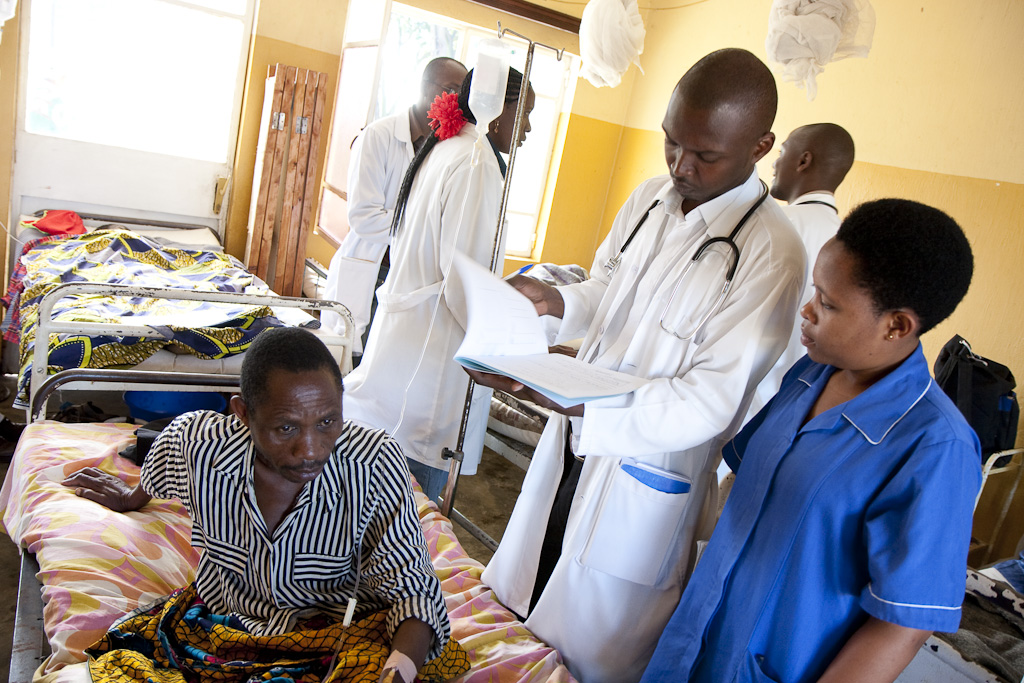
Janvier Yubahwe, a medical intern at Ruhengeri District Hospital in northern Rwanda, starts his day around 6:30 a.m. with a 15 minute walk to the hospital from his house. Recently, photographer Greg Kendall-Ball and I spent the day at the hospital with Janvier and his colleagues, learning more about the life of a doctor in Rwanda.The sun rises early here, so it was already bright and clear when we left Janvier’s house and made our way to the hospital with the hundreds of other people also walking to the market or to their work places. The volcanoes of the Virunga Mountains rose up behind us, and the dirt roads were black with volcanic rock—a contrast to the dark orange-red soil that characterizes much of the rest of this region.
By 7 am on this Monday morning, the staff of Rugengeri District Hospital gathered for the weekly all-staff meeting. Doctors, interns, nurses, lab staff and pharmacists sat on benches in a small room in the hospital to review cases from the week just past. Any deaths that occurred over the weekend were reported and discussed. Each department presented at least one difficult case for review by the specialists and other staff. General announcements—about H1N1 flu precautions, the next quarterly evaluation of the staff and hospital, and the visit from Physicians for Human Rights—closed the meeting, and the staff dispersed to their departments.Ruhengeri District Hospital is a high-performing and busy hospital serving somewhere between 380,000 – 400,000 people. District Hospitals in Rwanda are usually staffed only by medical officers with bachelor’s degrees in medicine, with specialists (those who have gone on to do a Masters degree) working only in the National Referral Hospitals. But Ruhengeri is home to a number of foreign specialists who have been recruited through partnerships between the hospital and outside universities or development agencies, making them an informal referral site for other district hospitals in the region.
Strong Political Will Brings Incredible Progress
Rwanda has made significant strides in strengthening and expanding the health workforce over the past few years. According to the Human Resources for Health Strategic Plan (2006-2010), in 2005 health centers and district hospitals met less than 30% of the required staffing norms. And, at the time of the drafting of the Health Sector Strategic Plan 2005-2009, the doctor to population ratio was 1 doctor to 50,000 people and the nurse to population ratio was 1 to 3900. Today, according to the Ministry of Health, Rwanda currently has one doctor for every 18,000 people and 1 nurse for every 1700 people. Although this is still not enough health workers to provide all the services needed to the population, it does demonstrate incredible progress and strong political will.Health outcomes also reflect this progress. The maternal mortality rate in Rwanda has dropped from 1,000 deaths per 100,000 live births, to 750 deaths per 100,000 over the past few years. Between 2005 and 2007, infant mortality decreased from 86 deaths per 1,000 live births to 62 deaths per 1,000. Although these rates are still far too high, the rapid decrease indicates that Rwanda is working hard to improve the health of its population.
Better Access to Health Services
The health workers and administrators I spoke with praised the social health insurance program—“Mutuelle de Sante”—for significantly increasing the number of people who are able to access health services. At a cost of about $2 a year for enrollment and then 10% of services and medicines costs when visiting a hospital or health centre, health care is more affordable for the poor. The percentage of insured in Rwanda jumped from 3% in 2002 to 75% in 2007, and current estimates of insurance coverage are now as high as 95%. Health facility utilization has also increased from 25% in 2001 to 72% in 2007, an increase that direct correlates with the initiation of the social health insurance program.
Lingering Concerns and Challenges
Despite this significant progress, the doctors and nurses we spoke to still articulated many of the same concerns and challenges that are present across Sub-Saharan Africa. The workload is still too much for the few health professionals available. The skill and training of the health professionals available at the district and community levels does not match the needs of the population. There are not enough trained midwives to assist in all the deliveries, contributing to the high rates of maternal and child deaths. Advocacy is still needed to encourage continued improvement within the health sector.As he finished seeing his last patient for the day, Janvier said:
Sometimes we see problems, and sometimes we see opportunities that we can use to solve people’s problems. But if everyone just keeps quiet, there will be no change. I think that we as health professionals have to advocate, because it’s the only way that will bring about a positive change.
Action Needed on PEPFAR: Update from Uganda
While in Uganda last week I met with PHR Health Action AIDS Advisor Dr. Peter Mugyenyi, the Director of the Joint Clinical Research Centre (JCRC), which provides care to thousands of people living with HIV/AIDS. You may remember that Dr. Mugyenyi was in DC in March with PHR to provide an update on the impact of PEPFAR (the President's Emergency Plan for AIDS Relief) in Uganda and highlight the importance of continued robust funding to meet the needs of people living with HIV in Sub-Saharan Africa.During his visit, Dr. Mugyenyi described the dire situation facing many HIV patients in Uganda. I learned on my recent trip that the situation has not improved. Dr. Mugyenyi remains extremely concerned about the fate of the 150,000 people living with HIV/AIDS in Uganda who are currently on treatment.Funding for PEPFAR-implementing partners like JCRC in Uganda was flat this year, instead of being scaled up as is needed and was expected after the 2008 reauthorization of PEPFAR. JCRC, which is providing AIDS treatment to more than 40,000 people, has no guarantee of funding after September 2009. Current contracts for treatment have yet to be negotiated due to the rebidding process for the new PEPFAR. If the contracts are not settled quickly, organizations like JCRC, which have successfully scaled up care and treatment services for thousands of HIV/AIDS patients over the past five years, will have to drastically cut their services in the next few months.With the flat-lining of the budget this year and the growing fear that there will be no new PEPFAR funding in the next fiscal year, JCRC has already been forced to make difficult decisions regarding patient care. Dr. Mugenyi has implemented new cost-cutting measures for all JCRC sites. For example, a new triage system for HIV-positive patients puts only the most critical cases on treatment, as opposed to offering treatment to all those who qualify based on the progression of their HIV disease. Such a system is contrary to the current standard of care for HIV, but it is the only way for JCRC to ensure that medications are available for the most critically ill.Dr. Mugyenyi is also ordering cheaper medicines – some with increased side effects – in order to save money and ensure enough medicines are available. And, JCRC is limiting the quantities of medications that patients can take away with them on each clinic visit in order to ration dwindling supplies. For those living in remote or rural areas, this will add an additional obstacle that may very well be the difference between life and death.With a reduction in funding, JCRC runs the real risk of staff layoffs that will further complicate and reduce PEPFAR’s ability to address Uganda’s HIV/AIDS crisis. Fewer staff means fewer HIV screenings, fewer CD4 tests, less monitoring of opportunistic conditions, and a weakened health system less capable of addressing HIV/AIDS and other endemic health conditions.Thousands of lives are at risk. At a minimum, Congress and the Administration must fully fund PEPFAR at the authorized level of $48 billion through FY’13. Yet, President Obama’s global health initiative calls for just $63 billion over six years for all global health programs, including HIV. The proposed funding levels for global health programming are far below what is needed and the minimal requested increases for PEPFAR are a major setback for the millions of people living with HIV throughout the world. We can’t back down now. Our partners across the globe like Dr. Mugyenyi have devoted their careers and their lives to stopping the spread of HIV and they are counting on our continued leadership and support.
Sign Up for Fall International Forensic Program Training Course
Summer is here, and the International Forensic Program’s fall training course is coming up fast:Forensic Laboratory and Medical Examiner Office Operations will be held in Fort Worth, Texas from October 18-30, 2009. Students will develop a working knowledge of available forensic services and reporting, and an understanding of the necessary quality control measures in producing court usable evidence. Applications are due July 1.It’s also never too early to start planning for our spring course – Crime Scene and Evidence Documentation. The 2010 course will be held in Tallahassee, Florida from April 20-24, 2009. Students learn the essentials of digital forensic photography, note taking, sketching and chain of custody. Alumni will be able to document evidence of human rights violations in a manner which will be admissible in court at a later date and maximize the information shared with other experts.These courses are designed for human rights field investigators and are also appropriate for medical professionals, employees of human rights NGOs, journalists and anyone who might need to document human rights violations or utilize and evaluate forensic services.Odongo Odiyo, MD from Kenya had this praise for the course:
This forensic course is very key and it is one of the most important courses that I think I've ever attended.
More information on the training programs offered by the IFP is available on the courses homepage. In addition to our annual courses, we are available to offer customized training programs in forensic services and documentation.
Sondra Crosby, MD on Her Work with Darfuri Women
Sondra Crosby, MD is one of the four members of the Physicians for Human Rights field team that went to the Farchana refugee camp in Chad last November to gather the data for the new PHR report, Nowhere to Turn: Failure to Protect, Support and Assure Justice for Darfuri Women. Boston Globe reporter James F. Smith interviewed Dr. Crosby and posted these video excerpts from their conversation on his blog at the Globe.
Health Professionals to Immigration Agency: Medical Care Is Not "Terrorism"
Over 100 health professionals sent a letter (pdf) urging the Secretary of the US Department of Homeland Security to stop denying entry into the US to health professionals who have treated wounded combatants.
In the letter, the PHR Board, Asylum Network members, and others said the “material support” to terrorism bar to admission is interpreted too broadly and should not be used to deny asylum and other immigration protections to health professionals.
The health professionals signing the letter protested the policy that denies doctors and nurses the opportunity to seek immigration status in the US merely because they have complied with internationally recognized ethical duties to treat anyone who is ill or wounded.
The urgency of this problem is illustrated by recent cases of health professionals who have been forced to seek US protection due to torture or fear of persecution in their home countries have been denied by immigration authorities or or remain in limbo due to the “material support” bar:
- a Sudanese doctor who, in his role as a humanitarian NGO physician, provided medical assistance to injured members of the Sudan Liberation Army (SLA)
- a Nepalese health worker who is seeking asylum after having been kidnapped by a Maoist group that required him to attend to a wounded rebel
- a Colombian nurse who was kidnapped by the Revolutionary Armed Forces of Colombia (FARC) and forced at gunpoint to provide medical care to its members
The PHR letter emphasized that the current US position conflicts with its obligations under the Geneva Conventions to protect health workers in conflict and with a longstanding US history of condemning violations of medical neutrality.
PHR and all of the letter signers urged DHS to restore the US commitment to medical neutrality by excluding the provision of medical care from the definition of “material support.”