
Press Release

PHR Letter to Turkish President Demands Charges Be Dropped Against Physician Human Rights Defenders

Physicians for Human Rights (PHR) has sent a letter to Turkish President Recep Tayyip Erdoğan expressing grave concern about the sentencing on December 19 of Dr. Şebnem Korur Fincancı, a world-renowned forensic medical expert and president of the Human Rights Foundation of Türkiye, to two years and six months in prison for signing a peace petition in 2016 with other respected Turkish academics.

Fincancı, who is also the former head of the Department of Forensic Medicine at Istanbul University’s Medical Faculty and a former member of the Istanbul Chamber of Medicine Honorary Committee, joined with others as a group known as “Academics for Peace” to sign the document entitled “We will not be party to this crime,” which called for a peaceful solution to conflict in southeast Türkiye between the outlawed Kurdistan Workers’ Party and Turkish security forces.

The letter, authored by PHR’s executive director, Donna McKay, reads, in part: “Dr. Fincancı, a globally-known human rights defender and the president of the Human Rights Foundation of Türkiye, is one of the world’s leaders in the documentation of torture…. She is one of thousands of peaceful protesters who are being punished in Türkiye merely for speaking out in favor of fairness, justice, and respect for human rights…. Just over one week ago, Dr. Gençay Gürsoy, founder and former president of the Turkish Medical Association, was sentenced to two years and three months in prison on the same false charges as those levied against Dr. Fincancı…. I respectfully urge you to immediately and unconditionally drop all charges against Dr. Fincancı and her colleagues, who we believe are being targeted merely for peacefully defending human rights and practicing their right to free expression.”

Copies of the letter were sent to Türkiye’s Grand National Assembly Speaker Binali Yıldırım, Turkish Justice Minister Abdulhamit Gül, Turkish Foreign Minister Mevlüt Çavuşoğlu, Turkish Minister of Health Fahrettin Koca, Türkiye’s ambassador to the United States, Serdar Kiliç, and Türkiye’s permanent representative to the United Nations, Feridun Hadi Sinirlioǧlu.

Read PHR’s letter to Turkish President Recep Tayyip Erdoğan here.
Read PHR’s earlier statement regarding Dr. Fincancı’s sentencing here
Read a statement from the World Medical Association here

Sign our petition calling for the dropping of all charges. 
Blog

Tijuana’s Tragedy: Central American Asylum Seekers

The caravan of more than 5,000 Central American asylum seekers who risked life and limb traveling weeks from Honduras to the Mexico-U.S. border at Tijuana probably thought that they didn’t have much left to lose.

Recent torrential rains in Tijuana proved them wrong.

Within hours, the deluge filled the uncovered Benito Juarez sports facility where the group had taken shelter two weeks prior. That downpour turned their tent city into a flooded cesspool that claimed much of what little they still possessed.

On November 30, I navigated the Benito Juarez site with a team of three Physicians for Human Rights colleagues and one of our Los Angeles-based medical partners. Just 36 hours previously had stood an encampment of tired-but-hopeful men, women, and children seeking to exercise their right under international law to apply for asylum in the United States. Now I saw a sad, sodden landscape of discarded wet blankets, sleeping bags, clothing, and children’s toys.

Around us, people packed up their salvageable belongings and moved toward Mexican government-supplied buses that would take them from the flooded facility to an abandoned outdoor concert venue that the authorities are repurposing as a longer-term shelter for asylum seekers. Above them was the constant drone of California’s San Diego Sector Border Patrol helicopters that hovered over the site, a simultaneous act of surveillance and intimidation that conveyed the unmistakable message that the asylum seekers are not welcome in the United States. Late last month, White House Chief of Staff John Kelly reportedly authorized the more than 5,000 U.S. military personnel deployed to the border in advance of the asylum seekers’ arrival in Tijuana to repel them from crossing the border with measures including “a show or use of force (including lethal force, where necessary).”

This kind of official U.S. government hostility is no news to the asylum seekers in Tijuana. The multi-racial, multinational grouping from Africa, the Caribbean, Central and South America, and southern Mexico totaled an estimated 3,000 people even before the arrival of the recent caravan. But it was the caravan which put the spotlight on Tijuana when it was exploited as pre-midterm elections political fodder for U.S. President Donald Trump, who demonized it as an “invasion” and banned anyone who crosses the U.S.-Mexico border between official border crossings from entering the asylum process – a move which violates the United States’ obligations under both domestic and international laws.

The San Diego Sector Border Patrol reinforced that hostility on November 25, when it used tear gas to disperse a group of hundreds of asylum seekers who broke off from a peaceful demonstration at the border in Tijuana and attempted to rush the border fences. Border Patrol authorities have defended the use of tear gas on the basis that “there were also assaults against [border patrol] personnel, with multiple U.S. Border Patrol agents hit by rocks,” but the collateral damage of that incident included the gassing of several women and children in the group, exposing them to the risk of severe physical and psychological health impacts.

But tear gas is one of the U.S. government’s cruder tools to deter asylum seekers from pursuing their legal right to apply for asylum. Its silver bullet of asylum-seeker deterrence is a policy called “metering,” which strictly limits the flow of those thousands of asylum seekers awaiting application interviews to a trickle of only 15 to 30 per day. In a city in which thousands of asylum seekers with little or no means of subsistence are relegated to weeks or months of uncertain waiting at the border for an opportunity to apply for asylum, “metering” is the equivalent of a bureaucratic war of attrition. It pits the limitless resources of the U.S. government against those of desperate, impoverished asylum seekers and effectively weaponizes hunger, fear, and frustration to drive away asylum seekers more effectively and discretely than tear gas or truncheons.

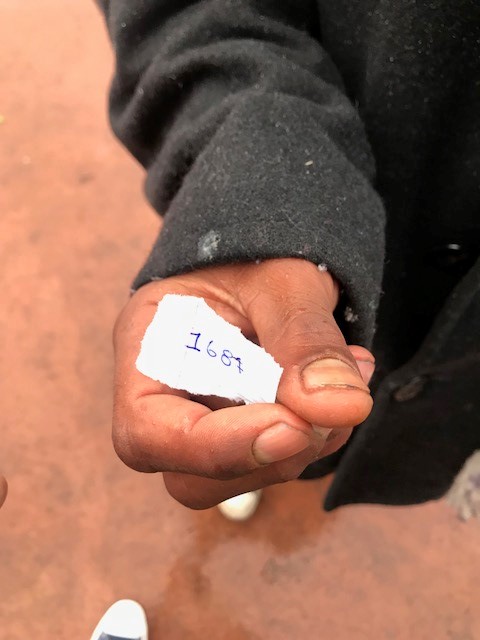
Asylum seekers have devised a system that attempts to grapple with the U.S. government’s chokehold of metering. In the corner of a small plaza outside the entrance to the west pedestrian access route from Tijuana to San Ysidro on the U.S. side of the border, asylum seekers patiently line up at a table to register their names and details into a handwritten book of all prospective asylum applicants to the United States. Asylum seekers are placed in a queue with an assigned number.

On November 29, I spoke to some of the people in that queue. They included a man from Cameroon fleeing political violence in his country. “If I go back home, I’m dead,” he told me of the threats to his life in his home country. Two weeks ago, he registered in the book and was given a number in the mid-400s. Moments later, a Honduran asylum seeker who had only just arrived in Tijuana walked away from the desk holding number 1687 in his hand. He joins the ranks of those already facing indefinite waits for an asylum application interview – a process that condemns them to penury and humiliation and fuels desperation that can prompt them to return home to potentially deadly peril or seek alternate routes over the border in search of sanctuary in the United States.

Those alternate routes may be dangerous, but might offer asylum seekers better odds of getting to the United States than formal asylum claim channels. Syracuse University’s Transactional Records Access Clearinghouse (TRAC) this week published a report indicating that immigration judges rejected a record-high number of asylum cases this year – 65 percent of the more than 42,000 total asylum applications decided in the fiscal year ending September 30, 2018. That total marks the highest number of such rejections since the TRAC started compiling the data in 2001.

It shouldn’t be this way.

People escaping persecution and torture who come to the United States have the right to apply for asylum and protection under the UN Convention Against Torture (CAT), an international treaty which the United States signed and ratified. The CAT stipulates that asylum seekers are allowed to remain in the United States legally and avoid deportation to countries where they may be harmed. The U.S. government has a legal obligation under the United Nations Refugee Convention to conduct individualized screenings of migrants arriving at U.S. ports of entry who are fleeing persecution in their countries of origin.

Refugee status was established in order to provide international protection for those with no other option – those whose governments are unable or unwilling to protect them at home. In countries where widespread violence and intimidation of citizens go unchecked, and where governments refuse to investigate or punish perpetrators, victims may have no choice but to flee. 

The U.S. Department of Homeland Security and U.S. Customs and Border Protection should provide sufficient measures for managing the arrival of migrants instead of fortifying the border with military troops and deploying tear gas against desperate women and children. The U.S. government should be using its resources to establish a humane immigration system and border enforcement policies that preserve health and human rights, rather than scapegoating those fleeing violence in their home countries. The thousands of asylum seekers waiting patiently in line in Tijuana deserve nothing less.

Multimedia

#PrioritizeLivesNotWalls

Thousands of migrants make their way to the U.S.-Mexico border each month in search of asylum. Many are fleeing violence and persecution. PHR recently sent a team to Tijuana, Mexico to assess the situation on the ground and to evaluate conditions. One mother, who fled a dangerous life in southern Mexico, spoke to us about her fears. She has two daughters, aged six and nine.

Every person who is escaping violence in their home country, and who has a credible fear of persecution, has the right to seek asylum in another country. Under both domestic and international laws the United States has an obligation to give asylum seekers the opportunity to bring their cases forward in a safe and dignified setting which respects their basic human rights.

Blog

Los Angeles Doctors Speak Out About Migrant Caravan: “We Swore an Oath to Protect Human Life”

Physicians across the United States, and across political aisles, share one trait: We swear an oath to protect our patients and to serve humanity. As practicing physicians in Los Angeles County, who provide care over the border in Tijuana and work with asylum seekers and refugees on a regular basis, we cannot stand by while a group of Central American civilians fleeing violence and seeking a better life are threatened with human rights violations.

President Trump has called the caravan of civilians which has arrived in Tijuana an “invasion,” and stated that it contains dangerous gang members and “unknown Middle Easterners” – without offering any proof to back up his statements. He dispatched thousands of troops to the southern border of the United States to deal with the group of migrants without pausing to consider the estimated 2,300 children among them. It was this type of rhetoric that inspired the Trump administration’s enforcement of a “zero tolerance” policy which forcibly separated thousands of children from their families
– children who are, in far too many cases, still living without their parents.

This dehumanizing language sparks panic and fear in our immigrant patients whom we treat on a daily basis in southern California. They’re so afraid of being apprehended by authorities that they often delay or forgo vital emergency care. The tragic result is that doctors like us in Los Angeles regularly witness preventable deaths and avoidable illness. As physicians, we have a duty to educate when misinformation threatens the health of our communities. That is why we are speaking out.  

Safety in Numbers

It was no surprise to us that the asylum seekers formed a caravan instead of trickling in in smaller clusters. Terrified to return to their homes, and fearful of braving the dangerous road north alone, families, children and individuals gathered together to make the long journey as a large unified group, in order to protect one another from kidnappers and traffickers.

They arrived with predictable pathology related to exposure along the grueling journey: sunburn, blisters, and swollen feet from walking dozens of miles a day in high temperatures, heavy rain, and flimsy footwear. Now, cramped by the thousands in a makeshift semi-outdoor shelter in Tijuana, more illnesses are likely. Accidental injuries, heat illness, hypothermia from sleeping outside in the cold, gastrointestinal illnesses, and cardiovascular events are to be expected. The thousands of children in the group are especially vulnerable to the health risks of living day to day without health care, clean water, or adequate sanitation. UNICEF teams reported that even before reaching Tijuana, many children were already suffering from gastrointestinal diseases, dehydration, and bronchitis. Women and girls were further at risk with rape reportedly so common that some were taking birth control to prevent pregnancy. Scuffles with local police and law enforcement, including a tear gas incident at the border, also resulted in numerous injuries. When we, as doctors, look at this picture of unrelenting threats of physical trauma amid unsanitary and dangerous conditions, we don’t see an invasion – we see thousands of desperate people risking their lives to flee impossible situations, and persevering despite the serious dangers they face.

A Desperate Flight from Violence

British Somali poet Warsan Shire once wrote: “No one leaves home unless home is the mouth of a shark.” The decision of the people in the caravan to leave home was not taken lightly. Last month, Dr. Schneberk sat with a young man who fled his Central American country after being persecuted for being devoted to his religion in a community threatened by secular gangs and violence. In his hometown, he was assaulted repeatedly, but kept going to Catholic Mass and keeping his faith alongside his family. His attackers brutalized him with increasing regularity and one day, he was held down and mutilated, and given the ultimatum: join their group or have his family members harmed. He decided to flee his country, albeit reluctantly, and head north in search of asylum. He recounted his story with tears in his eyes and spoke hopefully about the potential for safety within the United States.

Combating systemic violence of the sort experienced by this man, and by those fleeing other Central American nations, takes time. In the short term,international law provides a temporary solution: asylum. Refugee status was established after World War II in order to provide international protection for those with no other option – those whose governments are unable or unwilling to protect them at home. Extending asylum is not only the humane and ethical thing to do — it is within the United States’ legal responsibility under the UN Refugee Convention which it ratified, and to which its adherence is treaty-bound. Under both U.S. and international law, every individual seeking asylum in the United States has the right to have their claim fairly heard, and to be given safe haven while a decision is being made – and that safe haven should be in a non-traumatizing setting. Family jails like the tent city in Tornillo, Texas violate human rights and increase health risks. Research proves that alternatives, such as community-based settings, lead to over 90 percent of asylum seekers complying with immigration proceedings, so there is no excuse not to implement them.

Calling for Empathy

We call on the Trump administration to uphold its treaty-bound obligations to protect vulnerable children and families fleeing persecution. We call on the Department of Homeland Security and Department of Justice to respect domestic U.S.law by implementing the regular vetting process for those seeking asylum, and to allow individuals with well-founded fears of persecution to present their cases.

For years we have treated migrants – both documented and undocumented – and we have witnessed the effects of the U.S. immigration system firsthand. Simply put: it is failing. If we are to make any progress, we must put empathy and human rights at the forefront. Just as how we treat our patients reflects on our entire profession and our ethical commitments to do no harm, so too, how the United States treats these families, who are desperately fleeing violence and oppression, will forever reflect on its legacy.

Dr. Parveen Parmar and Dr. Todd Schneberk are both medical experts for Physicians for Human Rights and members of the PHR Asylum Network. Dr. Parmar is an associate professor of clinical emergency medicine and chief of the Division of International Emergency Medicine at the University of Southern California’s Keck School of Medicine. Dr. Schneberk is assistant program director of emergency medicine and resident assistant professor of clinical emergency medicine at LAC+USC Medical Center’s Department of Emergency Medicine

Blog

The Very Real Health Impacts of Tear Gas

For decades, the use of tear gas for crowd control has been fiercely debated. Over the past month, we’ve seen the conversation renewed, with unabated “yellow vest” protests in Paris, which have turned violent in a cloud of tear gas, and in the United States, where Customs and Border Protection fired smoke canisters at a group of asylum seekers who tried to cross the U.S.-Mexico border. The photographs and video that emerged from the border incident caused an outcry largely because it showed women and children – some pictured barefoot and in diapers – caught up in the melee.

It’s not only the optics of these incidents that are alarming, but also the real dangers which tear gas poses to people’s health – something which is often underreported. Tear gas – a class of weapon with several different chemical propellants and delivery methods – can be very harmful, and the use of these chemical weapons is widespread and increasing. While tear gas is intended to be used to protect public safety, it is frequently used to repress the rights to assembly and free speech. 

As an emergency physician, I have seen my fair share of patients with significant trauma, but it is only in rare instances that the patient’s ailment affects my own health. A few years ago, I took care of a young man who had experienced pepper spray. While I was examining him, I felt burning on my skin and teary eyes, and I even had trouble breathing. It was only after about 30 minutes of flushing with water and breathing fresh air that either of us felt better. It was terrifying, and the memory has stayed with me ever since. 

I have subsequently treated many more cases involving tear gas and pepper spray – evidence of how these weapons are being more frequently used. Some argue that it is better to use these weapons than to engage in lethal gunfire, but it’s important to consider that all weapons, including tear gas, can cause severe harm and can even be lethal.

The research my colleagues and I have done into these weapons has shown that, beyond the known effects of causing tearing and pain, tear gas can also cause chemical burns, allergic reactions, corneal injury, and respiratory distress, as well as blunt force trauma if the person is directly hit by the canister. There have been deaths, especially when the tear gas is used in enclosed spaces or against particularly vulnerable people.

Tear gas, by nature, is indiscriminate, and affects everyone within its reach – from those who may initiate a protest, to peaceful bystanders, to children caught up in the chaos, to law enforcement officers themselves. Young children, or those with asthma or respiratory disorders, and those who may not be able to run away quickly, are particularly at risk of serious injury. And those with previous skin, eye, or gastrointestinal problems can suffer amplified symptoms. When tear gas is used in enclosed spaces, excessive quantities are fired, or the canisters are targeted directly into a crowd or at a person, rather than at the outskirts of a gathering, these injuries can be significantly exacerbated. Symptoms can sometimes persist for long periods of time and certain individuals may be permanently disabled.

As an advocate for my patients, and as someone who has felt the symptoms herself, I feel obligated to point out the significant health consequences of tear gas and other crowd-control weapons.  At a time when vulnerable asylum-seeking families are seeking to have their voices heard, it’s important to remember that all people have the right to assemble and speak their minds. They should be allowed to peacefully protest and voice their opinions, without compromising public safety, and without the fear of being exposed to these potentially deadly weapons.


Read PHR’s factsheet about chemical irritants here.

Blog

Dispatch from Oslo

Nobel Peace Prize Spotlights Sexual Violence in Conflict

One day about 10 years ago, I received a call from the humanitarian affairs office of the UN in New York. A doctor from the Democratic Republic of the Congo was visiting, and our UN colleagues thought Physicians for Human Rights (PHR) might be interested in meeting with him. I was told the doctor was a surgeon specialized in treating women and girls who were being raped in massive numbers during the brutal wars in eastern Congo. Today, that doctor is receiving the Nobel Peace Prize. I am proud to call him a colleague and a friend, and to be in Oslo to witness the occasion.

https://twitter.com/susannahsirkin/status/1072094728387260416

What followed that first encounter between the extraordinary gynecological surgeon, Denis Mukwege, and PHR has been a profound and ambitious journey. We have partnered with Dr. Mukwege at UN forums in New York and Geneva, contributed together to a world summit on war-related sexual violence in London, and, most importantly, spent countless hours learning and teaching alongside him and his staff at Panzi Hospital in South Kivu, DRC to support survivors of these appalling crimes. Following a 2012 assassination attempt against Dr. Mukwege, we arranged a month-long refuge for him and his family near our then-headquarters in Boston.

The conflicts in eastern Congo are based on greed and the corrupt pursuit of power and control over vast mineral resources in an utterly impoverished country. They have taken a horrifying toll of up to six million lives over the past 20 years. Millions more women and girls have been raped or suffered other sexual violence – what was long known as “the silent crime.” It happened far from view. The shame and stigma attached to sexual violence and the sheer terror inflicted on the victims made it certain that most would keep quiet about assaults. There was little hope that police and courts would respond.

Thanks in great part to Dr. Mukwege’s leadership in breaking the silence, the crime of rape in war is finally heard and widely discussed. From caring for and healing thousands of lacerations and fistulas, trauma and isolation, came Dr. Mukwege’s thunderous message of medical and moral clarity. The ferocity of the attacks caused harms beyond imagination. Medical care and psychological support were desperately needed. But the unbridled violence perpetrated against his patients required an end to rampant impunity for the crimes as well.

https://twitter.com/susannahsirkin/status/1072115206170574849

When Dr. Mukwege first visited PHR in the United States, his anger and frustration were palpable. “I am treating women and sending them back to their villages only to be attacked again,” he told our staff. He related the grotesque term, “re-rape.” And he turned to us, saying, “My surgery is not enough. We need justice. An end to impunity.”

At PHR, which uses medicine and science to expose human rights abuses, we believe that an integral part of a doctor’s duty to victims of crimes is to document their injuries so they can contribute to a justice process. In Dr. Mukwege, we felt we had found a new, natural ally. “Come to Congo,” he appealed.

And so we did. Together with Dr. Mukwege’s staff and PHR experts, we have trained more than 1,350 doctors, lawyers, police, and judges in the DRC on how to document, preserve, and use evidence of sexual violence to obtain justice for survivors. We have worked with Panzi Hospital and staff to standardize the forensic intake form so that the medical information can be used in courts. We have advocated together for a holistic response to sexual violence – one which includes social and economic recovery. Together, we have developed dedicated pediatric examination spaces and processes for treating child patients.

And together, we tackled the heart-wrenching Kavumu case. For the past four years, every time I saw Dr. Mukwege, he was gripped by anguish over the serial assaults of tiny girls abducted from their homes in the dark of night, raped, mutilated, and left lying in the fields of the village of Kavumu. How could these crimes continue, with the same pattern and devastating injuries, year after year?

We resolved to bring everything we had to this case. Working over the course of four years with Congolese partners, Trial International, Panzi doctors, and the South Kivu military court, we finally saw the case successfully prosecuted. In December 2017, a sitting local parliamentarian, along with 10 members of his vicious militia, were convicted of crimes against humanity and sentenced to life in prison.

This signal judgment, like today’s Nobel Prize, is yet another step in ending the silence, stopping the shame and stigma, and bringing the voices of survivors to the fore.

Denis Mukwege’s life and work also demonstrate that stopping violence against women must be as much the work of men as it is of women. For, at its root, it results from gross gender discrimination. I will never forget a conversation with Dr. Mukwege in his Panzi Hospital office when he pulled out several photos of women with deep bruises and scars on their backs. Hands on his hips over his lab coat, he thundered above me, “Do you know what this is? It’s the wounds of women forced to bear burdens on their backs, day in and out, that are twice their own weight. We treat women worse than beasts. We owe them their dignity.”

It’s all about dignity for Dr. Mukwege. Which is why he perseveres today in bringing the voices of women and girls to the fore and has created an entire wing at Panzi that is devoted to economic empowerment for survivors.

“At Panzi, our holistic care programme – which includes medical, psychological, socio-economic and legal support – shows that even if the road to recovery is long and difficult, victims have the potential to turn their suffering into power,” Dr. Mukwege said in his Nobel acceptance speech today.

But he also warned: “This human tragedy will continue if those responsible are not prosecuted. Only the fight against impunity can break the spiral of violence.”

Dr. Mukwege accepted today’s Nobel in the name of those that have suffered so much – the Congolese people, more than 1,000 of whom have come to Oslo to honor his extraordinary work. Amidst the awe-inspiring grandeur and pageantry of the Nobel ceremony, I sat behind a Congolese colleague from Panzi Hospital who was dressed in traditional celebratory clothing and who led in the ululations that other women picked up from the back of the enormous hall when Mukwege’s honor was announced. People stood and clapped for a full five minutes for him. They later did the same when co-laureate Nadia Murad, a brave and outspoken Yazidi survivor, told her story. A Congolese journalist in the balcony photographer line started waving a DRC flag when Dr. Mukwege ended his remarks with a demand for peace.

There were many moments when I choked up – feeling the weight of these wars and the horror of the suffering, but grateful for these courageous human beings who represent such exceptional resilience and conviction.

They embody the spirit of the Universal Declaration of Human Rights, whose 70th anniversary we observe today, and whose lofty preamble begins with the recognition that the “inherent dignity and … the equal and inalienable rights of all members of the human family is the foundation of freedom, justice and peace in the world.” Today, we also celebrate the Nobel Committee’s recognition of the doctor who demands justice: a dear friend, courageous colleague, partner in advocacy, source of inspiration and hope.

Together with Nadia Murad, and with the force of this huge honor, Dr. Mukwege will continue to shatter the silence and to shame the perpetrators and bystanders to these heinous violations of rights and dignity.

https://twitter.com/susannahsirkin/status/1072136592578486273

Photo: Dr. Denis Mukwege with PHR’s Karen Naimer, Director of the Program on Sexual Violence in Conflict Zones (left) and Susannah Sirkin, Director of International Policy and Partnerships (right). 

Blog

ICE in the ER: How U.S. Policies are Causing an Immigrant Health Crisis

As the migrant crisis at the U.S.-Mexico border intensifies, there are indications that many have experienced significant physical and psychological trauma. Some are survivors of domestic and gang violence, including sexual violence. Some are suffering medical neglect in over-crowded U.S. immigrant detention facilities or dealing with the psychological repercussions of the administration’s brutal family separation polices. But this is just one aspect of the dire health landscape for immigrant populations in the United States.

During my time working at a community health clinic in the border city of Brownsville, Texas, the health implications of U.S. immigration policy were at the front of my mind. The fear of being targeted for immigration enforcement actions while receiving treatment has a devastating effect on undocumented populations accessing their right to health.

The undocumented community tends to avoid interaction with official agencies or entities out of fear that, if their status were revealed, they would be deported. Many patients told me that they had put off seeking health services as long as they could. This was rooted in various factors, including fear and lack of knowledge about the complex health and insurance system, the need for documentation, and lack of resources.

Both Immigration and Customs Enforcement and Customs and Border Patrol have “sensitive location” policies which prohibit immigration enforcement from taking place in hospitals and clinics, in order to ensure that the patient’s life takes priority. However, many immigrant rights groups report that these policies are not consistently enforced, with immigration officials regularly staking out emergency rooms, waiting rooms, and even labor and delivery rooms – causing a chilling effect that discourages immigrants from seeking critically needed medical care.

Financial insecurity is also an important determinant of health for immigrants, both those with legal status and those who are undocumented. When we spoke about their lifestyle and eating habits, many presented symptoms of malnutrition and told me their food choices were based on what they could afford. Obesity is a common underlying cause of the symptoms and illnesses that patients came in with, including high blood pressure, Type 2 diabetes, and respiratory diseases. In Brownsville, 52 percent of the adult population are obese and 32 percent are overweight, meaning 84 percent of adults weigh more than they should. In addition, many showed high levels of stress and voiced concerns about their financial stability, the wellbeing and safety of their family, inadequate housing that was posing environmental risks, and their legal status. It was clear that, for many, their health was the least of their worries.

Serving an impoverished and undereducated area with thousands of immigrants of all legal statuses poses many challenges. The Brownsville Community Health Center, where I served, offers basic health care services at a reduced cost, or, sometimes, at no cost, depending on income. Patients are never turned away for their inability to pay; the goal is to treat everyone with respect and dignity and recognize the value of each life without asking for proof of immigration status or anything else that could limit the services offered. Unfortunately, this means that the waiting areas are always full and a visit to the doctor can take many hours. This also means that health care providers are sometimes unable to thoroughly talk through a patient’s situation with them, as they are trying to get to the highest number of patients every day.

There are limited facilities that provide these kinds of services in the region and there is a high demand for them, especially among undocumented immigrants. Even though these health care providers are doing extraordinary work and providing desperately needed services to extremely vulnerable communities, there is much to be done to ensure that immigrants in South Texas are able to enjoy their basic human right: access the highest attainable standard of health.

One positive sign is the increased recognition of the role of “sanctuary” hospitals and clinics – those with policies which strictly protect patients’ confidential health information and do not permit immigration enforcement from taking place in their facilities. These are an important innovation and a real tool for doctors and other health care professional to leverage in protecting patients’ rights and health.

Another is the growing number of medical professionals who are stepping forward through Physicians for Human Rights’ Asylum Network to provide pro bono forensic medical and psychological evaluations of asylum seekers. These evaluations can corroborate asylum seekers’ stories of having suffered violence in their countries of origin, and can thus help them to receive permanent legal status, which in turn helps them to access health care and all other needed services.

The U.S. immigration crisis presents a clear opportunity for clinicians to engage not only as health care providers but also as human rights advocates. It is essential that health care professionals stand with immigrants and other vulnerable patient groups to ensure that human rights and health are protected.

Aranza Caballero, a Harvard Mindich Service Fellow, served as an intern for Physicians for Human Rights from June 2018 to August 2018 and contributed to our Asylum Program work.

Blog

Who Will Protect the Migrants?

I’m no stranger to rough situations. From 2015 to 2017, I monitored an international border in a conflict zone, wearing protective gear and driving an armored vehicle. I tallied civilian casualties, measured shelling craters, documented landmines and anti-tank mines, and advocated for concrete measures to improve protection for civilian populations. Managing the sometimes competing demands of hard security with that of human rights protection was the order of the day. And navigating a geographic area with serious security issues and active armed conflict became second nature. But my recent trip to the U.S.-Mexico border, as part of a Physicians for Human Rights team, made me rethink the notion of security and the delicate balance between protection and intimidation.

My job involves partnering with doctors and other clinicians; our goal is to provide asylum seekers with forensic evaluations that present clinical evidence supporting their asylum claims. Our work enables us to get up close and personal with asylum seekers, and to attempt to stand in their shoes, if only for a few hours. As I looked around me in Tijuana at the thousands of men, women, and children huddled in makeshift tents with completely inadequate sanitation, drainage, or garbage collection – many sniffling with colds or flu – I struggled to make sense of what was clearly a disproportionate security response to this growing humanitarian crisis. Squads of Mexican riot police in full gear with shields stood guard outside the Benito Juarez sports stadium where some 6,000 migrants were sheltering, and armed U.S. border patrol agents in flak jackets took up positions at the border crossing just a few miles away. Helicopters hovered loudly above our heads most of the day, flying low, in what became apparent was an intimidation tactic. After a day of heavy rainfall, as far as the eye could see, everything was drenched. Blankets, sleeping mats, and tents were soaked and muddied, and migrants hung their wet clothes on walls and fences, in the hope that they might dry in the elusive sun. The scene was that of desperation – not some fearsome mob in need of containment. Yet, the helicopters continued to fly overhead and busloads of riot police remained on standby.

It had been less than a week since tear gas had been deployed on a group of migrants near the border. I met two mothers with young children who were among those caught up in the chaotic incident. They told me how scared they had been – especially the children. It was yet another example of the disproportionate use of force at the border – a natural consequence of the United States investing in hard security measures instead of in an immigration system that protects basic human rights. Under these conditions, it’s almost inevitable that more incidents of violence will take place. With severe restrictions over who can approach the border and where, thousands of asylum seekers just wait indefinitely in Tijuana with little understanding of what options are available to them. The absence of a sense of fairness at the border and the lack of human rights protections have resulted in migrants taking the process into their own hands – for better or worse. There is a handwritten list at the Chaparral crossing which migrants have organized on their own in a bid to create some semblance of order during their seemingly endless wait. Some clutched small pieces of paper bearing their number – most with digits in the thousands, denoting weeks, if not months, of waiting. Some told me that they had been waiting for over a month just to have a chance to present their case, let alone cross the border. Mothers with children slept on sidewalks, sometimes facing threats to their safety, awaiting their turn.

We know from our work that an efficient and humane asylum system should ensure that asylum seekers’ rights are exercised within a reasonable length of time and that conditions at ports of entry for those who are waiting should be safe and humane. But if U.S. Customs and Border Protection don’t take immediate steps to improve, expand, and strengthen asylum processing staffing and infrastructure to address the current backlog and to prevent future backlogs, we’re unlikely to see the morass at the border change.

But perhaps most importantly, the U.S. government must recognize this situation for the humanitarian crisis that it is. Migrants from El Salvador, Guatemala, and Honduras, many of whom joined the recent migrant caravan, are fleeing real dangers in their home countries. Most are aware that if they are among the so-called “lucky ones” to enter the United States, they will likely face detention and possible family separation. Despite this, they still want to cross the border. For if they return home, they say, the dangers are far greater.

These people have a legitimate need for international protection – and the U.S. has a legal obligation – not to mention a moral one – to allow them to seek it. For now, though, they wait and they pray for their number to be called. As for what happens next, one woman told us, “Only God knows.”

Multimedia

PHR is in Tijuana assessing the challenges of vulnerable migrants

A PHR team recently met with asylum seekers who are gathered on the Tijuana side of the border awaiting entry to the United States. Our team visited a number of shelters overflowing with migrants – thousands of them women and children – from Central America. The Benito Juarez Sports Facility, which housed more than 5,000 mostly-Honduran asylum seekers in tents and makeshift structures on a playing field, was hit by rare torrential rains. The heavy downpour quickly turned the already-desperate situation into a squalid morass. On November 30, the majority of migrants were moved from the drenched location to another venue 20 miles south called El Barretal – a partially-covered concert arena – where they hope to find longer-term refuge while in Mexico.

Now that PHR is in Tijuana, our teams are preparing for weeks, or even months, of documenting and investigating the violations endured by this population so that we can assist them in getting the help they so desperately need.

Get Updates from PHR