Report

Widespread and Systematic: Violence against the Rohingya in Myanmar

In the final weeks before the massive 2017 Rohingya exodus from Myanmar, reports indicate that the vast majority of Rohingya settlements suffered violence, often extreme, at the hands of Myanmar security forces and civilians. As part of a large-scale and unique research effort to determine the scope, scale, and patterns of these attacks, Physicians for Human Rights (PHR) surveyed leaders from 604 Rohingya hamlets in Myanmar’s Rakhine state encompassing more than 916,000 people. The findings, coupled with in-depth interviews and forensic medical examinations of Rohingya survivors, point to a widespread and systematic pattern of targeted violence – including rapes and killings of women, men, and children – that drove more than 720,000 Rohingya into neighboring Bangladesh.

PHR’s previous research indicates that the grave human rights violations committed against the Rohingya in August 2017 should be investigated as crimes against humanity (namely murder and enforced disappearances, torture, rape and other sexual violence, and forcible transfer of populations). While parts of additional data PHR has collected are still being analyzed, this report shares select preliminary findings to support international efforts for the creation of an independent, impartial, and effective mechanism to collect, preserve, and analyze evidence for criminal investigations that can bring those responsible to justice.

PHR’s Methodology

By using its medical expertise and working with Rohingya survivors in Bangladesh, PHR has applied three main research methods to document the scope, scale, and patterns of attacks that took place against the Rohingya in late August 2017.

Epidemiological Survey: PHR surveyed leaders from 604 Rohingya hamlets in the townships of Maungdaw, Buthidaung, and Rathedaung in northern Rakhine state to gather data on the morbidity and mortality rates resulting from the events of late August 2017. To this end, the survey covered events in these hamlets from the end of Ramadan (June 24, 2017) to the time when the Rohingya residents of these hamlets fled to Bangladesh. Ninety-two percent of the hamlets surveyed were solely Rohingya, encompassing an estimated 136,320 Rohingya households and 916,399 Rohingya people.1

Qualitative Research: To complement the quantitative survey data, PHR conducted qualitative interviews with a select 40 hamlet leaders who reported mass killings, rapes, and/or mass graves. These in-depth interviews provided additional context to document the scale and nature of the attacks and the experiences of the Rohingya people during flight.

A 25-year-old Rohingya woman at Bangladesh’s Kutupalong refugee camp shows PHR’s Dr. Satu Salonen where she was shot during an attack on her village in Myanmar that killed her sister-in-law and two other family members. Photo: Salahuddin Ahmed for Physicians for Human Rights

Forensic Evidence Casework: PHR medical teams conducted forensic medical evaluations by examining more than 85 Rohingya survivors to corroborate the survey and qualitative findings. The breadth and geographical diversity of this forensic casework points to the widespread and systematic nature of human rights violations faced by the Rohingya. Moreover, drawing upon its forensic evidence casework, PHR published an in-depth study of the village of Chut Pyin as an emblematic case to illustrate how the systematic campaign against the Rohingya was carried out by the Myanmar state and the effect that it has had on a Rohingya community and its members.

To produce forensic evidence, PHR used an adapted version of the UN Office of the High Commissioner for Human Rights (OHCHR)’s “Manual on Effective Investigation and Documentation of Torture and Other Cruel, Inhuman or Degrading Treatment or Punishment,” known as the Istanbul Protocol. PHR’s forensic evidence casework draws exclusively on testimonies that demonstrate a high degree of consistency between described events and physical forensic examination findings, and with overall information reported by other credible sources.

Back to top

PHR’s Preliminary Key Findings

For decades, the Rohingya in Myanmar have been stateless and subjected to a wide range of human rights violations, including the denial of the right to health and education, limited political participation, restrictions on freedom of movement, forced displacement, arbitrary detentions and killings, forced labor, and trafficking, among other abuses.[2] In recent years, Myanmar has increasingly pressured Rohingya communities to register for National Verification Cards (NVCs), a citizenship identification process that did not offer participants the option to self-identify ethnically as Rohingya. As a result, many people refused to participate for fear of being registered as “illegal” and then expelled from Myanmar.[3]

PHR’s survey across 604 hamlets showed that in the weeks leading up to August 2017, Myanmar authorities held meetings with over 91 percent of these hamlets. Almost all of the hamlets (93 percent) noted that they were asked about the NVC during the meetings, which were largely convened by Border Guard Police (89 percent), Myanmar military (84 percent), and civil government officials (56 percent). More than two thirds of the hamlets reported that the meetings included threats of violence or reports of violence and restricted mobility in neighboring Rohingya hamlets.

Screen shot of a video showing the graves of Rohingya victims of the August 2017 massacre in Chut Pyin. One witness said he saw 10-20 bodies hastily buried two to three per grave in these fields of a neighboring village.

PHR’s forensic research on the village of Chut Pyin exemplifies how this systematic practice unfolded. Rohingya leaders in Chut Pyin reported that their last meeting with officials took place on August 22, when they were given 24 hours to reach a collective decision on whether the Rohingya would accept the NVC and were warned that they would die if the community did not agree.[4] When the Rohingya villagers rejected the NVC the following day, the Myanmar officials said to them “Do not leave your houses, and if we see you on the road, we will shoot you.”[5] Three days later, Chut Pyin was destroyed by Myanmar security forces and Rakhine Buddhist civilians, leaving some 400 Rohingya, including 99 children, dead or missing.

International law defines deportation or forcible transfer as the “threat of force or coercion, such as that caused by fear of violence, duress, detention, psychological oppression or abuse of power against such person or persons or another person.”[6] PHR’s survey shows that the majority of hamlets within which meetings were convened during this time (81 percent) perceived the meetings as threats, and over half of the respondents from the affected areas reported that this was one of the reasons why they fled. This demonstrates the coercive nature of a widespread and systematic policy that seemed designed to ensure Rohingya communities left Myanmar.

Violence and Injuries across Northern Rakhine State

PHR’s survey indicates that Chut Pyin was an emblematic case, as these threats turned into violence in subsequent weeks across many hamlets in northern Rakhine state: from the end of June to early September 2017, 88 percent of the survey respondents reported incidents of violence directly perpetrated against their hamlets, which led to a vast array of human rights violations. Ninety-one percent of the hamlets that reported violence noted blunt force trauma such as beatings, hitting, kicking, punches or biting, or penetrating injuries using weapons such as machetes, knives, and sticks. Hamlet leaders also reported that villagers were shot (55 percent) and that rape and sexual assault (28 percent) and gang rape (nine percent) took place during this period. Moreover, 88 percent of those who reported violence within their hamlet also described that the Rohingya’s right to freedom of movement had been affected with travel restrictions.

This survey data is supported by PHR’s forensic evidence casework. Ranging from 3.5 to 74 years of age, the 85 survivors whom PHR medically examined sustained several different kinds of injuries, with some survivors sustaining multiple injuries. These included gunshot wounds (56 percent); injuries from explosives or fragmented projectiles (23 percent); blunt force trauma, including kicking and beating (13 percent); and penetrating injuries such as stabbings and mutilations (nine percent). Out of these 85 survivors, almost a quarter now have a permanent disability and screened positive for post-traumatic stress disorder.

Three quarters of the surveyed leaders said that violence in their hamlet or a neighboring hamlet was the primary reason why the Rohingya in their community fled to Bangladesh. Other reasons leaders reported ranged from extortion (75 percent)[7] and arbitrary arrests (71 percent) to health issues (38 percent) and lack of food (29 percent), which speak to the range of human rights violations faced by the Rohingya. The effect on key sources of survival is evident, as more than 75 percent of hamlets reported fields or farms burned and/or homes torn down or destroyed, causing displacement by directly affecting the Rohingya’s livelihood in Myanmar. It is also worth noting that almost two thirds of the respondents (65 percent) reported that mosques in their hamlets were destroyed or burned, indicating a persecution based on ethnic and religious grounds.

PHR’s research shows that 64 percent of hamlet leaders reported that the Rohingya continued to face violence as they fled to Bangladesh: blunt force trauma such as beatings, hitting, kicking, punches, or biting, or penetrating injuries using weapons such as machetes, knives, sticks (82 percent); gunshot wounds (65 percent); mortars/RPGs/grenades (35 percent); rape (27 percent); and gang rape (11 percent).

Back to top

Conclusion and Recommendations

PHR’s forensic evaluations indicate that 85 percent of Rohingya survivors who were medically examined identified the Myanmar military as perpetrators of attacks on their villages. This is supported by the survey results, which show that 77 percent of hamlets that reported violence had observed helicopters overhead. Leaders also observed special military trucks (70 percent) and tanks (22 percent) in their hamlets, demonstrating the widespread presence of Myanmar security forces in Rohingya communities during this time.

A quarter of these hamlets reported that the violence took place on August 25, which marked the beginning of the military-led offensive on Rohingya villages, allegedly in response to attacks by the insurgent Arakan Rohingya Salvation Army (ARSA). More than two-thirds (69 percent) of the reported violence directly perpetrated against Rohingya hamlets took place from August 15 to September 4, when the military announced the end of its “clearance operations” against ARSA.

To date, Myanmar authorities have failed to conduct a full and independent investigation into the violence perpetrated against the Rohingya around August 2017 and have not fully cooperated with others seeking to do so. In June 2018, the Myanmar government announced the creation of an “independent commission of inquiry” to investigate further allegations of human rights abuses in Rakhine state. Given Myanmar’s limited past efforts on justice and accountability, there are reasonable grounds for concern about whether these investigations will be carried out effectively.[8]

PHR calls for an independent, impartial, and effective mechanism that can collect, preserve, and analyze evidence for criminal investigations, which in turn can establish individual responsibility for these crimes under international law. To this end, this mechanism must be given appropriate mandate, staff, resources, and overall capacity to monitor the human rights situation of the Rohingya and to assist in the building of criminal cases before appropriate judicial mechanisms.

Back to top

Endnotes

Banner photo: A Rohingya refugee carries his injured relative after crossing the river into Bangladesh in October 2017. Munir Uz Zaman/AFP/Getty Images

[1] The remaining eight percent of villages also included 8,255 people of other ethnicities (Mro, Rakhine, Hindu) residing in the affected areas.

[2] UN Office of the High Commissioner for Human Rights (OHCHR), “Report of OHCHR Mission to Bangladesh: Interviews with Rohingyas fleeing from Myanmar since 9 October 2016,” (3 February, 2017): https://www.ohchr.org/Documents/Countries/MM/FlashReport3Feb2017.pdf (p.7-13).

[3] Physicians for Human Rights, “‘Please Tell the World What They Have Done to Us’ – The Chut Pyin Massacre: Forensic Evidence of Violence against the Rohingya in Myanmar,” July 20, 2018: https://rohingya.phr.org/resources/chutpyin/ (p.10).

[4] Ibid, p.12.

[5] Ibid, p.13

[6] International Criminal Court (ICC), Elements of Crimes, 2011, ISBN no. 92-9227-232-2, available at https://www.icc-cpi.int/NR/rdonlyres/336923D8-A6AD-40EC-AD7B-45BF9DE73D56/0/ElementsOfCrimesEng.pdf (p. 6).

[7] Amnesty International documented that Myanmar security forces routinely extorted money from the families of Rohingya men and boys prior to and following the August 25 attacks: Amnesty International, “‘We Will Destroy Everything’ Military Responsibility for Crimes against Humanity in Rakhine State, Myanmar,” June 29, 2018: https://www.amnesty.org/download/Documents/ASA1686302018ENGLISH.PDF (p.30).

[8] Physicians for Human Rights, op cit, p.4.
Back to top

Blog

A Brewing Humanitarian Catastrophe as the Battle for Idlib Looms

At about two in the morning on August 21, 2013, 1,003 Syrian adults and 426 children took their last breath. Since then, the world has been shocked by videos of people vomiting and fainting, their muscles seizing, struggling to breathe as their nerves are electrified and their lungs become paralyzed – victims of a chemical attack. These scenes have continued to unfold as Syrians are repeatedly attacked with chemical weapons – often by their own government – and the world stands by quietly watching.

Now, a full-scale offensive by the Syrian government is imminent – one that will allow Bashar al-Assad, the same leader who has been gassing his own people, to regain full control of Syria. The city of Idlib, the last remaining opposition stronghold, has been continuously hit with air strikes and shelling this past month and Syrian troops have been gathering around the northern governorate. Meanwhile, the opposition’s brigades are to the north of Idlib and supporters of the militant group Hayat Tahrir al-Sham are to the south. Additionally, Türkiye has set up a dozen military posts and the United States has deployed around 2,000 troops in the northeast of Syria.

A full-on attack on Idlib would be devastating for the civilian population. Roughly three million people live in the city, half of whom settled there after fleeing violence elsewhere in Syria. An attack now could cause significant casualties and displace hundreds of thousands of people, forcing many to flee north towards Türkiye’s closed border. But the looming threat is one Syrians know too well: chemical weapons.

We have seen what chemical weapons can do. There have been at least 85 confirmed chemical weapon attacks since the conflict in Syria began more than seven years ago. Most attacks are suspected to involve chlorine, which can cause severe respiratory distress. Sarin, white phosphorous, and mustard gas have also reportedly been used. The most recent attack, on April 7, 2018 in Douma, Eastern Ghouta, killed more than 40 people and injured more than 500 others.

The use of chemical weapons is a war crime, and its use in a widespread and systematic manner against a civilian population is a crime against humanity. While both the Obama and Trump administrations have claimed that the use of chemical weapons is a “red line,” there has not been any significant international response to the situation in Syria.

This is not the first time international norms have been violated in the Syrian conflict. Physicians for Human Rights has corroborated 492 attacks on health care sites, including 79 hospitals that were struck at least twice, between March 2011 and December 2017, and has reported the killing of 847 medical personnel. These attacks undermine health care, endanger health professionals, and limit the flow of medical and humanitarian supplies to civilians in need; as such, they are considered violations of medical neutrality, the principle of noninterference with medical services in times of armed conflict. The use of chemical weapons is a breach of the Geneva Conventions on the laws of war.

With the battle over Idlib looming, it is more important than ever for the international community to take a stand and insist that the Syrian government and its Russian allies prioritize civilian safety, avoid unnecessary loss of human life, and refrain from using any chemical weapons under any circumstance. The civilian casualties from a large-scale attack on Idlib would be catastrophic for an already severely-impacted population, exhausted from seven years of war. We will not be able to say that we did not see it coming.

Blog

A mother outrageously separated from her son at the U.S. border

The Trump administration’s brutal enforcement of family separation and its crackdown on immigrants and asylum seekers has precipitated a full-blown human crisis at the U.S. border. Psychologist Barbara Eisold has spent decades as a volunteer for Physicians for Human Rights’ (PHR) Asylum Network – which provides pro bono forensic medical evaluations of asylum seekers to support their applications for safe haven in the United States – and has-flown to Texas to support families detained there. Since the recent family separation crisis, the need for such support is greater than ever. This month, Dr. Eisold accepted an urgent request referred through PHR to fly to Dilley, Texas within 48 hours to conduct an emergency evaluation of a mother who had been separated from her young child and was on the verge of deportation. 

The young woman had failed her “credible fear” interview, the preliminary meeting in which an asylum officer assesses if an applicant’s subjective fear of returning to their home country is credible enough to warrant proceeding to immigration court for a full hearing. The credible fear interview is a crucial step in the asylum process: if you “fail” the interview, you can appeal, but unless you present persuasive evidence, the judge can order your immediate deportation. This is where expert forensic evaluators like Dr. Eisold step in. They have the professional skills to help a client to share her story while minimizing re-traumatization, and to properly contextualize her trauma so the immigration judge can consider it during his or her deliberations.  

Here is Dr. Eisold’s story:

I met Ms. Cortés,*  a small, alert young woman from Central America, in the South Texas Family Detention in Dilley, Texas. She and her eight-year-old son, Raul, are being held there, while Cortés’ Washington- and New York-based attorneys prepare to appeal her negative credible fear interview because of the circumstances under which it was held.  I, a psychologist, was sent to Dilley to assess the symptoms of the trauma Cortés still experiences because of events that occurred both before her arrival in the United States and then after, the result of a month-long separation from Raul, forced upon her by Immigration and Customs Enforcement. My written report, describing these symptoms and providing a psychological diagnosis of post-traumatic stress disorder, will provide evidence that wrongs have been done to Cortés, and, hopefully, persuade the immigration judge that her fear of returning home is credible.

Cortés told me that, while still a child, she was raped repetitively by a relative, who swore to kill her parents if she told on him. As a result, not yet a teenager, she bore a daughter. After a month of caring for this child, her father, embarrassed by the baby’s parentage, gave her away, despite Cortés’ protests. 

Later, Cortés met a man she loved. Together, they had Raul, but, a few years after his birth, Raul’s parents separated. Meanwhile, people in Cortés’ village mercilessly humiliated her, first for bearing a fatherless daughter, then for giving the child away. Undaunted, Cortés set up a clothing stand. This “business” did quite well until recently, when gang members first tried extortion and, when Cortés couldn’t pay up, stole all her merchandise. Following this, she went to work cleaning peoples’ houses.

All this time, Cortés was living at home, under her father’s protection, a necessity in a country rampant with feminicide, where the law, compromised by corruption and gang violence, is disregarded and does not protect a woman who lives alone. But last year, Cortés’ father died, and some family members turned on her. One day, while Cortés was away, a drunken uncle tried to choke Raul. For Cortés, this was the last straw – Raul’s life, and therefore hers, was being threatened. They needed to leave. Thus, with her usual determination, Cortés packed up her son and the two set off on the perilous journey north. 

Nothing could prepare her for what awaited them. At the U.S. border, Cortés told me, she and Raul were first put into the “hielera” (“icehouse” – slang for the cold holding compounds used by Customs and Border Protection). But while Cortés slept, immigration officials took Raul away and sent him…. Cortés was not told where. Already beside herself because of this, Cortés was then sent, handcuffed, to the “perrera,” (“doghouse” – slang for a second holding compound), where a burly immigration official yelled at her and the other confused, grieving women, telling them that they would never see their children again. Cortés, constantly in tears for the month that followed, was desperate. She lived only for her son, she told me. 

It was in this state of mind that Cortés’ “credible fear” interview had taken place, on the telephone. Not surprisingly, she found it difficult to answer the interrogation of the asylum officer, and she failed it. But Cortés was lucky: somehow, her case came to the attention of attorneys. If it had not, Cortés would have been deported without her son. Meanwhile, it took the attorneys two to three weeks to locate Raul. Finally, the two were reunited in Dilley. 

Ms. Cortés has suffered a great deal.  Her case is emblematic, one of many which are currently being defended from the U.S. administration’s attack on legal protections and due process. As a psychologist, I believe that protection should be at the heart of our immigration policies. Ms. Cortés deserves that protection.   

*All names and other identifying details have been altered. 

Blog

Psychologists: Recognize the Stain that is Guantánamo

The U.S. psychology profession and its largest organization, the American Psychological Association, have been roiled by controversy for more than a decade. What are the proper roles for military and intelligence psychologists in national security interrogations and at Guantánamo and other detention sites that violate international law? The APA membership answered this question in 2008, with a landslide vote to ban psychologists from involvement with detainees at illegal detention sites – unless the psychologists work directly for detainees or for a human rights organization.

This APA policy – which remains in effect – is consistent with fundamental principles of international law that encourage detainee access to independent medical professionals who put their interests above those of the detaining country. In 2015, the Council of Representatives, the APA’s governing body, clarified that the UN Committee on Torture and its Special Rapporteurs for Human Rights and Torture are the appropriate authorities in deciding which detention facilities violate international law. Consequently, in December of that year, psychologists were ordered to cease involvement with detainees at the Guantánamo Bay prison.

An astonishing reversal is now under consideration. Tomorrow, immediately prior to the annual convention of psychologists in San Francisco, the APA Council votes on a proposal to undo this policy, and allow military psychologists to return to Guantánamo to treat detainees. I am among the Council members who oppose this change, which would reverse more than a decade of efforts to keep psychologists from contributing to human rights violations in U.S. national security detention settings.

In the process of discussing these issues with those who would return military psychologists to Guantánamo, a key point seems to color our differing perspectives: Is it more appropriate to view the majority of detainees at Guantánamo as dangerous terrorist enemies, or as largely the innocent victims of the “war on terror” and the abuses that were such a prevalent part of it? What this question obscures is the fact that these men are held indefinitely and denied the human right to a fair trial. Many are torture victims and they are detained in conditions that cause mental distress with no hope of release. That is why the APA’s policy requiring detainee access to psychologists independent of the detaining authority matters.

Of the 780 men who have been imprisoned at Guantánamo over the past 16 years, eight have so far been convicted by the Guantánamo Military Commissions. Three of these convictions have been overturned in full and one partially, making for a total of four convictions to date. Charges failedfiled against another nine men and seven men are still awaiting trial after 16 years.

Of the 731 men who have been released, the vast majority have never been charged with any crime. Just 40 men remain, five of whom have been cleared for release for many years but are still imprisoned. Nine have died, most allegedly by suicide (though questions remain that several may, in fact, have been homicides). 

More detainees have died in custody than have been convicted of a crime. And the number initially convicted (8) is equal to the number of Guantánamo prosecutors who have resigned in protest. Recently, a General in charge of Military Commissions defense was found guilty of contempt of court for acting in what he considered to be the only way he could, consistent with his legal ethics.

From the very beginning it was clear to many, including a senior CIA official who visited in 2002 and an early Guantánamo commander, that perhaps half, if not more, of detainees were completely innocent, while the majority of others were low-level Taliban or al Qaeda foot soldiers, far from “the worst of the worst” that our leaders claimed. Yet they languished in the prison for years, never accused of any crime, in violation of international law. It is now well documented that hundreds had been turned in for bounties paid by U.S. forces because they were in the wrong place at the wrong time. Those who did really bad things were a tiny number.

I experienced this quite personally as a consultant on several Guantánamo cases that still haunt me. Two of them were children when taken there. One was somewhere between age 12 and 16, and the other was around 16. The first was accused of a crime only to have a military court throw out the only evidence, a confession, as the result of torture. He was also subjected to sadistic sleep deprivation and isolation designed to “break” him (i.e., make him confess to a crime he didn’t commit) on the recommendation of a psychologist. These abuses were exposed by his Air Force JAG defense attorney. The psychologist was subpoenaed to testify to the Military Commission, and I was scheduled to testify about the ethics of her actions. This testimony was cancelled on the morning it was to occur as the psychologist reported that she would exercise her right against self-incrimination.

The treatment of this youth was so disturbing that the military prosecutor in the case resigned in protest, then testified for the defense, and then joined an ACLU lawsuit against the government demanding this youth’s release.  He explained his motives in a Washington Post op ed: “I Was Slow to Recognize the Stain of Guantanamo.”

After six years, this detainee, now at the beginning of adulthood, was ordered released by another court after another Marine JAG did what the government would not. He investigated his supposed crime and found witnesses that the crime was committed by another. Even then, the U.S. government tried to have the released detainee imprisoned upon his return to Afghanistan; this was prevented only by additional courageous efforts by the Marine JAG. 

The second youth was turned in with his father by bounty hunters and spent nearly six years in captivity. For several of these years, after he was separated from his father, he was distraught, frequently smearing feces on the wall. As revealed by my examination of this detainee’s medical records, he received no comfort from mental health staff, only incessant suicide evaluations. When both he and his father were released, they were sent to separate countries and neither was allowed to travel. The last I heard, he still had not seen his father, except on Skype.

It is sad for me to say, that in both these cases psychologists were part of the problem and not part of the solution. I am sure that was not always so, but it certainly was in these cases. And I really do not understand how my colleagues who will vote this week expect that detainees, who know firsthand that psychologists sometimes contributed to torture, are likely to trust psychologists from the same setting and same government that tortured them. It flies in the face of what we psychologists know about the importance of trust and a therapeutic affiliation in psychological treatment, from what the released detainees say, and from common sense.

Guantánamo was created to be a prison outside of all laws, U.S. or international. The U.S. government claimed in court last month that it can keep detainees at Guantánamo for 100 years without ever trying them or accusing them of a crime. The facility is now under the control of a president who has endorsed torture and the expansion of the prison, and who appointed a CIA Director who oversaw a secret “black site” where the torture of captives by psychologists is well documented. Thus the “errors” are ongoing and could very well get worse. Many in our military and intelligence community tell us that Guantánamo was an enormous strategic failure for the United States, as its existence became a major terrorist recruiting tool.

Our psychology profession is based upon principles of doing good, avoiding harm, and respecting the autonomy of individuals. Returning to Guantánamo – and other national security sites that fall under this APA policy – clashes with those values. I hope that my APA colleagues will not undo a decade of progress by sending our military colleagues back to Guantánamo, a worldwide symbol of human rights violations.

Blog

Yazidis: The Endless Tragedy

ISIS has been defeated and the organizational structure of its so-called Islamic State has collapsed, liberating almost all its occupied territories. However, the tragedy for the people of the religious Yazidi minority continues. More than 3,000 Yazidis, mostly women and children, remain in ISIS captivity, while most of the Yazidi population still lives in Internally Displaced Persons camps, unable to return to their homes. The Yazidis have not seen a single tangible step toward justice and remedy.

On this date, August 3, four years ago, ISIS launched an attack on the Sinjar area, about 75 miles west of Mosul, where most of the Yazidis have lived for at least a thousand years. The goal for ISIS was not only to occupy Sinjar, but also to erase this small minority group from the earth by committing genocide. Unfortunately, they were successful: the UN and the United States, among others, have recognized what happened to the Yazidis as a genocide. During its attack on Sinjar, ISIS killed the Yazidi men and took children and women as slaves. Many of them, especially young girls, were sold multiple times to many slave owners. The children were brainwashed to serve as child soldiers of the so-called Caliphate. The survivors fled to Sinjar mountain, where they were besieged by ISIS forces. Some, especially elders and children, perished due to the extremely hot and dry August weather.

ISIS considers the Yazidis to be “pagans” and not one of the Religions of the Book [Ahl al-Kitab]. That means, based on the radical extremist group’s interpretation of Sharia, or Islamic law, that different rules apply to the Yazidis than to Jews, Christians, and Muslims. According to ISIS, pagans should be eradicated.

Yazidis are unable and/or unwilling to return to their homes in Sinjar, which is still contested between the Iraqi government, the Kurdistan Regional Government (KRG), and the Turkish/Kurdish group the Kurdistan Workers Party. As these powers vie for control over the area, the Yazidi militias formed after August 2014 have cut their affiliations with each of them. Lack of security and stability, damaged infrastructure, and these conflicted affiliations create significant obstacles for the Yazidis to go back to their homeland and resume their lives.

This dispute over the land has multiple repercussions. Due to the competition over jurisdiction between Baghdad and Erbil, the process of exhuming mass graves in Sinjar has reached a stalemate. The graves are unprotected and exposed to severe weather, jeopardizing not only the process of identifying missing persons but also of preserving evidence of the crimes committed against the Yazidis.

The trauma that the Yazidis community has suffered is ongoing. They feel disappointed and hopeless. They believe they have been neglected by both national and the international powers. Some countries, like Australia, Canada, and Germany, have resettled thousands of the most vulnerable Yazidi women, those who were rescued from ISIS captivity. Still, there remains tremendous work to be done to mitigate the trauma inflicted on the Yazidis. Although Mosul was liberated more than a year ago, only a handful of Yazidi women and children have been released. And there remains the unanswered question:  where are the 3,105 people who were captured by ISIS?

The Yazidis need a substantial reparation program that develops material and moral remedies for this ongoing trauma. They wish for the crimes committed against them to be recognized; but although the Iraqi government and the UN have recognized the genocide, no real action has been taken.

In other words, there have been no tangible steps in terms of accountability or a truth-seeking process in response to the Yazidi massacre. Yes, the KRG established the Commission for Investigation and Gathering Evidence to collect and document evidences about the crimes, and the Higher Judicial Council of Iraq established a special investigative committee. However, while both committees are charged with investigating the same crimes and have a similar mandate, they neither coordinate nor collaborate. This is another affront delaying justice and signaling the continuation of the Yazidis’ calamity.

We at Physicians for Human Rights (PHR) are working with members of the Yazidi community to help build the capacity of medical and legal professionals to document the crimes committed against their people. We owe it to the Yazidis to address these atrocities, as part of the PHR mission in Iraq, and to promote justice and healing for the victims.

Multimedia

Dr. Samira

Profession: Gynecologist
Age: 49

by Simran Sachdev

العربية

Real names have not been used in this post in order to protect individuals’ security.

Dr. Samira
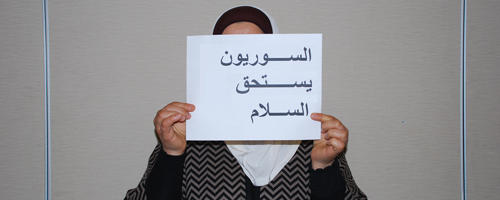
Dr. Samira holds a sign that says, “Syrians deserve peace.”

“The regime considers any doctor who aids the revolution by treating protesters the same as a man who defects from the army – or even worse.”

Upon hearing that Syrian government forces were retaliating against doctors for treating those involved in the revolution by attacking their children, Dr. Samira fled her home with her family and sought refuge in a nearby village. During this time, she lent her abandoned home to another family in need, as they had lost their own house during a bombing. When the Syrian army found this family in Samira’s house, they assumed the children living there were Samira’s. The soldiers separated the children from their parents and prepared to burn them alive. After the family insisted multiple times that these were their own children and not Samira’s, the soldiers investigated and ultimately let them go.

Samira’s story is a chilling, but all too common, example of the fear and persecution that doctors in Syria face on a daily basis. Multiple times throughout her country’s civil war, Samira has suffered from the persistent targeting of doctors.

One of the hospitals in which Samira worked was divided into two sections during the revolution: one part remained a private hospital, while the other was turned into a field hospital where doctors would secretly treat people injured during protests. While most patients who came to the field hospital were anti-regime, the doctors did not refuse treatment to anyone, regardless of their political leanings.

Samira and her colleagues kept the field hospital secret, worried that the government would respond by bombing it. She says, “The regime considers any doctor who aids the revolution by treating protesters the same as a man who defects from the army – or even worse. And the regime believes he deserves to receive punishment.” She gives the example of her husband, who has been arrested twice because he treated those involved in the uprising. Samira herself has received multiple calls from security officials asking her if she worked in a field hospital – something she continues to deny for her own safety.

Similar to other parts of Syria, Samira’s town suffered from an extreme shortage of doctors – especially surgeons. Many had left for Aleppo, and some had fled Syria altogether, forcing doctors without proper expertise to perform surgeries.

Samira recalls the time when the local mosque called for blood donors over the loud speakers. People came out to donate blood; but as they were leaving, they were shelled and had to be treated with transfusions with the very blood they had just donated. She also expressed concern about how medical workers were unable to even test the blood that was being donated during those days. They simply took the blood, stored it, and used it when needed without following proper procedures.

Samira knew of at least one hospital in her hometown that was completely destroyed in 2012. She recalls that regime forces came to loot the hospital one day, and then came back the second day to burn it to the ground.

She tells stories about people who underwent torture in detention, remembering that – in the beginning of the revolution – detainees would not be released until the apparent signs of torture had mostly disappeared. But over time, the regime started releasing detainees with full-fledged signs of torture, either out of carelessness or perhaps as a method of intimidation.

After fleeing her hometown for the safety of her family, Samira stayed in a nearby village for three weeks. She tried to continue her work as a doctor, but received warnings from her colleagues that the regime would discover that she was treating protesters. She decided to leave and reunite with her husband in Türkiye, who had fled before her.

Remarkably, Samira ends her story by saying she still feels optimistic: “Of course, the bill of blood we’ve paid hasn’t been cheap. Blood is covering the earth, but we hope something will come out of it – that we will eventually live in peace and safety.”

Physicians for Human Rights has documented attacks on medical personnel and facilities in Syria in this interactive map.

Multimedia

Dr. Abo Mayar

Profession: Orthopedic Surgeon
Age: 35

by Simran Sachdev

العربية

Real names have not been used in this post in order to protect individuals’ security.

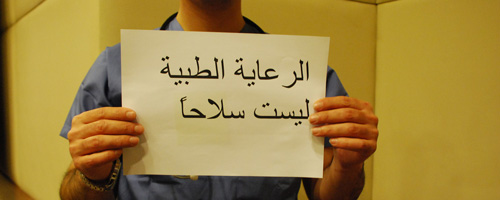
Dr. Abo MayarDr. Abo Mayar holds a sign that says, “Medical care is not a weapon.”
“I am not afraid of death – but I am afraid I will lose my hands, and all my work is within my hands.”

After having endured the civil war in Syria for over a year, Dr. Abo Mayar decided to take his family out of the country and move to a town in Türkiye, close to the Syrian border. Moving out of Syria did not stop his commitment to his people, and he has continued to serve them at field hospitals – two of which he has personally seen targeted and attacked.

Once his wife and children were safe in Türkiye, Abo Mayar went to Aleppo to work at a field hospital. He worked there for 40 days until regime forces discovered the hospital’s location, leading to the hospital’s bombardment in October 2012; a rocket hit the building directly, destroying it. Present and frightened by the explosion, Abo Mayar ran to the cellar, two floors down, where he waited until the building collapsed. He remained hidden for about 40 minutes before he felt it was safe to leave. While he does not know of any colleagues dying in this attack, he recalled that many patients lost their lives.

After the hospital in Aleppo was destroyed, Abo Mayar and a larger group of doctors founded a field hospital on the Syrian side of the Turkish border at the end of 2012. This field hospital, where Abo Mayar still works, has been bombed four times, though the perpetrators have thankfully missed the main building each time. Abo Mayar believes that they have been targeted for treating the opposition. He and his colleagues now fear the slightest of noises, which remind the doctors of sounds from previous attacks. He says there is a “continuous feeling of fear because all those who work in this establishment are at risk of death, and we don’t know when it will be our turn.” The constant fear has also led to depression, anxiety, and a lack of concentration during his surgeries – thus affecting the quality of his work. He and his colleagues sometimes even fear their own patients, worrying that they may come strapped with a bomb to blow up the hospital.

While Abo Mayar acknowledges all that he and his colleagues have achieved at the field hospital, he laments about the numerous obstacles they continue to face, including being understaffed for the high volume of patients that they see each day and for the number of patients that require specialists. Lacking adequate resources, patients do not get the time they need for proper treatment. The electricity has given out in the middle of physicians’ surgeries, drastically affecting their equipment and concentration. Abo Mayar himself is performing 5 to 10 orthopedic surgeries each day, four days in a row – a high number of daily trauma cases. He treats victims of explosions, barrel bombs, shellings, and more. He says that he and his colleagues feel lonely and isolated, and do not have time to spend with colleagues and friends; they experience a spiritual vacuum lacking the time to pray; and of course, the physical fatigue is immense with the long and arduous hours.

Having lost all sense of joy and happiness in his work, Abo Mayar still makes the hours-long journey each week to cross the border into Syria to serve his people. His trek often includes waiting hours at a time for transport or for official crossing procedures to be completed. Sometimes when transport is unavailable, Abo Mayar is forced to walk a lot of the way, or must resort to hanging off the back of trucks that are passing by.

He told us, “My wife tells me goodbye with tears in her eyes as I leave her and my two children for four days each week. She is five months pregnant with our third child. It’s very difficult to leave your wife in a strange country while you work in another. On my way to the Turkish border, I feel tears coming from my eyes without any control because I am so sad leaving my family. I don’t know if I’m going to see them again or if I will die in Syria.” Each week, after Abo Mayar’s work inside Syria is complete, he makes the same arduous journey back home to reunite with his family in Türkiye.

Before the Syrian revolution started, Abo Mayar worked in a variety of medical facilities: a government hospital in Damascus, his own private clinic, and a few private hospitals where he picked up shifts. As of when he shared this story, the government hospital was still functioning, but he did not know the status of his private clinic. However, the private hospitals where he used to work had become targets of the regime; one was completely destroyed, while the other had been taken over by the government.

When asked why he became a doctor, Abo Mayar responded that one can get a job anywhere in the world by being a doctor. “Being a doctor is like having a toolbox that you can take everywhere,” he said. When he made his career choice, he was likely unaware just how indispensable this toolbox would become to the people of Syria.

Physicians for Human Rights has documented attacks on medical personnel and facilities in Syria in this interactive map.

Multimedia

Dr. Sohail

Profession: Urologist
Age: 55

by Simran Sachdev

العربية

Real names have not been used in this post in order to protect individuals’ security.

Dr. Sohail
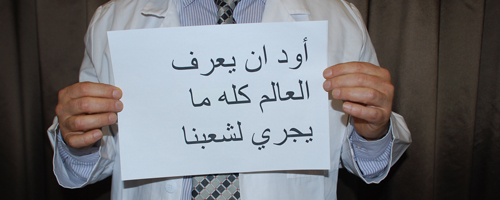
Dr. Sohail holds a sign that says, “I want the world to know what is happening to our people.”

“I’m a doctor. I treat people whether they are part of the opposition, or from the Syrian army, or loyalists to the Syrian president.”

Dr. Sohail was detained by the Syrian government twice; he was targeted for his activism and for being a doctor who treated injured protesters.

Dr. Sohail has spent much of the Syrian conflict treating the injured free of charge. During one period of detention, government security officials told him that he must seek permission from them before treating anyone. The first time he was detained, Dr. Sohail was held for two weeks under the charge of treating injured demonstrators. The army came to his home, went through and seized some of his things, and arrested him along with many others from his town. He says that upon arriving at the prison, he and those arrested with him were beaten.

While he is thankful that he was not tortured during his detention, he recalls hearing the screams of others as they were tortured “day and night.” A friend of his, who worked for the government, spoke to the intelligence branch on his behalf and asked officers to go easy on him. After this, the officers isolated Dr. Sohail in a room, until they let him go.

The second time, Dr. Sohail was arrested at a military checkpoint. Among the many charges against him were organizing against the state and, once again, treating injured protesters. Military personnel saw blood stains in his car and accused him of transporting injured people, at which point Dr. Sohail admitted taking injured demonstrators to the hospital. That a doctor would need to “admit” to helping the injured get to a medical facility is just one example of the absurdity that Dr. Sohail faced in trying to do his job.

Once detained, he was put into a cell measuring less than 4 by 6 feet with two other people; a fourth person came the next day. He recalls how there was not even enough space to lie down. He again regularly heard the screams of other detainees being tortured and spent a month and a half in these conditions. During his detention, Dr. Sohail was blindfolded and interrogated. He told the officers, “I’m a doctor. I treat people whether they are part of the opposition, or from the Syrian army, or loyalists to the Syrian president.” During one interrogation, an officer threatened that if Dr. Sohail did not speak up, the officer would hurt his son, who is a medical student.

While hearing others being brutally tortured took a psychological toll on Dr. Sohail, he also became more committed to the ideal of freedom after each arrest: “Each arrest gave me the power and energy to stay put and do more to achieve dignity and freedom and achieve the purpose of this revolution.”

After his second release from prison, someone warned Dr. Sohail that a military intelligence leader had ordered someone to assassinate him. He tried to stay calm, but when the Syrian army looted one of the hospitals he worked at, and then burned it down, he went into hiding and eventually fled the country.

For some time, Dr. Sohail continued to go back and forth to Syria to work at a field hospital, until he started serving refugees at a free clinic in Türkiye. He still plans to go home one day.

As for his hopes and dreams for Syria, he says that he simply wishes that Syrians could have freedom and live in peace.

Physicians for Human Rights has documented attacks on medical personnel and facilities in Syria in this interactive map.

Multimedia

BBC Interview of Stefan Schmitt on Rwandan Genocide Victims

On August 30, the United Nations marked the first International Day of the Disappeared. BBC radio's World Service interviewed PHR's Stefan Schmitt about identifying victims of the Rwandan genocide.


Source: BBC World Service


Multimedia

Dr. Nour

Profession: General Practitioner
Age: 37

by Simran Sachdev

العربية

Real names have not been used in this post in order to protect individuals’ security.

Dr. Nour
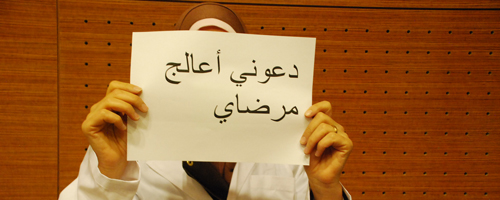
Dr. Nour holds a sign that says, “Let me treat my patients.”

“We treat anybody regardless of their identity.”

Dr. Nour, a general practitioner, works at a field hospital in Syria near the Turkish-Syrian border. She and the hospital are at constant risk of attack from aerial bombardment and car bombs. Sadly, she has first- hand experience with both. There have been five separate attacks on the field hospital, despite the many military targets in the area. In addition to dangers posed by the regime, Dr. Nour explains that she and her colleagues also worry about the self-declared Islamic State, which has threatened and kidnapped doctors.

During a car bomb attack in her hospital’s parking lot, Dr. Nour recounts hearing the first explosion and then shaking uncontrollably – and feeling unable to face the resulting horrors and injuries. She describes how the windows shook, and she knew the horrors that would await her in the emergency unit. Despite her hesitation, a dedication to treating those in need trumped her own fears.

Dr. Nour’s decision to study medicine stemmed from a realization that she could use her skills to help people – something she considers “the greatest thing in the world.” While she is happy with her career choice, she has also felt extreme burnout and trauma from all the patients she has treated and war wounds she has seen. She says, “I forget. I am nervous. Sometimes I lose hope… I think that death is very near to me.”

Dr. Nour’s experience is a stark reminder that doctors like her are not treating simple illnesses or injuries – they are working with tragic and deadly war wounds. Upon her arrival at the field hospital, the first person she encountered was a dead child. Once she removed the cover that was shielding him, she saw his head was extremely mangled. She wasn’t able to work for a week because of the shock of that sight; but after that experience, she said she became accustomed to such injuries.

She also lamented that there is a need for doctors in Syria to be better trained, as many are working far beyond their level of expertise due to the small number of medical workers who remain in the country. Some doctors were still in medical school or in the process of completing their residencies when the conflict started – but now they are conducting complex surgeries without proper training.

The town in which Dr. Nour lives has seen on-and-off fighting between the opposition and Bashar al-Assad’s army. The violence led her to flee to Türkiye for a period of time until she eventually returned home. Checkpoints regularly disrupted her work early on in the conflict when she was working at a clinic. A checkpoint had been erected between her home and the clinic; she was worried that she would be arrested there, so she missed work often. She eventually lost that job because of her absences and for missing the day she was supposed to renew her contract.

She currently continues her brave, life-saving work at the field hospital, and is steadfast in her resolve to save the lives of as many fellow Syrians as she can.

Physicians for Human Rights has documented attacks on medical personnel and facilities in Syria in this interactive map.

Get Updates from PHR