Multimedia

A Voice for Syria’s Victims of Torture: Dr. Hala Ghawi

Dr. Ghawi is pictured above, speaking with a man who was arrested and tortured by Syrian authorities. His father, who was arrested with him, was still missing as of May 2018.

“Members of my family were arrested and abused by the Assad regime, and many of my colleagues lost their lives under torture simply because they were carrying out their humanitarian duty. I have committed myself to this work, because it might someday help bring justice to the survivors and their families. Building peace in Syria cannot happen without justice, and, by documenting these cases, I can play a role in rebuilding Syrian society.” Dr. Hala Ghawi

When war broke out in Syria and medical facilities came under attack, surgeon Hala Ghawi began providing care in secret field hospitals – which made her a target for government forces. Her husband, also a doctor, was arrested, imprisoned, and tortured. Dr. Ghawi and her family fled to Jordan, where she was trained in forensic documentation by PHR and began documenting cases of torture and sexual violence among the Syrian refugees she worked with. A key PHR partner and recipient of the 2016 Physicians for Human Rights Award, Dr. Ghawi is now a women’s protection and empowerment consultant in Gazientep, Türkiye, and continues to document evidence of the war crimes being committed every day in her country.
Blog

10 Reasons Health Professionals Should Oppose Gina Haspel as CIA Director

On May 9, the Senate Intelligence Committee will hold a confirmation hearing to consider Gina Haspel, Trump’s pick to head the CIA. A fair hearing is impossible, given the agency’s campaign to ensure Haspel’s promotion and conceal her involvement in its post-9/11 torture program. However, what’s known is already disqualifying: Haspel supervised waterboarding and other torture at the first CIA “black site” in Thailand, helped destroy videotapes and other evidence of crimes, and helped feed lies about the “effectiveness” of torture to Congress and to two presidents.

Torture thrives on secrecy, and it is no accident that the CIA refuses to make public Haspel’s record of torture – let alone declassify the torture program or allow its victims to speak. Promoting Haspel to CIA director would be an affront to those victims and an unconscionable reward for committing grave human rights violations. More immediately, it would pose a dangerous risk of a return to torture under President Trump, with repercussions around the world.

Here are 10 reasons to #BlockHaspel:

    • Torture is illegal.
      Torture is one of the most serious human rights violations and is absolutely prohibited at all times. There are no exceptions that would permit its use, including war, public emergency, or orders from a superior officer. This ban is part of the U.S. Constitution, federal and state law, and international treaty obligations. It is also a peremptory norm of international law, meaning it is legally binding on all states, even non-signatories of international treaties prohibiting torture.
    • Torture is ethically prohibited.
      Preventing torture of those in custody is integral to the ethical duties and culture of the health professions. For example, the American Medical Association’s Code of Medical Ethics states that “Physicians must oppose and must not participate in torture for any reason.” Similarly, the American Psychological Association and the American Nurses Association condemn torture and prohibit participation in any form.
    • Torture enables other violations and undermines the rule of law.
      Torture is intimately linked to breaches of the rule of law. Secrecy, lack of transparency, and due process violations are all red flags — including incommunicado or secret detention, lack of transparency concerning detention location, failure to get before a judge, lack of charges, forced confession, secrecy of evidence, lack of access to lawyers, lack of access to doctors, and lack of prosecutions for torture. In addition, torture is often part of multi-tiered crimes, such as abductions and extrajudicial executions.
    • Torture endangers national security.
      Interrogators and intelligence professionals recognize that torture is not only ineffective in gaining accurate intelligence, it is also counterproductive. It damages national security by weakening alliances, threatening intelligence cooperation, disrupting military efforts, degrading military and intelligence integrity, enhancing enemy propaganda, damaging U.S. standing abroad, and undermining foreign policy goals and coherency.
    • Torture is morally abhorrent.
      Torture violates human dignity and degrades both victim and perpetrator. It applies the brute force of the state to people at their most vulnerable, using them “as pawns to be manipulated through their pain.”At its essence, torture aims to destroy people psychologically and to damage the physical, emotional, and social well-being of individuals and entire communities.
    • Torture causes severe pain or suffering.
      Torture causes severe pain or suffering in its victims, which can be mental, physical, or both. The CIA’s methods were specifically intended to psychologically incapacitate detainees through the infliction of pain and to produce feelings of extreme helplessness, fear, horror, and distress. These methods included waterboarding, sleep deprivation, isolation, beatings, restraints and shackling, stress positions, suspension, sensory deprivation and bombardment, temperature manipulation, and sexual assault and humiliation – and many of these torture techniques were used at the black site Haspel ran.
    • Torture causes profound mental and physical harm.
      Health professionals who evaluate and treat survivors see the clinical effects of torture, which often produces profound and long-term symptoms and disabilities. Physical health consequences include damage to the organs, brain, head and neck, chest and abdomen, genitals, nerves, skin, bones, and teeth from blunt force trauma and other injuries. Psychological consequences include post-traumatic stress disorder and major depression as well as anxiety disorders, somatic complaints, sexual dysfunction, psychosis, and neuropsychological impairment.
    • Torture destroys intimate and social relationships.
      Torture not only harms the minds and bodies of individuals, it also damages their cognitive, emotional, and behavioral functioning. This can destroy their ability to function in society, rupturing “intimate relationships between spouses, parents, children, other family members and relationships between the victims and their communities.” Survivors may also feel a deeply isolating sense of stigma and shame as a result of their torture.
    • Torture complicity compromises and degrades health professionals.
      In the CIA program, health professionals participated in torture, including doctors, psychologists, nurses, and physician assistants. Two psychologists – James Mitchell and Bruce Jessen – developed the techniques and tested them in Thailand, including under Haspel’s supervision. This included the waterboarding of detainee Abd Al-Rahim al-Nashiri. Health professionals were also involved in monitoring torture sessions, generating data on the effects of interrogation and detention, and treating detainees for the purpose of torture. Their presence was used to legitimize and sanction torture, extending to the policy authorization of these practices.
  • 10. Torture has a permissive effect around the world.
    The CIA torture program not only violated U.S. laws, values, and traditions, it entangled more than 50 countries around the world. The use of torture by the United States weakens respect for the absolute prohibition against this crime, undermines the ability to champion human rights abroad, and sends a message that torture can be committed with impunity.

Health professionals have long been in the vanguard of the international effort to eradicate torture and ill-treatment, and they play a leadership role in redressing the consequences of torture, providing medical, mental health, and other services to survivors of torture.

Torture violates everything health professionals stand for, as individuals committed to advancing health and well-being.

Haspel was part of a systematic policy of torture, and health professionals should oppose her confirmation. In addition, all records regarding Haspel’s involvement in torture and destruction of evidence must be declassified to enable senators to review her precise role in torture, and to ensure she accurately answers questions in the hearing.

Blog

Under Attack at Home and Refused Refuge Abroad

The Supreme Court today began hearing oral arguments in a case debating the constitutionality of President Trump’s September 2017 Presidential Proclamation, the third version of his administration’s controversial travel ban. The outcome of the Court’s deliberations will have far-reaching consequences for asylum seekers, refugees, and other vulnerable immigrants: while the first two travel bans were temporary, this one could be permanent.

The case came about as a result of a challenge led by the state of Hawaii, which argued that the ban violates the Immigration and Nationality Act prohibition on discrimination based on race, sex, nationality, place of birth, or place of residence. Trump’s travel ban targets eight countries (Chad, Iran, Libya, North Korea, Somalia, Syria, Venezuela, and Yemen), representing some 180 million people, the majority of Muslim faith and background. The Supreme Court will also consider whether these travel restrictions represent a violation of the First Amendment.

Syria, among the affected countries, has been ravaged by war for the past seven years. Some 11 million civilians have been displaced by the violent conflict, many of whom feel that their last hope is asylum abroad.

Dr. Saeed* is a young surgeon from western Syria. After the conflict started in his country, he continued to perform surgery in the hospital where he worked, which is in an area controlled by opposition forces. After a local news report of Dr. Saeed operating was uploaded to YouTube, he was arrested, detained, and tortured for days. He was released on the condition that he only work in a government hospital. Not long afterwards, Dr. Saeed’s brother and a friend were both victims of targeted killings. He feared that he would be next, so he fled to the United States and applied for asylum. Little did he know that, in today’s America, he would not be easily welcomed due to the policy changes initiated by the new administration. His case in limbo, Dr. Saeed now spends his time volunteering in a surgery research unit in the northeast United States while completing the painstaking process of converting his Syrian medical credentials into ones that are recognized by U.S. institutions.

A forensic evaluator volunteering for Physicians for Human Rights (PHR) examined Dr. Saeed in order to assess the severity and nature of his trauma symptoms. She found that he presented a clinical picture consistent with his narrative of having been tortured, exhibiting symptoms of Post-Traumatic Stress Disorder and Major Depressive Disorder.

His predicament begs the question: if someone as threatened and endangered as Dr. Saeed is not welcome in America, then who is?

Only 11 Syrian refugees have been admitted into the United States in 2018, despite the horrific and illegal use of chemical weapons throughout the conflict and the intentional targeting of health care and civilians, documented on an ongoing basis by PHR. After years of living in refugee camps, most displaced Syrians who manage to validate their asylum claims wait indefinitely for possible future resettlement, even after undergoing extreme vetting. The travel ban allows for the possibility of a waiver if a denial would cause the applicant “undue hardship.” Yet, according to the State Department, despite more than 8,400 visa applications from the eight countries targeted by the ban, only 100 have been issued waivers, an approval rate of just over one percent. A record-low refugee quota, which stands at 45,000 for 2018, coupled with a travel ban with no real waiver option, represent a systematic policy change which endangers the right of those with legitimate claims to seek asylum.

Some in the United States fear that asylum seekers like Dr. Saeed may cause a threat to national security. This is, after all, part of the justification for the Trump administration’s ban. But the reality is that very few people seek asylum by choice. Most are forced from homes they love under extreme duress, and seek haven in lands far away because they have run out of other options to protect their lives and those of their families.

For many like Dr. Saeed, it makes no sense for the United States to emphatically denounce the indiscriminate killing of innocent civilians and then in the same breath to say that those civilians threaten U.S. national security. The Unites States has ratified the 1967 Protocol relating to the status of refugees and it is its legal responsibility to “act in concert in a true spirit of international cooperation” to respond to global refugee crises. Article 3 of the protocol strictly prohibits discrimination against refugees based on race, religion, or country of origin. Asylum seekers should be treated no differently.

Admitting only a handful of refugees from war-torn parts of the world like Syria each year, in the face of mounting violence, including chemical attacks, is tantamount to deserting a population in need.

*Name changed to protect identity.

Blog

Combating Impunity: How We Risk Normalizing Chemical Weapons Attacks and Other War Crimes in Syria

For the past seven years, the Syrian conflict has proven to be one of the most complex and brutal wars in recent history. Since 2011, the death toll has been immense and the amount of civilian suffering unimaginable. What makes this conflict especially horrifying is the infliction of constant and widespread human rights violations documented by Physicians for Human Rights (PHR), the United Nations, and others, including the kidnapping, torture, and killing of civilians and the bombing of civilian targets, including health care facilities. PHR has been at the forefront of documenting attacks on hospitals and medical personnel across Syria since the start of the conflict – attacks that are in clear violation of international humanitarian law. And repeatedly, when many thought the situation could not get any worse, chemical weapons have been deployed , inflicting widespread terror, suffering, and death.

On March 19, 2013, the Syrian government allegedly launched a chemical attack in Khan al-Assal, Aleppo, killing more than two dozen people. As residents buried the dead and the finger of blame was pointed in various directions, another attack occurred. In August of that year, more than 1,000 people were killed in Ghouta, rural Damascus, by sarin gas. The shocking images of men, women, and children foaming at the mouth and gasping for air sparked international condemnation and led to the adoption by the UN Security Council of Resolution 2118, establishing a joint mission to oversee the destruction of Syria’s chemical weapons stockpile.

This, however, did not end the continued use of these reviled and inherently indiscriminate weapons.

Since 2013, dozens more chemical attacks have been reported, 34 of which have been confirmed by the Independent International Commission of Inquiry on the Syrian Arab Republic, including a sarin gas attack in April 2017 in Khan Sheikhoun which killed more than 80 people, and which was in clear defiance of the Chemical Weapons Convention. PHR reviewed videos of the 2017 attack and confirmed that the symptoms displayed by the victims  were consistent with the use of the outlawed nerve agent. In addition, experts from the Organization for the Prohibition of Chemical Weapons-UN Joint Investigative Mechanism linked samples of evidence from the attack site to registered chemical weapons stockpiles belonging to the Syrian government.

But despite clear evidence pointing to the identity of the perpetrators, little has been done to thwart these and countless other continued breeches of humanitarian law. The Security Council has been paralyzed by Russia’s use of its veto power, obstructing any viable course of action to seek accountability and justice.

Throughout the conflict, Syrians, who fear recurring chemical attacks on their communities, have said they feel abandoned and forgotten by the rest of the world. Their fears are justified. Five years after the Khan al-Assal chemical attack, with a lack of any comprehensive international framework in place for the protection of the Syrian people, it has happened yet again. On April 7, 2018, in Douma in eastern Ghouta, the last rebel-held stronghold in the area, at least 70 people died and as many as 500 were injured in an apparent chemical attack.

“The chemical weapons attacks are horrible,” says Dr. Homer Venters, director of programs at PHR. “The way in which these weapons hit civilians; the way in which this recent spate of attacks constitutes the most egregious violation of the treaty banning chemical weapons since it entered into force – it should shock all of us.”

Videos of the latest incident in Douma show men, women, and children lying lifeless, while others struggle for air and foam at the mouth – symptoms characteristic of a chemical attack.

But as the world watches these images, it no longer suffices to be shocked. It no longer suffices to convene Security Council meetings or hold press conferences that merely condemn these attacks. The shock and condemnation must culminate in more. The international community must enforce a plan for unhindered access for investigators to sites of attacks to allow thorough investigations, and a dedicated mechanism to hold the perpetrators accountable. Furthermore, a framework must immediately be set in place to ensure sustained protection of civilians, and continued, unfettered access to health care and humanitarian aid.

“We need to move from demanding accountability to actual protection of civilians and a real end to impunity, not only in the face of chemical weapons attacks, but for all mass atrocity crimes against the people of Syria, against health care facilities, and against health care providers themselves. We have to also make sure that the survivors of these horrible attacks can seek and receive impartial care when and where they need to,” Dr. Venters adds.

Syria_blog_photo_2

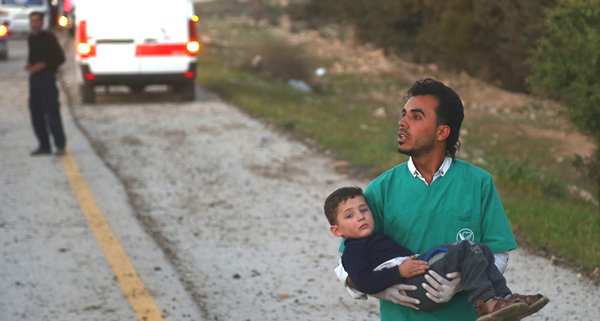
An injured Syrian boy is carried by a medical volunteer near the northern Syrian town of al-Bab, after they were evacuated from the last rebel-held pocket in Eastern Ghouta on April 3, 2018. NAZEER AL-KHATIB/AFP/Getty Images

With each chemical attack launched and with each hospital bombed or medical worker targeted with impunity, we risk normalizing this horrific and unacceptable flouting of longstanding humanitarian norms. It’s up to the international community to ensure that repeatedly violating universally accepted prohibitions against targeting civilians and using widely banned weapons does not become the new normal.

Blog

Yemen and Syria Rules of Combat: Is Blatant Disregard for Humanitarian Norms the New Normal?

War is the deliberate killing of people and destruction of infrastructure.

Even so, more than half a century ago, world governments agreed on rules to ensure that war would not be purposefully destructive of those who do not fight. These rules, known as international humanitarian law, were designed to lessen civilian suffering, and carve out particular protections for the provision of health care to anyone not actively engaged in the war. At the most basic level, international humanitarian law asserts that, while war unquestionably jeopardizes civilian wellbeing, it should not prevent the maintenance of health care amidst the chaos of the conflict. The end goal is to minimize cruelty.

Cruelty, however, has been a defining feature of the conflicts currently raging in Syria and Yemen. International humanitarian norms have been flouted through the bombing and shelling of health care facilities, blocking of humanitarian aid, besiegement, and the use of chemical weapons against civilians.

The extent to which these norms have been disrespected is remarkable. Over the course of the Syrian conflict, Physicians for Human Rights (PHR) has corroborated 492 attacks on health care sites, including 79 hospitals that were struck at least twice. Over a three-month period in 2017, PHR received reports of 10 attacks on health care facilities in Yemen, of which researchers were able to independently confirm four so far. In both Syria and Yemen, active parties to the conflict are allowed to unilaterally control access to humanitarian aid, leading to the denial of adequate care to civilians who are perceived as sympathizing with other parties.

But what is even more remarkable is the steady erosion of international humanitarian law that these recent conflicts has caused. Successive U.S. administrations have laid down various “red lines,” delineating just how egregious a violation of humanitarian norms they would tolerate before intervening. Warring parties in both Syria and Yemen have deployed shifting definitions of terrorism to justify broad carve-outs of what and who is an acceptable military target. Weapons sales to Saudi Arabia, which has led a three-year bombing campaign in Yemen, have skyrocketed, despite evidence of violations of the rules of war.

While international law has plenty to say about unilateral military action, internal conflicts, and acceptable weapons, the point here is that the clearest red line of all – the prohibition of attacks on health care facilities – has not featured clearly as a litmus test for when enough is enough in either conflict.

And that is as terrifying as the violations themselves.

International humanitarian law has not changed, of course. Attacks on hospitals and other health care facilities continue to be prohibited. Warring parties continue to have responsibility to allow unfettered access to humanitarian aid for those who need it.

But unless we insist on strict accountability for continued violations of the law – unless we treat it as the red line that it truly is – future conflicts will be characterized by even more flagrant disregard of norms. War will undoubtedly always be cruel. We, however, play a role in deciding to what extent.

Report

Beyond Imagination: Seven Years of Conflict in Syria

The seventh anniversary of the start of the Syrian conflict brings no sign of the fighting abating. In its latest issue brief, Physicians for Human Rights shows how a pattern of targeted attacks on health care in the war-torn country are generating a lethal context in which civilians suffer and die not only from the direct consequences of warfare, but also from denial of adequate medical care, malnutrition, and starvation. In so-called de-escalation zones, hospitals and other health facilities are under constant bombardment and shelling, medical personnel are being killed, humanitarian aid is systematically blocked, and civilian populations remain under siege.

PHR’s researchers have corroborated 492 attacks on health care sites, including 79 hospitals that were struck more than once, from the start of the conflict through the end of 2017. At least 847 medical personnel have been killed in this time period.

As the fighting enters its eight grueling year with nearly half a million lives lost, PHR renews its call for an end to the relentless attacks on civilians and civilian targets, which are in direct violation of international humanitarian law and which, amidst inaction from the international community, are taking place with utter impunity.

Blog

A Torturer as CIA Boss? Never

*Originally and exclusively published in the NY Daily News.
Not for re-use or redistribution in any other media.

President Trump’s nomination of Gina Haspel to serve as CIA director sends a destructive message to the world at the worst possible time. Haspel supervised the use of torture, then took part in destroying evidence of that crime. Her nomination is a clear signal to every human rights violator from Myanmar to Syria that the United States doesn’t take these vital protections seriously and that there will be no serious accountability for violations under Trump.

Sixteen years ago, Haspel headed a black site in Thailand where CIA detainees were secretly tortured. These practices were not only fruitless from an intelligence collection standpoint; they marked one of the most brutal, shameful and damaging chapters in American history.

Long-recognized forms of torture used on detainees included waterboarding, sleep deprivation, freezing and shackling so extreme it caused swelling and skin infections.

Interrogators waterboarded one detainee, Abu Zubaydah, at least 83 times and smashed his head against walls before deciding that his failure to provide useful information proved he had none to give.

Another detainee, Abd al-Rahim al-Nashiri, was also waterboarded and subjected to other torture; an independent Physicians for Human Rights clinician described him as one of the most severely traumatized individuals she has ever evaluated.

It is true that, in the wake of the 9/11 attacks, the United States was afraid more bloodshed would follow. This is not, however, an excuse to disregard core national values. Indeed, regimes all around the world that torture their people use precisely this national security justification.

Haspel not only failed to stop any of these immoral and illegal practices; she sought legal cover for them to continue.

Three years later, when the CIA program was coming under increasing internal and external scrutiny, Haspel helped destroy videotapes of some of the horrific “interrogations.”

Though Trump insisted early last year that torture “absolutely” works, claiming “we have to fight fire with fire,” torture is manifestly illegal. And Haspel’s efforts to conceal evidence of criminal conduct undercut any claim that she was following lawful orders.

The CIA torture program and subsequent coverup inflicted profound harm on human beings. The institutions that participated in it undermined national security and violated the legal and moral obligations of the United States.

It is a disservice to the many qualified women and men who could lead the CIA to promote a torturer to this prestigious office. At a bare minimum, as the Senate exercises its vital role of advice and consent on her nomination, senators must demand declassification of records illuminating Haspel’s role in this illegal program.

I have just returned from conducting evaluations of Rohingya women, men and children who survived horrific acts of violence by the military of Myanmar, also known as Burma. Many of them bore the physical scars of gunshots, machete wounds and burns, often inflicted together with unspeakable acts of sexual violence.

Torture, and impunity for torture, are signs of the erosion of the rule of law. They pave the way for executions and other extreme violations. The ability of the United States to demand accountability for such abuses will be greatly hampered if it glosses over its own torture history and promotes perpetrators to positions of authority, rather than censuring them.

The nomination of Haspel came on the same day that current CIA chief Mike Pompeo was nominated to become secretary of state. Pompeo has hailed Americans who engaged in torture as “patriots.”

Under Trump, we have seen an erosion of one of the most fundamental purposes of the State Department: to advance human rights around the world. We can expect more of the same under a Secretary Pompeo, and this should be of great concern.

Violating human rights and destroying evidence are just the kinds of crimes that Syria and Myanmar must be held accountable for. How can the United States make those arguments with a straight face in the United Nations and other forums if Haspel is confirmed?

For every picture of a dead child in Syria’s eastern Ghouta or horror story of a Rohingya rape survivor, the United States must now either hold itself to a higher standard, or decide that it will not be an example to the world.

As the former general counsel of the U.S. Navy, Alberto Mora, summed up: “When we tortured, we rendered incoherent a core element of our foreign policy: the protection of human dignity through the rule of law.”

For rurther reporting, please see our publishable PHR press release.

Blog

Rohingya Survivors Unsilenced

Refugee camps in Bangladesh are home to almost 700,000 Rohingyas fleeing ethnic persecution at the hands of the Myanmar government. Since summer 2017, soldiers and civilians in Myanmar’s northern Rakhine state of Myanmar have led brutal attacks against Rohingya men, women, and children — including murder, beatings, mass rape, opening fire on fleeing families, and torching entire villages. A team of PHR doctors recently visited refugees in camps near Cox’s Bazar, Bangladesh. These are their stories.

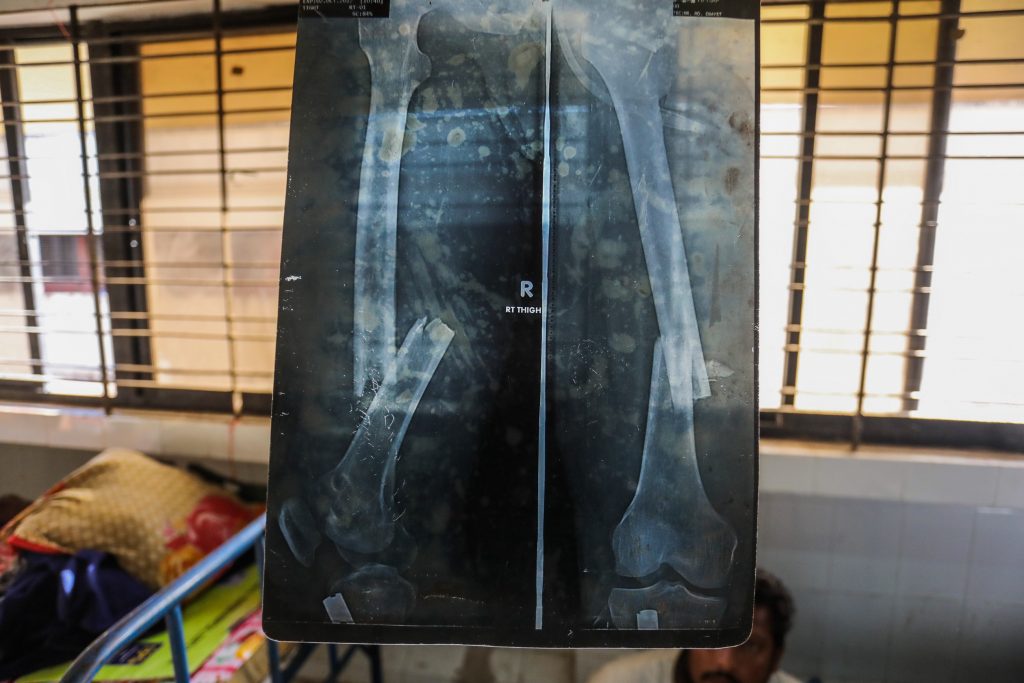
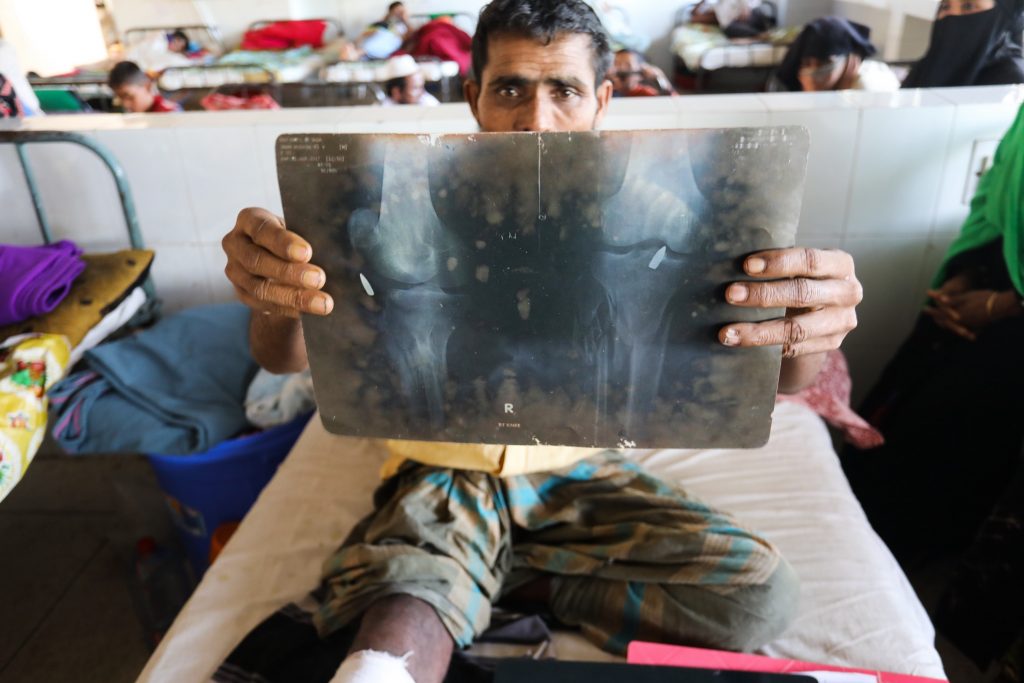
Tamir, 45, displays an x-ray of his legs that shows a shattered fibula, a fractured tibia, and a fully intact bullet that can be seen still lodged in the soft tissue of his knee — corroborating Tamir’s account of being shot from behind. He still cannot walk or bear weight on his legs.

“I was shot while fleeing. I was shot in my right lower leg as my family and I were escaping a military attack on foot about a month and a half ago. My family improvised a makeshift stretcher to carry me across the border to Bangladesh. There, they took me to the hospital for treatment.”

Tamir, 45
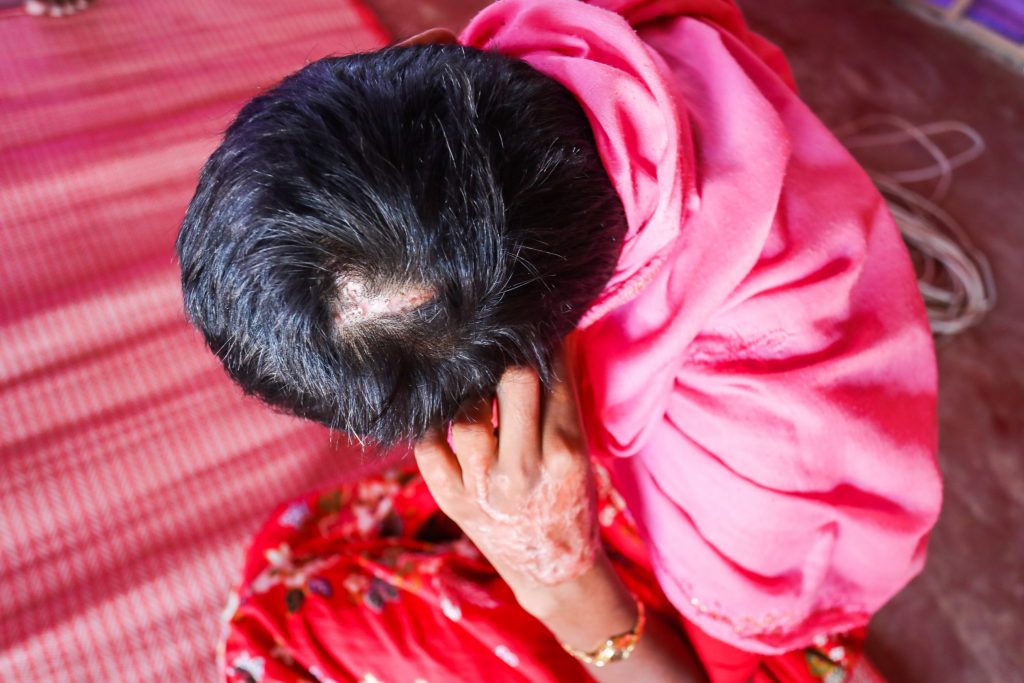
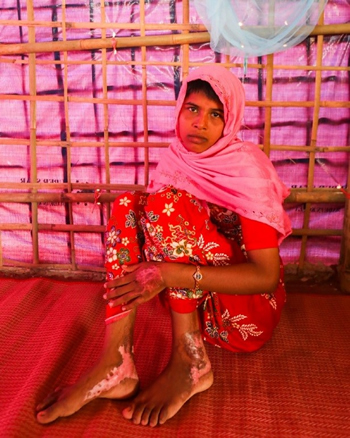
The machete wound to her head and burns and scarring on 15-year-old Amirah’s hands and feet coincide with her story of barely escaping her blazing house after she was knocked unconsciou

“They wanted to burn me alive.


“Soldiers and members of the Mog ethnic group attacked my village in Tula Toli on the evening of August 26. Five hundred women were captured by village soldiers and split into smaller groups inside a nearby house before the soldiers and Mog men raped the women and began killing the women and children with machetes.


“I lost consciousness after being struck on the head with a machete; I regained consciousness to the strong smell of burning flesh and pain radiating all over my body. Realizing my hands, feet, and back were in flames, I crawled out of the house where villagers helped me cross into the neighboring village and to the hospital.”

Amirah, 15
Karim’s left eye shows blurring of the perimeter of the iris. The injuries to Karim’s right hand reveal a traumatic loss of bone which has caused varying degrees of damage to his fingers.

“On August 27, I witnessed a loud explosion inside my home in my village. I collapsed to the ground in a state of confusion after being hit with something hot. My family members picked me up and led me out of the house, away from the village, when I noticed pain fixated in my right hand, left eye, arms, and chest. I remember not being able to see well, from the combination of smoke and flames and blurred vision in my left eye, as my family and I walked for two days to Bangladesh.

“I can only see light and dark from my left eye, not any shapes or colors.”

Karim
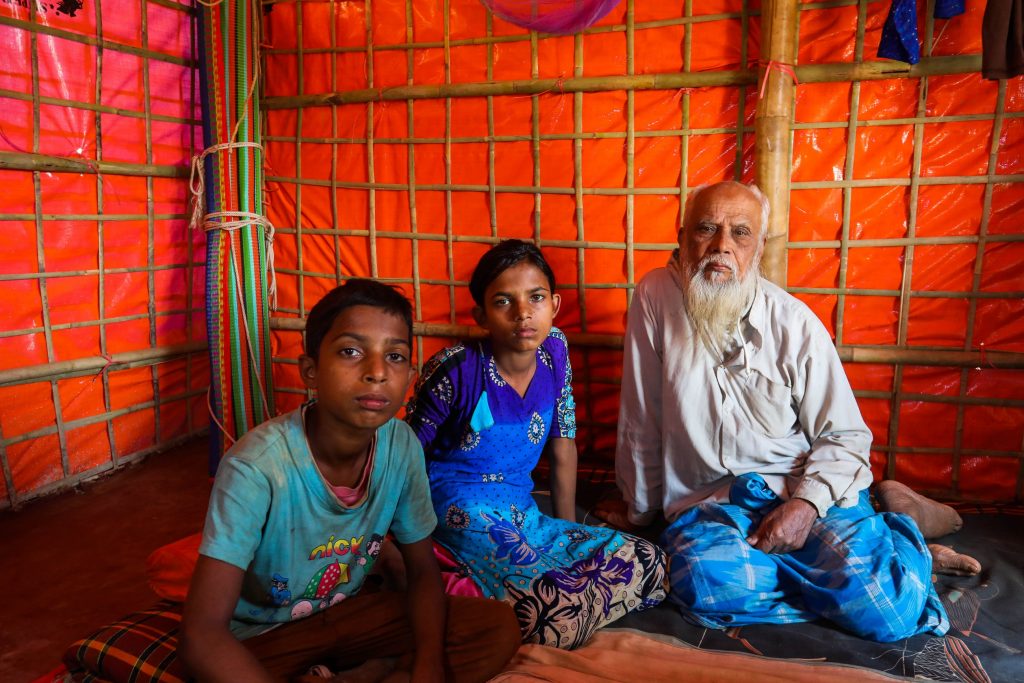
Noor, 10 (center), has small, unrecovered bullet fragments dispersed about her right hip, still causing her pain. Her brother Raschid and her uncle Muhammed are the only survivors of their immediate family. Muhammed believes between 2,000 and 3,000 villagers were killed during this massacre along the river bank.

“I was inside of my home in the village of Tula Toli, along with my mother, father, brother, uncle, and 16 other family members, on the morning our village was attacked. We all fled our home by foot as soldiers opened fire and started burning houses, prompting villagers to retreat to a nearby river bank. I managed to escape into the river where soldiers continued shooting towards me; from the river, I saw with my own eyes my parents being shot. I also felt a lot of pain in my hip.

“As I crossed the border into Bangladesh, I was transported to a hospital in Cox’s Bazar by villagers.”

Noor, 10
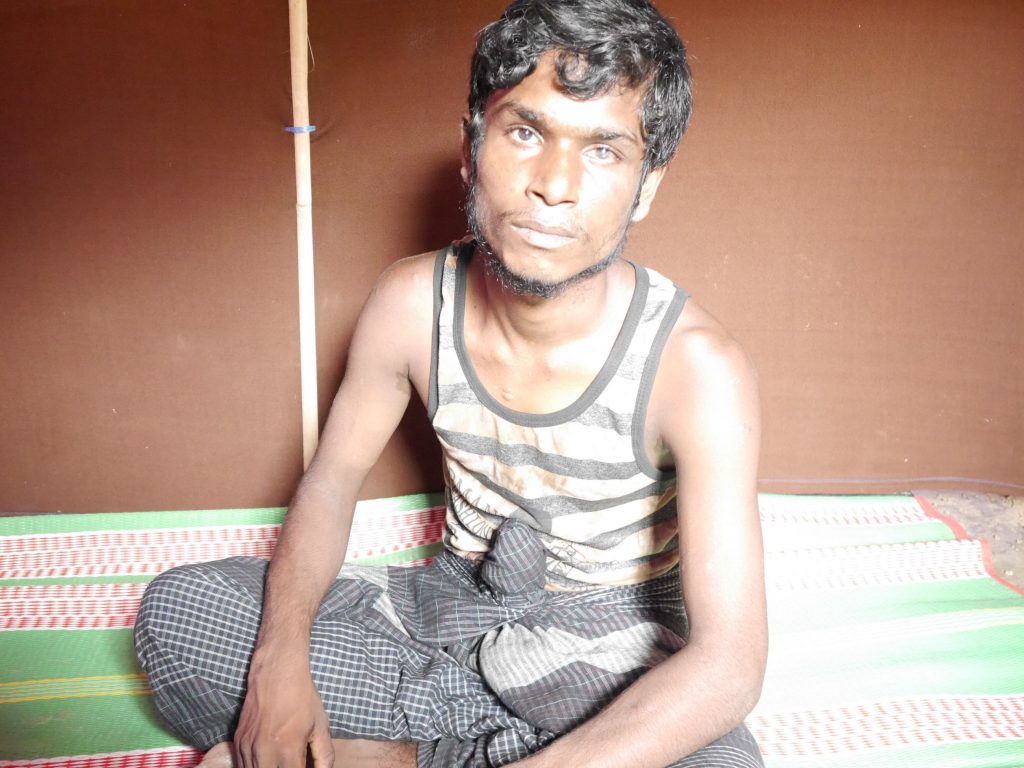
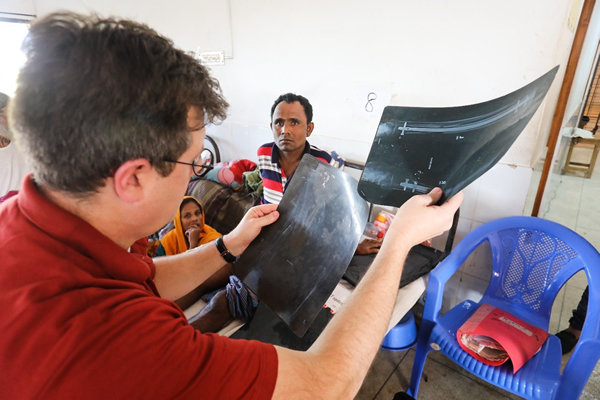
Amir’s two legs were broken in a brutal attack. X-rays and physical examination of Amir’s legs confirm extensive trauma and repeated strikes to his lower and upper legs — consistent with his narrative of being beaten and struck several times by soldiers who attacked his village in Myanmar.

“We attempted to flee the attack. They bound our hands with rope before taking turns to strike us with their rifles. They stopped beating me only when I pleaded to the soldiers that I would retreat to Bangladesh and never return to Myanmar again.”

Amir

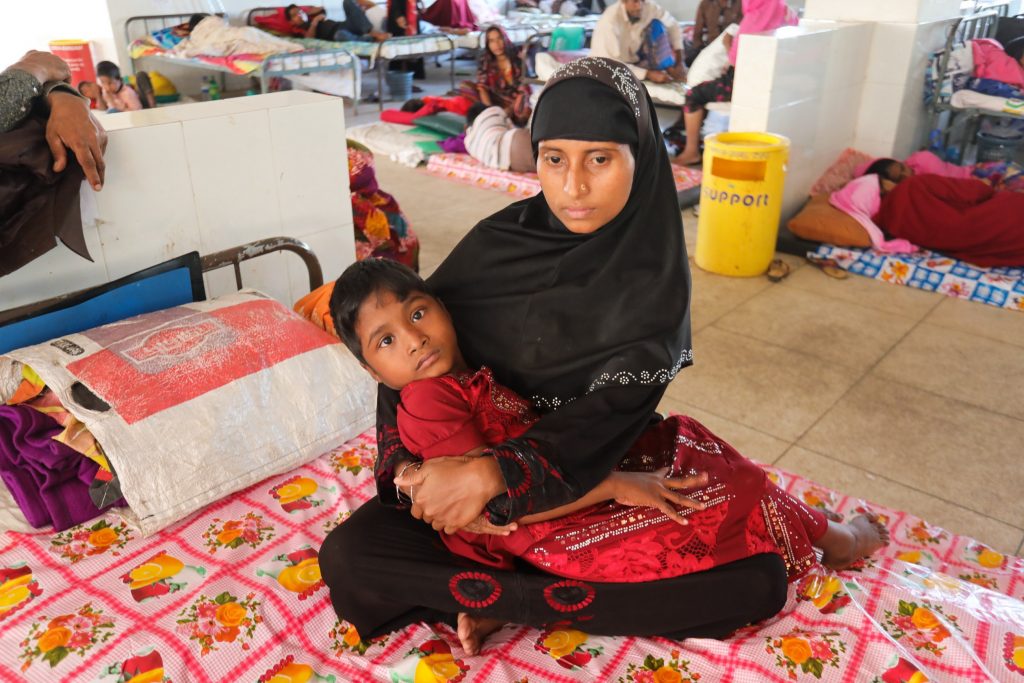
“I was in the house with my husband and Muriam, as well as Muriam’s grandparents. Our village was attacked by army soldiers, who began firing their rifles and throwing grenades at some of the homes. We ran out of our house, and one particular soldier grabbed Muriam and threw her against a wall. Then he and three others began to kick and stomp her with their combat boots.


“The physical attack lasted several minutes, and all that I and Muriam’s grandparents could do was beg them to stop. But it only got worse when the soldiers shot and killed my husband during the attack. I carried Muriam, with the help of her grandparents, to Bangladesh. When we arrived, she was in excruciating pain. We took her to the hospital and she couldn’t even walk. Muriam is still unable to bear weight or stand, and I take care of everything that she needs.”

Mother of five-year-old Muriam, who appears to have suffered a pelvic fracture and neurological damage when she was assaulted by members of the Myanmar military.
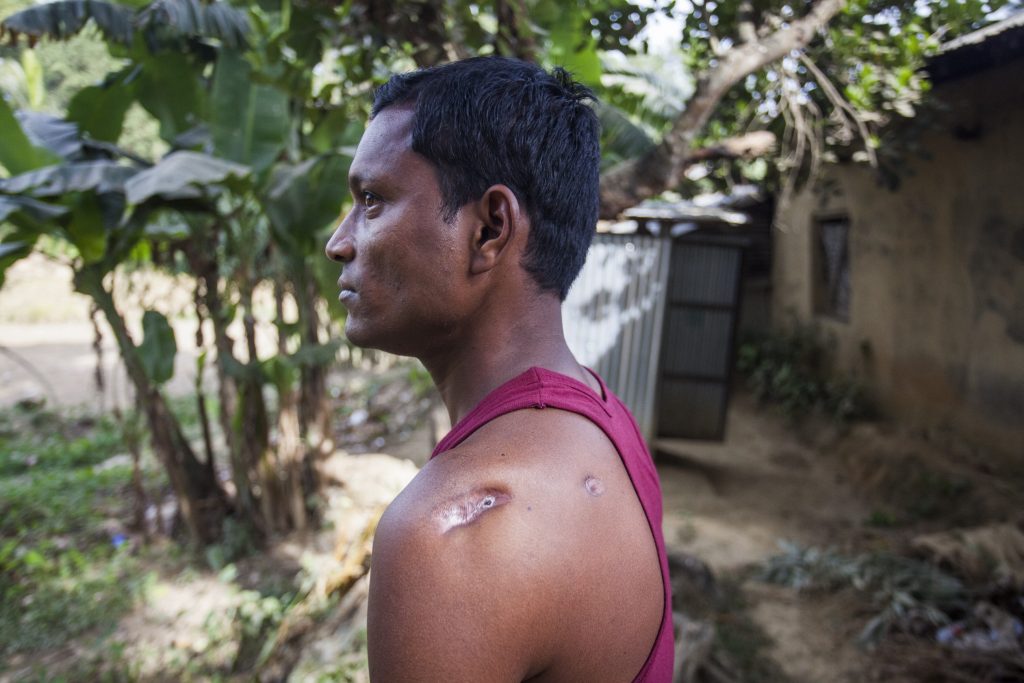
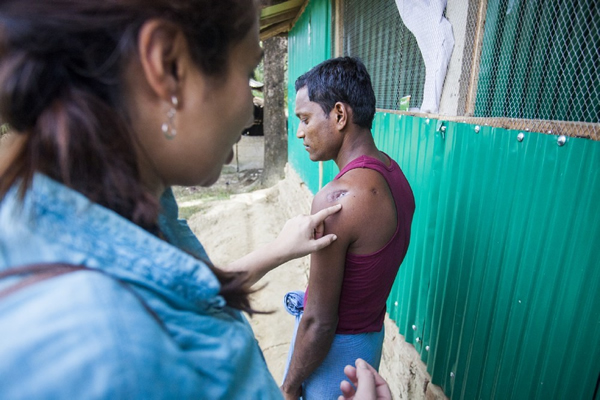
Muhammed has two areas of scarring on his back, which PHR doctors have determined to be highly consistent with his report of being shot from behind. The irregular scar located at the midline of his back is consistent with an entry wound and the other scar located above is consistent with a surgical incision, presumably to remove a bullet.

“After my village was attacked by military soldiers in late August, I was shot in the back as I escaped into nearby fields. On the morning of the attack, people who looked like Buddhists began firing guns into homes and setting houses on fire on one side of the village. I was inside my home with my parents, brothers, and sisters at the time of the attack, but became separated upon attempting to run away from the village and the soldiers.


“I was running across the fields in a group of about seven or eight men when soldiers about 50 to 100 meters behind us fired their guns, striking me in the back as I continued to flee. I was picked up by other men and carried to Bangladesh over the course of seven days. At a hospital in Bangladesh, doctors removed the bullet from my back. All that remains now is the scar, and the brutal memories.”

Muhammed

All names have been changed to protect patients’ privacy. Please credit photos to Salahuddin Ahmed Paulash for Physicians for Human Rights.

Blog

“We’re Seeing the Lucky Ones.”

Children with gunshot wounds, severe burns, traumatic injuries – these are just some of the atrocities PHR’s team of doctors documented on their recent trip to Bangladesh, where nearly 700,000 Rohingya have fled to escape a campaign of brutal violence by the Myanmar military. “The thing that really strikes me is that … we’re seeing the lucky ones, the lucky ones who were able to survive,” says PHR’s Dr. Rohini Haar.

Blog

The Difference Doctors Make

Rohingya women wait to be seen at the Hope Foundation clinic outside Balukhali camp in Bangladesh, which treats many of the nearly 700,000 Rohingya refugees who have fled extreme violence in Myanmar. Photo: Salahuddin Ahmed for Physicians for Human Rights.

Every day is a busy day at the Hope Foundation clinic outside Balukhali camp in Bangladesh. The small facility teems with Rohingya refugees who have fled a campaign of brutal violence by the Myanmar military. The week I was there last December, there was a man with a bullet wound, a woman with facial burns, and more women with tiny babies than I could count. The infants reminded me that some of these women made the harrowing trek to safety – through the jungle and across a river – while very pregnant.

The MedGlobal volunteer health workers at the clinic tend to these extraordinary traumas, but also to the day-to-day health needs – waterborne diseases, respiratory infections, and, increasingly, diphtheria and measles – that have become inevitable in the crowded refugee camp.

Dr. Rohini speaks with volunteers

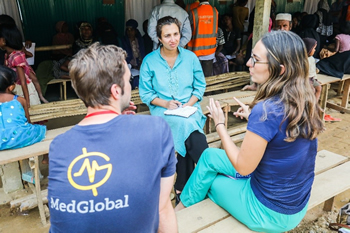
PHR’s Dr. Rohini Haar (center) speaks with MedGlobal volunteer health professionals Chris Hearne (left) and Rache Mureau-Haines (right) at the Hope Foundation clinic outside Balukhali refugee camp in Bangladesh. Photo: Salahuddin Ahmed for Physicians for Human Rights.

We’ve all been to the doctor. Maybe we’ve even been in an urgent situation where the doctor had to reset a bone or address another critical injury. So we can intuitively understand why medical workers are so important in a refugee camp. Obviously, the nearly 700,000 Rohingya who have surged into Bangladesh seeking safety require both urgent and regular medical care. Attending to their physical needs is job number one for medical workers in a complex humanitarian situation.

But doctors have another, equally important role to play when a human rights crisis leads to a humanitarian disaster. Dr. Vincent Iacopino, Physicians for Human Rights’ (PHR) senior medical advisor, once told me that after working for many years in refugee camps providing primary care, he decided to shift his focus to human rights because he wanted to get “upstream of the problem.” At PHR, we try to get upstream by collecting medical evidence of torture, sexual violence, and other human rights violations – evidence that can be used to stop these crimes and bring perpetrators to justice.

Rohingya girl

A Rohingya girl at the Balukhali refugee camp in Bangladesh. She was struck on the head with a machete by Myanmar military and left to die in her home, which the military had set on fire. She managed to crawl out but suffered terrible burns on her hands, feet, and back. Photo: Salahuddin Ahmed for Physicians for Human Rights

Despite their grueling schedules, the MedGlobal volunteers welcomed me and my PHR colleagues to their clinic. As they treated the Rohingya refugees’ wounds, my colleagues forensically documented the injuries. In this small clinic, in the midst of this humanitarian catastrophe, I saw an extraordinary example of medical professionals collaborating to treat their patients and to advocate for justice – using the tools of science and medicine.

Our team of PHR doctors documented that a machete wound to the head and burn patterns on a woman’s hands and feet were consistent with her story of being left to die, unconscious, in a burning hut. We met a man who had been shot in the back as he was running away, and children who were shot while inside their homes when the military sprayed the village with bullets. The scars on their bodies were consistent with the stories that they told us of their abuse in Myanmar and the trauma of their escape.

The machete and gunshot wounds, the burns, the broken limbs are all slowly healing, thanks to the work of our primary care colleagues. But the scars, both on the body and the mind, can last a lifetime. The work of PHR is to ensure that the world sees these scars – the hard evidence
of what happened to the Rohingya.

Dr. Rohini documents injury

PHR’s Dr. Rohini Haar documents the injuries of a Rohingya man who was shot by Myanmar forces after they attacked his village. The wounds are consistent with his account that he was shot from behind as he fled. Photo: Salahuddin Ahmed for Physicians for Human Rights

Through this documentation, we are building a case that the people who committed these savage acts committed crimes against humanity. We are ensuring that the voices of the Rohingya are heard and that the medical evidence of these atrocities will support future justice processes that will punish their persecutors.

This is painstaking work, and justice can sometimes be slow in coming. Consider the recent conviction of Ratko Mladic for crimes he committed in the former Yugoslavia more than 20 years ago. Forensic evidence collected by PHR helped to seal that verdict – and bring a measure of peace to the victims’ families. We hope justice for the Rohingya will come more quickly, and we will continue documenting cases and contributing to the evidence base. Because we know that health workers have a responsibility not only to treat their patients, but to advocate for their rights and to demand justice.

Dr. Homer documents injuries

PHR’s Dr. Homer Venters documents the injuries of a Rohingya man who had both of his legs broken during a savage beating by the Myanmar military. Photo: Salahuddin Ahmed for Physicians for Human Rights.

Get Updates from PHR