PHR remembers its founder, Dr. Jonathan Fine

Dr. Jonathan Fine (1931-2018), who died in Cambridge, Massachusetts on January 17, 2018, was the founder and first executive director of Physicians for Human Rights (PHR). A primary care physician raised in Brookline, Massachusetts, Fine was already a student activist as an undergraduate at Swarthmore College, before going on to receive his medical training at Yale University and an MPH from Johns Hopkins University. Dr. Fine’s early activism and a Fulbright Fellowship in India following medical school positioned him well to be a pioneering medical leader in the human rights movement.

Dr. Fine established PHR in 1986 with a group of Boston physicians after three years of mobilizing groundbreaking human rights investigations into disappearances, torture, and political imprisonment in Chile, the Philippines, and South Korea. “Unfortunately, the field of advocacy and investigation is going to be absolutely essential as long as humanity and all its mischiefs are possible,” Fine said in a 2014 PHR interview. “We’re never going to be deprived of an opportunity to combat injustice.”

Dr. Fine set a standard of charging to the heart of a conflict – wherever survivors and victims of mass atrocities were – to gather scientific evidence of human rights abuses. “As physicians, we could and would actively seek all points of view before we’d draw any conclusions as to what the facts were, or any conclusions as to the assignment of responsibility for the abuse of individuals,” he said.

In 1981, Fine responded to an unusual call for a delegation of U.S. physicians to fly on short notice to Chile to press for the release of medical colleagues who were being held by the brutal regime of General Augusto Pinochet. “I was itchy that medical practice was no longer the great challenge for me,” he recalled later. “And three physicians [in Chile] had disappeared.” The testimonies of torture survivors were so riveting and left Dr. Fine so outraged that within a few years of the mission, he left his medical practice to do advocacy work full time.

The three Chilean doctors were released five weeks after Dr. Fine’s extraordinary visit. A year later, while on a trip to Guatemala, Fine brazenly called a press conference on the steps of the Presidential Palace in Guatemala City to protest the disappearance of Dr. Juan José Hurtado. The Guatemalan doctor was released five days after Dr. Fine returned to the United States.

After founding PHR, Dr. Fine led numerous investigations, including into the massive use of tear gas in South Korea and the deployment of chemical weapons against Kurds in Iraq, and well as to Guatemala, the Occupied Palestinian Territory, and the Philippines – some of which resulted in the prompt release of political prisoners.

PHR Director of International Policy and Partnerships Susannah Sirkin, who was one of PHR’s founding staff members and who worked closely with Dr. Fine, described him as “A most visionary, tenacious, fierce, and generous human rights pioneer.”

Fine was so dedicated to the mission of PHR that he sold his house in order to fund staff salaries, office space, and the international investigations themselves in the early years.

“The passing of a trailblazer such as our beloved founder Dr. Jonathan Fine is a true loss to the human rights movement. Jonathan liked to find his own way in the world, and has undoubtedly paved a path for activist doctors to follow,” said PHR Executive Director Donna McKay.

Among many honors, including an honorary doctorate from Swarthmore in 1993, Dr. Fine received a Lifetime Achievement Award from the Greater Boston Labor Council in September 2001.

Dr. Fine’s passion and dedication to serve was undiminished, even in retirement. In 2007, at age 75, Dr. Fine organized his retired colleagues and founded Bedside Advocates, to help elderly and frail patients navigate the complexities of the medical system. During the last decade of his life, Dr. Fine spent time in rural India working with medical colleagues in the conflicted Chattisgarh tribal region, supporting embattled doctors in their struggle against poverty and oppression.
Dr.Fine’s obituary was recently run in the Lancet.

Blog

Breaking the Silence of Torture Survivors: A Psychologist’s Critical Role

Across the planet — every day — men, women, and even children are subjected
to the psychological and physical horrors of torture. Dr.
Sana Hamzeh, an expert consultant on mental health for PHR, has documented more than 70 cases of torture and sexual violence and treated nearly 3,000 survivors through the Lebanon-based Restart Center for Rehabilitation of Victims of Violence and Torture, which she co-founded with Executive Director Suzanne Jabbour. Dr. Hamzeh recently joined PHR’s project on forensic documentation in Iraq, where she instructed health providers and legal experts on the psychological impact of sexual abuse and torture. Helping survivors talk about their experiences, she says, is critical.

“One torture survivor I worked with told me: ‘I can’t pray. After being tortured I can’t pray.’ You know how people kneel in prayer, bending on their knees? It
reminded him of when they tortured him. They would force him to bend on the ground, naked. If he raised his head, they would smash it with a bottle.

“Another survivor told me he couldn’t use the bathroom because the smell of his urine reminded him of when his captors urinated on him in his prison cell.

“Torture permanently affects you; it is not a temporary thing that survivors can
just forget. It’s like a black spot on a white paper, almost impossible not to notice and attend to. Yet, victims of torture are not encouraged to talk about it and they feel very isolated.

“As psychotherapists, we need time to break that silence. I document
psychological torture, and my role is to find the consistencies between the
story of the violence and the results — to prove torture through the symptoms of a survivor. In the case of this man, when he prays, he remembers how he was tortured. He literally can’t put his knees on the ground — so there’s a high degree of consistency between what he says he experienced and what I document.

“Mental health professionals play a key role in revealing this kind of medical and psychological evidence, and, ultimately, such evidence can bolster a legal case. We allow people who have suffered torture to take the first step in learning about their rights and to shift from being victims to being survivors.

Nearly 3,400 members of Iraq’s Yazidi ethnic minority who were abducted in the 2014 genocide perpetrated by ISIS are still missing. Most are women and young girls living in sexual slavery. PHR is bolstering efforts to document these crimes.

“Nearly 3,400 members of Iraq’s Yazidi ethnic minority who were abducted in the 2014 genocide perpetrated by ISIS are still missing. Most are women and young girls living in sexual slavery. PHR is bolstering efforts to document these crimes.

“My PHR colleagues are pioneers in the field of documentation and evidence-gathering, and working with PHR is a privilege. I feel rewarded documenting cases for survivors and helping them claim their compensation and their rights — it’s the highlight of my profession.


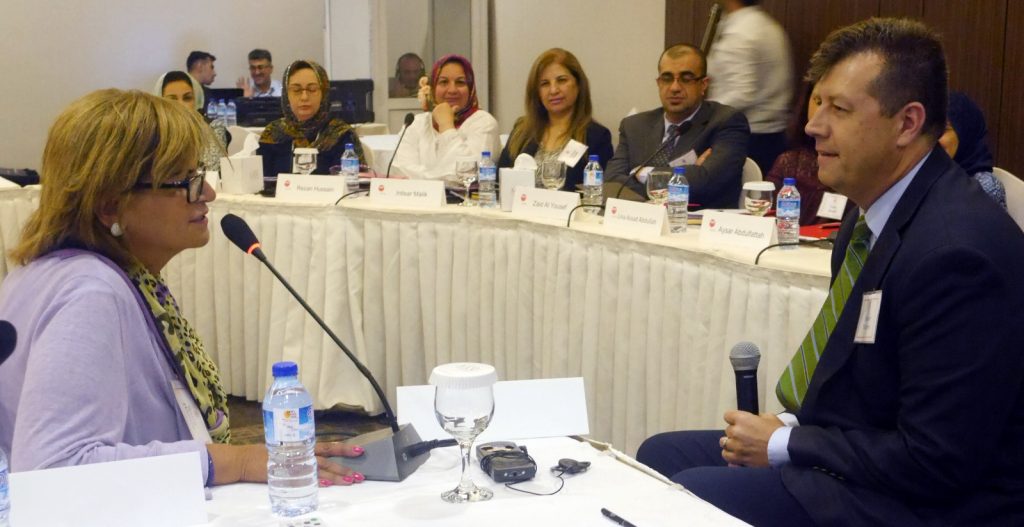
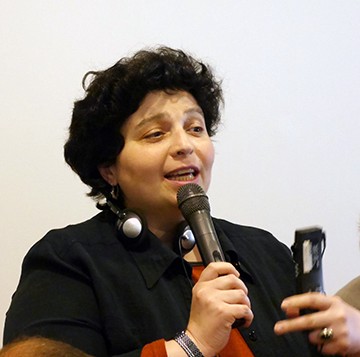
Mental health expert and PHR partner Dr. Sana Hamzeh (left) and Dr. Homer Venters, PHR director of programs, at a PHR training on forensic documentation in Erbil, Iraq in July 2017. 

“Torture puts people in a state between being dead and alive. Transforming the
individual’s perception from ‘broken’ to ‘beautiful’ is what I seek to achieve; I strive to make the person feel alive, rather than a person trapped in their own body.

“But after 30 years working in this field, I still sometimes pause to ask myself, ‘Am I doing enough?’”

Blog

Transforming Central Asian attitudes about torture

Dr. Rusudan Beriashvili is an expert in forensic medicine with more than 20 years of experience combating torture around the world. A longtime PHR partner, Dr. Beriashvili has trained thousands of people in the Istanbul Protocol, the internationally recognized UN standard for investigation and documentation of torture. She is leading PHR’s project to help governments and civil society across Central Asia implement these standards and create a culture that no longer tolerates torture.

“One of our biggest challenges is defining what torture is. People are just beginning to realize the role of governments in torture, to understand why it is perpetrated, and also the pain and suffering it inflicts. But many people still do not appreciate the psychological impact of torture — the fact that psychology is a powerful science and that psychologists can give effective input into the investigation of torture cases. In lots of cases, sometimes even judges and prosecutors do not have a clear understanding of this.

Forensic medicine expert and PHR partner 
Dr. Rusudan Beriashvili leads a PHR training
in Jordan of Syrian physicians. (PHR Photo)

“In Kazakhstan recently, we held a training for prosecutors. There were many young prosecutors, and they started with very skeptical questions and language. But after four days of long and tough discussions, a young prosecutor came to me and said: ‘You know, now I understand not only what you are teaching, I understand that I was working in absolutely the wrong way.’ It was the most important compliment for me. After finishing the training, he started conducting trainings for his own colleagues. He not only gained knowledge, he now delivers knowledge.

“In Tajikistan, years ago, the deputy head of the forensic medical center attended our training. He was very negative at the outset. But now, he is writing books about the Istanbul Protocol — and he’s one of the few people in all of Tajikistan producing independent forensic documentation of torture, which helps survivors secure justice. And in Kyrgyzstan, a representative from the state ministry was very skeptical when she first came to our training. But after two or three trainings, her mentality and perspective absolutely changed. She is now leading the work of the ministry of health in implementing the Istanbul Protocol. She is the locomotive of this work, and has become a real agent of change.

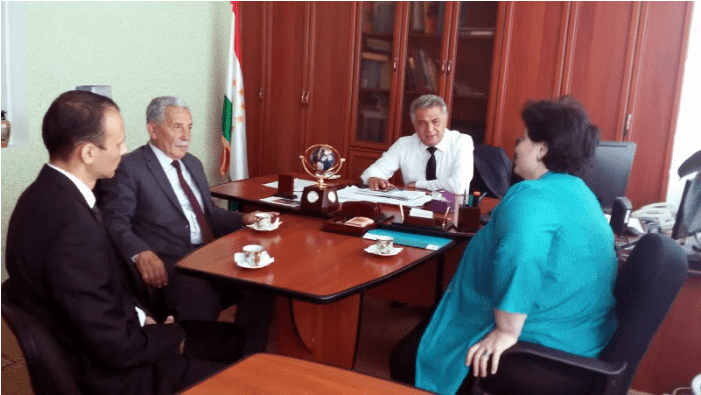
Dr. Beriashvili meeting with Tajikistan health officials. (PHR Photo)

“The PHR project and the Istanbul Protocol are changing beliefs and changing
systems — it’s very powerful. Five years ago, in many settings in Central Asia, it was impossible to utter the word ‘torture’ or to say out loud that torture exists. Now we have governments committing to the Istanbul Protocol, we have standards for implementation, torture rehabilitation programs, documentation centers, lots of legislative changes, books being published, NGOs working on this area. The network of people who are now involved in documentation and investigation stretches across Central Asia. Just in Kyrgyzstan alone, thousands of people have been trained by PHR or our local trainers. Thanks to the Istanbul Protocol and PHR’s work, the situation in Central Asia regarding torture has completely changed.”

Blog

Turkish Doctor Among Academics for Peace Members Under Government Threat

When the Turkish government unleashed the full fury of its repression following the July 2016 failed coup, thousands of teachers, journalists, lawyers, doctors, and members of civil society were fired from their jobs, jailed, arrested, or put on trial — including PHR’s fellow-activists Dr. Şebnem Korur Fincancı, and Dr. Serdar Küni of the Human Rights Foundation of Türkiye. But PHR has a decades-long history of standing by our Turkish colleagues.

“The courage of activists like Dr. Fincancı has been a huge inspiration to all of us who care about human rights, about justice and truth and decency. By standing with them, by mobilizing public outrage, and by speaking out against their oppressors, we give them strength and we show the power of our solidarity,” said PHR Executive Director Donna McKay, who attended Dr. Fincancı’s first trial in Istanbul for alleged terrorism after Fincancı participated in a press freedom campaign.

When Dr. Küni was put on trial in the spring of 2017 for treating alleged members of anti-government Kurdish armed groups, PHR sent Director of International Policy and Partnerships Susannah Sirkin and Researcher Christine Mehta to Dr. Küni’s first two court appearances in the southeastern city of Sırnak.

“The fact that we traveled there to attend the trial of a doctor in the crosshairs has a huge impact locally. This is a potential watershed case in which the Turkish government is targeting a doctor simply for doing his job. The whole human rights community is watching very carefully,” said Mehta, who conducted an investigation and published a report last year on the Turkish government’s widespread attacks on medical care in the country’s southeast. Said PHR’s Sirkin: “In the past year, citizens in Türkiye have been arrested, human rights are under threat, and the rule of law has essentially unraveled. By standing with our colleagues around the world, we put repressive governments on notice that we see what they’re doing and that human rights activists are not alone.”

This kind of solidarity helps transform hardship into victory. “From the farthest part of the world people came to support our cause,” Dr. Fincancı told PHR after her hearing. “It is a celebration of humanity!”

Blog

Documenting Violence Against the Rohingyas Firsthand: Evidence That Can’t Be Ignored

PHR documented the wounds of this Rohingya man at Balukhali refugee camp in Bangladesh. He was shot from behind by the Myanmar military while fleeing his village. Photo: Salahuddin Ahmed for Physicians for Human Rights

I’ve never met so many survivors of gunshots in a single place before. They’re not hard to find in the refugee camps in Bangladesh, which shelter nearly 650,000 Rohingyas who have fled Myanmar since the government there instituted a ruthless campaign of violence against them. Military leaders in Myanmar falsely claim they have mounted this brutal attack on civilians, many of them children, because they are “terrorists.” They have even stated that Rohingyas have set their own homes on fire.

The forensic evidence in these cases tells a vastly different story — the truth.

I traveled this month to Bangladesh with a team of doctors from Physicians for Human Rights to document the evidence and listen to survivors’ horrific accounts of physical and sexual violence.

We conducted careful forensic documentation following internationally accepted protocols to corroborate their stories, supported by physical examinations and x-rays.

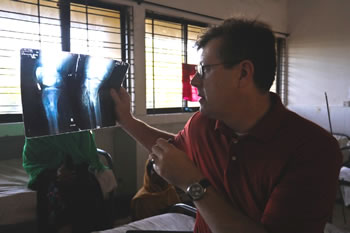
PHR’s Dr. Homer Venters examines an X-ray of a Rohingya man

PHR’s Dr. Homer Venters examines an X-ray of a Rohingya man who was shot from behind by the Myanmar military. The X-ray shows a bullet lodged in the knee. Photo: Salahuddin Ahmed for Physicians for Human Rights

One survivor, Tamir*, told me he was shot while fleeing his village. Like many, Tamir reported that his village in Rakhine state in Myanmar came under a coordinated attack by soldiers and civilian militias, who entered the village, opened fire on houses with rifles and rocket-propelled grenades, and set the homes aflame. As Tamir ran from his home, he reported, he was shot from behind. When I saw him in the hospital, physical examination of his leg revealed a bullet entry wound on the back of his lower leg, and I was able to feel the bullet still lodged in the front of his knee. Tamir’s x-ray revealed that both bones in his lower leg had been completely shattered and, despite surgery, he will likely never walk again without assistance. The medical evidence is highly consistent with Tamir’s account of events.

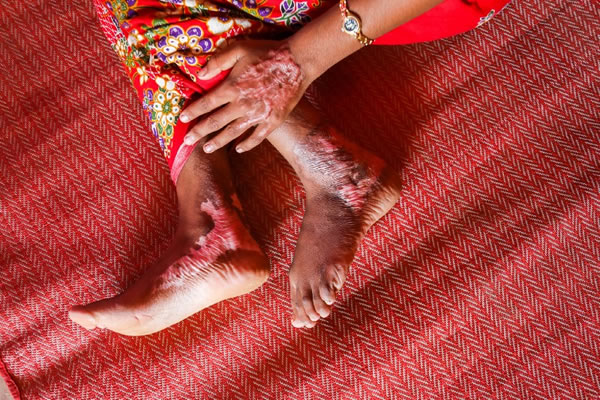
Another survivor, Amirah*, a young woman from a different village, recounted the horror of her entire community being attacked in their homes, and then being driven toward a second group of soldiers at a river bank. There, hundreds of women were separated from the men and boys and taken back to the homes in the village, where they were raped by both soldiers and civilian militias before being cut down with machetes. Then their homes were set on fire. The villagers who remained at the river were mowed down with rifle fire as they fled into the water. Amirah said that once she and other women were taken to the houses, she was struck on the head with a machete and knocked unconscious. Left for dead, she awoke to the pain and smell of her body on fire. She crawled out to escape the fire and made her way toward Bangladesh. Physical examination of Amirah revealed healing third degree burns on her hands and feet as well as a large healing laceration on her scalp, all highly consistent with her account of events.

Rohingya burn victim

A Rohingya woman at a refugee camp outside of Cox’s Bazar incurred serious burns following a Myanmar government attack on her village. Photo: Salahuddin Ahmed for Physicians for Human Rights

The violence inflicted on Tamir, Amirah, and the many other Rohingya refugees we have spoken with, is criminal. And yet the military leaders who ordered it and the soldiers who carried it out are unlikely to ever face justice within Myanmar: Experience shows that if criminal investigations happen at all, they will be inadequate and evidence will be shoddy and scarce. This is particularly alarming, because history has also taught us that internal conflicts are unlikely to come to an end without some form of accountability for atrocities committed — especially if the atrocities are ethnically charged.

The need for justice and accountability was painfully clear to us in Cox’s Bazar. The survivors we spoke with deserve justice, and so do all the other victims of this coordinated campaign of violence. Justice and accountability was also the focus of the recommendations made by the United Nations’ highest human rights official, Zeid Ra’ad al-Hussein, when he asked UN member states earlier this month to authorize investigations into the crimes committed against the Rohingyas in Myanmar. The evidence I gathered this month with my colleagues will be crucial to such investigations, which is why we take such care to forensically document and preserve our findings.

But in the more immediate future, urgent action is needed to ensure the safety, security, and health of Rohingya refugees. In an agreement negotiated behind closed doors in November, the Bangladeshi government agreed to send the Rohingyas back to Myanmar over the next two months. International law requires any return of refugees to be voluntary, and prohibits the return of anyone to potential violence or persecution. Nothing I saw or heard in the refugee camps indicates that the Rohingyas are safe in Myanmar, and few people I have spoken to would go back voluntarily.

This is also a form of accountability: believing the survivors of unspeakable violence when they say they cannot safely go home. Justice must start now.

*Names have been changed to protect patients’ privacy.


Blog

A Victory for Justice in the Congo

The little girl was so severely injured that the surgeon who attended her, a veteran clinician accustomed to treating survivors of sexual violence, was shocked. Just five years old, the child was one of dozens of young girls who were raped during a three-year reign of terror in the village of Kavumu in eastern Democratic Republic of the Congo (DRC).

“When I saw [the extent of her injuries], I said to myself that even if the forces of nature can allow something like this to go unpunished, God and man cannot allow it,” said Dr. Desiré Alumeti, a pediatric surgeon who treated many of the young victims at Bukavu’s Panzi Hospital, in South Kivu province, where most of the children were brought.

Last week, in a stunning victory for justice, a military court proved Dr. Alumeti right: eleven men responsible for these appalling crimes, including a powerful regional lawmaker, were sentenced to life in prison–guilty of crimes against humanity for the rapes of 39 girls and the murders of two men. The landmark case was buttressed by crucial forensic evidence provided by local medical and legal professionals trained by Physicians for Human Rights (PHR), which has assisted the investigation since the attacks began in 2013.

“This verdict is an historic win for accountability for the perpetrators of sexual violence and for access to justice for survivors and their families. It was an extraordinarily complex and challenging case and there were enormous hurdles along the way because very powerful people were presumed to be involved,” said Karen Naimer, director of PHR’s Program on Sexual Violence in Conflict Zones.

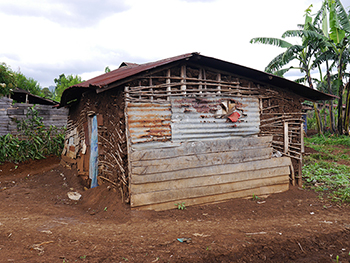
Kavumu home

Children as young as 18 months were stolen in the middle of the night from homes like these, raped, and then dumped in their yards or in fields surrounding the village of Kavumu, in eastern Democratic Republic of the Congo. Photo: PHR  

The assaults followed a sickening pattern. Children – all under 13 and some as young as 18 months – were stolen from their homes in the dead of night, raped and often mutilated, and dumped in their yards or the fields outside the village. It took three painful years to bring the cases to trial, three years of relentless attacks that ended only with the arrest of Frederic Batumike, a member of the South Kivu provincial assembly, in June 2016.

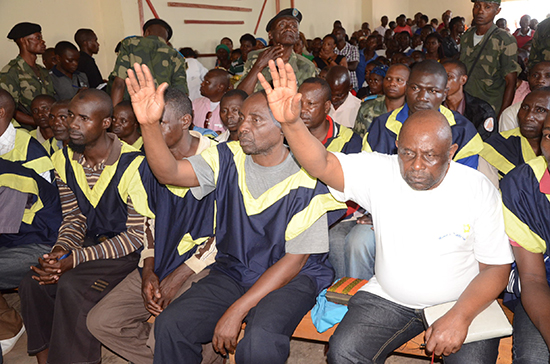
The court found that the perpetrators belonged to a militia led by Batumike, who was ultimately stripped of his immunity in order to stand trial. Seemingly unstoppable, the group had carried out the attacks under the guidance of a traditional occult leader, who instructed them that raping young virgins and collecting their hymenal blood would protect them against injury during armed conflict with Congolese government forces.

Kavumu defendants during sentencing
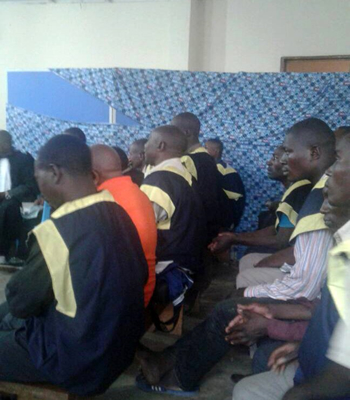
Congolese regional lawmaker Frederic Batumike (in white shirt) and members of his militia were sentenced to life in prison for murder and the rapes of 40 young girls. Photo: PHR

As the gruesome attacks accumulated over the months and years, PHR experts worked intensively with clinicians at Panzi Hospital to gather the forensic medical findings of the assaults, categorize injuries to help establish a pattern of criminality, and document the physical and psychological evidence. When civilian courts ignored the case, PHR, along with national and international partners, made a powerful appeal for it to be taken up by a military court.

Kavumu judges open court on day of verdict
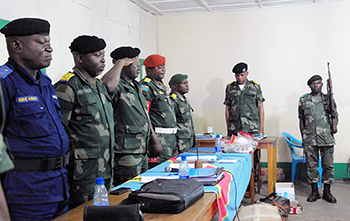
The military court prepares to deliver its verdict in the Kavumu child rape case. Photo: PHR

It was in that military court – set up as a mobile unit so that the crimes could be tried in the community where they occurred – that the impunity long enjoyed by the militia finally came to an end.

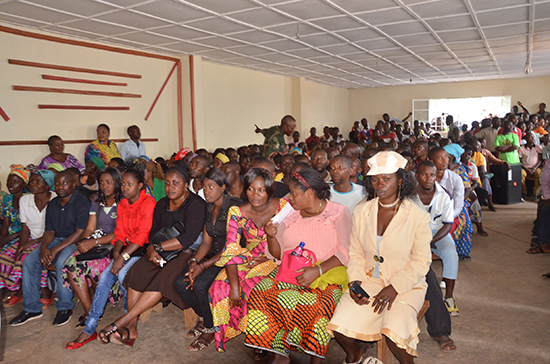
Having failed to derail the proceedings on technicalities during the almost three-week trial, Batumike and his 19 codefendants stood in a packed courtroom amidst heavy security, with two UN armored personnel carriers parked outside, to hear the judgment. Village residents filled the benches, including families of survivors, many of whom said that – before this day – they had almost lost hope for justice.

As the defendants stood, eleven, including Batumike, were given life sentences for crimes against humanity by rape and murder; three others were acquitted of rape, with two of those men facing sentences on other charges. Six other men who had stood trial were acquitted of charges of belonging to an armed group.

The court also awarded reparations of US $5,000 to each of the survivors of the attacks.

Public in courtroom for Kavumu verdict
Residents of Kavumu, including families of the survivors, packed the courtroom to hear the verdict in the child rape case which terrorized the village in eastern DRC for three years. Many said that, before this day, they had almost lost hope for justice. Photo: PHR

“This verdict gives hope to the multitudes of silent and traumatized victims who have not dared to speak out because they had no faith in our justice system,” Dr. Denis Mukwege, who founded and has led Panzi Hospital in treating tens of thousands of survivors of sexual violence, said in a statement. “This Kavumu trial is a strong message to political leaders at all levels who maintain militias. Militias that kill and rape civilians, attack Congolese armed forces and United Nations forces. Militias who commit war crimes and crimes against humanity. The message is clear: Sooner or later, justice will win.”

Witnesses' identity is protected in Kavumu courtroom
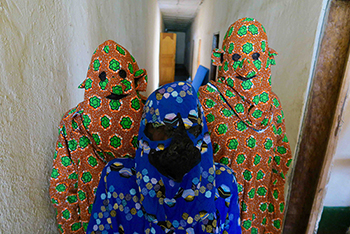
PHR and its partners urged that survivors and witnesses be granted full identity protection when providing testimony, including head-to-toe covering and the use of voice modification technology. Photos: PHR

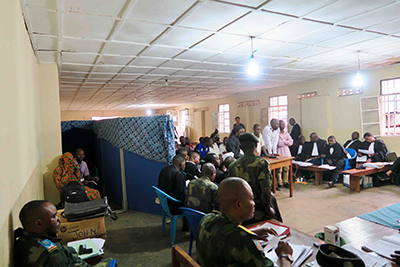
Just two days earlier, 12 parents of the young victims had taken the stand to describe the devastation the attacks had caused to their daughters and families. Following technical support and urging from PHR and its partners, the prosecution successfully requested that the court allow witnesses to testify behind a privacy screen, their bodies covered head to toe and their voices disguised with voice modification technology provided by PHR to shield their identities. After a child survivor broke down, sobbing, as discussion of her case began, the court allowed the children to be excused from testifying, as had been urged by PHR and partners.

The office of the UN’s Special Representative of the Secretary-General on Sexual Violence in Conflict, which had urged DRC authorities to move the case forward, said the verdict by the military court was a significant step forward in ending impunity for sexual violence in the Congo. But it warned that in order for justice to be fully served, the reparations awarded to the child survivors must be paid and the sentences against the perpetrators carried out.

Kavumu witnesses testify behind privacy screen
Following urging from PHR and its partners, prosecutors secured the court’s approval to protect witnesses’ identities by allowing them to testify behind a privacy screen. Photo: PHR

“This trial truly was groundbreaking for the justice process in the Democratic Republic of the Congo,” said PHR’s Naimer. “A sitting member of parliament, stripped of his immunity, was found guilty of crimes that he and his armed militia (which he controlled and financed) committed; the medical and legal evidence was comprehensive and compelling; the court took innovative steps to ensure the security and protection of victims and witnesses by shielding their identity in court and ensuring they would not testify in public sessions; and there was remarkable collaboration among medical and legal professionals, local, national, and international NGOs, and government officials.”

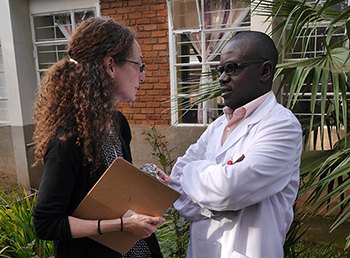
Karen Naimer and Dr Desire Alumeti
Karen Naimer, director of PHR’s Program on Sexual Violence in Conflict Zones, speaks with Panzi Hospital’s Dr. Desiré Alumeti, a pediatric surgeon who has treated many of the child rape survivors from Kavumu. Photo: PHR

For the doctors and nurses who had the grim task of caring for the young survivors, and healing their battered bodies and minds, the verdict was an extraordinary vindication. “Sometimes I felt depressed, but the courage of others was an antidepressant for me,” said Panzi’s Dr. Alumeti. “I salute the solidarity that was created around these children … together, we were unstoppable.”

The trailblazing case came together through the efforts of a Justice Task Force comprised of PHR, Panzi Hospital, the NGO TRIAL International, numerous Congolese civil society groups, and the Joint Human Rights Office of MONUSCO, which along with the FARDC (Congolese military) provided protection in the face of persistent security threats to survivors, their families, and witnesses throughout the investigation and during the trial. The important collaboration among so many key partners and stakeholders helped to ensure the case could progress in an effective and coordinated way.

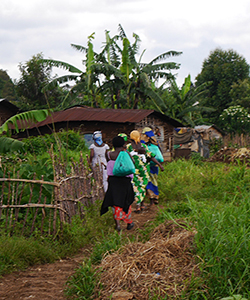
Kavumu women on path
Residents of the Congolese village of Kavumu. Survivors of the three-year scourge of child rapes, their families, and witnesses in the case have faced persistent security threats which will need to be addressed in the wake of the historic verdict against the children’s attackers. Photo: PHR

Damages in sexual violence cases are virtually never enforced in the DRC, and Naimer noted that vigorous advocacy will be needed in order to ensure that the reparations are properly implemented. It is also critical to address ongoing threats and risks to survivors, their families, and witnesses and to ensure that they can feel safe in their community without fear of reprisal.

“We need to ensure that this successful verdict is not an isolated event, but a model for how sexual violence cases can be prosecuted in the DRC going forward – so that it becomes the rule and not the exception,” she said.

Susannah Sirkin, PHR’s director of international policy and partnerships, said the case’s outcome demonstrates the potential for justice when political will is joined to a mobilized civil society and the technical training to produce unassailable, incontrovertible evidence.

“This historic victory for justice in the Congo is a result of the incredible dedication and perseverance of the medical, police, legal, and justice professionals on the ground, and the exceptional courage of the survivors and their families in coming forward. This verdict shows that with determination and solid evidence, even the most powerful people can be held to account for their crimes.”

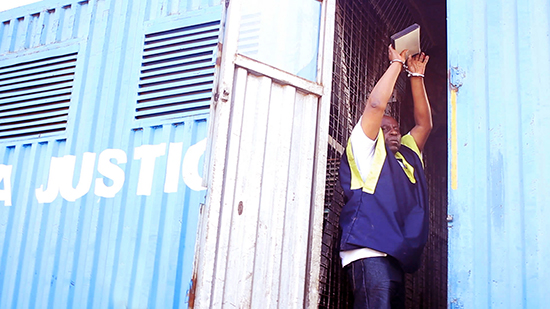
Congolese lawmaker Frederic Batumike climbing into police van
Congolese lawmaker Frederic Batumike is taken to prison after receiving a life sentence for leading his militia to murder two men and rape dozens of young girls. Photo: PHR
Blog

The UN Says the United States is Still Torturing Detainees at Guantánamo. More Reason Than Ever to Close it.

The U.N. special rapporteur on torture stated earlier this week that torture of a detainee at the Guantánamo Bay detention center is ongoing, despite a domestic ban on so-called “enhanced interrogation” torture techniques. The expert noted that the detainee, who endured years of CIA torture before being transferred to Guántanamo, continues to be subjected to abusive detention practices, including indefinite detention, solitary confinement, sleep deprivation, and denial of medical care. 

Yet earlier this fall, U.S. President Donald Trump, in a knee-jerk reaction to the second deadliest attack on New York City, said he would consider sending the terror suspect, Sayfullo Saipov, to the military prison at Guantánamo – where he would be tried by the ad hoc military commissions set up after 9/11. Trump later reversed his position, saying the military system would take too long.

“Statistically that process takes much longer than going through the federal system,” Trump stated. Swiftly after, the Justice Department charged Saipov with terrorism in a federal court.

As we approach the 16th anniversary of the opening of the prison at Guantánamo, the president’s decision not to send the Manhattan attacker there is the correct one – not only because federal courts are better equipped to prosecute terror suspects than the flawed military commissions, but also because the prison itself is illegitimate and inhumane, undermining U.S. national security interests. Put simply, it should be shut down. Neither Saipov nor Akayed Ullah, who earlier this week set off a pipe bomb in New York’s subway system, should be sent there.

As a practical matter, federal courts can prosecute high-profile terror suspects more efficiently and at lower cost than the military tribunals at Guantánamo. There is no need to be running a $450 million-per-year facility to house suspects. But focusing on financials misses the real point. Guantánamo has not led to justice, and the vast majority of men there remain uncharged.

The legal system for trying detainees at Guantánamo – the military commissions – is disastrous. The families of 9/11 victims are still in pretrial proceedings, with at least five more years until a trial would begin. The endless wait is due in large part to the fact that the military commissions were designed to be irregular proceedings in order to circumvent the due process requirements of federal courts, and to cover up evidence of torture. This manifests, among other ways, in profound secrecy and rules permitting the use of evidence obtained through torture.

These issues remain at play today, tainting the proceedings and casting doubt on the legitimacy of any convictions. In October, attorneys quit the defense team of Abd Al-Rahim al-Nashiri, the alleged mastermind of the 2000 USS Cole bombing. While the details are classified, the concerns relate to alleged spying by the government on privileged attorney-client conversations, raising a stark ethical conflict for representation in a capital case. Does anyone still believe in the efficacy of Guantánamo to bring about justice?

A day prior to the bike path attack, Physicians for Human Rights (PHR) hosted a talk with interrogation and counterintelligence expert Mark Fallon, author of the recently published book Unjustifiable Means: The Inside Story of How the CIA, Pentagon, and US Government Conspired to Torture. Fallon was deployed to Guantánamo as a naval criminal investigator in the wake of 9/11 – and became horrified by the eventual emergence of a prison that created a legal and ethical morass.

“Detainees held would exist in a sort of legal twilight,” he writes in his memoir, “neither prisoner of war captured on a traditional battlefield nor inmate held on American territory.”

The men at Guantánamo are still held indefinitely – and 31 of the 41 men have never even been charged with a crime. The details of the torture many have experienced – both in CIA and military custody – are harrowing; we at PHR have long documented the severe mental and physical harm detainees subjected to similar forms of abuse endure.

It is time to reverse the policies that sent those men there. Policies built on fear rather than facts can only bring us further from justice than we already are.

It is not too late to erase the harmful legacy of Guantánamo. By pushing to close, rather than expand, Guantánamo, we are protecting our national security and putting to rest a symbol that has stood for torture and inhumanity for almost 16 years.

Blog

Parents of Congolese Child Rape Victims Testify in Landmark Trial

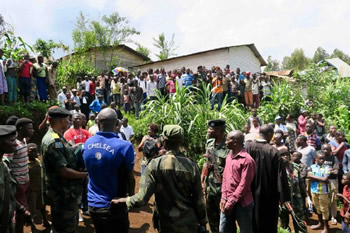
Two alleged perpetrators in the Kavumu child rape case are led through the village where the assaults took place, in eastern Democratic Republic of the Congo (DRC), during the landmark trial. Photo: PHR

The parents of a group of little Congolese girls who were savagely raped during a three-year reign of terror in eastern Democratic Republic of the Congo (DRC) took the stand today in a landmark trial, where Physicians for Human Rights (PHR) has provided technical support in gathering forensic evdience.

Twelve parents, their identities hidden by head-to-toe coverings and voice modification technology, told the court from behind a screen how their daughters had been dragged from their homes in the middle of the night, raped, and dumped near their homes or in fields surrounding the village of Kavumu.

Eighteen men accused of raping 46 young girls sit in a mobile court in Kavumu

Eighteen men accused of raping 46 young girls sit in a mobile court in Kavumu, DRC, while parents of the victims testify behind a cloth-covered screen. Photo: PHR

At one point, a child survivor who was sitting behind the witness screen with her mother broke into sobs as the mother, identified only as P17, recounted how she had found the little girl lying on the ground in front of the family’s home. The girl was escorted outside by a court psychologist.

Eighteen defendants, including Congolese lawmaker Frederic Batumike, are charged with kidnapping, raping, and mutilating 46 girls – some of them as young as eight months old – over a three-year period ending in 2016 with the arrest of Batumike and his alleged colleagues.

Batumike, who allegedly heads a militia that is accused of carrying out the rapes, had earlier tried to hold up proceedings by seeking the recusal of two of the military judges trying the case, but the request was rejected by an independent court. Batumike, who is also accused of having ordered the murders of two opponents, then said he would no longer cooperate with the court, citing his right to remain silent, and instructed his attorneys to stand down. The court ordered him to testify and appointed him court attorneys.

Frederic Batumike Sitting

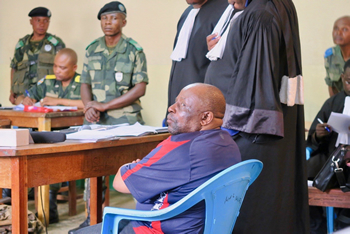
Frederic Batumike, a Congolese lawmaker alleged to have led the militia that carried out the rapes, sits in court with his attorneys. Photo: PHR

PHR has worked closely for years with local medical professionals, police and military investigators, and lawyers to gather evidence of the rapes. During the trial, PHR and local and international partners successfully advocated to protect the identities of witnesses and survivors by seeking permission from the court to use voice-modification technology, to be identified by a number instead of by name, to testify behind a screened-off area, and to testify in a closed court that would not be open to the public. PHR also worked with partners to seek the court’s approval not to retraumatize the child survivors by requiring them to testify in court, relying instead on video testimony of the children documented by PHR and its partners.

The mobile court traveled with two of the defendants

The mobile court traveled with two of the defendants (at left, in blue and red shirts) to a neighborhood where rapes occurred. Photos: PHR

The expertise of PHR and local police partners was also called upon to examine cell phone records as a means of establishing that the 18 defendants were part of a structured group, whose actions could be considered as organized and systematic.

Many of the accused come from Kavumu. The mobile court, a mechanism for allowing trials to take place in the communities in which crimes occurred, last week traveled with some of the defendants to neighborhoods in Kavumu where the rapes took place; there, former neighbors recognized the accused men, countering the men’s claims that they had never lived in the area and did not know each other.

Proving that the defendants not only knew each other but were part of an organized militia is a critical part of the prosecution’s case.

The proceedings will continue through next week.

Defense lawyers stand with a defendant

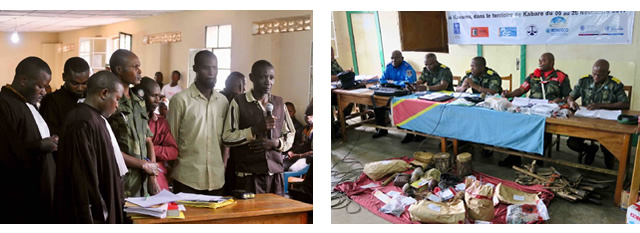
Left: Defense lawyers stand with a defendant (in red shirt) charged with murder and rape and two traditional medicine practitioners who allegedly aided the child rapes. Right: Judges from the mobile military court with evidence in the Kavumu child rape case. Photos: PHR
Blog

“Shot From Behind While Fleeing” – PHR’s Dr. Homer Venters Reports from the Myanmar-Bangladesh Border

One Rohingya man suffered a compound fracture in his leg when he was savagely beaten by Myanmar security forces. A 5-year-old girl was flung against a wall with such force that, two months later, she still can’t walk. A young woman was struck over the head with a machete and then left to die in her burning home.

Stories like these, and of mass rapes, mass killings, and mass graves, are some of the accounts being heard by a team of doctors from Physicians for Human Rights that is currently on the Myanmar-Bangladesh border to document evidence of extreme violence committed by Myanmar security forces against Rohingyas. Our colleagues have examined several men, women, and children who were shot in the back as they escaped villages that had been set aflame by their attackers. One women we spoke to said: “If we go back, they will kill us.”

In this video, our director of programs, Dr. Homer Venters, talks about what he and our team are witnessing in PHR’s second trip this fall to the refugee camps near Cox’s Bazar, Bangladesh, where almost 650,000 traumatized and desperate Rohingyas are sheltered. We will use the information and evidence we have gathered to draw attention to the profound suffering of the Rohingyas, to demand a response from world governments to prevent and punish the crimes being perpetrated against them, and to advocate that Rohingyas not be forced to return to areas of Myanmar where they are at risk of further persecution.


Donate

Blog

The Key to Cracking Sexual Violence Cases: Teaching Respect for the Survivor

“I found Adela* lying in the road, severely injured and near death. She had been captured by an armed group when she was only nine or ten, and enslaved, raped, and physically attacked over the course of ten years. She was so traumatized that she was unable to speak.

“Before, someone like Adela would have been brought into the police station for a very short interview — a half hour of direct questions. That’s all. But many sexual violence cases in the Democratic Republic of the Congo (DRC) were being thrown out, because many survivors couldn’t give evidence in those circumstances.

PHR trains responders on how to interact with survivors, how to listen to them and gain their trust. I worked on the case of Adela for many months with Gloire Bamporiki and Honorata Uvoya, two investigators we trained from the sexual violence unit of the police force in South Kivu, DRC. At first, Adela couldn’t talk to the investigators. But Gloire and Honorata visited her every single week in the hospital. They took the time, they were patient, they listened to her when she was ready to speak. And finally she did.

*not her real name

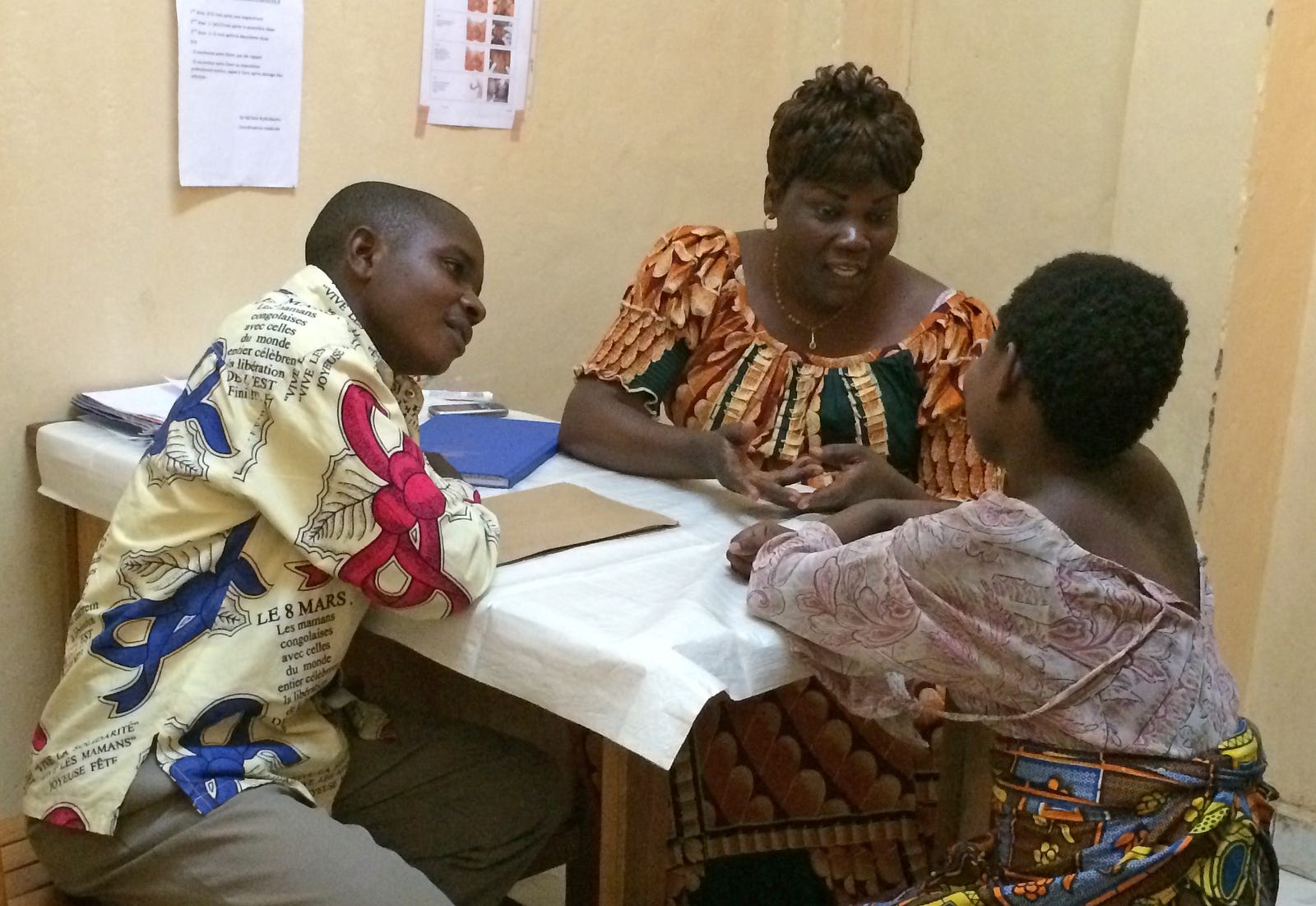
Police investigators and PHR partners Gloire Bamporiki and Honorata Uvoya (left and center) interview a survivor of sexual violence in South Kivu, DRC. (PHR Photo)

“I see this kind of big change among the people that we’ve trained, how they interact with and relate to survivors. Now they’re able to be more patient in their investigation. I’ve also had good feedback from prosecutors, who are using the same methods to interview survivors. They’re better able to understand the psychology of survivors, to communicate with them, and to listen to them — and, as a result, they’re better able to protect the survivor once the case gets to court. They can explain why a survivor might not be able
to speak, why she might not be able to identify a perpetrator, why she might have taken six months to come forward — and all this helps the case and improves a survivor’s chance of securing justice.

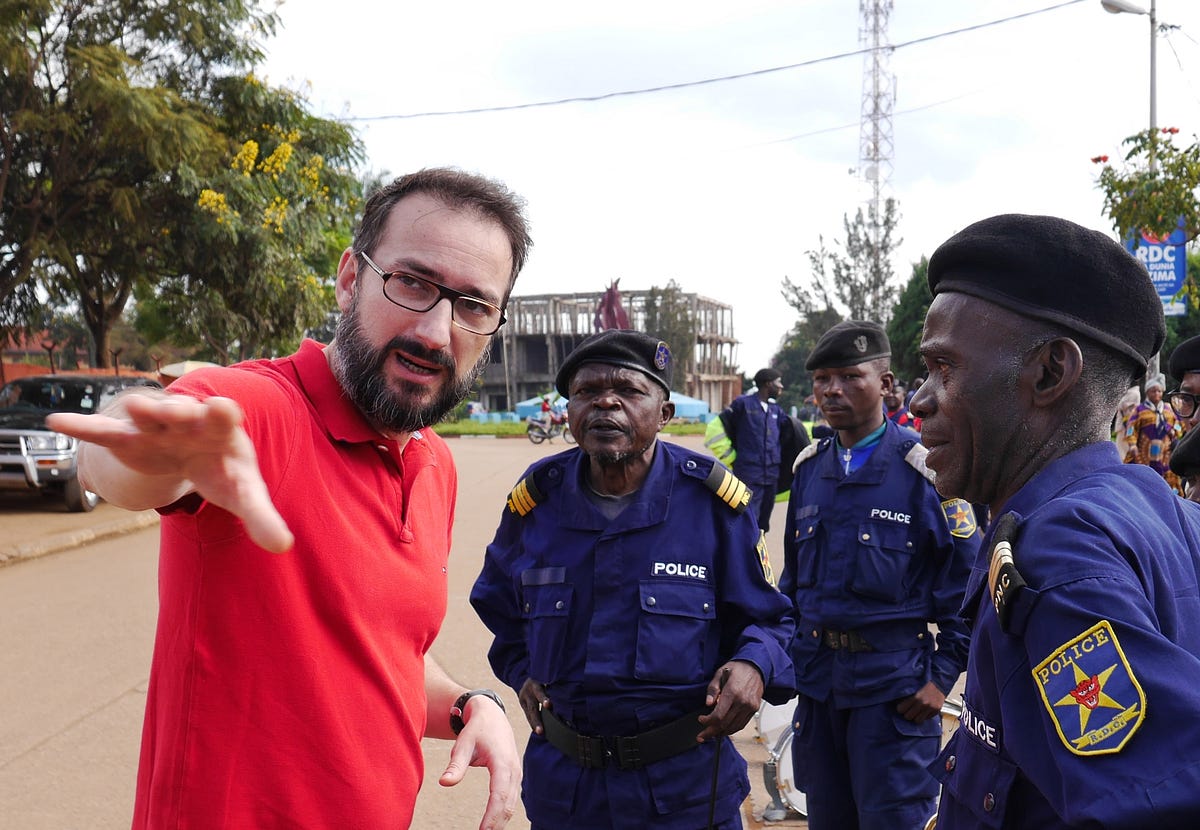
PHR’s Georges Kuzma speaking with members of the South Kivu, DRC police force. (PHR Photo)

“Today, the justice system in South Kivu is much more operational than it was
before. We’ve done a lot of education. And perpetrators see that they will be
prosecuted and convicted — that they can’t rape with impunity.”

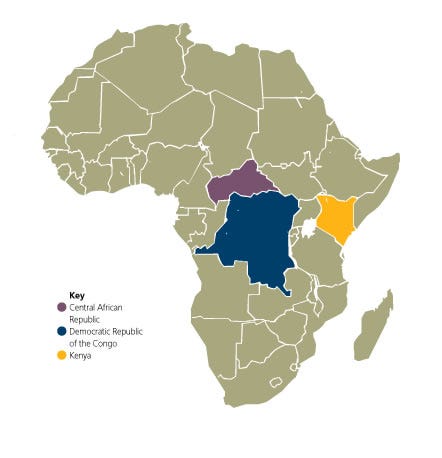
PHR trainers and our partners in the Central African Republic, the Democratic Republic of the Congo, and Kenya have empowered nearly 3,000 doctors, lawyers, police, judges, government officials, and community members with the skills and knowledge to combat sexual violence. (PHR Graphic)

Get Updates from PHR