Statements

Rights Organizations Call on US Secretary of State to Suspend Military Assistance to Bahrain

Physicians for Human Rights joined ten other organizations in calling on Secretary of State Hillary Clinton (pdf) to immediately suspend US military assistance and arms transfers to security force units in Bahrain that are engaging in human rights violations.

PHR and other groups have documented killings, torture, and beatings at the hands of the Bahraini security forces. The US Foreign Assistance Act prevents the US from sending military assistance to units that commit human rights violations, and PHR calls on the State Department to fully implement this law. Suspension of US military assistance to abusive security units would send a strong signal that the US does not tolerate attacks against non-violent protesters.
Blog

NY Times Article Highlights Need for Greater Protections for Unaccompanied Immigrant Children

In the complex debate over illegal immigration, one population goes largely unnoticed: the thousands of unaccompanied immigrant children who make their way to the US every year. Some of these children come to find work and send money back to their families, while others have no family left in their home countries and travel to the US looking for relatives to care for them. Many more come to escape violence from drug traffickers and gangs, which often try to recruit even very young children.  Unlike most undocumented adults apprehended at the border, these children are taken to shelters and given an opportunity to try to stay in the US.

But, just like undocumented adult immigrants, unaccompanied children face a number of barriers to gaining legal status in the US. While every person facing potential deportation has the privilege of representation, such representation must come at no expense to the government. Pro bono legal services for unaccompanied children are in short supply, and very few of these children have the resources to hire their own counsel. This means that most children in immigration proceedings are left to their own devices—and even those as young as 6 must navigate the complex immigration system alone.

In this regard, immigration law differs from all other aspects of juvenile law in which young people have a right to appointed counsel or a guardian ad litem (a child welfare professional charged with advocating on the child’s behalf). Under current immigration law, children are treated no differently from adults. Those who seek relief from deportation must grapple with a system that does little to accommodate their special needs.

For example, unaccompanied children may be eligible to seek asylum—but must satisfy the same requirements as adults. That is, they must characterize their experience in their home countries as “persecution,” presenting specific facts that fall into a narrow legal definition. Without an understanding of the socio-political conditions in their home country, this is an impossible task. Without an attorney, this form of relief is virtually unattainable for an unaccompanied child.

That a child is unable to effectively represent himself or herself in immigration court has been recognized by the American Bar Association, as well as legislators and policymakers across the country. The government provides limited funding for legal services providers to appear alongside unaccompanied children as “friends of the court” in some circumstances, and pro bono attorneys represent thousands of unaccompanied minors on their applications to stay in the US each year. But too many still slip through the cracks: unable to act as their own lawyers, they are deported to countries where they may have no means of support, and where they may be targeted for exploitation or even death.

The immigration system for unaccompanied children is in many respects an improvement over the system that applies to adults. But it is by no means perfect. Advocates must continue to press for the establishment of a system that provides appointed counsel and guardians ad litem for unaccompanied children. Once that fundamental safeguard is in place, broader reforms that create sufficient child-specific standards in immigration law should follow.

Blog

The Games Are Over

Apparent Dismissal of Torture Claims in UK Detention Center Reaffirms Need for Victims’ Medical Evaluation

London’s Summer Olympic Games focused the eyes of the world on Great Britain as it hosted a two-week celebration of international competition, coupled with what seemed like true respect for and appreciation of the histories and cultures of some of the world’s greatest athletes. As the games came to a close, however, so too did Britain’s seeming respect for its foreign visitors, as reports surfaced alleging that officials at its Dover immigration removal center have been too dismissive of detainees’ torture claims.

Britain’s Chief Inspector of Prisons Nick Hardwick describes the reports coming from medical officials examining detainees at Dover as poor, “often hand-written and difficult to read” and frequently lacking “photographs or body maps.” Medical officials in the Dover center apparently made no effort to truly understand or corroborate torture claims. As Hardwick explains, “in a case where the detainee claimed to have been shot, there was no judgment on whether the scars were consistent with gunshot wounds.” More disturbing is the plight of a detainee who claimed to have been raped. Instead of medically evaluating the detainee’s claim, prison officials reasoned that, if he truly had been raped, he would have raised this issue at the onset of his detention; since he had not done so, his claim of rape was dismissed.

The dismissal of torture claims by officials in Dover is obviously alarming for many reasons, but perhaps primarily because these torture victims should not even have been detained in the first place. Rule 35 of Great Britain’s 2001 Detention Centre Rules, which govern medical examinations of immigrants alleging torture, mandates that torture victims should be detained only in “exceptional circumstances.” Furthermore, Rule 35 requires doctors and healthcare teams in facilities like Dover to report the case of anyone they believe to have been tortured. When independent medical evidence is found to support a detainee’s torture claim, Rule 35 mandates that the victim be released.

Criticism of Britain’s inability to follow its own rules has been widespread. In February of the year, the UN High Commissioner for Refugees criticized Britain’s inadequate screening process that sent rape and torture survivors to detention centers in handcuffs. Furthermore, a recent investigation by UK-based Medical Justice found that, among 50 people who had medical evidence of torture, only one had been released in compliance with Rule 35. Since the study began in May 2010, only 14 of those detained have been granted asylum; the others are still in detention pending decisions about their claims.

The revelations regarding torture victims in Dover’s immigration center reaffirm our belief that a timely and proper medical evaluation by an independent clinician is essential for all asylum seekers and detainees claiming to be victims of torture. Forensic medical evaluations conducted in compliance with the Istanbul Protocol constitute critically important evidence in torture cases. Trained clinicians examine all signs and sequelae of physical and psychological abuse and produce a medical-legal affidavit documenting their conclusions. These affidavits serve as key evidence to use in the prosecution of perpetrators of torture, to help victims obtain redress in civil courts, and to substantiate claims of asylum in new countries.

In recent weeks, Great Britain has demonstrated its ability to welcome foreign guests to its shores and to treat them with the utmost respect and dignity. Now it must show that its hospitality is not limited to athletes, journalists, and politicians, but also embraces people most in need of its humanity.

Blog

Uzbekistan’s ‘House of Torture’ Is No ‘Home Sweet Home’

Horror Stories from Jaslyk Prison Emphasize the Need to Medically Document and Prosecute Torture Crimes

Most Uzbekistanis know it as the “House of Torture” or the “Place of No Return.” Uzbekistan, already notorious for its deplorable prison conditions and abuse of prisoners, has one prison that stands out more gruesome and horrific than the rest: Jaslyk Prison. Its prisoners, at least those lucky enough to live to tell their tales, have described the myriad methods of torture used at the prison, including sexual assault, needles forced under prisoners’ fingernails, electric shock, and long periods of isolation in solitary confinement without food or drink.

The stories that escape the walls of Jaslyk Prison are not for the faint of heart. Jaslyk was opened in 1999 following deadly bombings in Tashkent, and currently holds 5,000 to 7,000 inmates. The prison is located on the site of a former Soviet-era chemical-weapons testing area in the harsh northwest region of the country. Despite its isolated location and official silence about its existence, the stories of its inner workings were too horrific to stay secret for long. In 2002, human rights groups documented two suspicious deaths of prisoners from Jaslyk, whose bodies both exhibited clear signs of torture by submersion in boiling water.

Since those first reports, released prisoners and family members of deceased prisoners have begun to share their own horrific tales of the inhuman treatment within Jaslyk’s walls. Yusuf Juma, an Uzbekistani poet, spent three years at Jaslyk after challenging President Islam Karimov’s right to run for a new term in 2007. Juma describes Jaslyk as “nothing less than a death camp. It feels like there is no limit to the cruelty the prison officers there are capable of.” During Juma’s time in Jaslyk, he spent 15 days a month in solitary confinement. For the rest of the time, Juma would be transferred to a different facility in small iron box, which was “too small to sit, too small to stand up. And it was a bumpy road and my head would bang against iron. There wasn’t enough air to breathe.” As shocking as Juma’s story is, his treatment seems to be commonplace among those relegated to the country’s worst prison. He observes, “I don’t know which is worse – Jaslyk or Nazi concentration camps during World War II.”

Jaslyk has recently come to the world’s attention because of Valeriy Parijer, a businessman of dual Russian-Israeli citizenship who served a 10-year sentence in the Uzbekistani prison system starting in 2002. As his original prison sentence was about to expire, Uzbekistani officials recently sentenced him to an additional five-year term for “breaking prison rules,” and he was transferred to Jaslyk. Parijer’s wife describes his experience as “horrendous suffering” and recounts episodes where prison officials put needles under his fingernails and left him in an iron box for hours in the extreme summer heat. Parijer’s story has prompted the Israeli government to demand he be transferred to another prison immediately, and to call for his release.

Although Uzbekistan’s constitution and laws officially prohibit the kind of torture and inhuman treatment experienced by both Juma and Parijer, it is obvious that torture runs rampant within the country’s prisons, and perpetrators are operating with complete impunity. Despite Uzbekistan’s assurance that its prison conditions have improved over the years, the country still refuses to allow UN officials to visit its prisons, including the notorious Jaslyk facility. The UN Human Rights Committee expressed its concerns in a March 2010 publication where it found that the definition of torture in Uzbekistan’s criminal code was not in conformity with the UN Convention Against Torture.

The prevalence of torture within Jaslyk Prison illuminates the general culture of impunity that has plagued the entire Uzbekistani justice system, where people in police or penal custody are subject to cruel and inhuman treatment from the time of arrest to pre-trial detention to final sentencing. This cycle cannot be broken until torture crimes are thoroughly investigated, documented, and prosecuted.

Convictions of perpetrators are hard to obtain, however, when torture victims lack hard evidence to prove their claims of abuse. Eyewitness accounts (other than the victim’s) are rare, and torturers have become diabolically clever with their torture methods; many have adopted techniques that maximize pain while minimizing scarring so that victims have little evidence to show judges and prosecutors. But even after months and years have gone by, specially trained health professionals are often able to identify and interpret the scars left on victims’ minds and bodies. The findings of such forensic medical investigation are then summarized in medical-legal affidavits and presented as evidence in torture prosecutions. This objective medical documentation serves as a critical and irrefutable source of evidence that prosecutors can use to break the cycle of impunity that has tormented Uzbekistan’s people for years.

Blog

Don’t Miss It: Recognizing and Documenting Evidence of Torture and other Persecution

Home to several outstanding and internationally known hospitals, as well as the nation’s leading medical school, it is no wonder Boston is recognized as the epicenter of the medical profession. However, it was in this same medical hub that a patient’s female genital-mutilation (FGM) injuries went unnoticed and unrecorded.

The victim twice gave birth at one of Boston’s leading hospitals, and despite undergoing pelvic exams throughout the course of her pregnancies, the scars of her severe FGM were never addressed by a single clinician. Her medical record provided no indication that anything was out the ordinary.

How could the obvious manifestations of FGM go unnoticed, particularly by the world-class doctors examining her throughout two pregnancies? Judging by the proven excellence of the hospital and the caliber of its doctors, it’s clear that the oversight was not due to lack of medical expertise. However, the clinicians clearly lacked training on how to recognize physical and psychological evidence of persecution, how to effectively treat patients from other cultures, or both.

The need for this type of medical training is critical. The US Office of Refugee Resettlement estimates that 500,000 survivors of torture live in the United States today. Torture survivors live in communities across the US, both urban and rural.

Special medical training to recognize and understand the consequences of human rights abuses is no longer a niche specialty only for clinicians working with asylum seekers. Such training is necessary for all physicians, psychologists, nurses, and social workers determined to aid their patients effectively. Because the majority of torture injuries are chronic, special training is imperative to ensure clinicians can adequately provide the comprehensive care that torture victims desperately need.

PHR is conducting two training sessions to provide clinicians with the skills necessary to recognize and document evidence of torture and other human rights abuses. The two training sessions, held in Washington DC on September 22 and 23, 2012, will provide participants with the ability to fully recognize and document the medical manifestations of past torture and abuse. Each day of this medical training has been approved for 6.5 CME credits by the American Academy of Family Practice.

Get more information and sign up today!

Blog

South Korean Activist Seeks Medical Proof of Torture

Kim Young-hwan, the South Korean human rights defender who was held in detention by the Chinese government for over 100 days, is undergoing medical evaluation to investigate and document the torture that he says occurred at the hands of Chinese security agents.

Kim, who was allegedly helping North Korean defectors in China and promoting human rights in North Korea, was arrested on March 29 and charged with “endangering national security.” He was released and expelled from China on July 20 after human rights groups campaigned for his freedom.

Kim asserts that he was severely tortured, undergoing beatings, electric shocks, sleep deprivation, and forced hard labor, in the early days of his detention in northeastern China. The Chinese government officially denies the torture allegations, and South Korea is hesitant to press the matter before any international bodies or courts until it has material evidence that torture occurred.

Although most of the bruises and scars have faded by now, Kim knows that a forensic medical evaluation conducted in compliance with the UN Manual on the Effective Investigation and Documentation of Torture and other Cruel, Inhuman and Degrading Treatment or Punishment (aka “Istanbul Protocol”) constitutes critically important evidence in torture cases. Trained clinicians examine all signs of physical and psychological abuse and produce a medical-legal affidavit documenting their conclusions. These affidavits often serve as key evidence to prosecute perpetrators of torture.

Kim’s first set of medical evaluations took place on August 8, but the clinicians provided conflicting interpretations regarding a facial bruise. Kim is scheduled to undergo a more thorough examination next week.

It is critically important that Kim be evaluated by at least one clinician who has not only undergone Istanbul Protocol training but has also performed forensic evaluations recently and on a regular basis. Additionally, the South Korean government must ensure that the evaluators are objective, operating under complete clinical independence, and free from any undue political influence within or outside South Korea.

Blog

Government of Bangladesh Blocking Humanitarian Aid for Rohingya

Thai and Burmese press have reported that the Government of Bangladesh is cracking down on charitable organizations that offer assistance to Rohingya, an ethnic group that has faced endemic persecution and violence in Burma.

The Government of Bangladesh ordered the organizations to halt all delivery of humanitarian services, including health care and food provision, to Rohingya under the pretext that such services will encourage more Rohingya to flee to Bangladesh.

Over the past two months, an outbreak of violence in Arakan State, western Burma, between Rohingya and Arakanese has driven thousands of Rohingya across the border to Bangladesh. The violence has displaced an estimated 100,000 people, and thousands of homes have been destroyed. Instead of offering safety to those fleeing violence, as required under international law, Bangladesh returned many Rohingya to Burma, even those in desperate need of medical assistance.

The governments of both Burma and Bangladesh have flouted their international legal obligations to end violence against the Rohingya, to allow humanitarian organizations access to those in need, and to offer safe refuge to those facing violence. Burmese President Thein Sein announced that he wanted to expel Rohingya from the country, and asked for the entire Rohingya population to be placed in refugee camps or resettled abroad.

The persecution of Rohingya is nothing new; PHR documented abuses, including obstruction of humanitarian relief, against Rohingya refugees in Bangladesh in a 2010 report.

The denial of humanitarian services on the part of both governments exacerbates the harm caused by other human rights violations. Given the rising violence in Arakan State, the governments of both Burma and Bangladesh should allow humanitarian organizations open access to those in need. The Government of Burma should adhere to its responsibility to protect its citizens, not fan the flames of conflict as reported in human rights investigations. And the Government of Bangladesh should cease its practice of turning away refugees at the border, and instead offer refuge to those fleeing violence and ensure that refugees have access to essential services, including health care.

Report

Weaponizing Tear Gas

Bahrain's Unprecedented Use of Toxic Chemical Agents Against Civilians

Read the report (pdf) 

The Bahrain government’s indiscriminate use of tear gas as a weapon has resulted in the maiming, blinding, and even killing of civilian protesters, and must stop at once while the government reassesses the use of such toxic chemical agents. PHR’s new report details the findings of our investigation.

This report is based on interviews with more than 100 Bahraini citizens, including victims of civil rights violations, corroborating witnesses, civil society leaders, and government officials. It documents the authors’ findings, based on physical examinations and medical records. Among them:

  • A teenage boy was struck in his left eye by a tear gas canister fired at close range, which fractured his eye socket and ruptured his eyeball, leaving him blind in that eye.
  • A 27-year-old bystander suffered a fractured skull and intracranial bleeding when struck in the head with a tear gas canister.
  • A physiotherapist started wheezing, felt short of breath, and had difficulty speaking for two weeks after exposure to tear gas.
  • Several women who had miscarried reported that their doctors said they had noticed a significant rise in miscarriages in neighborhoods where tear gas was used frequently.
  • An asthmatic man routinely exposed to tear gas died in the hospital of acute respiratory failure after exposure to yet another tear gas explosion.

PHR is calling on Bahrain’s government to immediately end all attacks on civilians and to suspend its use of tear gas while it conducts an impartial investigation of tear gas misuse and holds accountable those who have used the gas in excessive or improper ways. In addition, PHR is asking that Bahrain’s government disclose information about the toxic chemical agents used by its security forces, and that it permit scientists and health professionals to study the effects of tear gas use in that country.

PHR is also seeking the creation of an international group of health professionals, public health experts, lawyers, and law enforcement officials to draft guiding principles on the use of all toxic chemical agents, and to determine whether certain such agents (including tear gas) which are now considered nonlethal should be reclassified under the Chemical Weapons Convention.

>> Read the Executive Summary (pdf)

>> Read the Executive Summary (عربي) (pdf)

>> Read Richard Sollom’s testimony to the Tom Lantos Human Rights Commission (US Congress) on Bahrain’s use of teargas against civilians.

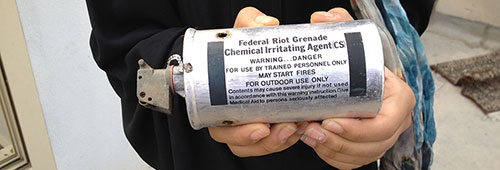
Bahraini woman holds an exploded tear gas canister that was shot into her house.

A Bahraini woman shows an exploded tear gas canister that was shot into her house. Photo: Richard Sollom, PHR


Report

Bitter Wounds and Lost Dreams

Human Rights Under Assault in Karen State, Burma

Even as Burma’s central government institutes political reforms, the Burmese army continues to routinely violate the human rights of ethnic minorities in Karen State, PHR reports, citing findings from a field survey conducted in early 2012.

PHR’s report – Bitter Wounds and Lost Dreams: Human Rights Under Assault in Karen State, Burma – provides a snapshot of ongoing abuses against Karen people and communities in the country’s mountainous eastern region bordering Thailand, where the army has been battling insurgent groups for decades.

Nearly one-third of the families surveyed reported having experienced human rights violations, including being forcibly evicted from their homes, being forced to work for the army, and being physically attacked — sometimes even tortured or raped. The research showed a much stronger incidence of human rights violations in territory controlled by the Burmese army than in areas where insurgent groups were actively striving for control.

The PHR survey indicated that people who lived near a mine, pipeline, hydroelectric dam, or other economic development project promoted by the Burmese government were significantly more likely to have experienced a human rights violation. People living near such projects were almost eight times more likely to be forced to work for the army and over six times more likely to be uprooted or have restrictions placed on their travel.

PHR’s research team trained 22 surveyors from five partner organizations who surveyed 665 households in 88 villages in Karen State in January 2012. The survey, conducted in two local languages, consisted of 93 questions covering human rights abuses, health indicators, food availability, and access to health care between January 2011 and January 2012.

Other

Richard Sollom Testifies Before Lantos Human Rights Commission on Bahrain's Use of Tear Gas

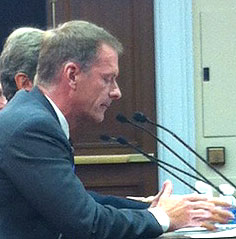
Richard Sollom testifying

PHR Deputy Director Richard Sollom urges Congress to maintain a ban on tear gas exports to Bahrain, during a hearing before the Tom Lantos Human Rights Commission, Aug. 1, 2012

PHR Deputy Director Richard Sollom testified before the Tom Lantos Human Rights Commission in the US Congress today during a hearing entitled Implementation of the Bahrain Independent Commission of Inquiry Report.

Mr. Sollom discussed crucial elements of his recent investigations in Bahrain, including his findings on attacks on medical professionals, militarization of health care, and excessive use of force. Mr. Sollom shared information with Members of the Commission regarding the Government of Bahrain’s rampant weaponization of tear gas, detailed in PHR’s report Weaponizing Tear Gas: Bahrain’s Unprecedented Use of Toxic Chemical Agents Against Civilians.

> Read the Testimony (pdf)

Get Updates from PHR