
Other

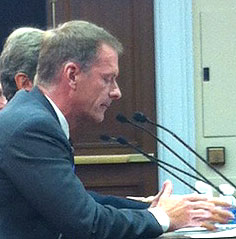
Richard Sollom Testifies Before Lantos Human Rights Commission on Bahrain's Use of Tear Gas

Richard Sollom testifying

PHR Deputy Director Richard Sollom urges Congress to maintain a ban on tear gas exports to Bahrain, during a hearing before the Tom Lantos Human Rights Commission, Aug. 1, 2012

PHR Deputy Director Richard Sollom testified before the Tom Lantos Human Rights Commission in the US Congress today during a hearing entitled Implementation of the Bahrain Independent Commission of Inquiry Report.

Mr. Sollom discussed crucial elements of his recent investigations in Bahrain, including his findings on attacks on medical professionals, militarization of health care, and excessive use of force. Mr. Sollom shared information with Members of the Commission regarding the Government of Bahrain’s rampant weaponization of tear gas, detailed in PHR’s report Weaponizing Tear Gas: Bahrain’s Unprecedented Use of Toxic Chemical Agents Against Civilians.

> Read the Testimony (pdf)
Statements

PHR Endorses Statement of International Campaign to Stop Rape and Gender Violence in Conflict on the Attack Against Dr. Denis Mukwege

Physicians for Human Rights, a founding Advisory Committee member of the International Campaign to Stop Rape and Gender Violence in Conflict, strongly endorses the following statement the Campaign released today following the violent attack last week on our esteemed colleague Dr. Denis Mukwege in Bukavu, DRC:

We of the International Campaign to Stop Rape & Gender Violence in Conflict stand with the women and men who are protesting today by organizing a ville morte (“dead city,” or general shutdown) in Bukavu. Last week, we were shocked to learn about the apparent assassination attempt on world-renowned surgeon, anti-rape activist, and our esteemed colleague, Dr. Denis Mukwege.

We support the women and men of Eastern Congo and join their call for an immediate and full investigation into this brutal armed attack that resulted in the death of the doctor’s long-time trusted guard, Joseph Bizimana.

The Campaign stands with the brave women and men of Eastern Congo struggling to survive increasing insecurity and escalating levels of violence that most of us cannot begin to imagine. The attack against Dr. Mukwege is another brazen display of the violence that persists in an atmosphere of impunity in Eastern Congo. Just last month, Dr. Mukwege issued a resounding call at the United Nations for an end to the violence and for the arrest and prosecution of the perpetrators of war crimes in the region.

We, Dr. Mukwege’s friends and colleagues in the International Campaign to Stop Rape & Gender Violence in Conflict, support that call. We, too, want to see the results of a full and immediate investigation of the attempt on Dr. Mukwege’s life and the murder of Joseph Bizimana — and persecution of other human rights defenders who also endure this terror.

We stand with the women and men in Bukavu in their appeals for security and justice. We join their calls on the Government of Congo to act urgently and address increased insecurity in Eastern Congo.

As Dr. Mukwege stated so clearly at the United Nations last month, “it is the courage of the women victims of sexual violence that will in the end overcome this evil.” Today we stand with them and their brave healer Dr. Mukwege.

>> Lire la déclaration en français (pdf)

See also this blog post from Susannah Sirkin, PHR’s representative on the Advisory Committee and Deputy Director of PHR’s Program on Sexual Violence in Conflict Zones.

Blog

PHR Demands that Government of Burma Rescind Citizenship Law

PHR joined 30 non-governmental organizations today to call for the repeal of Burma’s Citizenship Law.

The 1982 law authorized 135 enumerated ethnic groups for citizenship, and arbitrarily stripped others of their citizenship. The organizations call for the Citizenship Law to be replaced with a law that reflects basic principles of human rights and demonstrates adherence to international treaties.

The UN Convention on the Rights of the Child, for example, to which Burma is a party, requires states to ensure that children have the right to acquire a nationality. The Citizenship Law flouts this obligation as well as the principle in the Universal Declaration of Human Rights that states that each person has the right to nationality.

The criticism of Burma’s Citizenship Law comes at a time of crisis in Arakan State, western Burma, where religious and ethnic tension erupted into outright violence between Buddhist Arakanese and Muslim Rohingya several weeks ago.

Rohingya have been targets of systemic abuse at the hands of the Burmese government, including the inability to acquire Burmese citizenship. A new citizenship law, based on non-discrimination and equal rights, would be a first step to promoting religious and ethnic tolerance in the country.

Other groups included in today’s statement include Burma Campaign UK, Open Society Foundations, US Campaign for Burma, Chin Human Rights Organization, Altsean-Burma, Forum for Democracy in Burma, and Christian Solidarity Worldwide.

Multimedia

Reckoning With Torture: Mercedes Ruehl, Martha Davis, and Kristine Huskey

Mercedes Ruehl, Martha Davis, and Kristine Huskey read "Manner of Death: Homicide," excerpts from autopsy reports of detainees held in U.S. custody in Iraq and Afghanistan, December 2002 to November 2004.

This reading is produced by Reckoning With Torture, a collaborative film project between Doug Liman, the ACLU and PEN American Center that examines the human cost of America's post-9/11 torture program. To submit your own reading or to learn more about the project, visit ReckoningWithTorture.org.


Source: ReckoningWithTorture.org


Multimedia

Reckoning With Torture: Mercedes Ruehl and Kristine Huskey

Mercedes Ruehl and Kristine Huskey read "George Tenet on 60 Minutes: We Don't Torture," the transcript of former CIA Director George Tenet's interview with 60 Minutes correspondent Scott Pelley, April 29, 2007.

This reading is produced by Reckoning With Torture, a collaborative film project between Doug Liman, the ACLU and PEN American Center that examines the human cost of America's post-9/11 torture program. To submit your own reading or to learn more about the project, visit ReckoningWithTorture.org.


Source: ReckoningWithTorture.org


Statements

US Should Support Fundamental Freedoms in Bahrain and Sign UN Human Rights Council Statement

Physicians for Human Rights (PHR) today called on the US Administration to support fundamental freedoms in Bahrain and join 27 member states of the United Nations Human Rights Council in signing a principled statement regarding the ongoing human rights violations in Bahrain. The US is absent from the list of signatories.

The statement, which was issued yesterday, called for the implementation of recommendations of the Bahrain Independent Commission of Inquiry, including accountability for officials implicated in human rights violations. It also called on the Government of Bahrain to respect fundamental freedoms and end intimidation of human rights defenders. 

US Ambassador to the Human Rights Council Eileen Donahoe explained in a statement released yesterday that the US chose not to join the statement and instead is focusing on pressing Bahrain on human rights issues through its bilateral relations.

While the US has focused on Bahraini human rights abuses in the past, including in its statement during Bahrain's Universal Periodic Review before the Council, PHR is disappointed that the US did not publicly join the group of 27 nations to demonstrate its support for the joint statement. 

"The international community needs to speak with one voice to show to the people of Bahrain that it supports fundamental freedoms and condemns egregious human rights violations," said PHR Washington Director and Chief Policy Officer Hans Hogrefe. "The US should seize any and all  opportunities, public and private,  to be consistent in our message and to make clear our concerns regarding ongoing human rights violations in Bahrain and insufficient protection mechanisms to stem attacks on peaceful protesters," said Hogrefe. 

PHR recently returned from Bahrain, where it investigated the rampant misuse of toxic chemical agents on the part of the Bahraini security forces and the damaging health effects of such attacks. 

Blog

Psychological Torture in Detention

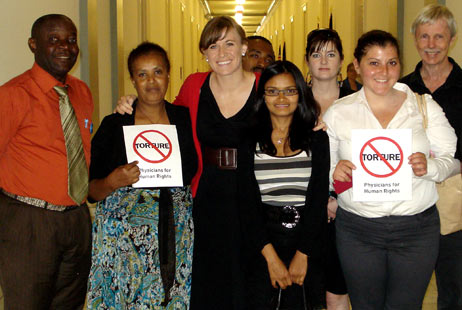
On June 27, Physicians for Human Rights and Torture Abolition and Survivors Support Coalition (TASSC) International held a briefing at the Capitol entitled “Psychological Torture in Detention” in recognition of Torture Awareness Month.

The discussion centered on the use of psychological torture on individuals in detention through practices such as prolonged indefinite detention and abusive solitary confinement. Kristine Huskey, Director of PHR’s Anti-Torture Campaign moderated a panel with torture survivor Pedro Mangue, psychiatrist Dr. Lynne Gaby, and PHR Asylum Advocacy Associate Mike Corradini.

Kristine Huskey opened the briefing by discussing the concept of psychological torture and how it is used by the US in national security detentions such as at Guantánamo, and immigration detentions, which share similar characteristics. In both types of detention, detainees are not convicted. Instead, the detention is for non-punitive purposes.

Despite the non-punitive intent of national security and immigration detention, individuals in such detentions are indefinitely confined and often placed in solitary confinement. This results in damaging psychological and physical effects as detainees are placed in custody with no way of knowing if or when they will be charged with a crime or if they will be able to see family again. Effects of indefinite detention and solitary confinement can include depression, severe and chronic anxiety, schizophrenia, personality changes, hypersensitivity, hallucinations, and panic attacks.

Pedro Mangue told of his experiences being repeatedly tortured in prisons in Equatorial Guinea, only to be immediately detained by Immigration and Customs Enforcement (ICE) when he finally escaped and asked for asylum in the United States. He also conveyed how he was subject to conditions such as extreme cold and isolation and deprivation of mental stimulation while in US immigration detention, making him feel that he was reliving what he had tried to escape. His story demonstrates how the effects of the torture he faced in his home country were magnified by the added stress and confusion of immigration detention—a reality that many asylum seekers in the US face.

Dr. Gaby highlighted the detrimental psychological effects of solitary confinement, particularly as it is used in immigration detention. Her story of a former patient held in solitary confinement for five years illustrated how lasting and devastating these psychological effects of confinement can become, making it extremely challenging to integrate detainees back into society once released from confinement.

Mike Corradini’s testimony focused largely on immigration detention and the challenges that asylum seekers arriving in the US face when put into detention. He reiterated that the incredibly frustrating system, conditions of the detention centers, treatment of detainees, and prevalence of indefinite detention, all contribute to the overwhelming psychological stress faced by detainees.

The discussion highlighted the fact that individuals detained under both types of detention are often detained for indefinite periods and kept in solitary confinement, resulting in psychological and physical harm that in some cases may rise to the level of torture, or cruel, inhuman, and degrading treatment. Changes need to be made to both systems in order to ensure humane treatment of asylum seekers and other detainees.

Those in attendance at the briefing were able to gain a deeper understanding of the detention system and the need to address the effects of solitary confinement and indefinite detention.

PHR & TASSC members, briefing June 2012

Blog

Remembering the Victims of U.S. Torture

Is it torture to waterboard a person, slam them against walls, deprive them of sleep, and force them into stress positions until they cry out for mercy? Close your eyes and imagine this is being done to your husband, your sister, or your child; it would seem to be an easy question to answer.  Certainly, prior to September 11, 2001, it was an easy call for the US, which labeled such practices torture.  What we universally agree is torture is not changed by the passage of time, special circumstances or who we do it to.  Torture is torture.

Yet today, some are asking whether such “interrogation techniques” are effective.  Here’s the answer of Senator John McCain, who was tortured: “under torture a person will say anything he thinks his captors want to hear — true or false — if he believes it will relieve his suffering. Often, information provided to stop the torture is deliberately misleading.” 

If it’s clearly torture, and it doesn’t appear to work, why does the effort to justify waterboarding and other forms of torture continue to be heard in America?  Former CIA officer Jose Rodriguez has been on book tour, touting the effectiveness of making some terrorism suspects “uncomfortable for a few days.”  Of course, we can’t judge for ourselves just how “uncomfortable” we made them—Rodriguez defied a court order and destroyed over 90 tapes with hundreds of hours of the interrogations. Apparently he concluded that the “heat” from destroying the tapes would be “nothing compared to what it would be if the tapes ever got into the public domain.” It seems that the image of making someone “uncomfortable” would have would have been “devastating” to us. 

In a digital world, it’s easy to believe that evidence of torture can be destroyed or silenced, leaving a vacuum into which distortions, lies, and hypocrisy can be peddled as truth. But the truth of what happened in Guantanamo and other US detention sites is out there, forever etched on the bodies, psyches, and souls of the hundreds of men who were released from detention after the US government determined they were not a threat.  We know, because we’ve met some of these men.

“Rashid” was never a threat to the US; indeed, upon his release from US detention, he was given a document confirming his innocence.  Kidnapped from his hospital bed in eastern Africa, Rashid spent five years in US custody in various detention sites including some of the worst in Afghanistan.  During that time, he suffered severe beatings, prolonged stress positions and solitary confinement, sexual assault, sleep deprivation, forced nakedness, the withholding of food and medical care, and forced intravenous medication during interrogations.  The unbearable pain and profound suffering Rashid experiences to this day was evident during an interview with Rashid as he described the “water room,” where he was forced to lie on a wet mat, naked and handcuffed, having cold water poured on him while men attempted to insert the spout of a water jug into his anus.  “Uncomfortable”? 

As we approach the end of June, Torture Awareness Month, try to think of Rashid and the many other men like him who spent years in US custody and were subject to waterboarding and other practices such as sexual humiliation, prolonged stress positions, and sleep deprivation.  Think of these men when you hear talk about “enhanced interrogation techniques.”  Imagine if your son, your father, or another one you love was imprisoned and tortured in a foreign land. What would you call it? We call it torture and it is unconscionable. 

At the very least, the men who were made “uncomfortable” deserve medical and psychological help. They deserve reparations. They deserve justice.

To this day, Rashid still suffers from the torture he endured while detained, describing himself as a “ghost wandering around the town in isolation, unable to eat or sleep.”

Much attention has (rightfully) been focused on ensuring the release of these men from their confinement. We must not forget, however, that the years they spent in US custody have a lasting effect on the bodies and the minds of men like Rashid. Our concern for the men who have been harmed must not stop when they walk out of the prison gates. If we cannot hold torturers accountable for their actions, we can at least commit ourselves to healing their victims.

Blog

International Donors Should Not Forsake Those Providing Care Along Burma’s Borders

Donor countries, including the United States, have supported organizations that provide essential humanitarian services to people along Burma’s borders. Border areas have long been neglected by medical and development programs run by the Burmese government, and this international assistance has helped countless people access medical care and food. Funds to organizations along Burma’s borders include efforts to supply community health workers that provide care to people in Burma with no other access to medical services – people who face ongoing threats of malaria and malnutrition.

Some political reforms have increased opportunities for international donors to directly fund civil society groups within Burma. Some donors have shifted their priorities, favoring internal beneficiaries to those groups that work on Burma’s borders. Emerging civil society groups in Burma rely on international aid and can make great improvements in the country with this assistance, but donors should not favor them at the expense of groups working in Burma’s border regions.

Humanitarian needs are acute along the Thai/Burma border, for example, where approximately 150,000 people seek medical care each year at the Mae Tao Clinic, run by Dr. Cynthia Maung. The clinic serves refugees and migrant workers in Thailand as well as people who cross the Burmese border specifically to receive medical assistance. The clinic has long stood as a necessary source of care for people with no other place to turn, but now the shift in donor focus to Burma’s interior has left Mae Tao Clinic in urgent need of funds and supplies. Mae Tao Clinic issued an urgent plea for assistance this week, stating that it will soon  end its provision of dry food rations to approximately 3000 children if it does not receive additional resources.

The international community must continue supporting organizations and initiatives that provide necessary care to people along Burma’s borders. They should heed Aung San Suu Kyi’s call during her recent Nobel Peace Prize acceptance speech, during which she warned donors against “compassion fatigue” and insisted that donors continue to provide necessary assistance to Burmese refugees in need of care. The reforms within Burma should not be a pretext for international groups to turn away from the growing humanitarian needs of people along its borders.

Mae Tao Clinic is requesting donations, which can be made through its website.

Blog

Medical Professionals Must Take Action Against Dr. Assad

Having mentored several generations of residents in internal medicine, I believe the vast majority of us became medical professionals for the right reason—we wanted to follow Hippocrates’ admonition “to cure sometimes, treat often, comfort always.” This choice does not make the members of our profession perfect. Doctors were on trial at Nuremberg, have aided genocide in Armenia, the Balkans, and Rwanda, and were complicit in torture in Chile and South Africa. But it does make us perfectly aware of the importance of medical professionals in times of armed conflict, when the sick and wounded need our skills and care more than ever.

As a person deeply committed to human rights, I deplore the violence that grips Syria. I mourn the thousands who have died. Sadly, recent efforts to enact a cease fire have been insufficient to stop the carnage.

But as a doctor, I must also specifically address the deliberate attacks waged by government forces on medical professionals and patients and the irony that Dr. Assad—as President Bashar was called when his profession was ophthalmology, not politics—took an oath when he became a physician to “do no harm.”

With some 10,000 dead, it is clear that Dr. Assad is more than willing to do harm on a massive scale. And to further oppress people, he is also attacking doctors, patients, and hospitals precisely because he understands the vital role of healers in holding a community together during times of armed conflict.

PHR has received evidence that government forces regularly deny wounded civilians impartial medical treatment; they invade, attack, and misuse hospitals; they attack and impede medical transport; and they detain and torture medical professionals for treating wounded civilians.

We must not consider these attacks mere “collateral damage,” itself a disingenuous term that obscures the pain and suffering inflicted on helpless civilians. These are not cases where a hospital is shelled by accident, an ambulance blown up by a forgotten landmine, or a nurse among those caught in a firefight.

Syrian forces are deliberately and systematically targeting healers, hospitals, and patients. The cumulative effect of such attacks is to further terrorize communities that have been shelled by tanks and heavy artillery and attacked by roving bands of militia. Every doctor beaten into silence is one less voice to share evidence of torture. For every health professional who is killed or intimidated into inaction, the sick and wounded will suffer and die.

I have never met Dr. Assad. But at one point in his medical training, he must have had the experience that I remember so well. He must have sat down with his first patient and started the daunting and humbling task of learning how to use his skills to heal. If Dr. Assad cannot remember that moment, then the medical community must live up to its ethical duty and speak out to remind him. As Chair of the Board for Physicians for Human Rights, along with Dr. James L. Madara, CEO and Executive Vice President of the American Medical Association, and Dr. Jose Gomes do Amaral, President of the World Medical Association, I sent a letter to Dr. Assad, urging him to stop his attacks.

The killing must stop so the healing can begin. Both sides of the conflict must immediately abide by all relevant international laws; they must cease all attacks on civilians, and take immediate steps to abide by the terms of the ceasefire agreement. The sick and wounded must be provided the help they need, and medical professionals must be free to do their job without interferences.

Get Updates from PHR