Blog

Colombia: Fair Bernal Porras Case Update

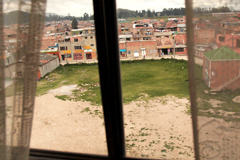
Photo of Soacha, Colombia

Soacha, Colombia, from where Fair Bernal Leonardo Porras was forcibly "disappeared," as seen through Mr. Porras' bedroom window. Photo: Mayra Martell.

Earlier this month, PHR reported on the issue of “false positives”; civilians who were kidnapped and executed by Colombian military forces with the intent of identifying them as either members of the FARC guerrilla movement or other illegal armed groups. Specifically, we focused on the case of Mr. Fair Bernal Leonardo Porras, a 26-year old builder who was forcibly disappeared from a rural town in northern Colombia. Two of PHR’s consultants, Dr. Robert Bux and Nery Osorio had provided expert testimony on the case in January 2012.

Since that time, the judicial process has continued to move forward. A preliminary announcement on March 30, 2012 stated that the defendants would face conviction. Shortly afterward, the Second Special Criminal Judge of Cundinamarca handed down a guilty verdict against the six defendants; all members of the Colombian Army. The perpetrators; a major, lieutenant, corporal, and three enlisted men were charged with aggravated homicide and forced disappearance and sentenced to between 35 and 52 years in prison for their crimes. While reading her verdict, the judge referred to the forensic report and testimony brought to the trial by PHR experts Dr. Robert Bux and Nery Osorio as key to having reached her decision.

“Considering the maximum penalty allowed by the Colombian legal system is 60 years in prison, Dr. Bux and I are overwhelmingly pleased by the judge’s verdict and feel that justice for Mr. Porras has indeed been realized.” explained Ms. Osorio.

Also weighing in on the court’s decision, IFP Director Stefan Schmitt added:

“This is a tremendously positive step forward for justice and rule of law in Colombia and I am pleased that PHR could provide some of the quality evidence and testimony that brought about this verdict. The prosecution and judiciary should be applauded for their dedication and professionalism and should serve as an example for others in the region.”

Physicians for Human Rights hopes that the court’s decision will bring some measure of relief and closure to the family of Mr. Porras and provide encouragement to the many families still seeking justice for their loved ones.

Other

Reassessing Solitary Confinement: The Human Rights, Fiscal, and Public Safety Consequences

Senate Judiciary Subcommittee Statement for the Record

Read the report (pdf)

Physicians for Human Rights urges members of Congress to work towards ending the use of solitary confinement in all facilities under federal jurisdiction, including federal prisons, immigration detention facilities, and national security detention facilities, in all but the most extreme cases.

Blog

Prohibiting Medical Participation in Torture

Eighteen years after the United States ratified the Convention Against Torture and Other Cruel, Inhuman and Degrading Treatment or Punishment, we are still engaging in illegal and immoral practices all over the world. Thus the need to raise awareness about torture and to take a public stand against it continues.

This month, June, is recognized by the global human rights community as Torture Awareness Month, with June 26 marking International Day in Support of Victims of Torture. At PHR, there is a special need to acknowledge the complicity of health care professionals in the torture of those under their care.

Unbeknownst to many—even those in the health care profession—doctors and psychologists played a crucial role in the system of torture and abusive treatment of detainees in locations such as Guantánamo Bay, Abu Ghraib, and other sites.

Numerous declassified government reports, including those by the United States Senate Armed Services Committee and the Inspector General for the CIA, however, have confirmed this well-kept secret.

PHR reports have also revealed doctors’ and psychologists’ involvement in excessive isolation, forced nudity, stress positions, sleep deprivation, temperature manipulation, confinement, and waterboarding. These are techniques that were designed, proffered, supervised, and recorded by licensed health care providers with the intention of destroying the physical and mental senses of detainees.

Many would believe that the systematic use of torture and “enhanced interrogation techniques” that heavily reigned during the previous Administration are in the past, but the reality is that those dark days are not far behind us, and they will be in our future if no one speaks out or acts  against such policies.

Fortunately, a ray of hope for the prevention of such illegal and unethical methods, and for the accountability of any of those involved, has been emerging within the US.

This year, state legislatures of Massachusetts and New York have an unprecedented opportunity to take a stand against health professionals’ involvement in torture.

Both states have pending bills which would prohibit state-licensed health care professionals from participating in unethical conduct by ensuring that they face professional sanctions if they engage in torture or abuse of detainees, or directly participate in the interrogation of individuals..

Furthermore, the bills would protect NY and MA-licensed healthcare professionals who resist unlawful orders to harm those in their care, and empower those professionals to safely report such orders after the fact.

In short, individuals who report torture, healthcare professionals who do not want to engage in torture, and those caught between their “do no harm” oath and the orders they receive from their employers, would all be protected under the bill.

Former Guantánamo detainee Fouad al-Rabiah—now home in Kuwait with his four children after being found innocent by a federal court—was repeatedly denied medication by doctors until he “cooperated” with his interrogators.

Fawzi Al Odah was strapped into a six-point restraint chair and force-fed though tubes too large for his nostrils by doctors, against his express wishes.

With laws enacted from bills such as those pending in NY and MA, the doctors who treated Fouad and Fawzi would not only be barred from participating in such abuse, they would also be required to report it if they witnessed it.

This is an opportunity for states to stand up for the integrity of the healthcare profession as well as fundamental American values. Massachusetts and New York serve as beacons of hope for the survival and advancement of civil and human rights in the US.

These bills should serve as an inspiration to other states to propose similar legislation throughout the country. We as a country must trust in the preservation of one of the most basic principles of medical ethics: do no harm.

Torture Awareness Month is an important time to raise the awareness of our friends, family, and community, and importantly, the awareness of our local and national representatives. We must share the urgent need for an immediate stop to torture, whether under military regimes or foreign governments—or our own democracy.

Blog

Immigration Status Should Never Affect Medical Care

Reasonable people can disagree about how to fix our nation’s broken immigration system. But local, state, and even federal law enforcement agents who stake out migrant worker health clinics and arrest US citizens for helping undocumented immigrants access medical services call to mind dark eras in history when governments denied marginalized groups even the most basic human rights.

The right of all people to access health care, regardless of their immigration status, should be so fundamental that even isolated incidents of its denial result in a public outcry.

And yet the push to criminalize immigration status at the state level, coupled with the Obama administration’s heedless and destructive effort to deport millions of immigrants, has resulted in numerous instances of immigrants being targeted for deportation while trying to access medical care.

Perhaps more importantly, it has created a climate of fear in immigrant communities that makes  both legal and undocumented immigrants think twice before seeking emergency medical care for themselves or their children.

A recent article by Kaiser Health News and USA Today shines some light on the chilling effect of reckless state and federal efforts to crack down on undocumented immigrants. For example, it cites a recent report [pdf] by the Florida Association of Community Health Centers, in which 82% of surveyed migrant health providers described incidents of migrant workers in their area being arrested while trying to access medical services.

On the northern US border, a caseworker for Finger Lakes Migrant & Community Health in upstate New York was arrested while taking two migrant workers to a dentist. The workers were placed in immigration detention.

Among the hardest-hit areas is Alabama, where a draconian anti-immigrant law has that state’s large migrant worker population terrified of being on the roads, and health care workers frustrated that they can’t treat patients in need of medical care.

While health workers are increasingly traveling to farms to provide their services so as not to risk arrest and deportation for undocumented immigrants, the effect of state laws and federal enforcement policies on the approximately 1.5 million undocumented immigrants who produce our nation’s food supply will undoubtedly be devastating.

There is no excuse for any law or any policy that would jeopardize someone’s health because of his or her immigration status. Federal, state, and local law enforcement agencies must recognize that the universal right to medical care does not depend on a sick person’s ability to show their papers.

A migrant worker has his teeth examined.

The University of Connecticut Migrant Farm Worker Clinics visit area farms and nurseries from June to October offering health screenings and preventive health education for migrant farm workers and their families, who otherwise lack access to health care due, in part, to fears of deportation. Photo: Spencer Platt/Getty Images.
Blog

Reflections on a Year of Fighting in Kachin State

This Saturday marks one year of fighting between the Burmese Army and the Kachin Independence Army (KIA) in northern Burma.

The fighting highlights issues faced in many areas of Burma today: the strained relationship between the central government and ethnic groups, the dangers associated with foreign energy companies and extractive industries, the inability of the central government to control the military, and persisting impunity for ongoing human rights abuses.

Fighting erupted in Kachin State last year when Burmese troops guarding a Chinese hydroelectric project encroached upon territory controlled by the KIA, the military wing of the Kachin Independence Organization (KIO). This act sparked the end of a 17-year ceasefire, although many Kachin previously were dissatisfied with the government because they felt that elements of the 2008 Burmese constitution limited their representation in government, and because some of their political parties were forbidden from participating in the 2010 general election. Burmese logging and mining operations in Kachin State that prioritized profit over the wellbeing of civilians added to the tension.

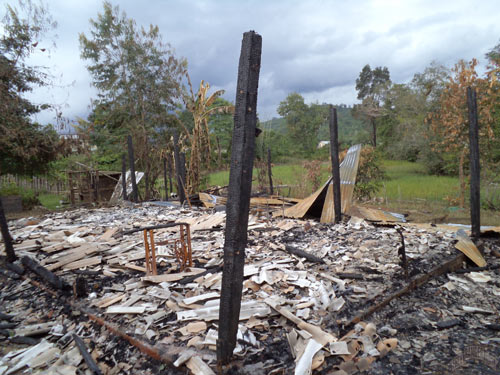
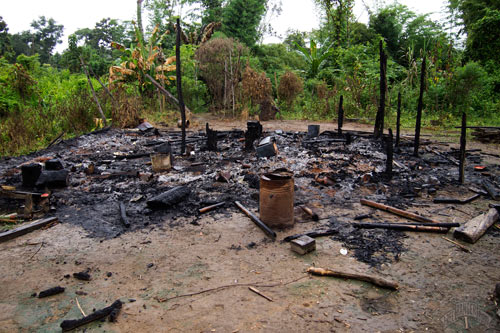
House Burned to Ground in Kachin State

This house was burned to the ground by Burmese Army forces. Photo: Kachin Women's Association Thailand

I visited Kachin State in September of last year, only three months after the fighting began. My goal was to corroborate reports of human rights violations, determine the humanitarian needs of civilians displaced by fighting there, and inform the international community about what was happening in the region.

At that time, news reports from Kachin were scarce, overshadowed by reports touting the positive changes occurring in urban areas of the country. Also at that time the UN had delivered aid to about 6000 internally displaced people (IDPs) in Burmese Army-controlled areas, but the UN showed reluctance to address the full spectrum of basic needs or even acknowledge IDPs in China or areas controlled by the KIO.

I visited camps that hosted about 10,000 IDPs in KIO areas and in China. The KIO refugee committee was administering camps in Laiza town, and a consortium of community-based organization were administering camps in Maijayang; both of these towns are on the Kachin/China border.

At the time of my visit, the groups delivering assistance were receiving almost no aid from external sources. The situation was so dire in some of the camps that IDPs were asked to go home, as food and medicine had run out. The food pipeline was tenuous, and the people running the camps expressed concern about how they would be able to offer continued assistance if the fighting were to continue.

When I was there, IDPs were living in temporary shelters in community centers and empty markets, and the Kachin relief committee had plans to expand a refugee camp on the outskirts of Laiza. But IDPs continue to arrive even now, outpacing construction efforts, and some are still housed in temporary quarters in Laiza town.

The IDPs I interviewed told me stories about how the Burmese Army attacked villages, stole food, and forced them to sweep for mines and carry supplies. They told me stories about Burmese Army abuses before the 1994 ceasefire and how they heard about abuses in nearby Karen and Shan states and decided to flee before troops reached their villages. Most of them told me they wouldn’t to go back to their villages until the KIO said it was safe. Despite 17 years of relative peace, villagers still had no trust in the Burmese Army.

That was eight months ago. Since then, fighting has continued, as have human rights abuses. In a report released today, the Kachin Women’s Association of Thailand (KWAT) highlights regular and widespread sexual violence committed by the Burmese Army under a system of impunity. Since June 9th of last year, KWAT has documented 43 cases of rape by the Burmese Army, 21 of which were also murders. The researchers also cite cases of the Burmese Army abducting women to use as sex slaves.

The Burmese government has refused to hold the Army accountable for these crimes. One husband of a woman who was abducted and disappeared filed suit in the Supreme Court in Naypidaw, Burma’s capital. An Army lieutenant testified that he had never heard of the woman, and court dismissed the case without hearing testimony from the husband. Similarly, the National Human Rights Council (NHRC) of Myanmar has refused to investigate any abuses in conflict areas, including in Kachin State. The failures on the parts on the Supreme Court and the NHRC are unfortunate and all too common in Burma; perpetrators of human rights violations there have never been held accountable for their crimes.

Since my visit to Kachin State, the Burmese government has granted the UN access to IDPs, and the UN has sent shipments of blankets and food. The international community has given some money to help the IDPs, but problems remain. KWAT reports that there are now about 75,000 displaced people scattered in at least 29 camps across Kachin State. The Free Burma Rangers (FBR) state that the cost of feeding IDPs is nearly $1million per month.

Although Burma has lifted the blockade on relief, fighting and donor country regulations which require that aid is funneled through a central government and not community-based groups or political insurgents, have limited the delivery of much-needed supplies.

In the meantime, fighting continues. FBR says that the Burma Army now has about 8,000 combat troops in Kachin State, some of which are closing on the KIO capital of Laiza. They reported on fighting in six different areas of Kachin State in May.

The president of Burma, Thein Sein, has twice called on the Burmese Army to stop its offensives in Kachin State, and both times the Army continued fighting. The KIO and the Burmese government have engaged in several rounds of peace talks, but so far no agreements have been made.

One year into Burma’s latest crisis and nearly two years since a nominally civilian government was elected, the same problems that have plagued Burma for decades are still evident. It is clear that the Army is more powerful than the government, that it is continuing to commit human rights abuses, and that there has been no effort to hold these perpetrators accountable. On this sober anniversary, we the international community should come together to press the Burmese government to end attacks on civilians in Kachin State and hold perpetrators of human rights violations accountable.

A destroyed home in Kachin State, Burma

This house in Kachin State was destroyed by Burmese Army forces. Photo: Free Burma Rangers
Blog

ILO: Forced Labor is Rife in Asia

In the International Labor Organization's (ILO) recently-published 2012 Global Estimate of Forced Labor, the ILO revealed that an estimated 21 million people across the globe are victims of forced labor.

The Asia/Pacific region accounts for the largest number of people forced into forced labor in the world – 56% of the global total. While forced labor is an international scourge, its particular concentration in Asia should rally the international community and individual countries to establish better safeguards against forced labor in the region.

Forced labor has long been a problem in Burma. The military has regularly used civilians to carry supplies, build roads and compounds, and clean and cook for troops. In 1998 the ILO convened a commission of inquiry to investigate forced labor in Burma, and after an extensive investigation it cited the Burmese government for “flagrant and persistent failure to comply with the [Forced Labor] Convention.”

The ILO also found that those subjected to forced labor received inadequate or nonexistent shelter and medical care, and were frequently beaten, abused, raped, and even killed by the military.

The problem continues: in 2010 PHR conducted an investigation of human rights violations in Chin State, western Burma, and reported that 91.9% of households interviewed reported at least one episode of a family member being forced to porter supplies for the military, sweep for landmines, build roads, conduct hard labor, or act as a servant or cook for the military in the previous year.

Nearly two-thirds of these acts of forced labor were committed by the Burma Army, a military notorious for rampant human rights violations. PHR partner groups have reported that forced labor continues in ethnic areas, and that the military continues to be responsible for the majority of abuses.

The international community should not ignore the military’s ongoing use of forced labor among ethnic communities, which persists despite some recent political reforms in the country.

Nobel laureate Aung San Suu Kyi now sits in Parliament, and the government has loosed its draconian media controls – but the military continues to use forced labor, especially in ethnic minority communities. Just last week Aung San Suu Kyi called for the international community to use “healthy skepticism” when assessing the changes in Burma. We should heed her advice.

The United States has announced it will ease its investment and financial services bans on Burma, which will allow US companies to conduct business in Burma. The US and other countries that are racing to invest in Burma should not do so without strict regulations prohibiting forced labor. Allowing companies to rush in without binding restrictions keeping them from profiting from forced labor will only cement the practice as a daily reality for too many people in Burma.   


Blog

Sectarian Violence in Western Burma

[UPDATE below]

Ten Burmese Muslims were lynched yesterday in Taunggote, Arakan State, in western Burma.

According to news reports, the lynch mob comprised 300 Buddhist Arakanese men and women who were seeking revenge for the rape and murder of an Arakanese woman. The victims, who were on a pilgrimage from Rangoon, were pulled off a bus and beaten to death. An Arakan group allegedly distributed leaflets calling attention to the rape, which may have incited the mob.

Muslims protested yesterday at a mosque in Rangoon, calling for justice for the victims. They also protested the use of racial slurs in state-run media reports that described the incident.

Historically in Western Burma, the State has targeted Muslims for forced labor and extortion, and has denied them citizenship and freedom to travel. These abuses have continued despite the changes in some government policies in Rangoon, and the use of racial slurs by the state media bodes ill for justice for the victims. Local media have not reported if an investigation is underway.

PHR calls for the police and the judiciary to investigate and prosecute those responsible for this crime. The government of Burma should treat all of its citizens equally, and ensure all have access to justice. This is a good time to start.

UPDATE: Burmese state media issued a retraction for using a racial slur to describe Muslims who were lynched earlier this week.

Blog

Between Indignation, Hope, and Resolution

I entered the Congo for the first time via the border that separates it from Burundi. We had taken a paved road to the border crossing in Burundi. The asphalt turned to dust, and then we were on the Congo side.

I surveyed the landscape all along the road to Bukavu, capital of South Kivu. It traverses the Ruzizi plain and the steep slopes of the mountains that constitute Congo’s natural border with Rwanda. It’s a paradise. The Congo seemed like the heart of the world to me.

Eastern Congo has everything going for it: a mild climate for people that is well suited for agriculture, endless space for raising cattle, a hydrolic system, perfect sunlight for sustainable and clean energy, rich soil and enormous wealth underground, and people. While this country has unlimited potential for stable and durable development, the population is among the world's poorest. Two years following my arrival, this paradox continues to shock me. Between extreme wealth and poverty, what is missing?

In looking at all the actors and actions invested in the political, economic and social “development” of the region, the absurdities pop out at you. The question on everyone's lips, especially those of the Congolese is this: "Why, after so many years of humanitarian aid, financial investment, and the strategies of international programs, is the Congo is still not developed?"

There’s the lack of security and poor sanitation and social infrastructure. And the Congolese people continue to suffer. I think of the millions of eastern Congolese, cut off from the major cities and centers of power, living in huts with no running water or electricity, no access to health care or to education.

Behind this naive observation, people have an answer, but dare not say it. Human rights are not a random text among international or “expert” recommendations. They’re a reminder to those who have forgotten it:  that people have inherent dignity by virtue of being human, that cannot be taken away. Dignity requires a guarantee of the right to food, drink, shelter, health care and above all, security. Can we live or survive in daily fear of physical suffering or death? Can we assure dignity in a climate of constant fear? In an atmosphere of fear, the Congolese people dare not demand their dignity.

On May 11 in Bukavu, South Kivu, DRC, I helped organize the launch of the International Campaign to Stop Rape and Gender-based Violence with the Nobel Women’s Initiative and others. We invited everyone: local associations across the province, victims, police, doctors, lawyers, judges, nurses, psychosocial workers.  We didn’t know who would respond: a dozen or hundreds? Access to Bukavu is difficult for those who come from afar. What’s more, everyone is tired of yet another campaign—more speeches, more funding requests, more calls for help, and then what?

At 3pm, we start the meeting. A psychosocial worker speaks, followed by two lawyers and a doctor. The room starts to fill up. More and more people arrive until the room is bursting.

Then a woman takes the floor and speaks in Swahili to bear witness to the atrocity inflicted on her. She describes the agony, the disgraceful acts committed against her by three men for three days until she finally escaped. How her baby died during her flight. How she crossed the forest and found a health center. Some months later, she tells us, her pregnant belly is diabolical to her.

Must we hear this testimony? If we don’t listen, who will? If we don’t respond to her voice and those of hundreds more women hidden through misery, fear, and stigma, who will?

When she finishes her testimony, we call on participants to join the Campaign. Hands are raised. "Why this campaign? What will happen next?"

We reply  that there are tools to put an end to this violence right here in this room today. An unexpected discussion ensues. Lawyers, doctors, victims, community organizations,  those known and unknown—all want to express themselves. Everyone wants to convey their deep desire to unload their buried burdens. Hands shoot up. In the room, we have professionals who take care of victims of sexual violence. It’s absurd to realize that this has become a profession! Everyone is united: It’s about time to stop treating only the consequences of the country’s condition, but also to address the causes. And technical, human, and financial resources are here in Congo. The solutions will not come from those who are responsible for the problems, but of necessity, from those who suffer from them.

The key word is launched: Let’s work together, we Congolese, each according to our means, in a coordinated manner to eliminate the causes of the violence so that we no longer have to treat the consequences!

While the dignity of millions of people is being sacrificed to the strategic interests of others, the people gathered in this room know that the solution will not come from outside. The future is here, in their hands.

Something is being born here. The mood changes from anger, to hope and resolution. No one will walk out of here today and forget what was said. No one wants to leave, thinking that this woman risked her life a second time to speak to this gathering for nothing! Everyone signs the Pledge for the Campaign and proposes a next meeting.

That same evening and the next morning the phone rings again and again. Individuals and organizations across the province are asking, "What can we do? We work in this area or that area and we want to participate.”

One thing is certain: there is strength in unity.

Blog

In Colombia, Evidence Proves Extrajudicial Executions by Military

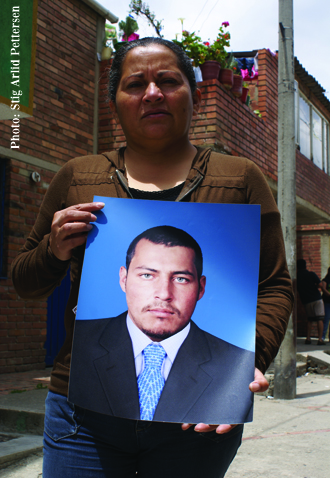
Luz Marina Bernal Porras

Luz Marina Bernal Porras holds photo of her son Fair Bernal Leonardo Porras, forcibly disappeared in rural Colombia.

In 2008, the Colombian government acknowledged the extrajudicial executions of 11 young men from a working class municipality near Bogota. These victims are among those known as “false positives”; civilians who were kidnapped by Colombian military forces with the intent of identifying them as either members of the FARC guerrilla movement or other illegal armed groups. This practice allows the military to inflate the number of enemies they’ve killed.

In August 2011, PHR’s International Forensic Program (IFP) Director Stefan Schmitt and two of the program’s expert consultants, Dr. Robert C. Bux and Attorney Nery Osorio, traveled to Bogota, Colombia as part of their ongoing project with local partner organization EQUITAS. They conducted autopsies, reviewed forensic reports by Colombian authorities, and submitted reports generated from these investigations to the courts as evidence.

This past January the PHR consultants rendered expert testimony via Skype at the federal court in Bogota, specifically regarding the death of Mr. Fair Bernal Leonardo Porras, a 26-year old builder who was forcibly disappeared from a rural town in northern Colombia.

Dr. Bux testified about the autopsy performed on the body of the deceased. “There’s no question as to what happened. Mr. Porras died of multiple gunshot wounds. He was murdered, period, end of story.” He indicated that the most important evidence presented at the trial was the scientific identification of the dead body through DNA; that the victim died of multiple gunshot wounds; and that there were indications that the crime scene had been altered and the body had been moved.

“The military was claiming that [Mr. Porras] and several narcotics dealers got in a running gun battle, yet there was not one tomato plant disturbed in this huge field where the crime allegedly took place. That doesn’t make any sense. Also, his body was positioned in a way that indicated he had to have been murdered somewhere else and then dumped a few hours later.”

Ms. Osorio’s testimony, which involved analysis of case documentation, reinforced Dr. Bux’s results. “The findings are conclusive,” she said. “I could find no evidence of the other individuals who allegedly fought with the deceased; in my opinion there was no combat scenario as reported by the military.”

The final key testimony was provided by Ms. Ana Carolina Guatame, a forensic anthropologist with EQUITAS whose organization in Colombia provides frontline human rights defenders and educators, government officials as well as children and youth with the knowledge, skills and attitudes required to promote human rights values and to combat inequality, exclusion, and other forms of human rights abuse.

Ms. Guatame reported on the injuries found, in terms of what might be expected in an armed conflict. She testified she reached the same conclusion as the other experts: “My own analysis of Mr. Porras’ injuries and his overall condition is not consistent with the military version of the event.”

Despite the many challenges that still exist in holding the guilty parties accountable and obtaining justice for these victims and their families, Dr. Bux is optimistic about the prosecutions in Colombia. “I’m very hopeful,” he said, adding, “I think that the Attorney General of the Republic [of Colombia] wants to get to the bottom of it and he’s going to keep prosecuting cases until he can find out exactly who’s responsible.”

Ms. Osorio added that “it has been a very hard and sad situation for Colombians, but the families of the victims and human rights advocates are fighting. I think the situation is improving and these types of positive judicial actions will help to eradicate these types of crimes.”

“PHR’s IFP will continue to monitor the status of these cases,” concluded Director Stefan Schmitt. “However, what we have seen so far is a promising respect for justice and rule of law within the Colombia judicial system.”

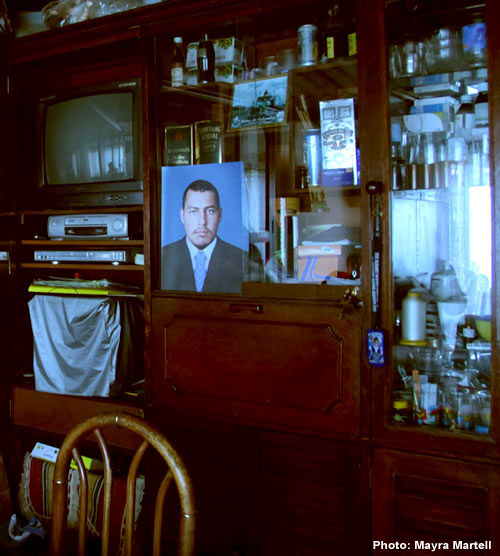
Fair Leonardo Porras Bernal

Fair Leonardo Porras Bernal's photo holds a place of honor in his mother's house.
Statements

PHR Recognizes World Refugee Day

On World Refugee Day, PHR affirms its dedication to ending human rights violations and protecting the rights of refugees and displaced people. The Office of the UN High Commissioner for Refugees estimates that 800,000 people were forced to flee across borders last year, adding to a population of 15.2 million refugees worldwide. Physicians for Human Rights (PHR) works internationally to address the root causes of displacement, investigating violence that causes individuals to seek refuge outside of their home countries. PHR has advocated for humanitarian aid for displaced and vulnerable populations, and PHR also mobilizes health professionals to assist individuals who seek sanctuary in the US after escaping violence or abuse abroad.

PHR is concerned that recent violence in western Burma will further contribute to the growing refugee population worldwide. Early this month, ethnic tensions in Arakan State fueled an outbreak of violence between Buddhist Arakanese, a recognized ethnic group in Burma that suffers human rights violations at the hands of the military, and Muslim Rohingya, a minority group that endures significant human rights violations and rampant discrimination. The Rohingya face statelessness in Burma, where they are denied citizenship and basic rights. They also face harsh treatment in Bangladesh, where many Rohingya have attempted to seek refuge. The Government of Bangladesh refuses to grant refuge to those fleeing violence in Burma, flouting its international legal obligations and casting entire families back to Burma, where violence and discrimination persist. Humanitarian assistance is a growing challenge for many in Burma displaced by the violence.

PHR thanks Congressman Joseph Crowley (D-NY) for calling attention to the humanitarian needs of the victims of the recent violence and for urging the Government of Bangladesh to provide refuge to those fleeing the violence in Burma. In recognition of World Refugee Day, PHR calls on all governments to grant refuge to those fleeing violence and to end forcible returns of vulnerable populations to situations of conflict, unrest, or disaster.

Get Updates from PHR