
Statements

Ethnic Violence in Arakan State Burma is Condemned

Physicians for Human Rights (PHR) condemns the recent ethnic clashes in Arakan State, Western Burma, and urges all parties to end the violence. PHR also calls on the Government of Burma to respect human rights in the region.

Ethnic tensions, which have long been high in the area, erupted into violence last week after three Muslim men allegedly raped and murdered a Buddhist ethnic Arakanse woman. After the men were jailed, a mob of Arakanese men and women lynched ten Muslims, triggering riots among Muslims in several towns in the state. These, in turn, led to a violent backlash from Arakanese.

The region has a long and complex history of ethnic strife. The Muslim Rohingya minority number about 800,000 in Northern Arakan State; most do not have citizenship despite having lived there for generations, and they have been long abused by government policies such as forced labor, forced migration, extortion, and severe restrictions on movement.

Arakanese people are predominately Buddhist and though they are a recognized minority group in Burma, they have also suffered discrimination by the government and human rights violations by the military. Recent abuses included the government’s crackdown on the Saffron revolution in 2007; this anti-government protest by Buddhist monks began in the capital of Arakan State. The government responded to the protest by torturing and imprisoning many monks in Arakan State.

In recent days, the Burmese government has deployed troops to quell the current violence and has imposed a curfew for the next two months. All international organizations working in the area have evacuated their foreign staff.

Buddhists and Muslims alike have lost homes, property, and family members in the violence in Arakan State. Several sources have reported that Rohingya are fleeing to Bangladesh but are being stopped and more than 1,000 have been sent back to Burma by Bangladeshi border patrols. One report said those refused entry included Rohingya who had been wounded in the violence, and that some later had died from their wounds.

Immediate action must be taken to ensure that international monitors and investigators have access to the area and to ensure that any civilians fleeing the area are able to seek refuge. PHR calls on the Government of Burma to allow international monitors into Arakan State and on the Government of Bangladesh to provide refuge to those fleeing the violence.

In the long term, the Burmese government must recognize that martial law is not a solution to ethnic tension, no matter which ethnic groups are involved. For more durable solutions, the Government of Burma must ensure the rights of all ethnic minorities, find durable solutions for stateless Rohingya, promote dialogue among ethnic groups, acknowledge past human rights abuses, and hold perpetrators accountable for their acts in a manner that adheres to internationally recognized legal standards.

 

Statements

Supreme Court Allows Racial Profiling Provision in Arizona Immigration Law to Stand

PHR Applauds Invalidation of Three Other Sections, Regrets Inaction on Key Provision

PHR today applauded the Supreme Court for striking down three provisions of Arizona’s controversial immigration law, commonly known as SB 1070, but regrets that it let Section 2(B), the “show me your papers” provision, stand.

While the Court unanimously upheld a provision requiring state law enforcement agents to determine the immigration status of any person they stop if they have “reasonable suspicion” to believe that the person is in the country illegally, the Court left the door open for future challenges to that provision. PHR praised the ruling as an important statement that the federal government, not the states, has the constitutional authority to set immigration policy.

Importantly, the Court set the stage for future challenges to Section 2(B) after it goes into effect. Given that forming a “reasonable suspicion” that someone is an undocumented immigrant will inevitably require racial profiling, such challenges are likely. But the Court declined to strike this provision down until it actually goes into effect, at which state courts will have an opportunity to determine the criteria for forming a reasonable suspicion.

While most of today’s ruling is great news for Arizona’s immigrants, leaving Section 2(B) in place will likely have dramatic effects in Arizona. Immigrants, including those who are here legally, stopped for even minor offenses will be detained in large numbers while police officers verify their immigration status.

Since it has not been determined what constitutes “reasonable suspicion,” Arizona police officers will have to offer little justification when stopping and detaining someone.

Although SB 1070 prohibits the use of race, color, or national origin in determining whether someone is undocumented, it is difficult to see what other criteria could give rise to such a “reasonable suspicion.” When future challenges to this provision inevitably make their way to the Supreme Court, PHR calls on the Justices to see that the law is harmful, discriminatory, and ultimately unconstitutional.

The Court considered three provisions of SB 1070 in addition to Section 2(B):

  • Section 3 created a state misdemeanor that criminalized the failure to carry documents proving legal immigration status – effectively authorizing the arrest and imprisonment of undocumented immigrants and other immigrants, such as asylum seekers, who are in the process of obtaining legal immigration status;
  • Section 5 created a state misdemeanor that applied to undocumented immigrants who solicited, applied for, or performed work as employees or independent contractors;
  • Section 6 provided that state law enforcement officers could arrest a person without a warrant if they had probably cause to believe the person “has committed any public offense that makes [him] removable from the United States,” requiring police officers to perform complex and nuanced analysis of federal immigration laws.

Relying on the Naturalization Clause of the Constitution, which gives Congress the power to establish laws regulating immigration, the Court found that three sections of SB 1070 were preempted by federal immigration law. According to this law, states cannot enact laws that in an area that the federal government has reserved for itself.

“The history of the United States,” Justice Kennedy writes in his opinion, “is in part made of the stories, talents, and lasting contributions of those who crossed oceans and deserts to come here.”

PHR calls on Arizona and other states to remember that the vast majority of undocumented immigrants are hardworking, law-abiding people trying to create a better life for themselves and their families.

Discriminatory laws like SB 1070 are aimed at destroying the fabric of immigrant communities, and hurt immigrants, Arizona, and the entire country. The Court was right to strike down much of the law, and PHR looks forward to the rest of SB 1070 being invalidated in the near future.


Statements

Obama's Decision to Suspend Deportations of DREAM-eligible Youth is a Step in the Right Direction

PHR applauds President Obama's announcement today to use his discretion to halt deportations of certain undocumented youth in the face of inaction from Congress on this issue. The Administration has sent a strong message that deporting immigrant youth is fundamentally unfair and is not sensible part of immigration enforcement. This policy shift stands in stark relief to the Administration's record number of deportations.

Secretary of Homeland Security Janet Napolitano announced that young people who meet certain criteria are a low priority for immigration enforcement. An individual who meets those criteria is one who came to the US before the age of 16, has continuously resided in the country for at least 5 years, is in school or has graduated from high school or is a US veteran, has not been convicted of a felony or certain misdemeanors nor poses a threat to security, and is not over 30 years old. Individuals who meet these requirements will be eligible for deferred action for a two-year period, subject to renewal, which would allow youth to receive relief from removal or be kept from entering removal proceedings. While this is not a path to citizenship or other permanent status, eligible youth may apply for work authorization.

While today's announcement represents a significant positive shift in immigration policy, Congress should follow the lead and enact legislation that will solidify the President's policies. The Administration and Congress should also work together to enact sustainable comprehensive immigration reform that includes paths to citizenship for undocumented people.

Blog

World Health Organization Adopts Resolution Requiring Documentation of Violations of Medical Neutrality

Member States of the World Health Organization (WHO) adopted a resolution on Friday that requires the body to document violations of medical neutrality.

Such violations include the deliberate blocking of access to health services, attacks on health care facilities, intimidation of medical professionals, and other attacks that threaten the ability of the medical community to provide impartial care to those in need.

PHR and other human rights organizations have investigated violations of medical neutrality in countries including Bahrain, Libya, and Syria, but until now there has been no systematic international effort to collect data about violations on an international level. The resolution symbolizes growing concern from the international community about attacks on health care in conflict and civil unrest. PHR joined 16 other organizations in affirming its support for the resolution.

The adoption of the resolution is a definitive step forward for the protection of medical neutrality.

But there is more that the international community and individual states can do in order to further promote the neutrality of medical professionals and facilities during times of violence. Members of the UN Human Rights Council, for example, should establish a Special Rapporteur on medical neutrality to build upon international data collection on attacks on health care and streamline international policies on this issue. Individual states should also fully commit to the need to protect medical neutrality on their own territory and assist with international efforts to collect data on abuses.

Blog

Zimbabwe Today, Burma Tomorrow? Holding Human Rights Abusers Accountable in South Africa

What happens when high-ranking government officials from Zimbabwe who committed crimes against humanity travel to South Africa, where the law requires the investigation and prosecution of such individuals?

Nothing.

That is, until now.

Ten years after enacting a universal jurisdiction law allowing for the prosecution of foreign nationals accused of committing serious human rights abuses, South Africa’s North Gauteng High Court issued a decision on May 8 mandating the investigation and prosecution of abuses under that law.

For the past decade, South Africa has served as a travel destination for members of Zimbabwean President Robert Mugabe’s government who stand accused of committing crimes against humanity during the 2007 elections in Zimbabwe. These officials allegedly tortured civilians who they believed to be part of Zimbabwe’s main opposition party with electric shocks, mock executions, and waterboarding.

In 2009, Physicians for Human Rights reported human rights violations at the hands of Mugabe officials, and the disastrous effects the crimes had on the country’s health care system.

Despite the existence of a universal jurisdiction statute that could be used to hold officials to account, South African prosecutors refused to investigate the abuses, citing “political considerations,” among other reasons.

In 2009, the South Africa Litigation Centre (SALC) and the Zimbabwean Exiles Forum (ZAF) filed a lawsuit against South African government officials, arguing that prosecutors had a duty to investigate and prosecute these crimes under South Africa’s Implementation of the Rome Statute of the International Criminal Court Act 27 of 2002 (“ICC Act”).

In his landmark decision, Judge H.J. Fabricius found that there was sufficient evidence to warrant an investigation into the abuses. As such, he held that by refusing to investigate the abuses, prosecutors had violated South Africa’s ICC Act. The court’s ruling could have significant implications for South Africa’s commitment to accountability for serious human rights abuses.

The decision also raises important questions about the prospects for justice and accountability in South Africa. For instance, will South Africa now investigate and prosecute other foreign government leaders who reside in or visit South Africa? A prime candidate for consideration would be Burma’s Ambassador to South Africa, Myint Naung, who reportedly served as commanding officer of a military battalion accused of committing war crimes in Burma.

According to the Karen Human Rights Group, South Africa has been hosting Ambassador Myint Naung since July 2011 despite evidence of his criminal responsibility.

It has been ten years since South Africa enacted a law granting universal jurisdiction to prosecute foreign human rights abusers. Ten years from now, when we consider the progress made in achieving accountability for human rights abuses, let’s hope that rather than abdicating its responsibility, South Africa instead has made a place for itself in history as a country that stood on the side of justice.

Blog

Burmese Political Prisoners Denied Health Care

The Assistance Association for Political Prisoners–Burma (AAPP) issued a press release yesterday calling for the Burmese government to immediately release three political prisoners who have life-threatening medical conditions.

Phyo Wai Aung, 32, who was arrested two years ago, severely tortured, and held in solitary confinement since his arrest, is reportedly dying of liver cancer. AAPP says that prison authorities rejected requests by his family to have him transported to a hospital for proper medical care. Sinphyu Taw Tun is suffering from advanced diabetes and high blood pressure, and is held at a large and over-populated prison that has only one 50-bed hospital. Myra Math, 69, has been diagnosed with diabetes, hypertension, and stroke. He is being held in Buthidaung prison, in remote Northern Arakan State, where AAPP reports there is no prison doctor.

AAPP has documented 153 deaths of political prisoners caused by delays in medical care, including two within the last six months.

“All of these deaths could have been prevented if there was early intervention from appropriate medical authorities. So-called reforms in Burma have had absolutely no effect on the lives of prisoners. It is a disgrace that lives continue to be lost in such a senseless manner,” said Bo Kyi, Joint-Secretary of AAPP.

Withholding medical care from any prisoners is, at the very least, in violation of the UN Standard Minimum Rules for the Treatment of Prisoners. In these cases, according to international guidelines for the documentation of torture, or the Istanbul Protocol, denial of medical care is torture.

 The Burmese government was highly praised earlier this year for releasing hundreds of political prisoners. However, hundreds more remain behind bars and the barbaric treatment they have received under the old Burmese regimes is continuing under the new government.

PHR supports AAPP’s call to release these three prisoners immediately. Additionally, PHR calls on the government of Burma to release all remaining political prisoners and to change its prison policies so that prisoners in need of medical care receive it without delay.

Blog

Rohingya Activist Nominated for Human Rights Award

PHR congratulates Zaw Min Htut, a Burmese Rohingya activist, on his nomination for the 2011 US State Department Human Rights Defenders Award.

Zaw Min Htut has been working for Rohingyas’ rights through the Burmese Rohingya Association of Japan since he fled Burma in 1998. Prior to that he was a student activist in Burma, and was detained for his participation in protests in 1996. In Japan, Zaw Min Htut has organized protests at the Burmese embassy and has written books on the history of Rohingya.

Nine people were nominated for the award, including one other Burmese who is a former political prisoner. The award is given to people who show “Exceptional valor and leadership in advocating the protection of human rights and democracy in the face of government repression.” The people of Burma have faced government repression for decades, and it is notable that two out of the nine nominees are from Burma.

The Rohingya are a Muslim minority who live in Western Burma, and are one of the most repressed groups in the country. Several groups (pdf), including PHR, have documented human rights abuses against Rohingya in Burma and in Bangladesh, where many have fled. Rohingya have long suffered the brutality of Burmese regime, including forced labor, extortion and forced migration.

Blog

ICE Struggles to Provide Humane Treatment to Transgender Detainees

Despite the failure of the US to ensure equal rights for lesbian, gay, bisexual, and transgender citizens, LGBT people around the world still see it as a place where they can live their lives freely and openly, without fear of imprisonment or torture. Thousands have come to the US seeking asylum after facing horrific persecution in their home countries because of their sexual orientation or gender identity. And though LGBT asylum claims remain difficult to win, many people are alive today thanks to the US asylum system.

But many LGBT asylum seekers who manage to make their way to the US must face a final form of torture before they are granted asylum. Held for months or even years in immigration detention facilities, LGBT detainees are routinely housed in segregation units, often in conditions of solitary confinement.

In a recent article, The Advocate recounts the stories of several transgender detainees who were locked in segregation simply because ICE doesn’t know what else to do with them. Kripcia, a native of El Salvador, was held in solitary confinement in Virginia for eight months after she was arrested for failing to pay a cab fare. Dulce, a transgender woman from Mexico who fled to the US after a sexual assault, was arrested for shoplifting a pair of shoes and placed in solitary confinement, often referred to as “the hole,” for six days. She was eventually transferred to the same segregation unit as Kripcia, which was primarily used to house male sex offenders. Both have subsequently been released from ICE custody, and Dulce has been granted authorization to live in the US. But their experiences in solitary confinement continue to haunt them.

For its part, ICE insists it is working to institute humane conditions for LGBT detainees. Andrew Lorenzen-Strait, the ICE Public Advocate, cites the recently-released 2011 Performance-Based National Detention Standards (PBNDS), which include rules mandating the provision of hormone therapy for transgender detainees and strengthening protections for victims of sexual assault in detention centers. The PBNDS also shift away from the presumption that transgender detainees should be held in segregation units by mandating a more systematic analysis of whether they can be housed safely in the general population.

But advocates who work with detainees say that ICE has a long way to go. The PBNDS are not legally enforceable, and many smaller jails that house immigration detainees alongside criminal inmates will have little incentive to modify their contracts to incorporate the new standards. And while the PBNDS include provisions aimed at stopping sexual assault in immigration detention facilities, the Department of Homeland Security, which includes ICE, has refused to allow detention facilities to be regulated by the Prison Rape Elimination Act (PREA), which, unlike the PBNDS, is legally binding and enforceable. Despite overwhelming evidence that ICE is not doing enough to protect detainees from sexual assault, when the PREA regulations are issued in a few weeks, immigration detention facilities will likely be exempt.

Meanwhile, LGBT detainees continue to languish in detention centers, subject to abuse by guards, ICE officers, and other detainees. They have little practical recourse when they are thrown into solitary confinement, a convenient way for detention facilities to deal with an inconvenient population. While ICE is taking concrete steps to improve detention conditions for LGBT detainees, the good intentions at ICE headquarters fail to filter down to local ICE offices.

Given the mental and physical abuse that LGBT detainees suffer on a regular basis, it is little wonder that Kripcia became suicidal after eight months in solitary confinement. “I just want to die,” she told an LGBT advocate. “I’m going crazy. But if I have to die, I want to go back to my country. I can’t die in here.”

Blog

International Campaign to Stop Rape in Conflict Holds DRC Launch

PHR, working with colleagues at Panzi Hospital in Bukavu, eastern Congo, and in collaboration with the Nobel Women’s Initiative and many others, had the privilege of convening one of many events across the globe to launch a new civil society effort to stop address sexual violence in conflict zones.

The following summary comes from the new Coordinator in the Democratic Republic of Congo (DRC) of PHR’s Program on Sexual Violence in Conflict Zones, Caroline Dauber.

On May 11 at the Hotel Residence in Bukavu, 130 representatives of civil society organizations as well as individuals gathered to learn about the International Campaign to Stop Rape & Gender Violence in Conflict.

Women and men from various organizations addressed different facets of rape and gender violence. Aimée Birindwa (Programme de Secours au Vulnérables et Sinistrés) from Uvira, South Kivu, spoke of the psychological consequences for many survivors. Attorney Aline Biruru (Association des Femmes Avocates – Association of Women Lawyers) from Bukavu and James Songa (Lawyers Without Borders) also from Bukavu informed participants about fighting impunity. Doctor Denis Mukwege, Director of Panzi Hospital, encouraged the participants to put into effect solutions that address the root causes of the conflict in the DRC.

Following the speeches, those assembled debated the goal of the Campaign and its strategy. The discussion centered around three points taht we made repeatedly:

  • First, rape and sexual violence are used as weapons to weaken the population, because a weakened population does not revolt.
  • Second, rape and sexual violence is a consequence of the current general situation in the DRC – the rising tensions between economic and political actors who are trying to appropriate the resources of Eastern DRC to the detriment of the population.
  • Third, it was emphasized that since military, political, economic, rebel, and international actors are responsible for the conflict, then it was unlikely that the solution will come from them, so the voices of civil society are vital.

Moreover, aid from the international community which has been delivered to Eastern DRC for the last 15 years has not yielded the desired results. As many international donors have strategic interest in the region, external funding and coordination mechanisms often prevent local initiatives from bringing about sustainable development. Participants strongly emphasized that much aid has gone to the consequences of the conflict, and not enough to address the root causes and the prevention of violence.

Everyone present agreed that visibility is a necessary tool to stop rape and gender violence, and that the Campaign will provide Congolese people with the necessary visibility and platform to take action.

More than 50 NGOs and dozens of individuals joined the Campaign. Needless to say the event was a success!

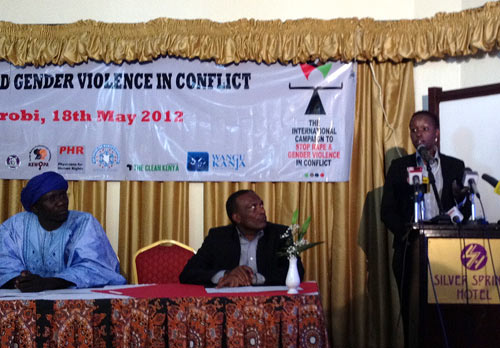
Rachel Muthoga at the Nairobi, Kenya, Launch of ICSRC

Rachel Muthoga from Physicians for Human Rights presents on the lack of rule of law in Kenya and why ending impunity for sexual violence is critical.
Blog

Special Rapporteur Mendez Assessing Torture Prohibition Measures in Tajikistan

United Nations Special Rapporteur on torture and other cruel, inhuman, or degrading treatment or punishment, Juan Méndez, is currently visiting Tajikistan to assess measures taken by the Tajik government to bring its torture prohibition legislation into compliance with international standards.

Mr. Juan Mendez, UN Special Rapporteur on Torture

Mr. Juan Méndez, United Nations Special Rapporteur on Torture and Other Cruel, Inhuman, and Degrading Treatment or Punishment

Mr. Mendez has noted that while the Tajik government has taken some steps to reduce the incidence of human rights violations, “there remain significant gaps in legislation, policies and law enforcement practices…” He specifically noted his intention to examine “…how the authorities comply with the universal obligations to afford victims of torture an effective remedy and to investigate, prosecute, and punish every episode of torture.”

This is Mr. Mendez’s second official visit to Central Asia since he was appointed Special Rapporteur in November 2010. Following his December 2011 visit to Kyrgyzstan, he noted that the “lack of effective safeguards against torture and ill treatment and the insignificant sanction provide for the crime of torture inevitable created an environment conducive to impunity.”

PHR affirms Mr. Mendez’s conclusions and remains deeply engaged in activities designed to break the vicious circle of impunity by documenting and investigating torture cases.

Although the scale of torture varies among the countries of Central Asia, it is generally widespread at police stations, detention centers, and prisons. A high degree of corruption and lack of public education and awareness about torture contribute to the silence in which torture occurs. The victims or their relatives fear to press for punishment of perpetrators and do not trust the judiciary and the law. 

In recent months PHR has conducted individual forensic medical evaluations for torture victims, as well as provided training to medical and legal professionals from Kyrgyzstan, Kazakhstan, and Tajikistan so that they are able to effectively document and investigate allegations of torture.

We also met with prosecutors, judges, and government officials to assist with development of National Preventative Mechanisms (NPMs) for preventing and protecting against torture. We are currently in the process of assessing further country-specific needs for these three countries as well as for Uzbekistan, Turkmenistan, and Georgia.

We look forward to continuing to work together with Mr. Mendez and other representatives of the Office of the High Commissioner for Human Rights on the effective documentation and investigation of torture and ill treatment in Tajikistan and other Central Asian countries.

Get Updates from PHR