Blog

Death on the Border: Questions Raised About Border Patrol Oversight

Luz Rojas, Anastasio´s mother

Luz Rojas, Anastasio´s mother, seen on the anniversary of the beating incident at the border.

As onlookers watched from a nearby overpass, a dozen officers from US Customs and Border Protection (CBP) beat and tasered Antastacio Hernandez Rojas until he had a heart attack. Handcuffed and hog-tied, Hernandez can be heard screaming “Help” as he lay on the ground absorbing kicks and electrical shocks from CBP officers who, upon noticing the crowd watching them from above, yelled at Hernandez to “stop resisting.” Near the end of the attack, which lasted almost half an hour, CBP officers can be seen in a newly-released video pulling off Hernandez’ pants, kneeling on his neck, and applying a Taser directly to his skin. He died soon after.

In June 2010, the San Diego Coroner classified Hernandez’ death as a homicide. But two years later, criminal charges have not been brought against the CBP officers seen beating Hernandez to death. In fact, no CBP officers have been successfully prosecuted—or even disciplined—for any of the eight immigrant deaths that have occurred along the border at the hands of CBP in recent years.

With over 60,000 officers and employees, CBP is the largest law enforcement agency in the United States. In 2007, the Bush administration began hiring new CBP agents at a rapid pace, with the goal of doubling the number of officers along the border. Today, over 21,000 agents patrol the US border, compared to only 11,000 in 2007. To accomplish this huge increase, CBP’s already low hiring standards were relaxed. Thousands of rookie CBP agents were issued batons, Tasers, and guns without having to pass background checks, submit to polygraph tests, or even complete high school.

Moreover, CBP manages to avoid the public scrutiny that keeps other law enforcement agencies in check. Though it considers rocks to be deadly weapons and has killed at least two people recently who threw rocks from the Mexican side of the border, it will not release its policies on when CBP officers are allowed to use deadly force.

Anastacio Hernandez Rojas had lived in the United States for 25 years. He had five children, all US citizens. He worked construction jobs until the housing bust made work hard to find. After being arrested for shoplifting dinner for his wife on Mother’s Day, he was deported to Mexico. And after tripping a sensor in the ground while crossing back into the US to be with his family, he was apprehended by CBP. He was detained while waiting to be deported again, and filed a complaint against a CBP officer who allegedly beat him in detention. That same CBP officer was in the car that took Hernandez back to the border, where he was killed.

While immigration from Mexico has drastically decreased from its high point at the turn of the century, reports of violence by CBP officers continue to emerge. The government must stop allowing CBP to act like a private militia, devoid of meaningful oversight and public scrutiny, and initiate swift criminal prosecutions of CBP officers who violate the law. Until then, CBP will continue to attack, torture, and even kill immigrants along the border with impunity.
Blog

Arizona v. United States: A Simple Supreme Court Case with Major Ramifications

What would the US look like if each of the 50 states decided who they wanted to let in their borders? Or if state legislatures, motivated by racism and backed by profit-driven prison corporations, could enact laws that made living conditions for immigrants within their borders so onerous that immigrants fled in droves?

On Wednesday, the Supreme Court will consider these questions when it hears arguments over the constitutionality of SB 1070 [pdf], the Arizona immigration law that seeks to force undocumented immigrants within the state to “self-deport” by requiring its police officers to arrest anyone who seems like they may be undocumented.

The legal issue in Arizona v. United States is simple: the Constitution assigns authority over foreign affairs, including immigration, to the federal government, and not to the states. Because the federal government has a comprehensive immigration regulation policy in place, federal immigration law preempts any state immigration laws that conflict with it.

The Arizona law plainly conflicts with federal immigration enforcement efforts, and is therefore—according to both the Constitution and Supreme Court precedent—unconstitutional.

The Court will hear arguments on four specific provisions of SB 1070. These provisions make it a crime in Arizona to be unlawfully present in the United States and seek work in the United States without authorization. The provisions also require state and local law enforcement to determine the immigration status of anyone whom they “reasonably believe” to be in the US unlawfully and authorize law enforcement to arrest anyone whom they believe to have committed a crime that makes them removable from the US without first obtaining a warrant.

The discretion this law gives to Arizona police is breathtaking, and many immigrants have already fled the state. Although the contested provisions were prevented from taking effect shortly after the law was passed, many other states have enacted similar laws aimed at terrorizing immigrant populations into fleeing.

Alabama’s experience with SB 56, an even more draconian version of SB 1070, illustrates the logical endpoints of these state laws. As thousands of immigrants have fled Alabama, crops rot in the fields for lack of workers to harvest them and parents have withdrawn their undocumented children from schools for fear that their children will be turned over to the police and deported.

Corporations that once brought much-needed jobs and money to the state are thinking twice about locating businesses there after a German executive from Mercedes-Benz, which has a major manufacturing operation in Alabama, was arrested when he could not produce his passport at a traffic stop. One report [pdf] estimates that SB 56 will cost the state up to 140,000 jobs and $10 billion in lost revenue, to say nothing of the effects on the people it targets.

Furthermore, laws like SB 1070 and SB 56 are designed to funnel even more immigrants into the immigration detention system, which holds around 34,000 immigrants every night. About half of these immigrants are detained in facilities run by private prison corporations like the Corrections Corporation of America, which was instrumental in drafting SB 1070.

While the arguments in front of the Supreme Court on Wednesday will have little to do with the noxious effects of SB 1070, the outcome of the case will have profound effects on the future of immigration policy.

If the Court holds that SB 1070 is preempted by federal law, Arizona and the other states that have enacted similar laws will likely look for other ways to target their immigrant populations. Indeed, Maricopa County Sheriff Joe Arpaio was adept at harassing and intimidating immigrants long before SB 1070 was passed, and other anti-immigrant sheriffs around the country have effectively criminalized being Latino in their counties.

But if the Court allows SB 1070 to stand, there will be little to stop individual states from effectively determining the racial composition of their populations. Immigrants will become even better targets for criminals, who will be free to target them with impunity if reporting crimes to the police results in deportation for crime victims.

The number of immigrants passing through detention facilities – which has hovered around a record-breaking 400,000 in each of the three years since Barack Obama became president – will likely increase, with private prison corporations benefiting at taxpayer expense. Even more families will be needlessly torn apart [pdf] as undocumented parents of US citizen children are deported.

Perhaps more importantly, it would force us to take a hard look at what we want our country to stand for. Have we learned that it should take more than mere “suspicion” to detain people largely based on their race, as we did with Japanese citizens during World War II? Will we experience another Great Migration, with immigrants leaving Arizona and similar states for ones where they can go to the grocery store without fear of deportation?

Or will enough Americans finally stand up to the bullies in Congress and state legislatures who use immigrants as scapegoats for everything from crime to economic turmoil and demand a comprehensive reform of our broken immigration system?

We should know the Court’s decision by the end of June. But its ramifications will be felt by immigrants and citizens alike for years to come. Let’s hope the Supreme Court gets this one right.

Blog

ICC to Investigate Rape in Misrata Using Doctors’ Testimonies and Hospital Records

ICC Chief Prosecutor Luis Moreno-Ocampo has announced his intention to investigate mass rape as a weapon of war in Misrata, Libya during last year’s conflict. Recognizing the harsh physical punishments and cultural dishonor that Libyan women face when reporting sexual assault, Ocampo says he will craft an investigation that calls not upon victims but rather upon the eyewitness testimonies and medical records of doctors who treated rape survivors.

Stories that Qaddafi forces systematically raped civilians last year in Misrata are common, but proof is lacking. Chief Prosecutor Ocampo asserted last year that Qaddafi forces may have used Viagra to systematically rape women, but that claim has not been substantiated.

One Libyan obstetrician/gynecologist told PHR that because rape is a “difficult crime for female Libyan[s],” violated Libyan women were reluctant to report sexual assaults publicly.

Following its investigation into war crimes committed in Misrata last year, PHR published shocking testimonies that Qaddafi forces transformed an elementary school into a detention site where witnesses reported that women and girls as young as 14 years old were raped.

PHR also documented “honor killings” in response to these rapes, as in the case of a father who slit the throats of his three daughters upon learning that Qaddafi forces reportedly raped them repeatedly for days while holding them captive.

PHR applauds the ICC for using medical documentation and the authority of doctors who retain first-hand, forensic knowledge of government abuses to investigate these allegations.

Doctors speak when their patients cannot. When abuses are considered “culturally taboo” and are not discussed openly, strong human rights reporting rooted in medical evidence—alongside forceful international criminal investigations—takes on paramount importance for the victims.

Blog

A Doctor's Response to Torture

In the recent volume of the Annals of Internal Medicine, Dr. Sondra Crosby—a PHR volunteer physician—describes her experience treating a former Guantánamo detainee who she calls “Rashid.” Rashid is a survivor of US torture.

Kidnapped from a hospital bed in a far away country and sold for a bounty, Rashid spent time in various US detention sites and was eventually transported—blindfolded and shackled—to Guantánamo.

During the 5 years Rashid spent in US custody, he suffered severe beatings, painful stress positions, prolonged solitary confinement, forced nakedness and humiliation, sleep deprivation, withholding of food, sexual assault, and rape. All along, Rashid was innocent. He was never charged with crime and upon his release, he was given a document confirming his innocence.

To this day, Rashid still suffers from the torture he endured while detained, describing himself as a “ghost wandering around the town in isolation, unable to eat or sleep.”

Dr. Crosby’s documentation of Rashid’s ordeal exposes the ongoing, yet largely unknown, saga of America’s torture victims who spent years of their lives wrongfully detained.

The United States has thus far made no attempt to offer recompense to these individuals, and it does not appear that it will do so anytime soon: in fact, the Military Commissions Act of 2009 severely limited the rights of former detainees to sue their former captor.

There are many former detainees like Rashid to whom we owe redress—in the form of physical treatment, like Dr. Crosby’s work, and financial compensation. This is the least we can do to help these men heal.

Dr. Crosby’s efforts are the first step in an attempt by PHR to address the plight of these men. Working with medical practitioners like Dr. Crosby, PHR is striving to highlight the needs of these torture survivors with the ultimate goal of securing rehabilitation and recompense.

It is unlikely that these men will ever receive just compensation, or that their suffering will ever be acknowledged by the US government.

Much attention has (rightfully) been focused on ensuring the release of these men from their confinement. We must not forget, however, that the years they spent in US custody have a lasting effect on the bodies and the minds of men like Rashid. Our concern for the men who have been harmed must not stop when they walk out of the prison gates.

Blog

President Obama, the US Should Join the Mine Ban Treaty

A young victim awaits treatment at the International Red Cross Orthopedic (ICRC) rehabilitation center on December 10, 2009 in Kabul, Afghanistan. (Photo: Majid Saeedi/Getty Images)

PHR joined partner organizations in an April 4, 2012, letter [pdf] calling on President Obama to officially announce future US policy on landmines, and to join the 1997 Mine Ban Treaty. To date, the US has not taken the official step of acceding to (joining) the monumental treaty which forbids countries from using, producing, stockpiling, or transferring anti-personnel mines and requires countries to destroy existing mines.

The Administration announced in November 2009 that it was conducting a thorough review of U.S. policy on the matter, and PHR at that time urged the President to announce a strong stance against landmines.

If the US accedes to the Mine Ban Treaty, it would join 159 other countries–including every member of NATO and the European Union–that are already party to the treaty. By joining the treaty, the US could encourage other countries to move one step closer to a world free of landmines. Dozens of major medical, nursing, and public health associations in the United States and globally have called on all nations to join the Mine Ban Treaty.

PHR was a leader of the International Campaign to Ban Landmines (ICBL), for which it shared the 1997 Nobel Peace Prize. This year marks the 20th anniversary of the ICBL, and offers an important opportunity to reflect on the extraordinary progress since the Campaign’s inception as well as to press for a greater international commitment to ban landmines.

Since the Mine Ban Treaty came into force, there has been a steep decline in the number of producers of the weapon as well as the number of governments that use mines. Vast areas previously infested with landmines have since been cleared, and there has been a decrease in the number of stockpiled mines.

While the use of landmines has significantly reduced since the 1990s, more progress is needed to end the scourge. Landmines continue to maim or kill an estimated 6000 people every year, including in areas of conflict such as Burma and Syria.

The 20thanniversary of the ICBL should provide the international community with renewed energy to press for universal commitment to the Mine Ban Treaty, greater support for mine clearance programs, and greater access to medical care for victims of mines.

Blog

Syrian Medics At The Frontline

In the last thirteen months, at least 8,000 Syrian civilians have died in a brutal government crackdown according to the UN. Medical professionals who dare to treat the injured have also found themselves in the line of fire.

Although exact numbers are unavailable, PHR has acquired the names  and photos of 56 Syrian medics killed in the violence, often for providing medical treatment to injured protestors or  to civilians denied medical treatment in government hospitals. Twenty of the medics were killed in Homs, and the the other attacks occurred in Dara’a, Aleppo, Hama, Deir al-Zour, and Idlib, the cities that have experienced the worst violence.

Medical professionals have an ethical duty to treat the injured regardless of race, religion, or politics. For Syrian medics, to fulfill this duty is to risk death at the hands of the regime. Their deaths are not accidental, but rather the result of targeted killings intended to disrupt citizens’ ability to get medical help.

Syrian regime forces have targeted medical professionals for treating patients, both at public hospitals and through the makeshift field clinics that medics have set up in homes and farms to care for injured civilians. One doctor told PHR that he fled the country after he was interrogated multiple times by regime forces. He reported that any doctor or nurse involved in treating the injured faced torture and even death.

Some medical professionals have been killed when security forces shelled their homes; others have been executed by snipers. Dr. Abdulrahim Alalmer was shot in the Alrastan hospital in Homs while treating wounded civilians. Pharmacist Maad Alhadiz was shot in the head by the security forces that stormed his pharmacy in Homs. Hakam Drak Siba, a paramedic with the Syrian Red Crescent, was shot and killed while driving injured patients to a hospital.

Security forces have also tortured medics to death. These victims include Mahmoud Ahmed Alrashidat, a nurse from Dara’a, and Red Crescent medic Assad Al Jamaan, who died shortly after being released from detention.

Medical students have been targeted as well. Abdulrazzaq Al-Raid Abdulrazzaq was only 20 years old when he died at the hands of security forces in Deir Al-Zour, and Mohammed Dirar Attar, a dentistry student from Aleppo, was shot in the eye.

One doctor from Homs who fled Syria told PHR that the regime was also killing eyewitnesses to these crimes to hide their culpability. He reported that, in Homs, he witnessed government attacks against the private hospital and makeshift clinics. 20 of the 56 medics identified by PHR were killed in Homs. This doctor said that all of the eyewitnesses have been killed, a fact that has left him feeling hopeless about any possibility of accountability.

PHR denounces Syrian government’s attacks on doctors and other medical professionals, which violate the principle of medical neutrality. Security forces must stop assassinating, detaining, and torturing Syrian medical professionals whose only crime is fulfilling their ethical duty and providing unbiased medical care during a time of crisis.

Blog

DHS Answers PHR’s Calls for Better Interpretation Services in Detention

For many of the 34,000 immigrants detained each night by Immigration and Customs Enforcement (ICE), language is one of the major barriers to accessing services, including urgent medical care, in detention facilities.

While many detained immigrants speak fluent English, others come to the US with either limited or no knowledge of English. This complicates interactions between detainees and detention facility staff, including health service providers, and can lead to problems including delays in accessing medical care or difficulty describing symptoms to health professionals.

PHR has long recognized that inadequate interpretation services in immigration detention can have profound consequences for detainees seeking medical care. We have consistently advocated with ICE for increased translation and interpretation services so that detainees with limited English proficiency can access medical services in detention.

So PHR is gratified to see that the Department of Homeland Security, which includes ICE, has developed a Language Access Plan to help ensure that all detainees receive adequate medical care in detention, regardless of language.

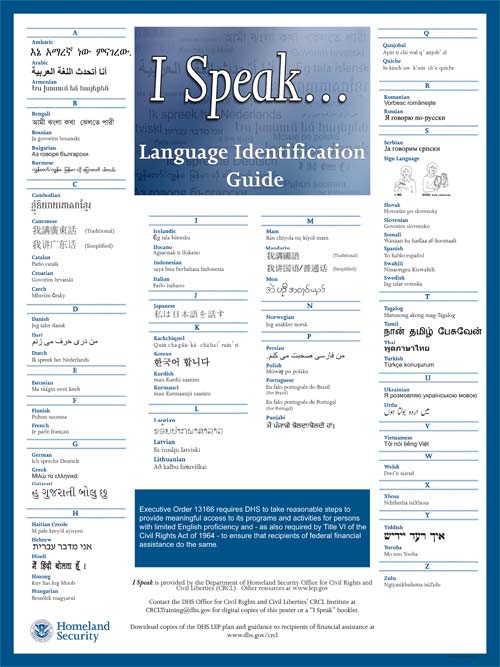
The Language Access Plan outlines important improvements in providing medical information to detainees with limited English proficiency. For example, ICE personnel have access to telephonic interpretation services, which are available for use during medical consultations. DHS’ Office of Civil Rights and Civil Liberties (CRCL) has also developed a series of “I Speak” posters, which detainees can use to indicate their language, and has customized the posters for use during medical examinations. The Language Access Plan also envisions increased training for detention facility employees in identifying languages spoken by detainees and accessing interpretation services.

As an agency that deals primarily with non-English speakers, ICE has a particular interest in ensuring that all detainees are able to access services in detention facilities, regardless of language. The Language Access Plan outlines vital improvements that could significantly impact the medical care that immigrants receive in detention. It is a welcome step in ICE’s ongoing efforts to create a more humane immigration detention system.

I Speak... (Language Poster, DHS)

Blog

"We would return if we felt safe" – Burmese Refugees in Delhi

This is the third of three posts by PHR's Burma Project Director, Bill Davis, on his recent trip to visit Burmese refugees in Delhi, India.

Over the course of a four-day visit to Delhi, I met with about three dozen refugees from Kachin, Chin, and Arakan States in Burma. We met in the bare cement offices of the many civil society organizations that the refugees have formed—Burma Centre Delhi, Women’s Rights and Welfare Association of Burma, Kachin Refugee Committee, Chin Refugee Committee, Chin Human Rights Organization.

Some of the refugees I spoke with fled Burma after the military’s violent crackdown on student protests in 1988. A few had arrived within the last year, fleeing fighting in Kachin State, and others said they had come to India because they wanted to live freely and without harassment from the military government. Some did not want to talk about why they left Burma.

All of them talked about returning, though.

“Everybody wants to go back to their home country—if they are safe,” a refugee told me. But when I talked with them two weeks ago, none of the refugees felt safe enough to return.

“We want to go home but there is still military rule for the Chin,” one refugee said, “Democracy in Burma is not for the Chin people, not for us.”

Another said, “We fear we will be arrested. We always fear that could happen.”

 A few Kachin had returned to Burma, but they joined the Kachin Independence Army (KIA), which has been fighting the Burmese army since June of last year. Living in peace is not an option.

“I grew up portering [doing forced labor] for the Burmese Army,” a Kachin said, “There’s no possibility of protesting the government—you either have to leave or fight. I didn’t want to join a rebel group so I came here.”

The Burmese government has made some changes in Burma, increased some freedoms and held elections. But it needs to do a lot more to convince these refugees that t is safe for them to move home.

The US must maintain pressure on the Burmese government to continue its reforms and to ensure that the reforms reach all areas of the country.

Blog

Yamuna Clinic Serves Burmese Refugees in Delhi

This is the second of three posts by PHR's Burma Project Director, Bill Davis, on his recent trip to visit Burmese refugees in Delhi, India.

The Yamuna Clinic occupies the second floor of a faded building in a dusty Burmese neighborhood in west Delhi. A dark cement staircase opens onto a balcony and a waiting room where about a dozen Burmese refugees sit on wooden benches.

Dr. Tint Swe, the clinic’s founder and only doctor, is preparing for the day’s cases. He is still exhausted from an all-night baby delivery two days before.

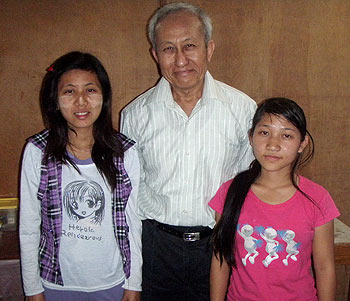
Dr. Tint Swe with clinic staff, Delhi, India

Dr. Tint Swe with Yamuna Clinic staff, Delhi, India. The Clinic served over 11,000 patients last year.

Dr. Tint Swe fled Burma in 1990, when the military regime took power and refused to acknowledge the results of the recent general election. He had been elected to the Burmese parliament as a member of the National League for Democracy (NLD), the opposition party led by Aung San Suu Kyi. Dr Tint Swe is still politically active as an exiled leader in the NLD.

The Yamuna clinic opened in 2004 to address the medical needs of refugees living in Delhi. It is funded by private donations and treats 50 to 100 patients per day. Common medical complaints are pregnancy, trauma, diarrhea, malaria, and respiratory infections.

The Yamuna clinic is serving an important need in the community. Burmese who have registered with the UNCHR can get free healthcare at hospitals run by the Indian government, but there are many barriers to accessing this healthcare. Refugees told PHR that a typical trip to the hospital entails taking off work (and missing a day’s pay), paying for transport to the hospital, and hoping to find a translator.

Refugees are often discriminated against—they are regularly bumped from the line to receive care by Indian nationals, and are frequently told to return to the hospital later in the week. The costs of transport and lost wages often make this impossible.

PHR applauds the Yamuna clinic and other who are struggling with limited resources to meet the needs of vulnerable people.

Blog

Life for Chin Refugees in Delhi, India

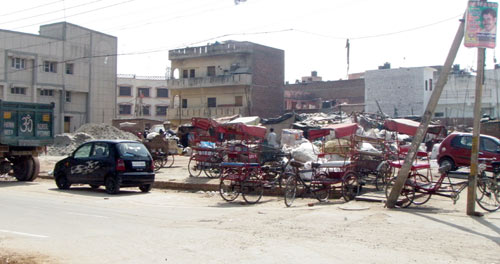
Chin refugee neighborhood, Delhi

A Delhi neighborhood where many Burmese Chin refugees live.

Two weeks ago I visited Delhi as part of PHR’s ongoing efforts to document human rights violations against Burma’s ethnic minorities and the situation of urban refugees. India is home to more than 100,000 displaced persons from Burma, of which only a few are officially recognized as “refugees.”

Life for Burmese refugees is difficult in India. Because they are not citizens and are different culturally and linguistically from the local population, many are ostracized and persecuted. Travel costs, language difficulties, and the risk of lost wages from missing work prevent many Burmese from accessing healthcare.

Because Burmese do not have Indian citizenship or work permits, they are often overcharged by landlords and underpaid by employers who know they have little recourse. As a result, many of the refugees live in poverty. Sadly, life for most of them was not any better inside Burma.

Most of the refugees come from Chin State, where PHR documented and reported mass atrocities in our 2011 report, Life Under the Junta: Evidence of Crimes Against Humanity in Chin State, Burma. The report documented that in 702 randomly-selected households across Chin State, 91.9% of people reported at least one episode of forced labor and 14.8% of households reported that the army beat, tortured, killed, or abducted a member of their household.

Despite the difficult living situation in Delhi, refugees are resilient and desire to help one another.

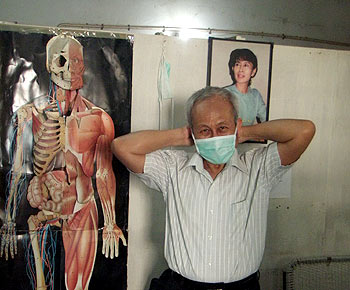
Dr. Tint Swe in clinic, Delhi, India

Dr. Tint Swe is a Burmese physician and former MP from the opposition NLD (National League of Democracy) party. He runs a free clinic in a predominately Burmese neighborhood.

While in Delhi, I had the privilege of meeting with Dr. Tint Swe, a Burmese physician and former MP from the opposition NLD (National League of Democracy) party. Dr. Tint Swe runs a free clinic in a predominately Burmese neighborhood. Since the clinic opened in 2004, Dr Tint Swe has delivered over 240 babies, and last year his clinic saw 11,000 patients.

I also met with Benhur Sang Lian, who advocates for refugees living with HIV. Benhur Siang Lian visits over 70 HIV-positive refugees, interpreting for them at clinic visits and educating them on their medications, nutrition, and how to prevent the spread of HIV. He became involved in the work when he saw the difficulties a friend of his was facing caring for his HIV-positive son.

None of the refugees who spoke with me were ready to return to Burma, despite the reports of change in that country. Refugees said they left Burma because they wanted more freedom or to escape harassment by the military. Their opinions have not changed: most said that they believe things would be the same if they were to return to Burma now.

The struggle for democracy in Burma is not over, and the Burmese government must do more to reconcile differences with ethnic minorities.

Get Updates from PHR