Blog

“Climb up – Speak Out” on International Women's Day

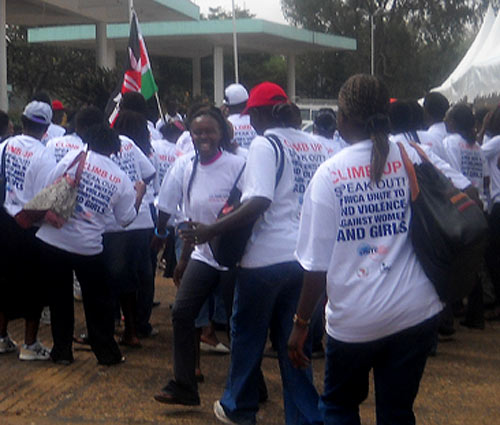
Climb Up - Speak Out Walk Participants

Participants in Nairobi, Kenya's "Climb Up – Speak Out" Walk celebrate International Women's Day, 8 March 2012.

It’s a cool morning in Nairobi as I arrive at Uhuru Park,the starting point of the “Climb up – Speak Out” walk to mark InternationalWomen’s Day 2012.

This venue has been the site of some of the fiercest battlesfor civil and human rights fought in Kenya, including the late Nobel laureate Dr.Wangari Maathai’s fight to preserve the park.

The walk, which was organized by a number of civil societyorganizations and is part of the UN Campaign to stop gender based violence, bringstogether survivors of gender-based violence and their supporters from all overKenya. 

There is a festive mood in the air. The walkers are warmingup with songs and dance as we await the commencement of the procession.

I meet many representatives of partner organizations,including nurses from the Kenyatta National Hospital (KNH), who are here with anumber of survivors of gender-based violence who have received treatment andpsychosocial support at the KNH gender violence recovery center.

The walk is flagged off by Hon. Fred Gumo, the Minister incharge of Regional Development. He lauds the organizers for their efforts inhighlighting the important issue of gender-based violence. He pledges that hewill use every forum available to him to highlight this issue during theupcoming elections.
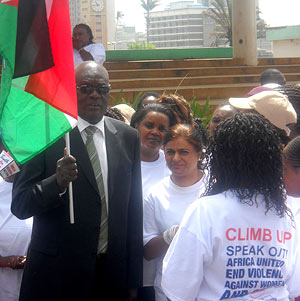
Hon. Fred Gumo, Minister of Regional Development, Kenya

The Hon. Fred Gumo, Minister of Regional Development, Kenya, flags off the start of the walk with the national flag of Kenya.

He waves the flag of Kenya and flags off the race. The racecommences with a marching band leading the way.

There is great enthusiasm amongst the walkers as they tacklethe hill. Police are on hand to stop traffic. Motorists and pedestrians gazewith interest at the banners being held aloft by the walkers.

The feeling of solidarity is strong as both men and womenparticipate in the walk.

As we walk for justice, 52 women from each country inAfrica, representing all the women of Africa who are striving to say no toviolence, will also climb Mt. Kilimanjaro.

Ann Njogu represents Kenya in the climb. Ann is the Chairpersonof the Center for Rights, Education, and Awareness (CREAW). She was a recipientof the 2010 International Women of Courage Award given by the US Department ofState to 10 outstanding women leaders worldwide in recognition of courage andleadership in the struggle for social justice and human rights.

She and the other women leaders are scaling the challengingMt. Kilimanjaro as we walk in solidarity with them in Nairobi.

As our journey concludes, triumph is in the air as theparticipants disperse, each possibly rejuvenated and inspired to do what theycan, within their sphere of influence, to finally put an end to gender-basedviolence.
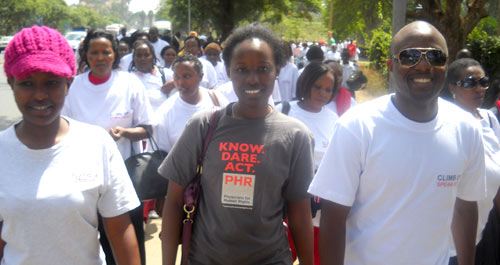
Rachel Muthoga with walkers, IWD 2012, Nairobi

Rachel Muthoga proudly wears her PHR Know Dare Act shirt while walking with Mike Wachira of CREAW for the Climb Up – Speak Out International Women's Day Walk in Nairobi.
Blog

International Women's Day: Advancement of Women Survivors of Sexual Violence

Each International Women’s Day we acknowledge the people whopromote the advancement of women and highlight the progress achieved over thepast year.

Today, in honor of International Women’s Day, PHR reaffirmsour commitment to comprehensive justice for survivors of sexual violence andsupport for those working on the front lines to help them.

Throughour Program on Sexual Violence in Conflict Zones, we strive to improve women’shealth, ensure greater access to justice for women, and give women an increasedvoice.

Improving of Women’s Health

PHRis committed to the physical and mental well-being and essential dignity of womenand girl survivors of sexual violence. This should extend through the entirejustice system—from the health clinic where a survivor first seeks care, tothe police station where she is interviewed, to the courthouse where shetestifies against her attacker.

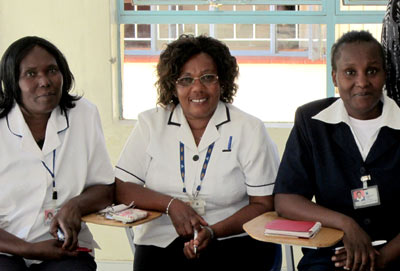
Three SAFE nurses

Three SAFE (Sexual Assault Forensic Examiner) nurses from Kenyatta National Hospital attend a meeting led by PHR in Nairobi in October 2011.

TheProgram on Sexual Violence in Conflict Zones also works to increase the role ofnurses, social workers, and other professionals involved in the forensic collectionand documentation of evidence.

Many—if not most—of these health professionals in the region are women. Shiftingthese important tasks to nurses in addition to doctors is imperative,especially given the shortage of qualified physicians in remote regions. Often, a physician’s signature is required onmedical forms that are used in court, so PHR and our local colleagues areadvocating for forensically-trained nurses to be permitted to sign these forms aswell.

Greater Access to Justice for Women

Women who survive sexual violence are entitled to a day incourt. Although sexual violence laws are “onthe books” in many countries, the barriers preventing women fromconfronting their attackers in court are still high.

Because of stigma and security concerns, survivors are oftendiscouraged from pursuing justice in court—frequently by their families andcommunities but also by the professionals from whom they seek help.

"Justice" can come in many forms, from the acknowledgementof the crime and resulting arrest, to prosecution in a court of law, and toreparations provided to a survivor including compensation.

PHR and our partners in Kenya and DRC are working to educatehealth care professionals, police, lawyers, magistrates, and judges to act withgreater sensitivity when they collect forensic evidence or support womenthrough trials. We encourage judges to admit a wider range of physical,psychological, and crime scene material as evidence of rape. Once the communities begin to see more successfulprosecutions, we hope it will encourage women and girl survivors to seek justice.


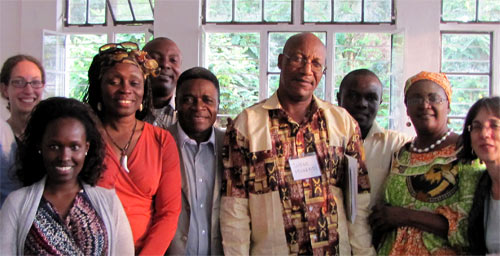
Participants from all three sectors (Kenya 10/2011)

Participants from all three sectors (health, legal and law enforcement) participate in PHR’s inaugural training workshop in Bukavu, DRC in January 2012. From left: PHR Program Director Karen Naimer, PHR Kenya Coordinator Rachel Muthoga, Dr. Marie Irene Tchangou, Maître Sylvestre Bisimwa Ntakaobajira, Président de Cour Baudouin Kipaka Basilimu, Colonel Magistrat Freddy Mukendi Tshidja-Manga, Dr. Desire Alumeti Munyali, Colonel Honorine Munyole, and PHR Deputy Director Susannah Sirkin.


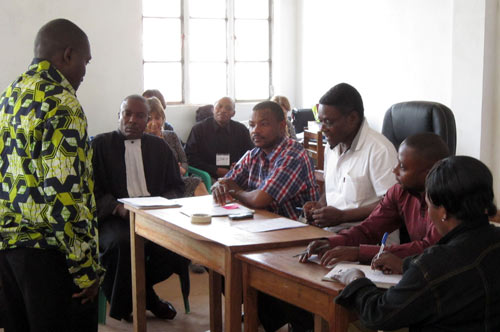
Mock Trial (DRC training, Jan 2012)

On Day 3 of the training in Bukavu, DRC, workshop participants took part in a mock trial. From left: David Bodeli Dombi as mock defendant; Maître Sylvestre Bisimwa Ntakaobajira as mock prosecutor; and James Songa, Colonel Magistrat Freddy Mukendi Tshidja-Manga and Paul Ramazani as mock judges.


Increased voice for women

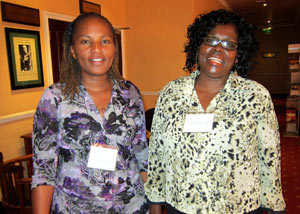
Wangu Kanja, Mercy Musomi, Nairobi Dec 2011

At the Nairobi Roundtable in December 2011, representatives from survivor organizations lent their voice to the discussion on sexual violence response in the health and justice systems. From left: Wangu Kanja, Executive Director of the Wangu Kanja Foundation and Mercy Musomi, Executive Director the Girl Child Network.

If we are going to address sexual violence in a sustainableand meaningful way, we must listen to the wishes of women and girl survivors. Strengtheningthe voice of women and girls within the health and justice systems is paramount.

So many survivors desire the ability to participate fully andsafely in the economic, social, and cultural life of their communities. With improved attitudes and reduced stigma, togetherwe can help women and girls raise their voice amidst the silence surroundingsexual violence.

Blog

International Women’s Day: Recognizing Female Asylum Seekers’ Challenges

As a nation built upon the ideals of freedom of expression,religious tolerance, and equality for all, America serves as a beacon for thosewho long to escape repressive governments and societies.

We resettle more refugees than any other country and grantasylum to tens of thousands of people each year.  Though our asylum system is by no meansperfect, those who benefit from it are able to start new lives and begin toheal from the trauma they and their families have suffered.

So given the US commitment to offering protection to allthose who seek it, the barriers facing women who seek asylum forgender-specific threats are truly remarkable.  

Gender-specific violence takes numerous forms and destroyslives around the world. Women in many societies are forced to undergo femalegenital cutting at a young age; those who manage to refuse are ostracized andoften forced to flee their homes. Women in China who violate its one-childpolicy must often abort their children and undergo forced sterilization.

In other places, women and girls are forced to marry menthey’ve never met or enter into polygamous marriages against their will. Andwomen who are victims of domestic violence often have no choice but to fleetheir countries in order to escape from abusive relationships.

While these are all legitimate grounds for receiving asylum,the process for establishing these claims can be arduous.

In almost all cases, women who have been victims of thesepractices must show that they are members of a “particular social group,” andthat they have been persecuted because of that membership. The process forarticulating a “particular social group” is much more difficult thanestablishing persecution based on, for example, opposition to a politicalregime.

In one well-documented example, Rody Alvarado fledto the US after escaping a particularly violent relationship in Guatemala. Herdomestic violence asylum case worked its way through the asylum system for 14years before she was finally granted asylum in 2009. The delay was largelybecause the US government did not recognize domestic violence as a legitimatebasis for asylum.

But thanks to courageous women like Rody, the road ahead forfemale asylum seekers may contain fewer obstacles.

Advocates across the country are taking a forceful stand insupport of gender-based asylum claims and establishing case law that will makeit easier for women to obtain asylum based on domestic violence, forcedmarriage, female genital cutting, and other gender-specific forms ofpersecution and torture.

And the movement to eliminate the arbitrary one-year bar toasylum applications – which a recent study has shown disproportionately barswomen from applying for asylum – has never been stronger.

On International Women’s Day, it is important to rememberthat persecution and torture are horrific, no matter the gender of the victim,the classification of the particular social group, or the role of the state asa perpetrator.  No just and equitablesystem would place more barriers to asylum in front of women than it does infront of men.

Our immigration laws are in dire need of reform, but weshould pay particular attention to the aspects of the asylum system thatprevent women from obtaining the protection they need.

As we work to improve the asylum system, we must also thinkabout how we can help those women who can’t escape persecution and torture, andwhose stories we never hear.

Blog

Marching for Immigration Justice in Cincinnati

Last week when I spoke at the “March Forth for Justice”conference on immigration, I was reminded that for many Americans, the problemsplaguing our immigration system seem too remote to pay much attention to.

We hear stories on the news, but we probably don’tpersonally know any of the 1.2 million immigrants who have been deported in thepast three years. We hear words like “amnesty,” “illegals,” and “DREAM Act,”but we don’t put faces to those words. We think that immigration is somethingthat affects people in California, Arizona, or Texas – but not where we live.

The truth is, immigrants live in every area of the country,and that the debate over immigration reform could have dramatic consequencesfor urban and rural communities alike.

Faith communities know this– they see immigrants filling theseats at houses of worship every weekend, and their congregations notice whenthe families of immigrants who have been deported turn to them for help.

So it was an honor to participate last weekend in a full-dayconference organized by faith communities in and around Cincinnati focused onimmigration issues. “March Forth for Justice” was co-sponsored by a coalition of Christian, Jewish, andIslamic organizations and spearheaded by the Unitarian Universalist Council ofGreater Cincinnati.

Conference participants heard about both the national debateover immigration, as well as that debate’s effect on communities in and aroundCincinnati.

A diverse group of speakers discussed Cincinnati’s historyas a city of immigrants, as well as the contributions to Cincinnati’s diversityfrom a new generation of immigrants. And three courageous young undocumentedimmigrants who have never known a home other than the United States discussedtheir hopes for a future in America, and their fears that they will be deportedregardless of their academic achievements and strong family and community ties.

Events like March Forth for Justice, which culminated in a rallyin support of the DREAM Act, remindus that immigration affects every corner of our country, and that the Obamaadministration’s destructive and counter-productive immigration enforcementpolicies rip apart communities every day.

The more frequently communities like Cincinnati rise up insupport of comprehensive immigration reform, including a pathway to legalresidency for undocumented immigrants, the greater the chances are of ourelected officials taking action to fix our nonsensical immigration system.

Congratulations to the organizers of March Forth for Justicefor a wonderful conference, and here’s hoping that faith communities and othersaround the country follow suit.

Blog

Chin Refugees Struggle in India

More than 100,000 undocumented Chin refugees living in Mizoram State, India needhumanitarian assistance, claims a reportreleased yesterday by independent investigators. Chin people come from westernBurma, which borders Mizoram State.

Thegovernment of India refuses to register refugees in Mizoram or allowsignificant amounts of aid to reach the area. As a result of theserestrictions, Chin refugees suffer from economic instability and limited accessto healthcare and education, and they are vulnerable to arrest, deportation andother forms of persecution.

Mostof the Chin refugees interviewed by the investigators reported that they fledpersecution from the Burmese government and feared human rights abuses if theyreturned to Burma. The refugees said that forced labor and pillaging of food bythe Burma Army were common.

PHR documented these crimes and manyothers in a 2011 report, Life Under the Junta:Evidence of Crimes Against Humanity in Burma's Chin State. PHR surveyed 702 randomly-selected households across Chin state andfound that 91.9% reported atleast one episode of forced labor and that 14.8% of households reported thatthe army beat, tortured, killed or abducted a member of that household.

TheChin people are fleeing these abuses, but sadly conditions are not much betterin India.

Yesterday’s report highlights the immediatehumanitarian problem in Mizoram, and also the long-term human rights problem inChin State. These problems are not unique to the Chin people—most ethnicpeoples in Burma face persecution at home and difficult lives abroad.

The international community shouldsupport the immediate needs of Burmese refugees everywhere and encourage theBurmese government to end human rights abuses of ethnic peoples. A slow processof democratic reform has begun in Rangoon, and the international communityshould ensure that this reform continues until it reaches all parts of thecountry.

Multimedia

PHR Provides Expert Voice on Torture of Individuals in Detention

Kristine Huskey appeared on the Arabic-language program, Alyoum ("Today"), to discuss the legal and political issues around torture of individuals in detention. The interview with Kristine begins at the 5:45 mark. Please NOTE: this hour-long program is in Arabic.

Watch or Listen Now »


Source: Alhurra TV


Blog

Despite Talks of Ceasefire, Burma Army Abuses Continue in Karen State

Two reports released today document abuses by the Burma Army against civilians in Karen State, Eastern Burma. The Burmese government and the Karen National Union, the main opposition group in Karen State, have been engaged in ceasefire talks since January of this year, and Burmese President Thein Sein has repeatedly called for peace in ethnic areas. But despite all the talk, the Burma Army’s abuse of civilians in Karen State continues.

The Free Burma Rangers (FBR) reported today that their teams documented human rights abuses by the Burma Army in six districts across Karen State. The abuses included forced labor, pillaging, torture, use of human shields, and the executions of civilians.

FBR teams interviewed villagers who had been captured, beaten, and held for two months by the Burmese Army. They reported that three civilians had been shot and killed by the Army since January, and more than 30 had been used as forced labor. Multiple villages were pillaged and at least one was mortared. All of these events happened after ceasefire talks began in January.

The Karen Women’s Association (KWO) also reported that on March 4, two Burma Army soldiers attacked a 22-year-old Karen woman while she was gardening. The soldiers allegedly beat her, drugged her, and were attempting to rape her when nearby gunfire frightened them away. KWO is now caring for the alleged victim.

The recent talk of ceasefires and Thein Sein’s calls for peace have been lauded by many in the international community as part of the positive changes in Burma, and many governments are citing this as cause for easing pressure on the Burmese government.

The US government has said that one of the conditions for lifting economic sanctions is peace in ethnic areas; however, as recent events have shown, talk of a ceasefire does not mean peace.

Easing pressure on the Burmese government too soon carries a great risk. If the Burmese Army continues to commit human rights abuses with impunity, it will be felt by civilians, like the ones included in these reports.

PHR encourages the Burmese government to continue its reforms and to embrace democracy. But PHR urges the international community to maintain pressure on Burma until the reforms are actually felt by civilians on the ground.

Blog

For One Immigrant, Erroneous Deportation Was a Death Sentence

Nelson Avila-Lopez had never been convicted of a crime whenhe burned to death in Honduras’ Comayagua prison last month. He fled Hondurasat age 16 to escape the gangs that were constantly pressuring him to join andcrossed into the US to live with his mother in Los Angeles. 

Four years later, he was detained by Immigration and CustomsEnforcement (ICE). After asserting that he would be targeted for persecution bygangs if he were deported to Honduras, an Immigration Judge granted him a stayof removal so that he could apply to stay in the US.

Before he even had a chance to apply, ICE transferred him toa detention facility in Arizona and put him on a plane to Honduras. When hearrived, he was taken to the Comayagua prison, where he died four months laterin a blazethat killed 358 inmates. His mother has returned to Honduras to find herson’s remains, which, like the bodies of the other inmates who died in the fireon February 14, was so badly burned that it will only be identified through DNAtesting.

Nelson should never have been deported. After asserting thathe was afraid of persecution in Honduras, he was legally entitled to apply forprotection in the US.

ICE casually stated that his deportation was the result of a“communications breakdown” between its officers and the Immigration Court. This tragic “breakdown” occurred even though ICElawyers were presumably present when the judge ordered a stay of removal—anddespite the fact that Nelson’s lawyer confirmed with ICE that they had receivednotice of the stay.

The Immigration Court also disputes ICE’s account, assertingthat it notified ICE of Nelson’s stay before his deportation. But regardless ofwhether Nelson’s deportation was a deliberate violation of the judge’s order ora simple mistake, the result was the same: Nelson spent the last four months ofhis life in the Honduran prison where he ultimately burned to death.

Sadly, this outcome was predictable and entirely preventable.The Obama administration’s heedless rush to deport every undocumented immigrantin the country has resulted in several well-documented erroneous deportations,including deportations of US citizens.

There is no excuse for ICE’s actions in this case.  If someone asserts that his life would be indanger if he were deported, ICE has a legal duty to let him remain in the USuntil an Immigration Judge decides whether he should be given permanentprotection.

Our immigration system is broken, and until Congress decidesto fix it, the Obama administration must ensure that all immigrants, andparticularly those who fear persecution and torture in their home countries,are given a chance to have their cases heard. 

It could start by ordering the Inspector General of theDepartment of Homeland Security to conduct an investigation into Nelson’s caseand issue a public report detailing exactly where the system failed. By recommendingsteps that ICE could take to fix these failures, perhaps a future “communicationsbreakdown” and erroneous deportation will be prevented.

If the governmentcannot recognize that its mistakes in immigration enforcement have direconsequences, Nelson will truly have died in vain.

Blog

Pro-Qaddafi Forces and Rebels Committed War Crimes

The United Nations concluded on March2, 2012 that both pro-Qaddafi forces and rebels committedwar crimes during the Libyan conflict last year.

In a report of the International Commission of Inquiry on Libya,the UN determined that pro-Qaddafi forces committed crimes against humanity,defined as the most serious attacks on human dignity and human rights.

According to the commission,“Acts of murder, enforced disappearance, and torture were perpetrated within thecontext of a widespread or systematic attack against a civilian population.” Rebelforces were found to have breached human rights and international law, but notto have committed crimes against humanity.

PHR documented war crimes in Libya during last year's conflict in two detailedreports on war crimes in Misrata and Tripoli, and continues tocallfor justice and accountability in Libya for all perpetrators of mass atrocities.

PHR is encouraged by the UnitedNations’ recent findings, and hopes that the conclusions of this independentcommission will spur serious discussions both nationally and internationallyabout how to best ensure accountability and justice for all Libyans.

Confirmation that pro-Qaddafi forcescommitted crimes against humanity is an important step in securing justice forLibya’s citizens. Current Libyan authorities and the international communitymust act upon these findings to ensure perpetrators are held accountable.

Blog

Smoke and Mirrors in the Gulf Kingdom of Bahrain

Behind the dense clouds of tear gas that still blanket thestreets of Bahrain, the Government continues its attacks on Shia neighborhoods,opposition and civil society leaders, and medical personnel.

Attempting to conceal its ongoing abuses, the Government employsPR firms towage a disinformation campaign, and it routinely obstructs international humanrights advocates from entering the Kingdom.

Case in point: I was deported from Bahrain on 8 January this year after the Government hadinvited Physicians for Human Rights (PHR) to visit and granted me a multiple-entryfive-year visa. Other international rights organizations later faced similartreatment.

After my deportation, the Government wrote saying it felt“it would be more beneficial for a visit from [my] esteemed organization totake place . . . after the end of February” when it had completed implementingrecommendations from the BICI report.

Now, the Ministry of Human Rights and Social Development hasinformed me of new regulations limiting the length of time human rightsorganizations could be in country to five working days.

This arbitrary time constraint is merely the latest in theGovernment’s smoke-and-mirrors campaign to hide its ongoing abuses.

PHR, along with Amnesty International, Human Rights First,and Human Rights Watch, issued a joint letter [pdf] of protest decrying this latest restriction.

Get Updates from PHR