
Blog

Conference Highlights Importance of Forensic Evidence to Asylum Seekers

Approximately 200 people from around the world gathered in Washington, DC on February 15-16 to participate in the “Forensic Evidence in the Fight Against Torture” conference. Participants, including PHR staff, shared experiences, challenges, emerging developments, and best practices from around the world.

While it’s impossible to capture the all the lessons learned in one blog post, there were a few noticeable trends across presentations that bear repeating.

First, there is a critical shortage of health professionals trained to do forensic evaluations. Forensic evaluations, both physical and psychological, provide compelling evidence—often the only evidence—in cases where human rights have been violated. They are submitted to court for a variety of reasons—to prosecute perpetrators, to secure redress for victims, and to obtain asylum—all of which contribute to healing the victim and ending the atmosphere of impunity that has allowed so many torturers to escape punishment for their heinous crimes.

The number of cases requiring evaluations to document and investigate human rights violations far exceeds the number of available clinicians in most countries, and the gap continues to widen around the world.

While the demand for Istanbul Protocol (IP) training continues to grow, the funds available to conduct these critically important trainings are in short supply.

The Istanbul Protocol, formally known as “the United Nations Manual on Effective Investigation and Documentation of Torture and Other Cruel, Inhuman or Degrading Treatment or Punishment,” outlines international, legal standards on protection against torture and sets out specific guidelines on how to conduct effective legal and medical investigations into allegations of torture. But many states and foundations fail to understand and recognize the value that forensic training and documentation play in addressing impunity and accountability of torture and other cruel, inhuman and degrading treatment, so they are reluctant to fund its implementation.

One of the greatest concerns highlighted at the conference was that, because forensic evaluations have become an increasingly regular part of submissions to courts and commissions of inquiry, adjudicators are beginning to question the integrity of cases that lack a forensic evaluation.

While it is gratifying to learn of the growing acceptance and recognition of the importance of forensic evidence, it is troubling to hear that courts may dismiss cases without it. Often victims are unable to obtain an evaluation simply because they cannot find or afford to have a qualified clinician document their case. This should never be grounds for dismissal of a case.

PHR continues to provide IP training around the world, and a group of clinicians are headed to Bishkek, Kyrgyzstan today to train new professionals.

Additionally, we will conduct an IP training on March 31 in Boston for clinicians interested in working with asylum seekers and others who are seeking safe refuge in this country. You can register for this training here on the PHR website.
Blog

Dissident Burmese Monk Faces New Charges

Yesterday, Burmese state media announced that Ashin Gambira, a Buddhist monk and recently released political prisoner, will once again face criminal charges in a Burmese court. He has been charged with “breaking Buddhist code of conduct,” breaking into two monasteries, and living in a third monastery, all of which had been shut down by the government in 2007.

The current charges against him suggest that the changes in Burma are fleeting, and this development warrants continued international support for the democracy movement there.

Ashin Gambira was a key organizer in the 2007 Saffron Revolution in Burma, in which thousands of Buddhist monks led protests against the military government. The old military regime arrested him for treason and sentenced him to prison for 68 years. He spent five years in prison, during which time he led hunger strikes and was reportedly tortured. Ashin Gambira was released in the January 13, 2012 prisoner amnesty.

The January prisoner release was seen by the international community as a huge step forward for reforms in Burma; however, the released prisoners are not entirely free. The bogus laws used to detain political prisoners remain on the books, and prisoners’ sentences were merely suspended and not commuted: if re-arrested they could still be forced to serve the remainders of their sentences.

Since his release, Ashin Gambira has been an outspoken critic of the new government. He has called for the government to apologize for abusing monks during the Saffron Revolution, and has said that reform in Burma is “fake” and that the government continues to violate human rights.

Ashin Gambira visited three of the 60 monasteries that had been raided and shut down by the government during the Saffron Revolution, and has been living in Maggin Monastery, where he previously ran an AIDS hospice.

In the middle of the night on February 10, in a move that echoed the tactics of the old military regime, plainclothes police abducted Ashin Gambira from Maggin Monastery. He was detained and interrogated for several hours and then released. Yesterday state media announced the charges against him.

The arrest of an outspoken dissident is reminiscent of the ways of the old military regime, and it is certainly a sign that change in Burma is neither as permanent nor as pervasive as the government has been leading the international community to believe. Ashin Gambira’s arrest is also a warning from the government to other dissidents.

The charges against Ashin Gambira are a reminder that the international community must continue to closely monitor the situation in Burma, and that the struggle for democracy in Burma is not nearly over. Progress should be rewarded, but setbacks like this should be reprimanded.

PHR calls for the government of Burma to drop the charges against Ashin Gambira, and to respect the freedom of speech of dissidents and all Burmese people.

PHR also calls on the international community to maintain pressure on the Burmese government, and to continue to push for lasting and genuine reforms.

Blog

ICE Public Advocate Steps in to Right a Wrong in Detention Facility

Advocacy organizations generally employ a three-prongapproach to ensure that human rights are protected: we work with governments toadvise them of what they’re doing right and wrong, we expose problems and abusesthrough investigations and reporting, and we support government agents as theywork to implement stronger  human rightsprotections.

PHR’s Asylum Program has been actively engaged in all ofthese activities over the past few years as we’ve worked with Immigration andCustoms Enforcement (ICE) to improve the immigration detention system, throughwhich about 400,000 immigrants pass each year. While we still have a long wayto go to ensure that immigrants are detained in the best and least-restrictiveconditions possible – and we maintain that the use of immigration detentionneeds to be drastically reduced – we have been impressed by the commitment andresponsiveness of some ICE staff who have worked to resolve our concerns, bothat a system-wide level and on individual cases.

Just yesterday, one of our volunteer psychologists was toldby officials at a New Jersey detention center that she would have to provideher social security number in order to gain entrance to the facility to performa forensic psychological evaluation for an asylum seeker. Forensicpsychological evaluations are often vital to proving that an asylum applicanthas suffered persecution and torture in his home country, and is genuinelyafraid of more harm if he or she does not receive asylum. The psychologist hadalready submitted personal information and subsequently been cleared to enterby ICE, so this additional requirement by the local officials was burdensomeand inappropriate. Needless to say, non-detained asylum applicants do not facethis additional hurdle in preparing their cases.

The ICE Public Advocateresponded within minutes to our request for his assistance, and he looped inother ICE staff to help resolve this issue. By the end of the day, we receivedconfirmation that our psychologist would be allowed entrance without anyfurther obstacles or requests for information.

PHR provided almost 500 forensic medical evaluations lastyear for victims of human rights abuses, and many of them were conducted indetention facilities. Historically, our volunteer clinicians have frequentlyencountered obstacles at the local facilities, so we are thrilled at ICE’sclear demonstration of its commitment to facilitate these examinations, whichare critically important to asylum seekers.


Blog

Abuses Continue Against Rohingya

Last week, the Special Rapporteur on the Situation of Human Rights in Myanmar called on the Burmese government to officially engage ethnic minority groups in serious dialogue and grant them fundamental rights. He specifically referenced the rights of the Rohingya in this call to action.

The Rohingya are one of the most persecuted minorities in Burma. Forced labor, extortion, restrictions on movement, forced deportation, and rape (pdf) by Burmese authorities have all been documented by human rights groups.

Many Rohingya have fled the atrocities in Burma for neighboring Bangladesh. However, the situation there is nearly as bad. According to the UN High Commissioner for Refugees, only 28,000 out of some 400,000 Rohingyas are officially recognized by the Bangladeshi authorities as refugees.

The undocumented Rohingya live in squalor, are regularly harassed by the local police, and are not able to access international humanitarian aid. PHR’s March 2010 emergency report, Stateless and Starving: Persecuted Rohingya Flee Burma and Starve in Bangladesh, found atrocious water and sanitation conditions, severe food insecurity, and multiple human rights violations, including arbitrary arrest and forced expulsion by Bangladeshi authorities.

Little progress has been made on a political solution to this problem. In a December 2011 meeting between Burmese President Thein Sein and Bangladeshi Prime Minister Sheikh Hasina, Thein Sein said Burma would allow documented Rohingya refugees from Bangladesh safely back into Burma. But since the vast majority of Rohingya in Bangladesh are not documented, it is unlikely that they will be allowed to return. Agreements like this serve to improve Burma’s image in the international community, but in fact do nothing to alleviate the suffering of hundreds of thousands of Rohingya.

If the Burmese government is truly serious about building lasting peace, it should immediately change the way it treats Rohingya. PHR strongly urges the Burmese government to end forced expulsions of Rohingya individuals, and to recognize the rights of all Rohingya, documented and otherwise.

PHR calls on the Bangladeshi government to cease arbitrary arrests of Rohingya and to allow aid organizations to help all Rohingya refugees. The human rights violations that have happened for decades against Rohingya are far too serious to be ignored by Burma’s reforms.

Blog

Feeling at Home in DRC – Reflections of PHR's Kenya Coordinator

PHR’s team just returned from a training session in the DRC, where they are working with international and local partners to hold perpetrators accountable for using rape as a weapon of war. This post is one in a series. Learn more about the project.

As a first time visitor to Bukavu, I fell in love with the region’s natural beauty and its people. Being able to converse in Swahili with people I met in town and at PHR’s forensic training workshop allowed me to feel right at home and made the cultural interchange very rich.

I was saddened to see the difficult challenges the people have to face there, which are quite similar to challenges that we face in Kenya but are further compounded in DRC by the general insecurity due to ongoing conflict in the eastern part of the country. In the face of these challenges, it was very heartening to see the will of the people to strive to end the menace of rape used as a weapon of war.

It was fascinating to observe that both the men and the women who participated in our training seemed to be equally invested in ending rape in war. It is inspiring to me and convinces me that with such will and determination, rape in war can and will be eradicated in the region.
 
At the onset of the training in a discussion with some of the participants, I was asked if Kenya has a problem with rape in war. This was enlightening to me as it showed that there was still a great need to publicize the extent of this problem in Kenya. It also demonstrated that there is a real need to build a network in the region to support synergies among professionals working in this field.

Blog

Witnessing Justice for Victims of Karadžić

I walk into Court Room 1 on Tuesday morning, January 31, at the International Criminal Tribunal for the Former Yugoslavia in The Hague.

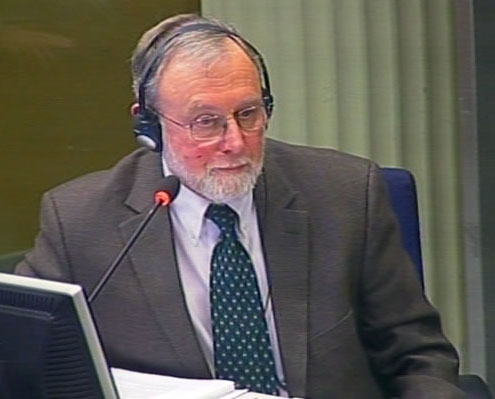
Arriving on this long-imagined scene is surreal. There, just on the other side of the thick one-way glass, is Dr.William (Bill) Haglund, former director of our InternationalForensic Program, sitting at the witness table. He’s staring at the reddened face and shocking white head of hair of Radovan Karadžić, whose face I know from years of newspaper images and “wanted” posters.

Bill Haglund testifies at the ICT for former Yugoslavia Jan 2012

Dr. William Haglund, a forensic anthropologist, death investigator, and former director of PHR’s International Forensic Program, was the UN’s Senior Forensic Advisor for the Tribunal and conducted forensic investigations of mass graves in the former Yugoslavia.

A psychiatrist, Dr. Karadžić was indicted by theTribunal in 2009 for war crimes, crimes against humanity, and genocide against the Muslim population of Bosnia. He is finally on trial for these many crimes, including the massacre of thousands of men and boys separated from their families when his troops overran a UN safe haven at Srebrenica in 1995.

I practically burst into tears as I stare straight ahead at the row of judges in red robes who are presiding over thishistoric case. An agitated Dr. Karadžić fidgets and rubs his hands together,apparently formulating his next question as he takes up his own defense and cross-examination of Bill.

For years, the government refused to handover Dr. Karazdžić, and many of us feared this day would never come.

Even though I’m watching him, I find it hard to believe that Bill is finally able to present the validity and credibility of the excruciating months of work done by PHR teams in 1996 to exhume the mass graves in and around this enclave in Bosnia.

I’m recalling that at one point during the weeks of excavations led by Bill and conducted by an international team of PHR archaeologists, anthropologists and pathologists, Bill rolled out a sleeping back and slept at the edge of one of the graves. The UN ProtectionForces only had a mandate to guard live humans, not human remains, and sleeping next to the dead was the only way Bill could safeguard the integrity of the site and make sure no one tampered with the evidence.

Bill is deliberate and even professorial. At one point Karadžić asks Bill how he was able to come to the conclusion that the bodies in the graves were those of civilians rather than combatants. Bill responds that combatants don’t wear blindfolds.

Karadžić then asks if they might not have been blindfolds but rather Muslim warrior head- bands that slipped down and landed over the eyes of the buried bodies. Bill answers curtly that these were tied tightly and didn’t move up over the eyes or down below them.

As Karadžić continues in a haphazard way to grasp for holes in the evidence or testimony, I’m filled with pride and gratitude for Bill, the trial lawyers, and the many PHR scientists whose persistence and patience that have brought us to this day.

I’m hoping that the thousands of loved ones who lost fathers, husbands, brothers, and sons will see a measure of justice in this trial. In the end, justice may come slowly, but it will come.

Blog

We Are All Connected

Using a ball of yarn, training participants realize the complicated web of communication involved in bringing justice to each case. Photo: Karen Naimer, PHR.

PHR’s team just returned from a training session in the DRC, where they are working with international and local partners to hold perpetrators accountable for using rape as a weapon of war. This is the final in a series. Learn more about the project.

Day one of the training: A 12-year-old school girl walked home with a male friend from class. On the way home, he invited her into his house and she found herself alone with him there. She stated that he forced her to take off her dress and then violated her.

In our training, a policewoman who is role-playing the victim, holds onto the end of the multicolored yarn and throws the ball of yarn to her colleague, role-playing the victim’s mother. The mother holds the string and throws the ball of yarn to a colleague who is role-playing the nurse, who throws it to the role-playing doctor, who throws it to the role-playing police.

The participants in the exercise begin to buzz and acknowledge to each other that this is just the beginning of a complicated web of communication and that is exactly why their court system fails.

The mock police officer then throws the ball to the school teacher, who throws it to the girl’s father, who throws it to the lawyer, who throws it to the perpetrator, who throws it to his own doctor, who throws it to the judge.

Collecting evidence in a high-quality manner is limited, non-existent, or simply fails; scene investigation is absent; corruption occurs at multiple levels; the parents disagree about pursuing the case; confidentiality is broken; the school does not support the victim; and the survivor gets lost in the system, ultimately convinced that it was a mistake to report the rape in the first place.

Through this role-play exercise, we demonstrated the problems that are regularly manifested in the medical and legal systems. By the end, the training room and the participants are wrapped in a complex tangle of yarn.

Participants brimmed with animated comments about the system that regularly fails people. As we look around the room we realize that the system is us! However, by working together, as our training session has us doing, we can begin to simplify processes and procedures to increase the likelihood that impunity is reduced, justice is served, and victims remain at the center of our work.

Multimedia

Dr. William Haglund Testifying at the Trial of Radovan Karadzic

(International Criminal Tribunal for the Former Yugoslavia, The Hague, Netherlands, January 30 & 31, 2012.) Dr. Radovan Karadzic, a Bosnian Serb leader and psychiatrist indicted by the Tribunal for war crimes, crimes against humanity, and genocide, is on trial for many crimes, including the 1995 massacre of hundreds of Bosnian Muslims in Srebrenica. Dr. William Haglund, a forensic anthropologist, death investigator, and former director of PHR’s International Forensic Program, was the UN's Senior Forensic Advisor for the Tribunal and conducted forensic investigations of mass graves in the former Yugoslavia.

Blog

City of Joy

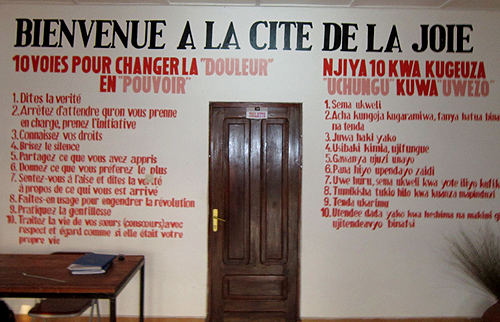
This banner welcomes all to the City of Joy guest house, Panzi, DRC. Photo: Susannah Sirkin, PHR.

PHR’s team just returned from a training session in the DRC, where they are working with international and local partners to hold perpetrators accountable for using rape as a weapon of war. This is one of a series. Learn more about the project.

Six young Congolese women burst through the doorway of our lodging in Panzi, South Kivu, where the PHR team is staying for several days as we train police, lawyers, judges, doctors, and nurses in effective evidence and documentation of sexual violence. They encircle us with clapping, cheering, singing, tight hugs, and huge smiles, saying “welcome, welcome.”

It turns out we’re the first guests to stay at the brand new and modest guest house on the campus of the City of Joy, a project of Eve Ensler’s V-Day, a global movement to end violence against women.

(The “City” aims to build legions of leaders from among the vast number of survivors of horrific sexual violence from Congo’s wars and post-conflict environment.)

Each evening, as we return to our guest house after a long day of intensive work with our local colleagues, the girls and women greet us, often waiting for our return at the doorstep.

One wants to be a doctor. She’s 18 and her parents were killed by the rebels. She has no funds for school, but she tells us, “I want to help others recover.” Another says she’s going back to her village to find the other girls who were raped and are afraid to tell anyone.

“They are all alone with their suffering,” says Mama Kyala, our host,  “and I will be there to support them and raise awareness.” She has a soft smile and a calm confidence. She sits with us well into the night over tea and biscuits. A social worker, she received the first rape survivor at Panzi Hospital when it opened 12 years ago.

Mama Kyala told us the story of another girl, now 19, who was forced into marriage at 16, became pregnant, and developed a fistula after giving birth. Her injury was so severe that she spent three years recovering at Panzi Hospital. The girl, now a confident young woman, came into the room to kiss Mama Kyala goodnight.

Mama Kyala indicated that so many of the survivors she has helped over the years at Panzi have nothing to return to when they leave the hospital. She is the “Mama” of dozens of girls and women who will soon return to the villages where they were cruelly violated. Mama Kyala told us “I used to cry every night, listening to their stories, but watching them recover, I know I just need to remain strong for them.”

For PHR, these intimate conversations by candlelight reinforce our conviction that justice doesn’t stop when the perpetrators are caught and convicted, important as that is, but when the victims receive reparation and become survivors.


The rules at City of Joy, written on the wall.

Everyone can be clear on what the rules are while at the City of Joy. Photo: Susannah Sirkin, PHR.
Blog

IFIs in Burma Must Meet the Needs of Survivors of Human Rights Violations

The US recently exercised a partial waiver authority underU.S. law which allows the US to support the work of international financialinstitutions (IFIs) including the World Bank and the International MonetaryFund (IMF) to operate in Burma, notwithstanding the existing US sanctions regime.The State Department announcedthat Secretary Clinton used a provision in the Trafficking Victims ProtectionAct to waive restrictions on Burma that previously kept the US from supportingassessments by IFIs.

The shift in US policy reflects some recent changes in Burma,including the release of high-level political prisoners, the politicalrecognition of Nobel Peace Prize Laureate Aung San Suu Kyi and the National Leaguefor Democracy, as well as the loosening of media restrictions.

This decision will allow the US to support initialassessments and limited technical assistance by IFIs, which aim to tacklesystemic poverty in developing countries. Poverty alleviation is an importantgoal, but the international community must remain vigilant regarding theongoing human rights violations in the country. The US should use its voice andits vote at the World Bank to ensure that any assessment or intervention isconducted in a way that will improve the well-being of marginalizedcommunities, including minority ethnic groups in rural Burma, and not the individualswho have long profited from the country’s military regime. The US and theinternational community must understand that IFI interventions will beeffective only when attacks on civilians end, impunity gives way toaccountability, and the rule of law is established and respected.

IFI programs must ensure that any economic support directly meetsthe needs of survivors of human rights violations and is not diverted by themilitary regime, and that this support fully includes members of minoritygroups. Crucial pre-conditions for successful poverty alleviation programs are theend of the ongoing military conflict in the ethnic regions, the end of severehuman rights violations which still continue in those areas, and accountabilityfor perpetrators of these crimes.

Given the checkered history of the World Bank in SoutheastAsia, the US should carefully track the institution’s activities in Burma. Inthe past, the World Bank has pushed for the construction of dams and otherinfrastructure projects, and in Burma, such projects are often the foundationfor displacement, increased food insecurity, the destruction of cultural and religious sites, and significant environmental damage.

Instead of being lifted out of poverty,people living in the vicinity of dams and similar projects face the prospect oflosing their homes and going to more extreme lengths to find food and othernecessities. In Burma, other similar projects have historically benefited thegovernments of neighboring countries, not the people of Burma—such programshardly deserve the worthy title of poverty alleviation.

Get Updates from PHR