Multimedia

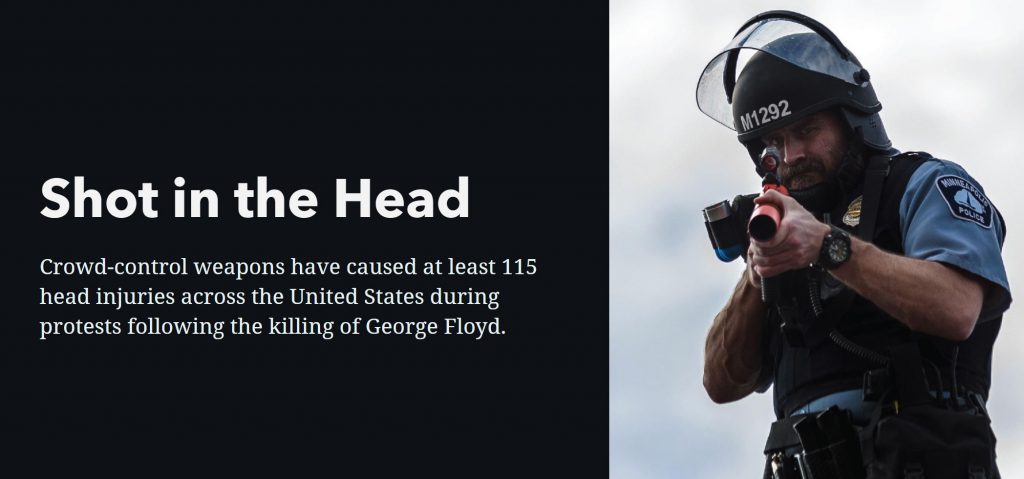
Shot in the Head

Crowd-control weapons have caused at least 115 head injuries across the United States during protests following the killing of George Floyd.

After George Floyd’s killing, captured on video and shown widely across the United States and around the world, millions of people took to the streets nationwide to support the Black Lives Matter movement and demand police accountability.

While protests in the United States in June and July of 2020 were overwhelmingly peaceful and without incident, some devolved into violent confrontations between police and protestors, including widespread law enforcement use of crowd-control weapons (also known as “less-lethal” weapons).

Tear gas, pepper spray, stun grenades, and acoustic weapons have all been extensively employed, but the scale of the use of kinetic impact projectiles (KIPs) stands out in reports from protestors, journalists, and bystanders. KIPs include various bullets and baton rounds, as well as tear gas canisters, that are fired into crowds from a gun, rifle, or other launcher.

In an effort to record the scope of KIP use and the resulting injuries, Physicians for Human Rights (PHR) used open-source research methods to collect publicly available data. We identified at least 115 people across the United States who were shot in the head or neck with KIPs from May 26 to July 27, 2020. Explore the presentation built on ArcGIS Storymaps below:
Webinar

Back to School During a Pandemic

On Thursday, September 10, PHR held a conversation about the implications of the COVID-19 pandemic on K-12 education as school districts across the United States consider how best to educate children while prioritizing the health, safety, and well-being of students, teachers, and their families. Our moderator was Ranit Mishori, MD, MHS, senior medical advisor at PHR.

Distinguished panelists

  • Sara Bode, MD, FAAP is a primary care pediatrician and the medical director of Nationwide Children’s Hospital’s Care Connection School-Based Health and Mobile Clinics. She serves on the executive committee of the American Academy of Pediatrics Council on School Health. She appeared on Good Morning America to discuss school reopenings during the pandemic.
  • Meira Levinson, PhD is a professor of education and a normative political philosopher working at the intersection of civic education, youth empowerment, racial justice, and educational ethics at the Harvard Graduate School of Education. In July, she co-authored a New England Journal of Medicine article on reopening primary schools during the COVID-19 pandemic. She formerly taught in the Atlanta and Boston public school systems. 
  • Keisha Scarlett, EdD is the chief of equity, partnerships, and engagement at Seattle Public Schools. She has served in multiple education roles, including as STEM teacher and district administrator. She is an author of the National Academies of Sciences, Engineering and Medicine’s report, “Reopening K-12 Schools During the COVID-19 Pandemic,” and has appeared on WBUR Boston to discuss school reopening challenges experienced by communities of color.
  • Heidi Schweingruber, PhD is the director of the Board on Science Education at the National Academies of Sciences, Engineering and Medicine, where her work includes K-12 science education, informal science education and higher education. She is an editor of the National Academies’ report, “Reopening K-12 Schools During the COVID-19 Pandemic.”

The conversation was moderated by Ranit Mishori, MD, MHS, senior medical advisor at PHR. She is a professor of family medicine at Georgetown University School of Medicine and serves as interim chief public health officer of Georgetown University.

See all events in PHR’s COVID-19 Webinar Series.

Blog

La menace de la COVID-19 : Ce que la RDC peut apprendre de sa lutte contre Ebola

Dr Lwanzo Pablo est médecin chef de Zone de santé de Butembo au Nord Kivu dans la République démocratique du Congo (RDC). Cette zone, qui dessert plus de 200 000 habitants, a été touché par la dixième épidémie de la maladie à Virus Ebola en RDC.


Read in English here.

L’épidémie de la maladie à virus Ebola m’a rencontré en 2018 quand je dirigeais la zone de santé de Butembo au Nord Kivu.  Les débuts avaient été chaotiques avec une menace réelle sur la propagation de l’épidémie dans les autres provinces de la RDC voire la sous-région de Grands lacs africains. Pourtant, des efforts considérables entrepris par le gouvernement et les communautés pour renforcer la capacité des professionnels de santé et de sensibiliser les populations ont permis de pallier ces difficultés et de contenir l’épidémie jusqu’à l’éradiquer dans ce foyer de l’Est. Dans l’attente de la fin de cette épidémie sur toute l’étendue de la RDC, le Nord Kivu doit maintenant faire face à une nouvelle menace : le Coronavirus. La RDC est mieux préparée qu’avant pour se confronter à cette pandémie et est bien positionnée pour incorporer des leçons apprises de l’épidémie d’Ebola dans sa riposte. Toutefois, il reste des faiblesses persistantes et structurelles qui entravent les efforts des acteurs de la riposte.

Parmi les difficultés que moi et mes collègues rencontrons dans la lutte contre le coronavirus figurent l’indisponibilité d’un laboratoire ou des tests de diagnostic puisque l’unique centre de dépistage en province se trouve à Goma située à plusieurs centaines de kilomètres de Butembo. Cela prend trop de temps de latence entre d’expédition des échantillons des prélèvements de patients et l’attente des résultats. Alors que pour Ebola il suffisait de quelques heures, pour la COVID-19 il faut actuellement quelques jours. Et pourtant l’accès rapide au résultat de test a fait toute la différence lors de la riposte contre Ebola puisque cela permettait de placer directement le patient en isolement et de débuter le traitement, ce qui a réduit considérablement les contaminations. Il a été rapporté que pendant cette longue attente certains malades ont déjà fui les centres d’isolement puisque n’étant pas fixé rapidement sur leur situation. Mise à part le manque d’équipement de traitement et de protection, qui est sans doute très grave, le personnel soignant n’a pas encore reçu de formation suffisante sur la prise en charge des malades de COVID-19.

Une autre difficulté supplémentaire se rapporte à la résistance de la population aux mesures sanitaires nécessaires, le port de masque et la distanciation sociale y compris. Une de raisons probables serait l’absence, dans le chef de la population, d’information fiable. En plus, les détournements et abus passés des fonds pour lutter contre l’Ebola  qualifiés d’« Ebola business », intervenus lors de la crise sanitaire et qui sont loin de faciliter la compréhension, renforcent les fausses croyances sur l’existence ou la transmission du coronavirus. En effet, la plupart des malades que moi et mes collègues recevons en consultation manifeste soit du scepticisme inquiétant sur le sérieux qu’il faut apporter à la riposte contre la COVID-19 soit sont anxieux pensant que le virus a été inséré au sein de la communauté à des fins politique ou financière. Toutes ces fausses croyances augmentent la méfiance et de fois l’insouciance fautive favorable à la propagation du coronavirus.

Et pourtant, devant toutes ces difficultés, je crois qu’il est possible pour la RDC de partir des acquis de la riposte contre Ebola pour monter un modèle d’intervention efficiente pour lutter contre le coronavirus. Grâce à la lutte contre l’Ebola, la RDC possède de nos jours une ressource humaine capable d’interventions à la riposte de la COVID-19 et cela d’une manière multisectorielle. En effet, Il existe des structures sanitaires qui disposent des agents compétents pour assurer des sensibilisations communautaires, des organisations à base communautaire qui ont déjà des capacités dans l’accompagnement des communautés affectées, et les équipes de ripostes (experts épidémiologistes locaux) qui sont capables d’intervenir en temps utile en situation d’épidémie. Comme pendant l’épidémie de la maladie à virus Ebola, la riposte se doit donc multisectorielle, impliquant plusieurs acteurs professionnels puisque les actions à mener doivent se concevoir en coordination pour plus d’impact. C’est ainsi que la stratégie de riposte d’Ebola mis en œuvre par l’Etat congolais impliquait le personnel soignant (les médecins, les infirmiers, les psychologues cliniciens, etc.) mais aussi les leaders communautaires et les autorités politico-administratives, les acteurs humanitaires ainsi que les acteurs de la société civile ….  Ce qui est loin d’être le cas dans les interventions actuelles. Plus inquiétant encore au sein des structures hospitalières de ma zone de santé il existe un plan de contingence clair se rapportant à cette pandémie mais difficile à rendre opérationnel faute de moyens et de partenaires.

Pour mieux répondre à cette crise, le gouvernement Congolais et les autorités provinciales devraient envisager les actions prioritaires ci-après : 1°. La formation spécifique à la COVID-19 du personnel médical et la sensibilisation de la communauté ; 2° la dotation en matériels pour la prévention et le contrôle de l’infection (PCI) pour donner des moyens afin de rendre le plan de contingence opérationnel. Ce qui comprend les tests rapides pour le diagnostic : disponibiliser les matériels et intrants PCI, renforcer la recherche de contacts et rendre opérationnel les points de contrôle sanitaires dans tous les axes ; 3° la coordination des équipes de riposte prépositionnées dans les zones de santé. Ce qui équivaut à mettre en place des actions en gamme multisectorielle pour la lutte contre la COVID-19. Elles impliquent que les différents intervenants se coordonnent suivant un plan d’action concertée sous le lead des autorités sanitaire du pays.

Il s’agit d’un temps plus difficile pour le personnel soignant auquel j’appartiens sachant que le coronavirus se déclare dans des zones à risque élevé qui font face déjà à d’autres menaces sanitaires à l’instar de la rougeole, choléra, poliomyélite. Moi et mes collègues restons disposés à respecter notre serment de médecin quoique nous intervenons dans un contexte peu sécurisé et moins fiable. J’espère sincèrement que les autorités pourront tirer les leçons de la riposte contre la maladie à virus Ebola pour que les erreurs du passé servent à éviter plus de perte en vies humaines pendant cette pandémie.  A la communauté international, je suggère d’apporter un appui technique et en matérielle pour couvrir le déficit affiché dans la formation et la dotation en équipement de laboratoire, de protection et de prélèvement voir de prise en charge des cas sévère. Ce partenariat sera critique pour permettre à l’Etat congolais d’offrir une meilleure réponse contre cette pandémie.  

Blog

Voices from the COVID-19 Pandemic: What the DRC Can Learn from its Fight Against Ebola

Dr. Pablo Lwanzo is the head doctor of the Butembo Health Zone in North Kivu, Democratic Republic of the Congo (DRC). This zone, home to more than 200,000 people, was recently the site of the tenth Ebola epidemic in the DRC. Dr. Lwanzo spoke to PHR about how the lessons of combatting Ebola can inform the way his country addresses the COVID-19 pandemic.


Read in French here.

I first encountered the Ebola virus in 2018, when I was overseeing the health zone of Butembo in North Kivu. It was chaotic in the beginning, with the threat of the virus looming over other provinces in the DRC and even the African Great Lakes region, more generally. Considerable efforts undertaken by the community and the government to sensitize populations and build the capacity of health professionals made it possible to overcome initial difficulties and fully eradicate the disease in the eastern part of the country. Now, as the Ebola epidemic nears its final stages in the DRC, North Kivu faces a new threat – the coronavirus. Thanks to the lessons learned in its fight against Ebola, the DRC is now better prepared to take on this new epidemic. However, many of the same structural challenges persist, impeding the DRC’s response.

Among the many issues my colleagues and I face is the limited availability of labs and tests. Currently, the only testing center in North Kivu is in the city of Goma, several hundred kilometers from Butembo. It takes far too long to ship the patient samples and wait for the results. Results for Ebola tests took only a few hours, and the rapid tests made all the difference in the fight against the disease, as they allowed the patient to isolate and begin treatment immediately, in turn reducing spread. For the coronavirus, test results take a few days. Reports indicate that, in the current pandemic, some patients are abandoning isolation centers because they are not receiving their COVID-19 status quickly enough. On top of issues with testing, we face a serious shortage of protective equipment, and health care workers aren’t adequately trained in how to treat COVID-19 patients.

“Thanks to the lessons learned in its fight against Ebola, the DRC is now better prepared to take on this new epidemic. However, many of the same structural challenges persist, impeding the DRC’s response.”

Another obstacle is the population’s resistance to following the necessary safety measures, including social distancing and wearing a mask. I believe this stems from a lack of accurate information about the pandemic. The misappropriation and abuse of aid and resources that took place during the Ebola crisis (which became known as “Ebola business”) further reinforces false beliefs about the existence or transmission of the coronavirus. My colleagues and I find it highly concerning that most of the patients that we see either express skepticism about the seriousness of COVID-19 or share suspicions that the virus was introduced in the community to advance certain political or financial interests. This widespread misinformation increases mistrust and at times leads to reckless behavior, both of which can increase the spread of the virus.

“Despite the challenges of providing care in such precarious circumstances, my colleagues and I remain committed to our oath as doctors to make every possible effort to save lives and heal people.”

Yet, faced with all of these difficulties, I believe it is still possible for the DRC to build on the successes of its Ebola response and set up an effective intervention model to fight the coronavirus. Due to the Ebola crisis, the DRC now has the professionals needed to respond to COVID-19 using a multi-sectoral approach. There are health structures that can ensure community sensitization, grassroots organizations that have the capacity to support affected communities, and response teams made up of local expert epidemiologists that are able to intervene early on in an epidemic. As was the case during the Ebola epidemic, the response to COVID-19 must be multi-sectoral. It must involve professionals from different fields who, when working in coordination, multiply their impact. This is why the Ebola response strategy implemented by the Congolese government involved not only health care staff (doctors, nurses, clinical psychologists, etc.) but also community leaders, political and administrative authorities and humanitarian workers, as well as members of civil society. This is far from the case in the current coronavirus interventions. Even more concerning to me is that contingency plans established by the health facilities in my own zone will be extremely difficult to operationalize due to a lack of material means and partnerships.

To effectively respond to this crisis, the following actions should be prioritized:  1) targeted trainings on COVID-19 for medical personnel and community awareness; 2) the provision of personal protective equipment (PPE) to prevent and control spread and to operationalize contingency plans (this includes rapid diagnostic tests, making the raw materials needed to produce PPE more widely available, strengthening contract tracing, and making health check points operational across all modes of transport); 3) the coordination of response teams that are pre-positioned in every health zone. Implementing these steps would allow for stakeholders from multiple sectors to work in concert under the leadership of the country’s health authorities, together strengthening the DRC’s fight against COVID-19.

It is an especially difficult time for health workers like me, as we witness the coronavirus spread in high-risk areas already confronting other dire health threats such as measles, cholera, and polio. Despite the challenges of providing care in such precarious circumstances, my colleagues and I remain committed to our oath as doctors to make every possible effort to save lives and heal people. I sincerely hope that the authorities incorporate lessons learned from the Ebola response as they tackle COVID-19, so that we don’t repeat our past mistakes and can prevent more loss of life during this pandemic. I also call on the international community to provide technical and material support to aid the DRC’s training efforts, increase access to lab equipment and PPE, and strengthen the country’s capacity to treat the most severe cases. This partnership will be crucial in ensuring the Congolese state provides a robust response to this pandemic.

Blog

Voices from the COVID-19 Pandemic: “In Tijuana or Matamoros, it’s become a living hell.”

Jose Mares is the Tijuana Logistics Coordinator for PHR partner Al Otro Lado, a legal services organization serving indigent deportees, refugees, and asylees in Mexico. Born in Mexico, Mares was brought to the United States when he was nine years old and lived there for three decades before being picked up by Immigration and Customs Enforcement (ICE) agents in early 2017 and deported. His daughter, mother, and all his siblings remain in the United States. Mares told his story during Physicians for Human Rights’ recent webinar on the impact of COVID-19 on refugee encampments in Mexico. The following is based on those remarks.


I was one of the first people to be deported by the Trump administration. This happened on February 9th of 2017, and I’ve been living in Tijuana ever since.

I was a single father of my 17-year-old daughter, whom I’ve raised since she was three-and-a-half years old. I was working as a tire salesman in Lancaster, California. That morning, my daughter drove me to work. Luckily, she didn’t see the six ICE agents that rushed me, put me in handcuffs, and pushed me into an unmarked van. This happened around 7:30 a.m.

“COVID-19 disrupted the lives of many people all over the world, but if you’re an immigrant, refugee, or a deportee living in Tijuana or Matamoros, it’s become a living hell.”

By 10:00 p.m., I was already in Tijuana. I had no court hearing and didn’t see a judge. I was picked up and deported the same day.

My daughter tried to keep up with payments for our house, but she was unable to and got evicted; she went from house to house until she was able to find a better-paying job. I attempted to cross illegally twice within the first three months of my deportation. I literally broke myself trying to get back home to my daughter.

When I first arrived in Tijuana, I was constantly harassed and threatened with jail by police because I didn’t have an I.D. Soon after I was deported, I connected with Al Otro Lado and started working with them. I was able to help other deportees obtain their documents and re-integrate back into society here in Tijuana. I have also worked with hundreds of refugees and immigrants since I started my job.

I have seen first-hand the mistreatment, the suffering, and the hardships that deportees, refugees, and immigrants face day to day, unable to receive even basic medical care, a safe place to sleep, or a warm meal to eat. The shelters in Tijuana are usually overcrowded, unsanitary, and unsafe. Things were already very hard for those stuck here – and then came MPP [“Migrant Protection Protocols”] and the pandemic.

Once MPP was implemented, it put an even bigger strain on shelters, organizations, and volunteers at border cities. Al Otro Lado set up MPP clinics in Tijuana and we provided housing for some families waiting for their court dates or for their number to come up on the infamous list of who gets to cross into the United States and present their case to U.S. border officials. We helped others with document translations and general support throughout their forced stay in Tijuana.

The pandemic put a hold on a lot of people’s lives around the world. Migrants and refugees who were fortunate to find employment started to lose their jobs; they faced eviction because they were unable to pay rent, and families started to go hungry with no food on the table. Al Otro Lado provided more than 200 prepaid debit cards with 4,000 pesos to clients, refugees, and migrants to help with basic needs for up to two months. Some medically vulnerable families were taken out of shelters and housed.

Government offices closed down because of the pandemic, so people being deported were not able to obtain any of the necessary documents like an I.D. or a birth certificate – and without those you can’t do anything in Tijuana. You also run the risk of being thrown in jail because you’re labeled as an indigent.

People in MPP are stuck along the border indefinitely. MPP courts are closed and so is the southern border, so even if they wanted to go home, they couldn’t. So, we then get whole families having to live in these shelters or tent cities with no end in sight.

COVID-19 disrupted the lives of many people all over the world, but if you’re an immigrant, refugee, or a deportee living in Tijuana or Matamoros, it’s become a living hell.

Webinar

Policing and Public Health in the Age of COVID-19

In the midst of the societal upheaval caused by the COVID-19 pandemic came the killing of George Floyd and calls for an end to systemic racism, including in policing practices. Law enforcement has a responsibility to protect the human rights to life, speech, and assembly. While the COVID-19 pandemic continues to cause illness and death, structural racism and police brutality in the United States have led to a public health crisis.

PHR hosted a conversation on policing and public health, focusing on the impact of harmful law enforcement practices in the age of COVID-19. Our moderator was Mary Bassett, MD, MPH, director of the François-Xavier Bagnoud Center for Health and Human Rights at Harvard University, FXB Professor of the Practice of Health and Human Rights at the Harvard School of Public Health, and former commissioner of the New York City Department of Health and Mental Hygiene.

Distinguished panelists:

  • Rhea Boyd, MD, MPH is a pediatrician and public health advocate who serves as the chief medical officer of San Diego 211, and as the director of equity and justice for The California Children’s Trust.
  • Marc Krupanski, MA, is a senior program officer for the Open Society Foundations’ Public Health Program
  • Teressa Raiford is the founder of Don’t Shoot Portland, a Black-led and community driven nonprofit in Portland, Oregon, that advocates for accountability to create social change in the spaces of racial justice and law enforcement accountability.

This conversation was moderated by Mary Bassett, MD, MPH, director of the François-Xavier Bagnoud Center for Health and Human Rights at the Harvard T.H. Chan School of Public Health.

See all events in PHR’s COVID-19 Webinar Series.

Multimedia

The Rohingya: Survivors of Atrocity

After enduring decades of persecution, abuses, and ethnic violence, when will the Rohingya finally see justice and respect for their rights?


On the day of the massacre, Myanmar security forces surrounded 23-year-old Umma Salama’s  home and ordered her family to come out.

They hit Umma in the head with a gun and then took her away and tied her to a tree, shouting “Don’t cry… If you cry, you will be killed.” While she was tied up, Umma saw security forces set fire to her house, and her husband, brother-in-law, daughter, and son shot dead as they tried to run away. She witnessed several other villagers shot dead and a bullet grazed her leg. Hours later, Umma’s mother-in-law was able to untie her from the tree. They hid in the forest and then went to a neighboring village, where they met others from Chut Pyin village.

A week later, they began walking to Bangladesh.


  • 0

    Number of Rohingya forced to flee Myanmar as a result of 2017 violence.


A Targeted People

Myanmar is a diverse country with many ethnic groups, languages, and religions. Predominantly Buddhist, the Bamar ethnic group represents 60-70 percent of the population. Despite this multiplicity, many ethnic groups face violence and discrimination, including the Rohingya.

For centuries, Muslim Rohingya people have lived in Rakhine state on the western coast of Myanmar, a predominantly Buddhist country. Since the Myanmar military junta stripped the Rohingya of citizenship in 1982, the Rohingya have been stateless and subjected to decades of human rights violations, including arbitrary detentions and killings, forced labor, restricted access to health and education, limited political participation, restrictions on freedom of movement, forced displacement, and trafficking. 

A violent August 2017 crackdown led by the Tatmadaw (armed forces of Myanmar) on Rohingya people living in northern Rakhine state killed thousands and drove more than 740,000 people out of Myanmar. The campaign unleashed extreme acts of violence against Rohingya communities: entire villages were burned, residents beaten, raped, and mutilated, and children slaughtered. In 2018, the then United Nations special envoy on human rights in Myanmar said that the military’s ferocious assault against the Rohingya bore “the hallmarks of a genocide.”

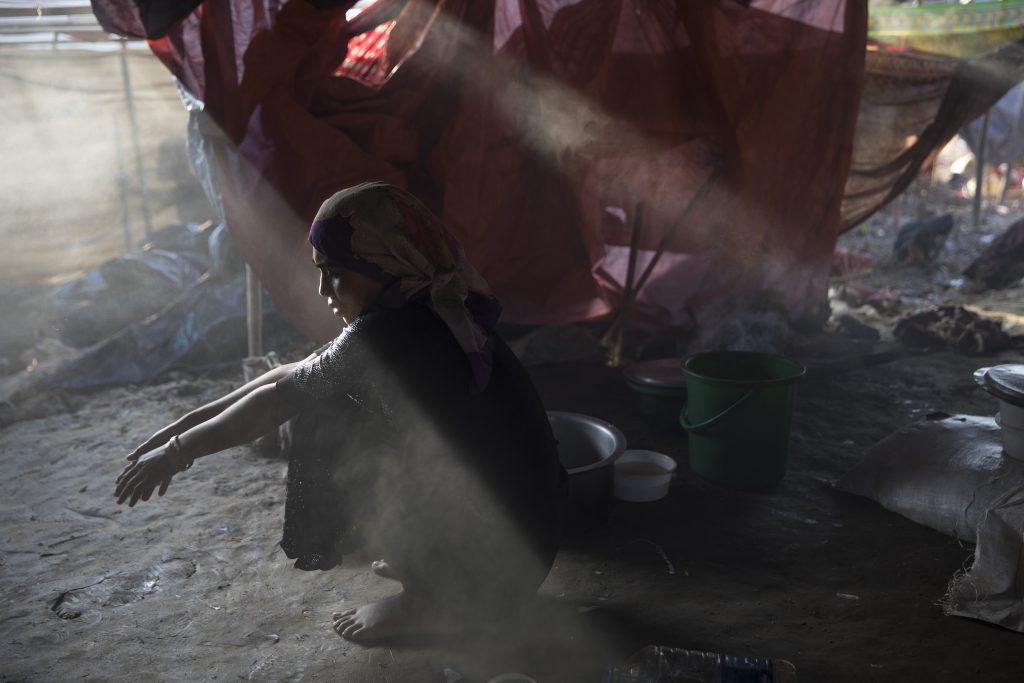
An 18 year-old refugee in her tent in Thainkhali camp, Cox’s Bazar, September 2017. (Paula Bronstein Getty Images)

Those who survived were eventually rescued by relatives or managed to take refuge in the surrounding forests, farmlands, or villages. In some cases, local health workers denied survivors necessary medical treatment due to pressure from the Tatmadaw. Many survivors had heard that Myanmar authorities required doctors to report injured Rohingya to the authorities, and thus avoided seeking medical care. These delays in getting medical attention exacerbated injuries and increased complications, including infection, less recovery of limb function, and higher levels of immobility and disability among victims. Hundreds of thousands undertook a perilous journey to escape across the border into Bangladesh.

Today, nearly one million Rohingya are crowded into refugee camps in Cox’s Bazar, Bangladesh, in the largest refugee settlement in the world. As a result of the violence, they are living with severe trauma, life-changing disabilities, and immeasurable loss. Moreover, those left behind in Myanmar continue to face grave risks. In September 2019, the UN’s Independent International Fact-Finding Mission on Myanmar concluded that “the Rohingya people remain at serious risk of genocide under the terms of the Genocide Convention”.

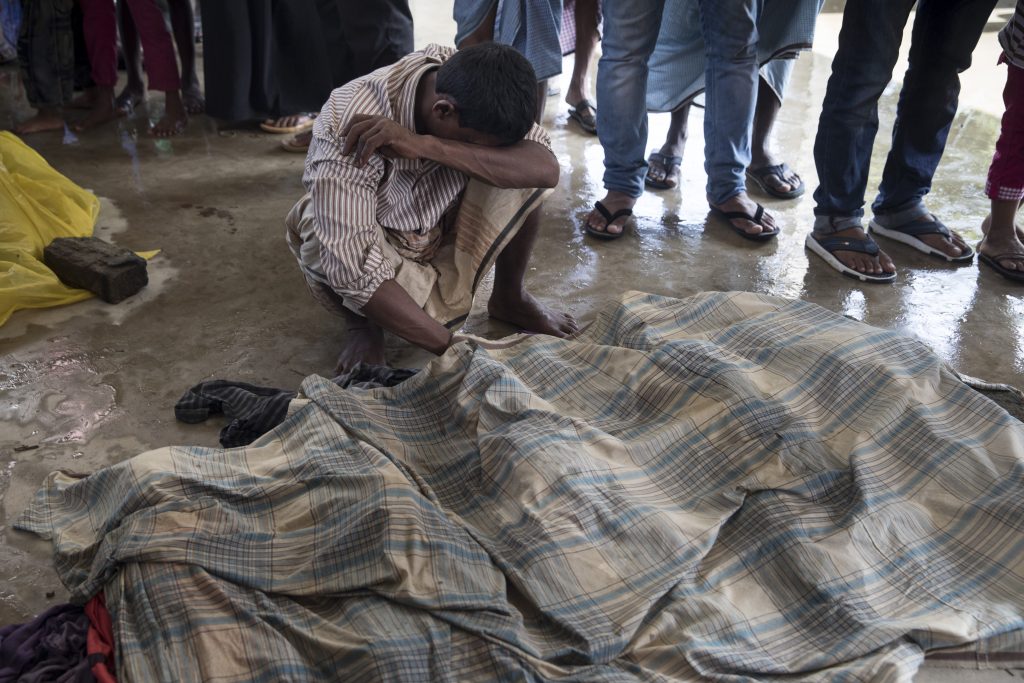
Family members mourn next to the bodies of babies before the funeral after a boat sank in rough seas off the coast of Bangladesh carrying more than 100 people in September 2017. Seventeen survivors were found along with the bodies of 20 women and children with over 50 missing. (Photo by Paula Bronstein/Getty Images)

On top of the risk of genocide and other mass atrocities, the Rohingya face new dangers from the COVID-19 pandemic: in March 2020, Myanmar recorded its first coronavirus cases, and in May, the first coronavirus case was found among Rohingya refugees in Bangladesh. In crowded conditions and lacking access to basic services, the refugee populations – as well as others displaced inside Myanmar – remain at grave risk from the virus. Several Rohingya interviewed by PHR say they want to return to Myanmar but refuse to do so without credible guarantees that their rights will be respected. The government of Myanmar, which has steadfastly denied responsibility for the atrocities perpetrated against the Rohingya, has done nothing to reassure them that they will be safe in their own country if they return.


Documenting Evidence of Atrocities

For more than 15 years, Physicians for Human Rights (PHR) has exposed and denounced human rights abuses in Myanmar, with a focus on the persecution of and violence against ethnic minorities like the Rohingya.

Following the brutal attacks against the Rohingya in August 2017, PHR sent teams of doctors to refugee camps in Bangladesh’s Cox’s Bazar to medically document atrocities suffered by the Rohingya at the hands of Myanmar security forces and Burmese civilian villagers. PHR medical experts documented injuries resulting from the beatings, rapes, gunshot wounds, and burns suffered by the Rohingya, in order to corroborate their stories and help them seek justice. PHR’s research is detailed in several reports like “Please Tell the World What They Have Done to Us” and “Widespread and Systematic,” as well as “Shot While Fleeing,” which highlights long-term disabilities resulting from the attacks.

Since 2019, PHR’s research has focused on the experiences of health care workers treating Rohingya survivors of violence in Myanmar, specifically sexual and gender-based violence. In 2020, PHR published Sexual Violence, Trauma, and Neglect, which features interviews with health workers who have treated Rohingya survivors in Bangladesh and who corroborate allegations of sexual violence by Myanmar military.

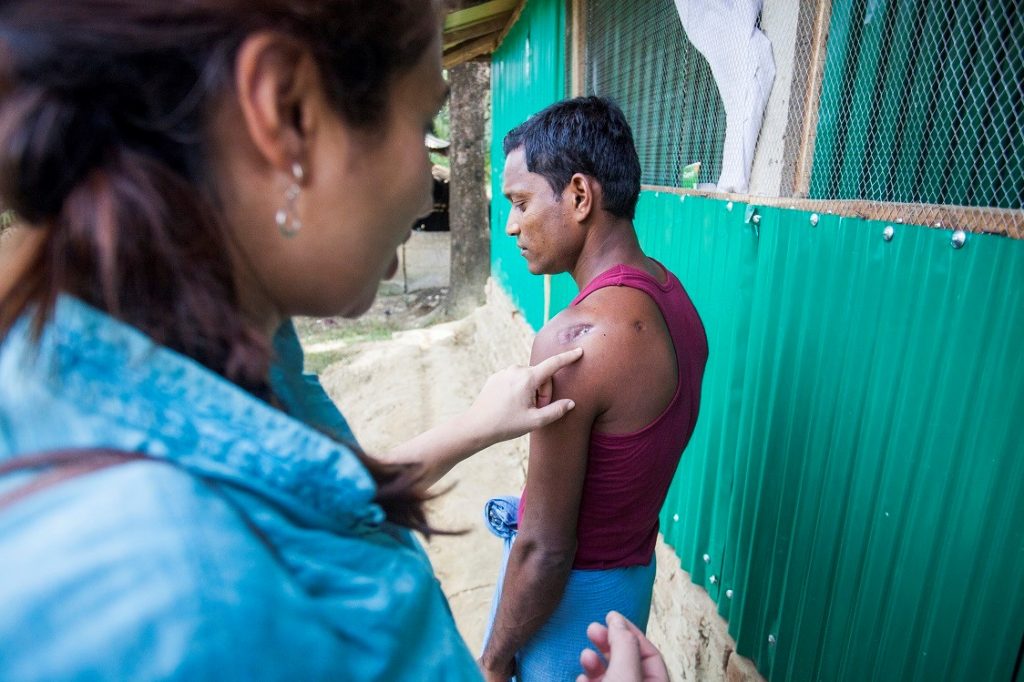
PHR Medical Expert Dr. Rohini Haar examining a Rohingya refugee in Balukhali refugee camp in Bangladesh. He suffered nerve injury after being shot in the back while fleeing Myanmar security forces and can no longer perform basic tasks using his arm. Photo: Salahuddin Ahmed for PHR
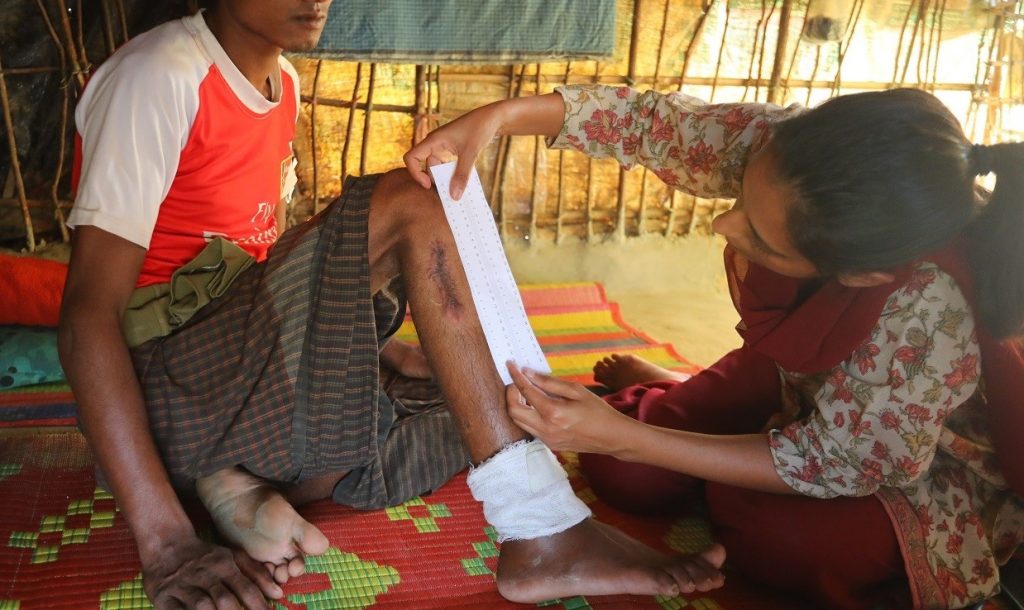
This man, 23, was shot in the right lower leg while fleeing attacking security forces. The wound became infected while he was being carried to Bangladesh by relatives, requiring subsequent surgery and skin grafts. He continues to have severe pain, needs crutches and can walk only a few feet, and may have a chronic bone infection. Photo: Salahuddin Ahmed for PHR
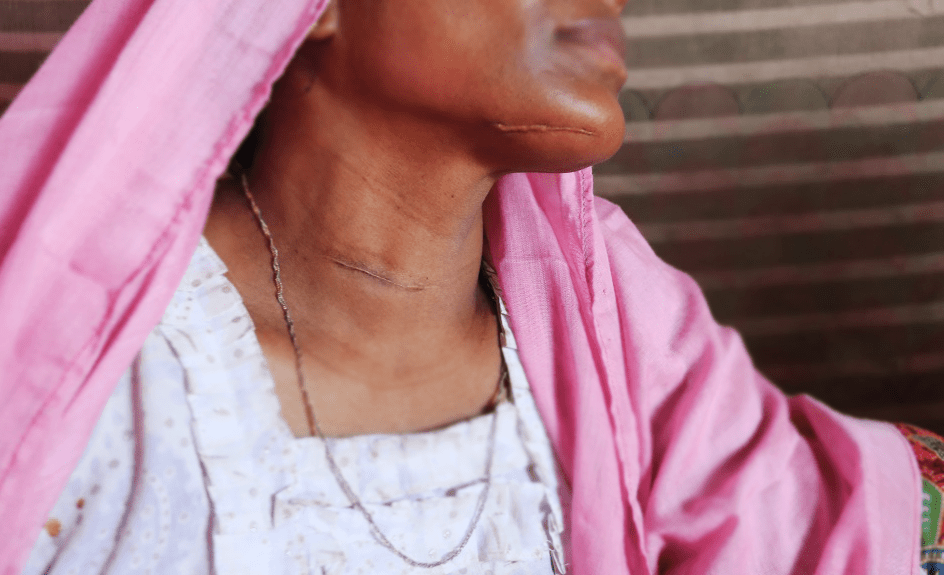
Myanmar security forces killed this refugee’s husband and five of her six children in front of her before beating her, breaking her wrist, and raping her. The man who raped her sliced her neck in two places and left her to die. She has limited wrist function as a result of the fracture. Photo: Salahuddin Ahmed for PHR

A Long Road to Justice

The widespread and systematic violence perpetrated against the Rohingya in recent years may amount to some of the most serious crimes codified under international law. PHR has called for these atrocities to be investigated as crimes against humanity. Our documentation of the scope, scale, and patterns of attacks that took place against the Rohingya in late August 2017 has been submitted to the UN Human Rights Council and made available to the UN’s Independent International Fact-Finding Mission on Myanmar.

Accountability and justice for the crimes committed against the Rohingya are critical to any hopes for a sustainable peace in Myanmar and beyond.

The Myanmar government continues to deny that its military committed atrocities against the Rohingya and is unwilling and unable to allow for meaningful accountability for these crimes. Yet, while international criminal processes are underway – such as the International Court of Justice (ICJ) hearing of The Gambia’s case against Myanmar for violating the Genocide Convention and the investigation of the International Criminal Court – reports of grave human rights violations continue to arise from across Myanmar.

PHR calls on the regional and international community to demand that Myanmar grant unrestricted access to United Nations agencies, officials, and international humanitarian and human rights organizations to provide essential services and conduct investigations into alleged human rights violations in Myanmar, especially in Rakhine state. Likewise, any discussion regarding the potential repatriation of Rohingya refugees to Myanmar can only proceed after guarantees are implemented for safe, dignified, and voluntary return in accordance with protections under international law.

It remains a stain on the UN Security Council’s record that it has disregarded the situation and has refused to take appropriate action. The impunity enjoyed by the Myanmar military, the continued violence against and forced displacement of civilians, and the government’s refusal to comply with international bodies warrant a series of measures to support human rights reforms in the country, including targeted sanctions, arms embargoes, and international support for accountability processes. Accountability and justice for the crimes committed against the Rohingya are critical to any hopes for a sustainable peace in Myanmar and beyond.


History of the Rohingya in Myanmar

1871–1911

The Muslim population in Arakan Kingdom triples and, by 1911, accounts for 94 percent and 84 percent of the population in the townships of Maungdaw and Buthidaung, respectively. Muslims first settle in the Mrauk U area of Arakan, now Myanmar’s Rakhine state. The Muslim population in Arakan Kingdom triples between 1871 and 1911.

1948

Burma achieves independence from Britain, and the Rohingya, an ethnic group comprising the majority of Muslims in Rakhine state, are considered citizens under the Constitution of 1948.

1974

A new constitution transfers power from the armed forces to a People’s Assembly headed by former military leaders. The Rohingya lose citizenship rights.

1977

Myanmar government persecution of the Rohingya causes 200,000 to flee to Bangladesh.

1982

Myanmar’s Citizenship Act of 1982 strips the Rohingya of their citizenship rights by requiring that citizens belong to one of 135 recognized national races, or provide evidence of family lineage in Myanmar before 1823. The list excludes the Rohingya.

1988

A nationwide pro-democracy “8888” movement by students is violently put down by government troops. By the end of the year, approximately 10,000 people have been killed in the crackdown. The State Law and Order Restoration Council (SLORC) is formed. 

1989

SLORC arrests thousands of dissidents, changes Burma’s name to Myanmar, and places pro-democracy leader Aung San Suu Kyi under house arrest. All Burmese are required to apply for new citizenship cards stating ethnicity and religion. The Rohingya are not able to obtain cards.

1991

More than 260,000 Rohingya flee to Bangladesh to escape human rights abuses by the Burmese military, including the confiscation of land, forced labor, rape, torture, and summary executions.

2012

Violence erupts in Myanmar when a Rakhine Buddhist woman is raped and murdered, allegedly by Muslim Rohingya men. 

2013

Violence continues with several attacks on Muslim villages that uproot 140,000 Rohingya, who became internally displaced people within Myanmar.

2014

Myanmar’s first country census in 30 years does not include the Rohingya as a recognized ethnic group. Government initiates a citizenship verification program, whereby the Rohingya are instructed to register as “Bengali,” an ethnic group native to India and Bangladesh.

2015

A new law is passed requiring political leaders to be citizens – thereby excluding Rohingya candidates – and Rohingya are barred from voting in the November elections. Myanmar government announces a new citizenship verification process and distributes National Verification Cards (NVCs); many Rohingya refuse to accept the NVC for fear of being registered as “illegal” and then expelled from Myanmar. 

2016

The insurgent Arakan Rohingya Solidarity Army (ARSA) attacks three Border Guard Police (BGP) outposts with swords, spears, and homemade weapons, killing nine officers. The Myanmar government labels ARSA “terrorists” and launches a military and BGP offensive that kills hundreds of Rohingya; some 87,000 flee to Bangladesh. The operations also recruit Rakhine Buddhist villagers in de facto state-sanctioned vigilante activities. 

March 2017

The United Nations Human Rights Council establishes a Fact-Finding Mission to investigate alleged human rights violations by military and security forces in Myanmar.


August 2017

The ARSA – armed primarily with knives and homemade bombs – raids 30 police outposts, killing 12 members of Myanmar’s security forces. With the help of Rakhine Buddhist civilians, Myanmar’s military unleashes a violent crackdown against the Rohingya, including arrests, disappearances, beatings, stabbings, mass shootings, rape and sexual violence, looting, and the burning of Rohingya villages. More than 740,000 Rohingya flee to Bangladesh.


September 2018

The UN Fact-Finding Mission releases its report, which states that the 2017 attacks against the Rohingya were widespread and systematic, and that the decades of anti-Rohingya violence served as a precursor to the attacks and mass exodus. Myanmar and Bangladesh begin talks to repatriate Rohingya refugees, amid calls that any repatriation be voluntary, safe, and dignified and that Myanmar restore full citizenship status to the Rohingya.

2018

The UN Human Rights Council establishes the Independent Investigative Mechanism (IIM) for Myanmar, which will compile material evidence and witness testimony for the future prosecution of those responsible for crimes against the Rohingya. In December, the General Assembly formally welcomes the IIM for Myanmar.

2019

In December, the International Court of Justice (ICJ) begins hearing the case of The Gambia v. Myanmar, which alleges that, in attacking the Rohingya, Myanmar violated its commitments under the Genocide Convention. In January 2020, the ICJ orders provisional measures requiring Myanmar to take actions to protect the Rohingya and in, July 2022, it dismisses Myanmar’s jurisdictional objections, finding that the Court can proceed to The Gambia’s claims on the merits.

2019

In November 2019 the International Criminal Court (ICC) authorizes an investigation into the situation of the Rohingya related to crimes committed against the Rohingya in Myanmar and their forced displacement to Bangladesh. 

2020

In March 2020, Myanmar records its first coronavirus cases. The Government of Bangladesh’s COVID19 restrictions adversely affect the provision of comprehensive health care for the Rohingya, including survivors of sexual violence. 

2021

On February 1, 2021, the Tatmadaw initiate a coup in Myanmar, ousting the democratically elected government. The Tatmadaw begins a systematic crack down on human rights and initiates increasing attacks on health care. 

2021

In November 2021, an Argentine appeals court approves the opening of an investigation into the Rohingya genocide in Myanmar, under the principle of universal jurisdiction.  

2022

In March 2022, the Biden administration formally announces its determination that violence committed against the Rohingya by Myanmar’s military (the Tatmadaw) amounts to genocide and crimes against humanity. 

Blog

Voices from the COVID-19 Pandemic: “This is going to be one of the greatest challenges our species has ever faced.”

Protecting health workers, a central mission of PHR, has taken on new urgency during the COVID-19 pandemic, as medical and health professionals face dangerous shortages of protective equipment, retaliation for speaking out, and physical violence for caring for the sick. Amid these mounting threats, PHR Board Member and The Lancet Editor-in-Chief Richard Horton moderated a high-level international conversation for PHR’s COVID webinar series on how we can better protect and support health care workers in their critical roles. Below are excerpts from his remarks. Dr. Horton’s new book, The COVID-19 Catastrophe, was published in June.


Back in March and April, I started to receive messages from frontline health care workers battling COVID-19 in the United Kingdom. “The hospitals in London are overwhelmed, brutal on the ground.” “It’s terrifying for staff, still no access to personal protective equipment or testing. I don’t feel safe.” “We’re literally making this up as we go along.” “It feels as if we are actively harming patients.” “We need protection, total carnage, humanitarian crisis.”

Every morning, I would wake up to literally dozens of messages like this – every day for over a month. We were putting our health care workers in the middle of an emergency with no protection whatsoever. And the long-term consequences on their physical and their mental health are impossible to imagine. Our countries, despite the assurances from many governments, were simply not prepared, despite decades of warnings that a pandemic would at some point engulf the world, as pandemics have done repeatedly.

We knew we needed to be ready for a surge in demand for medical supplies, for emergency stockage, and for regional production. But we didn’t do it. Many governments, in fact, felt so secure about their emergency provisions that they scaled back stockpiles of equipment.

We were also not prepared for the disproportionate way that COVID-19 has impacted communities of color and others in vulnerable settings. This pandemic has not leveled us, as some said it would. On the contrary, it has accentuated and exploited existing inequalities across our society with frightening facility. In conflict zones, where violence is already embedded in societies – places like Afghanistan, Libya, Pakistan, Palestine, Somalia, Yemen – COVID-19 has exacerbated the potential and the reality of that violence. Women, particularly, are bearing the brunt and the burden of this as caregivers and are suffering with their families in areas of acute fragility.

This pandemic has not leveled us, as some said it would. On the contrary, it has accentuated and exploited existing inequalities across our society with frightening facility.

And as infections and deaths from COVID-19 rise, fears engendered by the spread of the disease are bringing out some of the worst of humanity. The secretary-general of the United Nations has repeatedly drawn attention to the xenophobia and hate speech that has been unleashed by this pandemic. It has led to a “crescendo of violence,” in the words of Otmar Kloiber, secretary general of the World Medical Association, in which physical violence has somehow become more acceptable in society. Egregiously, this violence is often leveled at health care workers, who are targeted by those who perceive them not as critical and courageous actors in the fight against COVID-19, but as vectors of the disease.

We need to do much more to protect the doctors, nurses, technicians, ambulance drivers, and all the health care workers who are relentlessly and selflessly putting their own physical and psychological well-being on the line every day to stop COVID-19. Governments must dedicate resources for personal protective equipment and ensure that health workers’ voices are heard and protected, but they must also call out and punish acts of violence that target those on the front lines of the pandemic.

When one looks back at the history of epidemics and pandemics, we can be sure of one thing: this pandemic will change society. The number of infections, the number of deaths – many of them avoidable deaths – will change the expectations and demands of the public on governments. And this pandemic will, as a result, change governments.

We need to do much more to protect the doctors, nurses, technicians, ambulance drivers, and all the health care workers who are relentlessly and selflessly putting their own physical and psychological well-being on the line every day to stop COVID-19.

We will see a rebirth of the state, which has such a critical part to play in rebuilding health systems and strengthening social protections. We will see this change medicine and change science. It will highlight the importance of public health and primary care in strengthening individual health security as a mechanism for strengthening global health security.

And it will demand accountability. The promises and commitments that have been made by presidents and prime ministers will be expected to be delivered by a frustrated public who’ve seen their governments so often fail.

This is going to be a moment of instability, but also a moment of transformation. And it’s up to all of us to seize that moment, seize that opportunity – which should give us great hope for the possibilities for the future.

These are unprecedented times, in which we are witnessing an acute and chronic human emergency on our planet. Navigating our way through this is going to be one of the greatest challenges our species has ever faced.

Webinar

The Risk of Mass Atrocities During a Pandemic

On Wednesday, August 19, at 12:00 p.m. EDT, Physicians for Human Rights (PHR) hosted a conversation on the prevention of mass atrocities during the pandemic, to coincide with the August 25 anniversary of attacks by Myanmar security forces on Rohingya Muslim residents in northern Rakhine state, driving hundreds of thousands to live as refugees in neighboring Bangladesh.

Distinguished panelists

  • Yee Htun, JD is lecturer on law and clinical instructor at the International Human Rights Clinic at Harvard Law School. Born in Myanmar, she fled in 1988.
  • Akila Radhakrishnan, JD is president of the Global Justice Center, a nonprofit that works to define, establish, and protect human rights and gender equity by enforcing international laws.
  • Lawrence Woocher, MA is research director at the U.S. Holocaust Memorial Museum’s Simon-Skjodt Center and a lecturer at the Elliott School of International Affairs at George Washington University. He formerly served as senior atrocity prevention fellow with the United States Agency for International Development.

Our moderator was PHR board member Ambassador Stephen Rapp, JD, Sonia, and Harry Blumenthal Distinguished Fellow for the Prevention of Genocide at the U.S. Holocaust Memorial Museum’s Simon-Skjodt Center for the Prevention of Genocide.

See all events in PHR’s COVID-19 Webinar Series.

Blog

Enablers of Tragedy: How Leaders Are Fueling the Humanitarian Catastrophe in Yemen

In March 2020, Yemen marked the fifth anniversary of its armed conflict and braced for the new threats of COVID-19 to compound the situation facing the “world’s largest humanitarian crisis.” For a country that had previously endured the “triple tragedy” of cholera, famine, and deadly conflict, COVID-19 added to the long list of grave threats to life and security in Yemen. This July, the UN’s Emergency Relief Coordinator painted a bleak picture of the situation in the country, explaining that the humanitarian situation “has never been worse,” that famine is back on the horizon, that conflict is escalating, and that the economy is in tatters. Those conditions are inextricably linked to the way in which the main military forces – Ansar Allah, also known as the Houthis, and the Saudi- and Emirati-led Coalition – have conducted hostilities. Supported by Iran on one side and the likes of the Canada, France, the United Kingdom, and the United States on the other, these powerful military forces have been given the tacit green light by their international backers to continue committing serious human rights abuses, including through the bombardment of markets, schools, mosques, and hospitals without any concern for the consequences.

As a human rights NGO monitoring attacks on health care in Yemen and advocating for a rights-respecting response to COVID-19 globally, Physicians for Human Rights (PHR) has been gravely concerned to see so many parts of the international community give the “all clear” to warring parties that have histories of violently attacking health care. In June, the UN Secretary-General, Antonio Guterres, decided to remove the Saudi- and Emirati-led Coalition from the notorious “list of shame” – a report with an annex listing parties to conflicts that are violating children’s rights, including by attacking health facilities. Further boosting Saudi Arabia’s sense of impunity, the UK in July decided to re-authorize arms sales to Saudi Arabia, claiming to not see any risk of British military equipment being used in a serious violation of international humanitarian law. Through these decisions, the UK and the secretary-general’s office have exhibited a clear disregard for fact-based decision-making and stained their supposed commitments to leadership on universal human rights. To make matters worse, the Trump administration has announced that it seeks to bypass an arms control pact to allow for the sale of armed drones to Middle Eastern arms importers such as Saudi Arabia. These developments come just as the State Department inspector general released a report confirming that the agency has failed to take proper consideration of the risk of civilian casualties when selling $8 billion worth of weaponry to certain Middle Eastern countries last year.

The signals of approval afforded to militaries with atrocious track records conducting hostilities have resulted in an immediate uptick in attacks on civilians in Yemen, including the highest number of air raids by the Saudi- and Emirati-led Coalition since July 2018, according to Yemen Data Project. Just days after the UK secretary of state for international trade announced that the UK government would re-authorize arms sales to Saudi Arabia, a suspected Saudi- and Emirati-led Coalition air strike killed seven children and two women on July 14. On the very same day that the secretary-general removed the Saudi- and Emirati-led Coalition from its “list of shame,” an air strike killed 13 civilians, including three children. All the evidence had indicated that giving the green light to a party with as poor a record as Saudi Arabia would have disastrous consequences.

In March of this year, PHR and the Yemeni organization Mwatana for Human Rights released the most comprehensive analysis of the impact of the conflict on the Yemeni health system, finding that the Saudi- and Emirati-led Coalition, the Yemeni government, and the Houthi armed group have decimated Yemen’s health system, inflicted widespread death, and likely committed war crimes. Critically, the report illustrates patterns of attacks over four years of the conflict and across 20 of Yemen’s 22 governorates, pointing to 120 violent attacks on medical facilities and health workers. Both the Houthis and the Saudi- and Emirati-led Coalition have killed medical workers, with the Coalition primarily responsible for damage and destruction of health facilities through aerial bombardments. To date, there have been no steps taken towards meaningful accountability for these crimes and all too few consequences from the parties’ arms suppliers.

Today, the decimation of Yemen’s health system has created the worst conditions to fight COVID-19. Yemen has seen more than 500 deaths from the virus, though the numbers are likely far higher due to the lack of functioning health facilities and the prevailing fears of visiting them. Of further concern are reports that recent months have seen 50 percent fewer Yemenis seeking treatment for cholera out of fear of contracting coronavirus in health centers. Yemeni and international human rights and humanitarian organizations had made clear to the international community that urgent measures — including a complete ceasefire, the lifting of restrictions on humanitarian aid, and efforts to reduce the prison population — were needed to support Yemen in facing the crisis of COVID-19 and its compound impacts on a country already facing famine, cholera, and conflict.

Yemen is facing tragedy upon tragedy. With such a clear connection between the active destruction of the health system and the perfect storm posed by the compound threats of COVID-19, famine, cholera, and economic collapse, it is urgent that the international community act now to end the abuses. Attacks on health, whether through bombing a hospital or killing a medical worker, can constitute grave violations of international humanitarian law. These attacks cannot be tolerated, let alone given the green light by some of the most influential governments seeking to profit from arms exports to rights-abusing parties. As death rates from COVID-19 continue to spike in fragile and conflict-affected countries, it is unconscionable for lawmakers to continue rubber stamping humanitarian catastrophes abroad. Our leaders must stop this tragedy now.

Get Updates from PHR