Blog

Canada’s Conspicuous Absence in Pursuing Rohingya Justice

On November 11, the Gambia filed a 1948 Genocide Convention violation complaint against Myanmar with the International Court of Justice (ICJ), a decisive step toward justice for the Rohingya.

Canada’s minister of foreign affairs, Chrystia Freeland, declared that Canada “welcomes” the Gambia’s move, but omitted that the Canadian government could and should have taken the international lead in taking Myanmar to the ICJ months ago. Canada’s failure to do so is notable, given its prominent role in demanding accountability for the atrocities that Myanmar’s security forces inflicted on its Muslim Rohingya minority in late 2017 in northern Rakhine state.

The scale and barbarity of those abuses are unquestionable. In September 2018, the United Nations Fact-Finding Mission (FFM) published a 444-page report about human rights abuses against the Rohingya. The mission’s report concluded that there was evidence of atrocities – including mass killings, gang rapes, and mutilations – warranting criminal prosecution for crimes against humanity, war crimes, and genocide. The report names top military officials as targets for investigation and prosecution and blames civilian authorities for “spreading false narratives, denying the wrongdoing of the (security forces), blocking independent investigations … and overseeing the destruction of evidence.”

Investigations by Physicians for Human Rights over the past two years have put a tragic human face to the UN assessment, and provided scientific objectivity in refuting the government’s repeated denials. In 2018, PHR surveyed 604 leaders from Rohingya hamlets in Rakhine state encompassing more than 916,000 people. The findings, coupled with in-depth interviews and forensic medical examinations of Rohingya survivors, point to a widespread and systematic pattern of targeted violence – including rapes and killings of women, men, and children.

Despite that evidence, the Myanmar government has consistently stonewalled international efforts at accountability for those atrocities. The government rejected the UN FFM report’s findings as “false allegations.” The government has also blocked UN Special Rapporteur on Myanmar Yanghee Lee, who is tasked with assessing the human rights situation in that country.

But there are promising signs that international accountability efforts for the Rohingya are moving forward despite Myanmar’s intransigence. On Nov 13, Rohingya and Latin American human rights organizations filed a case with an Argentine court against Myanmar government and military officials under the concept of universal jurisdiction,  which allows that people implicated in the most serious international crimes may be arrested, prosecuted and convicted in countries other than their own. The Argentine court filing seeks “the criminal sanction of the perpetrators, accomplices and cover-ups of the genocide” perpetrated by Myanmar security forces against the Rohingya.

The very next day,  the International Criminal Court (ICC) announced that it had authorized a formal investigation into Myanmar government abuses against the Rohingya in late 2017 based on an acceptance that “widespread and/or systematic acts of violence may have been committed that could qualify as the crimes against humanity of deportation across the Myanmar-Bangladesh border and persecution on grounds of ethnicity and/or religion against the Rohingya population.” Prior efforts to initiate an ICC  investigation of the bloodshed have been complicated by the fact that Myanmar is not a signatory to the Rome Statute that established the court. International efforts to trigger an ICC probe via a resolution of the UN Security Council have been stymied by the opposition of Russia and China. Meanwhile, the UN-created Independent Investigative Mechanism for Myanmar (IIMM) officially began operations in September 2019 to probe whether Myanmar has committed crimes against humanity against its ethnic minorities over the past eight years.

Canada deserves credit for initially spearheading international efforts to demand accountability for those outrages. In October 2017, Prime Minister Justin Trudeau created the position of Special Envoy to Myanmar to lead accountability efforts. Following the September 2018 release of the damning UN report that implicated the Myanmar military in crimes against humanity and acts of “genocidal intent,” Canada’s parliament became the world’s first to vote unanimously that the Rohingya were the victims of a genocide and to urge prosecution of senior Myanmar military officials implicated in that crime. Canada’s senate echoed that determination a month later and also withdrew honorary citizenship to Myanmar’s civilian leader, Aung San Suu Kyi, for being “complicit” in the anti-Rohingya violence.

The Canadian government should bridge the gap between its Rohingya justice rhetoric and the reality. It can do so by supporting Gambia’s ICJ complaint against Myanmar for violation of the 1948 Genocide Convention through whatever means possible. That can include joining Gambia’s complaint if Gambia seeks that support. By doing so, Canada can signal to Myanmar the Canadian government’s resolve to seek accountability for allegations of genocide and pursue reparations for Myanmar’s atrocities against the Rohingya. The Canadian government should also impose individual sanctions, including travel bans and asset freezes, against Myanmar government and military officials – and their family members – implicated in the 2017 targeted violence against the Rohingya.

On November 11, Canada’s Minister Freeland stated that the government “will explore options to support the Gambia in these [accountability] efforts.” Until Freeland demonstrates that Canada has the political will to act on that commitment, the Rohingya have good reason to be skeptical of Canada’s commitment to justice and accountability.
Blog

Not Just Rapper T.I. : Doctors Get Requests for Sexist, Unscientific “Virginity Tests”

T.I. isn't alone in trying to verify his daughter's "purity." Even doctors don't do enough to push back against this gross violation of human rights.

This post originally appeared in USA Today.

American rapper and actor T.I. bragging on a podcast about subjecting his daughter to annual OB-GYN visits to determine whether her hymen is “still intact” has sparked widespread and deserved backlash. But as physicians, we know that T.I.’s outrageous actions are only the tip of the iceberg when it comes to the unscientific, archaic and degrading practice of so-called hymen checks or virginity tests.

Let’s dispel a tragically common myth right away — there is zero medical or scientific evidence that “hymen checks” can accurately or reliably determine whether a girl or woman has had sex. They are flagrant violations of the right to bodily autonomy.

Our team at Physicians for Human Rights recently pored over published research about the hymen from around the world. The reality is that many factors confound health professionals’ ability to accurately assess changes to the hymen, such as genetic, developmental, hormonal and external influences. Hymens come in many shapes and sizes — occasionally some women are born without one — and whether it is “intact” or not does not reflect one’s sexual experiences.

A painful, sexist, useless test

Sadly, T.I. is not alone in his misguided belief that he can somehow verify his daughter’s “purity” through these invasive tests. In the United States and around the world, people continue to embrace pseudoscience and subject too many girls and women to these demeaning exams.

And while some refer to this practice merely as a “check,” it can be very painful and uncomfortable, commonly involving a clinician inserting two fingers into the patient’s vagina. If done without consent, it can constitute sexual assault.  

The prevalence and acceptance of “virginity testing” reinforce gender inequality and further entrench patriarchal views of female sexuality, anatomy and autonomy. Reliance on this flawed and harmful practice is detrimental to women’s and girls’ health, safety and standing in society. The World Health Organization has rightly condemned this practice as “a violation of the human rights of girls and women.”

As physicians, we are sometimes asked by patients and their family members or partners to perform these exams. Although exact numbers are hard to come by, one 2017 study of nearly 300 U.S.-based OB-GYNs found that about 10% reported having been asked to perform a “virginity test” in the past year, and 34% of those who were asked actually agreed to perform it.

We don’t know what has compelled these or other physicians to perform this exam, but we know there are many physicians who themselves are not educated about the anatomy of the hymen and the outsize role it plays in unequal gender norms.

Physicians must debunk health myths

Clinicians must develop an awareness of not only the scientific facts, but also of the complex interplay of the cultural forces and social norms shaping the life of the patient in front of them. They must consider the moral, professional, ethical and practical consequences of performing, or not performing, the requested evaluation.

This is where the nation’s leading medical associations can play a role. However, as we document in an upcoming article, as of October, there are no publicly accessible policies to guide members of the American College of Obstetricians and Gynecologists, American College of Physicians or American Academy of Family Physicians, among other top medical organizations, about so-called virginity tests.

Health professionals lack clear guidance from the organizations that are supposed to support them in upholding their Hippocratic oath to “do no harm” and are left to navigate this ethical minefield on their own. These groups have a duty to patients and providers alike to offer science-based guidance and debunk the pervasive and destructive myths surrounding the hymen and its role in “virginity testing.”  

T.I.’s comments are abhorrent, and his behavior exposes deeply rooted misconceptions about women and girls, their sexuality, anatomy, autonomy, privacy and role in society. We empathize with T.I.’s daughter, who had to endure the indignity of these tests in the first place and who now has been dragged into the center of a global news and social media controversy. She does not deserve this.

For her — and for the many others who are at risk of these harmful exams, from Atlanta to Afghanistan — let’s ensure we move beyond outrage. We must help to educate T.I. and the many others who still believe such myths — including doctors themselves.

Dr. Ranit Mishori is a professor of family medicine at the Georgetown University School of Medicine and senior medical adviser at Physicians for Human Rights. Follow her on Twitter: @ranitmd. Dr. Sondra Crosby is a professor of medicine at Boston University and an expert medical consultant for Physicians for Human Rights. Follow her on Twitter: @sondracrosby16.

Statements

Testimony Submitted for the Record to the House Committee on Homeland Security Hearing on: “Examining the Human Rights and Legal Implications of DHS’ ‘Remain in Mexico’ Policy”

November 19, 2019

Submitted by Todd Schneberk, MD, MS, MA, as a Physicians for Human Rights (PHR) Medical Expert, Co-Director of the USC Keck Human Rights Collaborative and Assistant Program Director of the LAC+USC Emergency Medicine Residency Program.


Thank you for the opportunity to speak here today. My name is Todd Schneberk and I am an emergency physician who works in a large public county hospital taking care of underserved populations in Los Angeles, California. In addition to my clinical work, I conduct research and teach in a residency-training program as assistant professor of emergency medicine at LA County USC Medical Center. For the last four years, I also have been working on the other side of the U.S.-Mexico border, in Tijuana, in free mobile clinics for indigent patients, including many people who have been deported from the United States. Many of these deportees are young people and veterans. 

Today I speak as a medical expert for Physicians for Human Rights (PHR). For more than 30 years, PHR has provided forensic evaluations for asylum seekers in the United States. Based on the Istanbul Protocol – the international standard for documenting alleged torture and other cruel, inhuman, and degrading treatment – these forensic evaluations assess the degree to which physical and psychological findings corroborate allegations of abuse, and play a key role in the adjudication of asylum claims in the United States.

In the last three years, I have provided dozens of forensic medical affidavits for asylum seekers and I have trained several other physicians and residents in Los Angeles to perform these evaluations and produce affidavits. However, my work has changed dramatically this past year, ever since the Trump administration rolled out the Migrant Protection Protocols, also known as MPP or the “Remain in Mexico Policy.” With thousands of people now waiting in Mexico for a chance to seek asylum in the United States, my colleagues and I face an increasing demand to carry out these forensic evaluations on the other side of the border, and we have been doing so in Tijuana.

The Department of Homeland Security (DHS) has stated that the MPP was created so “vulnerable populations receive the protections they need.” However, the MPP clearly puts asylum seekers at risk and violates the principle of non-refoulement, which simply states that countries, including the United States, cannot return asylum seekers to a place where they could be subjected to great risk, irreparable harm, or persecution. The requirements of non-refoulement should not be new to the United States, given that it is included in U.S. domestic law, as well as the Convention against Torture, which the United States has signed and ratified.

As a medical expert, I regularly witness the dire impacts of the MPP. I am here today to share my assessment that the MPP – which daily puts migrant women, children, and men directly in harm’s way – should be halted and defunded immediately. I have seen how the MPP puts the mental and physical health of asylum seekers at grave risk, allowing harm to be inflicted upon a population that has already experienced severe levels of trauma. Many of the people we see have escaped extreme violence in their countries of origin. Instead of finding the safety they so desperately seek, they are forced back into under-resourced border towns like Tijuana, where they are exposed to further violence and exploitation. Each day that asylum seekers are forced to wait in these precarious settings compounds the massive trauma that forced them to flee their homes to seek safe haven within our borders. This situation can quite literally be a threat to their lives.

Physical and Psychological Health of Asylum Seekers

First, I would like to share my medical assessment of the state in which thousands of asylum seekers arrive at our ports of entry. In February this year, I was part of a PHR team of researchers and medical experts who documented the cases of asylum seekers in Tijuana. These findings later formed the basis of a PHR report named “If I went back, I would not survive.”

At migrant shelters and other safe havens, we interviewed and medically evaluated dozens of asylum seekers who shared harrowing stories of the extreme brutality they had experienced in their home countries – and whose physical and psychological scars bore out their narratives. These individuals and families were fleeing various forms of extortion, rape, torture, and killings. Not surprisingly, the majority screened positive for post-traumatic stress disorder (PTSD). Additionally, many screened positive for depression and also experienced significant fear and hypervigilance. Many were afraid they had been followed to the border by the very gangs they had fled, and some had been attacked even as they waited in Tijuana for their chance to cross to safety into the United States. Returning traumatized asylum seekers who are already in a particularly vulnerable situation to a place where they risk further violence directly violates the United States’ commitment, under international and domestic law, to uphold human rights.  

While I’m sure that these accounts are not new to you, I would like to share some of the physical and psychological signs and symptoms that PHR’s medical team documented among asylum seekers at the U.S. border. (All names I refer to throughout this testimony have been changed for security reasons.)

Javier,* a 36-year-old man who was extorted and beaten by a gang in El Salvador, reported symptoms of PTSD, severe depression, and anxiety. His inability to sleep led to physical exhaustion and lack of focus. He also felt constantly on guard and watchful. He told PHR, “Having seen so much violence, sometimes I start shaking … a kind of fear,” he said. “My body begins shaking and I go cold.”

Jimena* is a 21-year-old mother of two from Honduras who was raped because her husband refused to join a gang. She told us how armed men entered her home and threw her face-down on the kitchen floor. As she fought back, one of the men held her down while the other man raped her. She described to PHR her physical state afterwards: “I had bruises on my shoulders where they held me down. I had pain in the abdomen for three days and in my stomach throughout the pregnancy; it hurt to sit down.” Throughout PHR’s medical evaluation, Jimena demonstrated signs of severe depression and hypervigilance. Having to wait in Tijuana only compounded her fear and anxiety.   

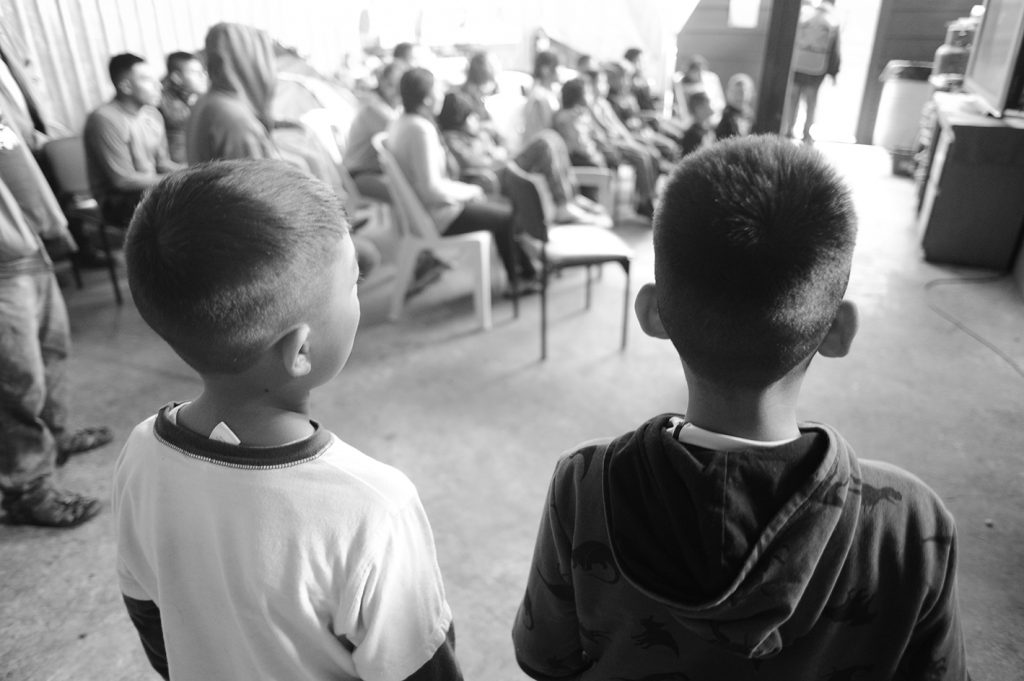
Perhaps the most distressing cases PHR documented concerned young children. In Tijuana, we interviewed Antonio,* an eight-year-old Honduran boy who was attacked by two men with a machete after his parents ran afoul of the local paramilitaries. Before the ordeal, Antonio’s favorite school subject was writing, and he enjoyed playing ball with his friends. Since the attack and his family’s flight to the border he has become sad and cries often. His parents told PHR that he holds his breath when he is afraid and often must hold his mother’s hand to be at ease. Since he arrived in Tijuana, Antonio also defecates in his bed and suffers from nightmares where he yells in his sleep, “Mom, hurry! Hurry! The guy is going to kill us!” Antonio himself reported symptoms of PTSD and anxiety disorder as well as somatization, whereby psychological distress manifests as physical ailments and attention problems.

As most asylum seekers stuck in Tijuana, Antonio did not have access to mental health care. His parents also did not have access to adequate medication or therapy for his attention deficit hyperactivity disorder, which likely exacerbated his condition. When reflecting on what the future held for her son, Antonio’s mother said, “I still don’t see it [ending]…. I want my children to be OK in a safe place … but we have not found that [safety] yet. Our hope is that they will give us asylum, so my kids will be safe on the other side.”

The Impact of the Migrant Protection Protocols (MPP)

Asylum seekers who arrive at U.S. ports of entry – including many bearing serious psychological and physical consequences of the trauma they have suffered – are now met at our border with the Migrant Protection Protocols – a brutal response to their appeal in good faith to await the processing of their asylum claim within the safety of the United States. Since the completion of PHR’s investigations, I have participated in multiple forensic evaluations of MPP returnees through a network of both Mexican and U.S. physicians and attorneys who serve this population. As my colleagues today will speak to other aspects of the implementation of the MPP, I would like to provide a series of short snapshots of some of the cases for which I have provided my medical expertise. I want it to be crystal clear who the people are that are being returned to Mexico under the MPP. 

Gerald is a gay schoolteacher from Ghana, which still has a law that criminalizes adult consensual same-sex conduct. When local community members discovered that he was gay, they tied a noose around his neck and dragged him by it behind a car. His larynx was crushed so badly that he had nearly lost his voice completely. He now speaks in a hoarse, barely audible whisper, in stark contrast to the booming voice he reported using to teach his 4th-graders at school. Gerald still bears ligature marks on his neck. Despite his strong claim for asylum, he has been unable to find legal counsel in Tijuana and struggles to make a viable life there while he waits.

Alec is a Honduran evangelical pastor who organized youth groups and a Christian anti-gang movement that opposed the recruitment of youth. One day, gang members assaulted him multiple times and ultimately shot him in the leg. They told Alec to stop trying to influence young men to join the church instead of the gangs. Gang members then raped his wife, with the ultimatum that this would keep happening unless he left the area. Alec fled after his wife was raped a second time. In addition to his physical scars, Alec was profoundly psychologically wounded, screening positive for depression and PTSD. Although he was initially granted asylum in immigration court, this decision was immediately appealed.

Martin is a young man from Honduras who was beaten for refusing to join a gang. At a young age, he was diagnosed with epilepsy, and had seizures repeatedly until he was finally placed on a combination of medications. He fled to the border but was unable to find the right medicine for his seizures when he was in Tijuana. Martin then suffered several seizures that caused significant head and facial trauma and also made him unable to keep a job there. Although a local charity helped him find medications, these were confiscated by U.S. border officials every time he crossed into the United States to attend his hearings, despite medical letters attesting to the importance of these medications. Each time he was returned to Mexico under MPP, he was sent back across the border without his medications, which posed a risk to his health.

Lydia is a woman from Honduras who is seeking asylum with her toddler, Jaime, and hoping to be reunited with her sister and niece who reside in the United States. She is fleeing domestic abuse, kidnapping, child abuse, and rape at the hands of gang members. Upon reaching Tijuana, she was alerted through her family connections that the gang had sent members to Tijuana to kill her. Lydia and her son remain indoors for fear of being seen. They have had difficulty finding any legal counsel; Jaime does not have access to routine pediatric care, and Lydia has had no access to mental health assistance to address the trauma of the sexual violence she suffered.

Concluding Remarks

These four cases represent a small fraction of the roughly 50,000 asylum seekers have been returned to Mexico under MPP. Another 26,000 wait, due to metering practices that limit the number of people allowed to cross every day, to pursue their legal right to seek safety in the United States for themselves and their family members. This is a total of 76,000 people affected by these two policies alone.

While I continue to return to Tijuana to provide MPP returnees with needed medical and psychological evaluations, I also continue to provide care to traumatized people every day in the emergency room in Los Angeles. Like any ER doctor, the first thing I do is try to make a patient feel safe. I control their environment as much as possible so that we can comfortably discuss and address their needs and fears. For the thousands who wait in Tijuana, however, this standard of safety is not being met; nor is access to basic medical and mental health needs. These needs include things like prenatal, obstetric, and routine pediatric care, such as vaccines and nutritional screening, but also expands to mental health services which are so desperately needed by this population.

This is especially true as our evaluations of the mental health of asylum seekers show that U.S. policies have stranded thousands of women, men, and children in places like Tijuana and made them vulnerable to violence, theft, and extortion by cartels, gangs, and police authorities. Clearly, current U.S. policies that restrict asylum seekers’ right to enter the United States is inflicting further trauma on them every day they must wait. The stress and constant vigilance required to survive in an under-resourced border town like Tijuana is a massive strain on already traumatized people. It harms their livelihood and wellbeing and is literally a threat to their lives.

Recommendations

All asylum seekers we interviewed sought protection due to targeted violence and intimidation from gangs and other non-state actors as well as violence by and/or denied protection by state authorities. While they represent a small sample of the thousands of asylum seekers currently waiting their turn to seek protection in the United States, their cases indicate that they have strong grounds to seek asylum and that their claims should be heard in a prompt and fair manner.

While the Obama administration implemented troubling policies regarding detention and deportation, since 2016, the Trump administration has undermined the integrity of the U.S. asylum system, introducing a series of restrictive policies that defy both international and U.S. law and egregiously obstruct the right to seek asylum. These policies – including the Migrant Protection Protocols – have placed people who are already in vulnerable situations – asylum seekers fleeing violence and trauma in their home countries – at further risk. Physicians for Human Rights’ findings point to the urgent need to protect the right of individuals to seek asylum in accordance with federal and international laws by implementing the following recommendations.

Congress should:

  • Direct the Department of Homeland Security to immediately abolish and defund the MPP and “metering,” as has already been proposed in Representative Veronica Escobar’s Asylum Seeker Protection Act (H.R. 2662).
  • Defund any policies that may negatively impact the right to seek asylum, such as pilot programs intended to authorize law enforcement officials other than trained U.S. Citizenship and Immigration Services (USCIS) asylum officers to conduct initial screenings known as “credible fear interviews” (CFIs).
  • Propose and pass new legislation to affirm the full range of rights guaranteed to asylum seekers to counteract any executive or departmental policies or directives that effectively restrict individuals’ access to asylum protection.
  • Provide adequate funding to ensure USCIS has sufficient resources to appropriately conduct CFIs.
  • Publicly support the work of individuals and organizations defending the rights of asylum seekers on the U.S. and Mexican sides of the border and monitor any threats to their ability to carry out this work.
  • Pursue policies that seek to create a safe, stable environment for asylum seekers to fulfill their right to pursue their asylum claims within the protection of the United States, and that meaningfully guard against the re-traumatization of this vulnerable population.

Statements

Physicians for Human Rights Public Comment on the Federal Regulations for Profiling Immigration Detainees via DNA Sampling

In this Public Comment, Physicians for Human Rights (PHR) argues that the U.S. Department of Justice proposed rule change for collecting genetic material from immigrants in federal detention is a dangerous misapplication of biotechnology that breaches fundamental civil and human rights. Read the full public comment here.

Open Letter

Open Letter on Plans to Move Rohingya Refugees to Bhasan Char Island

In this letter to Prime Minister Sheikh Hasina, Physicians for Human Rights (PHR) joins more than 30 international NGOs, and partner organizations to welcome the recent announcement by the Bangladesh Minister of Disaster Management and Relief Enamur Rahman to put on hold plans to relocate Rohingya refugees to Bhasan Char island and that any relocations would be voluntary. The letter also urges the Bangladeshi government to meaningfully consult Rohingya refugees on all potential solutions and plans affecting their situation and ensure relocations proceed only with their free, prior, and informed consent. Read the letter here.

Statements

PHR Briefing to U.S. Congress’s Lantos Human Rights Commission Hearing on Protecting Health Care During Armed Conflict

Written statement submitted by Susannah Sirkin, PHR director of policy, to the U.S. House of Representatives’ Tom Lantos Human Rights Commission Hearing on “Protecting Health Care During Armed Conflict.”


Thank you, Chairs McGovern and Smith, for holding this hearing at a most critical time, and for inviting me to testify before the Lantos Commission on behalf of Physicians for Human Rights.

We are an international non-governmental organization that brings the expertise of scientists and medical professionals to the defense of human rights. Physicians for Human Rights (PHR), which shared in the Nobel Peace Prize for our work to end the scourge of landmines, uses its investigations and expertise to advocate for persecuted health workers and facilities under attack, prevent torture, document mass atrocities, and hold those who violate human rights accountable.

For more than 30 years, we have investigated and reported on violations of the laws protecting health facilities and defended the duty of health workers to care for the sick and wounded without discrimination in situations of armed conflict. As the ICRC representative has indicated, attacks on health facilities and personnel are not a new phenomenon. But, given the amount of reporting and scrutiny available to governments, the UN, NGOs, and the public at large, and in the face of a unanimous UN General Assembly resolution[1] and Security Council Resolution 2286,[2] it is inexcusable that the laws protecting health continue to be blatantly flouted in the starkest ways. In many of today’s conflicts, hospitals are places of fear and danger, instead of hope and recovery.

When hospitals or health clinics are destroyed, the loss is far greater than the bricks and mortar of the buildings. Safe and protected spaces for people to obtain routine and urgent medical attention are also lost. When medical workers are killed, the human toll is not just their lives, but also the exponential number of people who will suffer without treatment by those missing medical professionals and the many lives that will be lost as a result.

During PHR’s decades of monitoring attacks on health in many of the world’s most devastating crises, the scale and scope of attacks on health care facilities and health workers today represent the greatest deterioration of international humanitarian standards we have ever witnessed. We see this in the increasingly complex conflict in Yemen, where indiscriminate warfare and blatant disregard of distinction and proportionality have resulted in the widespread destruction of health and humanitarian capabilities. Respect for international human rights norms has been shredded in Syria, where a deliberate campaign of military strikes targeting health workers and infrastructure has obliterated civilian centers and compelled the capitulation of opposition populations. Across the world, the breadth and severity of attacks on health care is an urgent crisis.

The widespread and systematic assault on health care during the almost nine year-long Syrian conflict represent a glaring new low on the list of violation. And although the horrors of Syria’s war may indeed receive more public attention than other conflicts, the failure to impose any accountability or to curb these barbaric acts sends a message to the world that the treaties protecting health in conflict can be blatantly trampled by warring parties.

So, my testimony will focus on the most egregious situation in Syria and what must be done to address it as the devastating conflict there moves to its apparent final phase.  I will also highlight the widespread destruction of health facilities in Yemen where medical care has been bombed and shelled virtually out of existence.

Syrian Health Care Under Siege

For more than eight years, Syrian government armed forces and their allies, including Russia, have targeted health facilities as a strategy of war to punish civilians residing in opposition-held territories, destroy their ability to survive, and draw them into government-held areas or drive them out of the country. The Syrian government has also methodically targeted health workers merely for fulfilling their ethical obligation to provide health care to the sick and wounded in their communities. PHR and other human rights organizations have documented the detention, torture, and killing of many hundreds of health workers.

We have rigorously researched and documented attacks on Syria’s health care system by all parties to the conflict from the very beginning of the fighting. From March 2011 through August 2019, PHR has corroborated[3] 583 attacks on at least 350 separate health facilities in Syria as well as the killing of 912 medical personnel. More than 90 percent of these attacks are attributed to either Syrian forces specifically, or to Syrian and Russian forces. Soon-to-be-published PHR research points to the Syrian government’s effective criminalization of the delivery of health care through its systematic detention, torture, and killing of health workers.

Since the Syrian government’s escalation on Idlib began in late April 2019, PHR has received reports of more than 57 attacks on health facilities. Among the many we have confirmed, three were carried out on a single day – May 5. On that day, Russian or Syrian government airstrikes damaged and put out of service a surgical unit in Hama; warplanes attacked a nearby women and children’s hospital in Hama, damaging equipment and infrastructure; and Russian or Syrian government forces hit the Kafr Nabl Surgical Hospital in Idlib, damaging the foundation and putting it out of service. The New York Times’ visual investigations team recently published a damning exposé on Russian culpability for these heinous war crimes, using a trove of Russian Air Force radio recordings and flight spotter logs.

Such sequenced attacks by the Syrian government and its Russian allies against health facilities in the same geographical locations are an indicator of the targeting not only of those individual facilities, but of local health networks and referral systems, whereby several hospitals have often been attacked within a short time frame. This strategy effectively deprives the local civilian population of life-saving medical care.

It was in this egregious context that agreements coordinated by the UN to notify all Russian, Turkish, and international coalition forces of the locations of health facilities – intended as a strategy to protect them – have been violated again and again. The Syrian and Russian governments have known exactly where most health facilities are located, and yet, they have continued to target them. The courageous remaining doctors in Syria provide life-saving care while being bombed.

The Syrian and Russian governments have known exactly where most health facilities are located, and yet, they have continued to target them. The courageous remaining doctors in Syria provide life-saving care while being bombed.

– Susannah Sirkin, Physicians for Human Rights

The magnitude, frequency, and distribution of attacks on health care in Syria over the past eight years reveal a widespread and systematic pattern of violations, rising to the level of war crimes and, in PHR’s assessment, crimes against humanity. For years, PHR and so many others have called on the international community to put a stop to these crimes and ensure that any resolution to the conflict in Syria carries justice and accountability at its center.

Yemen and U.S. Leverage

Since the escalation of the conflict in 2015, warring parties in Yemen have perpetrated serious violations of international humanitarian law, including through attacks on medical infrastructure and health workers. Parties to the conflict have damaged and destroyed hospitals through air- and land-based attacks and have actively prevented health workers from carrying out their duties impartially. By repeatedly attacking medical facilities and workers, the Saudi-Emirati-led coalition, their Houthi opponents, and the internationally-recognized Yemeni government – among others – have demonstrated their inability or unwillingness to comply with the most basic international rules and norms protecting civilians and civilian infrastructure from attack. These violations have effectively denied Yemenis access to medical services at the time they need them most.

Despite deadly and destructive attacks on health facilities and personnel on all sides, the United States continues to have the most influence and leverage over the Saudi-Emirati-led coalition – as these militaries are the most reliant on U.S.-produced arms, particularly in terms of their capability to continue airstrikes. Additionally, the UN-supported Civilian Impact Monitoring Project (CIMP) has most recently reported that “airstrikes were again the deadliest type of armed violence in Q3 [of] 2019, and have resulted in the highest number of civilian fatalities in each quarter since CIMP began monitoring.” To that end, we have welcomed bi-partisan efforts to end U.S. involvement in the conflict and to restrict U.S. arms support for the Coalition in Yemen. Specific, targeted, time-bound holds on U.S. munitions are a key form of leverage that the United States has to curtail attacks on health care and civilian infrastructure, stress the need for accountability, and urge support for a UN-led solution to the conflict.

Recommendations to Protect Health in Conflict

As a member of the Safeguarding Health in Conflict Coalition, PHR fully supports the recommendations of our coalition partners, including support by the US for continued global documentation of violations and assuring that the provision of medical care is not criminalized through counter-terrorism measures.  As we support myriad measures to educate militaries and warring factions on the need to protect health in conflicts, and to enable front line health workers to better protect their vital humanitarian mission, we are also convinced that a legacy of absolute flouting of humanitarian norms with utter impunity provides license to continued and repeated erosion in the future.  Therefore, we offer specific additional recommendations as they relate to Syria and Yemen.

Syria

In August, UN Secretary-General António Guterres initiated a Board of Inquiry, supported by the United States, among other Security Council members, to investigate the recent attacks on health facilities on UN-supported or “deconflicted” humanitarian facilities in the northwest of Syria. We urge the United States to demand that, in this UN process, the actors responsible for attacks on health facilities be identified, and the Board’s findings made public. Failure to do so will be a shameful betrayal of the patients, health care workers, and staff of humanitarian organizations who have died or suffered in the wake of these attacks.

However, the focus on this current limited inquiry should not distract from the overall imperative to hold perpetrators of the years of war crimes and crimes against humanity accountable.  Given the failure of the UN Security Council to refer the case of Syria to the International Criminal Court as a result of China and Russia’s vetoes, national courts must step up efforts to prosecute the crimes, and UN member states, including the United States, must re-invest in the International Impartial and Independent Mechanism (IIIM) for Syria.

Under the UN Resolution and the Terms of Reference that established this body, the IIIM head was meant to act as a prosecutor who builds cases for presentation in courts which meet international standards, although there is not yet a specific court to litigate this case.  The U.S. government negotiated with prior international courts – specifically, the International Criminal Court for the former Yugoslavia (ICTY), the International Criminal Tribunal for Rwanda, and the Special Court for Sierra Leone – to establish Rule 70(B) of their Rules of Procedure, under which the U.S. government could share non-public (but not top secret) information with the prosecutors under the ironclad guarantee that such information could not be disclosed without U.S. government consent. This was highly useful at the ICTY in its investigations of military operations by state actors in the former Yugoslavia. The same kind of sharing should be negotiated with the IIIM head, which would additionally open the possibility that she might share it – with U.S. government consent – with national prosecutors in proceedings in which the U.S. government has confidence.  It should be noted that the IIIM head, Catherine Marchi-Uhel, is a former French investigative judge, who was also ombudsman for the UN terrorism sanctions regime under the UN Security Council (with U.S. government support). The ICTY rule is set out in the appendix below (and is almost identical to the ICTR and SCSL rules).

In ongoing efforts to support critical documentation to support accountability measures, the FY20 Foreign Ops Appropriation should include language to specifically authorize funding of NGO investigations into the targeting of medical facilities and personnel for the purpose of justice and accountability efforts. This would be added to language in FY19 appropriations that provided $5 million for such grants for Syria and Iraq documentation to be made by the State Department’s Office of Global Criminal Justice, for administration by State’s regional Bureau for Near East Asia Affairs.

Yemen

Congress should support amendments currently under consideration for the FY20 National Defense Authorization Act (NDAA) that seek to leverage U.S. arms transfers to Saudi Arabia so as to limit capacity for the types of destructive strikes we have seen against civilians and health facilities in Yemen. In particular, the amendment by Congressman Tom Malinowski (Section 1099X of the House-passed NDAA) includes a one-year ban on Category IV air-to-ground bombs and missiles, which will effectively limit the ability of the Saudi-led coalition to strike hospitals and health workers, and send a clear message to the Saudi government that it must get serious about addressing attacks on civilians and civilian infrastructure, including medical care. Additionally, these key arms sales are a key piece of leverage that the US can use to pressure its partners to follow and support a UN-led mediation for a ceasefire, and ultimately an end to the conflict.

We want to urge support for this amendment at this moment, in particular, as the final provisions of the NDAA are currently being considered and negotiated. We urge representatives to press leadership to support the Malinowski amendment’s inclusion in the final bill.

Additional Recommendations

Beyond the specifics of the conflicts outlined in this statement, we recommend that Congress and the U.S. government work to formalize more structured and rigorous guidelines and procedures for accountability measures in cases of attacks on civilians and civilian infrastructure or other violations of international humanitarian law – in particular, attacks on health care facilities and health workers in conflict.

This should include enhanced scrutiny by the Departments of Defense and State of end-use monitoring for American-made munitions and other military supplies, as well as for humanitarian violations in military operations by coalitions that the US supports.

Incidents of attacks on health care should formally be included in the Department of State’s annual Human Rights Country Reports – to better mainstream the need for regular reporting on attacks on health workers and facilities as a critical human rights issue.

Appendix

ICTY Rule 70(B)

If the Prosecutor is in possession of information which has been provided to the Prosecutor on a confidential basis and which has been used solely for the purpose of generating new evidence, that initial information and its origin shall not be disclosed by the Prosecutor without the consent of the person or entity providing the initial information and shall in any event not be given in evidence without prior disclosure to the accused.

(International Criminal Tribunal for the former Yugoslavia, Rules of Procedure and Evidence, U.N. Doc. IT/32/Rev.50 (2015), entered into force 14 March 1994, amendments adopted 8 July 2015.)


[1] United Nations General Assembly, Resolution 70/104 (2015), “Safety and security of humanitarian personnel and protection of United Nations personnel,” available at: https://undocs.org/en/A/RES/70/104.

[2] United Nations Security Council, Resolution 2286 (2016), “On Protection of the Wounded and Sick, Medical Personnel and Humanitarian Personnel in Armed Conflict,” available at: https://www.un.org/press/en/2016/sc12347.doc.htm.

[3] Physicians for Human Rights, “Findings of Attacks on Health Care in Syria,” September 2019, available at: http://syriamap.phr.org/#/en/findings.

Blog

His Scars Told Us His Story

Asylum Seekers Bear Their Evidence to the U.S. Border

Manuel* was 15 when the local gang in El Salvador tried to enlist his older brother, Daniel. Daniel, trying to protect Manuel and his other brothers from being recruited, refused to join; gang members took him away, and, the next day, his strangled body was found in a ditch. Manuel had witnessed the abduction and knew his life was now in danger. He fled his home and embarked on a new life: one of fear, hypervigilance, and transience.

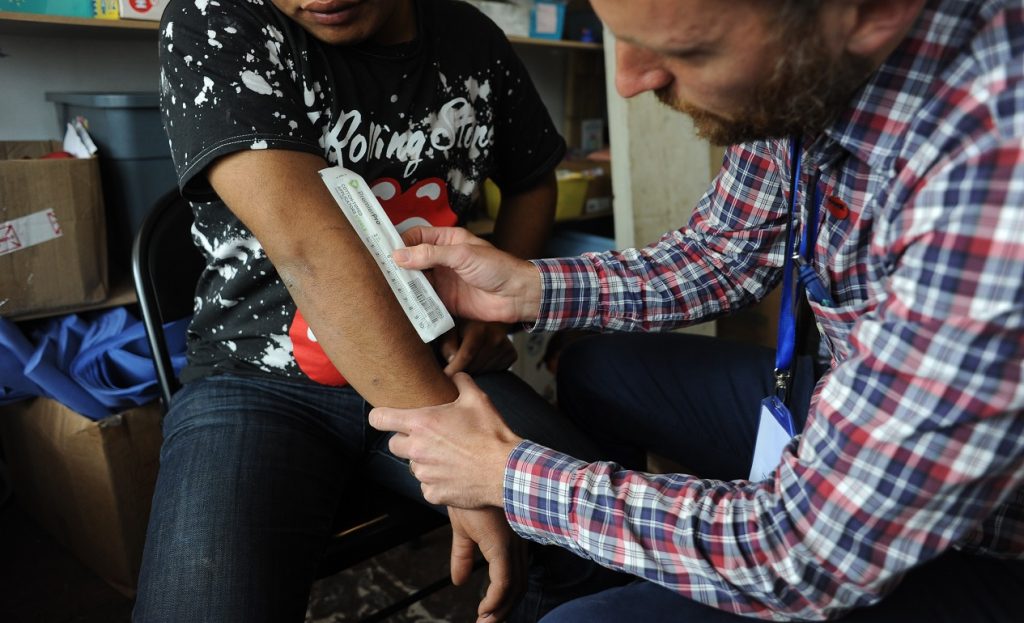
We met Manuel in Tijuana, where Physicians for Human Rights was conducting a field investigation to document the violence faced by asylum seekers and the extent to which the physical and psychological impacts of that violence corroborate their accounts of persecution. At migrant shelters and other safe havens, we met dozens of people, like Manuel, who told harrowing stories of the extreme brutality they had experienced in their home countries – and whose physical and psychological scars bore out their narratives.

The medical evidence collected by our doctors clearly refutes the sensationalized rhetoric of the Trump administration, which claims that the 60,000 migrants who wait along the U.S.-Mexico border are simply economic migrants trying to game the asylum system.

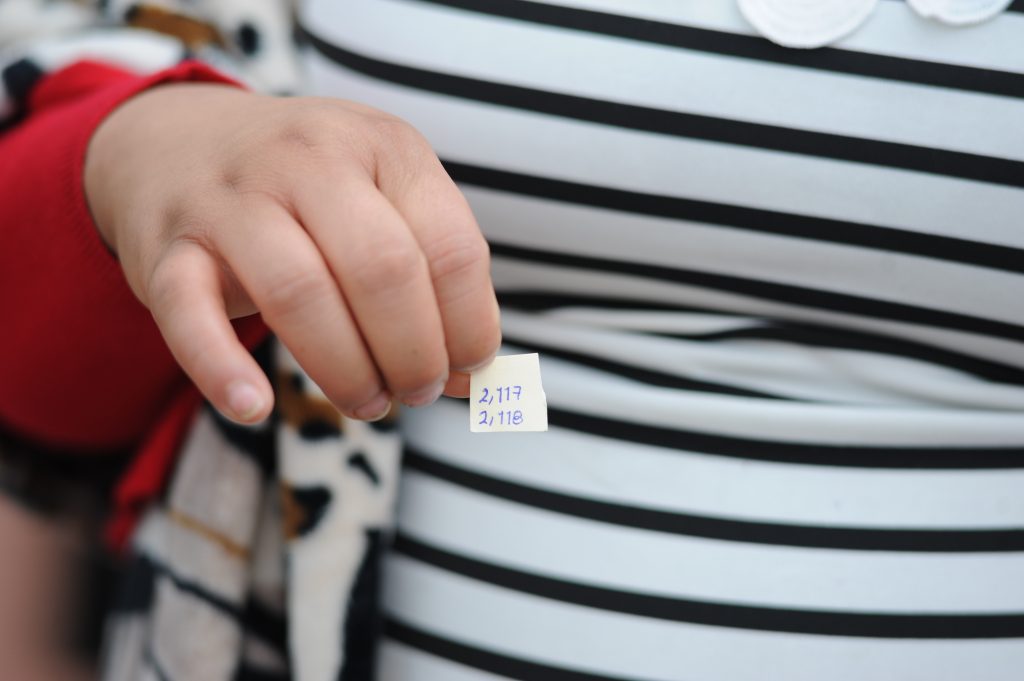
When Manuel left home, he first tried to flee to neighboring cities in El Salvador, but his whereabouts were continually discovered. After two years of being on the run, and travelling thousands of miles on foot, he finally reached the U.S.-Mexico border with the hope of seeking asylum in the United States. But instead of finding refuge, Manuel came face to face with the U.S. administration’s cruel and illegal metering system. Upon arriving at the border crossing, Manuel was handed a slip of paper with a number scrawled on it and told that he would have to wait weeks, and possibly months, for his turn to present his case to U.S. authorities.

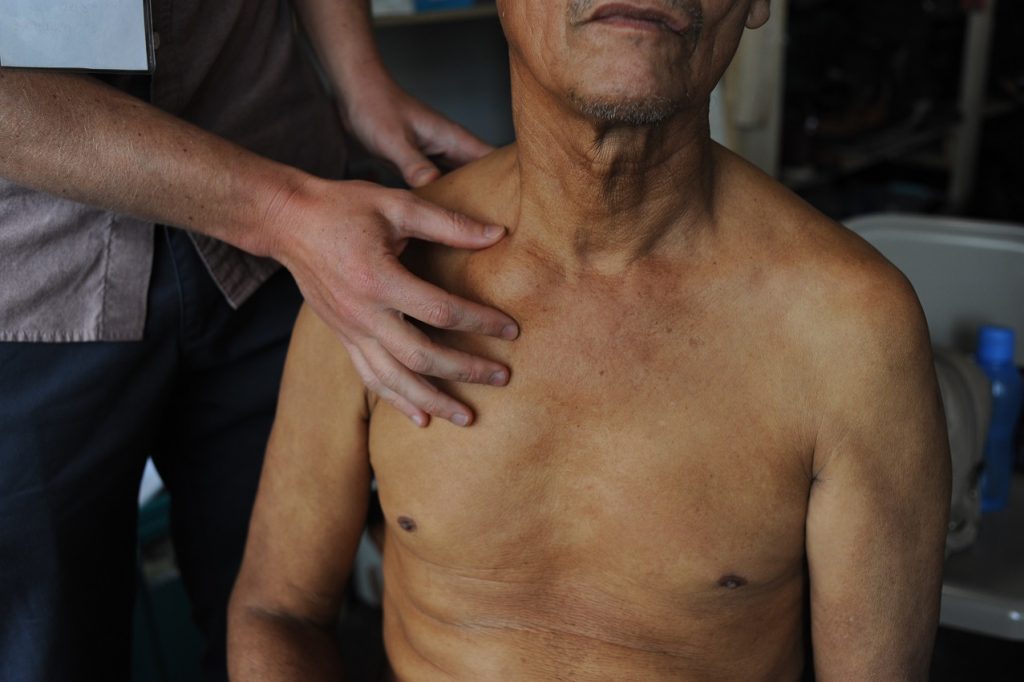
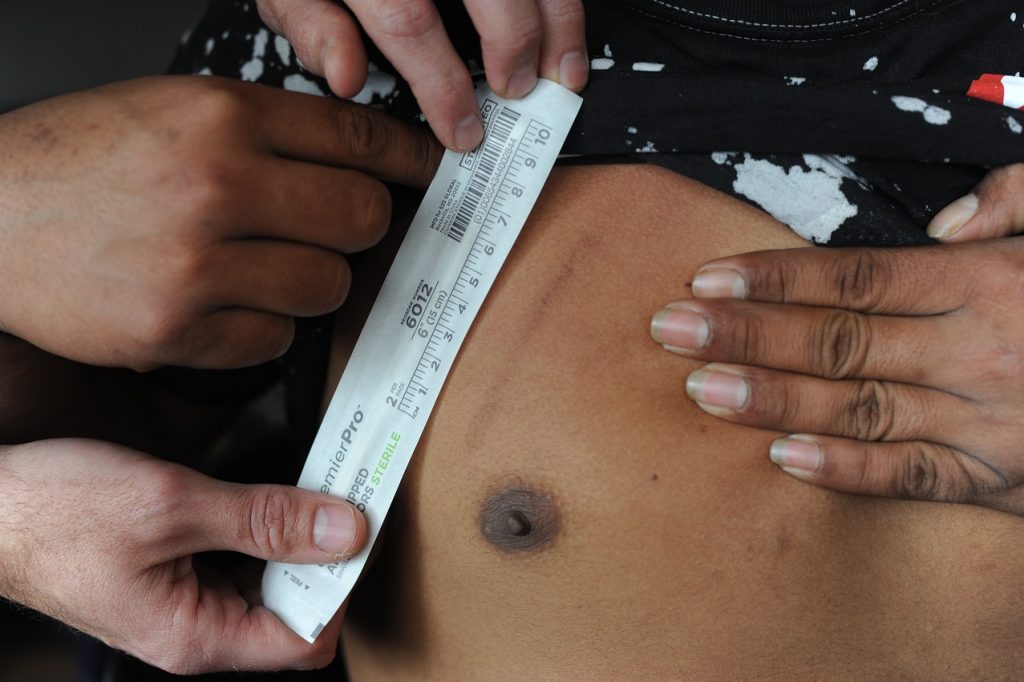
As Manuel waited, terrified, staying in make-shift camps, gang members found him and almost beat him to death. He managed to escape, but he still carries the psychological and physical scars of the brutal assault. One of those scars, documented during PHR’s clinical evaluation, is a hyperpigmented, linear scar across Manuel’s chest, highly consistent with his story of being hit with a metal rebar pipe. The scar runs next to a tattoo of Daniel’s name, a tribute Manuel had etched into his skin to honor his dead brother. The tattoo was how the gang members who attacked Manuel confirmed his identity – and tried to kill him.

PHR’s report of Manuel’s case, and many others like his, provides a critical insight into the influx of migrants at the U.S.-Mexico border. We documented dozens of stories of people fleeing violence in El Salvador, Guatemala, Honduras, Mexico, and Nicaragua at the hands of both gangs and corrupt government authorities. By applying medical expertise and psychological screens, we concluded that a majority of these asylum seekers had findings highly consistent with their narratives of having survived physical and sexual violence, extortion, death threats, and other extreme violence. We also found that most suffered from a combination of depression and post-traumatic stress syndrome.

What we did not find was evidence corroborating the U.S. administration’s claims about asylum seekers, a false narrative being used to prevent Manuel and people like him from seeking safe haven in the United States. We encourage the administration to reconsider. Sadly, Manuel’s case is not extraordinary – it is emblematic of the threats faced by so many in these countries. Rather than politicizing and misrepresenting asylum seekers, the Trump administration should respect their legal right to seek international protection and ensure the process is fair, humane, and swift. Their lives, as we show in our report, depend on it.

*Names changed for security reasons.

Blog

Bangladesh’s Troubling Rohingya Relocation Plan

This post originally appeared in the Asia Times

In its Cox’s Bazar refugee camps, Bangladesh has generously provided a modicum of safety and dignity to the Rohingya refugee survivors of the Myanmar military campaign of widespread and systematic violence in late 2017.

But the durability of that safety and dignity is now in doubt.

Last week, the Bangladeshi government announced that in November it will begin to relocate up to 100,000 of those more than 740,000 Rohingya refugees to Bhasan Char, a remote island in the Bay of Bengal. The Bangladeshi government’s motive for the planned relocation is to relieve desperate overcrowding in the Cox’s Bazar camps.

But the choice of Bhasan Char has raised serious concerns about the health and safety of Rohingya who relocate there.

Bhasan Char is prone to serious flooding and cyclones. Yanghee Lee, the United Nations Special Rapporteur on the situation of human rights in Myanmar, visited the island in January 2019 and returned expressing doubt about “whether the island is truly habitable.”

Lee warned the Bangladeshi government in March that a poorly-planned relocation to Bhasan Char, and without the consent of the refugees themselves, would “create a new crisis” for the Rohingya in Bangladesh.

The Bangladeshi government has insisted that all relocations to Bhasan Char will be strictly voluntary and that it has a list of 7,000 Rohingya refugees who have already agreed to move to the island. But it’s unclear whether those Rohingya are cognizant of the degree to which moving to Bhasan Char will worsen the already desperate isolation that refugee life has imposed on them.

Bhasan Char is hours by boat from the Bangladeshi mainland and sea conditions will effectively strand its residents for extended periods during the annual monsoon period. There are also questions about what access Rohingya refugees who relocate to Bhasan Char will have to health care and education.

Although the Bangladeshi government has upgraded infrastructure on the island to counter flood risks and built 1,440 buildings to house relocated Rohingya refugees, the island supports neither adequate agriculture nor commercial activity to sustain them.

The looming relocation to Bhasan Char is only the latest in a series of restrictive measures the Bangladeshi government has imposed on its Rohingya refugee population over the past two months. Those restrictions have been an official response to the August 25 mass protests by Rohingya refugees in the Cox’s Bazar camps, demanding accountability for the bloodshed of 2017.

The restrictions have included government directives to telecom service providers to cut services in the camps as well as efforts by Bangladeshi security forces to destroy SIM cards and confiscate the mobile phones of Rohingya refugees in the camps.

United Nations human rights experts have warned that “these restrictions have been applied in a discriminatory manner against members of the Rohingya minority, who are refugees in Bangladesh, but also that curfews and communications shutdowns could facilitate further serious human rights abuses against them.”

The Bangladeshi government has also announced plans to further physically isolate the Rohingya refugees in the Cox’s Bazar camps by enforcing an existing dusk-to-dawn curfew in the camps by ringing them with barbed-wire fencing and guard towers.

The Bangladeshi government has justified those measures as a response to criminal activity in the camps. But the increased Bangladeshi security presence in the camps have posed its own risks to the safety of the refugees who live there.

Earlier this month, Bangladeshi soldiers patrolling one of the camps allegedly forced their way into the home of a Rohingya refugee family and raped a 12-year-old Rohingya girl.

Bangladesh can and should do better by its Rohingya refugee population. But the plight of the Rohingya refugees in Bangladesh – which continues to shoulder significant subsistence and protection costs for their care – won’t significantly improve until Myanmar’s government guarantees a safe, dignified and voluntary repatriation of those refugees back to Myanmar.

However, the Myanmar government has adopted a strategy of craven denial of accountability for the crimes of 2017 and is refusing to guarantee citizenship for those Rohingya refugees, which makes repatriation unlikely anytime soon.

For the past two years, Myanmar’s government has denied its exhaustively documented culpability for those atrocities and stonewalled the international community. It has forbidden international organizations and observers, including UN Special Rapporteur Lee, from accessing Myanmar’s Rakhine state, where most of the Rohingya lived prior to bloodshed of late 2017.

The feasibility of repatriation is even more unlikely, given the dire risks that await the Rohingya back in Rakhine state. Earlier this week, the head of the United Nations Fact Finding Mission on Myanmar, Marzuki Darusman, warned of a “strong inference of continued genocidal intent on the part of the state in relation to the Rohingya and there is a serious risk of genocide recurring.”

What’s needed is international resolve to increase the pain point for Myanmar’s unwillingness to provide the accountability necessary to allow safe, dignified and voluntary Rohingya repatriation.

UN member states can contribute to that effort by filing a complaint against Myanmar to the International Court of Justice (ICJ) for Myanmar’s violation of the 1948 Convention on the Prevention and Punishment of the Crime of Genocide.

By doing so, UN member states can both spur the ICJ to investigate allegations of genocide and pursue reparations for Myanmar’s atrocities against the Rohingya as well as inspire other foreign governments to file their own ICJ complaints against Myanmar.

Foreign governments can and should also impose or tighten individual sanctions, including travel bans and asset freezes, against Myanmar government and military officials – and their family members – implicated in the 2017 violence.

Until individual states demonstrate the necessary political will to take such measures, accountability for the Rohingya will remain illusory and their safety and dignity in Bangladesh will continue to erode.

Blog

We Must Help Asylum Seekers. Here’s a Key Way to Do That.

For those fleeing torture and other forms of persecution, a doctor’s evaluation can make all the difference. Medical students can play a key role in offering this life-changing service.

When I was a second-year family medicine resident at Georgetown University an encounter with a young man from Rwanda changed my professional life forever.

The man had faced a horrific journey. In escaping the Rwandan genocide, he had walked across several African countries, been recruited as a child soldier, stowed away aboard a ship to Latin America, found his way to Mexico, and finally made it across the U.S.-Mexico border to safety and the prospects of a new life.

I had volunteered, under the supervision of a faculty advisor, to perform a forensic medical evaluation, usually an hours-long encounter to assess an asylum seeker’s claims of torture, ill treatment, or other form of persecution. Much of the process was oral – a history – as we slowly guided him to reveal his story in excruciating detail. There was a physical component too as we assessed and documented the scars he bore. Some of his scars, we noted, were psychological.

Although this encounter happened nearly 15 years ago, I still think about this man. I was aware that our assessment and report could help change his life. What I didn’t know was that it would change mine as well. 

There, in that exam room, my two worlds merged: once a journalist covering war and conflict, now a physician in training, I realized that some of the people I had covered as a journalist, I could now help in much more direct ways.

Eventually, I moved from student to teacher, and I have now trained hundreds of medical professionals on four continents in this practice through Physicians for Human Rights (PHR), one of the main organizations that works on asylum issues, and on my own. I always highlight its potential impact. Research shows that a medical evaluation more than doubles the odds of a person being granted asylum.

In the process, I have come to believe in the tremendous value for medical students and residents of involvement in these evaluations.

Certainly, the need for this service is great. In 2018, the United States received 254,300 new applications from asylum seekers, and tens of thousands of others have been waiting years to have their asylum requests reviewed. The current migrant crisis at the U.S.-Mexico border has highlighted the enormous medical and legal needs of asylum seekers. It has also inspired involvement from health professionals who may have been unaware of these issues previously.   

Research shows that a medical evaluation more than doubles the odds of a person being granted asylum.

Although more needs to be done, the medical community is stepping up. PHR now has grown its asylum network to more than 1,500 health professionals. In addition, we have seen a significant growth in the number of pro bono asylum programs established at medical schools in recent years. The number of student-led programs that PHR has helped establish has grown from six to nearly 20. At Georgetown University School of Medicine’s student-run asylum program, for example, we have trained hundreds of clinicians, residents, and medical students in the past five years.

Why involve residents and medical students? Beyond expanding the much-needed future pool of asylum evaluators, these assessments offer incredible educational opportunities.

As my co-authors and I argued in a recent article, participation is an experiential way to learn about human rights principles and the links between human rights violations and health. Participants get the opportunity to hone their physical examination skills, particularly the skin exam, and to engage in cross-cultural communication. They also participate in interprofessional education with behavioral health and legal professionals and develop leadership, patient advocacy, and operations management skills.

Students play many key roles in our program, including scheduling sessions and helping write affidavits. They also organize our trainings for health professionals – daylong events that focus on how to use clinical and medical expertise to assess claims of torture and ill treatment and document findings in a systematic way. In addition, in my department, our family medicine residents are required to complete at least one supervised asylum evaluation during their training. Many find the experience so meaningful that they ask to do more.

Why involve residents and medical students? Beyond expanding the much-needed future pool of asylum evaluators, these assessments offer incredible educational opportunities.

Our trainees are not alone in finding this service meaningful. In a 2015 survey we found that clinicians’ experiences performing these evaluations were overwhelmingly positive. As one participant wrote, “I am humbled and grateful to people who put themselves in my hands. I am privileged to meet these brave people who are trying to find a better life against great odds. I cannot imagine doing what they do.”

Of course, hearing stories of terrible trauma can be difficult. But more than anything, students and residents benefit from these experiences because asylum seekers’ stories are about the strength of the human spirit. I’ve seen it time and again.

I remember that from my own first encounter with that young man years ago. Retelling what happened was painful for him. Hearing what happened was tough for us. But it was also uplifting. His courage, his resilience, his hopefulness despite the great trauma he had suffered were incredibly inspiring. And the moment we learned that his application was granted was profoundly satisfying. Now in his mid-30s, I hope he is doing well out there and enjoying life in America.

This article was reprinted with permission from the Association of American Medical Colleges (AAMC).

Report

“If I went back, I would not survive.” Asylum Seekers Fleeing Violence in Mexico and Central America

Executive Summary

A cornerstone of President Donald Trump’s campaign in 2016 was to portray immigrants, refugees, and asylum seekers as a danger to the United States. Since taking office in January 2017, President Trump has continued such inflammatory rhetoric, deriding the U.S. asylum system as a “big fat con job” and accusing asylum seekers of exaggerating the violence they are fleeing.[1]

President Trump’s administration has matched that rhetoric with a hardline immigration policy agenda that targets people seeking asylum in the United States and obstructs the internationally and domestically recognized right of all people to seek asylum protection. 

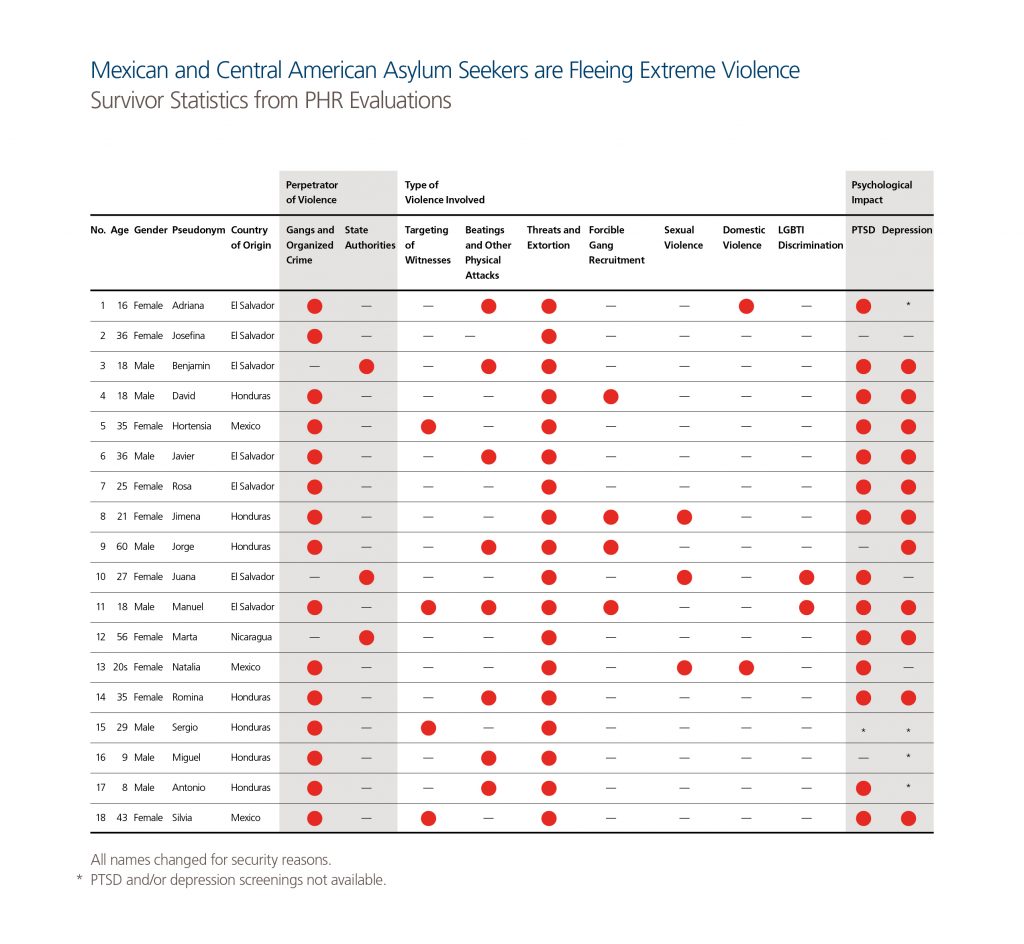
In the face of an array of restrictions, as of August 2019, an estimated 60,000 asylum seekers[2] were waiting along the southern border for the opportunity to exercise their right to seek asylum. Roughly one third of them were in Tijuana, Mexico. Drawing upon its experience providing forensic evaluations for thousands of asylum seekers in the United States over the past 30 years, PHR documented the cases of 18 asylum seekers waiting in Tijuana to assess the degree to which physical and psychological findings corroborate their allegations of abuse and persecution. This report is a compilation and analysis of those evaluations.  


Explore the Stories of Asylum Seekers Fleeing Violence in Mexico and Central America


This report examines the cases of 18 asylum seekers (15 adults, three minors) from Mexico and Central America: El Salvador (seven), Honduras (seven), Mexico (three), and Nicaragua (one). While not meant to be a representative sample, these cases provide a snapshot of these asylum seekers’ lives and histories, why they undertook treacherous journeys to seek protection in the United States, and the physical and psychological impact that their experiences have had on them. All of the evaluated asylum seekers provided credible accounts and corroborating evidence that they fled persecution resulting in significant trauma. Several of these asylum seekers endured multiple forms of persecution and trauma, reflecting the compounding violence in several countries that drives so many from this region to seek asylum.

Out of the 18 asylum seekers PHR medical experts interviewed and clinically evaluated, three faced violence perpetrated by state actors, such as police and security forces. The remaining 15 were targeted by non-state actors, such as gangs who pursue specific groups of people. For example, every young male whom PHR interviewed in Tijuana reported experiencing pressure to join a gang. These gangs routinely forcibly recruit youth to carry drugs or collect “protection money” in neighborhoods where they have a stronghold. Those who do not comply face violence in the form of beatings, kidnappings, and killings. Women risk sexual violence if their partner does not comply with a gang, or they do not agree to become a “girlfriend” to one of its members. Lesbian, gay, bisexual, transgender, and intersex individuals also face threats, arbitrary arrests, killings, and other violence by state and non-state actors.[3]  Because governments in the countries of origin lack the will or ability to protect people from these abuses, a bid for asylum often becomes the sole means for people to escape the possibility of deadly violence.

PHR further found that U.S. policies have stranded asylum seekers in Tijuana, where they are vulnerable to violence, theft, and extortion by cartels, gangs, and police authorities. Current U.S. asylum policies that restrict asylum seekers’ right to enter the United States inflict further trauma on them every day they must wait. Many of those interviewed by PHR reported feeling under imminent threat both during their journey to the U.S.-Mexico border and while they waited in Tijuana. Twelve out of the 15 adults interviewed screened positive for post-traumatic stress disorder (PTSD), and many who screened positive for depression also experienced fear and hypervigilance. Two out of the three children interviewed reported symptoms of PTSD, and one boy also showed signs of anxiety disorder and somatization, whereby psychological distress manifests as physical ailments and attention problems.

Current U.S. asylum policies that restrict asylum seekers’ right to enter the United States inflict further trauma on them every day they must wait.

PHR’s findings provide a compelling argument for the U.S. government to allow asylum seekers to apply for asylum in a prompt and fair manner and demonstrate how restrictive policies are likely to compound the stressors suffered by this already traumatized group of people. PHR asserts that the U.S. government should immediately stop impeding the internationally recognized right to seek asylum. Specifically, the US government should: 1) abolish the “metering” system which limits the number of people allowed to enter the United States each day to make their case for asylum; 2) ensure that the asylum application process is safe, predictable, and transparent; 3) end all practices, such as the Migrant Protection Protocols (which require applicants to return to Mexico to await their court date), intended to bar or deter asylum seekers from seeking protection in the United States; 4) cooperate with regional and international monitoring mechanisms from the Inter-American Commission on Human Rights and the United Nations; and 5) guarantee that human rights defenders, medical personnel, and legal and humanitarian organizations serving asylum seekers do not face arbitrary restrictions for their work.

“This is a health and human rights crisis that is being treated as a border security crisis.”

Ben McVane, MD, PHR Asylum Network member and assistant professor,
Icahn School of Medicine at Mount Sinai
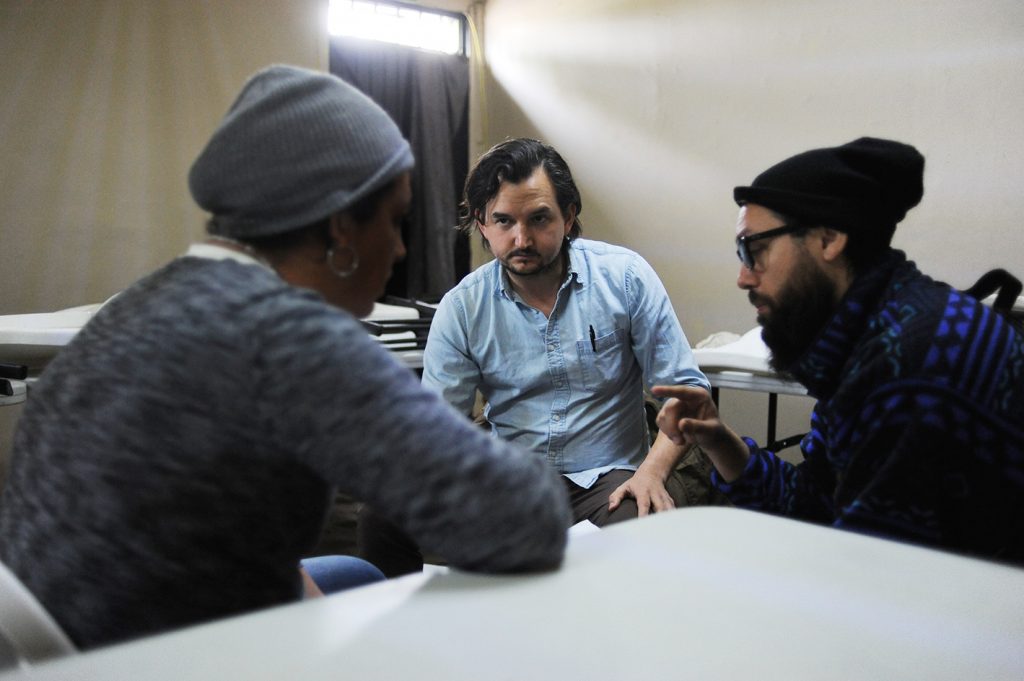
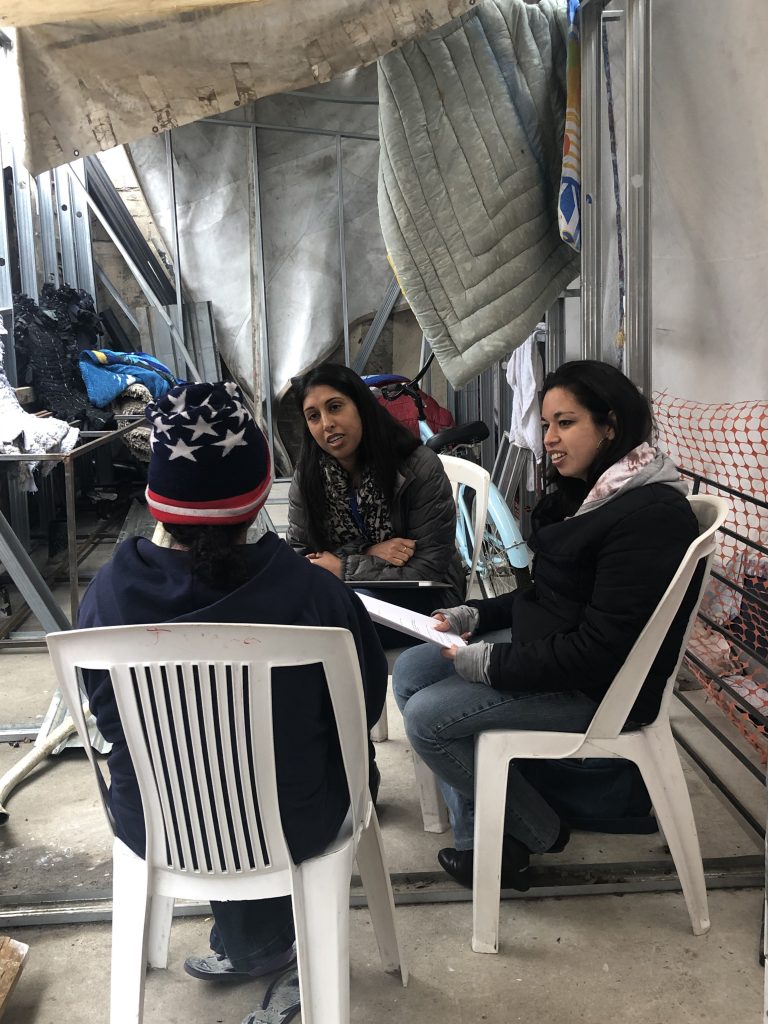
Juana (left), speaking to PHR’s Ben McVane, MD (center) and an interpreter, faced widespread persecution and sexual violence as a transgender woman in El Salvador. Nearly 90 percent of LGBTI asylum seekers and refugees from Central America report some form of sexual and gender-based violence in their countries of origin

Methodology

For more than 30 years, PHR has provided forensic evaluations for asylum seekers fleeing persecution. Based on the Istanbul Protocol [4] – the international standard to document alleged torture and other cruel, inhuman, and degrading treatment – these forensic evaluations assess the degree to which physical and psychological findings corroborate allegations of abuse.

In February 2019, PHR staff worked with migrant shelters and a legal aid organization in Tijuana, Mexico to identify asylum seekers who had physical scars or psychological distress/harm as a result of violence which led them to flee. PHR screened 35 asylum seekers – six were unable to undergo evaluations due to logistical constraints, four did not fit the eligibility criteria, and two declined to participate. PHR-trained medical professionals produced 23 detailed and consistent clinical evaluations, which are modified versions of a forensic evaluation – 18 of these asylum seekers are from Mexico and Central America, four from Cameroon, and one from Iraq.

PHR Clinical Evaluations

PHR created and applied a three-part clinical evaluation tool for adult asylum seekers for its research in Tijuana: a semi-structured interview documenting the event that drove the person to seek asylum; a physical exam of reported injuries [5] and available medical records; a PC-PTSD-5 psychological questionnaire to assess the presence of post-traumatic stress disorder; and a PHQ-9 questionnaire to assess the presence and severity of depression. Both mental health questionnaires have been independently validated and shown to have high sensitivity and specificity. PHR only interviewed minors between the age of seven and 17 accompanied by at least one parent with informed consent of each parent present and the child. These interviews were conducted by PHR clinicians with expertise in pediatrics and/or clinical psychology.

PHR-trained medical experts conducted clinical evaluations in Spanish or English, with the assistance of interpreters, when needed. Following an explanation of PHR’s work and the purpose of the investigation, PHR obtained verbal and written informed consent from each interviewee. All participants were informed that a clinical evaluation was not a formal evaluation of their asylum claim and received PHR’s contact information so that if/when the interviewee makes a formal claim in the United States with legal representation, they can request a full forensic evaluation to support their case.

PHR’s Ethics Review Board provided guidance and approved this study based on regulations outlined in Title 45 CFR Part 46, which are used by academic Institutional Review Boards in the United States. All PHR’s research and investigations involving human subjects are conducted in accordance with the Declaration of Helsinki 2000, a statement of ethical principles for medical research involving human subjects, including research on identifiable human material and data.[6]

Cases from Mexico and Central America

To highlight the plight of asylum seekers from this specific region, this report draws upon the 18 cases from Mexico and Central America: El Salvador (seven), Honduras (seven), Mexico (three), and Nicaragua (one). These are 15 adults [7] (nine females, including one transgender female, and six males) and three minors under the age of 18 (one female, two male). For safety and confidentiality, PHR replaced the names of asylum seekers with pseudonyms and uses only deidentified photographs. PHR also omitted from several cases identifying information such as occupation, ages/number of children, dates of flight, and town within country of origin, among other details that could compromise anonymity.

Introduction

The United States recognizes the right of individuals to seek protection from persecution in accordance with federal and international laws. Under U.S. law, an asylum seeker must show that he or she is unable or unwilling to return to his or her home country and cannot obtain state protection there due to past persecution or a well-founded fear of being persecuted in the future “on account of race, religion, nationality, membership in a particular social group, or political opinion.”[8]

In the United States, U.S. Customs and Border Protection historically has been responsible for processing border crossers and then referring those who are afraid to return for a credible fear interview. In that interview, a U.S. asylum officer asks a series of questions to determine whether the asylum seeker faces a “significant possibility”[9] of persecution in their country.[10] Asylum seekers must demonstrate a well-founded fear of persecution related to at least one of the protected grounds listed above. In addition, they must demonstrate either that the state is responsible for the persecution they are facing or that the government or state institutions are unwilling or unable to protect them from persecution by non-state actors, such as gangs.[11]  

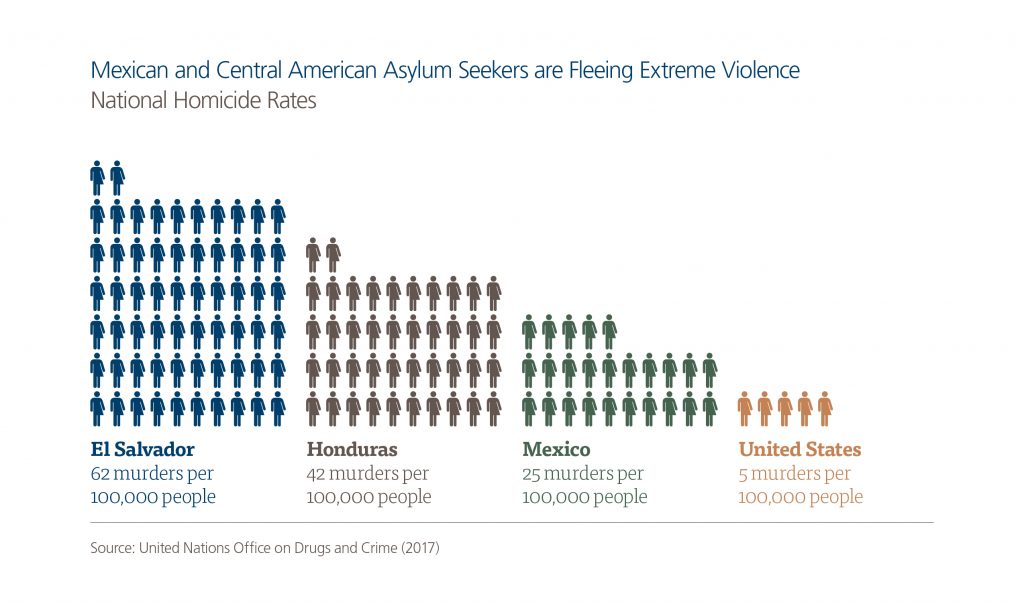
The Trump administration has decried the U.S. asylum system as an immigration “loophole” that is “being gamed,” suggesting that those who seek asylum do not have a well-founded fear of persecution, [12] and that the asylum system itself acts as a pull factor for migration. However, this narrative ignores violence and failed governments who are unable or unwilling to protect their people as a major factor pushing asylum seekers in Mexico and Central America. Despite a recent drop in homicide rates, El Salvador remains one of the most violent countries in the world, with 62 murders per 100,000 people, [13] almost 12 times the U.S. rate. Two thirds of these murders are gang-related.[14] While Honduras halved its homicide rate in 2018, it still stood at 42.8 per 100,000 people in 2017, [15] and eight violent massacres took place in the country in the first two weeks of 2019 alone. [16] Similarly, Mexico also experienced the deadliest year on record in 2018 [17] and the first three months of 2019 showed a 10 percent increase in homicides when compared to the same period in 2018. [18] Finally, the Nicaraguan government’s crackdown on the opposition in the form of arbitrary arrests, killings, beatings, torture, and sexual assault has forced at least 60,000 people to flee the country since April 2018. [19] 

The target, nature, and extensive reach of violence and impunity in this region have given entire families and specific groups no alternative but to flee north in search of safety.

Some groups are particularly at risk: Central American youth are 10 times more likely to be killed when compared to children in the United States[20] as they become victims to gangs, state security forces, and organized crime. Gangs especially seek out young recruits, as they can more discreetly smuggle drugs and weapons, or collect extortion payments.[21] Taxi drivers often are forced to carry illicit goods or act as informants in neighborhoods controlled by rival gangs. [22] Women are especially vulnerable: two out of three women killed in Central America [23] are murdered solely because of their gender, a pattern of violence known as “femicide.”[24] Those who resist forced prostitution and/or becoming sexually enslaved by gangs risk being killed.[25] The LGBTI (lesbian, gay, bisexual, transgender, and intersex) community also faces threats, arbitrary arrests, killings, and other violence by state and non-state actors.[26] 

The target, nature, and extensive reach of violence and impunity in this region have given entire families and specific groups no alternative but to flee north in search of safety. Tragically, these groups have come into the crosshairs of the Trump administration’s restrictive policies. Although many of these attempts have been struck down as unlawful, they have nonetheless had an impact on thousands of asylum seekers and prevented bona fide refugees from accessing their legal right to seek protection. For example, the increase in denial rates in the second half of 2018 corresponds with then Attorney General Jeff Sessions’s effort to limit the grounds on which immigration judges could grant asylum, making it increasingly difficult for those with domestic violence and gang violence claims to gain protection.[27] In December 2018, U.S. District Judge Emmet Sullivan ruled that each asylum claim must be considered individually and the government cannot impose blanket denials on asylum seekers.[28] Had Sessions’s decision prevailed, thousands of asylum seekers, including eight of the 18 cases included in this report, would no longer be eligible for asylum protection.[29]

The cases below tell the stories of young men who fled forced recruitment into gangs, women and girls who faced sexual and gender-based violence, and families who could not pay protection money to stay alive. PHR medical experts collected testimonies and conducted clinical evaluations to illustrate how violence unfolds in this region and demonstrate how already vulnerable and traumatized people risk being further harmed by restrictive U.S. policies that deny them the right to protection.

Findings: Asylum Seekers Are Fleeing Violence and Impunity

“There were two to three people killed every day in the neighborhood…. My elementary school friend was killed inside a car the same day she was going to give birth. There are so many killings now. At first, we could go to wakes, but now we cannot even go to pay our respects to a friend or family member. They already killed three of my nephews.”

Silvia, 43-year-old woman, Mexico

All cases in this report tell the stories of asylum seekers who sustained violence in their country of origin that led to physical scars and/or psychological symptoms resulting from violence or serious threats of violence. Physicians for Human Rights’ (PHR) findings describe multiple forms of violence perpetrated either by state actors, such as corrupt police officers (three cases), or by non-state actors, such as gangs and organized crime (15 cases). [30] This violence included beatings, rape, and murder. Many of the people who were targeted by gangs and organized crime described how government authorities in their country failed to protect them from the violence. [31]

Seeking Asylum with Post-Traumatic Stress Disorder

Post-traumatic stress disorder (PTSD) is a complex syndrome of somatic, cognitive, affective, and behavioral symptoms that results from the psychological trauma of direct or indirect violence or threats to life.[32] While studies show that asylum seekers who have suffered trauma also demonstrate impressive resilience and are often able to securely resettle their lives once in safety,[33] PTSD can impair asylum seekers’ ability to cope with physical challenges on the journey, and the cognitive effects can adversely impact an individual’s likelihood of obtaining asylum.

Historically, to be granted asylum in the United States, or even to pass the initial “credible fear interview,” an asylum-seeker must make a qualifying claim in a manner that is detailed and specific and demonstrates a “significant possibility” of persecution in their home country. Given the frequent lack of corroborating witnesses or physical evidence, internal consistency in the narrative becomes crucial. However, scientific studies have shown that the trauma narratives presented by PTSD patients are consistently rated as more disorganized than non-trauma narratives of these same patients or the trauma narratives of individuals without PTSD.[34],[35] Asylum seekers often also have more difficulty recounting their story the longer they have to wait.[36] From a clinical perspective, this additional time is likely to impact asylum seekers’ ability to build a consistent claim, which affects their ability to exercise their right to apply for asylum.[37]

PHR’s mental health evaluations included the administration of validated screening tools for PTSD, anxiety, and depression. Results of these clinical evaluations showed that 12 adults screened positive for PTSD. Similarly, 11 adults screened positive for depression; seven of them exhibited signs and symptoms consistent with moderately severe to severe depression. All but one asylum seeker reported that they “tried hard not to think about the event(s) or went out of their way to avoid situations that reminded them of the event(s),” and 15 of them reported experiencing nightmares or unwanted thoughts. For example, Javier (Case 6), a 36-year-old man who was extorted and beaten by a gang in El Salvador, reported symptoms of PTSD, severe depression, and anxiety. His inability to sleep led to physical exhaustion and lack of focus. He also felt constantly on guard and watchful. “Having seen so much violence, sometimes I start shaking … a kind of fear,” he said. “My body begins shaking and I go cold.”

Recounting a traumatic event may induce distressing symptoms. Thus, asylum seekers with PTSD may not share all details of their experiences, diminishing their capacity to effectively make their case. Moreover, an asylum seeker may seek to demonstrate resilience and avoid relaying the most central cause of what led them to seek protection, only bringing it up at the end of their narrative, possibly preventing its full elaboration or unintentionally diminishing its importance. For example, Juana (Case 10), a transgender woman who was sexually violated in El Salvador, only told PHR about the assault that prompted her to seek asylum towards the end of her interview. Similarly, the PHR medical expert who examined Jorge (Case 9), a 60-year-old Honduran whose clavicle was broken by gang members who attacked him with a baseball bat, said Jorge “often seems to intentionally withhold the most difficult parts of his experiences to hide embarrassment and demonstrate his positive attitude.”

“Having seen so much violence, sometimes I start shaking … a kind of fear…. My body begins shaking and I go cold.”

Javier, 36-year-old man, El Salvador
Jorge, 60, was attacked by gang members in Honduras who broke his clavicle with a baseball bat after he tried to rescue his nephews from recruitment into the gang. A PHR medical expert found that Jorge screens positive for post-traumatic stress disorder and moderate depression. He reports that he has trouble sleeping nearly every night and often has nightmares.

Violence by Non-State Actors:  Gangs and Organized Crime

PHR documented 10 cases that involved gang violence. They were all consistent with the United Nations High Commissioner for Refugees (UNHCR) definition of who gangs target and how this violence forces people to flee:[38] forcible youth recruitment into gangs; extortion of small business owners and other specific groups unable or unwilling to pay protection money or provide certain goods and services; threats or killings of witnesses to crimes, or those who have reported crimes; and gender-based violence toward women and girls, among other groups.[39] 

As the cases below demonstrate, gangs have a “high level of organized determination as to who should be killed, when and where,”[40] and these are not “random criminal acts.”[41] Moreover, PHR’s research found that in six of the 10 cases related to gang violence, the asylum seekers tried to find a safe haven in their own country or another country before fleeing to the United States, but continued to face insecurity given the gangs’ stronghold. As Manuel (Case 11), an 18-year-old man who fled gang recruitment in El Salvador, explained to PHR, “the country is so small that there are gangs in every corner and in all neighborhoods.”

“They said that they wanted soldiers, people who would work for them … youth.”

Manuel, 18-year-old man, El Salvador

Forcible Recruitment of Youth to Gangs

PHR documented five cases involving the forcible recruitment of youth to gangs.

Salvadoran brothers Manuel and Daniel were home when gang members showed up to pressure Daniel into joining the gang, which he had already refused to do. They took Daniel away, and the next day, his body was found in a canal, strangled with his own shoelaces. Manuel believed that the gang had planned to recruit Daniel, then Manuel, then his other brothers: “They were going to take us one by one.” Because he had witnessed Daniel being taken away by the gang members, Manuel became a target.

“I fled because I knew who was responsible and they were going to take my life. They were looking for me to kill me.”

Manuel, 18-year-old man, El Salvador

Sexual Violence as a Weapon for Recruitment

Women also become targets within the context of forcible recruitment. Jimena (Case 8), a 21-year-old woman from Honduras, was two months pregnant and had a toddler with her husband, Jose (Case 9). He worked at a private security firm and knew how to handle firearms, so a gang repeatedly asked him to join, but he always refused. One day, gang members beat him and told him that they would kill him or “hurt where it would hurt the most” if he did not join.

A few days later, two armed men came to Jimena’s home when she was alone. They threw her on the kitchen floor face down. As she fought back, one of the men kneeled by her head and held her down by the shoulders, while the other man raped her. The whole time she was terrified of losing her baby. Before leaving, the men said they would kill Jimena, her child, and Jose if he did not report to a specific location. The family immediately fled to another town in Honduras. Two months later, while Jimena’s cousin was visiting, two men drove by on a motorcycle and shot the cousin nine times, killing him instantly. Jimena and her husband interpreted his killing as a message from the gang that it had found them and that their lives were in imminent danger.  

That same day, Jimena and Jose began the five-month journey to Tijuana; Jimena gave birth to their new baby along the way. She described to PHR her physical state after the rape: “I had bruises on my shoulders where they held me down. I had pain in the abdomen for three days and in my stomach throughout the pregnancy; it hurt to sit down.”Jimena showed signs of depression and PTSD, including hyper vigilance and avoidance of situations that remind her of the gang members who raped her.

Honduran gang members raped Jimena – speaking with PHR’s Sural Shah, MD at a shelter in Tijuana, Mexico – in order to pressure her husband to join the gang

Extortion and Threats

Two out of the 10 asylum seekers who faced threats and/or violence from gangs or cartels reported that extortion in the form of demands for protection money was the reason they fled their countries. Estimates suggest that gangs in El Salvador and Honduras collect more than $300 million each year,[42] demonstrating the widespread nature of this practice in both countries.[43] Gangs target specific occupations, such as small business owners, transportation workers, or anyone who is known to have some steady income or can provide them with a needed service.[44] For example, one interviewee explained to PHR how the system works: “They say that they protect you from other gangs…. A young boy 13 or 14 years old will arrive and give you a phone, and someone on the other end tells you that you have to pay and if you do not comply, you will see what happens. And we know how they kill people for not paying, you hear about it daily…. They can increase it as they see fit and one can only say ‘yes.’”

“They said that this was a warning but next time they would kill all of us. That is why we left in the middle of the night. We do not feel safe. They are not playing games.”

Javier, 36-year-old man, El Salvador

Demands for Protection Money Turn Deadly

Javier (Case 6), a delivery man for a bakery in El Salvador, described how he was targeted for protection money because of his profession. He diligently paid roughly one eighth of his income every month to the gang until, one month, his earnings fell short. Two days past the payment’s due date, gang members beat Javier as a warning to pay up and not delay again. They punched and kicked him in the chest, shoulders, and back. He was only able to cover his face and did not fight for fear of being shot and killed. That same night, Javier and his family fled El Salvador.

“They said that this was a warning but next time they would kill all of us. That is why we left in the middle of the night. We do not feel safe. They are not playing games.”

Javier, 36-year-old man, El Salvador
Javier, Rosa, and their three children fled El Salvador after gang members beat Javier when he missed a monthly payment of protection money to the gang. They spoke to PHR’s Mary Cheffers, MD at a legal aid organization in Tijuana, Mexico.

Transportation Workers Are Targeted

Silvia (Case 18) described to PHR how her husband, a taxi driver, was forced to pay protection money to an organized crime group in southern Mexico, which later escalated to using his taxi to transport members. They reportedly told him and his fellow drivers: “We have your names and phone numbers. We know each one of you, where you live, and you can no longer decide for yourselves. If one of us asks you to take us somewhere, you have to do so. The first time you refuse, we will beat you until you bleed. The second time … there will not be a second time because we will just shoot you with bullets.” 

Silvia and her family fled their town in Mexico after her husband, who had been repeatedly pressured to work for organized crime, witnessed killings. She said many friends, neighbors, and relatives had been murdered by members of organized crime.

Silvia reported that, one morning, organized crime members told her husband to drive them to an area dominated by a rival group. They said, “You already have a bullet in your head anyway; it is better that you just take us.” As they drove, Silvia’s husband heard them speaking about the people they planned to kill and then he realized that the rival groups had planned a duel. Silvia’s husband managed to escape the crossfire unscathed but knew he would now be a target for both groups. Shortly afterwards, he, Silvia, and their children fled.

Silvia screened positive for depression and post-traumatic stress disorder. She described her nightmares as full of: “fear, terror, dread, panic. I wake up from nightmares and start to pray, asking God to help and protect me…. I dream that they kill my kids.… I dream that they muzzle everyone, and I scream.”

“If one of us asks you to take us somewhere, you
have to do so. The first time you refuse, we will
beat you until you bleed. The second time … there
will not be a second time because we will just
shoot you with bullets.”

Silvia, a 43-year-old woman from Mexico, quoting organized crime members who threatened her husband, a taxi driver

Killings and Witness Elimination

PHR documented cases in which witnesses to crimes were targeted by gangs and other forms of organized crime, such as cartels or paramilitary forces. For example, Silvia (Case 18) described to PHR that, in her neighborhood in Mexico, “when there are witnesses [of crimes], they have to kill all of them. This is where the hitmen come in – youth on motorcycles who go on a shooting spree.” Days after one of Silvia’s neighbors denounced a relative’s murder, her husband was shot as they swept their backyard. Another neighbor was killed simply after he saw local cartel members running across rooftops near his home.

Entire Families as Targets

Hortensia (Case 5), a 35-year-old woman from southern Mexico, told PHR that she and her family fled their home after her father was killed. They still did not know why exactly her father was targeted, but Hortensia could only assume that his small ranch was seen as a resource. Hortensia recounted that her father had started receiving threatening phone calls, and a name similar to his then appeared on a death list posted on social media. These did not worry him, however, as he did not owe anyone anything.

On the day of her father’s killing, Hortensia reported that she and some relatives were at her siblings’ shop when some cars stopped on the street. Several young men jumped out and ordered everyone to put their head down. They then moved toward her father and took him, threatening everyone else if they moved. That evening, Hortensia’s sister received a text message with a picture of her father’s beaten body with eight bullet wounds, one of which was lodged in his eye. A couple of days later, Hortensia’s sister received a threatening phone call saying that the whole family would be next. They were left notes that said, “Leave now and do not get yourself into problems.” Three days after they buried Hortensia’s father, the entire family left for Tijuana.

In Honduras, Sergio (Case 15) worked with a farmers’ collective and began suspecting that some members were using the collective to launder money, buy arms, and carry out land evictions. He and his wife, Romina (Case 14), told PHR how one day he was driving his motorcycle on a road and stopped because he heard gunshots. He then saw the dead body of a child. The men at the collective were convinced that Sergio had seen the killers and threatened to kill him. Other acquaintances told him he was a target because he “knew too much” and a member of the collective said to Romina “They are going to kill him anyway. Just turn him in [to us].”

Shortly afterwards, Sergio, Romina, and their son Antonio (Case 17) were riding their motorcycle, when two men on another motorcycle drove up to them and tried to strike them with a machete, missing the eight-year-old boy by just a few centimeters. With assistance from a local human rights organization, the family fled to another town and then crossed the border to Guatemala. They spent two months there before traveling to southern Mexico and later on to Tijuana. Romina still struggles with the trauma of what they experienced: “I feel pressure about everything … my kids, my husband, myself, and the family I left behind in Honduras,” she told PHR. “I am so anguished that I cannot concentrate on anything. I think to myself, ‘I cannot go on’ and then I become short of breath. Twenty minutes later I faint. My head hurts.”

Romina (left) – speaking with PHR’s Adam Richards, MD (right) and clinical psychology student Janet Yanez (center) – fled Honduras with her family after they received death threats and were attacked by men wielding a machete. She still struggles with the trauma that she experienced.

PTSD in Children

One of the children interviewed in Tijuana was Antonio (Case 17), an eight-year old Honduran boy who was attacked by two men with a machete. His attackers missed killing Antonio by just a few centimeters when they hurled the weapon at the boy as he rode on the back of a motorcycle with his parents. Antonio’s experience of violence in Honduras has contributed to signs and symptoms of PTSD and anxiety disorder.

Antonio’s favorite school subject was writing, and he enjoyed playing ball with his friends back in Honduras. But when PHR asked him how he felt about returning to his country, he replied, “I am afraid. I think something would happen to me. I think they would kill me and my parents.” PHR’s medical expert recorded that, since he witnessed violence, Antonio has become sad and cries often. He often holds his breath when he is afraid and often must hold his mother’s hand to be at ease. His parents told PHR that, since he arrived in Tijuana, Antonio often defecates in his bed and suffers from nightmares where he yells in his sleep, “Mom, hurry! Hurry! The guy is going to kill us!” His mother said that Antonio is scared until they comfort him and put him back to sleep. Antonio reported symptoms of PTSD and anxiety disorder as well as somatization, whereby psychological distress manifests as physical ailments and attention problems.

Since arriving in Tijuana, Antonio has not had access to mental health care. Antonio has attention deficit hyperactivity disorder; the family does not have adequate medication for him while they wait in Mexico, and this lack of medication is likely to exacerbate his condition. Antonio’s mother explained to PHR her concern for her children’s future: “I still don’t see it [ending]…. I want my children to be OK in a safe place … but we have not found that [safety] yet. Our hope is that they will give us asylum, so my kids will be safe on the other side.”

“I am afraid. I think something would happen to me. I think they would kill me and my parents.”

Antonio, eight-year-old boy, Honduras
Honduran brothers Miguel, 9, (left) and Antonio, 8, (right) at a shelter for migrants in Tijuana. Antonio narrowly missed being killed by two men connected to organized crime who attacked his family with a machete in Honduras.

Violence by State Actors and the Failure to Protect

Asylum seekers must demonstrate that the state is responsible for the persecution they are facing or demonstrate that their government or state institutions are unwilling or unable to protect them from the persecution of non-state actors such as gangs.[45] The three sections below draw upon PHR’s cases to illustrate how violence carried out by the state and/or its failure to provide protection from non-state actors has left many asylum seekers in Mexico and Central America with no options but to flee.

State Violence

States are mandated to protect their populations from violence, but corrupt authorities are too often directly involved in human rights violations in Mexico and Central America. PHR documented the three cases below of state actors as direct perpetrators.

Silenced for Her Political Dissent

In Nicaragua, after three consecutive terms in power, President Daniel Ortega faced mass protests in April 2018. A brutal crackdown by police and armed pro-government groups resulted in arbitrary arrests, killings, beatings, torture, and sexual assault.[46] As of April 2019, more than 60,000 Nicaraguans had fled to other countries in search of refuge.[47] Marta (Case 12) is one of these cases.

Marta was repeatedly threatened by police after she took part in a political protest in Nicaragua. After three men told her they “wanted her head,” she fled with her 23- year-old son.

Marta participated in the first protests in April 2018. Soon after, police officers arrived at her home, accusing her of supplying protestors with explosives because her sister owned a former fireworks workshop. The police raided Marta’s home and found nothing, but vowed to return. When protests broke out in July 2018, Marta stayed home due to a foot injury. She was sweeping her front yard when government supporters almost ran her over. She yelled at them, and, three hours later, police officers and anti-riot forces surrounded her home, accusing her of assaulting the government supporters.

She told PHR, “I felt that they were going to burn my house with me inside. I felt a horrible sense of fear.”Eventually the security forces left, and she never slept another night in her home.

Neighbors told her that from that moment, the police returned at least every other day, threatening that Marta would “pay for what she had done.” A week later, three men approached her, saying that they “wanted her head,” so she fled Nicaragua with her 23-year-old son.

“Most young men are returned [to their families] dead in black bags. And even those are lucky because they often kill the family, too. If I went back to El Salvador, I would not survive.”

Benjamín, 18-year-old man, El Salvador

Profiled as a Gang Member

El Salvador’s state security forces have instituted harsh anti-gang tactics that routinely involve excessive use of force, arbitrary arrests, and extrajudicial executions.[48] They conduct raids without warrants on homes of young Salvadoran men who have been profiled as suspected gang members due to their gender, age, and neighborhood.[49] Police officers wearing uniforms from El Salvador’s elite anti-gang unit took 18-year-old Benjamín (Case 3) from his home one afternoon. They drove for 30 minutes to a remote area, where the officers made him get out and kneel on gravel with his hands cuffed behind his back.

After beating him for hours and forcing him to put his fingerprints on a firearm, three officers drove Benjamín home and held him in the car while they searched his home. Benjamín suspected that they were trying to plant guns and drugs to falsely incriminate him. When his mother arrived, the officers told her that Benjamín was missing and suspected dead due to his alleged gang involvement. After interrogating his mother for hours to no avail, the officers let Benjamín go. Three days later, fearing that he would be targeted again, he fled north. Benjamín told PHR that he considers himself lucky. “Most young men are returned [to their families] dead in black bags. And even those are lucky because they often kill the family, too,” he said. “If I went back to El Salvador, I would not survive. I think it would be worse and they would finish me. I also fear for my family and my younger brother.”

Targeted for Her Sexual Identity

Juana (Case 10), a 27 year-old-transgender woman from El Salvador, faced widespread discrimination and persecution. Her family no longer spoke to her, and she could not get a job. Police officers often harassed her, pulling her long hair and telling her to cut it, or forcing her to do squats to “teach her to be more of a man.” One day, Juana was at a waterpark with a friend when two police officers stopped her and forced her into their car. She thought they were taking her to the station, but instead, Juana said, “They forced me to have sexual relations with them in the car.” When she threatened to report the incident, they replied “We hope you do. Then it will be worse for you next time,” demonstrating the lack of accountability of state security forces in El Salvador. After this traumatic event, Juana fled to Tijuana, sleeping in parks and gas stations along the way, as she had very little money. According to UNHCR, almost 90 percent of the LGBTI asylum seekers and refugees from Central America like Juana reported some form of sexual and gender-based violence in their countries of origin.[50]

Juana (left), a transgender woman from El Salvador, was repeatedly harassed by police officers because of her sexual identity. She fled after two police officers pushed her into their car and forced her to have sex with them.

Failure to Protect and Impunity

States fail to protect the population when government officials themselves are involved in human rights violations, and when they are unable or unwilling to provide protection from non-state actors. PHR documented how the lack of effective state protection leaves populations in Mexico and Central America at risk, and how this failure to protect influences people’s trust in state authorities. According to UNHCR, a state’s ability or willingness to protect can be assessed by analyzing the population’s willingness to seek assistance from authorities and whether this is perceived as futile or likely to increase risk of harm by gangs.[51] As Jorge (Case 9), a 60-year-old man from Honduras, told PHR, “We do not trust the police. They are part of the gangs. They get a percentage from the drugs they sell.” This sentiment was echoed by other asylum seekers as well.

“We do not trust the police. They are part of the gangs. They get a percentage from the drugs they sell.”

Jorge, 60-year-old man, Honduras

Fifteen asylum seekers interviewed by PHR – seven from Honduras, five from El Salvador, and three from Mexico – were targeted by non-state actors, such as gangs. For example, Javier (Case 6), the Honduran delivery-man whose case was highlighted above, explained to PHR why he decided to flee instead of asking the police for help: “They are linked. If one files a complaint, they themselves [the police] will pass on the information [to the gang].… We have seen people who have gone to testify and are dead in days.” Similarly, Manuel (Case 11), the 18-year-old Salvadoran who was being pursued by a gang, explained that: “It is all one corruption scheme, because in many neighborhoods they [gangs] pay the police to kill people whom they cannot [kill]. The gang pays the police to do the work of the gang.” Finally, Jimena (Case 8), who was raped in retaliation for her husband not joining a gang, told PHR why she did not go to authorities: “If I had told anyone, the gang members would have found out and killed me. If I had told police, this would have happened to me. They would have laughed. I knew a lot of people who filed reports, and this happened.”

“If you denounce a gang member, the police pass your information to the gang, and they make you disappear… A person gives testimony one day, and the next day they are dead.”

Javier, 36-year-old man, El Salvador

Gangs’ Pervasive Influence

Asylum seekers in Mexico and Central America are aware of how gangs exert influence over authorities, which leaves no recourse for protection. For example, PHR interviewed 16-year-old Adriana (Case 1), a girl who faced sexual and gender-based violence at the hands of her boyfriend, Pedro, whose brother was a gang member in El Salvador. In Adriana’s words, “He would always tell me that he would kill me if I did not go with him. He would not let me be with anyone else.… He told me that he would kill me and bury me.”

Romina, whose family was threatened and attacked after her husband witnessed the killing of a child, holding a complaint filed to the Honduran police on their behalf by a local human rights organization. Though the family fled to Guatemala and then to Mexico, they found that they had been followed there. “Our mistake was that we were entered into the system [when we went to the authorities] and then they [the attackers] knew where we were,” she told PHR.

She also described how Pedro routinely sent her videos showing how gang members killed their girlfriends or forced them to dance naked on camera if they did not follow orders. He also would describe women being gang-raped or having objects forced inside them. When Adriana tried to leave Pedro, he used his gang affiliation to threaten her and her family, and he once beat her when she was 4-1/2 months pregnant, causing her to lose the pregnancy.

Concerned for her safety, Adriana’s mother once told Pedro that she was taking her daughter home. Given that Adriana was a minor, she threatened to involve the police. Pedro replied, “You do not know what you are saying. It appears that you do not love your family. They will all be gone if you open your mouth,” implying that his brother’s gang would retaliate. He later warned again that “blood would flow” if they tried to do anything. Knowing that this could very well happen, Adriana and her mother did not lodge a complaint and instead escaped to another town. They found out through neighbors that their house was then ransacked. As they continued to receive threats from the gang via social media, both mother and daughter felt unsafe and fled El Salvador entirely. Adriana’s case illustrates how authorities are not seen as willing or able to protect people from gang violence, and also serves as an example of a broader pattern in El Salvador, where every 19 hours a woman is killed and every three hours someone is sexually assaulted.[52]

16-year-old Adriana lost a pregnancy when her boyfriend, who was connected to local gangs in El Salvador, beat her. He told Adriana’s mother that “blood would flow” if they tried to denounce the gang to the police.

Official Complaints Ignored

PHR interviewed some asylum seekers who did file complaints with authorities in their home countries. For example, Natalia (Case 13) is a mother of three in her 20s[53] who was a schoolteacher and dreamed of running a day care center. She told PHR that as her husband, Alejandro, became increasingly aggressive towards her and her children, he told Natalia that he was connected to drug trafficking and therefore she could not take action against him. When Natalia tried filing complaints with local law enforcement, she found Alejandro was right: nothing ever happened. Eventually, Natalia left him but he continued to verbally and physically abuse her and their children, at times showing up at her workplace with a gun. He also broke into her home and raped her.

Natalia reported to PHR that, one day, Alejandro took her children from her home just as she left for work. As he drove with the children, he found Natalia walking on the street and almost ran her over. Natalia told PHR that she heard the eldest boy screaming “Daddy, do not do anything to my mommy!” as Alejandro got out of the car and grabbed Natalia by the hair. He then dragged her to nearby train tracks, where he held her down and waited for a train. Natalia got away by biting his hand, but he warned her: “I have my boss’s permission to do anything. You will not escape, I will kill you. Do not even think of doing anything because the government is with us.” Natalia then escaped to another town, where Alejandro eventually tracked her down, saying: “I found you, bitch. You thought you would escape so easily from me? I already have someone who will buy you and your dirty children. You are going to see how you will suffer when they open up your kids,” referring to the fact that Alejandro had sold Natalia and the children to traffickers for their organs. She immediately sold as many her belongings as she could in one day and bought bus tickets that same night to go to Tijuana. 

Natalia (center), told PHR’s Mary Cheffers, MD (right) and an interpreter that her husband, after years of violence and abuse, had sold her and her children to traffickers for their organs. Her complaints to the police were ignored.

Law and Policy: The Right to Asylum under Assault in the United States

The Refugee Convention defines refugees as individuals “unable or unwilling to return to their country of origin owing to a well-founded fear of being persecuted for reasons of race, religion, nationality, membership of a particular social group, or political opinion.”[54] The United States government enshrined the goals of both instruments in domestic law with the passage of the Refugee Act of 1980.[55]

The Refugee Convention[56] is based on the principles of non-discrimination, non-penalization, and non-refoulement (a French term meaning “non-repulsion” or “non-return”). These principles translate into basic parameters: States should not discriminate against asylum seekers based on any prohibited grounds, such as race, gender, or sexual orientation.[57] States should not penalize asylum seekers for crossing without valid entry documents or between ports of entry.[58] States should not return asylum seekers to a place where they could be subjected to “great risk, irreparable harm, or persecution.”[59] The principle of non-refoulement is also included in U.S. domestic law,[60] the Convention against Torture (Article 3),[61] and the International Convention for the Protection of All Persons from Enforced Disappearance (Article 16).[62]

The U.S. asylum system has long been a complex process.[63] Since 2017, the Trump administration has proposed, adjusted, or implemented a series of restrictive policies that have made the process increasingly arduous for asylum seekers and hindered their legal right to seek protection. Those policies include family separation, prolonged detention under inadequate and harmful conditions, bans on eligibility for asylum, and other shifts in how credible fear interviews – the first step for those seeking asylum – are conducted and adjudicated, as well as the suggestion that asylum seekers should pay fees to apply for protection.[64] As discussed below, several of the Trump administration’s policies also may directly or indirectly violate the principle of non-refoulement by forcing asylum seekers to stay in locations where they may face harm and/or returning them to their countries of origin, where they also may experience further harm.

Creating Bottlenecks at the Border: The Practice of “Metering”

The practice of “metering” blocks timely access to asylum procedures. Created by the Obama administration in response to an increase in Haitian asylum seekers at the San Ysidro/Tijuana port of entry in 2016,[65] “metering” is a practice whereby Customs and Border Protection (CBP) officers limit the number of migrants who can be processed at a port of entry in any given day.[66]  Human rights organizations have argued that “metering” is illegal, filing a class action lawsuit in July 2017 to challenge this practice.[67] U.S. law does not specify any limit on the number of asylum seekers allowed entry into the United States to make a claim, and these individuals must be referred for inspection and processing upon arrival.[68] 

CBP’s motion to dismiss this lawsuit against “metering” was denied in July 2019,[69] and the lawsuit was in litigation as of September 2019.[70] Since the lawsuit was filed, the Trump administration has expanded metering at ports of entry across the southern border. This has drastically reduced the number of asylum seekers who are inspected and processed per day. For example, the San Ysidro/Tijuana port of entry generally processed anywhere from 40 to 100 asylum seekers per day in 2018.[71] As of September 2019, roughly 25 people were processed by CBP each day, and there are more than 10,000 people on the waiting list in Tijuana awaiting their turn to cross and make a claim.[72] Data indicates that, as of August 2019, there is a backlog of 26,000 asylum seekers across Mexico on waiting lists to present themselves to U.S. authorities and make their claim for asylum.[73] This number does not include the thousands of others who have been returned to Mexico under the Migrant Protection Protocols (MPP).

With few exceptions,[74] virtually all asylum seekers who present themselves at ports of entry along the U.S.-Mexico border are subject to the practice of metering before they can enter the United States. PHR documented the case of Natalia (Case 13), whose case is described in the above “Failure to Protect” section. When Natalia arrived at the U.S. border in Tijuana with her young children, she tried turning herself over to U.S. officials at the port of entry to claim asylum. However, Mexican authorities told her, “You have to get in line,” referring to the waiting list where thousands of asylum seekers have placed their name. With no food or money, Natalia eventually found a shelter where she spent at least two months waiting for the opportunity to make her claim to U.S. authorities. 

This woman fled her home with her family after three relatives were murdered by gangs. At the U.S. port of entry in Tijuana, where the number of asylum seekers allowed to cross daily is sharply limited by “metering,” the family was given numbers to designate their place in the line to present themselves to U.S. authorities

Sending Asylum Seekers into a Dangerous Limbo: “Remain in Mexico” Policy

In December 2018, the U.S. Department of Homeland Security (DHS) instituted the Migrant Protection Protocols.[75] Known as the “Remain in Mexico” policy, this protocol requires asylum seekers to await the processing of their case in Mexico, which obstructs their ability to access counsel and secure protection and leaves them vulnerable to violence, with no resources to move their claim forward. DHS has stated that the MPP was created so “vulnerable populations receive the protections they need,”[76] but this policy puts them at risk and violates the principle of non-refoulement.

Human rights groups have challenged the MPP in court. As of August 2019, however, the policy was expected to expand along the entire U.S.-Mexico border.[77] According to CBP, as of September 1, 2019, at least 42,000 asylum seekers have been returned to Mexico.[78] Human rights organizations state that MPP returnees include many vulnerable groups, such as seniors, children, pregnant women, and LGBTI individuals and people with disabilities who were meant to be exempt.[79] 

“Returning asylum seekers to Mexico endangers their lives and is a catastrophic stressor to their health. The amount of time they spend waiting is often correlated with an increase in complex physical and mental health problems.”

Mary Cheffers, MD, PHR Asylum Network member and clinical faculty, University of Southern California

The MPP also is putting asylum seekers directly in harm’s way.[80] Gripped by a record rate of homicides in 2018, Mexico is beset by violence from gangs and organized crime that perpetrate  extortion schemes, kidnappings, and killings – the very patterns of violence that Central American and other asylum seekers flee. [81] For example, David (Case 4) reported to PHR that he escaped forcible gang recruitment in Honduras by moving to Mexico, where his mother lived. While this country initially seemed safer for him, a group of men murdered David’ neighbors and warned him to leave, as he had witnessed the killing. A month later, the same men returned and told David that he had five days to leave. A close cousin had just been murdered in Honduras, so returning there was certainly not an option. David and his mother then traveled to Tijuana to try to seek asylum in the United States.

PHR interviewed several asylum seekers who faced violence while waiting in Tijuana.[82] For example, Manuel (Case 16) recounted how the same gang he had fled in El Salvador found him at a migrant shelter in Tijuana. When they saw him, several men threw Manuel into a tent and began beating him. As they threw punches, the gang members made phone calls to El Salvador to confirm that he was “the one.” When Manuel denied his identity, the men hit him harder on his chest with a metal rebar. During his interview with PHR Medical Expert Craig Torres-Ness, MD, Manuel recalls the ordeal: “I thought that at any moment I would lose my life.” The men also attempted to stab Manuel in the chest, but he was able to stave them off using his forearm as a shield. PHR’s clinical evaluation found that scars on Manuel’s chest and forearm were consistent with his report. Security at the migrant shelter intervened in time and Manuel escaped, then went into hiding in Tijuana while he awaited his turn to make a claim in the United States.

Manuel fled El Salvador after his brother was murdered for refusing to join a gang but found that he was still in danger even after arriving at the U.S.- Mexico border. Manuel told PHR’s Craig Torres-Ness, MD that men from the same gang found him in Tijuana and attacked him; the scar on his arm was consistent with his account of having fended off a knifing.

PHR documented other cases where asylum seekers faced threats or violence while in transit through Mexico. For example, Juana (Case 10) told PHR that on three occasions she was extorted by Mexican authorities, who told her that they would destroy her temporary visa unless she paid them money. Juana added that this sense of insecurity persisted even once she reached the border: “I do not feel safe in Tijuana. Gang members are everywhere; they can find us here and disappear us … I worry a lot. I’m not at peace. I feel like they can find us here at any moment and I do not know what could happen.” Benjamín (Case 3) also told PHR that he faced extortion throughout his journey, with local police officers falsely telling him that his visa was invalid. As Benjamín fled El Salvador because he had been kidnapped and beaten by the police, these interactions were particularly distressing: “Sometimes when I see police on the street, it reminds of the things I went through.”

“El Salvador has many gangs and they communicate with each other to search for people. I am in fear here [in Tijuana] too.”

Adriana, 16-year-old girl, El Salvador

Migrant Protection Protocols Obstructing Access to Legal Assistance

In addition to putting asylum seekers at risk, the MPP effectively blocks those remaining in Mexico from access to a U.S. lawyer. That legal assistance is essential for asylum seekers to adequately prepare to face an immigration judge; obstructing that aid has a deterrent effect on asylum seekers. From October 2016 to September 2017, courts/judges denied the claims of 90 percent of asylum seekers who lacked an attorney. However, judges and courts approved almost half of the claims of asylum seekers who had the benefit of lawyers.[83] For those who remain in Mexico, the prospects of assistance from a U.S. immigration lawyer are slim. As of June 2019, out of a total of 1,155 MPP cases that had been decided, only 14 cases (1.2 percent) had legal representation. Out of the 12,997 pending MPP cases, only 163 cases (1.3 percent) had legal representation.[84]

This lack of access to legal representation has affected how people are able to exercise the right to seek asylum. In February 2019, PHR interviewed Javier (Case 6), who fled extortion by gangs in El Salvador. When his metering number came up, Javier and his family went to their appointment with U.S. immigration officials. They were returned to Mexico under MPP. Given the lack of access to legal counsel, Javier felt that the system was stacked against him: “I do not know the laws in the United States. How will I represent myself? I take it as a lost cause.” If Javier were not granted asylum, he would be deported back to El Salvador, which he said was the equivalent 0f someone saying, “Give me five coffins, I’m sending this family to be buried there.”

“If I step on Honduran soil, they will kill us. And they will not care that I have a child.”

Jimena, 21-year-old woman, Honduras

Trying to Block Asylum Altogether: Third-Country Asylum Rule

Most asylum seekers waiting on the U.S.-Mexico border traveled through Guatemala and Mexico to reach a border crossing point. In what seems to be an effort to block asylum seekers from making a claim in the United States, in July 2019, the DHS and the Department of Justice issued the Third-Country Asylum Rule, also known as the “third-country transit bar.” This policy requires applicants to “apply for protection from persecution or torture where it was available in at least one third country outside the alien’s country of citizenship, nationality, or last lawful habitual residence through which he or she transited en route to the United States.”[85] 

The Third-Country Asylum Rule practically bans all asylum at the U.S.-Mexico border for all nationalities, except Mexicans: Hondurans and Salvadorans would have to seek and be denied asylum in Guatemala or Mexico before they can apply in the United States. Guatemalans would have to apply and be denied in Mexico before they would be eligible for asylum in the United States. The same would apply to asylum seekers of other nationalities who travelled through these countries to reach the U.S-Mexico border. 

The Third-Country Asylum Rule has been met with much resistance, given that it contravenes the longstanding asylum policies that allowed people to seek protection in the United States no matter how they arrived in the country. In July 2019, a California court issued a preliminary injunction against the rule. However, the following month, the U.S. Court of Appeals for the Ninth Circuit restricted the scope of this injunction to Ninth Circuit jurisdiction, which includes the border states of California and Arizona. This allowed the rule to be applied in the rest of the country, namely the border states of Texas and New Mexico, which are in the jurisdiction of other federal appeal courts.[86] On September 10, 2019, the Third-Country Asylum Rule was blocked again by a California district court, but this was reversed the following day by the Supreme Court. As of October 2019, this policy remains.

Although Guatemala is a gateway for Salvadorans and Hondurans trying to reach the United States’ southern border, the grim realities of its violent crime statistics underscore its likely unsuitability as even a temporary place of refuge for asylum seekers.[87] Guatemalans themselves, many of whom are fleeing violence linked to corruption, drug trafficking, and organized crime, filed almost 40,000 asylum applications in the United States in 2018.[88] PHR’s research shows how asylum seekers who sought to relocate to a third country, such as Mexico or Guatemala, continued to face threats or violence in those countries. For example, as detailed in previous parts of this report, Sergio (Case 15) and his family fled from Honduras to Guatemala. Sergio reported to PHR that, after two months in Guatemala, he was found by the same men he had been fleeing, so his family then went to Tijuana to seek protection in the United States. Similarly, as described in the previous section, David (Case 4) fled El Salvador to Mexico, only to be threatened again by violence there. 

In addition to violence and impunity, asylum seekers in Mexico may face the risk of refoulement, given that Mexican officials have been known to return Central Americans to their countries of origin, despite migrants’ fears of persecution and/or torture if returned.[89] [90] As described earlier, Marta (Case 12) fled Nicaragua due to political persecution. She reported to PHR that, after two days on a bus, she and her son were stopped by Mexican immigration officials at the Mexico-Guatemala border. She pleaded not to be deported back to Nicaragua, stating that she would be killed, and asked to be taken to the Mexican Commission for Refugee Assistance, the government agency responsible for processing refugee claims. Both requests were ignored, and Marta and her son were deported back to Nicaragua, where they were almost sent to a prison where political prisoners are held. Given her previous experience in Mexico, Marta continues to live in fear: “I am afraid of everyone here. I feel that if I go to the corner, someone will come by and kidnap me, asking for a ransom.” 

Conclusion

All asylum seekers included in this report sought protection due to targeted violence and intimidation from non-state actors, as well as violence by and/or denied protection by state authorities in Mexico and Central America. While they represent a small sample of the thousands of asylum seekers currently waiting their turn to seek protection in the United States, their cases indicate that they have strong grounds to seek asylum and that their claims should be heard in a prompt and fair manner. 

While the Obama administration implemented concerning policies regarding detention and deportation, since 2016, the Trump administration has undermined the integrity of the U.S. asylum system, introducing a series of restrictive policies that defy both international and U.S. law and egregiously obstruct the right to seek asylum. These policies have placed people who are already in vulnerable situations – asylum seekers fleeing violence and trauma in their home countries[91] – at further risk. Physicians for Human Rights’ findings point to the urgent need to protect the right of individuals to seek asylum in accordance with federal and international laws by implementing the following recommendations. 

Recommendations

 To the U.S. Government:

  • Ensure that the right to seek asylum is safeguarded, including when states are unwilling or unable to protect people from persecution by non-state actors, such as gang violence and domestic violence.
  • End all practices that bar asylum seekers from adequate and effective physical and legal protection inside the United States, including the Migrant Protection Protocols (MPP) and “metering” policies.
  • Prioritize resources to ensure that ports of entry across the U.S.-Mexico border can process and consider asylum claims in a fair and timely fashion.
  • Integrate trauma-informed standards and practices that are culturally and linguistically sensitive into every stage of the asylum-seeking process, from Customs and Border Protection processing through final adjudication. 
  • Uphold current United States Citizenship and Immigration Services (USCIS) standards for non-adversarial questioning to ensure fair processes and end any programs intended to authorize law enforcement officials other than trained USCIS asylum officers to conduct credible fear interviews (CFIs).
  • Provide the USCIS with adequate resources, staff, training, and supervision to appropriately conduct CFIs.
  • Limit detention of asylum seekers and increase access to and availability of community-based alternatives to detention to better facilitate access to essential services such as legal counsel and physical and mental health care.
  • Abolish family detention and refer family units to case managers who can connect families with nonprofit resources and representation.
  • Apply a presumption in favor of release on bond or parole for asylum seekers who have passed CFIs, which in turn can relieve detention centers and end “metering.”
  • Refrain from criminalizing or creating arbitrary restrictions on individuals and organizations working to defend migrant rights on the U.S. or Mexican side of the border.
  • Cease to use tariffs, trade sanctions, foreign aid, or other measures to pressure other countries to enter into “third country” agreements, especially if these countries are unable to provide effective legal or physical protection to asylum seekers.
  • Immediately grant outstanding requests by the United Nations Special Procedures and the Inter-American Commission on Human Rights to visit the U.S.-Mexico border for independent reporting and monitoring of policies and practices that affect the internationally recognized right to seek asylum. 

 To the U.S. Congress:

  • Exercise oversight of the Department of Homeland Security (DHS), Department of Justice, and the Department of Health and Human Services by holding oversight hearings, monitoring through congressional delegation visits, and requesting documentation from government officials involved in the asylum process. 
  • Direct DHS to immediately abolish the MPP and “metering,” as well as defund any policies that may negatively impact the right to seek asylum, such as pilot programs intended to authorize law enforcement officials other than trained USCIS asylum officers to conduct CFIs.
  • Propose and pass new legislation to affirm the full range of rights guaranteed to asylum seekers to counteract any executive or departmental policies or directives that effectively restrict individuals’ access to asylum protection.
  • Provide adequate funding to ensure USCIS has sufficient resources to appropriately conduct CFIs.
  • Publicly support the work of individuals and organizations working to defend the rights of asylum seekers on the U.S. and Mexican side of the border and monitor any threats to their ability to carry out this work.

To UN Member States:

  • Deliver statements under relevant items that address violations of international law pertaining to the situation of asylum seekers on the U.S.-Mexico Border.
  • Pressure the United States, Mexico, and the pertinent Central American countries, such as El Salvador and Honduras, to accept visit requests from relevant Special Procedures, including the UN Special Rapporteur on the human rights of migrants, Special Rapporteur on the right to health, Special Rapporteur on racism and xenophobia, and the Special Rapporteur on extrajudicial, summary or arbitrary executions. 
  • Issue a joint statement at the UN Human Rights Council reiterating the recommendations made to the U.S. government in this report, and on the rights of asylum seekers on the U.S. border, especially in relation to the UN Resolution on Migration A/HRC/41/L.7.
  • Include recommendations about the situation of asylum seekers in the United States’ Universal Periodic Review in May 2020.
  • Condemn any measures that criminalize or create arbitrary restrictions on individuals and organizations working to defend migrant rights and provide a safe and enabling environment for their work around the globe.

To the Governments of El Salvador, Honduras, Mexico, and Nicaragua:

  • Address the factors that drive asylum seekers toward the U.S. border, especially violence by state and non-state actors and endemic impunity for human rights violations.
  • Monitor the cases of asylum seekers returned through the MPP and ensure that the principle of non-refoulement is respected, as well as provide adequate essential services while asylum seekers wait in Mexico, including access to physical and mental health services. 
  • Condemn the MPP and any other policy or measure that does not uphold the principle of non-refoulement, closely monitoring cases that DHS has publicly stated would be exempt from the MPP. 
  • Create mechanisms to identify any asylum seekers who could face risks if returned to their country of origin and provide them effective and immediate protection.
  • Cease to militarize borders and preserve the right to freedom of movement by keeping borders open for those who wish to seek the right to asylum in another country. 
  • Provide a safe and enabling environment for individuals and organizations working to defend the rights of asylum seekers.

To the Inter-American Commission on Human Rights:

  • Conduct a formal investigation along both sides of the U.S.-Mexico border to document actions and policies by Mexico, Central American countries, and the United States that negatively impact the human rights of migrants, particularly asylum-seeking Central Americans who transit through Mexico to reach the United States.
  • Hold hearings before the Inter-American Commission aimed at exposing the root causes of mass migration from Central America to the United States and developing standards relating to the treatment of migrants, particularly in connection with policies such as “safe country” that negatively impact or in any way limit the right to seek asylum.
  • Publicly support the work of individuals and organizations working to defend the rights of asylum seekers on the U.S. and Mexican side of the border, including civil society organizations, lawyers, and journalists, and monitor any threats to their ability to carry out this work. 

Annex: Cases

Case 1 : Adriana, 16-year-old girl, El Salvador

Case 2: Josefina, 36-year-old woman, El Salvador

“He would always tell me that he would kill me if I did not go with him. He would not let me be with anyone else. (…) He told me that he would kill me and bury me.”

Adriana

When Adriana was 14 years old, she left home to live with her then boyfriend Pedro, a 16-year-old boy whose brother was a gang leader. After three months living together, he became increasingly controlling and restricted Adriana in every way.  He would not let her wear makeup, see her family, speak to others over the phone or social media, or even go to school.

When they were in public, Pedro often would get angry if Adriana lifted her head to look above the ground, accusing her of flirting with others. He routinely sent her videos showing how gang members killed their girlfriends or forced them to dance naked on camera, explaining that this is what happened when women did not follow orders. He also described women being gang-raped or having objects like bags or bottles forced inside them. 

Adriana turned for help to her mother, Josefina, who told Pedro that she was taking her daughter back because she was a minor and that she was prepared to involve the police. He replied, “You do not know what you are saying. It appears that you do not love your family because they will all be gone if you open your mouth,” implying that his brother’s gang would retaliate. On another occasion, Pedro warned the family that “blood would flow” if they tried to denounce the gang.

Adriana was responsible for all the domestic work for Pedro’s family, and rarely had food to eat.  When she became pregnant at age 15, Pedro’s mother told her that she would take the child away soon after Adriana gave birth. As Adriana lost weight and became pale during her pregnancy, her family became increasingly worried. One day, Adriana’s grandmother asked her to meet her for lunch. Pedro spent most of his days out, so Adriana visited her grandmother. When she returned, Pedro met her on the street to tell her that he had not given her permission to go. He hit her and took her phone away so she could no longer communicate with her family.

One night when Adriana was 4-1/2 months pregnant, she asked Pedro what they were going to eat for dinner. He said he had no money, so she questioned how he could buy drugs: “How do you have an unending supply of marijuana while I go hungry?” When she threw away his stash of marijuana, Pedro beat her in the back and the stomach. Adriana woke up bleeding in the middle of the night, so she walked to her mother’s home alone for help. A neighbor then drove them to the hospital, where Adriana spent 20 days and eventually lost her pregnancy. That night, she found she had been pregnant with twins.

“They control everything and know where everyone is at all times. I had not told anyone where we were, but he knew where we were.”

Josefina

When they left the hospital, Adriana returned to her mother’s home without telling anyone, but Pedro found out and showed up the following day to take her back. Josefina protested, but he told her, “Do not get involved. I am not in a relationship with you. Since the first day, she knew that this would be forever.” Out of fear, Adriana went with Pedro.  

Adriana had scheduled follow-up visits at the hospital and Pedro gave her permission to go only if she went with his mother. A month later, Josefina came up with a plan: when Pedro allowed Adriana to see her grandmother on her birthday, she and Josefina fled to another town. During their two months in hiding they received threats from gang members via social media and they feared for their grandmother’s life. A neighbor later told Josefina that the gang looted the family’s home and took all their belongings. 

Eventually, Adriana and Josefina had to flee El Salvador entirely. In late October 2018, they joined the migrant caravan that traveled from Central America to Mexico. After spending two months working in Mexico City to pay for the rest of their journey, Adriana fell ill and had to spend time in another town receiving medical treatment. She and Josefina arrived in Tijuana in February 2019 to seek asylum in the United States. They blocked all communication with family and friends in El Salvador out of fear of being tracked by the gang. 

PHR’s Clinical Evaluation

PHR’s clinical findings are highly consistent with Adriana’s narrative.  Adriana is tearful during the interview. She reports feeling irritable, stressed, and easy to anger. She has nightmares about the videos Pedro showed her of women being abused, as well as difficult parts of the journey (such as crossing a river) to Tijuana. Adriana reports having difficulty sleeping and she startles easily. She avoids people or situations that remind her of the events that she experienced and tries to block memories of the events. She reported that when she recalls an incident, her heart races.

Like many survivors of domestic abuse, Adriana feels guilty and ashamed; she wonders if she did enough to stop the events or if she brought the events upon herself. However, Adriana is aware that she deserves to be in a safe environment, where she can grow as an adolescent. She is currently in the care of Josefina, who is a loving mother who cares for her. Despite the trauma that she has experienced, Adriana demonstrates resilience, likely because of this protective influence in her life.

Case 3: Benjamín, 18-year-old man, El Salvador

“I was very lucky because most young men are returned [to their families] dead in black bags. And even those are lucky because they often kill the family, too.”

Benjamín

As a teenager, Benjamín spent most of his time studying and playing soccer or basketball, but he was unable to finish high school. Benjamín’s then-stepfather was increasingly hostile as he became involved with arms and drug trafficking through local police officers. He often beat Benjamín’s mother and, when she ended the relationship with him, he threatened her – so she filed a complaint with the police.  In retaliation, the stepfather destroyed the kitchen where Benjamín’s mother cooked to make a living. When she went back to the police, the officers claimed that they could not do anything because she still communicated with him. Benjamín believes his stepfather was protected by the police due to their mutual links to arms and drug trafficking.

With no options for protection, Benjamín and his family fled to another town, but this area was dominated by rival gangs and newcomers are often targeted as suspected informants. As Benjamín’s family began to receive threats in this new town, they returned to their hometown, in the hope that tensions with the stepfather had dissipated. However, the stepfather continued to harass the family and he sent Benjamín social media messages which ranged in tone from menacing to conciliatory, asking Benjamín to facilitate communication with his mother. 

One afternoon, Benjamín’s stepfather sent him a message to step outside his house. As soon as he did, Benjamín saw three police officers wearing uniforms from El Salvador’s elite anti-gang unit. A friend of Benjamín was arriving at the same time and the officers forced them into a car. They drove for 30 minutes to a remote area, where the officers made the two men get out and kneel on gravel with their hands cuffed behind their backs. For two hours, the officers beat them with their shirts pulled over their faces, so they would have difficulty breathing. One officer forced Benjamín to hold a firearm, which he believes was to register his fingerprints on the weapon. The officer also made Benjamín bite a large rock, threatening to smash his face with it if he refused. 

The police officers repeatedly tried to force Benjamín into falsely confessing his involvement with gangs, a common tactic by police forces under fire for ineffective crime-fighting. Benjamín’s friend pleaded with the officers to stop, saying this was a false accusation. In response, they beat the friend until his mouth was gushing blood and said they were going to kill them. They then drove them to a police station, where they were beaten for another three to four hours. Eventually, the officers slowed down the beatings, as they noticed Benjamín and his friend getting weaker.

Six police officers then drove the two young men back to Benjamín’s home. When they arrived, three of the men entered the house, allegedly searching for guns and drugs. Benjamín suspected that they were trying to plant drugs and guns to falsely incriminate him. While the other three officers guarded Benjamín and his friend in the car, the officers inside interrogated Benjamín’s mother for hours about his whereabouts, saying that he was suspected dead due to his alleged gang involvement. Eventually the police told her that her son was alive and returned him to her, but Benjamín’s friend remained in jail for three days.

Benjamín also spent three days in bed recovering from his wounds. He states that his mother understood what had happened, but they had an unspoken agreement not to discuss it in order to preserve their safety. Out of fear, Benjamín fled El Salvador. He waited three months at the Mexico-Guatemala border for a humanitarian visa to travel through Mexico legally. Even with this documentation, he faced extortion by local police officers, who often told him that his visa was not valid and that he was therefore in the country illegally.

“If I went back to El Salvador, I would not survive. I think it would be worse and they would finish me. I also fear for my family and my younger brother.”

Benjamín

PHR’s Clinical Evaluation

PHR’s clinical findings are highly consistent with Benjamín’s allegations of ill-treatment. Benjamín tells his story with a clear, steady voice in a linear manner. As expected, he is uncomfortable when discussing the more violent moments and exhibits signs and symptoms suggestive of both post-traumatic stress disorder and major depressive disorder. Moreover, he screened positive for both depression and post-traumatic stress disorder. 

Photographs provided by Benjamín from the time of his incident show circumferential uniformly parallel linear erythematous (red) markings, virtually diagnostic of tightly-applied handcuffs. The depth of the injury suggested by the photograph would not be expected to leave a permanent scar and there is no gross deformity of the wrist.

Benjamín describes intermittent back pain and has focal midline tenderness to palpation over the thoracic spine, without an apparent step-off or crepitus (cracking/popping). With shrugging of the shoulders, there is a reproducible audible cracking noise. This, along with the distribution of pain and tenderness in his back, are consistent with the described sub-acute blunt trauma of kneeling on the ground and leaning forward, while being beaten from above.

“I have nightmares and I am frightened all the time…. Sometimes, when I see police on the street, it reminds me of the things I went through.”

Benjamín’s elbow joint has several scattered 1-2 cm linear scars, slightly raised, with hypopigmentation suggestive of superficial lacerations left to heal by secondary intention, without the aid of suturing or wound closure. There also are several 2-3-cm areas of asymmetrical hyperpigmentation, consistent with superficial abrasions. These injuries are located in areas typical of defensive injuries and are consistent with Benjamín’s account of being beaten with batons with glancing blows.

Case 4: David, 18-year-old-man, Honduras

“When we go out in the streets, they are watching. In the streets, every corner was the same, death and gangs.”

David

Young men like David are routinely watched and recruited to join gangs in myriad ways and often with the cooperation of local police. One day, a man came to David’s home with a note saying he had to join a gang or leave town. His father, who at one point had been recruited into a gang himself, feared for David’s life. To get him out of Honduras, he sent David to his mother, who now lived in southern Mexico.

While Mexico seemed safer than Honduras, state-sanctioned paramilitary forces are known for violent land grabs and have displaced numerous rural communities. One day, a paramilitary group murdered David’s neighbors and they warned David to leave, as he had witnessed the killing. David did not report these events to Mexican authorities out of fear of retaliation. A month later, the same men returned and told David that he had five days to leave. A close cousin had just been murdered in Honduras, so returning there was not an option. With nowhere safe to go, David and his mother traveled to Tijuana to try to seek asylum in the United States.

PHR’s Clinical Evaluation

PHR’s clinical findings are consistent with David’s narrative. While he has no physical sign of ill-treatment, he screened positive for both post-traumatic stress disorder and major depression disorder. David reports stress, anxiety, and trouble sleeping nearly every day because he worries “that here they will find us and something will happen to us.” When asked if he feels safe in Tijuana, he replies “things are the same here – dangerous.” David reports that he struggles to socialize with others due to his anxiety and depression.

Case 5: Hortensia, 35-year-old-woman, Mexico

“We want to live in peace, without fear, and work.”

Hortensia

Hortensia worked at a market selling clothing in Mexico and was forced to pay a “war tax” as protection money to local gangs. She reported that sometimes dead bodies would show up with a sign on them saying, “for not paying.” Over a couple of years, she witnessed several killings. On one Sunday, there was a shootout at the market where she worked, and several people were killed. Hortensia became increasingly afraid after she became pregnant, so she moved in with her family, who lived in a nearby town. 

A name similar to Hortensia’s father’s appeared on a death list on social media, but this did not worry him, as he did not owe money to anyone. Then, one day, Hortensia and her family were at their store when a few cars stopped on the street. Several young men jumped out and ordered everyone to put their head down. They then moved toward Hortensia’s father and took him, threatening everyone else if they moved. Hortensia describes having clouded vision, feeling hot throughout her body and head, and being unable to move or speak. She eventually fainted.

That evening, Hortensia’s sister received a text message with a picture of their father’s beaten body with eight bullet wounds, one of which was in the eye. They do not know why Hortensia’s father was targeted; they could only assume that his small ranch was seen as a resource. A couple of days later, Hortensia’s sister received a threatening phone call saying that the whole family would be next. Hortensia shook uncontrollably. The family then received additional threatening phone calls and were left signs saying, “Leave now and do not get yourself into problems.” Hortensia said that they did not report the incident to the police out of fear of additional threats. Three days after they buried Hortensia’s father, the entire family fled to Tijuana.

PHR’s Clinical Evaluation

PHR’s clinical evaluation is consistent with Hortensia’s narrative. Hortensia screens positive for moderate depression and post-traumatic stress disorder. She recounts an episode of depression that lasted approximately eight days, in which she cried uncontrollably and could not eat. She also had flashbacks of her father and experienced acute shock symptoms such as fainting and\, losing her ability to talk when he was taken away. Having been in Tijuana for two weeks, Hortensia feels safe when inside the shelter where she is staying, but not on the street.

Case 6: Javier, 36-year-old man, El Salvador

Case 7: Rosa, 25-year-old woman, El Salvador

“I do this for my kids. We worry that something could happen to them.”

Javier

Javier and Rosa both grew up in the same small town in El Salvador and were married shortly after they met at their local church. They had both survived challenging childhoods in abusive families and had started a new life for themselves. Javier worked for a local bakery and Rosa stayed at home with their three children. For the first time in their life, they felt happy and comfortable. It took a decade of extortion and threats to their lives to make them flee El Salvador.

For the past 10 years, the gang that dominated their neighborhood demanded Javier pay monthly protection money, which was roughly one eighth of his income as a delivery man for the bakery. Javier diligently paid, until, one month, his earnings fell short. When he was two days past due, gang members accosted Javier and beat him as a warning to pay up and not delay again. They punched and kicked him in the chest, shoulders, and back. He was only able to cover his face and did not fight back for fear of being shot and killed. The same night, Javier and his family fled El Salvador.

Gang members in their neighborhood were arrested that day for other reasons, but Javier feared that they would suspect him of filing a police complaint for extortion or the beating, which would only increase his punishment from the gang. Javier specifically clarified to PHR that he did not go to the police; he knew that if he had done so, he would have been dead within days.

“One does not trust them [the police]. They are linked with all of them. If one files a complaint, they themselves will pass on the information [to the gang].”

 Javier

After fleeing their home, the family spent a day on a bus and finally arrived in southern Mexico, where they stayed for four months. During this time, one of their children became ill and had to be hospitalized. As there was no public medical care available, they had to pay for private care by begging on the streets.

“I let go of any shame. It [begging] was something that I’ve never done, but I did it for him.”

Javier

Friends back in El Salvador then told Javier that the gang had been asking about his whereabouts. Shortly after, he saw people from his Salvadoran neighborhood who were affiliated with the gangs. The shelter where they stayed also had been recently robbed at gunpoint, a reflection of high violence levels in Mexico and of how migrants are particularly vulnerable. Javier feared that he and his family could be found by the very gang that they were fleeing. He decided to head north to Tijuana with his family and join the list of people seeking asylum in the United States.

“It is death for sure if we return. We know that nothing good would await us if we went back.”

Rosa

PHR Clinical Evaluation

PHR’s clinical evaluations of both Javier and Rosa are highly consistent with their narrative.  Both Javier and Rosa screened positive for post-traumatic stress disorder: Javier screened positive for severe depression and Rosa screened positive for moderate severe depression.

Javier reports that nearly every day he feels depressed or hopeless, has trouble sleeping, and experiences physical exhaustion. Coupled with anxiety, this has affected his ability to maintain focus and he feels constantly watchful and on guard. Javier also sometimes feels guilty for his family’s situation. Rosa reports similar though less severe symptoms; however, she also feels detached from her surroundings and other people.

This is consistent with how Rosa and Javier describe living in fear in Tijuana. Javier describes how, two days prior, a stranger tried to communicate with him using hand signs identified with Salvadoran gangs. As these signs are often used to communicate with allies or to intimidate rival gangs, Javier avoided eye contact that could be interpreted as an acknowledgement of gang membership, which in turn could incite violence. The fact that Javier was singled out by this gang member makes him fear that gangs in Tijuana could be following him while he awaits his time to cross into the United States to make his asylum claim.

Case 8: Jimena, 21-year-old woman, Honduras

“If I step on Honduran soil, they will kill us. And they will not care that I have a child.”

Jimena

Jimena was two months pregnant and had a two-year-old son with her husband, Julio. He worked at a private security firm and knew how to handle firearms, so the gangs repeatedly asked him to join, but he refused. One day gang members severely beat Julio, leaving him unable to work for a week. When he went back to his job, they told him that they would kill him or “hurt [him] where it would hurt the most” if he did not join. A few days later, two armed men showed up at Jimena’s home when she was alone. They threw her on the kitchen floor face down. As she fought back, one of the men kneeled by her head and held her down by the shoulders, while the other man raped her. The whole time she was terrified of losing her baby.

“I had bruises on my shoulders where they held me down. I had pain in the abdomen for three days and in my stomach throughout the pregnancy; it hurt to sit down.”

Jimena

Before leaving, the men told Jimena that Julio had to report to a specific location to join the gang, otherwise they would kill the whole family. When Julio came home, she told him they had to leave due to threats from the gang. Out of fear and shame, she did not tell him about the rape. They immediately fled to another town in Honduras and lived peacefully for two months until her cousin visited them. While Jimena was at the store and her cousin was on the porch, two men drove by on a motorcycle and shot the cousin nine times, killing him instantly. Jimena and her husband interpreted his killing as a message from the gang that it had found them and that their lives were in imminent danger.  

“If I had told anyone, the gang members would have found out and killed me. If I had told police, this would have happened to me. They would have laughed. I knew a lot of people who filed reports, and this happened.”

Jimena

That same day, Jimena and Julio began the five-month journey to Tijuana, stopping to work on farms along the way to make ends meet. Jimena experienced frequent abdominal pain and had difficulty sitting. She eventually told Jose about the rape and he was understanding and supportive. After four months of traveling, the family finally reached the town of Mexicali on the U.S.-Mexico border, where Jimena gave birth to a daughter. Three weeks later, they continued to Tijuana to wait for their turn to cross into the United States and apply for asylum. 

“I do not feel safe in Tijuana. Gang members are everywhere; they can find us here and disappear us.… I worry a lot. I’m not at peace. I feel like they can find us here at any moment and I do not know what could happen.”

Jimena

PHR Clinical Evaluation

PHR’s clinical evaluation of Jimena is highly consistent with her narrative. Raised in a small town in Honduras, Jimena and her three siblings were abandoned by her father when she was a young child. Her stepfather raped her from the age of four until he died when she was 10 years old. Following his death, her mother left Jimena and her siblings to be raised by their grandmother. 

Jimena reports that her stepfather often raped her more than once a week and she would bleed almost every time. She had stomachaches and sometimes would not be able to sit down. These painful symptoms continued for two to three years after her stepfather died. Jimena experienced very similar symptoms with abdominal pain and difficulty sitting after the gang raped her. It is likely that the trauma of this recent sexual assault was compounded by the years of childhood abuse she experienced.

Throughout the clinical evaluation, Jimena has a flat affect and is tearful when speaking, demonstrating signs of severe depression. She reports that she often has to force herself to eat and has trouble concentrating. When asked if she experiences any nightmares, Jimena replies that she does not have nightmares because she does not sleep much. 

Jimena displays signs of hypervigilance and avoidance of situations that remind her of the rape. Even within a loving and supportive relationship with her husband, it is difficult for Jimena to feel safe. While she says that Julio is “a good man,” she sometimes feels afraid when he sleeps next to her son and avoids having him hug her son out of fear. She acknowledges this conflict and struggles to overcome these emotions for the sake of her family.

Jimena also reports that she once tried to kill herself. Now that she has left Honduras and feels safer, she no longer has this desire. Her children are her priority and she feels that she “must keep going for these two little people.” Throughout her interview, Jimena attentively cares for and feeds her newborn, holding and rocking her at all times.

Case 9: Jorge, 60-year-old man, Honduras

“They burn people alive. They put a lot of clothes on them, tie them up, and then drench them in gasoline…. I did not let them catch me. They would have burned me alive.”

Jorge

Jorge lived with his wife and sons in northern Honduras, where he worked as a small farmer. He left to do seasonal work and, over time, began hearing stories that his 17- and 20-year-old sons in Honduras were facing increasing pressure to join a gang. As the neighborhood was relatively peaceful, he did not understand how this was happening, so he returned to see for himself.

When he arrived in Honduras, Jorge found out that his family had not been paying the “war tax” – protection money demanded by gangs. The gang had forced his wife to marry a gang member and live in a house with the man in a neighborhood which was completely dominated by the gang. Both sons had been coerced into selling drugs, and even his 12- and 14-year-old nephews had been forced to do jobs for them. The eldest nephew became especially disturbed when the gang wanted him to commit a murder. Jorge decided to take all four boys out of Honduras. He first took his sons out of the country, and then returned for his nephews. The gang members began asking about the sons, who had been their recruits, and Jorge’s wife sent him secret messages begging him to leave Honduras before he got killed.

Jorge was walking down the street when he was approached from behind and hit in the shoulder, neck, and chest with a baseball bat, which broke his clavicle. He wanted the gang to be brought to justice, so he decided to file a complaint in the hope that they would be prosecuted. Knowing that local police have links to gangs, he filed the case with the Ombudsman’s office in the capital of Tegucigalpa, still to no avail.

“We do not trust the police. They are part of the gangs. They get a percentage from the drugs they sell.”

Jorge

Jorge’s wife then overheard gang members discussing plans to kill Jorge because of his complaint so she warned him that he should leave Honduras. Soon thereafter, she and her new partner left for El Salvador. The gang then ransacked the home, taking everything inside – things that Jorge had bought with his years of work. He was left with nothing. Jorge and his nephews then began the six-week journey to Tijuana, walking and taking buses and the train. His hope was to reunite his two nephews with their father, who now lives in the United States.

PHR Medical Expert Todd Schneberk, MD examines Jorge, 60, whose clavicle was broken by Honduran gang members and who experiences continued pain and weakness in his arm as a result of the injury. He is unlikely to regain his full pre-injury functionality.

PHR Clinical Evaluation

Jorge’s clinical evaluation is highly consistent with his narrative. When Jorge raises his arm above 90 degrees, he experiences pain and weakness (4/5 strength) and therefore has difficulty doing manual labor, which was how he made a living previously. He did not seek medical attention when he was beaten in Honduras in September 2018 because he was afraid that the gang members would find him, as they are sometimes tipped off by health professionals. Nearly four months after the beating, Jorge’s clavicle still had 5 cms of swelling near the sterno-clavicular joint. He is unlikely to ever regain his pre-injury level of functionality.

Jorge screens positive for post-traumatic stress disorder and moderate depression. He reports that he has trouble sleeping nearly every night and often has nightmares. Jorge also is afraid of gang members in Tijuana. He has seen people with tattoos that identify them as part of the same gang he was fleeing in Honduras. He is afraid that they could identify him and his nephews and try to kill them.

PHR’s medical expert also explicitly noted that Jorge attempted to be very stoic during the interview and examination and that he could be experiencing more severe symptoms than he displays. For example, Jorge laughed when he first spoke of the beating – a common natural response to downplay trauma. He often seems to intentionally withhold the most difficult parts of his experiences to hide embarrassment and demonstrate his positive attitude.

This is consistent with how Jorge clarifies that, while he has pain in his clavicle, he is ready to work hard and contribute positively to life in the United States. When he does speak of what happened with his family, Jorge becomes tearful; he describes how he feels that his wife and sons went through the experiences they did because he could not be there to protect them. This is one of the sources of Jorge’s persistent feelings of guilt and anguish.

Case 10: Juana, 27-year-old woman, El Salvador

“There were two police officers. They forced me to have sexual relations with them in the car.”

Juana

Juana and her brother were young when they lost their father, who was killed in a robbery. Her mother worked, so the siblings were often cared for by aunts, who routinely beat them, especially Juana. At the age of 12, Juana, who was born male, began reflecting on her sexuality, and at age 17, she started dressing as a woman. When Juana told her family that she was attracted to men and wanted to live as a woman, her aunt hit her with her fists and sticks, saying “This cannot be happening!” After two days of beatings, Juana defended herself by grabbing her aunt’s hand before she struck her. Juana’s aunt filed a complaint against Juana for domestic abuse; the police then arrested and detained Juana.

Juana spent eight days in jail, even though she tried explaining what had actually happened. Her aunt had instructed the officers to put Juana in a male ward with other inmates, but a female police officer intervened. While Juana was in custody, the officers often slapped her, and none of her relatives visited. When she was released, her family obtained a restraining order against her. They never communicated with her again.

No one would give Juana a job due to her gender identity. With nowhere to go, she survived for 10 years by living intermittently with friends who were accepting of her, and she made ends meet by lip-synching at a circus and selling cosmetics. Juana also reported that police officers often harassed her; they would pull her long hair, telling her to cut it before the next time they saw her, or force her to do squats to “teach her to be more of a man.”

One day, Juana was at a water park with a friend, when two police officers forced her into their car. She thought they were taking her to the station, but instead, Juana said, “They forced me to have sexual relations with them in the car.” When she threatened to report them, they replied “We hope you do. Then it will be worse for you next time.” Realizing that she would never be safe in El Salvador, Juana left on an 18-day journey to Tijuana, sleeping in parks and gas stations because she had very little money.

PHR Clinical Evaluation

Juana’s clinical evaluation is highly consistent with her narrative. She was born male and describes initial gender dysphoria from a very young age, which involves an incongruence between a person’s physical or assigned gender and the gender with which they identify. This condition significantly affected Juana’s social functioning, and she suffered a number of psycho-social challenges, which pose higher risks to transgender adolescents: family rejection, loss of financial support, homelessness, and sexual exploitation. Juana screens positive for post-traumatic stress disorder (PTSD), which is seen at high rates among transgender asylum seekers, as well as the broader transgender community. 

During the clinical evaluation, Juana volunteers information around her sexual assault only towards the end, after a period of rapport building; even then, the subject requires careful probing. Her avoidance of and distancing herself from the topic of her sexual assault are further suggestive of a component of PTSD.

“I don’t know what would happen if I went back to El Salvador. The truth is, that is why I left.”

Juana

Case 11: Manuel, 18-year-old man, El Salvador

“I fled because I knew who was responsible and they were going to take my life. They were looking for me to kill me.”

Manuel

Manuel went to school until the second grade and tried continuing his education with night classes but ended up dropping out because he could not afford the bus ticket to get to school. His job unloading watermelons from trucks paid him the equivalent of $100 a week, with which he helped his mother and siblings.

Manuel and his older brother Daniel enjoyed listening to and writing rap music together. Like many young men in El Salvador, Daniel was targeted by a gang who wanted to recruit him, but he refused to join. One evening, when Manuel and Daniel were at home, gang members arrived on motorcycles and asked Daniel to go with them. When Daniel asked why, the leader said that they wanted to talk about their offer. Out of fear that they would kill him and Manuel, Daniel went with the gang members. The next day, his body was found in a canal. He had been strangled with his own shoelaces. 

The gang then began pursuing Manuel. Having witnessed Daniel being taken away by these members, Manuel knew who was responsible for Daniel’s death – which he knew made him a target. He also believed that the gang had planned to recruit Daniel, and then Manuel and his other brothers, one by one. When asked if he had gone to authorities, Manuel told PHR: “It is all one corruption scheme because in many neighborhoods they [gangs] pay the police to kill people whom they cannot [kill]. The gang pays the police to do the work of the gang.”

“They said that they wanted soldiers, people who would work for them … youth.”

Manuel

Manuel fled and took refuge in another town. Eventually, the gang found Manuel at this refuge, so he fled to yet another town, but was again found. With nowhere else to go, Manuel then joined the migrant caravan that traveled from Central America to Tijuana in late 2018.

“The country is so small that there are gangs in every corner and in all neighborhoods.”

Manuel

Upon arriving in Tijuana, Manuel stayed in el Barretal, a defunct concert venue that lodged roughly 3,000 caravan migrants while they waited for their opportunity to speak with immigration officers at the U.S. border. There, members of the same gang Manuel had been fleeing for the past two years found him, threw him into a tent, and began beating him.

Manuel reported that, as they punched him, the gang members made phone calls to El Salvador to confirm that he was the one who had fled because of his brother.

When they ripped off his shirt and saw Daniel’s name tattooed on Manuel’s chest, they hit him harder on his chest with a metal rebar because he had lied. They also attempted to stab him in the chest, which he was able to stave off using his forearm as a shield. Finally, police officers intervened, and Manuel escaped. He then went into hiding in Tijuana while he waited for his turn to make a claim in the United States.

“I thought that at any moment I would lose my life.”

Manuel
PHR’s Dr. Craig Torres-Ness found that scars on Manuel’s chest and right forearm are consistent with his narrative of having been struck with a rebar and of shielding his body from knife attacks.

PHR Clinical Evaluation

Manuel’s clinical evaluation is highly consistent with his narrative. Across Manuel’s chest is a linear, hyperpigmented scar that is highly consistent with being struck with a rebar. In addition, he has two jagged, hyperpigmented scars on his right forearm that are consistent with defense wounds suffered while shielding his body from the knife. These scars are highly consistent with the beatings he described. 

Manuel reports anxiety and stress, as well as trouble sleeping and nightmares due to fear. For several days in the past two weeks, he has felt particularly tired and depressed, and he often feels badly about himself and has trouble concentrating on daily life activities. Manuel exhibits signs and symptoms consistent with moderate to severe depression.

He also screened positive for post-traumatic stress disorder, feeling distant from others and being on guard. For example, he describes how, when he sees people running towards him, he runs too because he thinks that they are people who want to hurt him, making his mind race. He once ran from a place he felt unsafe and began sweating. Manuel said it has crossed his mind that maybe it would be better to be dead. 

“Yes, fleeing affects your mind.”

Manuel

Case 12: Marta, 56-year-old woman, Nicaragua

“I felt that they were going to burn my house with me inside. I felt a horrible sense of fear.”

When demonstrations broke out against Nicaraguan President Daniel Ortega in April 2018, Marta attended demonstrations and often assisted with water and medicines, as many protestors had been barred from basic supplies. One day, the police arrived at her home, accusing her of supplying protestors with explosives. Her sister lived next door and owned an inoperative fireworks workshop. The police raided Marta’s home and found nothing, but vowed to return. 

Marta did not take part in a series of protests that broke out in July 2018. She was sweeping the street outside her home when government supporters drove by and almost ran her over; she yelled at them and then went inside her house. Three hours later, police officers and anti-riot forces surrounded Marta’s home for an hour. They pointed their guns at the house, accusing her of assaulting government supporters who had driven by earlier. She remained quiet, so eventually they left, but from thereon they returned at least every other day, threatening Marta that she would “pay for what she had done.”

Out of fear, Marta never spent another night in her home. A week after this incident, she stopped by her home to pick up clothes when three men approached her, saying that they “wanted her head” because she was helping protestors. Two weeks later, police and anti-riot forces surrounded her home again while she was inside. Because her town did not have any human rights body that could offer her any protection, Marta said, she decided to flee Nicaragua with her 23-year-old son.

After two days on a bus, Marta and her son were stopped by Mexican immigration officials at the Mexico-Guatemala border. She pleaded with them not to deport her back to Nicaragua, stating that she would be killed, and asked to be taken to the Mexican Commission for Refugee Assistance, the government agency responsible for processing refugee claims. Both requests were ignored, and Marta and her son were deported.

Upon her arrival in Nicaragua, Marta overheard immigration authorities saying that she and her son would be sent to El Chipote, an infamous maximum-security prison where political prisoners were sent.[93] When she heard this, Marta signaled to her son and they asked to go to the bathroom. Marta managed to escape, but for months she did not know whether her son had found safety.

Marta travelled again to the Mexican border, where immigration officials took her belongings and money. She spent months waiting for her humanitarian visa and consulted a lawyer for help but was unable to pay the fee required. During this time, she received a text message saying “We have identified you. We know where you are and we are coming for your head.” Marta also suffered an attempted rape while waiting at the border and was threatened with a knife in retaliation for filing a complaint about the incident. Marta repeatedly pleaded with Mexican immigration officials for help. After months, they gave her a humanitarian visa with which she made the journey to Tijuana, where she hoped to be able to cross to safety in the United States. 

PHR Clinical Evaluation

“I am afraid of everyone here. It feels as though, if I go to the corner, someone will come by and kidnap me, asking for a ransom.”

Marta

Marta’s clinical evaluation is highly consistent with her narrative. She reported symptoms of post-traumatic stress disorder and screened positive for moderately severe depression. Marta received psychological care while at the Mexico-Guatemala border to address the anxiety she felt about not knowing her son’s whereabouts and fearing that he had been detained at El Chipote prison, known for mistreating political prisoners.

Marta feels unsafe in Tijuana. Her ex-husband sent her some money, but she has not gone to retrieve it out of fear that she will be mugged. She also wants to work, but she is afraid of going out and avoids speaking with others due to lack of trust. Marta also feels physically exhausted and frustrated by ever-changing immigration information that makes her feel hopeless about the future. She feels easily startled, and she frequently wakes up multiple times throughout night with nightmares.

Case 13: Natalia, woman in her 20s, Mexico

“If you do anything, you will see that I have permission[s] to kill you or take the children.”

Natalia

Natalia was a schoolteacher in her hometown in Mexico who dreamed of running a day care center. Six months after she married Alejandro,[95] Natalia noticed that he would go missing for prolonged periods and she found out that he had a drug addiction. She got Alejandro into rehab, but he kept relapsing, and with every relapse came beatings. When Alejandro became aggressive with her child, who was just a toddler, Natalia realized that the situation was more dangerous.

Alejandro eventually lost his job and then began showing up at Natalia’s workplace, yelling at her when parents dropped off or picked up their kids at the school. Natalia’s supervisor eventually asked her to leave the job, as it was affecting the students and other teachers. Alejandro told Natalia that he was involved in drug trafficking and that she could not take action against him without repercussions. One evening, Alejandro came home drunk and started beating her and the children. By then Natalia also had a baby, who Alejandro grabbed and threw in his crib. After this incident, Natalia finally filed a complaint against Alejandro and the police issued an arrest warrant. However, his parents convinced the judge to send him to rehab instead of detention. 

Shortly after entering rehab, Alejandro was back in town. Although he and Natalia were now separated, he began showing up at Natalia’s workplace with a gun. She tried filing additional complaints with local law enforcement, but nothing ever happened. Alejandro, while continuing to harass and threaten her, reminded Natalia frequently that no complaint would ever be investigated. One night, Alejandro broke into her home and raped Natalia. Although she took emergency contraception, she became pregnant. Throughout her pregnancy, she refused to have Alejandro back in the house, but he kept coming by to verbally and physically abuse her and the children. He remained in town until the child was born to ensure the baby would carry his name, and then disappeared. More than two years went by without a sign of him.

As Natalia worked on Saturdays, she often left the children in the care of Alejandro’s father, who seemed inexplicably anxious one day. He assured her everything was fine, so she left the house to go to her job. As she was crossing the street, a car came speeding by and approached so close that it side-swiped her. She then saw that it was her husband driving, with her three children in the back seat. She heard her eldest son screaming “Daddy, do not do anything to my Mommy!”

Alejandro then got out of the car and grabbed Natalia by the hair. He dragged her to nearby train tracks, where he laid her down and held her as he waited for a train to come. Natalia bit his hand and he let her go, cursing as he went back to his car with the kids: “I have my boss’s permission to do anything. You will not escape. I will kill you. Do not even think of doing anything because the government is with us.”

Natalia got her children back that evening, forcibly seizing them from her in-laws’ home, where Alejandro had taken them. She then went one more time to file a complaint against Alejandro at the public prosecutor’s office. It was the first time she had come across a sympathetic authority, who also gave her a copy of the formal complaint officially stamped. She finally felt heard, but to no avail. 

Two days later, Alejandro came to Natalia’s job with a gun. She ran to the bathroom and he followed her while the customers screamed. Alejandro eventually left, but Natalia lost her job again and her boss told her that she had to flee if she wanted to remain safe. She immediately packed and brought her children to a distant town, where they were sheltered at a safehouse. Natalia stayed there for some weeks. Life seemed calm, until, as she was taking her children to school one day, Alejandro drove up to her, accompanied by another man in the car. 

Alejandro said, “I found you, bitch. You thought you would escape so easily from me? I already have someone who will buy you and your dirty children. You are going to see how you will suffer when they open up your kids,” which was a reference to someone harvesting her children’s organs in front of her. 

Alejandro had sold Natalia and the children for their organs. She believes that he did this to pay a financial debt, or that this was a bet he made in a bad gamble, which she knew well was one of his vices. With no option left, she immediately bought bus tickets that same night for Tijuana. When she arrived in Tijuana, she tried walking across the border to claim asylum, only to be turned back by Mexican authorities who told her she had to “get in line.” With no food or money, Natalia eventually found a shelter where she spent at least two months.

“Every so often I am scared that he will show up at the door and hurt other people, randomly shoot someone.”

Natalia

PHR Clinical Evaluation

Natalia’s clinical evaluation is highly consistent with her narrative. While Natalia has physical scars on her forearms from when Alejandro angrily broke glass that fell on her, she mostly shows significant emotional and psychological pain triggered by recalling her experiences, as documented during the in-person interview with PHR.

Surprisingly, although she does demonstrate some traumatic psychological effects, such as ongoing stress, hypervigilance, and nightmares, Natalia shows no signs of clinical depression and has a near-zero score on her depression screen. Her personal resilience in the face of these difficulties is often seen in asylum seekers. Whether it is Natalia’s hope of obtaining asylum or a personal strength that allows her not to internalize the negative experiences, PHR’s evaluation reveals a single mother of three children who is resourceful and determined to obtain security for her family. 

Case 14; Romina, 36-year-old woman, Honduras

Case 15: Sergio, 29-year-old man, Honduras

Case 16: Miguel, 9-year-old boy, Honduras

Case 17: Antonio, 8-year-old boy

“My children’s situation makes me feel desperate because they are already in the first year of school and I still don’t see it [ending]…. I want my children to be OK in a safe place…. All that we have done, we have done for them – more than for us – but we have not found that yet. Our hope is that they will give us asylum, so my kids will be safe on the other side.”

Romina

Romina, Sergio, and their two boys lived in an area of Honduras where small-scale farmers, private security firms, and paramilitaries clash over land. Sergio worked with a farmers’ collective. He suspected that some members were using the collective to launder money, buy arms, and work with a paramilitary group involved in robberies and violent land evictions. One day, Sergio saw a child gunned down lying on the ground, surrounded by seven armed men, some of whom were masked. Days later, some collective members called Sergio and asked whether he knew who had killed the child. Although Sergio did not recognize the killers, the men did not believe him. They said, “You will only leave this collective with cotton in your nostrils and ears,” while showing him a 9-mm gun, which was a way of telling Sergio that he would be killed if he left. 

“My heart was pounding, I felt goosebumps, a fire on my feet. I felt that my head was going crazy… One partner would come to me and show me a gun, saying that they would shoot me in the face.”

Sergio

Sergio

Sergio and Romina’s lives were never the same after that day. People often told Sergio that he was a target and that he “knew too much.” A man also came by to see Romina when she was home alone. He told her, “They are going to kill him anyway. Just turn him in [to us] and we will give you your part.” On one occasion, two men on a motorcycle attacked Sergio, Romina, and their son Antonio with a machete, missing the boy by just a few centimeters. 

With assistance from a local human rights organization, which filed a complaint to the authorities, the family fled to another town and then crossed the border to Guatemala. They spent two months there before reaching southern Mexico – only to find out that they had been followed there. They then headed to Tijuana, where they hoped to seek protection in the United States.  The family still does not feel safe in Tijuana. When asked what would happen if she had to go back to Honduras, Romina replies, “It would be better to be dead.”

“Our mistake was that we were entered into the system [when we went to the authorities] and then they [the attackers] knew where we were.”

Romina

PHR’s Clinical Evaluation

PHR conducted an extensive interview with Sergio, but he did not undergo a full clinical evaluation. Romina’s clinical evaluation is consistent with her narrative. At times during the interview, she seems disassociated, a common reaction given the nature of the experiences she recounts. She also reports a range of psychiatric symptoms that are consistent with her positive screen for major depression and post-traumatic stress disorder. Since the threats to her family began, Romina reports that she suffers from insomnia; that, intermittently, her heart races; and that her symptoms of wheezing and shortness of breath have become more severe, which has prompted her to use her inhaled asthma medication with greater frequency.

“I’m so anguished that I cannot concentrate on anything. I think to myself, ‘I cannot go on’ and then I become short of breath. Twenty minutes later I faint, my head hurts, and I feel as though I cannot go on any longer. The children are there so then I have to get myself back together.”

Romina

Although Romina attributes the perceived worsening of her respiratory symptoms to an exacerbation of “asthma,” she notes that prior to the traumatic events noted above, it had been years since her respiratory symptoms required any treatment. In the context of her other mental health symptoms, it is possible, if not likely, that her perceived shortness of breath is related to her anxiety. Romina’s mental health also has ongoing major adverse effects on her ability to interact with others. She is startled easily and has profound distrust of others. On two occasions, she has suffered from suicidal ideation by considering cutting her wrists or jumping off a balcony to end her life.

“Sometimes I am almost hypnotized, as if I disappear for a moment; this happens when I feel as though I can go on no longer.… I asked for psychological help because I was at the point where I could hurt myself. I would grab knives and would put them here [pointing to her arm] and would feel like cutting myself, but then I would always look at my children and they have always been my salvation.”

Romina

Sergio and Romina’s eight-year-old son, Antonio, screened positive for PTSD and anxiety.  His favorite school subject had been writing, and he enjoyed playing ball with his friends back in Honduras. But when asked if he would return to his country, he replies “I am afraid. I think something would happen to me. I think they would kill me and my mother and my parents.”  Since he witnessed violence, Antonio has become sad and cries often. He often holds his breath when he is afraid, and he has to hold his mother’s hand to be at ease. His parents report that he defecates in his bed since they arrived in Tijuana and he has nightmares where he says in his sleep, “Mom, hurry! Hurry! The guy is going to kill us!” 

Romina reports that Antonio is scared until they comfort him and put him back to sleep. When the family arrived in southern Mexico, he attended three sessions with a psychologist, but they then had to leave for Tijuana and, since then, he has not had access to mental health care. Antonio also suffers from hyperactivity; the family does not have adequate medication for him while they wait in Mexico, which is likely to exacerbate his anxiety. 

Despite having had to flee home precipitously with his family, an event which is typically destabilizing for children, Antonio’s brother Miguel demonstrates resilience during his clinical evaluation, though he says he is very worried about his brother and tries to help him. Miguel misses home and the rest of his relatives who were left behind, but he is scared that his family would be killed if they return home.

Case 18: Silvia, 43-year-old woman, Mexico

“There were two to three people killed every day in the neighborhood…. My elementary school friend was killed inside a car the same day she was going to give birth. There are so many killings now. At first, we could go to wakes, but now we cannot even go to pay our respects to a friend or family member. They already killed three of my nephews.”

Silvia

Silvia’s husband was a taxi driver, whose route went from his neighborhood to the center of their town in Mexico. Organized crime groups on both ends of the route began fighting over the area’s taxi network, demanding protection money from the drivers and threatening to kill them if they paid the rival group. Silvia’s husband paid the tax to one of the groups so that he would be allowed to work. Then the demands escalated: the group forced him to work as a “scout,” transporting members often to high-risk areas dominated by the rival group. They told him: “We have your names and phone numbers. We know each one of you, where you live, and you can no longer decide for yourselves. If one of us asks you to take us somewhere, you have to. The first time you refuse, we will beat you until you bleed. The second time … there will not be a second time because we will just shoot you.”

Filing a complaint with the authorities was not an option, given that the police often patrolled the area but never took action. Moreover, witnesses to shootings in the neighborhood were often killed. In fact, days after one of Silvia’s neighbors went to the police to denounce her son’s murder, she and her husband were shot as they swept their backyard. A neighbor who publicly denounced the killings also was murdered, while another one was killed simply because he saw suspects running across rooftops near his home. Silvia often told her husband, “When I see a motorcycle drive by, I feel as though they are going to shoot me.”

One morning, members of the organized crime group told Silvia’s husband to drive them to an area controlled by the rival group. They told him, “You already have a bullet in your head anyway; it is better that you just take us.” As they drove, Silvia’s husband heard them speaking about the people they planned to kill. When they arrived, he realized that the rival groups had planned a duel. Silvia’s husband managed to escape the crossfire unscathed but left the men he took there behind. As he had witnessed the killings, he knew he was now a target for both groups. Shortly after, Silvia and her husband fled to Tijuana with their three children.

PHR Clinical Evaluation

“Fear, terror, dread, panic. I wake up from nightmares and start to pray, asking God to help and protect me…. I have dreams where they kill my kids.”

Silvia

Silvia screened positive for depression and post-traumatic stress disorder; she reports that she has trouble sleeping and does not eat well. When her children, who range from 10 to 15 years of age, are away for a prolonged period, she has anxiety and worries that they are dead. She also tells PHR that a shooting that took place in front of their home had a profound impact on her children. The eldest child hid under his bed and, since then, suffers from incontinence. While still in their home town, her other son often said that he wanted a gun to “kill all those people out there who keep shooting and killing people.” Silvia’s middle child became very reserved. He stopped going to school because he said older kids using drugs often asked him to keep an eye out for teachers around, and if he did not comply, he would come home covered in bruises.[94]

“I often have nightmares that they kill my husband and my kids. I dream that they muzzle everyone, and I scream. I walk into a sewer where I cannot find my way out.”

Silvia

Acknowledgments

This report was written by Tamaryn Nelson, MPA, PHR senior researcher and investigator for this project, with co-authorship by Hajar Habbach, PHR asylum program associate. Additional writers include Phelim Kine, PHR deputy director of programs and director of research and investigations; Isabella Muti, Harvard Mindich Service Fellow; and Elsa Raker, PHR program assistant. External review was provided by Eleni Bakst, JD, Equal Justice Works Fellow at Human Rights First; Melissa Crow, JD, senior supervising attorney at the Southern Poverty Law Center; Nicole Elizabeth Ramos, JD, director of the Border Rights Project at Al Otro Lado; and Sarah Rich, JD, senior staff attorney at the Southern Poverty Law Center.

Clinical evaluations were conducted by the following PHR medical experts: Mary Cheffers, MD, clinical faculty at the University of Southern California’s (USC) Keck School of Medicine; Ben McVane, MD, assistant professor, Department of Emergency Medicine, Icahn School of Medicine at Mount Sinai; Adam Richards, MD, PhD, MPH, DTM&H, assistant professor, University of California Los Angeles (UCLA) Division of General Internal Medicine & Health Services Research; Todd Schneberk, MD, MS, MA, Los Angeles County + USC Medical Center; Sural Shah, MD, MPH, assistant professor of Medicine, UCLA Division of Medicine-Pediatrics and co-director of the Olive View-UCLA Human Rights Clinic; Craig Torres-Ness, MD, MPH clinical assistant professor, Department of Emergency Medicine, USC’s Keck School of Medicine; and Yanet Yanez, MA, doctoral candidate in clinical psychology at Alliant International University, Los Angeles. The research tools used also drew upon collaborations with Parveen Parmar, MD, MPH, associate professor of clinical emergency medicine at USC’s Keck School of Medicine.

Leadership and staff of PHR contributed to the writing and editing of this report, including Maryam Al-Khawaja, former Europe director; DeDe Dunevant, director of communications; Kathryn Hampton, network program officer; Derek Hodel, interim director of programs; Phelim Kine; Donna McKay, executive director; Michael Payne, advocacy officer; and Susannah Sirkin, MEd, director of policy. The report benefitted from external review by PHR Board Member Michele Heisler, MD, MPA.

The report was reviewed, edited, and prepared for publication by Claudia Rader, MS, PHR senior communications manager. Legal research was contributed by Sarah Stoughton, JD, former PHR intern. Theresa McMackin, PHR communications intern, helped prepare the report for publication.

PHR would also like to thank Al Otro Lado, El Colegio de la Frontera Norte, and the American Friends Service Committee, which provided invaluable support during this field investigation in Tijuana, Mexico. PHR is also grateful to interpreters affiliated with the Clinica Herida in Tijuana, as well as Gabriela Mejan and Sylvia Schoenbaum, who provided interpretation, translation, and transcription for all clinical evaluations. PHR is especially indebted to all asylum seekers who shared their stories and engaged with PHR medical experts to receive clinical evaluations.

Support for this report was provided by the Open Society Foundations.

Endnotes


[1] Donica Phifer, “Donald Trump Calls Asylum Claims a ‘Big Fat Con Job,’ Says Mexico Should Stop Migrant Caravans from Traveling to U.S. Border,” Newsweek, March 29, 2019, https://www.newsweek.com/donald-trump-calls-asylum-claims-big-fat-con-job-says-mexico-should-stop-1379453.

[2] Known as the “Remain in Mexico” policy, the “Migrant Protection Protocols” has expelled over 42,000 asylum seekers and other migrants to Mexico. Press Briefing by CBP Acting Commissioner Mark Morgan,” The White House, September 9, 2019, https://www.whitehouse.gov/briefings-statements/press-briefing-cbp-acting-commissioner-mark-morgan/. An estimated additional 18,000 asylum seekers are stranded in Mexico due to “metering” – the policy of setting limits on the number of asylum seekers processed per day at U.S. ports of entry. “Delivered to Danger: Illegal Remain in Mexico Policy Imperils Asylum Seekers’ Lives and Denies Due Process,” Human Rights First, August 2019, https://www.humanrightsfirst.org/sites/default/files/Delivered-to-Danger-August-2019%20.pdf.

[3] “Discriminatory laws and practices and acts of violence against individuals based on their sexual orientation and gender identity,” United Nations High Commissioner for Human Rights (OHCHR), Human Rights Council, November 17, 2011,  https://www.ohchr.org/documents/issues/discrimination/a.hrc.19.41_english.pdf.

[4] The Istanbul Protocol is the international standard to assess, investigate, and document alleged instances of torture and other cruel, inhuman, and degrading treatment. “Istanbul Protocol: Manual on Effective Investigation and Documentation of Torture and Other Cruel, Inhuman, or Degrading Treatment or Punishment,” OHCHR, 2004.  https://phr.org/issues/torture/international-torture/istanbul-protocol.html.

[5] This tool is based on the Istanbul Protocol referenced above.

[6] “World Medical Association Declaration of Helsinki: Ethical Principles for Medical Research Involving Human Subjects,” World Medical Association, https://www.wma.net/policies-post/wma-declaration-of-helsinki-ethical-principles-for-medical-research-involving-human-subjects/.

[7] One of the male adults did not undergo the PC-PTSD-5 psychological questionnaire to assess the presence of post-traumatic stress disorder (PTSD) and the PHQ-9 questionnaire to assess the presence and severity of depression. While PHR’s medical expert discussed at length his situation and impacts on his mental/physical health, PHR cannot state whether he screened positively for PTSD and/or depression.

[8] Title 8 – Aliens and Nationality, U.S. Code (2011), §1158. Asylum. Page 109.

[9] “Frequently Asked Questions,” U.S. Department of Homeland Security (DHS), U.S. Citizenship and Immigration Services (USCIS), https://www.uscis.gov/faq-page/credible-fear-faq.

[10] “Credible Fear Cases Completed and Referrals for Credible Fear Interview,” USCIS, accessed July 22, 2019, https://www.dhs.gov/immigration-statistics/readingroom/RFA/credible-fear-cases-interview.

[11] “Policy Memorandum: Guidance for Processing Reasonable Fear, Credible Fear, Asylum, and Refugee Claims in Accordance with Matter of A-B,” USCIS, July 11, 2018,  accessed July 22, 2019, https://www.uscis.gov/sites/default/files/USCIS/Laws/Memoranda/2018/2018-06-18-PM-602-0162-USCIS-Memorandum-Matter-of-A-B.pdf.

[12] Rafael Bernal and Mike Lillis, “Immigrant Fight Heats Up,” The Hill, May 30, 2018, https://thehill.com/business-a-lobbying/389808-immigrant-fight-heats-up.

[13] United Nations Office on Drugs and Crime, “Global Study on Homicide,” UNODC Statistics and Data, accessed July 18, 2019, https://dataunodc.un.org/GSH_app.

[14] United Nations, Human Rights Council, Report of the Special Rapporteur on extrajudicial, summary or arbitrary executions on her mission to El Salvador, A/HRC/38/44/Add.2 (18 June 2018), available from https://www.ohchr.org/EN/Issues/Executions/Pages/CountryVisits.aspx.

[15] Chris Dalby and Camilo Carranza, “InSight Crime’s 2018 Homicide Round-Up,” InSight Crime, last modified January 22, 2019, https://www.insightcrime.org/news/analysis/insight-crime-2018-homicide-roundup/.

[16] Parker Asmann, “New Year’s Bloodshed Casts Doubt on Honduras Security Gains,” InSight Crime, last modified January 15, 2019, accessed July 18, 2019, https://www.insightcrime.org/news/brief/new-year-bloodshed-casts-doubt-honduras-security-gains/

[17] Thomson Reuters, “Murders in Mexico Rise by a Third in 2018 to New Record,” Reuters, last modified January 21, 2019, accessed July 18, 2019, https://www.reuters.com/article/us-mexico-violence/murders-in-mexico-rise-by-a-third-in-2018-to-new-record-idUSKCN1PF27J?il=0

[18] BBC, “Mexico Murder Rate Rises in First Three Months of 2019,” BBC News, last modified April 22, 2019, accessed July 18, 2019, https://www.bbc.com/news/world-latin-america-48012923.

[19] “One Year into Nicaragua Crisis, More than 60,000 Forced to Flee Their Country,” United Nations High Commissioner for Refugees (UNHCR), April 16, 2019, https://www.unhcr.org/en-us/news/briefing/2019/4/5cb58bd74/year-nicaragua-crisis-60000-forced-flee-country.html.

[20] “Hidden in Plain Sight: A Statistical Analysis of Violence against Children,” United Nations Children’s Fund (UNICEF), September 2014, http://files.unicef.org/publications/files/Hidden_in_plain_sight_statistical_analysis_EN_3_Sept_2014.pdf.

[21] Maureen Meyer and Elyssa Pachico, “Fact Sheet: U.S. Immigration and Central American Asylum Seekers,” Washington Office on Latin America (WOLA) Advocacy for Human Rights in the Americas, last modified February 1, 2018, accessed July 15, 2019, https://www.wola.org/analysis/fact-sheet-united-states-immigration-central-american-asylum-seekers/.

[22] Patrick Corcoran, “Why Organized Crime Targets Taxi Drivers in Mexico,” InSight Crime, last modified April 13, 2012, accessed July 15, 2019, https://www.insightcrime.org/news/analysis/why-organized-crime-targets-taxi-drivers-in-mexico/.

[23] Leonie Rauls and Tamar Ziff, “High Rates of Violence against Women in Latin America despite Femicide Legislation: Possible Steps Forward,” The Dialogue: Leadership for the Americas, last modified October 15, 2018, accessed July 15, 2019, https://www.thedialogue.org/blogs/2018/10/high-rates-of-violence-against-women-in-latin-america-despite-femicide-legislation-possible-steps-forward/.

[24] “Central American and Mexico Gang Assessment,” USAID Bureau for Latin America and the Caribbean Office of Regional Sustainable Development, April 2006, accessed July 22, 2019, https://pdf.usaid.gov/pdf_docs/PNADG834.pdf.

[25] “UN Expert Urges El Salvador Step Up Measures to Halt Murders, Vicious Cycle of Impunity,” OHCHR, last modified February 6, 2018, accessed July 15, 2019, https://www.ohchr.org/EN/NewsEvents/Pages/DisplayNews.aspx?NewsID=22635&LangID=E.

[26] “Discriminatory Laws and Practices,”UNHCR.

[27] “Asylum Decisions,” TRAC Immigration, current through July 2019, https://trac.syr.edu/phptools/immigration/asylum/.

[28] Jennifer Chang Newell, “Federal Judge Blocks Trump’s Policy Gutting Asylum for People Fleeing Domestic and Gang Violence,” American Civil Liberties Union (ACLU), last modified December 19, 2018, accessed July 18, 2019, https://www.aclu.org/blog/federal-judge-blocks-trumps-policy-gutting-asylum-people-fleeing-domestic-and-gang-violence.

[29] “Asylum Decisions and Denials Jump in 2018,” TRAC Immigration, November 29, 2018, https://trac.syr.edu/whatsnew/email.181129.html .

[30] These numbers merely give context to PHR’s findings and are not meant to be interpreted as representative of the population of asylum seekers or trends in the region.

[31] International human rights law lays down obligations which States are bound to respect. By becoming parties to international treaties, States assume obligations and duties under international law to respect, to protect, and to fulfil human rights. The obligation to respect means that States must refrain from interfering with or curtailing the enjoyment of human rights. The obligation to protect requires States to protect individuals and groups against human rights abuses. The obligation to fulfil means that States must take positive action to facilitate the enjoyment of basic human rights. For more information, see: “International Human Rights Law,” OHCHR, https://www.ohchr.org/en/professionalinterest/pages/internationallaw.aspx.

[32] B.A. van der Kolk, D. Pelcovitz, S. Roth, et al, “Dissociation, somatization, and affect dysregulation: the complexity of adaptation of trauma,” The American Journal of Psychiatry, 1996, 153:83. https://www.ncbi.nlm.nih.gov/pubmed/8659645.

[33] Morton Beiser, “Strangers at the Gate: The ‘Boat People’s’ First Ten Years in Canada,” Toronto: University of Toronto Press; 1999; Dr. Maïté Pahud, Ray Kirk, Dr. Jeffrey D Gage, Andrew Hornblow, “The Coping Processes of Adult Refugees Resettled in New Zealand,”, Working Paper No. 179, UNHCR, 2009, www.unhcr.org/4b167d769.html; Siriwardhana, et al, “A Systematic Review of Resilience and Mental Health Outcomes of Conflict-driven Adult Forced Migrants, Conflict and Health, 8:13, 2014, https://conflictandhealth.biomedcentral.com/articles/10.1186/1752-1505-8-13.

[34] C.R. Brewin,“Episodic memory, perceptual memory, and their interaction: foundations for a theory of posttraumatic stress disorder,” Psychological Bulletin Journal, 140(1):69–97, 2014, https://doi.org/10.1037/a0033722.

[35] A 2005 study of refugees diagnosed with PTSD (all of whom had been granted asylum) analyzed two controlled retellings of their testimony. The comparative study found a 30 percent discrepancy between the central details, and a higher rate for peripheral details. For more information, see: Jane Herlihy and Stuart Turner, “Should Discrepant Accounts Given by Asylum Seekers be Taken as Proof of Deceit?,” Torture, 16:2, 2006, https://irct.org/assets/uploads/Should%20discrepant%20accounts.pdf.  

[36] Ibid.

[37] Ibid.

[38] Please note that these categories are not mutually exclusive.

[39] “Guidance Note on Refugee Claims Relating to Victims of Organized Gangs,” UNHCR, March 2010, https://www.refworld.org/pdfid/4bb21fa02.pdf.

[40] “UN Expert Urges El Salvador Step Up Measures to Halt Murders, Vicious Cycle of Impunity,” OHCHR, last modified February 6, 2018, accessed July 15, 2019, https://www.ohchr.org/EN/NewsEvents/Pages/DisplayNews.aspx?NewsID=22635&LangID=E.

[41] Ibid.

[42]  “Life Under Gang Rule in El Salvador,” International Crisis Group (ICG), last modified November 26, 2018, accessed July 15, 2019, https://www.crisisgroup.org/latin-america-caribbean/central-america/el-salvador/life-under-gang-rule-el-salvador.

[43] “Gang Assessment, USAID.

[44] Gangs have attacked and killed taxi and bus drivers in Central America and Mexico. Taxi drivers often serve as “scouts” for police or rival gang members, given that they often know who is in a neighborhood at any given time. They also are used for gang members to get around and to smuggle illicit goods.

[45] “Policy Memorandum,” USCIS.

[46] “Nicaraguan State Systematically Attacked Citizens after Outbreak of Protests,” WOLA, December 21, 2018, https://www.wola.org/2018/12/report-nicaragua-government-human-rights-crimes/.

[47] “One Year into Nicaragua Crisis,” OHCHR.

[48] “Report of the Special Rapporteur on extrajudicial, summary or arbitrary executions on her mission to El Salvador,” OHCHR, June 18, 2018, https://www.ohchr.org/EN/Issues/Executions/Pages/CountryVisits.aspx.

[49] “Life Under Gang Rule,” ICG.

[50] Michelle Hoffman and Alex St-David, “Forced to Flee Her Home, Trans Activist Calls for Tolerance,” UNHCR USA, May 17, 2018, https://www.unhcr.org/en-us/news/stories/2018/5/5afbf0aa4/forced-flee-home-trans-activist-calls-tolerance.html.

[51] “Guidance Note on Refugee Claims Relating to Victims of Organized Gangs,” UNHCR Division of International Protection March 2010, https://www.refworld.org/cgi-bin/texis/vtx/rwmain?page=search&docid=4bb21fa02&skip=0&query=unhcr%20guidance%20note%20on%20refugee%20claims%20relating%20to%20victims%20of%20organized%20gangs.

[52] “Report of the Special Rapporteur on extrajudicial, summary or arbitrary executions,” OHCHR.

[53] Age, city, and other details have been withheld for security reasons.

[54] Convention and Protocol Relating to the Status of Refugees, UNHCR, July 25, 1951, https://www.unhcr.org/en-us/3b66c2aa10.

[55] Donald Kerwin, “Recommitting to the US Refugee Protection System on the 35th Anniversary of the Refugee Act of 1980,” Huffington Post, June 26, 2015, https://www.huffpost.com/entry/recommitting-to-the-us-re_b_7663864?guccounter=1.

[56] UNHCR’s advisory opinion on the matter describes how this applies to asylum seekers specifically: “As such persons [asylum seekers] may be refugees, it is an established principle of international refugee law that they should not be returned or expelled pending a final determination of their status.” For more information, see: “Advisory Opinion on the Extraterritorial Application of Non-Refoulement Obligations under the 1951 Convention relating to the Status of Refugees and its 1967 Protocol,” UNHCR, January 26, 2007, https://www.unhcr.org/4d9486929.pdf.

[57] Convention on Refugees, UNHCR.

[58] Ibid.

[59] The Principle of Non-Refoulement under International Human Rights Law, OHCHR, https://www.ohchr.org/Documents/Issues/Migration/GlobalCompactMigration/ThePrincipleNon-RefoulementUnderInternationalHumanRightsLaw.pdf.

[60] Title 8 – Aliens and Nationality, U.S. Code (2011), §1158. Asylum. Page 109.

[61] David Weissbrodt and Isabel Hortreiter, “The Principle of Non-Refoulement: Article 3 of the Convention against Torture and Other Cruel, Inhuman or Degrading Treatment or Punishment in Comparison with the Non-Refoulement Provisions of Other International Human Rights Treaties,” Scholarship Repository: University of Minnesota Law School, 1999, https://scholarship.law.umn.edu/cgi/viewcontent.cgi?article=1366&context=faculty_articles.

[62] Convention for the Protection of All Persons from Enforced Disappearance, OCHHR, https://www.ohchr.org/en/hrbodies/ced/pages/conventionced.aspx.

[63] “Asylum in the United States,” American Immigration Council (AIC), May 14, 2018, https://www.americanimmigrationcouncil.org/research/asylum-united-states.

[64] Laurel Wamsley, “Trump Calls for Asylum-Seekers to Pay Fees, Proposing New Restrictions,” National Public Radio (NPR), last modified April 30, 2019, https://www.npr.org/2019/04/30/718627010/trump-calls-for-asylum-seekers-to-pay-fees-proposing-new-restrictions.

[65] Muzaffar Chishti, Sarah Pierce, and Hannah Jacks, “Trump Administration’s Unprecedented Actions on Asylum at U.S. Border Hit Road Block,” Migration Policy Institute, November 29, 2018,  https://www.migrationpolicy.org/article/trump-administrations-unprecedented-actions-asylum-southern-border-hit-legal-roadblock.

[66]  “Asylum Processing and the Waitlists at the US Mexico Border,” Robert Strauss Center for International Security and Law,December 2018, 20, https://www.strausscenter.org/images/MSI/AsylumReport_MSI.pdf.

[67] “Challenging Customs and Border Protection’s Unlawful Practice of Turning Away Asylum Seekers”, Al Otro Lado, Inc. v. Nielsen, No. 3:17-cv-02366-BAS-KSC (S.D. Cal.), AIC, https://www.americanimmigrationcouncil.org/litigation/challenging-customs-and-border-protections-unlawful-practice-turning-away-asylum-seekers.

[68] Title 8 – Aliens and Nationality, U.S. Code (2011), §1225, https://www.law.cornell.edu/uscode/text/8/1225.

[69] “Challenging Customs and Border Protection’s Unlawful Practice.”

[70] Ibid.

[71] Kirk Semple, “What Is ‘La Lista,’ Which Controls Migrants’ Fates in Tijuana?,” New York Times (Tijuana, Mexico), November 30, 2018, https://www.nytimes.com/2018/11/30/world/americas/caravan-migrants-tijuana-mexico.html.

[72] Numbers from local sources in Tijuana, Mexico.

[73] Jason Kao and Denise Lu, “How Trump’s Policies Are Leaving Thousands of Asylum Seekers Waiting in Mexico”, New York Times, August 18, 2019. https://www.nytimes.com/interactive/2019/08/18/us/mexico-immigration-asylum.html.

[74] For example, although unaccompanied minors are supposed to be exempt, they still face many barriers to entry. CBP officials have been known to turn away unaccompanied children despite their legal protections, and, in some cases, “failed to identify” the children as “unaccompanied.” For more information, see: “Refugee Blockade: The Trump Administration’s Obstruction of Asylum Claims at the Border,” Human Rights First, December 2018, https://www.humanrightsfirst.org/sites/default/files/December_Border_Report.pdf.

[75] “Migrant Protection Protocols,” DHS, news release, January 24, 2019, accessed July 15, 2019, https://www.dhs.gov/news/2019/01/24/migrant-protection-protocols.

[76] Ibid.

[77] Reade Levinson, Mica Rosenberg, and Kristina Cooke, “Exclusive: Asylum Seekers Returned to Mexico Rarely Win Bids to Wait in U.S.,” Reuters, last modified June 12, 2019, https://www.reuters.com/article/us-usa-immigration-returns-exclusive/exclusive-asylum-seekers-returned-to-mexico-rarely-win-bids-to-wait-in-us-idUSKCN1TD13Z.

[78] “Press Briefing by Mark Morgan,” The White House.

[79] John Washington, “The US Is Making a Mockery of Its Asylum Obligations,” The Nation, July 3, 2019, accessed July 26, 2019, https://www.thenation.com/article/immigration-mexico-trump-asylum/.  

[80] Historically, CBP would refer asylum seekers who were afraid of returning to their country for a credible fear interview (CFI), whereby an asylum officer determines whether the asylum seeker faces a “significant possibility” of persecution in their country if returned. Reports indicate that thousands of asylum seekers are now being denied CFIs under MPP. Under this policy, asylum seekers face a much higher standard (“more likely than not”) to be allowed to remain in the United States during their immigration court proceedings, which could last months. For more information, see: “Credible Fear Cases Completed and Referrals for Credible Fear Interview,” DHS, accessed July 22, 2019, https://www.dhs.gov/immigration-statistics/readingroom/RFA/credible-fear-cases-interview.

[81] “Mexico’s Southern Border: Security, Violence and Migration in the Trump Era,” ICG, last modified May 9, 2018, https://www.crisisgroup.org/latin-america-caribbean/mexico/66-mexicos-southern-border-security-violence-and-migration-trump-era.

[82] Rocio Cara Labrador and Danielle Renwick, “Central America’s Violent Northern Triangle,” Council on Foreign Relations, last modified June 26, 2018, accessed July 15, 2019, https://www.cfr.org/backgrounder/central-americas-violent-northern-triangle.

[83] Zuzana Cepla, “Fact Sheet: U.S. Asylum Process,” National Immigration Forum, last modified January 10, 2019, https://immigrationforum.org/article/fact-sheet-u-s-asylum-process/.

[84] “Access to Attorneys Difficult for those Required to Remain in Mexico,” TRAC, July 29, 2019, https://trac.syr.edu/immigration/reports/568/

[85] “DHS and DOJ Issue Third-Country Asylum Rule,” DHS Office of Public Affairs, news release, July 15, 2019, https://content.govdelivery.com/accounts/USDHS/bulletins/251a4f7.

[86] Daniella Silva, “Federal Judge Issues Preliminary Injunction Blocking Trump Asylum Restrictions at Southern Border,” NBC, July 24, 2019,https://www.nbcnews.com/news/us-news/federal-judge-declines-block-trump-asylum-restrictions-southern-border-n1033756.

[87] Guatemalan homicide rates lowered slightly from 26.1 in 2017 to 22.4 per 100,000 in 2018, but independent experts claim that 5,000 murders went undocumented. Perhaps more significantly, Guatemala has a high homicide rate, coupled with an impunity rate of 95 percent, whereby nearly all cases go unresolved and these killers remain at large. Established in 2017, the United Nations-backed International Commission against Impunity in Guatemala (CICIG) has made progress to investigate organized crime and reinforce local efforts to strengthen the rule of law. In August 2018, President Jimmy Morales announced that he would not renew CICIG’s mandate and prohibited CICIG Commissioner Iván Velásquez Gómez from re-entering the country. For more information, see: Chris Dalby and Camilo Carranza, “InSight Crime’s 2018 Homocide Round-up,” January 22, 2019, https://www.insightcrime.org/news/analysis/insight-crime-2018-homicide-roundup/; “Guatemala: Events of 2018,” Human Rights Watch, https://www.hrw.org/world-report/2019/country-chapters/guatemala.

[88] “Asylum Applications and Refugees from Guatemala,” WorldData.info, https://www.worlddata.info/america/guatemala/asylum.php.

[89]“Dangerous Territory: Mexico Still Not Safe for Refugees,” Human Rights First, July 2017, http://www.humanrightsfirst.org/sites/default/files/HRF-Mexico-Asylum-System-rep.pdf.   

[90] “Asylum,” COURTalks, 2, European Court of Human Rights,  https://www.echr.coe.int/Documents/COURTalks_Asyl_Talk_ENG.PDF.

[91] “The Protection Gauntlet: How the United States is Blocking Access to Asylum Seekers and Endangering the Lives of Children at the Border,” Kids in Need of Defense (KIND), December 21, 2018, https://supportkind.org/resources/the-protection-gauntlet-how-the-united-states-is-blocking-access-to-asylum-seekers-and-endangering-the-lives-of-children-at-the-u-s-border/

[92] Cases are in alphabetical order.

[93] Hannah Summers, “Mother of Student Held over Ortega Protest in Global Plea for Help,” The Guardian, January 23, 2019, https://www.theguardian.com/global-development/2019/jan/03/mother-of-student-held-over-ortega-protest-in-global-plea-for-help-nicaragua-amaya-eva-coppens

[94] Age, city, and other details have been withheld for security reasons.

Get Updates from PHR