Blog

A Deadly Prescription: the U.S. “Remain in Mexico” Policy

A husband and father of two young children found dead and dismembered in a suitcase on a street in eastern Tijuana, Mexico. A single mother too terrified to leave her two-room shack in Tijuana after being abducted with her nine-year-old daughter for a $10,000 ransom. A man tortured in front of his three-year-old son after the two were kidnapped while walking down the streets of Reynosa, leaving his wife to desperately scrape together funds for their release.

These are accounts from just one recent week of the horrors endured by men, women, and children who had formally applied for asylum in the United States after fleeing beatings, killings, forcible gang recruitment, threats and extortion, and widespread sexual and domestic violence in their Central American countries. Each has now faced the very kind of violence and trauma they sought to escape as a direct result of the Trump administration’s Migrant Protection Protocols (MPP), known as the “Remain in Mexico” policy. And these accounts are just the tip of the iceberg. There are public reports of more than 600 asylum seekers returned to Mexico under MPP over the past 10 months that have been victims of “rape, kidnapping, torture, and other violent attacks.”

As emergency physicians who have provided medical care and performed forensic evaluations of asylum seekers in Tijuana over the past several years, we have witnessed how MPP directly exposes migrant men, women, and children who come to America in bona fide need of protection to ongoing, pervasive violence. The MPP policy was first implemented in February 2019 in Tijuana and forces asylum seekers to remain in under-resourced border towns in Mexico as they await court proceedings in the United States. The administration touts MPP as a mechanism to reduce “overcrowding” in detention facilities and an alternative to family separation. But instead of finding the safety they so desperately seek while their asylum claims are reviewed, migrants are being routinely exposed to extreme violence and trauma.

By endangering lawful asylum seekers, the Remain in Mexico policy violates the United States’ longstanding commitments under both domestic and international law. The established legal principle of non-refoulement bars countries from returning asylum seekers to a place where they could be subjected to great risk, irreparable harm, or persecution. The U.S. administration’s rejection of this principle and willingness to impose such risks seems rooted in the unfounded view that asylum seekers are really economic immigrants who concoct phony persecution claims to game the system in order to gain entry to the United States. 

This is far from the truth that we saw earlier this year when we traveled to Tijuana with a team of Physicians for Human Rights clinicians. Our interviews and medical evaluations of 18 asylum seekers provided credible accounts and corroborating evidence that these people had indeed fled persecution and bear physical marks of the trauma they have suffered.

The recent murder and dismemberment of the asylum seeker in Tijuana is just one extreme example of how the “Remain in Mexico” policy compounds the trauma these migrants seek to escape and renders them highly vulnerable to grave new dangers. Our first sworn obligation as physicians is to do no harm; an asylum system specifically designed to protect those fleeing harm must, at a minimum, not impose further injury.

The U.S. Congress must muster the political will to direct the Department of Homeland Security to abolish and defund the MPP and other policies that unlawfully violate the rights of asylum seekers and stain our collective conscience. Until it does, the lives of tens of thousands of asylum seekers stranded in Tijuana and other cities along the border not only “Remain in Mexico” – they remain in serious, unnecessary, and life-threatening danger.


Madeline Ross, MD is a Physicians for Human Rights forensic medical evaluator and emergency medicine resident at LAC+USC Medical Center.

Todd Schneberk, MD, MS, MA is a Physicians for Human Rights medical expert, co-director of the USC Keck Human Rights Collaborative, and assistant program director of the LAC+USC Emergency Medicine Residency Program.

Statements

PHR Public Comment: New Asylum Cooperative Agreements Put Asylum Seekers in Danger

In this Public Comment, Physicians for Human Rights (PHR) argues that the agreements with El Salvador, Guatemala, and Honduras violate U.S. and international law on the right to seek asylum and pose a serious risk to the safety of those seeking protection in the United States. Read the comment here.

Standing with Health Professionals on the Front Lines: PHR’s 2019 Annual Report

Dear friends of PHR,

As we publish the Physicians for Human Rights 2019 Annual Report, we are many weeks into one of the greatest global public health crises of the last century. One thing that we’ve learned in these very challenging times is that there’s so much we don’t know about the COVID-19 pandemic and the long-term impacts it will have on our lives and institutions.

What we do know is that Physicians for Human Rights’ (PHR) work is more critical than ever. The coronavirus crisis has highlighted squarely the central issues that PHR wrestles with every day: the critical importance of using science-based approaches, of protecting health workers, and of safeguarding the human rights of all people, but most particularly women and children, immigrants, refugees, detainees, and other populations at risk. As the pandemic erupted, PHR pivoted to bring the full force of our partnerships and global networks of medical professionals to address the COVID-19 crisis on many fronts, demanding protection for frontline health workers, advocating for migrant children and families at the U.S. border, in U.S. detention, and in refugee settings, and mobilizing the public and the medical community to insist that human rights be respected amidst the unfolding public health emergency.

Throughout the year, we continued to amplify the voices of health experts and scientists working at the intersection of medicine, science, and human rights, and to advocate on behalf of desperate asylum seekers at the U.S.-Mexico border, Rohingya refugees in Bangladesh, health professionals and civilians under attack in Syria and Yemen, survivors of sexual violence in the DRC and Kenya, and many others. In the face of ongoing assaults on human rights, we are keeping these issues in the eye of policymakers and the public and moving the needle on accountability and justice.

PHR’s work is urgently needed, as never before. Thank you for helping us to support the courageous medical professionals and human rights defenders who dedicate their lives to upholding human rights for all.

Donna McKay, Executive Director

Alan K. Jones, Board Chair

Read the Physicians for Human Rights 2019 Annual Report.

Report

Breaking Cycles of Violence: Gaps in Prevention of and Response to Electoral-Related Sexual Violence in Kenya

This report was jointly produced by Physicians for Human Rights, the Office of the United Nations High Commissioner for Human Rights, and UN Women.

I. Introduction

‘I was targeted because my husband is from a different community that was perceived to hold a differing political opinion from the one of the dominant community we live in.’

Survivor of sexual violence during the 2017 elections interviewed in this research 

Electoral-related sexual violence (ERSV) is a form of sexual violence, including rape, gang rape, sexual assault and defilement [1], associated with electoral processes and/or intended to influence or achieve a political end within an electoral process.  In Kenya, sexual violence has been a recurrent feature of elections, which have been marred by deadly violence, unrest and serious human rights violations and abuses. Outbreaks of sexual violence during elections have been documented since the 1990s.[2] Following the post-election violence in 2007/2008, the Commission of Inquiry into the Post-Election Violence (CIPEV), known as the ‘Waki Commission’, documented 900 cases of sexual violence perpetrated by security agents, militia groups and civilians against both men, boys, women and girls in a context of large scale violence, mass displacement and more than 1,000 deaths.[3]

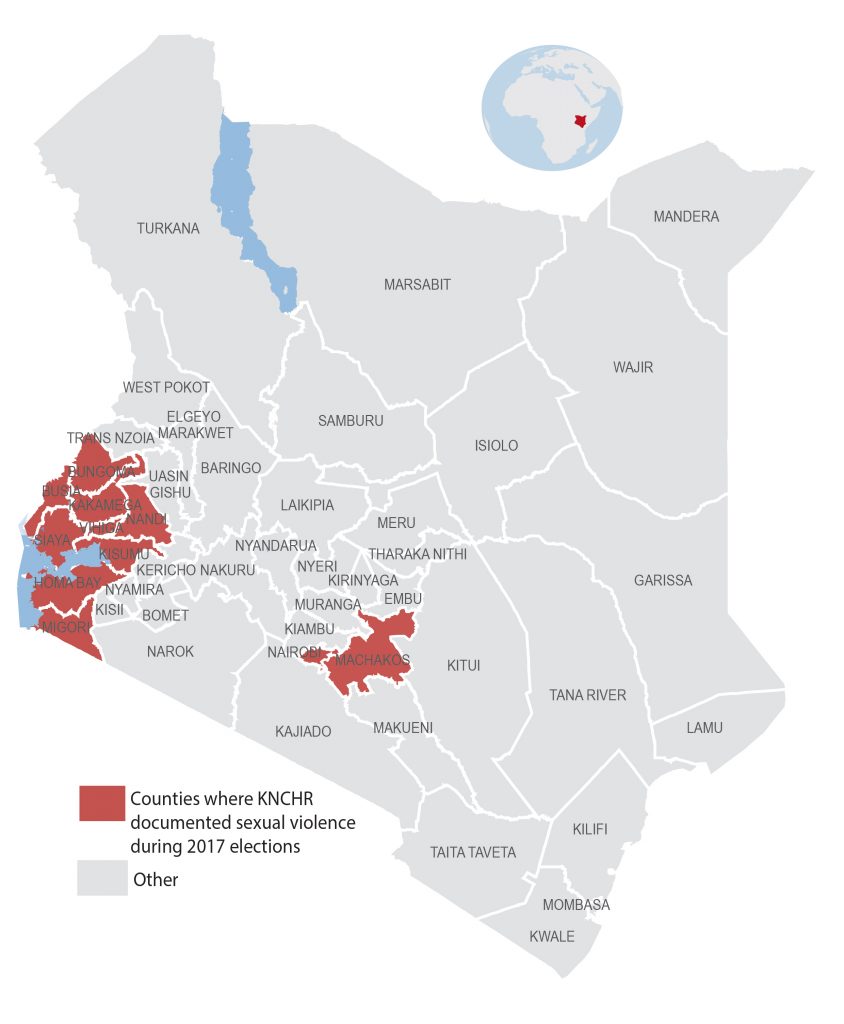
CIPEV provided critical recommendations for reform and was followed by the historic adoption in 2010 of a progressive Constitution with a robust Bill of Rights. Since 2010, an impressive set of laws, policies and standard operating procedures have been developed on prevention and response to sexual violence. Yet, during the general elections held in August and October 2017, within a context of localised violence, large numbers of cases of sexual violence perpetrated by persons in uniform and civilians were again documented. According to the Kenya National Commission on Human Rights (KNCHR), at least 201 Kenyans – most of them women and girls — were subjected to rape and other forms of sexual violence; [4] however the actual figure is likely higher due to under-reporting and the fact that KNCHR documented these in 11 of the 47 counties.

KNCHR, which documented sexual violence during the 2007/08 post-election violence and noted similar patterns in 2017, has characterised ERSV as a premeditated act ‘used as a weapon for electoral-related conflict’.[5] As documented by CIPEV, the Truth Justice and Reconciliation Commission and KNCHR, in Kenya, ERSV has been committed by non-state and state actors, and has targeted political aspirants, their supporters and families, and other civilians, particularly targeting ‘select’ communities owing to their geographical or physical locality and their ethnic origins, which are then directly linked to their perceived political leanings. [6] ERSV is an effort to punish, terrorise or dehumanise communities and individuals, and to influence voting conduct and the outcomes of elections, including by displacing people so that they do not vote. Across different regions and localities in Kenya, common ERSV trends documented in 2007/08 and in 2017 include targeted rape of women and girls following political unrest which forced men to flee, and targeted rape of men and boys. ERSV has also been opportunistic, fueled by a breakdown of law and order and unrest.[7] Ahead of the 2017 elections, there were mass pre-emptive movements of people from their villages due to their fear of being subjected to violence.

Sexual violence is a violation of human rights and fundamental freedoms, and in itself constitutes discrimination.[8] Survivors may suffer the long-term consequences of physical injuries, including fistula and severe vaginal and rectal injuries; sexually transmitted diseases, including HIV/AIDs; unwanted pregnancies; stigma and rejection by family members; psychological trauma, including anxiety and post-traumatic stress disorder; and loss of livelihoods and educational opportunities.

Understanding the particular characteristics of ERSV is important to aid the proper identification of ERSV and monitoring of trends and patterns, hence bolstering measures for prevention and response in future election periods. In addition to the profound consequences of sexual violence, survivors of ERSV have had to contend with immense barriers in reporting violations, accessing protection and pursuing justice.

Geographical distribution of cases of electoral-related sexual violence documented during Kenya’s 2017 elections.
Source: Kenya National Commission for Human Rights (KNCHR)

Rationale for the gap analysis study

While Kenya has strengthened its institutional and legislative frameworks, these did not lead to strengthened prevention of and more effective responses to ERSV during the last elections in 2017. It is against this backdrop that the Office of the United Nations High Commissioner for Human Rights (OHCHR), United Nations Entity for Gender Equality and the Empowerment of Women (UN Women) and Physicians for Human Rights (PHR) jointly conducted a comprehensive gap analysis study to review the institutional weaknesses that undermine effective prevention of and response to ERSV in Kenya. Building on KNCHR’s findings on the scale and patterns of sexual violence observed during the 2017 elections, the objective was to build a body of evidence to identify gaps, document good practices and support the formulation of survivor-centred short- and medium-term measures that should be prioritised by duty bearers, especially in the health, security and legal sectors, for effective prevention and response ahead of the next elections in 2022.

This study recognises that Kenya has a high incidence of sexual violence outside election periods. According to the Kenya Demographic Health Survey (2014), sexual violence during non-election years is prevalent in both private and public spheres, with 45% of women and 44% of men aged between 15 and 49 years having experienced sexual and gender-based violence.[9] For this reason, many of the recommendations formulated in this study apply more generally and can serve to strengthen state interventions in election and non-election situations.

Methodology of the study

The study was conceptualised as a human rights-based assessment of gaps and challenges in the prevention and response to ERSV during the 2017 electoral period. The study was conducted by a multi-disciplinary team of six researchers, including gender specialists, a social scientist, and legal and human rights practitioners with expertise in sexual and gender-based violence, access to justice and reparations. Field research was carried out in Nairobi, Kisumu, Bungoma and Vihiga counties, where 85% of ERSV cases documented by KNCHR in 2017 were recorded.

The research employed quantitative and qualitative methodologies.[10] Quantitative data was obtained through a retrospective review of records of Post-Rape Care (PRC) forms and registers at five public and private health facilities within the four counties – Nairobi Women’s Hospital – Gender Recovery Centre, Jaramogi Oginga Odinga Referral and Teaching Hospital, Makadara Health Centre (private), Mama Lucy Kibaki Hospital and Vihiga County Referral Hospital – within a three-week period in February 2019. The PRC records reviewed covered the immediate pre-election period [1 July to 6 August 2017], election period [7 August to 31 October 2017], and post-election period [1 November to 31 December 2017], to analyse trends in reporting and responses.

A total of 200 participants from the community, public service, law enforcement, health, forensics, justice, development partners, civil society organisations and ERSV survivors were involved in the qualitative study through extensive key informant interviews and 10 focus group discussions. Two workshops were conducted with stakeholders in April and June 2019 to validate the findings and recommendations of the study.

The study benefited from collaboration with a wide range of Government partners, notably the State Department of Gender Affairs under the Ministry of Public Service, Youth and Gender Affairs, the National Police Service (NPS), constitutional and legislative oversight bodies such as KNCHR, the Independent Policing Oversight Authority (IPOA) and the National Gender and Equality Commission (NGEC). It also relied upon the testimonies, insights and guidance from survivors’ networks and women’s rights organisations, notably Grace Agenda and Wangu Kanja Foundation. OHCHR, UN Women and PHR are particularly grateful to the 53 survivors of ERSV during the 2017 and 2007 elections, 44 police officers and 95 Government officials from a wide range of institutions that took part in the qualitative interviews.

During the study, the research team put in place stringent measures to ensure meaningful consultations with and participation of rights holders, affected individuals and relevant duty bearers; prevent and mitigate any potential harm to survivors of ERSV and all participants involved in the study; uphold strict standards of confidentiality and security of sensitive information obtained through the study; ensure informed consent of all participants; and maintain impartiality, objectivity and transparency throughout the study.

The research is part of the efforts of the United Nations in Kenya, in partnership with Government and civil society organisations, to stamp out gender based violence including sexual violence against women and girls and men and boys, and advance protection of their rights. It has been undertaken within the framework of the UN Development Assistance Framework 2018-2022 that the United Nations Country Team in Kenya developed in collaboration with the Government, and the Joint UN-Government of Kenya Programme on Prevention and Response to Gender-Based Violence (2017-2022). This research is also an initiative of the PHR Program on Sexual Violence in Conflict Zones, building on its multi-sectoral engagement with and capacity development of service providers to support meaningful access to justice for survivors.

Click here for a more detailed methodology.

II. Kenya’s Human Rights Obligations on Prevention and Response to Sexual Violence 

The study is anchored in the human rights obligations that bind Kenya to prevent sexual violence, afford protection to survivors, effectively and promptly investigate and prosecute cases of sexual violence, and provide reparations to survivors.[11] Relevant standards are stipulated in international and regional human rights treaties and conventions to which Kenya is a State Party, including the UN Convention on the Elimination of All Forms of Discrimination against Women (CEDAW), UN International Covenant on Civil and Political Rights (ICCPR), UN Convention against Torture and Other Cruel, Inhuman or Degrading Treatment or Punishment (CAT), UN International Covenant on Economic, Social and Cultural Rights (ICESCR), African Charter on Human and People’s Rights (ACHPR), and the Protocol to the African Charter on Human and People’s Rights on the Rights of Women in Africa (Maputo Protocol). CEDAW, ICCPR, CAT, ICESCR and ACHPR have developed practical guidance on ‘how’ states are expected to effectively prevent, protect, investigate and prosecute sexual violence and provide reparations to survivors of sexual violence.[12] These have been used to measure actions taken by the Government of Kenya during the 2017 election period and discuss findings in the report. 

The Constitution of Kenya 2010 has a robust Bill of Rights that safeguards every person’s right not be subjected to ‘any form of violence’ from either public or private sources,[13] as an enforceable right with remedies.[14] It explicitly prohibits discrimination on any grounds, including sex, ethnicity, age and social origin.[15] The Constitution also provides for the right to health, which requires timely, affordable, non-discriminatory access to quality medical assistance for survivors. The right to health includes the collection and management of forensic evidence with the aim of prosecuting cases of sexual violence and providing effective remedies to survivors. Article 38 of the Constitution, read together with Article 81(e), safeguards everyone’s right to exercise their political rights, either as voters or candidates in free and fair elections devoid of violence.

According to the Constitution, international and regional human rights treaties and conventions ratified by Kenya are part of Kenyan law.[16] Under international human rights law, Kenya must adopt and implement necessary legislative, regulatory, institutional and all appropriate measures to prevent, protect, conduct effective and timely investigations, prosecute acts of sexual violence and provide adequate remedies and reparations to survivors of sexual violence,[17] including in elections, committed by State and non-state actors. This obligation is of immediate nature and is to be pursued by all appropriate measures without delay. [18]

Kenya is also bound to adhere to the principles of non-discrimination and ‘do no harm’. The principle of non-discrimination denotes that the rights of survivors must be guaranteed irrespective of their ethnicity, political opinions, health, age, disability, culture and marital status.[19] The principle of ‘do no harm’ denotes that measures undertaken must give priority to the well-being and security of survivors and witnesses of sexual violence and minimise the negative impact of actions to combat sexual violence and its consequences.[20]

Kenya’s human rights obligations continue to apply during periods of unrest or conflict.[21] In fact, electoral periods, which in Kenya are often marred by violence and repeated patterns of sexual violence, require a deliberate effort to implement State obligations with regard to ERSV.

III. Findings of the Study

The findings and recommendations of the study are structured around four areas of State obligations: prevention; protection; investigation, prosecution and ensuring accountability; and access to remedies and reparations.

State Obligations to Prevent ERSV

The State is obliged by human rights treaties and conventions to undertake steps to prevent sexual violence.[22] Specifically, the Government of Kenya is obliged to prevent ERSV through:

  • Taking all appropriate measures to prevent acts of sexual violence the authorities are aware of, or to address the risk of violence;
  • Establishing a system to regularly collect, analyse and publish data disaggregated by type of violence, so as to further develop preventative measures;
  • Developing and implementing awareness-raising programmes with relevant stakeholders countrywide; and
  • Providing mandatory, recurrent and effective capacity-building and training for law enforcement officers to equip them to adequately prevent and address violence.

The study established that Government was hampered in fulfilment of its obligation to prevent ERSV due to: 1) lack of anticipation and planning for the risk of ERSV; 2) inadequate coordination and monitoring in implementation of contingency planning; 3) failure to develop and implement survivor-centred, comprehensive and coordinated awareness-raising programmes countrywide; and 4) lack of mandatory, recurrent and effective capacity-building and training for law enforcement officers.

The Government must implement preventive measures with a survivor-centred approach, and design and implement the measures with the participation of women. The Government is also under a duty to allocate appropriate human and financial resources to effectively implement laws and policies for the prevention of sexual violence. The failure of the State to undertake appropriate measures to prevent acts of sexual and gender-based violence (SGBV), including ERSV, in cases where it is aware or should be aware of the risk of such violence provides tacit permission or encouragement to perpetrate such acts of violence.[23]

Lack of anticipation and planning for the risk of ERSV

The State is mandated to allocate appropriate human and financial resources to effectively implement laws and policies for the prevention of SGBV, including ERSV.[24] Despite patterns of sexual violence in virtually every Kenyan election since the 1990’s, there was a lack of anticipation and planning for the risk of ERSV in 2017 by electoral actors, and resource and capacity gaps in this regard.

The Independent Electoral Boundaries Commission (IEBC), in line with its Strategic Plan (2015-2022) and its Elections Operations Plan (2015-2017), one year ahead of the 2017 elections established a formal partnership with the NPS under its Electoral Security Arrangement Plan (ESAP) to ‘promote and ensure security of campaign periods’ and conduct a ‘joint election risk assessment and response’.[25] However, IEBC’s Strategic Plan and Elections Operations Plan focused on the risks of general violence and did not integrate an assessment of the risk of ERSV. Consequently, the ESAP did not explicitly include a risk assessment of ERSV, and rather focused on the security of electoral materials and candidates, and on tackling the risk of general violence during the election.[26] The IEBC respondents interviewed indicated that they did not have specialized technical gender capacity to undertake thorough contextual analysis and hot spot mapping that would identify possible triggers and ERSV risks against electoral timelines, noting that each phase of the electoral process carries different risks.

The IEBC has a duty to ensure adherence to codes of conduct by political parties, their candidates and members during the electoral period and to take steps to prevent violence and respect human rights.[27] In 2017, IEBC developed a Code of Conduct for nominations by political parties as provided in the Elections (Party Primaries and Party Lists) Regulations 2017. This code, together with three other Codes of Conduct provided in the IEBC Act, the Elections Act and the Political Parties Act, all proscribe violence, harassment and intimidation by candidates and political parties.[28] IEBC established a partnership with the Office of the Director of Public Prosecution (ODPP) to monitor compliance with these codes of conduct. However, due to inadequate resources, the partnership was only operationalised on the day of elections and focused on monitoring at polling stations. It excluded the key phase of the primary elections in April 2017, during which a large number of women candidates experienced verbal and physical attacks, and threats of sexual violence. Women candidates interviewed by the research team observed that threats of sexual violence and sexual assault directed at women during the electoral period often escalate to ERSV and called for such threats and assaults to be prevented and addressed. A woman candidate during the 2017 general elections aptly stated, ’I did not see IEBC monitors or any monitors. As a candidate, I was sexually harassed as my breasts were touched on several occasions during campaigns. Sexual violence escalates from such forms of sexual assault…’.

Political parties have a duty to ensure adherence to codes of conduct, to respect human rights and to publicly condemn, avoid, refrain from, and take steps to prevent violence.[29] Political parties did not establish effective internal dispute resolution mechanisms for receiving complaints of threats and ERSV, and for enforcing compliance with the Political Parties Act code of conduct. Interviewed women candidates indicated their political parties’ dispute resolution mechanisms had high thresholds for evidence, requiring corroboration to address threats of violence, including ERSV, and, as a result, their cases were largely unaddressed. A woman respondent, who was a political party agent during the 2017 general elections, told the research team that she received several threats of sexual violence for being an agent for ‘the wrong political party’ and informed her political party of these threats but did not receive any assistance, although the provision of security is stipulated under the codes of conduct. After a series of such threats, she was raped.

State security officers were deployed countrywide as part of security planning. However, the officers did not receive specific pre-deployment briefings on how to deal with risks of and respond to ERSV. The 2017 general elections saw a massive deploymentof 180,000 officers drawn from the NPS, as well as special police officers deployed as reinforcement from the Kenya Prisons Service, Kenya Wildlife Service, Kenya Forest Services and National Youth Service. NPS general security planning focused on ‘crime prevention and response during electoral period’. NPS respondents noted this would be enough to prepare for risks of sexual violence. Some security officer respondents said, ‘in cases where sexual violence is perpetrated during riots, police contain riots to ensure sexual violence cases are not escalated, as a mitigation measure.’ Senior NPS respondents observed that it was not possible to know where and when ERSV would take place since ERSV is a ‘private crime’, and it did not warrant any kind of specialized mechanisms beyond the general crime mapping. As discussed in the next section on protection, due to this gap in planning for the risk of ERSV, safe corridors were not put in place during periods of containment to enable survivors to seek safety and medical assistance.

Inadequate coordination and monitoring in implementation of contingency planning and absence of ERSV data collection system

The State must, when undertaking appropriate measures to prevent sexual violence, coordinate with relevant actors and undertake regular monitoring so as to enhance the prevention of such violence.[30] The Government is called upon to ensure civil society organisations, including community organisations, directly participate in an ongoing manner in prevention activities and in all stages of the development, implementation and monitoring of action plans.[31]

A National Contingency Plan for the 2017 general elections was developed by the National Disaster Operations Centre, located in the Ministry of Interior and Coordination of National Government. The plan was developed in collaboration with key Ministries, State, non-state, development and humanitarian actors. It was premised on lessons learned from the 2007/2008 post-election violence.[32] The planning process commenced in August 2016, one year before the elections, and was intended to cover the pre-election to post-election period from March to November 2017. The National Contingency Plan acknowledged sexual violence as one of the gaps and challenges to prioritize for preparedness and response,[33] and consisted of four inter-related pillars: early warning and prevention; security and safety; humanitarian assistance; and mass casualty incidents. Key actors working in these four sectors were required to develop specific preparedness and response plans to be annexed to the National Contingency Plan.

However, despite the prioritization of addressing sexual violence, there were challenges and gaps in implementation:

  • Sexual violence was unevenly prioritised in the implementation of the National Contingency Plan (see details in following section on protection);
  • Implementation of the plans was undermined by funding delays, as close as three to four weeks prior to elections (see details in following section); 
  • Due to weak coordination between election observers, such as Uwiano Platform for Peace, and other actors, such as KNCHR and civil society organisations, documented information on risks and actual patterns of ERSV was not integrated in early warning, prevention and contingency plans under the IEBC Inter-Agency Coordination Committee composed of relevant line ministries for information sharing on election security risks.

KNCHR did not receive earmarked Government funding to enable it carry out countrywide human monitoring during the 2017 elections period  but was able to deploy over 100 human rights monitors with financial support from development partners. Whilst NGEC and KNCHR both deployed monitors, they did not coordinate monitoring throughout the electoral period, to exercise their complementary roles as stipulated in the Constitution and in their constitutive Acts.[34] NGEC deployed monitors to implement a tool on the political participation of marginalised groups, but its monitors (two in each of the 47 counties) were not utilised to monitor ERSV.

The State is required to establish a system to regularly collect, analyse and publish data categorized by type of violence so as to further develop preventative measures.[35] The NPS indicated to the research team, however, that while police stations gather data on age, gender and types of gender-based violence, the data is only processed annually for statistical purposes. Thus, data collected during the electoral period was not analysed in real time so as to enhance election contingency plans and early warning systems for the prevention of ERSV.

Failure to develop and implement survivor-centred, comprehensive and coordinated awareness-raising programmes countrywide

The State is obliged by human rights treaties and conventions to develop and implement awareness-raising programmes targeting women and men at all levels of society to prevent sexual violence. Such programmes should provide information on relevant laws, encourage reporting of sexual violence, and provide information on mechanisms available to report acts of violence and measures to protect, assist and support victims.[36]

The study found failure to develop and implement survivor-centred, comprehensive and coordinated awareness-raising programmes countrywide. The study established that while awareness-raising activities were conducted by State actors prior to the election period, activities were:

  • Uncoordinated, resulting in duplication;
  • Not carried out countrywide due to limited resources. Respondents from Government and civil society organisations indicated that their selection of target counties was often based on availability of staff in those counties due to resources constraints. Awareness-raising initiatives were reported to be minimal in Bungoma and Vihiga counties, which saw high prevalence of sexual violence in the 2017 elections;
  • Neither standardised nor comprehensive, and were disseminated late, at times two to three weeks prior to the general elections, due to delayed receipt of donor funding. As discussed in detail in the following sections, awareness-raising materials lacked practical information on several key aspects, such as how to preserve evidence and report cases to the NPS Internal Affairs Unit and IPOA.

Lack of mandatory, recurrent and effective capacity-building and training for law enforcement officers

The State is required to provide mandatory, recurrent and effective capacity-building and training for law enforcement officers to equip them to adequately prevent and address sexual violence. Training should focus on different types of sexual violence and on how to detect and prevent them, and should centre on the rights and needs of survivors.[37]

The study found failure to provide mandatory, recurrent and effective capacity building and training for law enforcement officers. The study established that the Government had instituted efforts to conduct training for law enforcement agencies, but these had challenges and gaps:

  • Trainings conducted for the NPS and security officers drawn as reinforcements from other services largely focused on preparing security personnel in case of riots or demonstrations, and criminal investigation of election offences such as voter bribery, but did not provide operational guidance on their role to prevent and respond to sexual violence;
  • The NPS does not provide training to police officers on how to proactively detect risks for sexual violence, enhance protection during outbreaks of violence or perform other tasks such as escorting survivors to safe places. Police P officers who were interviewed confirmed that their standard basic training focuses on ‘investigation’ and sexual violence is largely treated as any other crime. There are no specific instructions on how to prevent re-traumatisation or management of forensic evidence in the chain of custody during unrest or in the context of late reporting by survivors;
  • The NPS Standing Orders, which contain elaborate provisions on how police officers should receive and act on complaints from survivors of sexual violence, were finalised in July 2017 and therefore were not reflected in training provided before the August 2017 elections;[38]
  • Police respondents indicated that between electoral cycles a number of police officers receive ad hoc specialised training on sexual violence by civil society organisations and UN agencies. However, the content of training is not harmonized, police are not sufficiently consulted to ensure training addresses NPS training needs assessments, and there is no database of police officers who have received specialised training so as to specifically assign them to gender desks in police units.

Good practice: In February 2019, the NPS launched its ‘Standard Operating Procedures on GBV Prevention and Response’ that aims at ‘in-service training for serving police officers and new recruits as a stand-alone program, in all County Police Training Centres and Regional Training Centres’ and ‘establish a database of officers trained in GBV preventive and responsive policing’.


State Obligations to Protect

The State is obliged by human rights treaties and conventions to provide timely, accessible, affordable, adequate, appropriate and efficient measures to protect survivors and individuals at risk for new acts and consequences of sexual violence.[39] Under these treaties and conventions, the Kenyan government is obliged to protect individuals from ERSV through:[40]

  • An effective legislative, policy and regulatory system, with adequate institutional mechanisms and budgetary and human resources for protective measures;
  • Safety and security measures, such as crisis support, rescue and referral centres, safe houses and shelters, and confidential reporting mechanisms to protect victims and their families from stigmatisation and reprisals, regardless of whether they have lodged a legal complaint;
  • Emergency response measures, including 24-hour toll-free helplines, rescue and rapid health care services, crisis counselling, referrals and linkages to comprehensive follow-up services;
  • Comprehensive health care, including sexual and reproductive health care, to address physical and psychological trauma, and medical forensic services;  
  • Legal and socio-economic assistance to support victims and survivors in accessing remedies for ERSV and restoring their livelihoods, including provision of transportation, skill-building training, employment opportunities, education, childcare and affordable housing.

The study found that the State has established various protection measures, but the Government was hampered in its fulfilment of its obligations to protect ERSV survivors by: 1) delays in implementation of laws and national policies; 2) failure to establish safety and security measures for survivors; 3) inadequate preparation of emergency response to ERSV; 4) failure to ensure access to affordable, appropriate, quality and comprehensive health care services; 5) ineffective access to information on availability of protection measures and services; and 6) lack of coordination among stakeholders in the design and implementation of measures for protection and assistance to survivors.

The State has a duty to ensure that protection measures are accessible to all victims and survivors of ERSV, without discrimination on any basis, in all locations. These obligations are applicable at all levels of Government, including within devolved county governments. The Government must, therefore, ensure that county governments are allocated adequate financial, human and other resources to effectively and fully implement protection measures for victims and survivors of ERSV; the Government must retain the authority to require compliance, coordination and monitoring within devolved governments.[41]

Delays in implementation of laws and national policies, resulting in ineffective protection and assistance to survivors

The Victim Protection Act No. 17 of 2014 provides for assistance and protective measures to victims of crime, including security, rehabilitation, health, psychological and psychosocial support, legal services, transport, childcare and other appropriate assistance to manage physical injuries and emotional trauma, facilitate access and participation in criminal and restorative justice processes, obtain reparation, and deal with consequences of victimization.[42] However, the draft Regulations required to operationalize the Act were prepared prior to the 2017 elections, but were not finalised and gazetted.

The Government has not developed operational frameworks to ensure effective implementation of and resource allocation for protection measures outlined in the 2014 National Policy on Prevention and Response to Gender-Based Violence. These measures include safety and security, psychosocial support, socio-economic assistance, legal aid and referral services for victims and survivors of sexual violence.  Further, the Multi-Sectoral Standard Operating Procedures on Prevention and Response to Sexual Violence 2013 are yet to be operationalised to institutionalise follow up and referral mechanisms for medical, psychosocial support and protection services to survivors; thus, referral and follow up are ad-hoc depending on clinicians’ knowledge of other service providers. The Government has also yet to finalise and adopt a policy on the uniform treatment of all sexual offences envisaged under Section 46 of the Sexual Offences Act

Further, the national policies on Gender-Based Violence and Health have not yet been adopted into the laws of the four county governments where the study was conducted, resulting in inadequate resource allocation and provision of protective measures.

Failure to establish safety and security measures for the protection of survivors 

The State has a responsibility to create or fund safety and security measures for survivors of sexual violence. Such measures should be accessible to all survivors and their children or families; be provided at no cost and regardless of whether a survivor has lodged a legal complaint; guarantee absolute safety, privacy and confidentiality; and be sufficiently funded and staffed with competent personnel.[43] ERSV survivors in Bungoma told the research team they refrained from reporting ERSV because of reprisals from perpetrators and due to numerous, repeated and unabated threats or attacks by well-known gangs in the area during the electoral period.

There is no Government-established safe shelter; therefore clinicians indicated that they referred ERSV survivors to safe shelters run by civil society organisations, which can only offer protection for a few days and often lack the capacity or resources to provide protection for survivors together with their children or spouses. In some instances where emergency shelter was available,survivors were fearful of leaving their children behind without anyone to provide them with care, food and security.In some cases, child survivors were referred to borstal institutions/juvenile centres due to the lack of alternative shelters that would be more appropriate for their protection.

Insufficient time, resources and expertise to implement the National Contingency Plan to effectively anticipate and prepare for emergency response for survivors of ERSV

The State has a duty to ensure adequate protection and accessibility of emergency health care and protection services to survivors. This includes the development and dissemination of standard operating procedures and referral pathways to link security actors with service providers offering medical, legal, psychological, and socio-economic assistance.[44] The study found there was a failure to ensure adequate protection and accessibility of emergency health care and protection services to survivors.

The National Contingency Plan required agencies under its humanitarian pillar to work closely with agencies under the early warning, security and health pillars to provide safe access to affected populations and coordinate health services in emergency situations. However:

  • Operationalization of the plan at the county levels through the 8 regional hubs, County Disaster Committees and Steering Groups commenced too close to the elections, leaving insufficient time for effective county risk assessments, planning, adequate training, simulations and coordination with key actors and stakeholders from regions and communities that were likely to be affected;
  • Technical assistance to support provision of protection and emergency response measures for ERSV and other forms of SGBV was not available until September and November 2017, several weeks after the outbreak of election-related violence following the general election in August 2017 and fresh presidential elections in October 2017;
  • Greater attention was placed on mitigating and addressing internal displacement, loss of life, serious physical injuries and destruction of property, in comparison to sexual violence. As a consequence, most of the responses to reported cases of ERSV were reactive and initiated well after the violence had erupted;
  • The national and county contingency plans failed to contemplate the effect of containment (the blocking of roads as a security measure to quell violence in affected communities) on the access of survivors of ERSV to emergency health care, safety and other protective measures. There was no coordination between first responders, humanitarian agencies and security actors to provide safe access into and out of affected communities, and safety for survivors, humanitarian workers and volunteers. A respondent described the chaotic situation, “youth were throwing stones and police were throwing tear gas”. The heavy presence of security personnel instilled fear within the affected communities;
  • The national and county governments did not put in place effective contingency measures for health and psychological support services for survivors of ERSV, in light of the doctors’ and nurses’ industrial strike that was ongoing during the electoral period. Jaramogi Oginga Odinga Teaching and Referral Hospital Gender-Based Violence Recovery Center in Kisumu County was the only one of the four public health facilities reviewed during the research that was operational during the electoral period.

A civil society-based national toll-free helpline, 1195, which is manned 24 hours by Healthcare Assistance Kenya (HAK) provided confidential reporting support to survivors of ERSV.

However, the State did not provide it with additional personnel or resources in anticipation of ERSV cases. HAK responders were overworked some handling 36 hour shifts, lines were reported to have jammed following elections and there were no follow-up mechanism for the helpline to establish survivors received protection, medical and support services.

As a result of these challenges in the implementation of contingency plans, 29 out of 39 survivors who reported ERSV during the 2017 elections and who were interviewed in Bungoma, Vihiga, Kisumu and Nairobi counties were unable to access medical care, and two survivors contracted HIV and other STDs as a consequence of delayed medical treatment. Three of the 39 survivors were minors, and one conceived a child as a result of rape.

Failure to address existing structural, resource and capacity gaps to ensure access to affordable, appropriate, quality and comprehensive health care services, including sexual and reproductive health care, psychological care and medical forensic services.

  • National policies, guidelines, regulations and Standard Operating Procedures for provision of PRC health services have yet to be fully adopted and implemented within Nairobi, Kisumu, Vihiga and Bungoma counties as envisaged under Section 15 of the Health Act No. 21 of 2017. As a result, there were no earmarked or sufficient resources allocated within the budgets of county governments to ensure provision of available, accessible, appropriate and high-quality PRC health services. County governments were heavily dependent on grants from donors for the implementation of health policies, resulting in a heavier focus on areas of donor interest such as maternal health and HIV.
  • Most health facilities do not provide 24-hour specialized, integrated and comprehensive medico-legal services. Survivors who report after 5 p.m. are often received through the casualty ward and only provided with emergency contraceptives, PEP kits and treatment of serious injuries. Most survivors do not return to the facility for follow-up treatment and psychosocial support due to lack of fare. A health professional respondent noted ‘“The return rate for the second visit is at 80%; but by the fifth visit the rate of follow up visits decreases to 28%. Once the survivors complete their PEP dosage and confirm that they are not pregnant or HIV-negative they begin to fall out.’

Good practice: The study established promising strategies for survivor-centred comprehensive medical treatment and follow-up. Nairobi Women Hospital-Gender Violence Recovery Centre reported that it has been able to improve the rate of survivors return to 90% through sustained phone calls, establishment of additional branches to enhance accessibility, and database of network of hospital, state and non-state actors countrywide for referral of survivors for follow up health care, safe shelter and legal aid.

  • Misconceptions that men are incapable of being raped and stigma about being perceived as weak hindered male survivors from reporting violations. “Adult male survivors shy off from reporting ERSV. They are ridiculed at different service points and by their peers. They only come forward when very severely injured, such as a case where a man had his testicles cut off and became suicidal,” stated a hospital administrator in Nairobi. PRC records reviewed confirmed the effect of gender stereotypes, as the records indicated that 5% of the total reported cases involved male survivors.
  • There are regular shortages or complete lack of essential medicines, commodities and equipment for provision of PRC services. Two of the reviewed health facilities reported that they had not had emergency contraceptives for almost five months. Health professionals said they lacked PRC supplies.
  • Respondents reported that survivors are charged for completion of P3 Forms (police forms to be completed by medical officers) by medical examiners in public health facilities, and in some facilities they have to pay for laboratory services and prescribed medication in violation of Section 35 of the Sexual Offences Act No. 3 of 2006, which entitles survivors to receive free medical treatment from public health facilities and gazetted private hospitals.
  • Survivors did not receive ongoing psychosocial support, counselling, or peer and community support to deal with trauma and reduce stigmatization. Health professionals reported that they were only able to facilitate or provide survivors with counselling during HIV testing and follow up on PEP adherence within a three-month follow-up period.
  • The absence of clear and standardised policies and guidelines for provision of abortion services to survivors who became pregnant as a result of rape presents barriers to access to timely and non-discriminatory abortion services. In some cases, there are requirements for pre-authorization, which contradict Article 26(4) of the Constitution. A health care worker reported that clearance from five doctors was required to recommend the provision of safe abortion to survivors who became pregnant from rape: “In some cases, survivors come back to the hospital for post-abortion care after performing back street abortions”.
  • There are inadequate resources for effective collection, documentation and preservation of medical forensic evidence and chain of custody. The five health facilities assessed during the study did not have pre-assembled and standardized rape kits. Health professionals also reported persistent shortages in supply of the comprehensive PRC forms used for standardized examination, collection and documentation of medical forensic evidence. Health professionals were also reluctant to give evidence in court proceedings following completion of PRC forms because they often have to pay for their own transport costs.
  • Lack of harmonization and consistent practice in the completion and use of medical PRC and police P3 forms present challenges to the comprehensive documentation of medical evidence, result in double reporting or conflicting information, and often expose survivors to re-traumatisation when re-examined for the purpose of filling out both forms separately.
  • Due to inadequate resources for training by the Ministry of Health, there is only a small cadre of competent clinicians available to provide post-rape care services, which is inadequate compared to the number of reported cases of sexual violence and even more so during emergency periods.

 Public health facilities lack safe, private and gender-sensitive facilities for examination of survivors of sexual violence. A clinician in one facility described, “When a survivor reports through outpatient, clinical officers have to get one of their colleagues out of the triaging room in order to have privacy while examining the patient… sometimes, I just have to examine the patient in my office.” Another observed challenge within the facilities was that, at times, sexual violence cases are referred to the Maternal Child Unit which creates a barrier to male survivors who would fear reporting their cases in midst of women and children.

Ineffective access to information on availability of protection measures and services

The service provider directory developed and disseminated by UN Women and its partners, including the State Department for Gender Affairs, was only available a few weeks prior to August 2017 due to delayed disbursement of production, hence there was not sufficient time to test and ensure all functional service providers at community level were included in the directory. Respondents reported that some of the service providers’ contacts were not operational during the electoral period.

Absence of coordination, including with community-based actors, in the design and implementation of measures for protection and assistance to survivors.

The absence of coordination resulted in parallel, disjointed and duplicative response efforts being conducted by different organisations, within existing programmes run by County Technical Working Groups, Court Users Committees and the NGEC GBV working groups. Further, the implementation of the National Contingency Plan was heavily driven by humanitarian and development partners, with minimal involvement of community and non-state actors, and assumed that survivors would readily access emergency protection and support services. Human rights defenders, who were the most vital first responders to the majority of ERSV survivors within affected communities, were not effectively utilised by state actors under the National Contingency Plan.

The study also noted promising practices whose effectiveness can be improved upon to address challenges of insufficient resources, inadequate time for planning, weak linkages, lack of knowledge among survivors on response and referral mechanism, well acknowledged by the survivors’ first responders. In Nairobi, the national network of survivors of sexual violence monitored electoral activities and reported signs of risk of violence to the Wangu Kanja Foundation, which collaborated with key stakeholders, including police, County commissioners, churches, and other actors, and provided safe shelters to support access to protective measures for survivors of sexual violence. Also in Nairobi, the Election Observation Group (ELOG) referred cases of ERSV reported by its monitors to the Centre for Rights Education and Awareness, a CSO, which subsequently facilitated survivors’ access to emergency health and psychological care, legal assistance and psychosocial support.

 Kisumu had a promising coordination the  Jaramogi Oginga Odinga Referral and Teaching Hospital and the County Technical Working Group trained community health volunteers and actors to sensitise survivors in affected communities on the importance of reporting and create awareness on health care and other protection measures available through its Gender-Based Violence Recovery Center. Through these community awareness campaigns, several survivors were identified and eventually sought health care. In  Vihiga County, a Red Cross volunteer established base at a shop within an informal settlement that was experiencing violence and ferried emergency contraceptives and HIV post-exposure prophylaxis to survivors using a motorbike through the bushes.

State Obligations to Investigate, Prosecute and Ensure Accountability

The State is obliged to take all appropriate measures to investigate, prosecute and apply appropriate legal and disciplinary sanctions to ensure accountability for violations of human rights, including acts constituting international crimes, as part of the obligation to provide access to effective remedies.[45] The obligation to prosecute and provide adequate remedy for ERSV includes:

  • Effective laws, institutions and a system in place to address sexual violence committed by State and non-state actors.[46]
  • Eliminate barriers to access to justice and guarantee essential components of access to justice for survivors of ERSV such as accessibility; effective, accountable and gender-responsive justice institutions; and just and timely remedies.[47]

The study established that Kenya has an overall impressive legal and institutional framework in place to investigate, prosecute, and establish accountability for sexual violence in Kenya, including during elections and other situations of unrest. However, the Government was hampered in fulfilling its obligations due to: 1) lack of specificity, linkage and a confusing duality in the legal framework criminalising and sanctioning ERSV in Kenya; 2) inaccessibility and unavailability of reporting and complaints response mechanisms to ERSV survivors; 3) failure to conduct survivor-centred, timely and properly resourced investigations; 4) ineffective coordination between investigative agencies; 5) weak linkages with organisations working with survivors; 6) limited specialised prosecution capacity; and 7) lack of effective data collection throughout the criminal justice system.

To date, there have been no completed prosecutions, adjudication and convictions for cases of ERSV arising from the 2017 election period or from the 2007/2008 post-elections violence. Gaps and challenges noted relating to 2007/2008 ERSV persisted following the 2017 elections, and must be addressed urgently to ensure accountability. Accountability is an important element of prevention of future violations.   

Lack of specificity, linkage and a confusing duality in the legal framework criminalising and sanctioning ERSV 

The State is obliged to adopt legislation[48] prohibiting all forms of gender-based violence against women and girls, including by the criminalisation of sexual violence, in line with international standards.  However, under Kenya’s legal framework:

  • There is no definition of ERSV, which hampers the identification and treatment of ERSV as a unique and particular manifestation of sexual violence requiring specific investigation and prosecution, especially in cases of targeted, widespread or systematic sexual violence.
  • The Election Offences Act prescribes lesser penalties for sexual violence in comparison with the Sexual Offences Act, which is the law under which sexual violence is investigated, prosecuted and punished in Kenya therefore creating a duality in punishing sexual violence.
  • The Election Offences Act does not make any linkage with the Sexual Offences Act so as to guide the investigation and prosecution of wide-ranging forms of sexual violence outlined under the Sexual Offences Act, which could be perpetrated and manifest as ERSV.

Inaccessibility and unavailability to ERSV survivors of reporting and complaints response mechanisms

The State is obliged to ensure access to information to support access to justice.[49] The study found that Kenya has robust reporting and complaints mechanisms – such as the Independent Policing Oversight Authority (IPOA), Police Internal Affairs Unit[50] (IAU) and the Witness Protection Agency[51] (WPA) – but there were challenges and gaps in ERSV survivors accessing these mechanisms. 

  • Despite the documented prevalence of ERSV in past elections, there were no specific contingency measures established, such as an ad hoc reporting centre, to facilitate the reporting of ERSV to police during the 2017 electoral period. The majority of ERSV survivors interviewed indicated that police stations or patrol bases were too far from their villages and inaccessible during the period of unrest following the initial announcement of presidential election results.
  • Survivors and community members did not have information on the existence and mandates of IPOA and IAU (a specialised oversight unit within NPS), as special complaints mechanisms available to investigate ERSV perpetrated by police; and on WPA as an available protective mechanism.
  • Prior to the 2017 elections, 49 out of the 53 survivors interviewed were unaware of the existence and mandate of IPOA. Four of the 53 survivors were aware of IPOA as a result of awareness raising by various NGOs. After the 2017 elections, 10 of 49 survivors who were unaware of IPOA became aware of its existence after IPOA investigators approached six of those survivors in Kisumu to follow up on the reports they had made to local police stations regarding ERSV perpetrated by police. None of the 53 survivors interviewed were aware of the existence and mandate of the IAU. IAU investigators indicated to the research team they had not received any reports from members of the public on police-perpetrated ERSV. 44 of the 53 survivors interviewed were unaware of the existence and mandate of the WPA.
  • There were inadequate resources to ensure the operational devolution of IAU to the county level, to improve their accessibility and availability to communities. IPOA has devolved offices in Kisumu and Kakamega counties that also cover Vihiga and Bungoma counties. Avenues for reporting to the IPOA and/or the IAU include telephone, email, mail and reporting at a police station, field office or the Office of the Ombudsman.[52] These avenues are limited and inaccessible to persons who cannot afford mobile telephone airtime or internet costs, or fare to travel to the offices far from their locality.
  • ERSV survivors reported that they were not apprised of the progress of investigations in their cases. Therefore, they were apprehensive that they may not secure justice.
  • Perceived corruption within the police and unaddressed security concerns amongst survivors’ communities also discouraged survivors from reporting ERSV cases to the police.

Failure to conduct survivor-centred, timely and properly resourced investigations

The State is obliged to ensure that investigations are prompt and expeditious;[53] independent and impartial;[54] transparent to allow for public scrutiny and victim participation;[55] thorough and aimed at uncovering the facts of what happened;[56] and capable of identifying and punishing those responsible.[57] Victims ought to be informed of and have access to hearings and all relevant information on the investigation.[58] States must also guarantee that the rules applicable to gathering and using evidence do not discriminate against survivors of sexual violence.[59] 

The study uncovered serious gaps and challenges resulting in an inability to carry out survivor-centred, timely and competent investigations of ERSV cases due to:

  1. Inadequate technical capacity, knowledge and skills within investigative agencies to handle cases of ERSV;
  2. Absence of effective systems, procedures, measures and safeguards to facilitate investigative agencies to undertake effective investigations into police-perpetrated ERSV; and  
  3. Failure to address existing structural, resource and capacity gaps to the conduct of prompt, thorough and effective investigations of sexual violence during non-election years.

Inadequate technical capacity, knowledge, skills and competence within investigative agencies

The State is obliged to establish diverse institutional measures, which are competent and properly resourced, to enforce laws combating sexual violence. Measures include the establishment and adequate funding of specialised units, which are staffed with properly trained and specialised officers.[60] IPOA, IAU and NPS indicated that they had not received specialised and continuous training, and therefore lacked technical capacity, skills, competence and knowledge on distinct forms, types and manifestations of ERSV and the specialised investigations required. This hampered investigations of ERSV following the 2017 elections. The study noted:

  • Investigators from the NPS, IPOA and the IAU placed heavy reliance on reporting by survivors in order to initiate investigations into ERSV. This was regardless of information being available within the public sphere on widespread or systematic ERSV in 2017.[61] Police respondents indicated they could not commence investigations unless a report was filed, as it would amount to “actively engineering reports”. This approach did not take into consideration that the NPS, IPOA and IAU can initiate investigations on their own motion.[62]

In 2018, IPOA proactively visited a number of 2017 ERSV survivors in Kisumu to record their complaints after the survivors filed complaints with different police stations in Kisumu. However, the survivors indicated that since then, IPOA has not shared any feedback.

Similarly, upon receiving instructions from the Inspector General, the NPS Internal Affairs Unit conducted a visit to Kisumu in 2018, drawing on the findings of civil society organisations on ERSV perpetrated by police in 2017, namely Human Rights Watch and the Wangu Kanja Foundation. This resulted in an internal report that recommended further investigations by the Directorate of Criminal Investigations and IPOA.

  • A section of police officers interviewed were unaware of protective and other support measures which are in place for the benefit of ERSV survivors. Nine of the 44 police officers interviewed were unaware of protective mechanisms such as the Witness Protection Act[63] for the benefit of victims of crime, including survivors of ERSV.  Twenty of the 44 police officers interviewed, even though aware of the WPA, were unaware of the procedure to invoke its mandate towards supporting investigation and prosecution of ERSV cases.
  • Some survivors reported having been treated by police officers in an insensitive manner. Survivors were asked distressing and shame-inducing questions by multiple investigating officials and were not allowed to lodge complaints when they could not identify perpetrators. In other cases, they were sent away from police stations once they stated they were reporting cases of ERSV involving police.
  • Contrary to the provisions of the ‘Police Manual’ requiring investigations of crimes regardless of where a report is made or originates, police officers indicated they would only take up investigation of sexual violence that occurred within their own jurisdiction. This does not take into account that survivors – for security or economic reasons – may need to report to their nearest police station, which is not necessarily in the area where the crime occurred.
  • There was a lack of understanding within the investigative agencies that investigations should proceed even if the perpetrator’s identity is unknown. Police indicated such cases are marked pending under investigations, with no movement, unless survivors provide further evidence.  
  • There was lack of knowledge on the specificities of sexual violence occurring during conflict or periods of unrest, including its types, trends, patterns, and the prevailing context within which ERSV occurs. The knowledge is essential for:
  • Conducting thorough and targeted investigations into ERSV and pursuing criminal accountability for commanders under whose command ERSV allegedly occurred within a certain area or locality, when the identity of individual police perpetrators cannot be established. Members of IPOA and IAU who were interviewed stated that in cases where the identity of alleged perpetrators was not known, and where additional evidence had not been availed by the survivor to assist in the identification of the alleged police perpetrators, they were unlikely to pursue investigations owing to the difficulties anticipated in identifying the perpetrators, since Kenya does not have DNA or fingerprint databases. 
  • Not placing the burden of investigations on survivors and requiring them to provide corroborating evidence. Survivors reported that where forensic medical evidence was unavailable, police officers required them to secure corroborating evidence, such as identifying witnesses and bringing them to police stations for the investigations to proceed.
  • Appreciating the physical, mental or socio-economic challenges faced by survivors in reporting ERSV cases within a period during which forensic evidence may be collected.
  • Being cognisant that in situations of unrest, sexual violence may have similar patterns. IAU seemed to lack appreciation that sexual violence during situations of unrest may manifest in similar patterns: some of their investigators questioned the credibility of survivors’ accounts because of these similarities.

Interviewees from the three investigative agencies noted that unaddressed mental health concerns and psychological welfare of investigators working in the investigating agencies affects their ability and capacity to conduct prompt and thorough investigations into ERSV. It is compounded by inadequate training on how to handle the effects of ERSV, and absence of mandatory and regular debriefings. Police interviewees added that the poor socio-economic, living and working conditions of police officers affects their ability, willingness and commitment to undertake prompt, independent, transparent and thorough investigations that are capable of uncovering the facts of what happened, and identifying and punishing those responsible.

Absence of effective systems, procedures, measures and safeguards to facilitate investigative agencies to undertake effective investigations into police-perpetrated ERSV

Respondents from investigative agencies indicated they contend with barriers in conducting effective investigations of police-perpetrated ERSV due to:

  • Absence of effective systems and procedures to handle cases of police officers who fail to or are unwilling to investigate their colleagues owing to comradery amongst police officers.
  • Lack of transparency and information on the deployment of police officers, including reinforcements, during the elections, which hampered the identification of alleged direct police perpetrators and the conduct of investigations. The massive deployment of security officers prior to and during the 2017 election period was largely executed without information being provided to communities,[64] therefore posing challenges in pursuing accountability for police-perpetrated ERSV. Survivors from Kisumu, Vihiga and Nairobi Counties observed that ‘there was a change of guard of police officers who had been working in our areas within a short period before the general elections. New police officers who were not known by communities were brought in.’ In stark positive contrast, it was observed that the police commanders in Homabay County held community dialogues and introduced newly deployed officers to the communities.

Failure to address existing structural resource and capacity gaps to conduct prompt, thorough and effective investigations of sexual violence during non-election years

Lack of adequate financial, human and physical resources to investigative agencies to facilitate the conduct of prompt, thorough and effective investigations of sexual violence during non-elections exacerbated the obstacles of conducting investigations of ERSV. These include:

  • Lack of gender desks or specialised units to handle cases of sexual violence at all police stations. Where available, the gender desks or offices are not always or regularly staffed with police officers who have received specialised training on handling sexual violence cases, including how to undertake effective investigations of ERSV cases.
  • Unavailability of Occurrence Books (OBs), a mandatory tool used by the police to record all incidents of crimes, and mandatory P3 forms used by police officers to request medical examinations of survivors and perpetrators (if available) so as to document medical evidence. Survivors reported being asked for payment to make photocopies of the P3 form, or to download the form from the internet themselves.
  • Lack of knowledge amongst police officers that medical PRC forms can be used in lieu of the police P3 form. The NPS Service Standing Order stipulates that the use of PRC forms suffices in sexual violence cases, but the Police Manual does not reflect this.
  • Absence of designated physical spaces to safeguard the privacy and dignity of survivors of ERSV filing reports at police stations.
  • Lack of facilities and infrastructure for proper evidence storage, leading to the loss or adulteration of evidence in support of reported ERSV cases. IPOA, IAU and the Government Chemist reported cases of improper management of forensic evidence collected by police officers in ERSV cases due to improper storage and handling of exhibits.
  • Lack of support within police stations to provide financial assistance to ERSV survivors to travel to and attend health institutions for the documentation of sexual violence or return for follow up.
  • Negative attitudes, prejudices and stereotypes on ERSV by police officers. Police officers indicated that sexual violence is not treated as a ‘top-priority crime’, as opposed to crimes such as murder.

Weak coordination and cooperation among investigative agencies

The State is obliged to encourage cooperation and coordination amongst all levels and branches of the justice system, including investigative agencies, in order to improve access to justice for victims of ERSV.[65] Coordination and cooperation across investigative agencies were less than optimal due to misconceptions and a lack of understanding of each agency’s mandate to conduct investigations. Some police officers perceived IPOA as ‘against the Police’ and felt that their investigations were not impartial. This affects the officers’ will to collaborate with IPOA on investigations, including investigations of ERSV.

Further, there was no mechanism to formalise effective coordination between investigative agencies and oversight bodies with investigative mandates,[66] such as KNCHR, which has a good reach within communities, is a crucial source of information and is mandated to ‘refer and report cases to relevant agencies for further follow-up’.

Weak linkages and inadequate cooperation with organisations working with survivors

The State must work together with survivors of sexual violence and organisations that work to support survivors, in order to properly consider their views and expertise, as well as access relevant information to improve access to justice for survivors.[67]

The study found a widespread perception within the Police, including the IAU, that NGOs are ‘against the NPS’, hence unwilling to cooperate with the Police. The three investigative agencies expressed frustration that non-state actors, such as civil society organisations and humanitarian agencies, were unwilling to share information which would assist in the conduct of their investigations, but did not appreciate the application of principles of confidentiality and prior informed consent of ERSV survivors.

Cooperation between investigative agencies, especially Police, and survivors and communities is poor due to mistrust. Survivors indicated that they do not trust the Police and stated they would be unwilling to engage with the IAU, perceived as a branch of the Police as opposed to being an oversight body, and with the IPOA, which they believe to be staffed with police officers. Lack of transparency with local communities regarding the deployment of police officers during the 2017 election period also strained relations between the Police and communities, fuelling mistrust and affecting willingness to cooperate with investigators following up on cases that resulted from the violence.

Need for strengthened prosecution capacity

The State is obliged to prosecute cases of ERSV, to ensure accountability for violations and abuses, and provide effective remedies. The study found that there was insufficient capacity and resources within ODPP and the Judiciary, in particular:

  • Limited specialised technical capacity within ODPP, including availability of mandatory specialised training on how to prosecute and undertake prosecution-led investigations on ERSV;
  • Inadequate human and financial resources within ODPP to prosecute ERSV. There is only one specialised SGBV unit in Nairobi, with none at the county level;
  • Lack of a specialised division within the Judiciary to hear and determine cases on sexual violence, including ERSV;
  • Lack of specialised mandatory capacity building on ERSV for the Judiciary;
  • Inordinate delays of more than 8 years in the Judiciary completing hearings and delivering judgements in constitutional cases filed by ERSV survivors from 2007/2008,[68] seeking accountability for violations and reparations for harm suffered.

Lack of effective data collection, monitoring, evaluation and oversight to track progress of cases through the criminal justice system

The State is obliged to establish a system to regularly collect, analyse and publish statistical data on SGBV, including ERSV. This should include data on the number of complaints received; the rates of dismissal and withdrawal of complaints; prosecution and conviction rates; time taken for disposal of cases; sentences imposed; and compensation/reparations provided to survivors. The analysis of data collected should enable the identification of protection failures (including in investigations and prosecutions) and improve and further develop prevention and response measures to ERSV.[69] This obligation requires that all State agencies operating within justice process establish well-conceived, operated and coordinated data collection systems.

The study established that although NPS, IPOA, ODPP, NGEC and the Judiciary collect data on sexual violence cases, this is inadequate because:

  • The various data collection systems are not harmonised nor linked, and do not collect uniform data. Therefore, Kenya has no system in place to track the progress of sexual violence cases throughout the criminal justice system from the point of entry into the system to the conclusion.
  • The data collection systems of NPS, IPOA, ODPP and Judiciary do not disaggregate data on type of ERSV cases and perpetrators.
  • The Judiciary’s data on sexual violence is recorded in its ‘Sexual Offences Case Register’ that only documents cases that led to conviction, as opposed to all cases which are heard and determined by the courts of law.   
  • Data collected by the ODPP, IPOA and IAU is not regularly published or readily available for review by external parties, including survivors, civil society and other Government offices, so as to inform planning for prevention and response initiatives prior to elections.
  • Although IPOA publishes statistics on sexual violence cases received, disaggregated data on locations and perpetrators is only available upon written request. 
  • State actors in the criminal justice system are supposed to provide data on SGBV cases to NGEC’s centralised, integrated data collection and information management system, the Sexual and Gender-Based Violence Information System (SGBVIS).[70] However the system is not up to date because criminal justice actors provide irregular and incomplete updates.

State Obligations to Provide Remedies and Reparations

As part of the obligation to provide access to justice, including adequate, effective, prompt and appropriate redress and remedies, the State is under an obligation to provide reparations for SGBV, including when such acts constitute international crimes.[71] This relates to SGBV when committed by state actors, as well as omissions and failure to prevent, protect and provide access to justice on the part of public authorities. In the absence of reparations, the obligation to provide an appropriate remedy is not discharged.[72] Under international human rights law and standards, the State must ensure that reparations are adequate, proportional to the gravity of the human rights violations and harm suffered, comprehensive, holistic, effective, timely, promptly attributed, transformative, complementary, inclusive and participatory.[73]

The study established that while Kenya has initiated efforts to provide reparations, the following gaps remain glaring:

  • The Government is yet to specifically acknowledge the violations suffered by survivors, the State responsibility in relation to these violations, and the burden and plight that survivors are currently facing.  Government has not initiated yet a process of consultation with survivors in relation to reparations.
  • The draft Public Finance Management (Reparations for Historical Injustices Fund) Regulations 2017 is yet to be adopted, and there are inadequate consultations with survivors and civil society organisations to guide the operationalization of the Restorative Justice Fund. In March 2015, President Uhuru Kenyatta had directed Treasury to set up a KES 10 Billion Restorative Justice Fund (close to 10 Million US dollars) to be utilised for restorative justice processes over a period of three years.[74] The Fund was to be used to ‘provide a measure of relief’ to victims of gross human rights violations, including survivors of ERSV to repair harm and losses suffered but has never been operationalised. In April 2019, President Kenyatta reaffirmed his commitment to the Restorative Justice Fund but stated that the funds would go towards “establishing symbols of hope across the country through the construction of heritage sites and community information centres.”[75]  This declaration excludes important aspects of comprehensive and effective individual reparations for survivors of ERSV, including survivors that bore children of rape and male survivors.
  • The Government gazetted the TJRC report, but excluded Volumes IIA and IIC, which provide lists and details of incidents of sexual violence as gross human rights violations. Parliament has not debated and adopted the TJRC report in full, in particular the section dealing with sexual violence.
  • The Government has failed to respond to the urgent and continuing needs and priorities of ERSV survivors. Interviewed ERSV survivors identified the following pressing measures for reparations:  comprehensive medical care (e.g. for eye injuries due to tear gas used in Vihiga county in 2017); psychosocial support, including for families and communities; support for children born of rape; education for child ERSV survivors whose education were disrupted (e.g. in Bungoma county); compensation for economic losses; and assistance to participate in justice processes. 

The comprehensive and diverse forms of reparations to survivors of ERSV include: restitution, compensation, rehabilitation, satisfaction and guarantees of non-repetition[76]. Compensation should be appropriate and proportionate to the gravity of the violation and the circumstances of each case, recognizing wide-ranging harm faced by survivors, such as: physical or mental harm; lost opportunities, including employment, education and social benefits; material damages and loss of earnings; moral damage; and, costs required for legal or expert assistance, medicine and medical services, and psychological and social services. Rehabilitation, on the other hand, could be through the provision of adequate, available, accessible, acceptable and quality legal, social and health services, including medical, sexual, reproductive and mental health services for the complete recovery of ERSV victims.

Measures of satisfaction may include public and official acknowledgement of the violations and of State responsibility in relation to the acts and omissions, as well as measures to fulfil victims’ right to truth, including in relation to ERSV, official public apologies, symbolic measures, such as commemorations and tributes to survivors of ERSV, as well as measures to bringing to justice perpetrators of ERSV, as well as guarantees of non-recurrence, such as legal and institutional reforms, as well as educational, societal and cultural interventions, among others.

III. Conclusion

Sexual violence surrounding elections has remained a recurrent feature in Kenya’s electoral cycles, which compounds the existing persistent crisis in society. Concrete actions are needed to ensure accountability, address the grievances and meet the rights needs of survivors, and put in place effective preventive measures well ahead of the next elections in 2022. Although the Government of Kenya has made laudable steps towards the establishment of legislative, institutional and other measures aimed at addressing sexual violence, there remain numerous gaps and barriers to effective prevention of and response to ERSV that need to be urgently addressed so that ERSV does not recur in future elections.

In the course of this study, Government officials and institutions have acknowledged gaps in prevention of and response to ERSV in the 2017 elections, and proactively contributed much of the analysis and recommendations set out in this report. The Government, together with human rights organisations, civil society and survivors’ networks, have shown outstanding commitment towards change and have underscored the urgency in breaking the cycle of ERSV in Kenya. It is time to decisively act to address and prevent ERSV in Kenya. OHCHR, UN Women and Physicians for Human Rights stand ready to work side by side with the Government, civil society and survivors in these common efforts.

“We urge the Government to recognize our plight and take swift action to provide us with the needed assistance and access to justice. As victims, we have faith that the Government of Kenya will help us.”

(KB) Survivor of 2017 Election-Related Sexual Violence

IV. Recommendations   

In designing and implementing measures on prevention of and response to ERSV, State actors should ensure strong linkages and cooperation with civil society organisations, women’s organisations and survivors’ networks at all levels.

Prevention

  • Sexual violence should be prioritized – in policy and in practice – for security contingency planning and preparedness ahead of the elections. (IEBC, Ministry of Interior, NPS and County Governments, Political Parties, NGEC, KNCHR)
  • Electoral security preparedness and hotspot mapping should include a dedicated risk assessment on ERSV and specific arrangements for prevention, mitigation and response.
  • Early messaging from electoral and security agencies should emphasize zero tolerance for sexual violence. (IEBC, Ministry of Interior and NPS)
  • All candidates and party leaders should be required to make a public commitment not to tolerate or condone sexual violence. (IEBC and political parties)
  • Enforcement of electoral codes of conduct should be strengthened, including by explicitly listing sexual violence as prohibited conduct and through a formal partnership with relevant state and non-state actors to promptly receive and act on allegations (IEBC and ORPP).
  • Early warning mechanisms established by electoral and security actors should include indicators, expertise and resources to detect and mitigate risks of sexual violence. There should be effective linkages with other state and non-state actors involved in human rights monitoring. Deliberate efforts should be made to proactively and meaningfully consult and engage survivors’ networks, grassroots and community-based organizations. (Ministry of Interior, NCIC)
  • In the budget cycle preceding the elections, budget should be allocated specifically to finance the full spectrum of measures on prevention and should be coordinated at national and county level amongst all relevant key actors. (National Treasury, Parliament)
  • Resources should be allocated for deployment of monitors by KNCHR and NGEC; establishment and implementation of their monitoring should be coordinated. (National Treasury, Parliament)
  • Ensure that voter materials and other awareness-raising tools are developed and disseminated at least one year before elections and contain specific contents relating to ERSV, including how to detect and mitigate risks as well as available reporting mechanisms and medico-legal services. (IEBC, NGEC, KNCHR, NPS, IPOA)
  • Specialised and standardised training should be designed and provided to security agents to underscore their roles and responsibilities to prevent and protect persons at risk of sexual violence. (IEBC and NPS)

Protection

  • Prioritise the adoption of a national policy to guide the implementation of the Victim Protection Act, Sexual Offences Act, Health Act and other relevant laws, and establish an institutional framework for data collection, monitoring, evaluation and enhancement of measures in place for survivors of sexual violence, including in emergency situations. (AG, SDGA, Ministry of Health, Council of Governors)
  • Initiate national contingency planning for protection of communities in ERSV hotspot areas at least one-and-a-half years before the next general elections, to be followed by adaptation of contingency plans at County levels at least one year before the elections. (Ministry of Interior, MOH, GOC)
  • Fast-track full operationalization for effective implementation of the Victim Protection Act, including through the adoption of its Regulations. (AG) 
  • Urgently adopt specific standards and guidelines to ensure consistency, availability and accessibility of abortion services and related public information to all survivors of sexual violence, including ERSV, in accordance with Article 26(4) of the Constitution.
  • Review the 2013 Multi-Sectoral Standard Operating Procedures on Prevention and Response to Sexual Violence to include effective provision of protection and support services to survivors of ERSV and other emergencies in conflict situations. (MOH)
  • Prioritize review and revision of the post-rape care (PRC) form to enhance documentation of circumstances surrounding sexual offences, including additional markers for description of unknown perpetrators involved in ERSV and other conflict-related sexual violence. (MOH, Judiciary)
  • All county governments should prioritize the adoption, adaptation and effective implementation of national health policies, laws, regulations and guidelines on management of sexual violence. This includes the Reproductive Health Policy, National Guidelines on Management of Sexual Violence, Sexual Offences (Medical Treatment) Regulations, the National Training Curriculum and related SOPs. (County governments)
  • Provide enhanced and earmarked minimum threshold of annual budgetary allocation for post-rape care services within relevant Ministries and institutions for effective provision of comprehensive health care, safety, psychosocial support, legal aid and other protection services to ERSV and other survivors of sexual violence. (SDGA, Ministry of Health, Council of Governors, Health Sector Inter-Governmental Consultative Forum)
  • Take deliberate steps to enhance availability and accessibility of appropriate psychological care and psychosocial support to survivors of ERSV and other forms of sexual violence. This includes through compulsory competency-based training curriculums for all cadres of health care professionals providing PRC services; development of Demographic Health Integrated System (DHIS) to monitor mental health care needs and services provided to ERSV survivors in accordance with Part B of the PRC form; enhancing existing referral pathways; and provision of holistic psychosocial support services to survivors. (County governments, national MOH, Kenya Association of Psychologists)
  • Enhance data collection, monitoring, evaluation and quality control of health care, psychosocial support, safety, and other protection and support services offered to ERSV and other survivors of sexual violence, including: through review of DHIS, PRC form and registers to include disaggregation on ERSV cases and indicators related to forensic management of sexual violence cases within the health sector; serialization of the PRC form to facilitate tracking of cases and referrals for protection and support services within and from the health sector to other sectors; and frequent and timely publication of PRC service provided through County-level DHIS. (County governments, national MOH, Kenya Association of Psychologists)

Investigation, Prosecution and Accountability

  • Promote legislative amendments to enhance investigation and prosecution of ERSV, including under the Election Offences Act to proscribe ERSV as an election offence, outlining the specific ‘elements of the crime’ with stiff penalties and formally linking it to the Sexual Offences Act. (Parliament) 
  • Amend the Active Case Management of Criminal Cases in Magistrate’s Courts and the High Court of Kenya, and the 2014 Sexual Offences Rules of Court, to require that all sexual violence cases be expedited. (Judiciary)
  • Establish contingency measures to ensure timely access to justice such as ad hoc, secure reporting centres staffed with Police Officers and officers from IPOA and IAU, within communities. (NPS, IPOA)
  • Strengthen capacity and skills for effective investigation, prosecution and adjudication of ERSV cases including through mandatory, specialised and continuous competency-based training so they handle cases in a survivor-centred and trauma-informed manner so as to secure accountability. (IPOA, IAU, NPS, ODPP, Judiciary)
  • Strengthen training, support and resilience strategies to mitigate vicarious trauma and reduce burn-out experienced by investigators and service providers. (NPS, IPOA, IAU)
  • Enhance financial, human resources and institutional capacity of investigative agencies, prosecution and Judiciary to undertake prompt and effective investigations, prosecution and adjudication of ERSV cases in a survivor-centred manner. (NPS, IPOA, IAU, ODPP and Judiciary)
  • Enhance accountability for police-perpetrated ERSV by including amendments into NPS Service Standing Orders to require that all deployment notices and records contain comprehensive identifying information of all police officers deployed into an area. (NPS)
  • Enhance coordination between investigative agencies, and as well between investigative agencies and oversight agencies, to enhance effective conduct of investigations and well as with other actors to improve accountability for ERSV. (IPOA, IAU, NPS)
  • Enhance coordination between oversight mechanisms such as KNCHR and NGEC, investigative agencies, the ODPP, survivors’ networks, organisations working with survivors and protection agencies. (KNCHR, NGEC, NPS, ODPP)
  • The Police should make a concerted effort towards improving its relationship with the public, including through progress on community policing.(NPS)
  • Consider establishing the Office of the Special Rapporteur on Sexual Violence with enforcement powers, as envisaged in the TJRC report, to enhance data collection, monitoring, evaluation and oversight of justice processes. (National Government)
  • Streamline the use of medical evidence in ERSV cases by amending and harmonising all relevant documents. These include NPS SSO (2017), the Police Manual, 2019 NPS SOPs on GBV,[77] and SOA Medical Treatment Regulations. In particular, documents should be amended to accurately reflect that a PRC form can be completed by a registered nurse, clinical officer or medical practitioner,[78] and P3 and PRC forms are not be a pre-condition to the initiation of investigations in sexual violence cases. (NPS, AG)
  • Enhance timely comprehensive public awareness, especially in communities in rural and remote areas, on access to justice processes and procedures. (NPS, IPOA, IAU, WPA)

Reparations

  • The Government should specifically acknowledge the violations of the rights of survivors of electoral-related sexual violence and commit to a process of consultations with survivors and civil society, including women and human rights organisations by providing support to survivors, in view to inform the design and implementation of reparations measures and programmes. (Office of the President)
  • The draft Public Finance Management (Reparations for Historical Injustices Fund) Regulations 2017 should be adopted to guide the operationalization of the Restorative Justice Fund. (National Government-Treasury, AG)
  • Public official clarifications should be provided on the partial gazettement of the TJRC report, which excluded Volumes IIA and IIC that provide lists and details of incidents of gross human rights violations. Parliamentary debate and adoption of the TJRC report should not be further delayed. (Speaker of Parliament)
  • Design, adopt and implement a comprehensive reparation policy and framework, with specific focus on urgent provision of reparations to ERSV survivors. These should entail a broad range of measures that include: comprehensive mapping of ERSV survivors and consultation with the survivors to document their harms and identify their needs, provision of financial compensation, public and official acknowledgement of State responsibility in the violations and harm, measures of rehabilitation, including medical and psychosocial support, symbolic measures including memorialisation, educational and cultural interventions, as well as legal and institutional reforms adopted as guarantees of non-recurrence. (AG)

[1] Crimes defined in the Sexual Offences Act No. 3 of 2006 (Kenya).

[2] See, for example, the report of the ‘Judicial Commission of Inquiry into Tribal Clashes in Kenya’ in respect of 1992 elections, and volume 11A of the final report of the Truth Justice and Reconciliation Commission (2013) which covered the period from 1963 to 2008.

[3] Final report of the Commission of Inquiry into the Post-Election Violence (2008), pp 237-268.

[4] KNCHR, Silhouettes of Brutality: An Account of Sexual Violence During and After the 2017 General Elections (2018).

[5]Ibid, p. 6.

[6] KNCHR, above note 4, pp 42-50.

[7] Report of the UN Secretary-General on Conflict-Related Sexual Violence, March 2019, S/2019/280

[8] CEDAW/C/GC/35, Para. 21 and CEDAW/C/GC/28, Para.19.

[9] Kenya Demographic Health Survey p. xxiv.

[10] A detailed outline of the methodologies used is available at [insert hyperlink to PHR website]. Purposive and snowballing methodology was utilised for qualitative key informant interviews and focus group discussions. Five health facilities were purposively selected following indication by interviewed survivors that they had sought PRC treatments there.

[11] CEDAW/ C/2010/47/GC.28, under Article 2 of CEDAW; and Principle 6 and Guidelines on Combating Sexual Violence and its Consequences in Africa (Niamey Guidelines) p. 18.

[12] CEDAW General Recommendations no. 19, 28, 33 and 345; ICESCR General Comment no. 12 and ACHPR Guidelines on Combating Sexual Violence and its Consequences in Africa (Niamey Guidelines).

[13] Article 29(c) of the Constitution.

[14] Article 22(1) and Article 23(3) of the Constitution.

[15] Article 27 of the Constitution.

[16] Article 2(5)(6)of the Constitution. 

[17] CEDAW/ C/2010/47/GC.28 under Article 2 of CEDAW; and Principle 6 of Niamey Guidelines.

[18]CEDAW/C/GC/35, Para. 21. 

[19] Niamey Guidelines Principle 4.

[20] Niamey Guidelines Principle 5.

[21] CEDAW/ C/2010/47/GC.28.

[22] CEDAW/C/CR/24; CEDAW/C/GC/19; CEDAW/ C/2010/47/GC.28; CEDAW/C/GC 35/; Maputo Protocol; Niamey Guidelines. 

[23] CEDAW/C/CR/ 24, Para 28; CEDAW/C/ GC/35, Paras. 24(2) (b) and 34(f).

[24] CEDAW/C/GR/35 Para 34(f)

[25] Independent Electoral Boundaries Commission, The Post-Election Evaluation Report, For The August 8, 2017 General Election and October 26, 2017 Fresh Presidential Election, Moving Kenya towards a Stronger Democracy, p. 172.

[26] IEBC (The Post Elections Evaluation Report 2017) p.166, 172-174.

[27] Article 88(4) (j) of the Constitution; Section 4(j) of IEBC Act No.9 of 2011; Section 15 the Second Schedule of the Elections Act No.24 of 2011; Section 48 of Political Parties Act No.11 of 2011.

[28]Article 91(1)(d)(f)(h) of the Constitution; Sections 5(d) (e), 6(a)(b) and the Second Schedule of the Elections Act, Section 7(a)(b) of Political Parties Act.  

[29] Article 91(1)(d)(f)(h) of the Constitution; Section 7(a)(b) of Political Parties Act No. 11 of 2011.

[30] CEDAW/C/CR/ 24, Para 28.

[31] Niamey Guidelines Principle 19.

[32] Republic of Kenya, National Contingency Plan to Manage Possible Effects of 8th August 2017 Electioneering: All-sector inclusive Disaster Management Contingency Plan (National Contingency Plan 2017), page 17.

[33] National Contingency Plan 2017, page 4.

[34] Article 59(1) (2) of Constitution; Section 8 NGEC Act No.15 of 2011; Section 8 KNCHR Act No. 14 of 2011.

[35] CEDAW/C/GR/ 35, Para 34(b).

[36] CEDAW/C/CR/35 Para 30 (b)(ii), Niamey Guidelines Principles 11. 2 and 11.4.

[37] CEDAW/C/CR/ 35, 30; and Niamey Guidelines Principles 14.1 and 15.

[38] National Police Service Standing Orders, Kenya Subsidiary Legislation, 2017 Chapter 67, Section 9(1)(2)(3).

[39] CEDAW/C/GR/19 , CEDAW/C/GR/24;  CESCR/C/GR/14; CESCR/C/GR/22. 

[40] CEDAW/C/GR/19. Para.19; CEDAW/C/GR/24 Paras.11, 15(a) (b) and 21; CESCR/C/GR/14; CESCR/C/GR/22.

[41] CEDAW/C/GR/ 24. Para 11.

[42] Sections 27 -30 of Victim Protection Act No. 17 of 2014.

[43] CEDAW/C/GR/24. Para.21.

[44] CESCR/C/GR/14; CESCR/C/GR/22. 

[45]  CEDAW/C/GC/30, para. 38 (b). Also see the UN Basic Principles and Guidelines on the Right to a Remedy and Reparation for Victims of Gross Violations of International Human Rights Law and Serious Violations of International Humanitarian Law, Resolution adopted by the General Assembly on 16 December 2005, 21 March 2006, A/RES/60/147, paras. 3 and 4( UN Reparations Principles).

[46] CEDAW, arts. 2 (c) and (g); CEDAW/C/GC/35, para. 22, CEDAW/C/GC/35, para. 24 (b).

[47] UN Women, UNDP, UNODC and OHCHR, A Practitioner’s Toolkit on Women’s Access to Justice Programming.

[48] Section 3 of the Interpretation of Terms, Interpretation and General Provisions Act, Chapter 2, Laws of Kenya.

[49] CEDAW/C/GR/33, paras. 17 (d); CEDAW/C/GR/35, para. 43.

[50] Established under s. 87 (1) of the NPS Act (2011). e

[51] Established under the Witness Protection Act No. 16 of 2006

[52] See https://www.ipoa.go.ke/how-to-complain/ [accessed 8 May 2019].

[53] UN Human Rights Committee (HRC), CCPR General Comment No. 20: 10 March 1992, para. 14.

[54] Ibid. Please also see Article 2(3) of the ICCPR and see UN Human Rights Committee (HRC), General comment no. 31 [80] 26 May 2004, CCPR/C/21/Rev.1/Add.13, para. 15.

[55] See the Victim Protection Act.

[56] UN Reparations Principles.

[57] See Encarnación Blanco Abad v. Spain, UN CAT, Views of 14 May 1998, UN doc. CAT/C/20/D/59/1996, para 8.8; Dzemajl v. Yugoslavia, UNCAT, Views of 21 November 2002, UN doc. CAT/C/29/D/161/2000, para 9.4.

[58] See Article 4 of the Istanbul Protocol.

[59] Niamey Guidelines, para. 40(b)(i), (ii).

[60] CEDAW/C/GC/35, paras. 24 (b), 26 (b), 38 (c), 53; CEDAW//GC/33, paras. 4, 39 (a), 51 (c), 54, 56 (a), (b) and (c).

[61] See HRW ‘They Were Men in Uniform’ and KNCHR ‘Silhouettes of Brutality’.

[62]  Section 6(a) of IPOA Act; and Section 87(4) (c) NPS Act.

[63] Section 3A of the Witness Protection Act, No. 16 of 2016.

[64] Kenya Gazette Notice (Vol. CXIX—No. 101, 21 July 2017) did not specify the area of deployment, the commanding officer or any chain of command, thereby making it exceedingly difficult to trace the various special police officers deployed. It is difficult to obtain information at local police stations on the identity of the various officers deployed in a particular area, since a majority have only been deployed for the specific purpose of the election.

[65] CEDAW/C/GC/35, para. 48.

[66] Sections 8(c), (d), (e) and 29(1) KNCHR Act (2011); Sections 8 (f), 29 (1) and 30 (b) NGEC Act (2011); and Sections 8 (a) and (b), 29 (1) and 30 (b) CAJ Act (2011).

[67] CEDAW/C/GC/35, para. 48.

[68] Constitutional Petition No. 273 of 2011 (CP 273/2011); Constitutional Petition No. 122 of 2013 (CP 122/2013); and, Constitutional Petition No. 15 of 2014.

[69] CEDAW/C/GC/35, para. 49; CEDAW/C/GC/33, para. 20 (d).

[70] NGEC SGBVIS is accessible at http://sgbvis.ngeckenya.org/login.php.

[71] UN Basic Principles and Guidelines on the Right to a Remedy and Reparation (2005), para. 2 (c); CEDAW/C/GC/28, paras. 32, 37 (b); CEDAW/C/GC/33, para. 51 (a); CEDAW/C/GC/35, paras. 23, 24 (b), 26 (a), 53; UNSG Guidance Note on Reparations for Conflict-Related Sexual Violence, available at: https://www.ohchr.org/Documents/Press/GuidanceNoteReparationsJune-2014.pdf.

[72] CEDAW/C/GC/28, para. 32.

[73] CEDAW GR 33, para. 19 (b); CEDAW GR 35, paras. 29, 46 and 47; CEDAW GR 30, para. 81; and UNSG Guidance Note on Reparations for Conflict-Related Sexual Violence, pp. 1, 6, 8, 10 – 12.

[74] Speech by His Excellency Hon. Uhuru Kenyatta, during the State of the Nation Address at Parliament Buildings at para. 83 (26 March 2015), available at http://www.president.go.ke/2015/03/26/speech-by-his-excellency-hon-uhuru-kenyatta-c-g-h-president-and-commander-in-chief-of-the-defence-forces-of-the-republic-of-kenya-during-the-state-of-the-nation-address-at-parliament-buildings-na/.

[75] Speech by His Excellency Hon. Uhuru Kenyatta, during the State of the Nation address at Parliament Buildings 4 April 2019), available at: http://www.president.go.ke/2019/04/04/speech-by-his-excellency-hon-uhuru-kenyatta-c-g-h-president-of-the-republic-of-kenya-and-commander-in-chief-of-the-defence-forces-during-the-2019-state-of-the-nation-address-at-parliament-building/.

[76] UN Reparations Principles paras. 19 – 23; CEDAW/C/GR/28, para. 32; CEDAW/C/GR/33, para. 19 (b) and (e); CEDAW/C/GR/35, paras. 26, 46 and 49; UNSG Guidance Note on Reparations for Conflict-Related Sexual Violence, pp. 5 – 6 and 15 – 20. See also A/69/518, Report of the Special Rapporteur on Truth, Justice, Reparations and Guarantees of Non-Recurrence on reparations for gross human rights violations and serious violations of international humanitarian law.

[77] As contained in the NPS SSO (2017), Chapter 42 – Guide to Criminal Investigations, para. 3 (5).

[78] As contained in the NPS SSO (2017), Chapter 42 – Guide to Criminal Investigations, para. 3 (5).

Blog

‘The Lady’ is a Liar: Suu Kyi’s Genocide Whitewash

“Rohingya civilians.” That’s the phrase conspicuously absent from Myanmar State Counselor Aung San Suu Kyi’s 3,500-word statement to the International Court of Justice on Wednesday. The omission is no accident.

Suu Kyi’s highly anticipated ICJ appearance was to answer to The Gambia’s official complaint of Myanmar’s violations of the United Nations’ 1948 Genocide Convention, linked to the extreme military abuses against Muslim Rohingya civilians. Yet her judicial defense strategy studiously avoided any mention of civilian suffering.

Instead, Suu Kyi – the 1991 Nobel Peace Prize laureate – peddled the Myanmar military‘s long-discredited narrative that its activities in northern Rakhine state in August 2017 constituted legitimate “clearance operations” in response to attacks on police posts, allegedly perpetrated by an insurgent group. According to Suu Kyi, what transpired was merely “an internal armed conflict started by coordinated and comprehensive attacks by the Arakan Rohingya Salvation Army, to which Myanmar’s Defense Services responded.”

Unfortunately for Suu Kyi, that narrative is at odds with voluminous evidence compiled by the United Nations’ Independent International Fact Finding Mission on MyanmarPhysicians for Human Rights (PHR), and other rights monitors. That documentation demonstrates a vicious, widespread, and systematic targeting of Rohingya civilians by security forces in a weeks-long violence spree that began on August 25, 2017. That’s when security forces attacked hundreds of Rohingya villages, massacring thousands of their residents, gang-raping thousands more, and burning their homes to the ground.

As of January this year, the violence and ongoing abuses had killed at least 10,000 Rohingya civilians and prompted about 740,000 others to flee for their lives to Cox’s Bazar in neighboring Bangladesh, where they remain. Some 600,000 Rohingya civilians still in Rakhine state remain at risk of further genocidal acts, according to the UN’s Fact-Finding Mission.

Suu Kyi’s claims of judicious and lawful use of force by the Myanmar military flies in the face of compelling evidence of egregious brutality inflicted on Rohingya civilians. The results of a quantitative survey conducted by PHR of 605 surviving Rohingya community leaders in Bangladesh published in March paints a grim picture of the terror inflicted by Myanmar security forces. Most respondents identified the military and the official Border Guard Police as the security forces who deployed “military assets, including helicopters, military trucks, and tanks” against defenseless Rohingya men, women and children in August 2017.

But Suu Kyi made clear that she was not in The Hague to focus on facts.

Instead, she contended that the Myanmar military had strenuously sought to “minimize the risk of collateral damage” in their operations. Even worse, she sought to malign the integrity of The Gambia by asserting that its ICJ genocide complaint constituted “an incomplete and misleading factual picture of the situation in Rakhine state.” Suu Kyi salted this slight by suggesting that foreign states were incapable of informed and balanced assessments of these atrocities because “the situation in Rakhine is complex and not easy to fathom.”

What Suu Kyi failed to mention is that her government has consistently blocked outside scrutiny of the 2017 bloodshed by prohibiting international organizations seeking to investigate the slaughter from accessing the area. The government has also blocked the United Nations Special Rapporteur to Myanmar, Yanghee Lee, tasked with assessing the human-rights situation in the country, from undertaking a credible investigation into the violence. In 2017, the government placed restrictions on an official fact-finding mission led by Lee that she described as an “affront to the independence of my mandate.” That December, the government announced it was denying her access to the country.

Instead, Suu Kyi sought to assure the judges in The Hague that her government and the Myanmar military are best placed to ensure accountability for the violence of late 2017 in northern Rakhine. Specifically, she touted the capacity of Myanmar’s very own so-called Independent Commission of Inquiry to ensure justice is done. She neglected to mention that the ICOI discredited itself as a state whitewash operation when it reported in December that it “had found no evidence so far to prove the widespread allegations that government security forces committed mass human-rights abuses.”

Suu Kyi’s patent falsehoods and doublespeak would be laughable if the stakes were not so high. Without meaningful accountability for the crimes of 2017, there is no possibility of a safe, voluntary, and dignified return of the hundreds of thousands of Rohingya refugees who have taken refuge in Bangladesh.

Those Rohingya won’t return to Myanmar while their military victimizers roam free with the explicit approval of a government that refuses to utter the word “Rohingya” and continues to justify their mass extermination as a reasonable response to “terrorist activities.”

Suu Kyi’s shameful performance in The Hague makes clear that she and “her father’s army” are resolutely unwilling to impose accountability on themselves. That failure only reinforces The Gambia’s case at the ICJ that Myanmar’s crimes against the Rohingya require a substantive international judicial response to ensure accountability for past atrocities and to help deter future abuses.

Originally published in Asia Times

Multimedia

Video: “Because We Are Doctors”

How Syrian Health Workers Became a Target for Arrest and Torture

Syrian doctor “Youssef” was treating a patient in the hospital when state security forces arrived and arrested him. He is one of countless health workers who provided care to the wounded, only to be arrested, detained, and tortured by the Assad regime.

Physicians for Human Rights (PHR) conducted an investigation into the purposeful, illegal, and brutal strategy by the Syrian government to commit these targeted atrocities against medical workers, effectively criminalizing their delivery of health care to the sick and wounded. PHR clinicians conducted in-depth interviews and structured psychological assessments of 21 formerly-detained Syrian health professionals, including “Youssef”, providing new insight into how the Syrian government has grotesquely punished health workers for carrying out their professional duties.

Read the full report: “My Only Crime Was That I Was a Doctor”: How the Syrian Government Targets Health Workers for Arrest, Detention, and Torture


This report is supported with German Federal Foreign Office’s funds by ifa (Institut für Auslandsbeziehungen), Funding Programme zivik.

Report

“My Only Crime Was That I Was a Doctor”

How the Syrian Government Targets Health Workers for Arrest, Detention, and Torture

Executive Summary

In 2011, the Syrian government cracked down with extreme violence on mass popular protests calling for sweeping economic and political reform after more than 50 years of dictatorship. The anti-government opposition responded to that repression by organizing both political and military resistance to the Syrian regime. By mid-2012, Syria was experiencing a full-fledged internal conflict.[1] For the past eight years, the Syrian government and its allies have sought to systematically extinguish dissent through every means at their disposal, a strategy that has entailed massive human rights violations. The conflict has killed hundreds of thousands of civilians and displaced more than half of Syria’s population internally and across the country’s borders. The Syrian government has prosecuted the war by intentionally targeting civilian populations in restive areas and any perceived opposition supporters. It has imposed sieges on opposition-held areas,[2] shelled and bombarded densely populated urban centers, and conducted a campaign of arrest, torture, and enforced disappearance of suspected insurgents and their supporters that has laid waste to much of the country and sparked an exodus of millions of Syrians seeking refuge in neighboring countries and beyond.[3]

The Syrian government and its allies have also systematically targeted health facilities and health workers as part of a wider strategy of war aimed at breaking civilian populations and forcing them into submission.[4] Since the beginning of the conflict, Physicians for Human Rights (PHR) has documented 583 attacks on health facilities; the Syrian government and its allies have been responsible for carrying out more than 90 percent of these attacks.[5] Through their purposeful assault on health, the Syrian government and its allies have systematically denied access to medical care in areas outside of their immediate control and actively persecuted health workers who, in adherence to their professional ethics, courageously provide such care to the sick and wounded, including opposition supporters.[6] The Syrian government has blatantly disregarded special protections afforded to medical units and personnel under international humanitarian law and has branded health workers – who provide nondiscriminatory health care in line with their legal and ethical obligations – as enemies of the state.

While much documentation and data have been presented to policymakers and the public regarding the relentless bombing and destruction of health facilities,[7] less is known about the experiences and suffering of health personnel who have been targeted for their medical work during the conflict. For this report, PHR clinician researchers conducted semi-structured interviews and brief structured psychological assessments between June and August 2019 with 21 formerly detained Syrian health care workers, of whom two were women and 19 were men. These included people working in a wide range of health sectors: physicians (seven), pharmacists (four), medical volunteers (three), paramedics (one), and psychiatrists (one). While other parties to the conflict – including non-state armed groups – have perpetrated crimes, including arbitrary detention, this report focuses on detentions carried out by the Syrian government in order to provide further insight into its strategy of systematic targeting of health infrastructure and personnel throughout the conflict. While more data may be necessary to generalize knowledge about the targeting of Syrian health care workers since the start of the conflict in 2011, this report illustrates how the Syrian government has effectively criminalized the provision of nondiscriminatory care to all, regardless of political affiliation.

PHR research focused on the following key issues: To what extent, if at all, were health workers targeted for detention and ill-treatment due to their provision of nondiscriminatory care and other efforts to support the provision of care? What were their experiences in detention and what types of ill-treatment, if any, were they subjected to? What was the impact of the detention and ill-treatment of health workers on their decision to leave Syria, and their willingness to practice in their field, and on their desire to potentially return to Syria?

The study reveals that the majority of the formerly detained health workers interviewed by PHR were arrested by Syrian government forces specifically because of their status as care providers, and their real or perceived involvement in the provision of health services to opposition members and sympathizers. Through examination of health workers’ experiences in detention, the report shows the link between their involvement in the provision of nondiscriminatory health care and their arrest, imprisonment, and ill-treatment in detention. Although the interviewees’ detention experiences differed, their accounts point consistently to the Syrian government’s system of detention, interrogation, and torture of those providing health care, or supporting access to health care, for perceived opponents. The health workers whose experiences PHR has documented are among the many who continue to provide and enable health care, despite the associated risks. This report details the price they paid for doing so, while recognizing that they are among those fortunate enough to have survived Syrian government detention facilities.

In most of the cases documented in this study, Syrian security forces inflicted torture on detainees as an integral part of the interrogation process. Interviewees reported that Syrian security forces regularly beat, humiliated, and subjected them to stress positions. In some cases, they were burned, shocked with electricity, and sexually assaulted. Interviewees described an interrogation process aimed to force “confessions” to activities considered treasonous under the Syrian Counter-terrorism Law 19 (2012),[8] as well as to gather information on other health workers and health care activities. In many cases, interrogations centered on the interviewees’ involvement in medical work. Syrian government interrogators and torturers accused many of the former detainees of working in or establishing field hospitals, providing medical treatment and material support to “terrorists,” and other acts considered to be subversive. Many of the interviewees who appeared in Syrian courts were confronted with confessions extracted under torture and reported that they were accused by judges of having been involved in providing or supporting medical care to “terrorists.”

Several interviewees reported long-term health consequences due to lack of access to medical care in detention after torture. In all cases, the interviewees were subjected to inhumane living conditions within detention: overcrowding; lack of sanitation; lack of access to food, water, toilets, and medical care; and lack of ventilation. The conditions described may also constitute ill-treatment and, in some cases, torture. The lack of medical care prompted some of the interviewees to provide health services to others in detention, even as they witnessed the deadly consequences of torture, abuse, and poor conditions, and often felt powerless in the face of disease and injury.

Based on voluminous documentation of the Syrian Government’s violent targeting of the health sector and its systematic use of detention and torture to suppress perceived dissent, Physicians for Human Rights finds that the Syrian government has violated both national and international laws as well as basic medical ethics and the obligation to care for the sick and wounded without discrimination in all circumstances. In this report’s recommendations, Physicians for Human Rights calls upon:

  • Parties to the conflict, particularly the Syrian government and affiliated forces, to immediately and unconditionally release all arbitrarily or unlawfully detained individuals and allow unconditional access to official and unofficial detention sites;
  • The Syrian government to respect the rights and dignity of all Syrian citizens, and particularly health workers on whom the country’s civilian population relies;
  • United Nations member states, regional bodies, and the international community to hold the Syrian government accountable for its human rights and international humanitarian law violations.

Dr. Youssef: A Surgeon Tortured for Supporting “Terrorists”

Dr. Youssef’s interrogators repeatedly asked him about the medical point network he had helped to establish and the network’s members. Interrogators told him they detained him for supporting “terrorists” and working against the regime.

Dr. Youssef was in his fourth year of surgical residency when the conflict in Syria erupted. He joined several friends to create an anonymous network of volunteers who established medical points[9] to treat individuals who were injured while peacefully protesting.

On August 21, 2011, seven plainclothes security officers arrested Dr. Youssef as he was treating a patient in a hospital in the Qalamoun region north of Rural Damascus governorate. They took him to the al-Nabek State Security Branch. There, the authorities took his personal effects, strip-searched him, and confined him in a 1-by-1.5 meter cell for the next 69 days. He was not charged or given any reason for his arrest and was not allowed to contact his family or seek counsel. State security authorities interrogated and tortured Dr. Youssef daily for periods of between one and three hours. The interrogators had detailed knowledge of his activities, including awareness of jokes he had told to certain individuals on specific days. Dr. Youssef’s interrogators repeatedly asked him about the medical point network he had helped to establish and the network’s members. Interrogators told him they detained him for supporting “terrorists” and working against the regime. The severity of the torture increased in each session. The initial torture sessions consisted of his interrogators beating his stomach and legs with heavy electric cables. They later applied electricity to his genitalia and administered electrical shocks to his body while he was submerged in water. They threatened to hang him on three separate occasions. Despite the constant torture, Dr. Youssef continued to deny all charges, both fabricated and real, in order to protect himself, his colleagues, and his friends.

A month into his detention, an interrogator told Dr. Youssef that authorities had already detained his colleagues, mentioning them by name. The guards nevertheless continued to torture him, apparently solely to punish him. They beat the soles of his feet with thick plastic pipes filled with concrete. He eventually confessed to various activities he was accused of having been involved in, including providing support to protesters, on the express condition that his captors improve the conditions of his detention. The authorities required that he write his confession three separate times.

On the 69th day of his detention, the authorities moved Dr. Youssef to a larger cell within al-Nabek State Security Branch for two weeks before transferring him to the General Intelligence Branch in Kafarsouseh, Damascus. At the end of these two weeks, and after almost three months of detention in intelligence facilities without charges, he was transferred to Adra Civilian Prison north of Damascus. In Adra, Dr. Youssef had more regular access to food, and could communicate with his family for the first time since his arrest. The authorities finally filed formal legal charges against him in the Civil Court of Damascus and subsequently released him on bail in December 2011 without rendering a verdict.

In September 2013, Dr. Youssef learned from members of the opposition that they had information from an agent working with an intelligence branch in al-Nabek that the authorities intended to re-arrest him. He immediately left for opposition-controlled Idlib, where he began working in a field hospital. In August 2014, Dr. Youssef left for Türkiye. While he is not able to practice medicine in Türkiye, he has continued to provide administrative and programmatic support to the medical sector inside Syria.

Dr. Youssef was arrested while treating a patient at a hospital north of Damascus. He was detained and tortured for a year on charges of supporting “terrorists.”

Introduction

Physicians for Human Rights (PHR) has – through a rigorous methodology, that includes English and Arabic open-source research and field source corroboration – verified and mapped attacks on medical facilities and medical personnel by all parties to the conflict since 2011.[10] By early September 2019, combatants had inflicted 583 attacks on at least 350 medical facilities.[11] By PHR’s assessment, the Syrian government and its allies are responsible for 90 percent of those attacks.[12] The systematic targeting of health facilities and health workers has been a crucial component of a wider strategy of war employed by the Syrian government and its allies to force civilian populations into submission.[13] Through its purposeful assault on health, the Syrian government and its allies have systematically denied access to medical care in areas outside of their immediate control and actively persecuted health workers who, in line with their professional ethics, provide such care to perceived opposition supporters.[14] The Syrian government has intentionally targeted Syrian health workers providing nondiscriminatory health care as enemies of the state. It has explicitly equated health workers who provide nondiscriminatory care with “terrorists”[15] who can and should be detained, tortured, and killed.[16] Through in-depth qualitative interviews with 21 formerly detained health workers, the following report provides evidence of the link between their arrest, imprisonment, and ill-treatment and their engagement in the medical field.

Background

Overview of the Conflict

In February 2011, small-scale protests broke out in Syria opposing corruption, raising economic grievances, and calling for democratic rights and for the release of political prisoners. The largely peaceful protests expanded in March, when thousands of Syrian citizens in multiple locations across the country assembled in the streets, demanding sweeping economic and political reforms and adopting anti-government slogans.[17] The Syrian government responded with a violent crackdown that fueled wider protests.[18][19] At the end of April 2011, the Syrian government conducted its first large-scale military operation[20] in what would become a full-fledged campaign to suppress dissent. Toward the end of summer 2011, the opposition began to organize itself into distinct political groupings.[21] Those factions in turn organized their own military wings, bolstered in numbers by mass defections from the Syrian Arab Army as well as by a growing stream of foreign fighters.[22] By July 2012, hostilities in Syria had transitioned from an insurgency to a full-fledged internal conflict.[23] The number of armed groups grew, and many sought and began receiving material and operational support from foreign states with widely diverging agendas.[24]

As armed anti-government groups proliferated, the violence increased exponentially. The Syrian government deployed a strategy that appeared primarily to target civilian populations of restive areas and any suspected opposition supporters. It imposed sieges on opposition-held areas,[25] shelled and bombarded densely populated urban centers, used chemical weapons to target civilians, established extensive networks of security checkpoints, and led a widespread campaign of arrest, torture, and enforced disappearance of suspected insurgents and their supporters.[26] The Syrian government’s practices drew international condemnation, including through UN Security Council resolutions 2042,[27] 2118,[28] and 2139.[29]  Anti-government armed groups perpetrated similar abuses, albeit on a significantly smaller scale.[30] Despite the scale and intensity of the Syrian government’s repression and its effective monopoly on air power during the early phases of the war, by early 2015 it appeared to be drifting toward defeat[31] with large tracts of territory falling to a variety of armed groups, including the self-declared Islamic State (ISIS). In September 2015, Russia intervened in support of the Syrian government, tipping the scale in its favor while compounding civilian suffering.[32] The Syrian government and its allies, through relentless coordinated air and ground offensives, have since been able to recapture most opposition-held areas. As of the writing of this report, northwestern Syria (primarily the northern part of Hama and the entirety of Idlib) is the only area that remains under anti-government armed group control and has been the target of a concerted air campaign since April 2019.[33]

By some estimates, the Syrian conflict has claimed the lives of more than half a million people.[34] The Syrian Observatory for Human Rights reports at least 372,000 documented deaths by August 2019,[35] an estimated third of whom were civilians. More than half of Syria’s pre-war population of 22 million has been displaced internally or has fled the country as refugees since 2011.[36] The conflict has led to one of the most complex and dire humanitarian situations in recent history, with an estimated 11.7 million people currently aid-dependent for basic subsistence.[37] Attempts by the United Nations and UN member states to end the Syrian conflict have repeatedly failed.[38] Prospects for a negotiated settlement remain unlikely, given that the Syrian government and its allies can justifiably perceive the relative success of a military strategy premised on egregious violations of human rights and basic international norms.[39]

Detention, Torture, and Ill-treatment

Among the host of harrowing abuses that have defined the Syrian conflict, arbitrary detention, enforced disappearance, and torture of Syrian civilians – primarily perpetrated by the Syrian government – are notable for their frequency and gratuitous cruelty. International and national human rights organizations and independent bodies mandated to investigate alleged human rights violations have extensively documented the Syrian government’s routine practice of arbitrary detention and torture of civilians.[40] That documentation reveals an industrial-scale Syrian government incarceration apparatus that has enabled the detention, interrogation, torture, extrajudicial execution, and disappearance of tens of thousands of civilians perceived as opposition supporters or as insufficiently loyal to the regime.[41] That apparatus is in many respects a natural extension of a system that has been in place since the inception of the Ba’athist regime,[42] largely facilitated through the powers conferred on security forces by the establishment of a perpetual state of emergency[43] and legislative decrees that provide security forces full immunity.[44]

In 2011, anti-government protests caused the Syrian government to expand the detention system to stifle growing dissent. The Counter-terrorism Court, established by the 2012 Counter-terrorism Laws,[45] provided judicial cover for a campaign of mass-arrests.[46] As of the end of August 2019, information from the United Nations’ Independent International Commission of Inquiry on the Syrian Arab Republic (IICOI) and Syrian human rights monitors suggests that the number of people detained since 2011 – mostly at the hands of the Syrian government – now exceeds 100,000.[47]

The Syrian government incarceration apparatus has enabled the detention, interrogation, torture, extrajudicial execution, and disappearance of tens of thousands of civilians perceived as opposition supporters or as insufficiently loyal to the regime.

The IICOI has determined that most detainees of the Syrian government are being held without due process and denied access to their families and to legal representation.[48] The commission states that detainees

“… endure various forms of brutal torture and subsist in severely inhumane conditions. Many have died in detention, while others have been summarily executed. The bodies of those who have died as a result of torture, neglect, inhumane conditions, or from executions are rarely returned to their families, who are also not notified about burials.”[49]

In its February 2016 report on deaths in detention in Syria, the IICOI concluded that Syrian government forces committed crimes constituting a “systematic and widespread attack against a civilian population”[50] through their conduct of mass arrests, enforced disappearance, and subsequent ill-treatment and killing of detainees. The IICOI further concluded that the Syrian government is responsible for crimes against humanity and war crimes linked to detention.[51]

While the Syrian government and its allies have been responsible for the majority of violations in the conflict, non-state armed groups have also perpetrated crimes, including arbitrary detention under brutal conditions, torture of detainees, and summary executions of perceived government supporters, humanitarian workers, and activists, among others.[52] A range of anti-government armed groups have also been implicated in such acts, including Hayat Tahrir al-Sham (HTS, previously Jabhat al-Nusra),[53] Kurdish forces (forces associated with the Democratic Union Party),[54] and ISIS.[55] The actions of these and other armed groups in depriving civilians of their liberty are reprehensible and rise in some cases to the level of war crimes.[56] While the larger issue of detention practices by non-state armed groups lies outside the scope of this report, the interviews on which the report is based demonstrate the widespread and systematic use of ill-treatment and torture of health care workers in Syrian government detention facilities.

Doctors treat a wounded man in a field hospital in the opposition-held city of Qusayr in July 2012. Most of the health workers interviewed by PHR said they were detained and tortured by Syrian government forces because they provided health care, or supported access to care, for perceived opponents.
Photo: Antonio Pampliega/ AFP/Getty Images

Methodology

Sampling Strategy

Physicians for Human Rights (PHR) used chain, or snowball, sampling to identify potentially eligible health workers for this study. While this method does not lead to a representative sample, it constituted the only sampling option that allowed for effective contact with eligible participants with whom outreach is otherwise extremely difficult. In addition, utilizing established networks and existing relationships helped with the development of necessary trust among potential participants, given ongoing threats to health care workers and medical communities remaining in Syria. The team sought to form as representative a sample as possible by engaging a wide variety of different professional groups within the health sector and individuals with links to a range of geographical areas in Syria. The participants in the research were all Syrian nationals above the age of 18; they were engaged in medical work as professionals or as volunteers during the Syrian conflict; and they had been detained by a party to the conflict after 2011.

Human Subject Protections

The PHR clinician researchers obtained consent from each interviewee following a detailed explanation of PHR’s work, the purpose of the investigation, and the voluntary nature of participation. To preserve the security and confidentiality of the participants, PHR has replaced their names with pseudonyms and taken their pictures in a fully de-identified manner.

PHR’s Ethics Review Board provided guidance to and approved this study based on regulations outlined in Title 45 CFR Part 46, which are used by academic institutional review boards in the United States. All PHR’s research and investigations involving human subjects are conducted in accordance with the Declaration of Helsinki 2000, a statement of ethical principles for medical research involving human subjects, including research on identifiable human material and data.[57]

Semi-structured Interviews

Clinician researchers conducted semi-structured interviews and brief structured psychological assessments between June and August 2019 with 21 health workers who had experienced detention in Syria.[58] Some of the interviews were conducted in person in Beirut, Lebanon, and in Gaziantep and Istanbul, Türkiye. Others were conducted remotely over secure connections with participants residing in France, Germany, Syria, and Türkiye.

Interviewers sought to understand the extent to which health workers were targeted for detention and ill-treatment due to their provision of nondiscriminatory care and other efforts to support nondiscriminatory provision of health care; their experiences in detention and the types of ill-treatment to which they were subjected; and the impact of the detention and ill-treatment of health workers on their decision to leave Syria. Finally, the PHR team sought to understand the interviewees’ intentions to practice in the health care field and to return to Syria, as well as their perceived ability to do so.

At the end of each session, the clinician interviewers conducted brief psychological assessments using a form that adheres to Istanbul Protocol[59] guidelines which form the international standard for the documentation of torture and ill-treatment. They assessed the interviewees’: 1) social functioning; 2) past and current psychological symptoms; 3) changes in psychological symptoms over time; and 4) current mental status.

Qualitative Data Analysis

Drawing on notes and full recordings of the interviews, PHR clinician researchers wrote case reports based on each interview. Clinicians provided diagnostic interpretations of the results of the psychological assessments, credibility of the accounts, and evaluation of the extent to which interviewees reported a connection between their medical and health care-related activities and their detention and subsequent treatment during detention. PHR analyzed all interview transcripts thematically, aiming to establish a causal link between health workers’ provision of care and their targeting for detention and ill-treatment.

PHR Clinical Team

All interviews were conducted by a highly experienced team of two physicians and one psychologist trained in the Istanbul Protocol: Sana Hamzeh, PsyD, Ahmad Banasr, MD, and Michele Heisler, MD, MPA. Two of the clinicians are fluent in Arabic.

Terminology

In this report, the term “health worker” refers to individuals who at the time of detention were engaged professionally or as volunteers in the search for, collection, transportation, diagnosis, or treatment of the wounded and sick (including provision of first aid); in the prevention of disease; or in the provision of logistical or administrative support to health services. Health workers can include physicians, nurses, paramedics, ambulance drivers, search and rescue personnel, pharmacists, and others.

Limitations

Allegations of torture and ill-treatment may be affected by recall bias and/or intentional exaggeration or misrepresentation by the former detainees for personal and/or political gain. PHR was not able to investigate and corroborate the statements made by the interviewees in this report. Interrogation and detention records were not available for examination. The highly trained clinician interviewers made independent determinations relating to the veracity and credibility of the testimony of the interviewees based on the internal consistency of the statements and how the details of the statements compare to available information on detention and ill-treatment in Syria.

PHR was able to interview only two formerly detained female health workers, despite extensive efforts. The relative shortage of Syrian women health care providers as the conflict has developed is a complex phenomenon that merits further study; this may contribute to the low numbers of women detainees willing to be interviewed. Additionally, the stigma associated with detention and especially the physical forms of ill-treatment and torture may be a further barrier to participation. Thus, the experiences of female health workers who were detained is under-documented.

Nevertheless, the report provides useful insights into challenges faced by health workers in Syria as a result of their direct or indirect involvement in the provision of care. Through an examination of the experiences of 21 health workers who survived detention in Syria, this report provides evidence of the link between their engagement in the medical field and their arrest, imprisonment and ill-treatment. The report cannot provide a comprehensive picture of how detention was used in the persecution of health workers in Syria and, based on sample size and composition, its claims are not generalizable. They do, however, illustrate the experiences of similarly situated individuals working in an oppressive legal and political environment. It is critical to remember that PHR was able to reach only individuals fortunate enough to have survived Syrian security branches and detention facilities. PHR believes these and other survivors represent a fraction of the health professionals subjected to abuses. The experiences of health workers still in Syrian detention facilities, who were killed in these facilities, or whose fates remain unknown are impossible to represent in this study.

Findings

Overview

The health workers interviewed by Physicians for Human Rights (PHR) all reported experiences consistent with being targeted for arrest by Syrian security forces because of their status as health workers. Syrian security forces arrested and detained all of the 21 health workers interviewed by PHR.[60] Syrian security forces arrested more than three-quarters of those health workers between 2011 and 2013, with a third of these arrested in 2012.

Security forces detained the interviewees in facilities in Aleppo, Damascus, Rural Damascus, Daraa, Hama, and Homs. Syrian military units, the Syrian Ministry of Interior, and the four main security services operated the detention facilities.[61]

Health workers PHR interviewed were often transferred multiple times between different security service branches, as well as between military and civilian detention facilities. On average, interviewees reported being transferred at least three times; some were relocated up to six times. The duration of detention in each facility between transfers varied from a few hours to more than a year.

Without exception, Syrian authorities subjected the interviewees to systematic interrogation and torture. Interviewees described experiencing identifiable patterns of violence and mistreatment that recurred as they were transferred from one detention facility to another. In most cases, torture was fully integrated into the interrogation process. In many cases, participants described how their captors used torture or the threat of torture to force them to “confess” to supporting or taking part in acts of violence against the state. In many cases, interrogations centered on the participants’ involvement in medical work. Syrian government interrogators and torturers accused many of the participants of working in or establishing field hospitals, providing medical treatment to “terrorists,” and/or providing material support to “terrorist” organizations and working to overthrow the Syrian government. Although some interviewees were charged in civil court, the majority of formerly detained Syrian health workers interviewed by PHR experienced judicial review of their cases by either military field courts,[62] military courts,[63] or Counter-terrorism Court,[64] where due process protections are suspended in practice.

Health workers engaged in any activity perceived to benefit those characterized as opposition sympathizers would be targeted by Syrian government security forces for arrest at checkpoints, in their homes, and at their workplaces.

Involvement in Health Care Service Provision

All of the formerly detained health workers whom PHR interviewed reported a clear link between their role in provision of nondiscriminatory care and the circumstances leading to arrest and detention.

Dr. Jamal’s ordeal underscores the relationship between provision of such care and the Syrian security forces’ deliberate targeting of health workers suspected of aiding opposition forces or supporters. Dr. Jamal was a second-year medical student in 2011 when the first peaceful protests erupted. By 2013, ever-rising demands for medical care, due primarily to Syrian government attacks on civilian areas, motivated him to start volunteering in a field hospital in opposition-controlled Aleppo.

“When I got involved in 2013, I hadn’t even finished medical school yet. But the medical needs were so acute, there was such a clear shortage of doctors, that a friend and I decided to cross to the other [opposition-controlled] side of Aleppo – there was still an open crossing then – and start working at a field hospital there. We crossed back into government-controlled Aleppo about three months later to take our exams. We kept going back and forth to keep up with our studies. At the beginning we really didn’t know what we were doing. They put us in the emergency ward and taught us how to suture wounds, stop bleeding, insert IV lines.”

Dr. Jamal’s involvement in emergency medical care provision mirrors that of many of the health workers interviewed for this report. Many interviewees described first responding to the needs of individual injured protestors, then, as the conflict escalated, digging through rubble for survivors, tending to torn limbs, and treating multiple trauma victims. In a growing organizational vacuum, many professionals and volunteers became involved in the administrative and logistical sides of health care: they procured and distributed medical supplies, secured funding, and established medical points and field hospitals on emerging front lines. Describing his work in northeastern Syria, Ali, a pharmacist from Hama, said, “I was a pharmacist, a nurse, a doctor, a receptionist. Everything.”

“We treated injured people – civilians, opposition soldiers, captured regime soldiers – we didn’t care who they were.”

Wessam, describing his provision of nondiscriminatory care in field hospitals in Rural Damascus
Wessam, a health volunteer from Rural Damascus, was tortured and detained for almost three years after he was found carrying medical supplies. He said his interrogators “wanted names of doctors and where the field hospitals and warehouses were.”
Photo: Diego Cupolo for Physicians for Human Rights

The formerly detained health workers PHR interviewed come from diverse professional backgrounds. Most of the participants received varying levels of professional training as doctors, nurses, and pharmacists. A few had no medical experience prior to 2011; they entered the health sector as volunteers for reasons of conscience. Their roles ranged from first responders who treated victims at the site of incidents of mass violence to logisticians who coordinated administrative tasks in field hospitals.

Most interviewees told PHR that they became aware early in the crisis of the risks associated with their work – being beaten, detained, or shot while tending to injured protestors. They also learned that health workers engaged in any activity perceived to benefit those characterized as opposition sympathizers would be targeted by Syrian government security forces for arrest at checkpoints, in their homes, and at their workplaces. All the participants, many of whom lost colleagues to death and detention long before becoming victims themselves, articulated recognition that the nondiscriminatory provision of health care services was officially forbidden by the Syrian government under Counter-terrorism Law 19, in which health care was seen as “material support for terrorism.”

In the face of a violent crackdown that rapidly evolved into an internal conflict, concerned health workers responded with a form of makeshift medical response, spurred by necessity and surrounded by constraints and danger that persist to this day in some areas of Syria. Importantly, it shaped how individuals injured as a result of violence perpetrated by the Syrian security forces were provided with treatment. Health workers organized anonymous coordination structures, established clandestine medical response cells, smuggled medical supplies, and furtively raised funds to support health care service provision. Surgeons surreptitiously operated on the injured in makeshift wards inside people’s homes. The health workers whose experiences PHR documents are among the many who continued providing and enabling health care despite the associated risks of arrest, detention, and torture.

Circumstances of Arrest

Most of the formerly detained health workers interviewed by PHR reported they were arrested by Syrian government forces specifically because of their status as health workers and their (real or perceived) involvement in the provision of health services to the opposition. Those arrests and subsequent detentions were the result of either targeted security force intrusions into health workers’ homes or workplaces or resulted from the exposure of their status as health workers at military checkpoints or during other random sweeps by security forces.

In the majority of cases documented by PHR, health workers were arrested at their places of work. Doctors, nurses, and other health workers were taken by security forces from hospitals, clinics, and offices. In a particularly alarming case, Air Force Intelligence members arrested Dr. Ahmad, a surgeon from Hama, in the surgical ward of his hospital while he was operating on a patient with a thigh injury.

“You have a field hospital here! This is going to send you to your death.”

Ali, a pharmacist, quoting the soldier who arrested him after searching his vehicle at a checkpoint in Hama

“On October 27, 2011, I finished my shift at the Hama National Hospital, and I drove back home. My hometown is about 45 km away from the city of Hama. I got there around 3:30 in the afternoon. I got a phone call from a local man telling me that one of my relatives was injured. So, I drove to the hospital in town to treat him. I was in the surgical ward when they [Air Force Intelligence] came in. There was a huge raid on the hospital. They took me along with a lab technician. Of course, they also took the patient. I was surprised to learn later that he was still alive. The way they pulled him off the respirator, I thought he wouldn’t last 10 minutes in their custody.”

Dr. Ahmad subsequently learned during interrogation that the patient with the thigh injury was suspected by authorities of being a “terrorist.” Air Force Intelligence arrested Dr. Ahmad merely because he was treating him. “My only crime was that I was a doctor,” he said. In a similar case, in August 2012, Air Force Intelligence arrested Dr. Loay, a general physician from Damascus, while he was treating a patient at a field hospital in the town of Jobar, east of the capital. Dr. Loay recalls that a large number of Air Force Intelligence personnel raided the small facility and arrested him along with two nurses. He and the nurses had managed to remove the patient from the facility right before they were arrested. The Air Force Intelligence personnel took Dr. Loay to the Mezzeh Military Airport Intelligence Branch in Damascus and detained him there for more than 14 months. In yet another example, Hassan, a nurse from Homs, was arrested from the hospital in which he worked by Political Security.

Ali, a pharmacist from Hama, was detained after Syrian soldiers found medical supplies in his vehicle.
Photo: Diego Cupolo for Physicians for Human Rights

“I was working in the emergency ward, changing a patient’s dressing. I felt a tap on my shoulder. I said ‘One moment.’… I was pulled back by the shoulder, my arms were twisted behind my back, and I was slammed against a wall. I was handcuffed, blindfolded, and quickly loaded into a vehicle…. The entire medical staff was arrested on that day.”

“I remember it was morning. I was working in the emergency ward, changing a patient’s dressing. I felt a tap on my shoulder. I said, ‘One moment.’ As soon as those words came out of my mouth, I was pulled back by the shoulder, my arms were twisted behind my back, and I was slammed against a wall. I was handcuffed, blindfolded, and quickly loaded into a vehicle. The vehicle was full and very noisy. There were many people yelling, asking where they were being taken. Later, when I was released, I was told the entire medical staff was arrested on that day.”

A significant number of former detainees interviewed were arrested at military or security checkpoints. Those arrests were the result of the inclusion of their names on official government wanted lists, or due to behavior deemed suspicious by security forces. In March 2015, Passport and Immigration officials arrested Omar, a health volunteer from Harasta, Rural Damascus, while he was applying for a passport. Prior to his arrest, Omar had been involved in a network of volunteers who procured and transported medication into government-besieged areas. He later learned that one of his associates had given him up to interrogators under torture, resulting in the addition of his name to an official wanted list apparently disseminated across Syrian government agencies.

Soldiers arrested Dr. Hadi, a 34-year-old pediatrician from Daraa, after a chance discovery that he was delivering supplies to a field hospital providing nondiscriminatory medical care.

“On August 9, 2012, in the late afternoon, I was stopped at a military checkpoint on the main highway between Daraa and Damascus. It was a 9th Armored Division checkpoint. They’re based out of Sanamein in that same area. In early 2012, I and a group of other doctors started secretly setting up medical points to respond to injuries, especially in Eastern Ghouta.… On that day, I was with a driver and we were transporting a quantity of medical supplies – saline, antibiotics, gauze, medical plaster, etc. – to a field hospital in Daraa. That was the third time we did that. The first two times we went through side roads. But on that day, they caught us on the highway.”

Dr. Hadi and the driver were both arrested and sent to the 9th Division base in Sanamein, Daraa. That same evening, an interrogator at the base accused Dr. Hadi of intending to equip an anti-regime field hospital. Five days later, he was transferred into the custody of Military Intelligence. The circumstances of Dr. Hadi’s arrest point to a government-wide policy criminalizing the provision of health care to perceived supporters of the opposition. Syrian authorities detained him without legal justification for nearly six months, during which he was repeatedly interrogated and tortured before he was finally released after managing to bribe a judge in Counter-terrorism Court.

“There was a huge raid on the hospital. They took me along with a lab technician…. They also took the patient. I was surprised to learn later that he was still alive. The way they pulled him off the respirator, I thought he wouldn’t last 10 minutes in their custody.”

Dr. Ahmad, a surgeon arrested while operating on a patient in Hama

Interrogation

The health workers interviewed by PHR described interrogation as a routine part of their experience in detention. The interrogation sessions varied significantly in frequency, process, and length, but were almost always accompanied by torture. Interrogators accused many of the interviewees of providing medical care to “terrorists” or of establishing or providing material support to “terrorist” organizations. Interrogators demanded details about detainees’ specific role in the medical sector, their patients, their colleagues, and their sources of funding.

In some cases, interrogators appeared to be equipped with accurate information about the detainees’ medical activities. In July 2014, Military Intelligence arrested Samer, a pharmacist from Damascus involved in transporting/delivering medical supplies into Eastern Ghouta. He remembers being surrounded by Military Intelligence personnel as he was leaving his office and one of them saying, “We finally caught you.” During his first interrogation at Military Intelligence Branch 215 in Damascus, his interrogators gave him a pen and paper and instructed him to provide an account of his life “from birth until detention.” To protect his colleagues, Samer wrote a vague account of independently providing treatment to injured protesters. Two hours later, his interrogators brought him back for more questioning and asked about his colleagues by name, with obvious knowledge of their roles in the network and his relationship to each of them. Interrogators told him that one of his colleagues had already been detained and had told them everything about Samer’s activities. Although Samer decided to cooperate with his interrogators after deducing that his colleague had likely confessed all relevant details under torture, his captors still subjected him to severe beatings and threats of torture and death. Samer eventually confessed to distributing medication to besieged towns in the eastern suburbs of Damascus and disclosed information that led to the eventual arrest of one of his associates.

“You [doctors] are far more dangerous than terrorists. We kill them, you bring them back.”

Dr. Loay, quoting his interrogator at al-Mazzeh Air Force Intelligence Branch in Damascus

In other cases, the interrogators did not appear to possess information about the detainees but showed clear interest in their work as health professionals once such information was disclosed. In October 2014, Third Armored Division soldiers arrested Dr. Hussam, a surgeon from Rural Damascus, at a checkpoint in the town of Qutayfah, north of Damascus. His arrest was apparently linked to his town of origin – Harasta, an opposition stronghold. When Dr. Hussam’s interrogator learned he was a physician, he reacted gleefully, muttered “excellent,” and shifted his line of questioning to specific questions about Dr. Hussam’s workplace, patients, and colleagues. The interrogations even strayed to granular details about his profession, including about his hospital’s intake process and patient records’ storage details.  Dr. Hussam concluded that the interrogator was seeking actionable information on medical facilities and medical personnel working in opposition-held areas.

“We finally caught you,” military intelligence officers told Samer when they arrested him at his office. Samer, a pharmacist who helped deliver medical supplies to the opposition-held area of eastern Ghouta, was tortured and detained for 17 months.
Photo: Diego Cupolo for Physicians for Human Rights

“He kept saying that you are a group of organized doctors and you have your own field hospitals and your own warehouses … He wanted names of doctors and where the field hospitals and warehouse were … They charged me with ‘supporting terrorism by medical supplies.’”

Wessam, a health volunteer from Rural Damascus, describing his interrogation during detention

Syrian security authorities also consistently sought to extract confessions from the interviewees. Interrogators repeatedly urged detainees to “confess” to a variety of charges that ranged from fact-based allegations to nonsensical accusations. In numerous cases, “confessions” didn’t even require specific allegations or charges. Four-and-a-half months into the detention of Majd, a surgical assistant from Idlib, at the Air Force Intelligence branch in al-Leramoun, Aleppo, a prison guard forced him to fingerprint blank pages. The following day, a Military Court judge informed him that he had confessed to crimes including killing 12 Syrian Arab Army officers and 17 soldiers, planning to bomb the military academy, and treating “terrorists.” Majd described those fabricated accusations as an essential part of the interrogation process. “It’s a negotiation with your interrogator,” he told PHR. “He accuses you of carrying a certain number of weapons and munitions. Then, as you cry out in pain while you’re being tortured, he says: ‘Fine, you were carrying fewer weapons.’” Most health workers interviewed were forced to sign or fingerprint prepared confessions or blank papers. The authorities used these documents, collected under torture or its threat, as evidence against them. Amin, a surgical assistant from Homs, explained: “During one of the torture sessions, while handcuffed, they forced me to fingerprint a number of papers. When I asked what I was confessing to, the officer told me to shut my mouth and to be thankful to be leaving the branch alive.”

In the cases of the health workers interviewed by PHR, the extraction of confessions rarely ended their torture. While in some cases confessions led to a temporary lull in ill-treatment, the interrogation and torture process often repeated itself following transfer to other facilities. These transfers appeared arbitrary in nature and the interviewees rarely knew where they were being taken until they reached their destination. The length of detention in each facility varied and the reason for transfer was never apparent to the interviewees. From the sample of 21 interviewees, it was difficult to deduce any pattern or meaning behind the transfers, although arbitrary and repeated transfer could have been used to induce psychological distress.

Torture

Health workers PHR interviewed described in gruesome detail the forms of torture[65] Syrian security services subjected them to. The beatings and humiliation often began shortly after arrest and rose and fell in intensity and cruelty through cycles of interrogation and transfers between detention facilities. In some cases, the torture only ended after authorities transferred detainees to civilian prisons. PHR interviewees were unambiguous in their assertions that their torturers sought to viciously and repeatedly punish them for their provision of health care to people the Syrian government had decreed were forbidden from receiving such treatment.

Torture methods varied from one detention facility to another. Most of the formerly detained health workers whom PHR interviewed described being subjected to prolonged beatings and forced stress positions, including hanging by the arms for extended periods of time. Humiliation tactics, including prolonged nudity and insults to family and faith, were also common throughout all mentioned detention facilities. Interviewees also described Syrian guards and interrogators inflicting burns with cigarettes, electrical shock, sexual assault, and a variety of psychological stress methods, including staging mock executions.

Most interviewees reported the use of falaqa (also known as falanga), which entails lashes to the soles of the feet with electrical wire, silicon tubes, or blunt sticks. Interrogators employed this torture technique across all mentioned security branches. Detainees subjected to falaqa reported intense and prolonged pain, bleeding, infections, and an inability to walk or stand following falaqa sessions. Mohannad, a pharmacist from Idlib who Military Intelligence detained and repeatedly tortured for seven days in August 2011, recalled that the pain from falaqa lingered for more than a month after his release. Most interviewees reported being subjected to various stress positions, the most common of which was the shabeh method, whereby the subject is suspended from a ceiling or pipe by the wrists for prolonged periods of time. The balanco method, in which the subject is hung by the wrists while they are tied behind his or her back, was also reported as common. “Sometimes it took me months to regain full use of my hands after I was subjected to these hanging sessions. You need someone to feed you and clean you. Your hands become useless,” one interviewee said. In addition, being beaten with thick PVC pipes, a method labeled “al-Akhdar al-Brahimi” (the name of the UN Special Envoy to Syria at the time) was reported by several interviewees, as was being lashed with steel wire or electrical cables.

“Losing consciousness was a blessing because it was a break from all the physical and psychological torture.”

Tareq, a health activities coordinator from Aleppo, describing his treatment during interrogations

A few of the interviewees reported sexual assault and torture by Syrian security personnel. The abuses included groping, electrical shocks applied to their genitals, the burning of their genitals with boiling water, and threats of rape. Dr. Ibrahim, a pediatrician from Daraa, stated that the soldiers and interrogators of the 9th Armored Division used a combination of physical and psychological methods when torturing him. “They would force us to torture ourselves,” he related. Dr. Ibrahim’s torturers forced him to grab live electrical wires and hold them while the current was on. If he refused, he would be beaten until he complied. If he let go of the cables while being electrocuted, he would be beaten until he grabbed them again. “Every cell of my body writhed from the pain. You feel like you can’t stop shrieking. The shocks bounced me around the room. Even after it was over, the pain persisted as if I was still being electrocuted.”

PHR research does not indicate that Syrian government authorities subjected health workers to any distinctive form, intensity, or duration of torture. Instead, PHR’s interviews reconfirmed that Syrian authorities use torture systematically. Regardless of what type of activities they are involved in, those detained by the Syrian government for political reasons are subjected to torture and interrogation as a matter of course.[66] PHR research provides compelling evidence that health workers who provide or facilitate nondiscriminatory medical care are subject to the same brutal torture regimen as political prisoners, suspected insurgents, and those deemed “terrorists” by the Syrian government.[67] 

“Every cell of my body writhed from the pain. You feel like you can’t stop shrieking. The shocks bounced me around the room. Even after it was over, the pain persisted as if I was still being electrocuted.”

Dr. Ibrahim, a pediatrician from Daraa
Dr. Ibrahim, a pediatrician from Daraa, was brutally tortured by Syrian security forces who accused him of supporting “terrorists” through his field hospital.
Photo: Diego Cupolo for Physicians for Human Rights

Tareq: Brutalized for Volunteering as a Medic

Before the conflict, Tareq worked in marketing in Aleppo. He had no previous medical training. Soon after the government crackdown began in 2011, he trained in first aid and started working as a paramedic, transferring patients between medical facilities. He eventually joined a group of doctors as a member of a non-profit organization that offered medical services in eastern Aleppo and became the administrative director of one of the main trauma hospitals in opposition-controlled East Aleppo. 

Toward the end of May 2013, Military Security arrested Tareq at home and placed him in solitary confinement at the Military Security Branch of Aleppo until the end of the summer. In addition to a raft of accusations related to “undermining” the Syrian state, Tareq’s interrogators charged him with “membership in a terrorist organization,” in reference to the Aleppo City Medical Council. About four months into his detention, Military Security transferred Tareq to Damascus, where he was imprisoned underground in al-Mazzeh Military Airport for one week before being transferred to the Palestine Branch of Military Intelligence in Damascus. They placed him in solitary confinement in cell number 56. He was interrogated and tortured three months later and then again two months after that.

Tareq’s interrogators subjected him to a broad range of torture methods including a variety of stress positions, beatings, electrocution, burning of the body – including the genitalia – with boiling water, and sexual assault. Tareq described how he often fainted from the pain during interrogation sessions. “Losing consciousness was a blessing because it was a break from all the physical and psychological torture,” he said. At one point during his detention in the Palestine Branch, Tareq was hung naked by the arms in front of a female detainee placed in the same position.

“They brought me in and hung me from the ceiling and, in a second, removed all my clothes. I suddenly realized I was completely naked. I was unable to understand what was happening until I saw a naked woman one meter in front of me. Her nipples were burnt. There were cigarette burns across her chest. Her hair was unkempt. There was dried up blood between her thighs. I felt a deep shame. For three days, the woman was hung in front of me. It was the most difficult period of the past four years. The prison guard used to enter and insult us. He did not touch us with his hands because he was disgusted by us. He used to molest the woman with a plastic tube and tell me: “Why don’t you defend her? Where’s your honor?” In the same way, he used to molest me while interrogating me to get me to have an erection. Ultimately, he would insult her and ask her: “Is it enough? Is its size large enough for you? Are you satisfied?” She would cry.”

In addition, he witnessed several other instances of sexual violence against other detainees.

“They brought in two women and the soldiers on duty raped them right in front of us. One of them fainted from screaming. I thought she was dead. She was a nurse from Qusair in Homs. Confronting those kinds of atrocities and feeling powerless in front of this inhumanity is much harder than physical torture.”

In total, Tareq was detained in the Palestine Branch for 14 months. After numerous cycles of torture, they took his fingerprints, which he interpreted as a sign that he would go to court. Instead, he was transferred to the Military Police prison in Qaboun, Damascus, where he was detained for nearly one month. On October 29, 2014, Tareq was transferred to Adra Prison, which he described as a “five-star hotel compared to the previous detention facilities.” While at Adra Prison, he appeared in Counter-terrorism Court about once every six months. He was charged with “supporting a terrorist organization” (the medical board) and plotting to overthrow the Syrian regime. The court sentenced him to 10 years in prison, revoked his Syrian nationality, confiscated his assets, and fined him 1,800,000 Syrian pounds (the equivalent of $3,500 at the time). With the help of a lawyer provided to him by the International Committee of the Red Cross, he was released after having been detained for four years, five months, and ten days. 

“They brought in two women and the soldiers on duty raped them right in front of us. One of them fainted from screaming. I thought she was dead. She was a nurse from Qusair in Homs. Confronting those kinds of atrocities and feeling powerless in front of this inhumanity is much harder than physical torture.”

Tareq, a health activities coordinator who was subjected to extreme torture, including sexual violence, during more than four years of detention

Inhumane Conditions in Detention

“We got used to the smell of dead bodies.”

Omar, describing how frequently fellow detainees would die in custody in the Kafarsouseh Military Intelligence Branch, Damascus

Beyond the systematic torture they endured, each of the interviewees reported extremely poor living conditions across all detention centers. Those conditions, according to numerous human rights instruments, including a 1992 ruling by the Human Rights Committee,[68] may amount to torture.  Interviewees consistently encountered overcrowding, extremely poor sanitation, lack of access to medical care, insufficient food, and lack of access to clean drinking water. Interviewees told PHR that these conditions appeared to be intentional and designed to compound detainees’ misery. Following his arrest by Air Force Intelligence in Aleppo, Majd was held for a single night at the Kweires Military Aviation Institute about 30 km east of Aleppo city. Air Force Intelligence then transferred him to its branch in al-Leramoun, and detained him there for four-and-a-half months.

“They walked us in to the facility and stripped us all of our clothing. They stood us on a wall naked, both arms and one leg up for about half an hour. Then they distributed us into cells. Mine was cell number three – a room that’s about six meters long and four meters wide. There was a single square window no bigger than 25-by-25 centimeters. It was covered with a steel plate with three holes drilled into it and a very small fan.… We were 125 people in that space. Everyone was in their underwear. The smell was horrendous. You would have to lift your head above the crowd to be able to breath. The cell itself was filthy and we were not allowed to clean it. We were allowed to go the bathroom three times a day. However, they only gave us 60 seconds to relieve ourselves and they beat us with silicone sticks on the way there and back.”

Wessam, a health volunteer from Rural Damascus, described trying to cope with the severe overcrowding in the al-Fayha Political Security Branch in Damascus, where more than 60 prisoners were placed in a four-by-five-meter cell. “We assigned three men to each tile and divided our days into three shifts,” Wessam explained. “One detainee would sleep on his side with his legs on the second detainee who would be sitting, while the third detainee would be standing. We took turns: eight hours standing, eight hours sitting, and eight hours sleeping.”

Wessam, a health volunteer, was packed into a four-by-five-meter cell with more than 60 other prisoners, who had to stand, sit, and sleep in eight-hour shifts on a tiny portion of the floor. A number died of rampant disease.
Photo: Diego Cupolo for Physicians for Human Rights

All 21 interviewed health workers said that the authorities rarely provided sufficient quantities of food, and the food that was provided was frequently inedible. Most participants described receiving two to three meals a day that usually consisted of a piece of bread or a few bites of rice. In a few cases, detainees were given olives or a bit of marmalade. Interviewees said that this scant diet often led to malnutrition, dramatic weight loss, and long-term constipation. One interviewee reported weighing 90 kg before being detained. His weight upon release was 54 kg. Food deprivation was also used by Syrian security services as a form of punishment. Tareq, the 44-year-old health activities coordinator from Aleppo, recalled how food was used to manipulate and humiliate detainees in the Palestine Branch.[69]

“Most of the time we would eat and never be full. We just wished that one day we would get that feeling of satisfaction after a meal again. For a time, they cuffed our hands behind our backs during meal time so we would have to eat like animals. All I wished for then was to be able to use a spoon. Then they deprived us of food altogether and dumped our meals in the toilet in front of us. My only wish then was to be able to eat.”

“When we came out [of detention], we were two men and 12 corpses.”

Tareq, a health activities coordinator who endured more than four years of torture, describing how few prisoners survived the dire conditions of detention

Hassan, a nurse from Homs, described the first week of Ramadan in 2012 at the Riot Unit in Homs Central Prison, when prison authorities cut off food, water, and electricity in response to detainees protesting poor conditions. Hassan spoke of how blockaded detainees resorted to drinking stagnant water from an old reservoir and to hunting mice and rats and cooking them over burning blankets to break their fast. 

The majority of interviewees described being denied regular access to showers and soap. Omar, the health volunteer from Harasta, explained that in his 63 days of detention in the Kafarsouse Military Security Branch in Damascus, prison authorities allowed him to shower only twice. Describing the process, he said:

“They told us to take our clothes off and rounded us up by groups of 50. They led us from our building to another and then down into a basement. There, we were led into the showers three at a time. The water was boiling hot. They gave us 60 seconds to shower. Anything over that and we would get the whip. They gave us one bar of soap and the three of us would try to lather each other up as quickly as possible. That shower space was also a toilet and the kitchen where the prison’s food was cooked.”

Some interviewees reported not being allowed access to the toilet, forcing them to relieve themselves in their cells. The cells were often described as filthy, with grime, blood, and dirt covering the ground and the walls. Unsanitary conditions led to chronic diarrhea, widespread lice, scabies, and a range of severe skin infections. Describing conditions in Military Intelligence Branch 215, Omar said:

“Lice was itself a form of punishment because they didn’t even try to treat it. Eleven of us would need to share a single blanket, even though some of us would have lice or scabies. It was a tactic they used to transmit these diseases and make us feel even more depressed.”

These conditions exposed detainees to a range of health risks that were compounded by the lack of adequate medical care available to them. Many of the interviewees reported that authorities denied them medical care or provided inadequate, incompetent, and even hostile services. Hazem, a 28-year-old nurse from Aleppo, was released from detention permanently disabled as a result of a brutal beating to his knee that went untreated. Although he did receive medical attention, an injection a nurse gave him at the State Security Branch in Aleppo where he was injured left him temporarily paralyzed, and his injury never healed. Hazem spent time in the Military Hospital in Aleppo as well as Damascus Hospital, where he reported that detainee patients were often neglected, beaten, and ill-treated. One interviewee summarized detainees’ fear of the quality of medical care in detention by stating that “people would prefer to die in prison than go to the hospital and have to suffer through more torture.” Almost all interviewees recalled witnessing the death of fellow detainees as a result of torture, poor prison conditions, and/or a lack of adequate medical care. Referring to his 14 months of detention at the Military Intelligence’s Palestine Branch in Damascus, Tareq stated that those who made it out of the facility alive were the lucky few. “When we came out, we were two men and 12 corpses.”

Since medical care was either unavailable or inadequate, many interviewees provided health care while in detention in order to fill the gap, either with the consent of the detaining authorities or in secret. As health workers, they witnessed the impact of prevalent abuse and neglect and did what they could to counter it with the limited resources available to them. In the Jameeliyeh Military Police Branch in Aleppo, prison guards would often bring medical cases to Majd for treatment. “They would only bring them to my corner if they were dying,” he said. “I watched 14 detainees die and the only thing I could do for them was pray.” In Homs Central Prison, authorities allowed Hassan to establish a medical unit in the prison to offer medical services to prisoners. It had 10 beds and received medications from the Syrian Red Crescent. When detainees arrived at the civilian prison from other branches, Hassan and other health volunteers, including an anesthetist and a pharmacist, would conduct a preliminary assessment, provide medications for scabies and lice, and address wounds when possible. The situation was drastically different in security branches. Hassan explained:

“In the security branch, I tried to provide some medical care – in secret, naturally. If I was caught providing consultations or care to anyone, the consequences would have been dire. Given conditions in the detention site, we saw a lot of skin ulcers. The infections were horrible. We tried to treat them. With an infected skin ulcer, you must make a small incision to drain the pus. We used to make those incisions with whatever was available. We tried to get our hands on what little soap and salt was available around us to make disinfectants.”

Interviewees described the conditions to be far worse – more violent, more crowded, more inhumane – in security branches than in civilian prisons. Even in facilities where conditions were described by some interviewees as “less intolerable” – primarily in Adra Central Prison and Homs Central Prison – the most fundamental international standards relating to the treatment of prisoners[70] were ignored.

As documented by various human rights organizations and monitoring bodies, including the United Nations Independent International Commission of Inquiry (IICOI), Syrian authorities have been aware of these conditions and of their devastating and often deadly impact on individuals in their custody.[71] This awareness, in addition to the effective control the Syrian government exerts over all regime-affiliated official and unofficial detention sites, has led the IICOI to conclude that these conditions have been inflicted on detainees “in the pursuance of a state policy to attack a civilian population.”[72]

Enforced Disappearances

Most detention cases documented by PHR can be qualified as enforced disappearances.[73],[74] In most cases, and unless relatives were at the scene of arrest, the families of the interviewees had no information about their whereabouts or fate for months. During their detention in security branches, none of the detainees were allowed any contact with the outside world. Many were only able to contact their families once they were transferred to civilian prisons. The gravity of enforced disappearances and their impact on the families of detainees was palpable in Dr. Jamal’s description of the scene outside the Civilian Court in Damascus on the day he was released:

“As soon as I came out of the courthouse – and this is a something I will never forget – about 50 women rushed me. Each one of them had a picture in her hand. ‘This is my son,’ ‘This is my husband,’ ‘This is my brother,’ they would tell me. ‘Have you seen my son?’ I tried to look at the pictures, but I couldn’t recognize any of the faces. There was a man there who told me to leave before more of them showed up. And that’s what I did. I ran away. It was such a difficult moment. They’re just standing there, and they show these pictures to every detainee who gets released out of that courthouse.”

Arbitrary Detention by Non-Government Armed Groups

Anti-government armed groups detained three of the 21 health workers interviewed by PHR following their release from Syrian government detention facilities. The groups included the Islamic State (ISIS) and Hayat Tahrir al-Sham (HTS). In all three cases, the detentions had no relation to the detainees’ medical work. Their captors subjected all three interviewees to varying degrees of ill-treatment. An ISIS security cell arrested Tamer, a pharmacist who coordinated vaccination campaigns in northeast Syria, in June 2017 for carrying a satellite phone. ISIS detained him for seven days in the basement of an unknown makeshift facility, where guards repeatedly threatened him with execution. HTS detained Tareq, the health activities coordinator from Aleppo, toward the beginning of May 2017 for four days on charges of being secular and of “delaying victory.” His captors forced him to listen to sermons on HTS’s expectations of public conduct in areas under its control, but otherwise did not mistreat him. An unknown armed group abducted and detained Dr. Loay in Western Aleppo and held him for one week, during which he reports no torture. He was released after his family paid $28,000 in ransom. It should be noted that these three cases are not representative of documented patterns of more extreme abuse carried out by non-government armed groups – specifically ISIS and HTS. ISIS and HTS have perpetrated serious violations in territories under their control, including detention, torture, and summary executions.[75]

Leila: Beaten for Providing Medical Assistance

Leila is a certified physical therapist and natural healer from Damascus. When protests began in 2011, she started treating injured demonstrators at a clinic in her opposition-sympathetic neighborhood. As the conflict escalated, Leila’s neighborhood came under increased government attack, driving out most physicians in the area. This created an immense shortage in medical practitioners, especially female professionals. Leila and her colleagues used her clinic to treat war casualties. “The government noticed what we were up to and shelled the clinic almost immediately,” she recalled. 

In early 2012, Leila began volunteering as a paramedic with the Red Crescent. In the fall of that year, Leila and other volunteers received a call that one of her son’s friends had been injured in a particularly unsafe area of her neighborhood. She volunteered to go tend to him, thinking that she ran a lower risk of targeting as a woman. She left on foot, because ambulances were being targeted by government forces. Before she reached the injured boy, she was shot by a government sniper. The bullet entered her shoulder, ruptured her lung and exited her back. Severely injured and struggling to find help, Leila was arrested by soldiers from the Syrian army’s 4th Armored Division. They took her to al-Mujtahed Hospital in al-Mujtahed neighborhood in Damascus, where she was held for 12 days under arrest and guarded while she was treated. When she had partially recovered, she was transferred from the hospital to the Air Force Intelligence Branch. Air Force Intelligence detained Leila for a full day before releasing her. In the few hours she spent at the branch, interrogators beat her, verbally abused her, and accused her of providing support to “terrorists.”

Syrian Air Force Intelligence officers detained Leila, a paramedic, for almost five months, accusing her of providing medical assistance to armed combatants, beating her, and trying to force her to share locations of field hospitals.

Following her release and recovery, Leila continued her work in the health sector. During a trip with her sister to buy medical equipment and medication in Damascus in October 2015, she was arrested again, this time by the police. Her sister was immediately released but the police transferred Leila to the Air Force Intelligence Branch in al-Mezze Military Airport in Damascus. For the next 11 days, Air Force Intelligence personnel interrogated and beat Leila on a daily basis. They accused her of providing medical assistance to armed combatants, smuggling explosives into Damascus, and providing material support to “terrorists.” They showed her maps of the city and asked her to share the locations of the field hospitals she knew about. Leila tried to explain to her interrogators that she only did humanitarian work but was often threatened with violence when she made that claim. After almost five months in detention, interrogators forced Leila to fingerprint a stack of papers she was not allowed to read. She was then moved to the Airforce Intelligence Branch in Harasta, where she was held for eight days before being released.

Almost immediately after being released, Leila returned to her work in field hospitals as the government’s bombing campaign on opposition-held areas around Damascus intensified. When her neighborhood fell to Syrian government forces, Leila left Syria for Türkiye.

Judicial Mechanisms

PHR interviews with formerly detained health workers reveal the absence of legitimate judicial processes to which Syrian authorities subjected detainees. In multiple cases, interviewees reported that judges specifically designated nondiscriminatory medical activities as crimes. In many other cases, medical activities were not explicitly referenced as accusations in court but were instead couched under generic “support for terrorism” charges.

The role of the Syrian judiciary in perpetuating arbitrary detention is underscored throughout the testimonies of the health workers PHR interviewed for this study. Three-quarters of the interviewees experienced some form of judicial process during their detention. They appeared in court and usually faced formal charges. More than half of those who passed through the Syrian court system appeared in Counter-terrorism Court. The remainder appeared in military courts, military field courts, civil courts, or a combination thereof. Those interviewees whose cases were tried in Counter-terrorism and military courts reported a consistent, almost exclusive, reliance by judges on “evidence” that had been wholly fabricated by security services, or confessions obtained through torture.

All interviewees described a highly unpredictable experience of the court system, with no discernible rules or procedures. Pre-trial detention periods varied from one interviewee to another. The interviewees’ interactions with the judges were described as perfunctory, and sometimes lasted less than a minute. Some of the interviewees were able to appoint lawyers to represent them. However, even when assisted by counsel, interviewees stated the lawyers were not present in every court session and, when they were, they seemed powerless to raise a defense.

Many interviewees stated that the sole “evidence” presented in court proceedings were confessions either extracted under torture or entirely fabricated by interrogators. In at least five cases, judges dismissed or ignored allegations of torture raised by the detainees in their court hearings. In his first session in the Military Court of Homs, Hassan reported that he told the military judge that he had been forced to confess under torture, pointing to his blue, swollen face as proof. Hassan said the judge responded, “You look fine to me.” After nine months in the Homs Central Prison, Hassan was released into forced conscription into the Syrian army.

Few of the interviewees who passed through the court system were released, even when the court dismissed their cases or rendered not-guilty verdicts. In at least five cases, interviewees secured their release by bribing judges through their lawyers. After his case was referred to the criminal section of the Counter-terrorism Court, Samer, the 33-year-old pharmacist from Damascus, stated that a string of lawyers extorted him and his family with the promise of a not-guilty judgment in return for a payment. Finally, he and his family reached an agreement with a lawyer whereby they paid him the sum of $10,000 only after the judge released Samer on bail. Similarly, the Harasta health volunteer, Omar, paid a bribe of $8,000 to the Counter-terrorism Court in return for being granted bail. Both Samer and Omar fled government-controlled territory before the sentencing phase. Dr. Loay characterized his experience in the First Military Field Court of Damascus as a “farce”: 

“You walk into the courtroom and stand in front of a judge, your arms and legs bound with chains. He asks for your name, your date of birth, and goes on to sentence you. I was convicted of six offenses: financing terrorism, abduction, murder, working to undermine patriotic sentiment, working to bring about the downfall of the Syrian regime, and conspiring against the state. I was sentenced to death by hanging. The presiding judge was a general in military uniform.”

Post-Detention Experiences

Post-Detention Work

After being released from detention, almost all of those whom PHR interviewed sought in some way to continue humanitarian work, despite their detention ordeals. Many returned to work in field hospitals in opposition-controlled parts of the country, with some of those who were interviewed remotely still living and working in these areas. The decision to leave Syria was difficult for many interviewees, with a number noting their desire to keep their family members safe as the main factor. Several interviewees provide clinical care for Syrian refugees in neighboring countries. Others have moved into coordination or administrative roles to continue providing support for health care facilities within Syria, for displaced populations, or for broader public health efforts in their countries of residence. Many reported continuing to derive a strong sense of meaning and purpose from their current work, even if their professional goals had to change.

All interviewees currently living in exile reported that they would not consider returning to live and work in Syria without a change in regime and guarantees for their security. Some described this as “only if Assad left power,” others as “only when there is safety, complete safety.” Many participants expressed their ongoing fear of returning to government-controlled areas of Syria, as they had information that gave them credible reasons to believe they were still wanted by different security apparatuses. Mohannad, the Idlib pharmacist who worked with a humanitarian organization, explained:

“I would never even think of going near an area controlled by the Syrian government. I know that the minute I go near a government-controlled area I will be detained, and I am sure killed.… I know I am still wanted because I worked with what they consider to be a ‘terrorist organization.’ Many of my friends and colleagues have been detained. Some are still in detention. Others have been killed. There is a high risk. This is not just a fear, this is a reality and a nightmare.”

Psychological Impact of Detention

All the health workers interviewed had experienced multiple traumatic events since the Syrian conflict began. In addition to their shared experience of detention, almost all had also experienced the death of friends or family members, direct bombings and shelling, or other attacks. It is thus impossible to disentangle the impact of detention from these other experiences. While the duration of detention and severity and frequency of torture during detention varied among interviewees, most described a similar temporal course of psychological symptoms after release from detention. Most reported nightmares, hypervigilance, and feeling depressed, withdrawn, and avoidant immediately after release, with the severity of symptoms diminishing over time for those now living outside of Syria. Many evinced a high level of self-awareness, describing positive strategies they used to cope with painful memories of what they had experienced, such as employing humor or trying to recount their experiences to others. A few noted that they continued to grapple with feeling emotionally detached, socially withdrawn, or needing to avoid certain situations that reminded them of events during detention. One respondent had been tortured on his birthday and avoided all mention and celebration of his and others’ birthdays; another had difficulty providing treatment for patients who had also been prisoners.

The most frequently reported continued negative emotion was a sense of guilt for being alive while other health worker detainees had died. Even those who suffered long detentions with repeated, brutal torture described feeling guilty that they had not suffered as much as other people had, such as friends and colleagues who had been killed. As Dr. Youssef explained: “I always feel guilty. After I was released from detention, I felt I should do more. Then I felt guilty that I should have taken responsibility for mobilizing the opposition. Since I have come to Türkiye, I have felt guilty for being safe in Gaziantep. Four of my friends who stayed in Idlib to work at a field hospital were killed by a bombing of the hospital in 2013; I feel guilty that I didn’t encourage them to leave.”

Dr. Youssef, a surgeon who was detained and tortured for a year, looks at images of doctors at the hospital in Rural Damascus where he used to work. He says he often feels guilty for having survived when many colleagues and other detained health professionals were killed.

“In Syria, those who issue judgements are the intelligence services and not the judges.”

Dr. Ahmad, who appeared in Counter-terrorism Court 16 months after he was first arrested

All those interviewed generously provided hours of their time to recount their experiences and share their stories. Despite their ordeals, their defining characteristic was resilience. Dr. Ziad, a psychiatrist from Rural Damascus, stated “I hit the bottom after detention. Now I am granted new life so I must do more and live differently.” Their commitment to their medical work was also evident in their continuation in the medical or humanitarian field post-detention. As one physician explained, “I did have a lot of hopelessness and guilt but working with detainees transformed my bitterness to energy.”

Legal Framework

Armed Conflict Classification and Applicable International Humanitarian Law

This report focuses on detention and abuse by the Syrian government and non-state armed groups; for the purpose of legal analysis, the conflict in Syria may be characterized as primarily a non-international armed conflict in which obligations arise under both international treaty and customary law.

The body of treaty law outlining States parties’ obligations under international humanitarian law (IHL) are the Geneva Conventions of 1949, which Syria ratified in 1953. Significantly, they contain provisions related to protecting civilians, regulating detention, and safeguarding medical personnel. Common Article 3 of the Geneva Conventions applies to all parties to the conflict in Syria and contains specific stipulations on the equal and humane treatment of persons taking no active part in hostilities. Common Article 3 prohibits mutilation, torture, humiliating and degrading treatment, and the passing of sentences and the carrying out of executions without previous judgment by a “regularly constituted court.”[76] In addition to the IHL obligations arising under treaty law, the Syrian government and other parties to the conflict in Syria are bound by customary international humanitarian law (CIL), including, but not limited to: Rule 99, prohibiting the arbitrary deprivation of liberty;[77] Rule 90, prohibiting torture and other cruel and inhumane punishment;[78] Rule 98, prohibiting enforced disappearances;[79] and Rule 89, prohibiting murder.[80]

CIL also protects the provision of medical care.[81] Rule 25 of customary international humanitarian law provides for the protection and respect of medical personnel engaged exclusively in medical duties,[82] with the idea that they should not be knowingly attacked or prevented from discharging their functions. Rule 26 of CIL prohibits the punishment of a person for performing medical duties in line with medical ethics.[83]

Applicable International Human Rights Law

In addition to its obligations under IHL and CIL, Syria has ratified multiple international treaties containing articles relevant to the detention, abuse, and torture of health workers in Syria. Critically, Syria has ratified the International Covenant on Economic, Social and Cultural Rights, which codifies the right to physical and mental health in Article 12. The obligation to extend the right to health in a nondiscriminatory manner is articulated in Article 2.2, which states that “the rights enunciated in the present Covenant will be exercised without discrimination of any kind[84] (emphasis added).

The International Covenant on Civil and Political Rights (ICCPR) was ratified by Syria in 1969. Article 7 of the ICCPR prohibits torture or cruel, inhuman, or degrading treatment or punishment.[85] Significantly, Articles 9, 10, and 14 of the ICCPR also pertain to aspects of the abuses alleged: prohibition of arbitrary arrest or detention (Art. 9); the humane treatment of detainees (Art. 10); and provision of fair trials (Art. 14).[86] Of particular interest for this report, Syria ratified the Convention against Torture (CAT) in 2004.[87] Article 2 of the CAT requires States parties to actively prevent acts of torture in territories under their jurisdiction, allowing for no derogation under any circumstances, including in a state of war, internal instability, or public emergency.[88]

While Syria is not party to the Rome Statute, which established the International Criminal Court, the court may obtain jurisdiction to investigate and prosecute acts proscribed therein through a number of mechanisms including potentially through the discretion of the Prosecutor, though this has not yet proved possible.[89] Of note, Article 7 of the Rome Statute provides that imprisonment or other deprivation of physical liberty, torture, and enforced disappearance may be considered crimes against humanity when committed as part of “a widespread and systematic attack directed against any civilian population.”[90]

Applicable Domestic Law and Abrogation

In theory, the Syrian Constitution of 2012 provides for a range of protections against arbitrary detention and torture. In practice, however, these guarantees are all but invalidated through the judiciary’s effective capture by the executive and security branches. In its section on the rule of law, Articles 51-53, the Constitution spells out human rights and principles that include the presumption of innocence in trials, the right to counsel, the right to fair trial, the prohibition of torture and cruel treatment, and the prohibition of false imprisonment.[91] The Syrian Penal Code and the Code of Criminal Procedures provide for similar procedural protections.

A permanent, nation-wide state of emergency established in 1963 enabled the creation of a parallel judicial system which has been used to quell dissent and preserve regime stability.[92] Exceptional courts, including military courts and the Supreme State Security Court, funneled untold numbers of people perceived by the Syrian government as threats into both official and unofficial detention sites.[93] The state of emergency was lifted in April 2011 only to be replaced by sweeping counter-terrorism measures that included the promulgation of Counter-terrorism Law 19, and the establishment of the Counter-terrorism Court through Decree 22 in July 2012.[94] The Counter-terrorism Court has enabled the Syrian government to circumvent the handful of constitutional and procedural protections provided to civilians under domestic law and has facilitated a campaign of widespread human rights abuses.

Conclusion

This study’s findings indicate that the government of Syria has targeted health workers for arbitrary arrest, detention, and torture for the ostensible “crime” of honoring their professional codes of ethics, which require them to provide care to the sick and wounded without discrimination. Syrian security forces have purposefully conflated provision of medical care to civilians who live in opposition-controlled areas and to those whom they consider direct opponents with “terrorism.” They have subjected health care workers to brutal and unlawful punishment, resulting in severe trauma and, in some cases, permanent disability. Additionally, removing these health workers from areas in which patients are desperately in need of lifesaving care may have resulted in large numbers of preventable illnesses and fatalities. Together, these actions violate both national and international laws and demonstrate profound disrespect for universally recognized norms of medical ethics: the obligations of health professionals to care for the sick and wounded without preference or discrimination. Within methodological limitations, these findings provide compelling evidence of the targeting of health workers in Syria.

This study provides evidence of patterns of arbitrary arrest of health workers in their homes and workplaces. In some cases, these arrests were based on evidence of “criminality” obtained during the torture of those health workers’ colleagues or associates. In other cases, health workers were detained after medical supplies or equipment – materials associated by the Syrian government with nondiscriminatory care provision – were discovered on their persons at security checkpoints. While the cases documented in this report are not recent, ongoing PHR investigations indicate that the Syrian government’s practices of detention, torture, and enforced disappearance continue to affect health workers,[95] among many others targeted by the regime as political enemies.

Medical facilities and health workers are both particularly vulnerable to attack and essential to community health during times of violent conflict. They represent a safety net that is obligated to support the community and treat all wounded and sick individuals, regardless of their affiliations. This duty by necessity places health workers on the front lines of conflict and human suffering. Physicians and other health workers in Syria have been arrested and detained in the course of fulfilling their obligations to provide medical care both inside and outside medical facilities. This purposeful and unlawful mistreatment aims to prevent physicians from participating in the care of opposition forces and civilians who live in areas dominated by those forces. In line with the extensively documented strategy of attacking health care facilities,[96] the targeting and mistreatment of health workers also serves to decrease vital health care capacity, erode trust in the safety of health institutions, and weaken health systems in the short and long term.

The Syrian government and its allies have consistently demonstrated contempt for human rights and international humanitarian law. During the eight years of the conflict to date, they have deployed a strategy directed first and foremost at civilian populations of restive areas and persons perceived to be supporting the opposition. They have imposed sieges on opposition-held areas,[97] shelled and bombarded densely populated urban centers, established extensive networks of security checkpoints, and led a widespread campaign of arrest, torture, and enforced disappearance of suspected insurgents and their supporters.

For years, evidence of abuses carried out by the Syrian security forces has been reported by numerous human rights groups.[98] Torture, including beatings, sexual violence, solitary confinement, electrical shocks, and food deprivation are commonly used against detainees suspected of anti-government sympathies, including health workers. Physicians for Human Rights calls upon the Syrian government to respect the rights and dignity of all Syrian citizens and particularly the health workers on whom the country’s civilian population desperately relies.

Recommendations

The situation of detainees in Syria, including those targeted because they are health workers, forms a crucial part of a human rights crisis of enormous proportions. Resolving this crisis is critical for Syria’s future. The issue of arbitrary detention has been widely perceived as a precondition to any political solution to the conflict. It figures prominently in four UN Security Council resolutions on Syria (UNSC 2139,[99] 2254,[100] 2268,[101] 2474[102]), is seen by the Special Envoy for Syria as a critical element of trust building to support the political process,[103] and is notably present in the third Brussels Conference Co-Chairs declaration.[104] Nevertheless, this stated interest has yet to translate into substantive progress. The only current negotiation platform for discussing the release of detainees – the Astana Working Group on Detentions and Abductions – has never evolved beyond its limits as a prisoner swap mechanism, leaving the issue of detainees within a framework that has been seen by many as supporting the interests of the Syrian government and its allies. With thousands of people still detained or missing, and the pace of arrests reportedly rising in areas recently re-taken by the Syrian government,[105] the issue requires urgent action by a range of actors implicated in the Syrian conflict. Physicians for Human Rights therefore calls on all concerned parties to implement the following recommendations without delay:

To the Syrian Government and Affiliated Forces, and All Parties to the Conflict:

  • Immediately and unconditionally release all arbitrarily or unlawfully detained individuals from official and unofficial detention sites, starting with the most vulnerable, including children, women, the elderly, and the disabled.
  • Take immediate and systemic measures to prevent the torture and ill-treatment of detainees and ensure that allegations of abuse are investigated and abusers held accountable.
  • Disclose the locations of all official and unofficial detention sites and provide comprehensive lists of all those held in those sites.
  • Disclose information to families on the location and status of detained and abducted relatives, notifying them of the circumstances of death and location of burial when applicable.
  • End the use of “exceptional” courts, including military field tribunals and the Counter-terrorism Court. Suspend all sentences passed through these courts and guarantee fair trials for the accused under UN supervision. 
  • Allow unconditional access to all places of detention, official and unofficial, by designated international bodies and humanitarian organizations.
  • Improve detention conditions in compliance with international standards, including through ensuring detainee contact with families, access to medical care, and sufficient water and food, as well as preventing torture, ill-treatment, and sexual violence.
  • Respect health services and protect medical personnel, patients, facilities, and transport from attack or interference.

To the Russian Federation:

(As the main supporter of the Syrian government and a party to the conflict in Syria)

  • Use influence to press the Syrian government to implement the above-listed recommendations, focusing on the unconditional release of those arbitrarily detained, disclosing information to families on the fate and whereabouts of detained relatives, and granting access by international monitors to detention sites.
  • Support UN Security Council measures to accelerate the release of the arbitrarily detained, including medical personnel, in accordance with resolutions 2139 and 2254.

To the United Nations Security Council:

  • Address non-implementation of prior UN Security Council resolutions by adopting a stand-alone resolution on the situation of detainees and missing persons, setting out in detail the steps that the government of Syria is required to take under international law.
  • Enforce accountability by referring the situation in Syria to the Prosecutor of the International Criminal Court.
  • Adopt targeted sanctions against persons, agencies, and groups credibly suspected of being responsible for or complicit in conduct leading to arbitrary arrests, custodial deaths, torture, and enforced disappearances.
  • Encourage all parties to the conflict to abide by UNSC resolutions 2139, 2254, 2268, and 2474 and draw specific attention to the targeting of medical personnel.

To the UN Special Envoy for Syria:

  • Ensure that discussions of human rights and international humanitarian law violations, including arbitrary detention, torture, enforced disappearances, and attacks on health, are prominent within the political process.
  • Re-insert the issue of detainees, abductees, and the missing under the framework of the Geneva peace process and push the Astana Guarantors to widen the scope of the Working Group on Detainees and Abductees beyond its current focus on low-level one-to-one prisoner exchange and into a scalable release of civilian prisoners.

To UN Member States:

  • Refrain from forcibly returning Syrian refugees to their country of origin, given the ongoing risks of targeting, detention, abductions, enforced disappearance, torture, and ill-treatment.
  • Strengthen targeted sanctions against Syrian officials credibly implicated in the ongoing serious violations of international humanitarian law and international human rights law.
  • Exercise international and domestic law, including universal jurisdiction principles, to investigate and prosecute Syrian military and civilian officials responsible for carrying out war crimes and crimes against humanity against detainees in Syria. Ensure cooperation among states, including sharing of evidence bilaterally, where possible, with national prosecutors who are pursuing these cases in domestic courts.

Acknowledgments

This report was written by Physicians for Human Rights (PHR) staff members Rayan Koteiche, MENA researcher, and Serene Murad, associate researcher, with co-authorship by Michele Heisler, MD, MPA, medical director. Phelim Kine, PHR deputy director of programs and director of research and investigations, also contributed to the writing of the report. External review was provided by Adrienne Fricke, JD, MA, senior fellow at the Harvard Humanitarian Initiative.

The clinical evaluations for this report were conducted by Michele Heisler; Ahmad Banasr, MD, head of the Clinical Forensic Department in Tunisia; and Sana Hamzeh, PhD, head of treatment and rehabilitation of torture and trauma survivors at Restart Center, Lebanon.

PHR leadership and staff contributed to the writing and editing of this report, including DeDe Dunevant, director of communications; Derek Hodel, interim program director; Donna McKay, executive director; Michael Payne, interim director of advocacy; and Susannah Sirkin, director of policy. The report benefitted from review by PHR Emeritus Board Member Robert S. Lawrence, MD. The report was reviewed, edited, and prepared for publication by Claudia Rader, MS, senior communications manager. Multimedia associated with the report was coordinated by Hannah Dunphy, digital communications manager. Research was contributed by Isabelle Clements, MENA intern. Theresa McMackin and Maya Tessler, communications interns, helped prepare the report for publication.

PHR would also like to thank Syria Relief and Development, the Union of Medical Care and Relief Organizations, the Syrian American Medical Society, the Assistance Coordination Unit, the Center for Victims of Torture, and Restart Center for the support they provided to the research. PHR is also grateful to Ali Barazi and his associates for translating the report. PHR is especially indebted to all the survivors of detention and torture who shared their stories.

This report is supported in part with German Federal Foreign Office’s funds by ifa (Institut für Auslandsbeziehungen), Funding Programme zivik.


Endnotes

[1] Joseph Holliday, “The Assad Regime: From Counterinsurgency to Civil War,” The Institute for the Study of War, March 2013, 9, http://www.understandingwar.org/sites/default/files/TheAssadRegime-web.pdf.

[2] “Sieges as a Weapon of War: Encircle, starve, surrender, evacuate,” Independent International Commission of Inquiry on the Syrian Arab Republic, May 29, 2018, https://www.ohchr.org/Documents/HRBodies/HRCouncil/CoISyria/PolicyPaperSieges_29May2018.pdf.

[3] United Nations General Assembly, “Report of the Independent International Commission of Inquiry on the Syrian Arab Republic*,” February 5, 2015, 4-5, https://documents-dds-ny.un.org/doc/UNDOC/GEN/G15/019/37/PDF/G1501937.pdf?OpenElement.

[4] Physicians for Human Rights, “The Syrian Conflict: Eight Years of Devastation and Destruction of the Health System,” March 12, 2019, https://phr.org/our-work/resources/the-syrian-conflict-eight-years-of-devastation-and-destruction-of-the-health-system/.

[5] Physicians for Human Rights, “Illegal Attacks on Health Care in Syria,” http://syriamap.phr.org/#/en.

[6] “On Eighth Anniversary of Syria Conflict, PHR Renews Call for Accountability, Cessation of Attacks on Health Care Infrastructure,” Physicians for Human Rights,  March 12, 2019, https://phr.org/news/on-eighth-anniversary-of-syria-conflict-phr-renews-call-for-accountability-cessation-of-attacks-on-health-care-infrastructure/

[7] Physicians for Human Rights, “Illegal Attacks on Health Care in Syria.” 

[8] Law 19 defines “terrorism” in an overly broad manner as: “every act that aims at creating a state of panic among the people, destabilizing public security and damaging the basic infrastructure of the country by using weapons, ammunition, explosives, flammable materials, toxic products, epidemiological or bacteriological factors or any method fulfilling the same purposes” (emphasis added).

[9] Emergency response units/centers with limited staff and equipment usually established on the front lines or in particularly volatile areas for emergency stabilization of trauma cases and referral to larger medical facilities.

[10] Physicians for Human Rights, “Illegal Attacks on Health Care in Syria.”

[11] Ibid.

[12] Ibid.

[13] Physicians for Human Rights, “The Syrian Conflict: Eight Years of Devastation and Destruction of the Health System.”

[14] Ibid.

[15] Mazen Eyon, “Russia, China Veto a draft resolution that aims to protect terrorists in Idleb,” Syrian Arab News Agency, September 19, 2019, https://www.sana.sy/en/?p=173708.

[16] Human Rights Watch, “Syria: Counterterrorism Court Used to Stifle Dissent,” June 25, 2013, https://www.hrw.org/news/2013/06/25/syria-counterterrorism-court-used-stifle-dissent. Accessed on October 23, 2019.

[17] Khaled Yacoub Oweis, “Syria protests spread, authorities pull back,” Reuters, 21 March 2011, https://www.reuters.com/article/us-syria/syria-protests-spread-authorities-pull-back-idUSTRE72K4CD20110321.

[18] Katherine Marsh, Haroon Siddique, and Matthew Taylor, “Syria’s crackdown on protesters becomes dramatically more brutal,” The Guardian, April 25, 2011, https://www.theguardian.com/world/2011/apr/25/syria-crackdown-protesters-brutal.

[19] “Thousands of Syrians chant anti-regime slogans at protesters’ funerals,” The Telegraph, December 21, 2011, https://www.telegraph.co.uk/news/worldnews/middleeast/syria/8970985/Thousands-of-Syrians-chant-anti-regime-slogans-at-protesters-funerals.html.

[20] United Nations General Assembly, “Report of the independent international commission of inquiry on the Syrian Arab Republic,” November 23, 2011, 8,https://undocs.org/A/HRC/S-17/2/Add.1.

[21] “Guide to the Syrian Opposition,” BBC News, October 17, 2003, https://www.bbc.com/news/world-middle-east-15798218.

[22] United Nations General Assembly, “Report of the Independent International Commission of Inquiry on the Syrian Arab Republic*,” February 5, 2015, 5, https://documents-dds-ny.un.org/doc/UNDOC/GEN/G15/019/37/PDF/G1501937.pdf?OpenElement.

[23] Holliday, “The Assad Regime,”9.

[24] Joost Hiltermann, “The Syrian Conflict and International Support for Rebel Groups,” International Crisis Group, September 28, 2018, https://www.crisisgroup.org/middle-east-north-africa/eastern-mediterranean/syria/syrian-conflict-and-international-support-rebel-groups.

[25] Independent International Commission of Inquiry on the Syrian Arab Republic, “Sieges as a Weapon of War: Encircle, starve, surrender, evacuate,”  May 29, 2018, https://www.ohchr.org/Documents/HRBodies/HRCouncil/CoISyria/PolicyPaperSieges_29May2018.pdf.

[26] United Nations General Assembly, “Report of the Independent International Commission of Inquiry on the Syrian Arab Republic*,” February 5, 2015, 4-5, https://documents-dds-ny.un.org/doc/UNDOC/GEN/G15/019/37/PDF/G1501937.pdf?OpenElement.

[27] United Nations Security Council, “Resolution 2042 (2012),” April 14, 2012, https://www.securitycouncilreport.org/atf/cf/%7B65BFCF9B-6D27-4E9C-8CD3-CF6E4FF96FF9%7D/Syria%20SRES%202042.pdf.

[28]  United Nations Security Council, “Resolution 2118 (2013),” September 27, 2013, http://www.securitycouncilreport.org/atf/cf/%7B65BFCF9B-6D27-4E9C-8CD3-CF6E4FF96FF9%7D/s_res_2118.pdf.

[29]  United Nations Security Council, “Resolution 2139 (2014),” February 22, 2014,  http://www.securitycouncilreport.org/atf/cf/%7B65BFCF9B-6D27-4E9C-8CD3-CF6E4FF96FF9%7D/s_res_2139.pdf.

[30] Hiltermann, “The Syrian Conflict and International Support for Rebel Groups.”

[31] Kareem Shaheen, “String of losses in Syria leaves Assad regime increasingly precarious,” The Guardian, June 11, 2015, https://www.theguardian.com/world/2015/jun/11/syria-losses-east-assad-regime-precarious.

[32] Andrew Osborn, “Russia begins Syria air strikes in its biggest Mideast intervention in decades,” Reuters, September 30, 2015, https://www.reuters.com/article/us-mideast-crisis-russia/russia-begins-syria-air-strikes-in-its-biggest-mideast-intervention-in-decades-idUSKCN0RU0MG20150930.

[33] “Under-Secretary-General for Humanitarian Affairs and Emergency Relief Coordinator, Mark Lowcock Press Statement on Northwest Syria, 18 July 2019,” ReliefWeb, July 18, 2019, https://reliefweb.int/report/syrian-arab-republic/under-secretary-general-humanitarian-affairs-and-emergency-relief-93.  

[34] “More than 570 thousand people were killed on the Syrian territory within 8 years of revolution demanding freedom, democracy, justice, and equality,” Syrian Observatory for Human Rights, March 15, 2019, http://www.syriahr.com/en/?p=120851.

[35] “In the highest monthly death toll in 17 months, 1520 people were killed in August 2019,” Syrian Observatory for Human Rights, September 1, 2019, http://www.syriahr.com/en/?p=139262.

[36] “Quick facts: What you need to know about the Syria crisis,” Mercy Corps, accessed October 23, 2019, https://www.mercycorps.org/articles/iraq-jordan-lebanon-syria-turkey/quick-facts-what-you-need-know-about-syria-crisis#idlib

[37] United Nations Office for the Coordination of Humanitarian Affairs, “Syrian Arab Republic,”https://www.unocha.org/syria.

[38] Three UN envoys who tried and failed in quest for Syria peace,” France 24, January 15, 2019, https://www.france24.com/en/20190115-three-un-envoys-who-tried-failed-quest-syria-peace.

[39] Anne Barnard, “Syrian Government Documents Show Widespread Abuses, Rights Center Says,” New York Times, May 21, 2019, https://www.nytimes.com/2019/05/21/world/middleeast/syrian-government-documents-abuses.html.

[40] Amnesty International, Human Rights Watch, the Syrian Network for Human Rights, the Violations Documentation Center, and the United Nations Independent International Commission of Inquiry on Syria have all documented the various facets of detention in Syria.

[41] Office of the High Commissioner for Human Rights (OHCHR), “Out of Sight, Out of Mind: Deaths in Detention in the Syrian Arab Republic,” February 3, 2016, 4, https://www.ohchr.org/Documents/HRBodies/HRCouncil/CoISyria/A-HRC-31-CRP1_en.pdf.

[42] Syria’s Arab Socialist Baath Party came to power in a military coup in 1963 and legislated a state of emergency that gave the government unchecked authority to curb individual freedoms when matters of national security were thought to be at stake.

[43] Amnesty International, “Syria: Torture by the security forces,” October 1987, 1, https://www.amnesty.org/download/Documents/200000/mde240091987en.pdf.

[44] Human Rights Watch, “A Wasted Decade: Human Rights in Syria during Bashar al-Asad’s Ten Years in Power,” July 16, 2010, https://www.hrw.org/report/2010/07/16/wasted-decade/human-rights-syria-during-bashar-al-asads-first-ten-years-power.

[45] As discussed in the Legal Standards section of this report, the counter-terrorism laws (June 28, 2012) and the Counter-terrorism Court promulgated in July 2012 largely replaced the state of emergency that had been lifted by President Assad in April 2011.

[46] Human Rights Watch, “Syria: Counterterrorism Court Used to Stifle Dissent,” June 25, 2013, https://www.hrw.org/news/2013/06/25/syria-counterterrorism-court-used-stifle-dissent.

[47] United Nations Security Council, “Security Council Failing Thousands of People Detained, Abducted in Syria, Civil Society Speakers Say, Demanding Information about Missing Persons’ Whereabouts,” August 7, 2019, https://www.un.org/press/en/2019/sc13913.doc.htm

[48]Independent International Commission of Inquiry on the Syrian Arab Republic, “Detention in the Syrian Arab Republic: A Way Forward,”March 8, 2018, https://www.ohchr.org/Documents/HRBodies/HRCouncil/CoISyria/AWayForward_DetentionInSyria.pdf.

[49] Ibid, 2.

[50] OHCHR, “Out of Sight, Out of Mind,” 16.

[51] Ibid, 17.

[52] Amnesty International, “Amnesty Report: Abductions, Torture and Summary Killings at the Hands of Armed Groups in Syria”, July 3, 2016, https://www.amnestyusa.org/press-releases/amnesty-report-abductions-torture-and-summary-killings-at-the-hands-of-armed-groups-in-syria/.

[53] Ibid, 16.

[54] Amnesty International, “Syria: Arbitrary detentions and blatantly unfair trials mar PYD fight against terrorism,” September 7, 2015, https://www.amnesty.org/en/latest/news/2015/09/syria-abuses-mar-pyd-fight-against-terrorism/.

[55] OHCHR, “Out of Sight, Out of Mind,” 14; Ibid.

[56] Ibid, 1 and 18.

[57] Physicians for Human Rights, “Shot While Fleeing: Rohingya Disabled by Myanmar Authorities’ Targeted Violence,”  June 25, 2019, https://phr.org/our-work/resources/shot-while-fleeing-rohingya-disabled-by-myanmar-authorities-targeted-violence/#_edn30.

[58] The semi-structured interview protocol covered eight broad domains: 1) background demographic, educational, and professional information; 2) pre-detention work and experiences; 3) events leading to detention and circumstances of arrest; 4) experiences during detention and, if relevant, of judicial processes, sentencing, and imprisonment; 5) circumstances and experiences of release; 6) post-detention work and experiences in Syria; 7) current living situation, work, and circumstances; and 8) conditions under which the interviewees would return to live and work in Syria.

[59] OHCHR, Istanbul Protocol Manual on the Effective Investigation and Documentation of Torture and Other Cruel, Inhuman or Degrading Treatment or Punishment, 2004,  https://www.ohchr.org/Documents/Publications/training8Rev1en.pdf.

[60] Three of the interviewees also reported arrests and detention by non-government armed groups, including the Islamic State and Hayat Tahrir al-Sham, following their release from government detention facilities.

[61] The main security services are the Department of Military Intelligence (Shu`bat al-Mukhabarat al-`Askariyya); the Air Force Intelligence Directorate (Idarat al-Mukhabarat al-Jawiyya); the Political Security Directorate (Idarat al-Amn al-Siyasi); and the General Intelligence Directorate (Idarat al-Mukhabarat al-`Amma).

[62] Established by Legislative Decree No. 109 of 17 August 1968, for use during armed conflict, either against the enemy or to prosecute soldiers who deserted the battlefield. Later, Legislative Decree No. 109 of 17 August 1968 was amended to expand the court’s jurisdiction to also cover periods of “domestic unrest.” Mikael Ekman, ed, “ILAC Rule of Law Assessment Report: Syria 2017,” International Legal Assistance Consortium, http://www.ilacnet.org/wp-content/uploads/2017/04/Syria2017.pdf.

[63] Established to deal with all cases involving members of the military or police; Ibid.

[64] Established in July 2012, the Counter-terrorism Court has exclusive jurisdiction over all cases concerning terrorism in Syria with the authority to also try civilians for state security offenses, including activists, demonstrators, and related personnel; Ibid.

[65] Torture is defined by the Convention Against Torture as “any act by which severe pain or suffering, whether physical or mental, is intentionally inflicted on a person for such purposes as obtaining from him or a third person information or a confession, punishing him for an act he or a third person has committed or is suspected of having committed, or intimidating or coercing him or a third person, or for any reason based on discrimination of any kind, when such pain or suffering is inflicted by or at the instigation of or with the consent or acquiescence of a public official or other person acting in an official capacity.”

[66] Human Rights Watch, “Torture Archipelago: Arbitrary Arrests, Torture, and Enforced Disappearances in Syria’s Underground Prisons since March 2011,” July 3, 2012, https://www.hrw.org/report/2012/07/03/torture-archipelago/arbitrary-arrests-torture-and-enforced-disappearances-syrias.

[67] Torture in prisons run by Syrian authorities has been an entrenched practice for decades – one that has been scaled up since the beginning of the conflict, but whose methods have changed very little over time. So far-reaching has this practice of torture been, that terms describing its methods – falaqa, shabeh, balanco and many others – have become elemental to the Syrian lexicon. Torture is banned under a number of international treaties to which Syria is party. When torture is committed as part of a widespread and systematic attack against civilian populations, as has been the case in Syria, it amounts to a crime against humanity under international customary law and the Rome Statute of the International Criminal Court.

[68] Office of the High Commissioner for Human Rights, ‘‘CCPR General Comment No.21 : Article 10 Humane Treatment of Persons Deprived of Their Liberty,’’ Refworld, April 10, 1992, 1, https://www.refworld.org/docid/453883fb11.html.

[69] Military Intelligence Branch 235 in Damascus is known as Palestine Branch.

[70]United Nations Office on Drugs and Crime, Standard Minimum Rules for the Treatment of Prisoners, https://www.unodc.org/pdf/criminal_justice/UN_Standard_Minimum_Rules_for_the_Treatment_of_Prisoners.pdf.

[71] United Nations Human Rights Council, “Out of Sight, Out of Mind.”   

[72] Ibid, 17.

[73] The International Convention for the Protection of All Persons from Enforced Disappearance defines a person as “disappeared” if they are: “Arrested, detained or abducted against their will or otherwise deprived of their liberty by officials of different branches or level of Government, or by organized groups or private individuals acting on behalf of the Government, followed by a refusal to disclose the fate or whereabouts of the persons concerned or a refusal to acknowledge the deprivation of their liberty, which places such persons outside the protection of the law.”

[74] United Nations, International Convention for the Protection of All Persons from Enforced Disappearance, https://www.un.org/en/development/desa/population/migration/generalassembly/docs/globalcompact/A_RES_47_133.pdf.

[75] United Nations Human Rights Council, “Out of Sight, Out of Mind,” 14.

[76] International Committee of the Red Cross, The Geneva Conventions, August 12, 1949, 36, https://www.icrc.org/en/doc/assets/files/publications/icrc-002-0173.pdf.

[77] International Committee of the Red Cross, “Rule 99. Deprivation of Liberty,” Customary International Law, July 2019, https://ihl-databases.icrc.org/customary-ihl/eng/docs/v1_rul_rule99#Fn_B4BD78D1_00002.

[78] International Committee of the Red Cross, “Rule 90. Torture and Cruel, Inhuman or Degrading Treatment,” Customary International Law, July 2019, https://ihl-databases.icrc.org/customary-ihl/eng/docs/v1_rul_rule90.

[79] International Committee of the Red Cross, “Rule 98. Enforced Disappearance,” Customary International Law, July 2019, https://ihl-databases.icrc.org/customary-ihl/eng/docs/v1_cha_chapter32_rule98.

[80] International Committee of the Red Cross, “Rule 89. Violence to Life,” Customary International Law, July 2019, https://ihl-databases.icrc.org/customary-ihl/eng/docs/v1_cha_chapter32_rule89.

[81] International Committee of the Red Cross, “Rule 110. Treatment and Care of the Wounded, Sick and Shipwrecked,” Customary International Law, July 2019, https://ihl-databases.icrc.org/customary-ihl/eng/docs/v1_rul_rule110.

[82] International Committee of the Red Cross, “Rule 25: Medical Personnel,” Customary International Law, updated July 2019, https://ihl-databases.icrc.org/customary-ihl/eng/docs/v1_rul_rule25#Fn_E202BFDC_00002.

[83] International Committee of the Red Cross, “Rule 26. Medical Activities,” Customary International Law, updated July 2019, https://ihl-databases.icrc.org/customary-ihl/eng/docs/v1_rul_rule26.

[84] UN General Assembly, International Covenant on Economic, Social and Cultural Rights, January 3, 1976, https://www.ohchr.org/EN/professionalinterest/pages/cescr.aspx.

[85] Ibid.

[86] United Nations General Assembly, International Covenant on Civil and Political Rights, December 19, 1966, 5-6, https://treaties.un.org/doc/publication/unts/volume%20999/volume-999-i-14668-english.pdf.

[87] Syria has declared its reservation to the competence of the committee of the CAT: “In accordance with the provisions of article 28, paragraph 1, of the Convention, the Syrian Arab Republic does not recognize the competence of the Committee against Torture provided for in article 20 thereof. United Nations General Assembly, Convention Against Torture and Other Cruel, Inhuman or Degrading Treatment or Punishment, December 10, 1984, https://treaties.un.org/pages/ViewDetails.aspx?src=IND&mtdsg_no=IV-9&chapter=4&lang=en.

[88] United Nations General Assembly, Convention Against Torture and Other Cruel, Inhuman or Degrading Treatment or Punishment, 3.

[89] International Criminal Court, Rome Statute of the International Criminal Court, July 17, 1998, 3-4, https://www.icc-cpi.int/NR/rdonlyres/ADD16852-AEE9-4757-ABE7-9CDC7CF02886/283503/RomeStatutEng1.pdf.

[90] Ibid, 13.

[91] Syrian Arab Republic’s Constitution of 2012, “Chapter II: Rule of Law,” 11, https://www.constituteproject.org/constitution/Syria_2012.pdf?lang=en.

[92] Human Rights Watch, “A Wasted Decade: Human Rights in Syria during Bashar al-Asad’s First Ten Years in Power,” July 16, 2010, https://www.hrw.org/report/2010/07/16/wasted-decade/human-rights-syria-during-bashar-al-asads-first-ten-years-power; Amnesty International, “Syria: End Human Rights Violations in Syria,” October 2011, 3-4, https://www.amnesty.org/download/Documents/32000/mde240342011en.pdf

[93] Mikael Ekman, ed, “ILAC Rule of Law Assessment Report: Syria 2017,”46-7.

[94] Syrian Arab Republic Constitution of 2012, “Article 1 of Law 19, Anti-Terrorism Law,”   http://www.parliament.gov.sy/arabic/index.php?node=55151&cat=4306.

[95] PHR is in the process of documenting a number of recently reported cases of Syrian security forces’ arrest and enforced disappearance of health workers, including doctors and first responders from the Damascus suburb of Eastern Ghouta and the southern governorate of Daraa.

[96] Physicians for Human Rights, “Illegal Attacks on Health Care in Syria.”

[97] Independent International Commission of Inquiry on the Syrian Arab Republic, “Sieges as a Weapon of War.”

[98] Human Rights Watch, “Torture Archipelago.”

[99] United Nations Security Council, “Resolution 2139 (2014).”

[100] United Nations Security Council, “Resolution 2254 (2015),” December 18, 2015, https://undocs.org/S/RES/2254(2015).

[101] United Nations Security Council, “Resolution 2268 (2016),” February 26, 2016, https://undocs.org/S/RES/2268(2016).

[102] United Nations Security Council, “Resolution 2474 (2019),” June 11, 2019,  https://undocs.org/S/RES/2474(2019).

[103] Special Envoy Pedersen has mentioned that addressing the issue of detainees, abductees, and the missing is a priority and would help “heal wounds and build confidence” and move the political process in the right direction; Oslo Forum Interview, “Moving Forward: Geir O. Pedersen on developments in Syria,” Centre for Humanitarian Dialogue, May 9, 2019, https://www.hdcentre.org/wp-content/uploads/2019/06/Moving-forward-Geir-O-Pedersen-on-developments-in-Syria.pdf.

[104] “Brussels III Conference on ‘Supporting the future of Syria and the region’: co-chairs declaration,” European Council, March 14, 2019, https://www.consilium.europa.eu/en/press/press-releases/2019/03/14/brussels-iii-conference-on-supporting-the-future-of-syria-and-the-region-co-chairs-declaration/, point 11.

[105] Human Rights Watch, “Syria: Detention, Harassment in Retaken Areas,” May 21, 2019, https://www.hrw.org/news/2019/05/21/syria-detention-harassment-retaken-areas.

Blog

Global Use of Torture and the Urgency of “The Report”: A Conversation between Experts

Below is an excerpt from a conversation between Vincent Iacopino, MD, PhD, PHR senior medical advisor, and Juan E. Méndez, former UN Special Rapporteur on torture and other cruel, inhuman or degrading treatment or punishment. The discussion was moderated by Anthony Romero, executive director of the ACLU and PHR board member, in October 2019.

In it, these leading global anti-torture advocates discuss progress made by the international movement to end torture, the challenge of shifting cultural ideas around torture, and why the film “The Report” is a timely reminder of the ongoing impunity for the torture utilized by the U.S. military after the attacks of September 11, 2001.


Anthony Romero: I want to reflect first on the U.S. context. Talk to me first about how big of a mistake is it in your point of view that we do not hold anyone accountable for torture.

Dr. Vince Iacopino: This is the United States of America: we prohibited torture and we criticized other countries [for practicing it]. All of a sudden, we acknowledge that [U.S.] torture has been systematic and authorized by policy and no one is held into account? There’s been no accountability. There’s been a great amount of information that we’ve been able to glean, but there are millions of pages more. The new Hollywood movie called “The Report” speaks to the millions of pages that didn’t end up into the [torture] report. We are upside-down and backwards right now because we don’t have the truth.

The narrative still stands: we did our best to try to obtain information and we tortured thousands of people. No one has been charged there except for a few people. This is horrendous. But we will repeat this history of violence in this country if we don’t acknowledge the truth.  

Juan E. Méndez: The United States is at fault, under international Iaw. The bad example has spread and continues to spread. We need to investigate and punish every act of torture. Some are saying, well, maybe under the circumstances, people who tortured thought that they were doing something lawful. For me, saying that is an insult to our intelligence. They didn’t have the authority by law, so the actions are not legal.

Romero: Why is that, given the current state of the West Wing, why don’t we see or hear more about individuals being rendered or greater use of torture. Do you think it’s still such a norm?

Méndez: I can only speculate… Most of the war against terror has shifted. Now it’s more territorial. They don’t apprehend people, they kill them in battle.

Early on, the George W. Bush administration seemed to be intent on gathering a lot of people, torturing them, and keeping them for whatever length of time to destroy al-Qaeda and ISIS. I think now the war has shifted. They don’t rely so much on either the cooperation of other states or their own kidnapping forces around the world. They don’t rely on them for interrogation. That speculation of course can change. If we have another attack here on the United States, I think it will be a lot worse the next time around.

“The United States is at fault, under international Iaw. The bad example has spread and continues to spread. We need to investigate and punish every act of torture.”

Juan E. Méndez

Romero: There are activities [of] this administration that we find problematic, such as conditions of confinement of immigrants in detention centers, overcrowding detention centers. We have big debates on whether or not to call this torture.

Iacopino: It’s obviously cruel and inhumane. It is the infliction of severe physical and mental pain. The severity and the vulnerability: that is torture. We know it’s hard to prove it… [but], in my perspective, it’s torture.

Romero: Give us a better sense of the progress we’re making, the case to prevent torture. Talk to me a little bit about where you see the debate, what we need to do differently to regroup, to ground our understanding of torture as an effective or ineffective tool in interrogation.

Méndez: We have been losing a lot of ground in the battle against torture. It’s false to say that torture works. It’s false to say that it’s inevitable or useful at all. It’s false to say that sometimes it is the only thing that gets us safe and secure, and so I have some sense that we can still regain the universal condemnation [that we saw] from before 2001.

But I think the main obstacle we have for abolishing torture in our time is this kind of cultural acknowledgement and acceptance of torture. Pop culture conditions us into thinking that torture is something that is inevitable, that when it comes to very serious crimes like terrorism, organized crime, that it’s the only thing that works. I think we really need to regain the upper hand in the popular culture. I think some important things are being done along those lines, but I think that we have to do a lot more.

Iacopino: As Juan already said, torture is not a rational act that produces information. There’s a lot of neurobiology to support this: when you inflict severe pain on an individual, it has cognitive effects. It’s unethical and causes severe pain and suffering.

With the Senate Select Committee on Intelligence Report, there were 6,700 pages that never saw the light of day. There were about 500 pages, heavily redacted, of the executive summary. It showed that questionable intelligence was gained that could otherwise [have been] gained by non-coercive methods. This is a huge applied research study, if you will, that we practiced torture in theaters of operation, tortured thousands of people, and got no actionable intelligence.

Does torture work? Look at our history, we knew before we started this policy of widespread, systematic torture in the U.S.-Vietnam terror. We knew ahead of time that it didn’t work…The CIA acknowledged in the 1970’s and 1980’s that it produces false confessions.

Romero: Juan, you have worked on the torture issue at the highest levels of the human rights community, as a Special Rapporteur, at Human Rights Watch, and other experience, but what makes you so different from those of us who work on torture is that you have first-hand experience. Help us understand a little about the years and the time you spent as a victim and now a survivor of torture. How does that change the way you think about the work and inform the way you approach your work at the highest policy levels in the world?

Méndez: Yes, I suffered torture under the government of Argentina a little before the military coup. I was very interested in the matter of torture and particularly on how to confront it because I was a young lawyer; I represented political prisoners, and almost all the work we did was to stop people from being tortured by petition for habeas corpus or by making denunciations in public.

I got very lucky because I was arrested and tortured at a time when they still did not have the disappearance policy in place. So, yes, they tortured me very brutally. I then spent a year and a half in prison before being adopted by Amnesty International as a prisoner of conscience.

I came into exile and I met some wonderful people here in the United States, including people who were starting to document torture from a scientific and medical perspective. That’s how I became acquainted with many of you, and what eventually became Physicians for Human Rights. I have long admired your organization. I always thought that what we needed to do is to make sure that every act of torture is investigated, prosecuted, and punished. If we could only make sure that the torturer knows that he or she will see the inside of a jail, then maybe we could prevent it. Over the years, however, I learned that investigating, prosecuting, and punishing is not that easy. We need to, most of all, force the political will. But one way of forcing the political will is being very good about documenting torture and making sure that we put institutions on the spot so they cannot deny that torture has happened.

As the special rapporteur on torture, I always visited countries with the assistance of a physician who was a forensic expert. I became very familiar with the Istanbul Protocol, and how useful it can be if we know how to use it. Prevention has many facets, but I still think that investigating, prosecuting, and punishing is central to the task of abolishing torture in our lifetime.

“Prevention has many facets, but I still think that investigating, prosecuting, and punishing is central to the task of abolishing torture in our lifetime.”

Juan E. Méndez

Romero: Vince, let me ask you to give a broader context around the Istanbul Protocol… Can you give us a sense of what it is, and how effective has it been in the development of the anti-torture movement? 

Iacopino: With regards to the Istanbul Protocol, it simply happened because Turkish doctors were not empowered to submit their own testimonies in courts of law… the State’s forensic doctors would dismiss the facts, neglect evidence, and simply write a sentence saying there’s no evidence at all. We decided in a meeting that we should come up with a framework that holds States accountable to their obligations to investigate and document torture. That was the very simple idea we had. We used our best knowledge. We were 75 people from 40 different organizations and from 15 countries. It took us three years to develop a series of guidelines and principles on the effective investigation and documentation of torture. Today, it’s impressive to me to see how it’s been used. We know that it’s been cited in regional courts and human rights mechanisms. It has really become the gold standard for effective investigation and documentation of torture.

Romero: Juan you’ve been working on a series of protocols for non-coercive interviewing methods. Can you talk about how you’re approaching that work, and how that can help reignite the commitment that torture does indeed not work?

Méndez: I drew inspiration for it from the work of the ACLU and others on documenting torture early on and also from the great law enforcement people who stood up and said it’s immoral and illegal. Not only does it not work; it’s very counter-productive.

In my very last report as a Special Rapporteur in the UN General Assembly in October 2016, I suggested that we needed a [new] instrument, like the Istanbul Protocol for the Documentation of Torture, like the Nelson Mandela Standard Minimum Rules for the Treatment of Prisoners. We needed one on how to do effective criminal investigations and interviews that [are] free from torture, a process that is legal and ethical but is also much more effective.

This is a complex task, as you can imagine, but I’m very excited. I think by next year we’ll have something to show to the world. It’s going to be a form of universalizing a method that is proven, and that is based on the presumption of innocence in the beginning of the process; not on the search [for] confession, but [for] truth.

Romero: Let’s wrap up with where you think we should go. Give us a sense of where you think we should go to make a difference.

Iacopino: Think about the time in 2004 when the Abu Ghraib photos came out. When people see it, they know it’s torture. They know this is something we shouldn’t do. When you hear somebody scream, when you see their injuries, when they learn about their psychological pain, and how their lives have been changed forever. I think people have to understand the consequences of those actions and the truth about its utility, the counterproductivity, and how it is jeopardizing human rights. Other organizations have done remarkable work getting retired admirals and generals to talk about how this jeopardizes the soldiers who are in the field. I think people need an understanding of what torture is. To stigmatize it as it should be – that in itself is prevention. Rule of law, accountability, [and] justice are critically important. We need to prosecute people who are responsible, and that includes health professionals who are complicit.

On the other side of this, I’ve taught health and human rights for many years. I think there’s a cultural aspect to promoting human dignity and the idea of rights as essential to our survival, to our health as human beings. If you look at climate change and global inequality, we’re on a path to self-destruction. The only way to survive is to be healthy and to respect one another for the equality and dignity that we all have.

“When people see it, they know it’s torture. They know this is something we shouldn’t do. When you hear somebody scream, when you see their injuries, when they learn about their psychological pain, and how their lives have been changed forever.”

Dr. Vince Iacopino

Méndez: I think it’s important that we use the word torture where it’s justified. We need to explain … why we’re fighting against this torture, beginning with the severity of pain and suffering, the intent factor, and the purpose factor. Through that context, we can play a very good educational role in making people understand. In terms of what we need to do, it’s to side with those in the front trenches that are fighting against torture in very difficult circumstances: medical professionals, lawyers, and the torture victims themselves. Help give them a voice, amplify what they say and defend, protect them from retribution for the role they play in fighting torture.

I think we also need to strengthen the mechanism of accountability, domestically and internationally. I think we need to strengthen the mechanism of protection, especially [at] the United Nations level. We need to persuade states to participate in much more effective ways than what has been displayed lately.

Blog

What Netflix’s “Unbelievable” Can Teach Us About Survivors of Sexual Violence

In the opening scene of the first episode of the Netflix show “Unbelievable,” 18-year-old Marie is huddled under a blanket on her apartment floor. When police arrive on the scene, one officer squats down next to her: “Marie, I’m Officer Curren. I’m here to help you. Can you tell me what happened?” Marie looks at him with a confused stare, as if to say, “Don’t you already know?” and replies “I was raped.”

In his eagerness to get her story, Officer Curren fails Marie right from the start: he does not ask how she is or whether she needs medical attention, nor does he offer her a choice to go somewhere private before recounting what happened. Marie’s traumatization only continues as she is asked again and again to tell her story – through five separate interviews – during which she proclaims, “I already told him,” or, “I already told you.” When she arrives at the hospital, she is photographed, swabbed, and examined, with little explanation provided and little privacy afforded to her. She is discharged abruptly with a bag of medications and the verbal instruction “If you experience any of the following: …shortness of breath, trouble swallowing, hives, thoughts of killing yourself…there’s a number there.” These acts of re-traumatization remove Marie’s agency and cause her to feel victimized. Ultimately, she is so defeated that she recants her report of rape.

“Unbelievable”, which is based on a 2015 article published by T. Christian Miller of ProPublica and Ken Armstrong of The Marshall Project, accurately dramatizes how the treatment of a sexual violence survivor can go so sadly wrong. As a professional working with Physicians for Human Rights (PHR) to strengthen medical-legal responses to survivors of sexual violence, I recognized Marie’s challenges because they are the same hurdles that survivors around the world navigate every day. From basic lack of compassion on the part of service providers, skepticism of the veracity of Marie’s story, or the lack of coordination among the different sectors responding to her case, the absence of a holistic, survivor-centered approach to care and treatment only exacerbates trauma and can inadvertently thwart investigations and prosecutions. As we launch the 16 Days of Activism against Gender-Based Violence with the imperative to end impunity for sexual violence and rape, Marie’s experiences as presented in “Unbelievable” are a reminder of how much work we still have ahead of us.

In PHR’s Program on Sexual Violence in Conflict Zones, we have learned that a survivor-centered, trauma-informed approach is the cornerstone of an effective response to sexual violence. Our colleagues in the Democratic Republic of the Congo (DRC), Kenya, and elsewhere are helping societies create effective responses to sexual violence survivors by cultivating networks and partnerships among medical, law enforcement, and legal professionals.

The challenges are even more complex when communities are consumed by or have only recently emerged from armed conflict, where sexual violence is often used as a weapon of war. Our partners must often work in situations where the rule of law has disintegrated, security is tenuous, basic resources are limited, and survivors’ needs are both fundamental and extensive. In some communities, the social stigma alone of admitting you were raped can cost you your life or livelihood or result in rejection from your family. It is in these settings that the further importance of survivor-centered responses by law enforcement and health professionals cannot be overstated.

PHR enhances the way medical, law enforcement, and legal professionals tackle these challenges through multi-sectoral training workshops using international standards, best practices for sexual violence documentation, and innovative tools. These methods and materials empower clinicians, police officers, lawyers, and judges to use evidence-based techniques that focus on the survivor to document evidence of sexual violence, strengthen investigations, and deploy forensic expertise to hold perpetrators accountable and improve access to justice for survivors.

Beyond training, we foster strong medical-legal networks of professionals to advance justice on a case-by-case basis to best serve survivors through a coordinated response. One such case is the complex investigation and prosecution of a series of incidents of sexual violence concerning more than 40 young girls – some as young as 18 months – in the DRC. Between 2013 and 2016, these children were systematically taken from their homes and raped in the South Kivu village of Kavumu by members of a local militia. PHR supported a multi-sectoral team to gather accounts from victims and build a case against the perpetrators, including the militia leader, who was a powerful sitting member of parliament. For more than three years, medical and legal professionals met monthly to share information on case developments, safely gather and analyze evidence, and discuss ways to communicate updates to the survivors and their families On December 13, 2017, the court convicted 11 perpetrators, including the lawmaker, of crimes against humanity for rape and murder and sentenced them to life in prison – a watershed moment for justice in the Congo.

After finishing Episode 1 of “Unbelievable” I was unsure if I wanted to watch further episodes dramatizing poor responses to sexual violence. I was glad I pressed on: in the second episode, we are introduced to a new rape survivor, Amber, and a police detective named Duvall, who we would be proud to count as one of our PHR trainees.

When Detective Duvall arrives on the scene, she surveys the police officers, paramedics, and flashing lights filling the parking lot of the apartment complex. She finds Amber in a quiet corner under a tree and approaches her cautiously. Duvall greets her compassionately and asks how she is feeling and if she is willing to answer some questions. She asks Amber if she would like to go somewhere more private to speak. By doing so, Detective Duvall gives Amber agency over her own experience. As the episode unfolds, the detective coordinates with other key players to ensure a smooth investigation of her case, and, ultimately, *spoiler alert* effective prosecution.

The experiences reflected in “Unbelievable” bring into sharp focus the damage that can be caused by an uninformed and unsensitized approach to survivors. But the show also illuminates the transformative potential of an approach that is collaborative, coordinated, and survivor-centered. Through PHR’s work, we seek to ensure that the number of Detective Duvalls in the world grows, and that survivors like Marie and Amber can receive the care they need and the justice they deserve.

Blog

Malaysia’s leadership deficit on Rohingya justice

Originally published by Malaysiakini

On Nov 11, Gambia filed a 1948 Genocide Convention violation complaint against Myanmar with the International Court of Justice (ICJ), a decisive step toward justice for the Rohingya.

But Gambia’s ground-breaking move also underscored the failure of Association of Southeast Asian Nation (Asean) member states, and particularly Malaysia, in taking the lead in confronting Myanmar’s crimes against the Rohingya.

After all, over the past two years, senior Malaysian government officials have decisively broken ranks with their Asean counterparts in their outspoken demands for accountability for the atrocities that Myanmar’s security forces inflicted on its Muslim Rohingya minority in late 2017 in northern Rakhine state.

The scale and barbarity of those abuses are unquestionable. In September 2018, the United Nations Fact-Finding Mission (FFM) published a 444-page report about human rights abuses against the Rohingya.

The mission’s report concluded that there was evidence of atrocities – including mass killings, gang rapes, and mutilations – warranting criminal prosecution for crimes against humanity, war crimes, and genocide. The report names top military officials as targets for investigation and prosecution and blame civilian authorities for “spreading false narratives, denying the wrongdoing of the (security forces), blocking independent investigations … and overseeing the destruction of evidence.”

Investigations by Physicians for Human Rights (PHR) over the past two years have put a tragic human face to the UN assessment and provided scientific objectivity in refuting the government’s repeated denials. In 2018, PHR surveyed 604 leaders from Rohingya hamlets in Rakhine state encompassing more than 916,000 people. The findings, coupled with in-depth interviews and forensic medical examinations of Rohingya survivors, point to a widespread and systematic pattern of targeted violence – including rapes and killings of women, men, and children.

Despite that evidence, the Myanmar government has consistently stonewalled international efforts at accountability for those atrocities. The government rejected the UN FFM report’s findings as “false allegations.” It has also blocked UN Special Rapporteur on Myanmar Yanghee Lee, who is tasked with assessing the human rights situation in that country.

International accountability

But there are promising signs that international accountability efforts for the Rohingya are moving forward despite Myanmar’s intransigence.

On Nov 13, Rohingya and Latin American human rights organisations filed a case with an Argentine court against Myanmar government and military officials under the concept of universal jurisdiction, which allows that people implicated in the most serious international crimes may be arrested, prosecuted and convicted in countries other than their own. The Argentine court filing seeks “the criminal sanction of the perpetrators, accomplices and cover-ups of the genocide” perpetrated by Myanmar security forces against the Rohingya.

The very next day, the International Criminal Court (ICC) announced that it had authorised a formal investigation into Myanmar government abuses against the Rohingya in late 2017 based on an acceptance that “widespread and/or systematic acts of violence may have been committed that could qualify as the crimes against humanity of deportation across the Myanmar-Bangladesh border and persecution on grounds of ethnicity and/or religion against the Rohingya population.”

Prior efforts to initiate an ICC investigation of the bloodshed have been complicated by the fact that Myanmar is not a signatory to the Rome Statute that established the court. International efforts to trigger an ICC probe via a resolution of the UN Security Council have been stymied by the opposition of Russia and China. Meanwhile, the UN-created Independent Investigative Mechanism for Myanmar (IIMM) officially began operations in September 2019 to probe whether Myanmar has committed crimes against humanity against its ethnic minorities over the past eight years.

Rhetorical support

The Malaysian government has expressed strong rhetorical support for accountability for the outrages inflicted on the Rohingya and has criticised perceived inaction by other states and international organisations in doing likewise. Foreign Minister Saifuddin Abdullah took the lead in that regard in June 2019 when he issued an unambiguous call for the perpetrators of the 2017 campaign of widespread and systematic violence by Myanmar security forces against Rohingya civilians “to be brought to justice.”

Not to be outdone, a month later Prime Minister Dr Mahathir Mohamad declared that the Rohingya were the victims of a “genocide” and that, in the absence of safety and citizenship in Myanmar, they should be granted their own sovereign “self-governing territory” insulated from predation by Myanmar security forces. In September, Mahathir went one step further by stating that the Rohingya had been targets of Myanmar government “institutionalised terrorism,” that included “mass killings, systematic rape and other gross violations of human rights [that] resulted in Rohingya fleeing the country on masse.”

But despite that fiery rhetoric, there is no evidence that either Mahathir or Saifuddin sought to follow through on it in any meaningful way. Although the Malaysian government has had no shortage of time or evidence to file a Genocide Convention complaint against Myanmar with the ICJ, it passed on an opportunity that Gambia, located thousands of miles from Myanmar on another continent, delivered on earlier this week.

Despite that missed opportunity, there’s still much the Malaysian government can do to support justice and accountability efforts for the Rohingya. It can start by using its position of moral clarity on the Rohingya’s plight to push, pull, and prod its fellow Asean members into rejecting the grouping’s “non-interference principle,” behind which Asean states have long hidden to avoid engaging on member states’ human rights abuses.

Asean can then leverage its hefty diplomatic and economic leverage to spur Myanmar to stop victimising the Rohingya and take substantive moves toward accountability. Malaysia can also, in collaboration with Asean members or independently, impose individual sanctions, including travel bans and asset freezes, against Myanmar government and military officials – and their family members – implicated in the 2017 targeted violence against the Rohingya.

In September, Mahathir declared that “It is left up to us – the international community, to do something about the [Rohingya] situation.” He now needs to demonstrate that he and his government have the political will to act on that rhetoric. Until that happens, the Rohingya have good reason to question Malaysia’s commitment to accountability and justice.

Get Updates from PHR