Physicians for Human Rights was founded in 1986 on a simple but powerful conviction: that the skills of medicine and science could be mobilized to support human rights. A small group of physicians and health professionals set out to document abuses to bear witness to victims and demand accountability for perpetrators. Forty years later, that founding conviction still drives everything PHR does.
Over four decades, PHR has worked in more than fifty countries. Its teams of forensic scientists exhumed mass graves in the Balkans and Rwanda, providing the evidence that convicted perpetrators of genocide before international tribunals. As a founding member of the International Campaign to Ban Landmines, PHR helped secure a global treaty and shared the Nobel Peace Prize in 1997. PHR’s experts also helped author the Istanbul Protocol, the first international guidelines for documenting torture, which continue to shape medical and legal practice worldwide.
The issues have evolved, and so has PHR. In its early years, PHR focused on documenting torture and conducting forensic exhumations. PHR then shifted toward using that documentation as a foundation for broader advocacy, legal reform, and strengthening the capacity of national medical, law enforcement, and legal partners.
Today, PHR mobilizes thousands of clinicians to support asylum seekers, documents attacks on health care in active conflicts, and has developed MediCapt, a mobile platform for collecting forensic evidence of sexual violence for use in court. Through it all, the approach has remained consistent: document rigorously, advocate strategically, and empower the medical and legal professionals on the front lines.
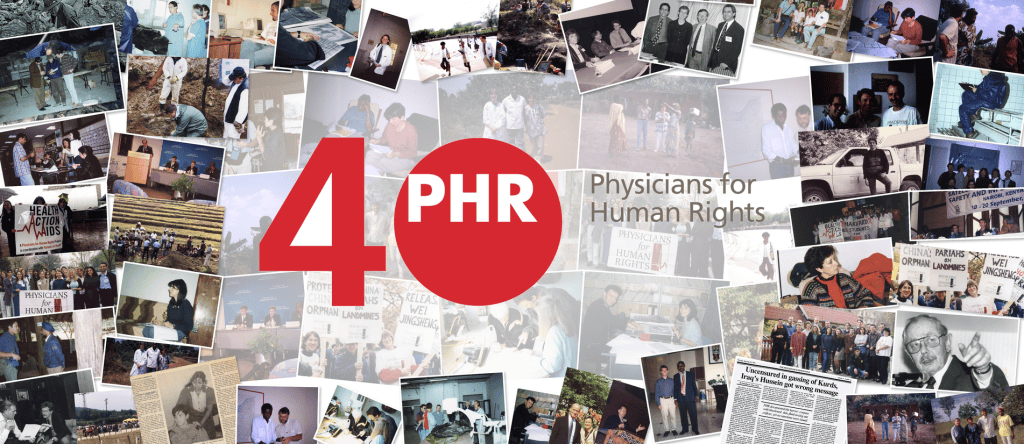
To mark PHR’s 40th anniversary, we looked back into PHR’s archives at Columbia University to trace the moments that defined this organization and the people who built it. What follows is a timeline of 40 milestones across 40 years: investigations that exposed massacres and torture, campaigns that reshaped policy, legal victories built on medical evidence, and acts of courage by the clinicians, forensic experts, lawyers, and survivors who carried this work forward.
These milestones tell forty years of history, but they are also a reminder that the work is not finished. The same patterns of abuse PHR documented in Chile, Iraq, and Bosnia appear today in Kenya, Ukraine, and Gaza. The crises are different, but the need for rigorous, credible documentation, and accountability remains as urgent as ever. We invite you to explore the timeline, learn about this history, and join us in the work ahead.
Timeline: 40 Years of Wielding Medical Evidence for Justice and Human Rights

PHR documents and advocates against the detention and torture of physicians in Chile during the regime of General Augusto Pinochet. PHR helps secure freedom for heroic Chilean health professionals.

PHR publishes the Winds of Death report, which documents lethal chemical weapons that Saddam Hussein deployed against Kurdish populations in Iraq. PHR’s research was ultimately used as evidence in war crimes prosecution of high-ranking Iraqi officials.

PHR conducts the first international human rights investigation into excessive use of force by Israeli military and security forces during the first Palestinian Intifada. Through forensic analyses of Palestinian detainees who died in custody, PHR successfully challenges Israel’s claim of “moderate physical pressure” on detainees and provides expert opinions in successful cases before the Israeli high court.

PHR launches its Asylum Network. Today the PHR Asylum Network mobilizes more than 2,000 clinicians across the United States to conduct over 700 pro bono forensic medical evaluations each year for people seeking asylum and other forms of relief, supporting families to access safety and refuge from persecution. Research finds that PHR evaluations double the chances of an asylum seeker being granted relief.

PHR mobilizes experts to exhume the bodies of victims of the El Mozote massacre, one of the worst atrocities of the Salvadoran Civil War. The scientists provide forensic documentation to the Salvadoran Truth Commission, as documented in the PHR report El Salvador: Health Care Under Siege.

PHR investigates and speaks out about the continued involvement of U.S. physicians in executions – which clearly violates medical professional ethics including the principle of “Do No Harm.” PHR’s 1994 report “Breach of Trust” finds that even when U.S. state laws are vague about requiring physician participation, in practice, physicians are often directly involved in the execution process.

PHR helps reunite families by using DNA testing to trace children adopted in the United States, who “disappeared” during El Salvador’s civil war, through collaboration with the Asociación Pro-Búsqueda de los Niños y Niñas Desaparecidos.

At the request of Venezuelan NGO Provea, PHR’s investigators assessed the health impacts of a state-owned petrochemical plant in El Hornito, Venezuela. PHR’s research established a strong link between environmental destruction and human rights, which led to a court ruling in favor of the local community.

Dozens of PHR experts exhume mass graves in the Balkans – including from the 1995 Srebrenica massacre, in which more than 8,000 Muslim men and boys were taken from a UN safe area and slaughtered by Bosnian Serb forces. The scientists provided forensic evidence presented in trials that convicted Serb leaders of crimes against humanity at the International Criminal Tribunal for the former Yugoslavia.

PHR documents the mass grave at Kibuye, Rwanda – one of the largest mass graves ever exhumed and analyzed for forensic purposes. PHR’s documentation was used in court at the International Criminal Tribunal for Rwanda to support evidence of the crime of genocide that had taken place in 1994 against the ethnic Tutsi population.

PHR’s research reports, community mobilization, and international government advocacy as part of the International Campaign to Ban Landmines lead to the International Mine Ban Treaty.

PHR shares the Nobel Peace Prize for the International Campaign to Ban Landmines as one of the founding coordinators of the unprecedented global effort.

PHR’s report The Taliban’s War on Women: A Health and Human Rights Crisis in Afghanistan is the first to provide extensive documentation of the widespread physical and psychological suffering inflicted on Afghan women by the Taliban.

Collaborating with the American Association for the Advancement of Science (AAAS), PHR issues Human Rights and Health: The Legacy of Apartheid, exposing how South Africa’s health sector subordinated ethical and human rights obligations to the racist practices and political repression of the state during Apartheid.

PHR experts lead the development of the Istanbul Protocol, the first set of international standards for the medical documentation of torture and its consequences. The Istanbul Protocol becomes the gold standard for documenting torture around the world.

PHR’s Health Action AIDS Campaign helps direct billions of dollars in public and private aid to prevent and treat HIV/AIDS in Africa, including through the U.S. government’s flagship PEPFAR program.

PHR documents conflict-related sexual violence in Sierra Leone and leads an international campaign to end rape as a weapon of war.

Since 9/11, PHR wages a tireless campaign to expose and end torture by the U.S. government and demand justice for victims and accountability for perpetrators. PHR is the first to assess physical harms and severe psychological pain and suffering inflicted on national security detainees by the U.S. military in a series of landmark reports.

Working with the United Nations High Commissioner for Human Rights, PHR begins documenting and exhuming a mass grave in northern Afghanistan, in which 2,000 surrendered Taliban fighters and others are reported to have been suffocated to death or shot in container trucks by U.S.-allied Afghan troops. Finding initial evidence of mass atrocities, PHR advocates relentlessly for a thorough international and U.S. accounting.

PHR exhumes and identifies the remains of Nigerian activists Ken Saro-Wiwa and the Ogoni Nine, who had led protests against Shell Oil and the Nigerian government for the rights of the Ogoni people and for the protection of their oil-rich lands. PHR helps return the remains of the executed activists to their families.

PHR documents genocide and mass sexual violence in Darfur, Sudan to support international prosecutions. The International Criminal Court cites PHR’s scientific evidence while PHR mobilizes public opinion through its Stop Mass Rape in Darfur and Chad campaign and the Darfur Survival Campaign.

PHR begins years of research on human rights violations against the Rohingya and other ethnic minorities in Myanmar, including on the 2017 military crackdown in Rakhine state and violations following the 2021 military coup. PHR’s evidence is cited by The Gambia’s legal team at the International Court of Justice (ICJ) on the case of genocide brought against Myanmar.

PHR’s Iran, Free the Docs international advocacy campaign secures the release of two leading Iranian physicians and HIV/AIDS activists.

PHR helps form the Afghanistan Forensic Science Organization (AFSO), a pioneering group of forensic investigators who work to strengthen their country’s justice system by mapping and registering mass grave sites throughout the country.

PHR’s capacity strengthening global programs support more than 4,500 medical, law enforcement, and legal professionals across Central Asia, DRC, Kenya, CAR, Ethiopia, Iraq and beyond to conduct forensic documentation of torture and sexual violence for accountability at the national level.

PHR’s anti-torture training and capacity strengthening work in Central Asia leads to Kyrgyzstan’s first-ever criminal conviction for torture.


PHR’s research and campaigning leads to the American Psychological Association (APA) banning psychologists from participating in national security interrogations. Following that ban, the Pentagon withdrew psychologists from detainee operations at Guantánamo Bay.

PHR defends a U.S. Navy nurse who refused to force-feed detainees at Guantánamo Bay. PHR coordinates advocacy with the American Nurses Association (ANA) and the American Medical Association (AMA), leading to the dropping of charges, and the nurse retires with full honors.

Drawing on decades of research, PHR and partners publish seminal research on the health and human rights harms of crowd-control weapons (CCWs). PHR has conducted investigations into governments’ excessive and indiscriminate use of CCWs in dozens of countries. PHR’s research is cited in numerous local, state, and international regulations and guidelines, in addition to the Torture-Free Trade Treaty.

PHR contributes to the passage of UN Security Council Resolution 2286, which commits countries to protect health care in conflict zones. PHR co-founds the Safeguarding Health in Conflict Coalition (SHCC) and documents attacks on health care in dozens of countries over the last 40 years.

PHR evidence contributes to the conviction of former Bosnian Serb leaders Radovan Karadžić and Ratko Mladić for genocide, war crimes, and crimes against humanity committed during the Bosnian war.

Alongside Congolese partners including Panzi Hospital, PHR investigates and documents the Kavumu child rape case, in which more than 40 young girls were kidnapped and raped by militia members. PHR’s evidence and advocacy contributes to the investigation of Congolese medical, legal, and law enforcement professionals and the first-ever verdict of crimes against humanity against a sitting lawmaker in DRC.

PHR and partners in Kenya launch MediCapt, an award-winning mobile digital platform that collects and preserves forensic evidence of sexual violence for prosecution. MediCapt is used by clinicians across numerous health care facilities in Kenya and DRC.

PHR exposes the long-lasting psychological harms to children and parents of the U.S. government’s family separation policy, determining that cases of family separation meet U.N. criteria for torture.

Years of strategic litigation by PHR and Kenyan partners results in the High Court of Nairobi in Kenya, for the first time, holding the State responsible for its failure to investigate election-related sexual violence and ordering compensation for four survivors.

PHR pioneers a standardized medico-legal form for survivor-centered documentation of sexual violence and torture. The form is adopted by national governments in The Democratic Republic of the Congo and Iraq following years of advocacy by PHR and partners.

PHR and partners persuade six U.S. medical associations and three U.S. states to end the use of “excited delirium” as a cause of death in police custody. Following a landmark report from PHR and subsequent campaigning, there are no longer any major U.S. medical associations that endorse this racist and pseudoscientific concept.

Building on decades of research and advocacy on U.S. immigration detention, PHR and partners publish a series of landmark reports exposing deaths, medical neglect, solitary confinement, and force-feeding in ICE detention facilities.

PHR documents the impacts of state abortion bans on emergency health care in the United States, contributing to a U.S. Supreme Court judgment enjoining Idaho’s abortion ban.

In a landmark judgment, the International Court of Justice (ICJ) held Myanmar responsible for committing genocide against the Rohingya. In its decision, the ICJ cited extensive medical and public health evidence from PHR that helped establish how Myanmar’s military used sexual violence to commit genocide.
Join Our Movement
As we reflect on 40 years of impact for health and human rights, our work is more urgent than ever in the United States and around the world. PHR’s community of supporters ensure we can continue to document attacks on health care around the world, fight for reproductive justice and the right to seek asylum in the United States, and much more. Make your gift today.