Blog

COVID-19 Amidst Syria’s Conflict: Neglect and Suppression

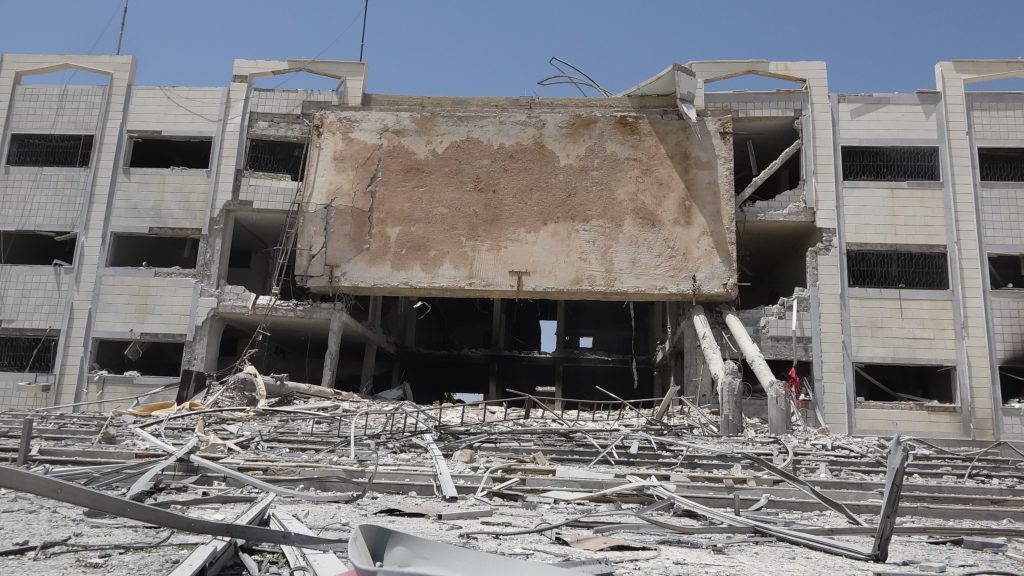
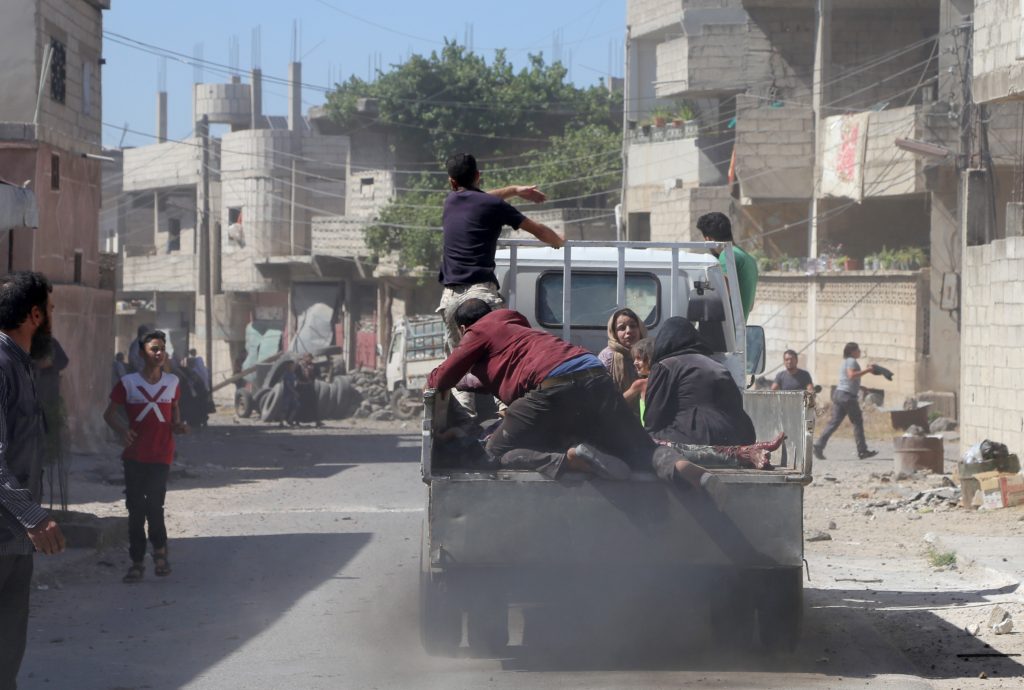
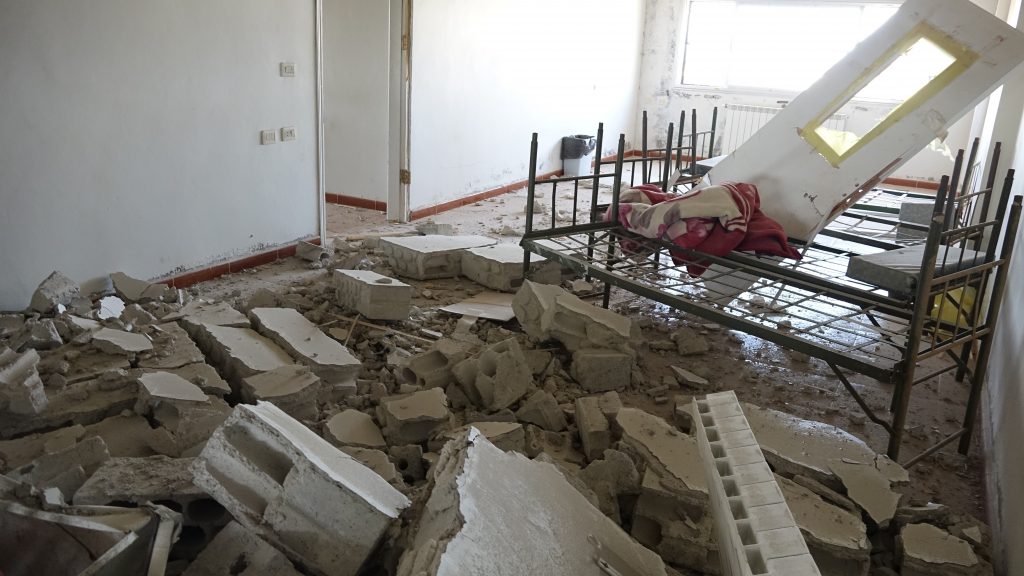
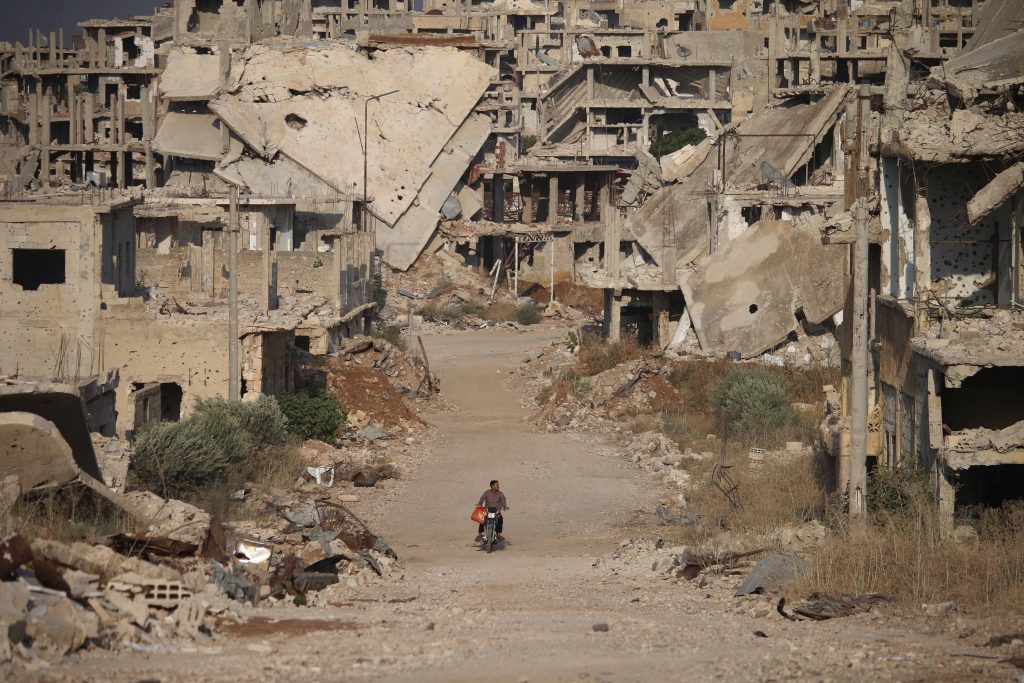
Nine months into the outbreak of the COVID-19 pandemic, Syria’s public health conditions continue to worsen by the day. The Syrian government has been heavily criticized for its inadequate response to the spread of the disease and for suppressing information regarding the COVID-19 infection rate. After President Bashar al-Assad’s nine-year targeted assault on medical workers and health care facilities, the country’s already-strained public health system is being further crippled by the heavy demands of the coronavirus.

As of December 23, the Syrian government had officially confirmed only 10,442 cases of COVID-19 and 630 deaths in the territories it controls. Government reports released in October indicated that a total of 239 health care workers had tested positive for the virus, with only 15 deaths. However, the Syrian Medical Association reported 61 health care workers’ deaths in just the month of August, suggesting that the government is significantly downplaying the severity of the situation.

Instead of enacting aggressive public health measures, the government has instead focused its efforts on silencing medical professionals about the true toll of the virus.

Indeed, despite official numbers suggesting that Syria is doing well – the best in the Middle East – Syria has systematically failed to implement adequate preventative measures, protect its health care workers with medical supplies and personal protective equipment (PPE), and test large numbers of people for COVID-19. But instead of enacting aggressive public health measures, the government has instead focused its efforts on silencing medical professionals about the true toll of the virus.

Syria’s Case Number Reality

Recent documentation highlights the alarming state of Syria’s underlying public health conditions. While WHO representatives in Syria praise the country’s response to the pandemic, burial sites in Damascus are struggling to cope with huge surges in COVID-19 victims and mass graves are being built to bury hundreds each day. A recent study conducted by Imperial College London estimates that only about 1.25 percent of the actual COVID-19 deaths in Damascus are being counted.

Such major undercounting in Damascus, the province that is likely to have the most robust surveillance system in all of Syria, indicates that other regions, especially non-government held or “reconciled” territories – which were formerly under opposition control but engaged in a reconciliation agreement with the Syrian government – are suffering similar or worse mortality rates. A report from Physicians for Human Rights (PHR) reveals the systemic discrimination against and apparently purposeful neglect of Daraa governorate, in southwestern Syria. Health professionals and facilities in this reconciled province largely lack PPE, COVID-19 testing kits, and medical equipment needed to monitor and treat severe cases. Checkpoints between Daraa and Damascus restrict medical access to facilities with functioning beds and ventilators. In addition, authorities have blocked humanitarian assistance from reaching the province, further worsening the conditions of its deficient health system.

Silencing of Health Care Workers

To ensure the government’s success in denying the spread of the virus, Syrian medical professionals have had to perform their duties under the watchful eyes of security forces in state-run hospitals. A Middle East Institute report cites a Syrian physician reporting that, back in March, government’s security forces tightened their hold on hospital facilities. They instructed physicians to downplay the prevalence of the virus and falsely attribute COVID-19 deaths to pneumonia. The government designated special teams to deal with COVID-19 patients in hospitals, composed of doctors they trusted would keep silent about the dire conditions. Other physicians were not allowed to come in contact with the COVID patients, enter their wards, or access their medical information.

Because of the tense political climate around coronavirus in the country, Syria’s doctors live in constant fear of publicly addressing the problems they are witnessing. Those who speak out put their lives on the line. Dr. Emad Taher was killed just days after voicing concerns over the government’s poor COVID-19 response. PHR’s report highlights the high-profile case of the University of Damascus’s dean of medicine, who was fired after he publicly disagreed with the government’s policy to reopen schools. This form of persecution and intimidation hinders physicians from sharing potentially life-saving information about the virus’s prevalence, modes of propagation, prevention, and treatment. The reckless and securitized approach the Syrian government has taken to address the global pandemic has had grave consequences for the country’s ability to cope and effectively save the lives of thousands of its citizens.

Meaningful attempts to improve Syria’s dismantled health care system must be undertaken in order to enable its population to overcome the devastating toll of the COVID-19 pandemic. This calls for a collective effort from both local and international bodies. The United Nations, global governments, and humanitarian actors must urge the Syrian government and Ministry of Health to exercise transparency and report COVID-19-related data in order to accurately assess the virus’s impact and the populations’ health needs. The Syrian government must exercise greater urgency in designating an effective response to the pandemic and it must abandon discriminatory practices in resource allocation that are often imposed on reconciled territories like Daraa. In its efforts to defeat the coronavirus, Syrian leadership must embrace the counsel and criticisms of its health care workers and benefit from their professional expertise.

Only a coordinated, coherent response that relies on skilled professionals, protected and supported by the government without discrimination, can help Syria overcome such a tremendous crisis.
Report

Praying for Hand Soap and Masks

Health and Human Rights Violations in U.S. Immigration Detention during the COVID-19 Pandemic

Executive Summary

Physical and psychological abuse and inadequate medical care have long been documented in U.S. Immigration and Customs Enforcement (ICE) facilities, where previous infectious disease outbreaks were poorly contained. In 2020, as the COVID-19 pandemic spread across the United States, it became clear that ICE’s continued negligence, coupled with the vast expansion of U.S. immigration detention, would likely lead to a public health disaster.

Given the lack of transparent data and the severe health risks in congregate settings caused by the pandemic, Physicians for Human Rights (PHR) staff and Harvard Medical School faculty and students sought to document conditions experienced by people recently released from U.S. immigration detention. From July 13 to October 3, 2020, the research team conducted 50 interviews of immigrants formerly detained by ICE using a standardized questionnaire covering 1) Demographics; 2) COVID-19 education; 3) Hygiene and sanitation measures; 4) COVID-19 testing and medical management; and 5) Protests and retaliation. The 50 participants were detained at 22 different ICE detention facilities – representing nine county facilities and 13 private facilities – in 12 different states. Overall, 52 percent of interviewees reported at least one comorbidity that placed them at an absolute high risk of severe COVID-19 if they contracted the virus. All study participants were 18 years of age or older, in the United States at the time of the interview, and had been held in ICE detention with a release date on or after March 15, 2020.

ICE practices did not comply with Centers for Disease Control and Prevention guidance … creating unacceptable health risks which violated the constitutional and human rights of detainees.

Information reported by the interviewees uncovered significant shortcomings in ICE’s response to the virus. Staff efforts to inform people about COVID-19 were limited and inconsistent. The vast majority of respondents (85 percent) first heard about COVID-19 in detention by watching the news on television, while ICE staff in some facilities attempted to downplay the significance of COVID-19 and actively prevented people from learning about the virus from the news by asking them to change the television channel.

Nearly all immigrants interviewed were unable to maintain social distance throughout the detention center. Eighty percent reported never being able to maintain a six-foot distance from others in their eating area. Some 96 percent reported that they were less than six feet from their nearest neighbor when sleeping. The average distance reported between beds was 2.87 feet. Twenty-seven people reported that when new individuals entered the detention center after March 15, they were not quarantined for two weeks before entering the general unit.

Forty-two percent of participants reported not having access to soap at some point during their detention. When soap or hand sanitizer was not available, some participants reported resorting to using shampoo to wash their hands, and one even used toothpaste. Thirty-six percent of participants reported relying on purchasing soap from the commissary. Several people relied on donations from outside organizations, while others had to forgo other basic necessities to purchase soap. Eighteen percent of participants reported most commonly using water alone to wash their hands. Eighty-two percent of people reported not having access to hand sanitizer anywhere in the detention facility. Twenty-six percent of participants reported never observing disinfection of frequently touched surfaces in common areas (e.g. doorknobs, light switches, countertops, recreation equipment). The overwhelming majority (83 percent) reported that detainees disinfected the common areas themselves.

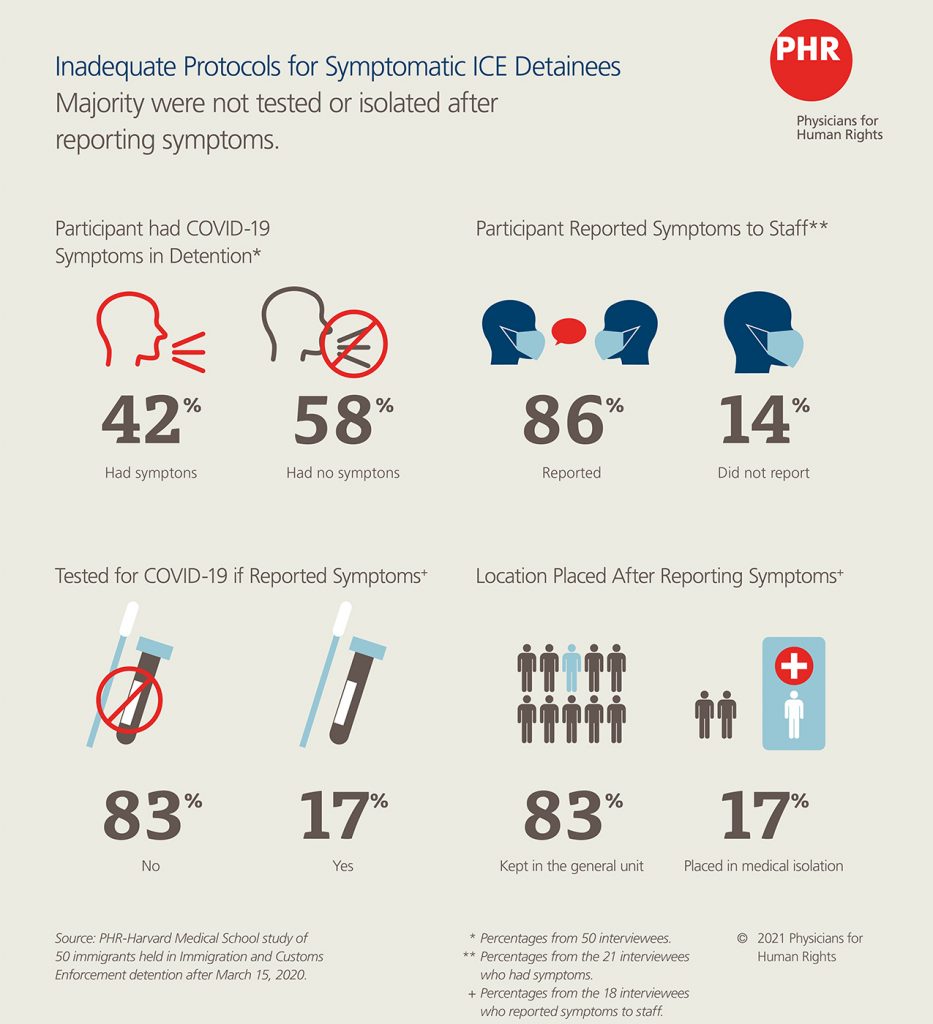
Twenty-one out of 50 people interviewed (42 percent) experienced symptoms of COVID-19 during the pandemic, such as fever, cough, muscle aches, and loss of smell. Three out of these 21 (14 percent) never officially reported their symptoms due to fear of being sent to solitary confinement or other punishment, or anticipation of denial of medical care. Out of all respondents who reported symptoms, only 17 percent (three people) were appropriately isolated from the general population and tested for COVID-19, one of whom tested positive. The remaining 83 percent (15 people) reported their symptoms to facility staff members but did not get tested for COVID-19 and were not isolated.

Interviewees reported facing prolonged wait times before being able to see a medical professional, with an average wait time of 100 hours (approximately four days). One person reported having had to wait a total of 25 days for an appointment. Importantly, two people were never seen by a medical professional at all, even after reporting their symptoms to staff members.

While 88 percent of all participants (44 people) had at least one comorbidity placing them at possible increased risk of severe COVID-19, 56 percent (28 people) reported these risk factors to detention staff, but only four of them were told that they were at high risk of having a serious illness with COVID-19. None of those four were given the option to have an individual room.

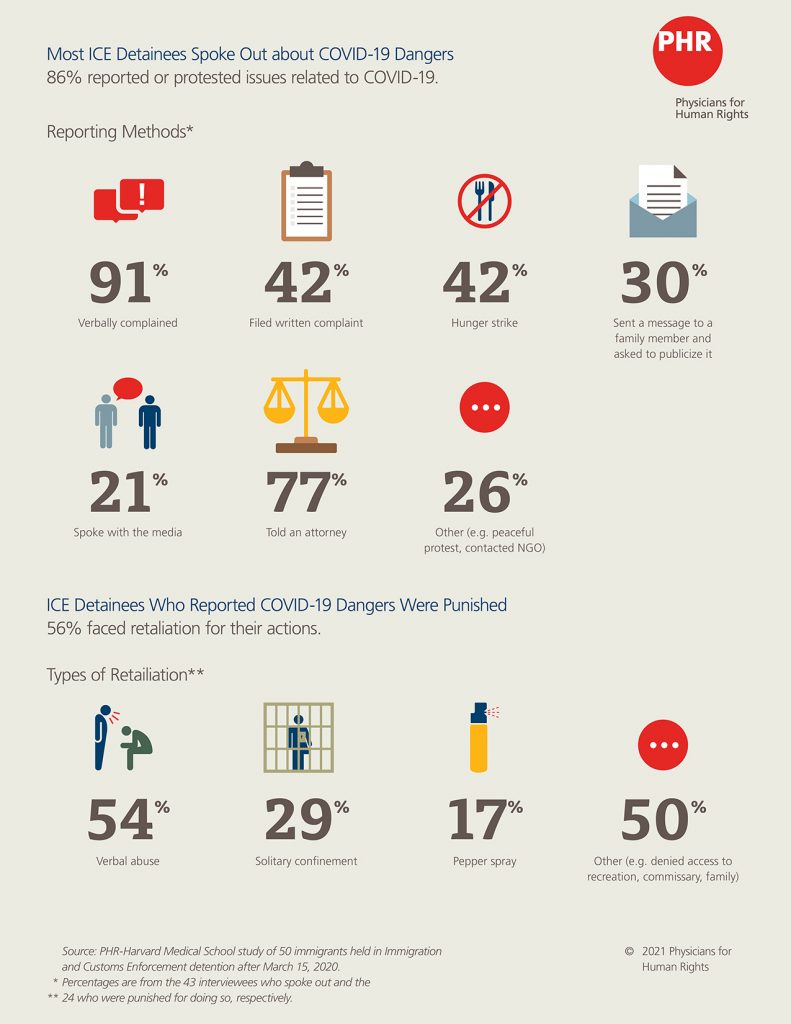
Forty-three study participants (86 percent) stated that they reported and/or protested about issues related to COVID-19, including verbally complaining to staff about unsanitary conditions or lack of personal protective equipment, filing formal grievances, going on hunger strikes, reporting conditions to lawyers, reporting conditions to the media, and sending messages to family members with the hope they would be publicized. Of these 43 who protested, 56 percent (24 people) reported experiencing acts of intimidation and retaliation after their complaints, including verbal abuse by detention facility staff, being pepper sprayed, being placed in solitary confinement, and experiencing threats or actions of limiting food, communication, or commissary access.

The government cannot put people in danger or act with deliberate indifference to a foreseeable or obvious threat, and is required to provide for the reasonable health and safety of people in detention.

As civil detainees, people in immigration detention are entitled to due process under the Fifth Amendment of the U.S. Constitution and cannot be held in punitive conditions. The government cannot put people in danger or act with deliberate indifference to a foreseeable or obvious threat, and is required to provide for the reasonable health and safety of people in detention. The UN Standard Minimum Rules for the Treatment of Prisoners, which apply in all detention settings, confirm that health care for people who are detained is the responsibility of the state, and that health care also must follow public health principles in regard to management of infectious disease, including treatment and clinical isolation.

In fact, international law limits the use of immigration detention and prohibits criminalizing border crossing for asylum seekers. Article 31(2) of the UN Refugee Convention permits states to restrict refugee freedom of movement only when necessary, otherwise it may amount to a “penalty,” which is prohibited under the Convention. The UN High Commissioner for Refugees’ (UNHCR) Executive Committee considers detention of asylum seekers as meeting the necessity test only when the government detains people to verify their identity or issue documents, to make a preliminary assessment of their asylum claim, or based on an individualized security assessment. International standards consider immigration detention as a last resort and require periodic hearings for all types of detention in order to prevent arbitrary detention.

International bodies and U.S. federal courts have applied these standards to the context of the pandemic. The World Health Organization, the UN High Commissioner for Human Rights, and UNHCR stated in March 2020 that, given the risk of severe illness and death from COVID-19, people in immigration detention should be released “without delay.” U.S. federal courts have variously ordered ICE to locate and release people at high risk of severe illness or death due to the coronavirus, to give masks and sanitizer to detainees, to ensure availability of testing, and to take a range of precautionary measures, such as isolating people who test positive, temporarily halting intake, enforcing social distancing and mask wearing, and providing appropriate sanitary and hygiene supplies.

The harsh and punitive conditions reported in this study show that ICE practices did not comply with Centers for Disease Control and Prevention guidance or with ICE’s own Pandemic Response Requirements, creating unacceptable health risks which violated the constitutional and human rights of detainees. International law requires governments to use immigration detention only as a last resort, and the U.S. constitution prohibits punitive conditions in civil detention, requiring the government to ensure safe and healthy conditions. As an urgent matter, the U.S. government should release all people from immigration detention to allow them to safely shelter in the community, absent a substantiated individual determination that the person represents a public security risk. Safely releasing people from immigration detention is in accordance with international human rights and U.S. constitutional standards and represents the best way to prevent further outbreaks of COVID-19.

  • 0

    People held in U.S. Immigration and Customs Enforcement (ICE) Detention, as of January 4, 2021.

Introduction

In April 2020, the United States held more than 56,000 people in 220 immigration detention facilities across the country in what has become the largest immigration detention system in the world[1] – a far cry from the 7,475 people who were held in U.S. immigration detention in 1995.[2] Xenophobia and discrimination against Black and brown immigrants have been driving factors in the increase in the immigration detention population, a manifestation of the systemic racism that has also driven mass incarceration in the United States.[3] Expansion of immigration detention accelerated under the presidency of Donald Trump, whose administration opened numerous government-run detention centers and increased the number of contracts with private for-profit companies to operate additional facilities.[4] Immigration and Customs Enforcement (ICE), the federal agency that runs these facilities, has long been accused of human rights violations, physical and psychological abuse, inadequate medical care leading to otherwise preventable health crises, and deaths in custody. Additionally, previous badly contained infectious disease outbreaks all point to “systemic failures of healthcare provision and government oversight.”[5],[6] In fact, independent medical review of detainee death reports concluded that in 8 out of 15 reported deaths in ICE custody between December 2015 and April 2017, medical negligence was a contributing factor.[7] In 2020, as the COVID-19 pandemic spread across the country, it became clear that ICE’s continued negligence, coupled with the vast expansion of immigration detention, would likely lead to a public health disaster.[8]

Immigration detention facilities are not unlike other congregate settings, such as nursing homes and prisons, where the infection rate of the novel coronavirus virus, SARS-Cov-2, and death toll from COVID-19 are disproportionately high.[9] Despite the risk and calls for decarceration,[10] ICE has been largely unwilling to release immigrants into the community in the United States except under the pressure of litigation, instead stating that it has followed U.S. Centers for Disease Control and Prevention (CDC) guidelines to manage the pandemic in detention centers.[11] However, so far, ICE’s handling of COVID-19 has resulted in, at minimum, reported infections of 558 people currently held at these facilities and eight deaths in custody – numbers considered to be undercounted.[12]

Motivated by the lack of transparency about the COVID-19 public health disaster in immigration detention, this study seeks to shed light on the experiences of immigrants who survived the pandemic in detention. Through the stories of 50 individuals, we aim to provide a snapshot of the conditions in some detention facilities, and to make recommendations for next steps to reduce the risk and harm from SARS-CoV-2 in immigration detention.

Background

The number of people per month who tested positive for SARS-CoV-2 (the novel coronavirus that causes COVID-19) in Immigration and Customs Enforcement (ICE) detention between April and August 2020 was between 5.7 to 21.8 times higher than the case rate of the U.S. general population during that same time.[13] While testing rates increased during that time, so did test positivity rates, demonstrating that increased case rates could not be exclusively attributed to increased testing and suggesting that strategies to prevent infection have largely failed.[14] At the time of this report’s drafting, the number of cumulative infections ICE reports sits at 8545,[15] despite the fact that the number of people held in detention has decreased[16] and now stands at 16,037.

As the COVID-19 pandemic spread across the country, it became clear that ICE’s continued negligence, coupled with the vast expansion of immigration detention, would likely lead to a public health disaster.

ICE has internal agency guidelines, which could have addressed these challenges from the very start of the pandemic. On March 15, 2020, ICE reported that it was “incorporating CDC’s [Centers for Disease Control and Prevention] COVID-19 guidance” into its own existing protocol,[17] the Pandemic Workforce Protection Plan, which was activated to address coronavirus as early as January 2020.[18] Also in January 2020, the Department of Homeland Security (DHS) issued guidance which included the use of personal protective equipment (PPE). By April 10, 2020, ICE published its first version of the “Enforcement and Removal Operations COVID-19 Pandemic Response Requirements” (PRR). Around this time, public health experts were calling for the widespread release of people from immigration detention as the only way to ensure safety.[19] New versions of the PRR were released on June 22, July 28, September 4, and October 27, and all versions utilized guidance from the CDC.[20] ICE’s updated PRR, issued on October 27, contains positive changes such requiring facilities to identify those with medical vulnerabilities, testing new arrivals, and clarifying that medical isolation is not solitary confinement; however, standards alone do not guarantee proper implementation.[21]

Historically, ICE has failed to meet its own health and safety standards. In 2019, the Office of the Inspector General (OIG) of the DHS found “egregious violations” of ICE’s own 2011 Performance-Based National Detention Standards.[22] Violations included multiple issues related to health and safety, such as a lack of hygiene supplies, unsafe food, and unclean bathrooms.[23] In 2016, the OIG also found major gaps in DHS’s ability to respond to a pandemic.[24]

ICE’s adherence to its own COVID-19 standards has been equally poor to date. For instance, CDC guidelines on proper “cohorting” include “isolating multiple laboratory-confirmed COVID-19 cases together as a group”; such “cohorting” should only occur “if there are no other available options.”[25] However, in April, immigrants at La Palma Correctional Center in Arizona were being cohorted in their respective housing units.[26] Grouping together those who have COVID-19 with those who may not is a recipe for accelerated transmission, and risks deadly consequences.

Though the PRR recommends that facilities provide adequate hygiene supplies and educate people about the virus, individuals in immigration detention have spoken out about a lack of hand sanitizer, soap, and masks, and non-existent educational materials about the virus.[27] Human rights advocates have also reported inappropriate and dangerous use of disinfecting chemicals to sanitize ICE detention facilities; for example, people in detention reported burning, bleeding, and rashes in response to the use of HDQ Neutral, which is an industrial-strength chemical.[28]

Additionally, the standards themselves contains significant caveats which limit their effectiveness in preventing the spread of COVID-19, while problematically and inappropriately limiting ICE’s responsibility to uphold these measures. For instance, while the PRR states that “Whenever possible, all staff and detainees should maintain a distance of six feet from one another,” it also notes that “strict social distancing may not be possible” and immigrants are recommended to “sleep head to foot.”[29] At times, concrete guidelines have not been in keeping with public health principles; for example, advocates have noted that ICE did not recommend testing people who were asymptomatic, though the CDC had already warned that the virus could be spread through asymptomatic carriers.[30] Instead, the PRR required facilities to screen people entering detention centers based on their own verbal expression of a very limited number of symptoms of COVID-19 (when it was already known that the list of potential COVID-19-related symptoms was more extensive), rather than an actual negative test result.[31]

Lastly, the PRR includes clawback clauses which allow for significant exceptions. For instance, the July 28 PRR states that facilities should, “where possible, limit transfers of detained non-ICE populations to and from other jurisdictions and facilities unless necessary for medical evaluation, medical isolation/quarantine, clinical care, extenuating security concerns, to facilitate release or removal, or to prevent overcrowding.”[32] These guidelines do not apply to the many detained immigrants who are not held by ICE, nor do they account for the many exceptions to the rule.[33] In practice, ICE has continued transfers which likely contributed to spread of the virus. For example, in May, an ICE attorney admitted that ICE was not always testing people before transferring them, citing low testing capacity; when a federal judge in Miami ordered ICE to reduce occupancy of South Florida detention centers to 75 percent of capacity, ICE transferred people instead of releasing them.[34] Similar actions have been taken by ICE across the country.

ICE has undertaken a host of other harmful practices during the pandemic, such as: prolonged solitary confinement under the guise of medical isolation[35]; deportation of people from detention center COVID-19 hotspots to countries where these deportation flights contributed to the rise of COVID-19;[36] using tear gas,[37] commissary account freezing, and transfers as retaliatory measures against immigrants protesting their confinement during the pandemic;[38] and using the virus as a pretext to issue a series of executive actions aimed at closing the border based entirely on specious public health grounds generally contested by public health experts.[39]  

There has been an overall reduction in the detention population due to expulsions, border closures, and deportation.[40] However, except for a brief pause in March 2020, ICE has also continued large-scale arrests of immigrants, including people with no criminal record, continuing intake of new people into detention during the pandemic.[41]

Despite ample public health and medical research recommendations for release … ICE states that it continues to hold more than 16,000 people in detention facilities across the country.

One of the most serious issues with ICE’s handling of the COVID-19 pandemic is the lack of transparency. A whistleblower, who worked as a nurse in an ICE facility in Georgia, reported that she was demoted in retaliation for speaking up about insufficient COVID-19 precautionary measures in the facility.[42] The June 2020 report by the DHS OIG on ICE’s early pandemic response contained significant shortcomings, such as failing to include data on contracted staff or asking individuals in detention to provide feedback.[43]

When cases began to rise at the beginning of the pandemic, thousands of medical professionals wrote a letter to ICE recommending that the agency release people to community-based alternatives to detention while their cases were pending.[44] ICE ignored this letter. Yet, despite ICE’s objections, federal data has shown that the majority of people who are released from detention show up for their hearings,[45] and most immigrants have family or community connections with whom to reside.[46] Public health advocates’ guidelines describe how to conduct release in a safe way during the pandemic.[47]

Despite ample public health and medical research recommendations for release, and emergency litigation at the national, state, and individual level, as of January 2021, ICE states that it continues to hold more than 16,000 people in detention facilities across the country.[48]

Given the lack of transparent data and the severe health risks in congregate settings caused by the pandemic, PHR and Harvard Medical School faculty and students sought to document conditions experienced by people recently released from immigration detention. These interviews uncovered significant failures in the agency’s handling of the virus within its detention facilities, creating dangerous conditions and leaving immigrants with no recourse to protect themselves.

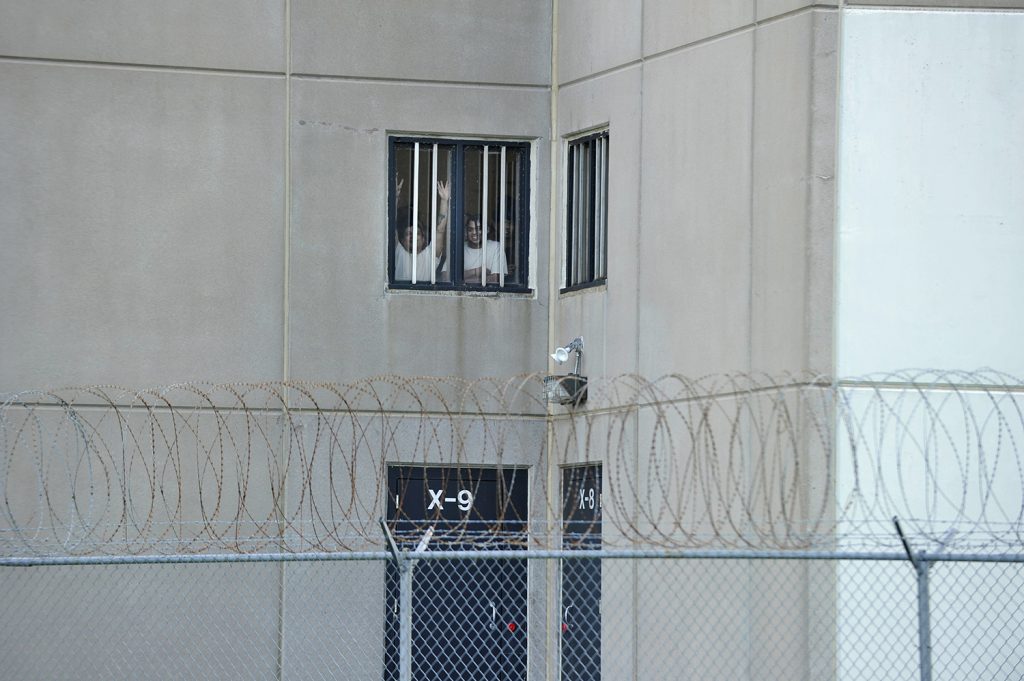
Detainees at Stafford County Detention Center in Dover, NH wave to marchers rallying in their support in August 2019. Photo: Joseph Prezioso/AFP/Getty Images

Methods and Limitations

From July 13 to October 3, 2020, the research team conducted 50 interviews of immigrants formerly detained by Immigrations and Customs Enforcement (ICE) using a standardized questionnaire. All study participants were 18 years of age or older, in the United States at the time of the interview, and had been held in ICE detention with a release date on or after March 15, 2020 (two days after the declaration of a national emergency due to COVID-19).[49] All interviews were conducted by WhatsApp call or standard telephone call, directly in the participants’ native languages (English or Spanish), or with an interpreter if needed (n=4). Interviews lasted one to two hours. Participation was voluntary, and all participants provided verbal informed consent to participate in the study. A $40 electronic gift card was offered to participants as reimbursement of a standard meal and phone minutes. This study was reviewed by the Harvard Medical School Institutional Review Board and determined to be exempt from further review. The study was also reviewed and approved by the Physicians for Human Rights’ Ethical Review Board.

Structured interviews included a questionnaire that was designed to assess the implementation of ICE’s National Detention Standards (NDS) (Version 2.0, 2019) as well as ICE’s Enforcement and Removal Operations COVID-19 Pandemic Response Requirements (PRR) (Version 1.0, April 10, 2020).[50],[51] Many of the questions were written to assess adherence to policies enumerated in the PRR, as well as the NDS, which were in place prior to the onset of the COVID-19 pandemic. The questionnaire included five sections: 1) Demographics; 2) COVID-19 Education; 3) Hygiene and Sanitation Measures; 4) COVID-19 Testing and Medical Management; and 5) Protests and Retaliation. The data collected during the interviews were both quantitative and qualitative in nature. All quantitative data was statistically analyzed in Excel (Version 16.40).

Participant Recruitment

Participants were recruited through outreach to immigration attorneys. Attorneys were asked to present information about the study to clients who had been released from ICE detention on or after March 15, 2020, using a standardized script and flyer. By March 15, COVID-19 was known to be a serious infectious disease, especially in congregate settings; in that week there occurred the first report of an ICE staff member being infected. Both human rights groups and DHS medical expert whistleblowers issued warnings about the dire consequences of not releasing people from immigration detention.[52]

Attorneys were notified that this study did not include a language restriction. If individuals stated that they were interested in participating, they were referred to the study through their attorneys, who shared the participant’s phone number, time availability, preferred language, and preferred mode of contact (WhatsApp or phone). Attorneys did not share the names of participants with the research team in order to ensure anonymity and protect participants. Fifty-nine people were referred to the study and contacted by research staff. Nine of those decided not to participate in the study. Fifty people participated in the study and completed the entire questionnaire verbally. Forty-nine participants accepted the electronic gift card.

Human Subjects Protections

Referred participants were largely contacted through WhatsApp, which provides end-to-end encryption. For participants who did not have or prefer WhatsApp, a regular phone line was used to conduct the interview. Consent forms were shared with participants prior to the interview in their preferred language (either through WhatsApp message or text message services). Prior to initiating the interview, the consent form was verbally reviewed with participants in its entirety, and verbal consent was obtained. Participants were assured that their interview was confidential and anonymous, and that none of their responses would be communicated to their lawyer or affect their pending immigration case. During the interview, quantitative and qualitative data was collected in real time in a secure REDCap database. No identifying information was collected or stored. Participant information (including name of the referring lawyer and participant phone number) were collected in a separate REDCap database that cannot be linked to participants’ survey responses. Finally, participants who accepted the electronic gift card for participation were sent the electronic gift card through WhatsApp message, short message services, or, if preferred, email. Any email communication with lawyers and participants was conducted through a Harvard Medical School delegated access email account used exclusively by study staff, and all correspondence was deleted 30 days after completion of the study. The study staff’s WhatsApp accounts used to contact participants and conduct the interviews were cleared of correspondence data after completion of all interviews.

PHR shared the findings of this report with the U.S. Department of Homeland Security and requested a response but had not received any as of the date of publication.

Limitations

The data presented in the report represent the experiences of 50 individuals held in ICE detention in a limited number of facilities across the United States. Our sample, therefore, may not be representative of the experiences of people held in ICE facilities after March 15, 2020.[53] Another limitation of the study is sampling bias – only people released from detention and still residing in the United States were interviewed, although many people in ICE detention during the pandemic have been deported and many continue to be detained. Additional sampling bias exists in this data, as most interviewees stayed in adult facilities and only one stayed in a family detention facility, therefore not representing the different types of facilities that ICE operates. Additionally, all interviewed detainees had representation from lawyers who in turn decided which clients to refer, reflecting possible selection bias on the part of our collaborating attorneys. Although this study did not include a language restriction, lawyers may have been more likely to refer clients with whom they could communicate more easily without the use of an interpreter. This data also includes recall bias, as responses are based on participant memory of detention conditions. There was additionally potential for variation between interviewers, but care was taken to minimize this variability through extensive interviewer training before and during the study period. The use of a structured questionnaire with consistent wording was designed to reduce interviewer bias. Lastly, the data captures experiences through August 2020 and is therefore a snapshot that will not include additional information that may be shaped by the coronavirus surge in the fall of 2020 with its further strain on resources and capacity.

PHR shared the findings of this report with the U.S. Department of Homeland Security and requested a response but had not received any as of the date of publication.

Key Findings

Demographics

Of the 50 participants interviewed, 76 percent identified as male (n=38) and 24 percent as female (n=12). The age range was 20-52 years old (average age: 36 years old), with 46 percent of participants being in their 30s. The participants were originally from 22 different countries (nine from Mexico, eight from Venezuela, four from El Salvador, three from Cuba, and three from Uganda). With respect to languages, participants’ primary languages included English, French, Haitian Creole, Kinyarwanda, Luganda, Russian, Sonikeh, Spanish, Tigrinya, Twi, and Zulu. Many spoke two languages well, one of which was English or Spanish. Twenty-six interviews were conducted in English (52 percent), 20 in Spanish by native Spanish-speaking interviewers (40 percent), and four with a translator (two Spanish, one Russian, one Tigrinya) (eight percent).

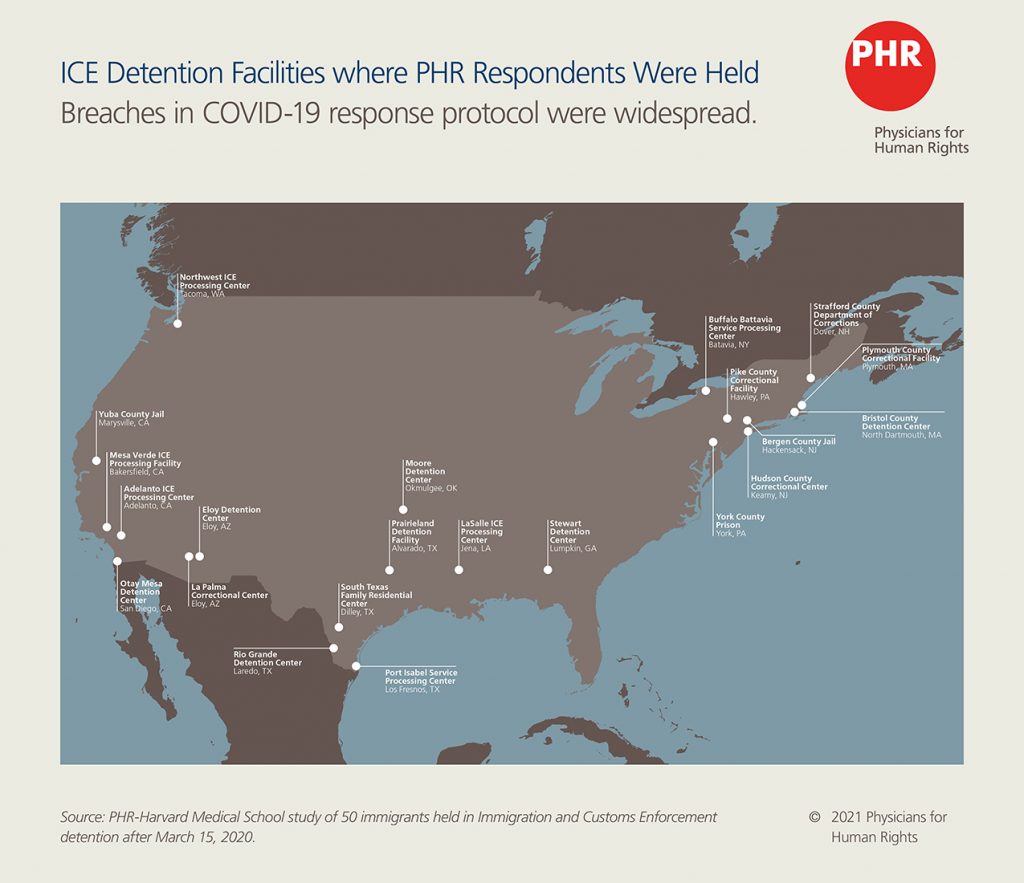
Participants had entered the United States as early as 1980 and as recently as March 2020. With respect to their most recent detention, the average length of stay was 241 days (range: 14 days to two years). The 50 participants were detained at 22 different ICE detention facilities – representing nine county facilities and 13 private facilities – in 12 different states. Approximately the same number of people were held in county facilities as in privately contracted facilities. The private facilities were run by GEO Group (five facilities), CoreCivic (five), Ahtna Support and Training Services (one), Akima Global Services (one), and LaSalle Corrections (one). One participant was transferred between two facilities after March 15, 2020, another was transferred between three facilities after March 15, 2020. All were held in adult facilities, except for one person who was held in South Texas Family Residential Center in Dilley, Texas. Participants were released from detention between March 16 and August 12, 2020, with six released in March, 20 in April, eight in May, 12 in June, three in July, and one in August.

“They didn’t want to talk about it. They were hiding information about the coronavirus from us. They didn’t tell us anything.”

37-year-old man, Plymouth County Correctional Facility

The Centers for Disease Control and Prevention (CDC) lists certain conditions as putting individuals at high risk of severe illness from COVID-19, while other conditions might place an individual at increased risk.[54] Notably, these lists have been modified as more data has come out about high-risk comorbidities. In our study population, no participants were over 65 years old. Participants did, however, have several other comorbidities that are listed as either possibly or definitively placing them at high risk of severe illness, per the CDC. With respect to comorbidities listed as an absolute high risk, participants reported having a heart condition (20 percent), immunocompromised state (eight percent), adult-onset diabetes (12 percent), chronic kidney disease (four percent), and obesity or severe obesity (32 percent). Participants also reported having several comorbidities that the CDC lists as possibly putting them at increased risk for severe COVID-19: hypertension (30 percent), chronic lung disease or asthma (30 percent), liver disease (12 percent), and being overweight (38 percent).

Overall, 26 people (52 percent) reported at least one comorbidity that placed them at an absolute high risk of severe COVID-19 if they contracted the virus. When considering all of the comorbidities listed by the CDC as possibly or definitively conferring high risk of severe COVID-19, 44 people (88 percent) reported at least one such comorbidity.

Detention Staff Made Limited Efforts to Inform Detainees About COVID-19

Staff efforts to inform people about COVID-19 were limited and inconsistent, despite requirements to educate detainees as part of the PRR. Of study participants who were in detention after the implementation of the Pandemic Response Requirements (PRR) (41 people),[55] only five percent reported first hearing about COVID-19 from facility staff. The vast majority (85 percent) first heard about COVID-19 in detention by watching the news on television. ICE staff in some facilities even attempted to downplay the significance of COVID-19 and actively prevented people from learning about the virus from the news by asking them to change the television channel.

Early in the course of the pandemic, many people began looking for information on how to protect themselves from contracting COVID-19 in detention centers. While the majority of the 41 interviewees in detention after April 10 (66 percent) saw signs in the facilities about hand hygiene, only 39 percent saw signs about proper coughing etiquette. If any signs were posted, there were on average six signs throughout the entire facility. However, the presence of signs did not mean that immigrants could read or understand them, as the wording was sometimes only in English. Of people who reported seeing signs in facilities, 85 percent reported that signs were also available in Spanish and 11 percent reported that signs were available in another additional language. These trends suggest that ICE did not fully comply with the COVID-19 PRR that requires signage on hand hygiene and coughing etiquette to be offered in English, Spanish, and “any other common languages for the population inside each detention center.”[56] Considering the diverse languages spoken in each detention center, these signs were insufficient methods of education given the inconsistency of implementation and lack of language concordance.

ICE staff made few efforts to educate people directly, such as through verbal communication and educational meetings. Aside from signs, 39 percent of individuals reported learning about hand hygiene and 24 percent reported learning about coughing etiquette from staff directly. ICE staff also provided minimal guidelines and education around social distancing: a minority of immigrants reported being told by staff not to share eating utensils (22 percent), not to shake hands with others (37 percent), to stay six feet away from others (59 percent), and to avoid gathering in groups (34 percent). Per the COVID-19 PRR, ICE staff are required to educate detainees about these types of contact to minimize COVID-19 spread,[57] but many people were completely unaware of these policies.

Education from ICE staff about COVID-19 symptoms was also lacking. Only 46 percent (19) of respondents reported that ICE staff educated them directly about COVID-19 symptoms. Of the 19 people who received information about COVID-19 symptoms from staff, 100 percent were told that COVID-19 can present with fever, 68 percent were told about cough, and 63 percent were told about shortness of breath. This represents only three of more than 10 symptoms that can be suggestive of COVID-19. The lack of basic education on COVID-19 symptoms demonstrated that COVID-19 information, even when delivered, was minimal. Many detainees learned only by watching the news about COVID-19 spread and mitigation. Overall, interviewees reported that the lack of comprehensive information contributed to high levels of fear and anxiety among detained immigrants about the severity of the disease and their safety in detention.

Social Distancing Did Not Exist in Detention

Nearly all immigrants interviewed were unable to maintain social distance throughout the detention center. Eighty percent reported never being able to maintain a six-foot distance from others in their eating area. Respondents emphasized that even when they were told to stay six feet apart, it was nearly impossible to do so: “In dormitories, even staying apart three feet is impossible, there’s no way they can say that. How could you tell people to stay six feet apart?” (29-year-old man, Yuba County Jail). One person reported, “When the 80 of us ate together, we were elbow-to-elbow” (27-year-old man, Tacoma Northwest Detention Center). 

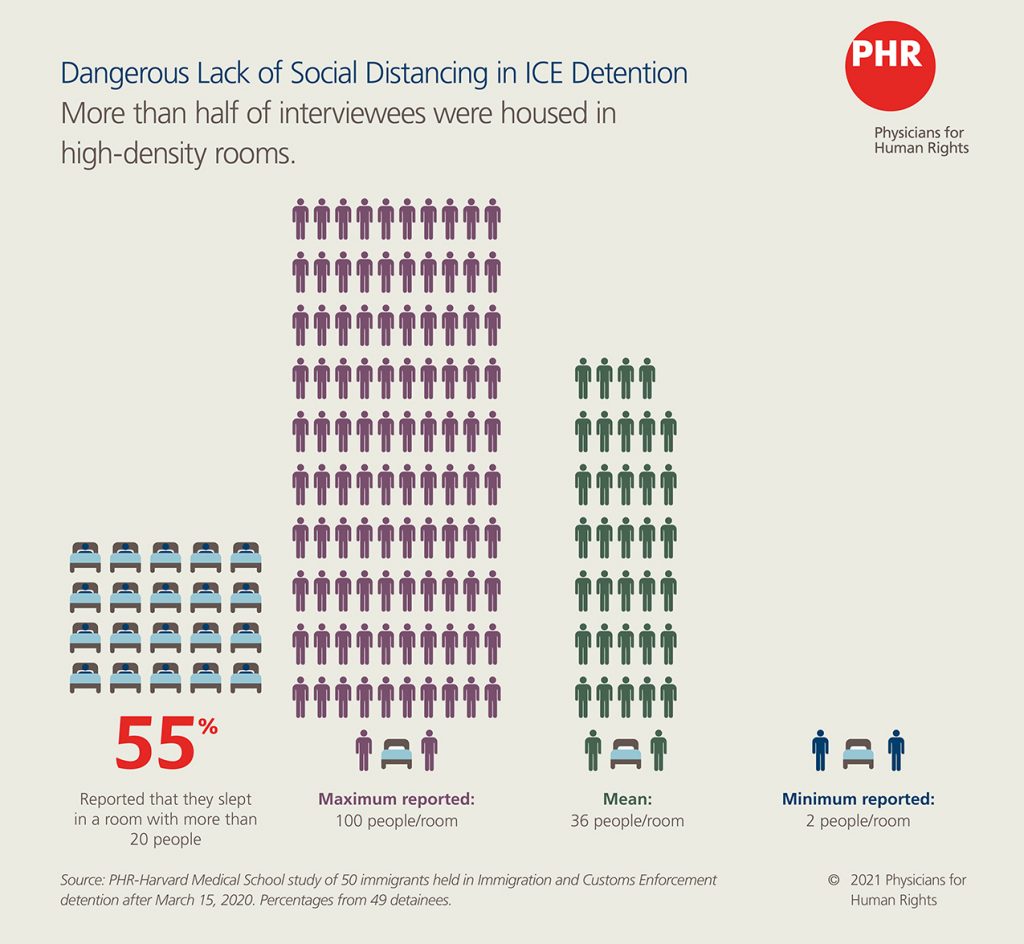
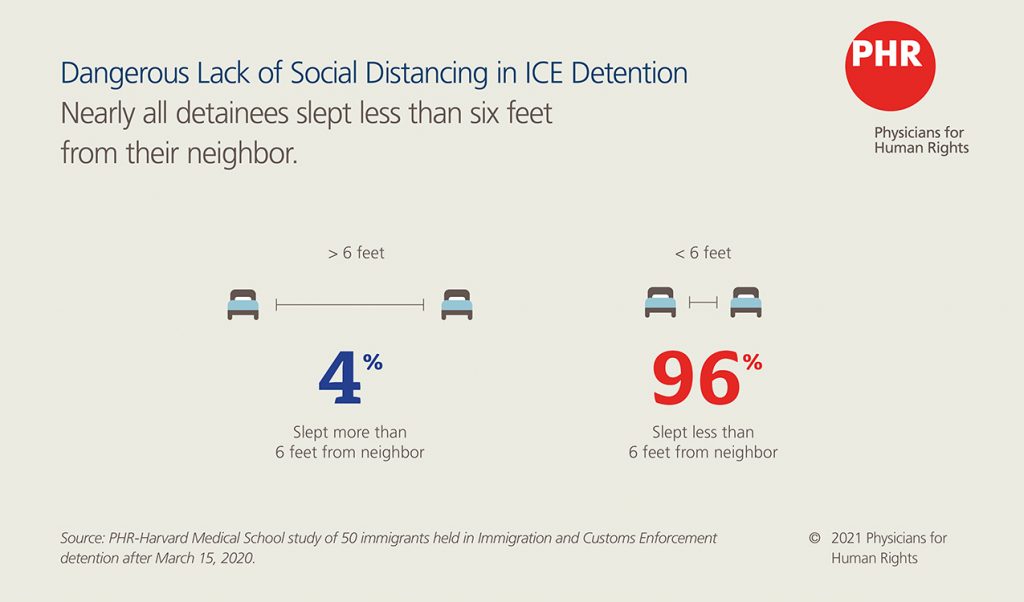
Interviewees slept in rooms that on average housed 36 people (Range 2-100, Median = 34). Some 96 percent reported that they were less than six feet from their nearest neighbor when sleeping. The average distance reported between beds was 2.87 feet. Some 32 percent of interviewees were told to sleep “head-to-foot” with their nearby neighbors. One person reported: “They told us to sleep head-to-foot after they started getting lawsuits (51-year-old man, Yuba County Jail). Many reported that sleeping head to foot “didn’t make a difference because our beds were four feet apart.” (32-year-old man, Yuba County Jail).

“On the bunk beds, you could feel the other person’s breath on you, it was too close.”

29-year-old man, Yuba County Jail

ICE acknowledges that strict social distancing may not be possible in detention facilities but still requires facilities to implement several measures to facilitate social distancing, including: avoiding congregating in groups of 10 or more, maintaining a distance of six feet as much as possible, rearranging beds to allow for six feet between people when sleeping, recommending that people sharing sleeping quarters sleep “head-to-foot,” and staggering different housing units’ meal and recreation hours.[58] Despite these guidelines, the interviews indicate that after the PRR was published, because of detention center organization, none of these measures were consistently implemented. As of March 1, 2020, the CDC recommended that people maintain physical distances from one another of at least six feet, especially in congregate settings.[59] Interviews demonstrate that ICE was also not adhering to these guidelines prior to the PRR.

The PRR outlines that facilities should reduce their populations so they can transition people from dormitory-style housing to “hous[ing] detainees in individual rooms.” However, few detention centers implemented changes to their housing practices. Only six people (13 percent) reported that there was a change in their housing after March 15, 2020. In these new housing arrangements, individuals slept in rooms that housed 10 people on average (Range 2-40, Median = 2). However, these changes in housing sometimes came with additional sanitation problems. Two interviewees shared that their new housing had major sanitation and plumbing problems, as the sink and toilet in the cells were not functional.

“When the 80 of us ate together, we were elbow-to-elbow.”

27-year-old man, Tacoma Northwest Detention Center

Another major concern was the extent of contact between different housing units. Thirty-six percent of interviewees reported having meals at the same time as people from other housing units. Thirty percent reported having recreational time at the same time as people from other housing units. Respondents also shared concerns about interacting with people from other housing units when they were transported to the medical units or to court appointments. These patterns were inconsistent with the COVID-19 PRR, which requires that detainees’ access to recreation and meal hours should be staggered to limit inter-housing interaction, which can contribute to the spread of the virus.

Finally, the PRR requires ICE to “limit transfers,” which necessarily create new contacts and points of exposure and transmission. Within this group of 50 participants, 13 were transferred to another detention facility after March 15, including three who reported symptoms. Twenty-seven people reported that when new individuals entered the detention center after March 15, they were not quarantined for two weeks before entering the general unit.

“They told us to sleep head-to-foot after they started getting lawsuits.”

51-year-old man, Yuba County Jail

23.5-Hour Daily Lockdowns Created Adverse Mental Health Impacts

In several detention centers, certain COVID-19 mitigation strategies directly violated immigrants’ rights, as lockdowns were implemented with limited communication and restrictions were placed on basic activities. Four people shared that after March 15, 2020, their movements were extremely limited, and they were at times locked in their cells for 23 to 23.5 hours a day: “They put us in cells with one other person out of fear that we would infect each other. We were kept there for 23.5 hours a day” (36-year-old man, Hudson County Correctional Center).

When lockdowns began, people received minimal information about why these changes were occurring and for how long. As one interviewee noted: In April, they locked us in our bunkers and would bring food to our cells. They didn’t explain to us why we were not allowed to leave our bunkers anymore; they just told us that was the way it was going to be, like animals(42-year-old woman, Eloy Detention Center).Additionally, one man held in Plymouth County Correctional Center described that during lockdown, he was not even allowed to shower, watch TV, make phone calls, or talk to other detainees.

“In April, they locked us in our bunkers and would bring food to our cells. They didn’t explain to us why we were not allowed to leave our bunkers anymore; they just told us that was the way it was going to be, like animals.”

42-year-old woman, Eloy Detention Center

In particular, the lack of social interactions and recreational activities led to people feeling isolated and created adverse mental health effects: “One could not go out to the yard, we could not do anything. You felt locked up and you would get depressed” (42-year-old woman, Eloy Detention Center and La Palma Correctional Center). These lengthy lockdowns existed in a setting where mental health conditions and concerns are highly prevalent, leading to potential exacerbations of existing issues.[60] One interviewee stated, “There were lots of suicides, people cutting their veins, hanging themselves. There were six total. They all happened in March. COVID-19 started and people became restless. My bunker was in front of ‘the hole’ and we could see how they brought out the beds with the body on it. After this started happening, they stopped letting us out of our cells and would bring us our food” (52-year-old man, Eloy Detention Center and La Palma Correctional Center).

New Masks in Detention Were a Luxury

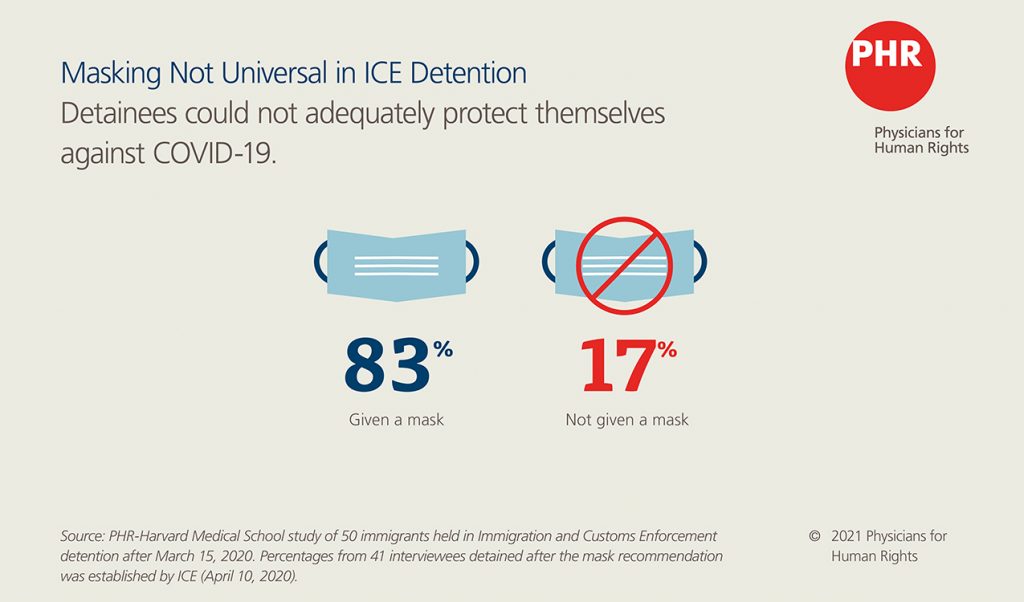
Per the COVID-19 PRR, free, washable cloth face coverings should be provided to and worn by detained individuals and staff. Specifically, the mask should “fit snugly but comfortably,” “be secured with ties or ear loops,” and “include multiple layers of fabric.”[61] Of the 41 participants who were detained after the PRR’s mask mandate was established (April 10, 2020), 83 percent (34 people) reported being given a face covering during their detention. Interviewees were given their first mask sometime between March and May 2020, depending on the facility. Of people given a mask, 59 percent (20 people) were given cloth face coverings, while 50 percent were given paper surgical masks. Even when people were given masks, it was often a one-time occurrence: of the respondents given a mask, 11 (32 percent) never had their mask replaced, 11 (32 percent) had their mask replaced once, and seven (21 percent) were given a new mask at least once a week. Five people had their mask replaced more than once, but infrequently. The quality of masks was variable, as stated by one respondent: “The mask was almost made out of old sheets with strings to tie at the back of your head. It wasn’t thick or anything. It was just a cover-up for them” (46-year-old man, Franklin County and York County Prisons).

“I had to make my own mask. I used the sleeve of one of my shirts.”

31-year-old man, Strafford County Department of Corrections

The fact that 17 percent of participants (seven people) in detention after April 10, 2020 were not given a mask indicates that even the most basic and effective mitigation strategies were not implemented at times in some detention centers. One person who never received a mask reported making his own mask, using the sleeve of one of his shirts. Another person reported that he was mocked for not having a mask by the facility staff: “Sometimes the guards, who did have face coverings, would laugh at us and be happy that we did not have facemasks” (33-year-old man in Otay Mesa Detention Center). It often took special circumstances for ICE to provide masks. Interviewees reported that masks were provided to them only after a lawsuit, immediately before a visit by a news team, or after a COVID-19 death in ICE detention.

“I have HIV, and so I asked the doctors and the staff of the detention center to … give me a face mask so that I could protect myself, as I was more vulnerable. They did not want to help me.”

33-year-old man, Otay Mesa Detention Center

Even when masks were provided, people were not consistently educated on how to use them properly. Of the 34 people given a mask, 56 percent (19 people) were told how, where, and when to use their mask. One person reported, “They just give you the mask. If you use it or not, that’s your decision (52-year-old man held in 12 different detention centers).” Mandates on when masks were supposed to be worn varied and were not clearly communicated: “There was a period of two weeks that we had to have our masks on at all times when we left our cells, but then they stopped mandating it. Perhaps because there were others that were sick” (25-year-old woman, Eloy Detention Center). The detention staff also did not lead by example, which could have exposed people to the disease: “They gave us masks every two days but no one wore them – not even the staff and security guards” (51-year-old man, Mesa Verde Detention Facility).

Four people were required to sign a waiver in order to receive a mask. One person believed the waiver absolved centers of liability (as described elsewhere[62]): “They started offering us masks in May after the big lawsuit, but they made us sign a waiver [that] in case we got sick, they wouldn’t be accountable” (27-year-old man, Tacoma Northwest Detention Center).  Another person reported language barriers when signing the form: “On April 10, they gave us a mask but they made us sign a document in English, even though many of us did not speak English. The document said that if we signed, we waived the responsibility of the center if we were to get sick with COVID-19” (32-year-old man, Otay Mesa Detention Center).[63]

With No Soap, Immigrants Were Forced to Use Water Alone or Other Bath Products to Wash Their Hands

Per the most recent National Detention Standards (NDS) and the COVID-19 PRR, all facilities that house people detained by ICE are required to “replenish personal hygiene items at no cost to the detainee on an as-needed basis” (NDS) and provide individuals with “no-cost, unlimited access to supplies for hand

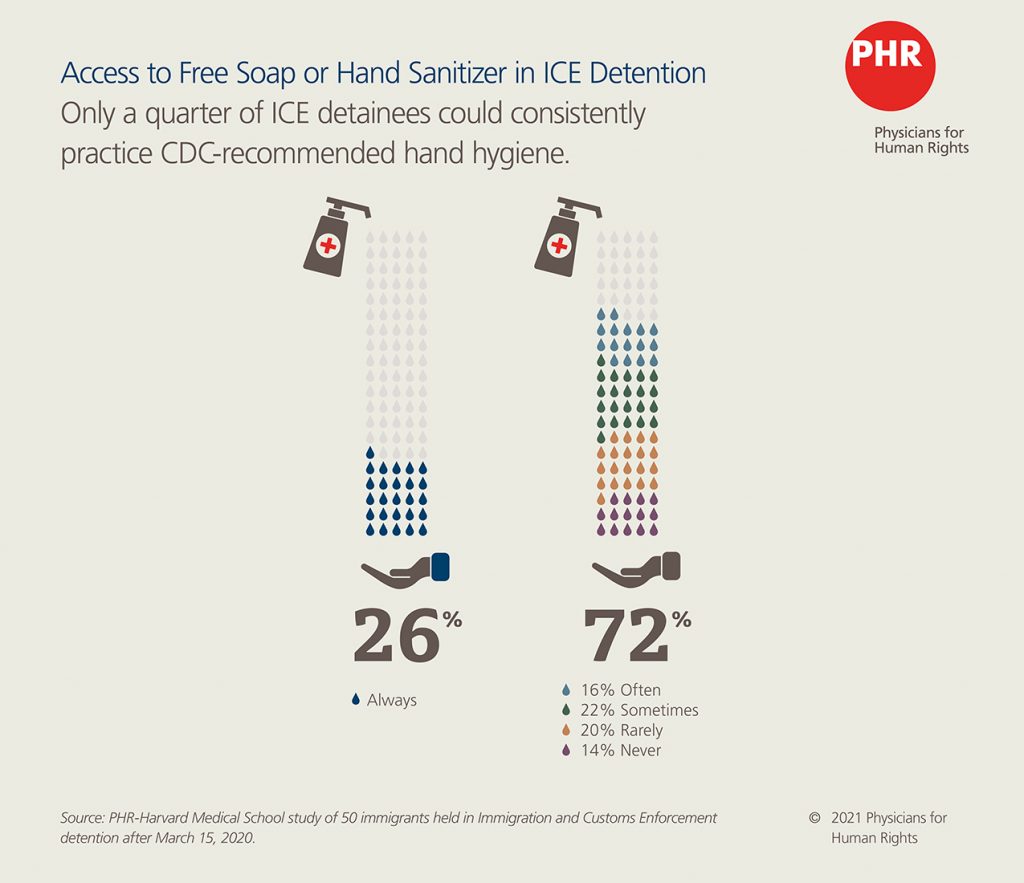
cleansing, including liquid soap, [and] running water” as well as “alcohol-based hand sanitizer with at least 60 percent alcohol where permissible based on security restrictions” (PRR).[64], [65] Per the PRR, ICE does not recommend providing bar soap, but, if it is used, facilities must “ensure that it does not irritate the skin as this would discourage frequent hand washing and ensure that individuals are not sharing bars of soap.” The study’s findings show that soap was commonly unavailable to detained immigrants. Instead, people often had to rely on buying soap with their own money, washing their hands with water alone, or using other bath products to wash their hands.

“Hand soap and masks – those were like a luxury. We prayed for that in detention.”

32-year-old man, Yuba County Jail

These requirements were far from the actual lived experiences of the study participants. Forty-two percent of participants reported not having access to soap at some point during their detention: “Before [April], we would have weeks where we would not have soap…. We would request [it] but they would ignore us” (32-year-old woman, Bristol County Detention Center). When participants did have access, they were worried about the quality of the soap. One participant was concerned that “the soap was mixed with water” (39-year-old man, Bristol County Detention Center), while another was worried that “everyone used the same bar soap in the bathroom” (40-year-old man, Mesa Verde Detention Center). When soap or hand sanitizer was not available, some participants reported resorting to using shampoo to wash their hands, and one even used toothpaste.

Detainees were often forced to purchase soap with their own personal funds. Thirty-six percent of participants reported relying on purchasing soap from the commissary. Several people relied on donations from outside organizations, while others had to forgo other basic necessities to purchase soap: “Faithful Friends [a church-based organization] sent $20 per individual to buy soap in the commissary” (29-year-old man, Yuba County Jail). Another person reported: “I was working [in detention] to try to get money to call my family. I couldn’t buy bar soap…. People had to choose between buying food from the commissary or bar soap, they couldn’t afford both” (25-year-old man, Port Isabel Detention Center). Certain people with no funds to purchase soap were left without any ability to practice effective hygiene: “People who did not have money had to wash their hands only with water” (33-year-old man, Otay Mesa Detention Center). Eighteen percent of participants reported most commonly using water alone to wash their hands.

“People had to choose between buying food from the commissary or bar soap, they couldn’t afford both.”

25-year-old man, Port Isabel Detention Center

Hand sanitizer was nearly inaccessible to most participants. Eighty-two percent of people reported not having access to hand sanitizer anywhere in the detention facility. Several people reported that hand sanitizer was provided to the staff, but not to the detained population. One participant reported: “The guards have hand sanitizer in their area. But inmates can’t touch it. They’ll tell you, it’s not for us, just for them” (46-year-old man, York County Prison). Another person discussed how they were told to sanitize their hands but were never given hand sanitizer: “The fliers said we should use hand sanitizer but we didn’t have access to it and they didn’t supply it” (42-year-old woman, Eloy Detention Center).

Immigrants Disinfected Detention Facilities Themselves to Protect Against COVID-19

The NDS requires that all facilities maintain clean surfaces and fixtures and requires that sufficient cleaning equipment and supplies be made available throughout each facility.[66] In addition, per the COVID-19 PRR, facilities must “clean and disinfect surfaces and objects that are frequently touched, especially in common areas (e.g., doorknobs, light switches, sink handles, countertops, toilets, toilet handles, recreation equipment) … several times a day.” Our findings show that disinfection of facilities was inconsistent and that detainees most commonly had to clean the facilities themselves, for little or no pay. The quality of cleaning supplies, and often the lack of cleaning supplies all together, posed immense risk to the health of detained immigrants.

“We had to take on the initiative to clean the common room, especially after we found out that the sickness was getting worse. We would ask the detention center guards to give us cleaning supplies, but they didn’t.”

44-year-old woman, Adelanto ICE Processing Center

Disinfection of common areas was inconsistent and did not follow the NDS or PRR. Twenty-six percent of participants reported never observing disinfection of frequently touched surfaces in common areas (e.g. doorknobs, light switches, countertops, and recreation equipment). Of the 36 people who reported observing disinfection, only 56 percent reported seeing disinfection several times a day. The overwhelming majority (83 percent) reported that detainees disinfected the common areas themselves. Only 11 percent reported that facility staff disinfected the center.

Detainees who cleaned the common areas were often working through a voluntary employment program in the detention centers in order to secure funds for basic goods (e.g. soap, paying for telephone). Four people mentioned that they were paid $1 a day to help with cleaning (an individual bar of soap ranged from $2.29 to $3.00 in various facilities). One person raised concern around the voluntary nature of cleaning: “The detainees that did the cleaning had volunteered, they paid you a dollar a day. But it wasn’t really volunteering, they forced it upon you. I participated in cleaning the medical room” (27-year-old man, Tacoma Northwest Detention Center). Another person described how they stopped being paid once the pandemic started: “If a detainee wants to, they can help clean and are paid $1 per day to help clean. But when COVID-19 started, they didn’t pay any more and so detainees stopped cleaning with the program. Instead, everyone had to clean on their own space” (51-year-old woman, Eloy Detention Center). One person reported that staff threatened to place him in solitary confinement if he refused to clean.

Several people reported that disinfection of common areas was often self-initiated rather than mandated by ICE staff: “We had to take on the initiative to clean the common room, especially after we found out that the sickness was getting worse. We would ask the detention center guards to give us cleaning supplies, but they didn’t” (44-year-old woman, Adelanto ICE Processing Center). Another person reported: “The phones were not cleaned between people. After everyone started complaining in May, they gave us a cleaning agent and towels to clean them” (20-year-old woman, Eloy Detention Center). When detention staff did the cleaning, it was often insufficient: “They never cleaned the bathrooms or doorknobs themselves, they just sprayed Clorox on it, they never cleaned it. Then we cleaned it ourselves (32-year-old man, Yuba County Jail).”

Even when tasked to clean the common areas themselves, several detainees mentioned that they were not given enough supplies to clean properly. They reported not having “brooms or equipment … or hot water” (36-year-old man, Bergen County Jail) and having “to clean the bathrooms only with water” (24-year-old woman, Eloy Detention Center). Sometimes, people reported cleaning their dorms with the “same soap [they used] to clean [their] hands” (P28) or going “weeks without having cleaning supplies:” (24-year-old woman, Eloy Detention Center).

The potential health effects of cleaning supplies on the detained population was also concerning. One person reported that the cleaning supplies “caused many of the detainees to have respiratory issues” (32-year-old man, Otay Mesa Detention Center), while another reported that “many people started getting nosebleed from using the cleaning liquid” (27-year-old man, Tacoma Northwest Detention Center).

Detained Immigrants with Viral Symptoms Were Often Not Tested for COVID-19 or Appropriately Isolated

Participants reported a consistent lack of action by facility staff to appropriately respond to potential COVID-19 cases on the continuum from prevention to treatment. Detainees faced long wait times to see medical professionals, lack of both testing and isolation of symptomatic patients, and misuse of solitary confinement. Many facilities were non-compliant with both the 2019 NDS and the COVID-19 PRR guidelines that outline appropriate medical care, isolation of symptomatic individuals, and testing.[67]

Twenty-one out of 50 people interviewed (42 percent) experienced symptoms of COVID-19 during the pandemic, such as fever, cough, muscle aches, and loss of smell. Three out of these 21 (14 percent) never officially reported their symptoms due to fear of being sent to solitary confinement or other punishment, or anticipation of denial of medical care, because “the doctor would not come until you were very, very sick, almost at death’s door” (32-year-old man, Otay Mesa Detention Center).

“The doctor would not come until you were very, very sick, almost at death’s door.”

32-year-old man, Otay Mesa Detention Center

Out of all respondents who had reported symptoms, only 17 percent (three people) were appropriately isolated from the general population and tested for COVID-19, one of whom tested positive. The remaining 83 percent (15 people) reported their symptoms to facility staff members but did not get tested for COVID-19 and were not isolated. Common reasons that interviewees cited as to why they were not tested were: no one in the facility was able to get tested; detainees’ “symptoms were not severe enough” as perceived by staff; and staff members did not take their issues seriously because they thought the detainees were just pretending to be sick. One asymptomatic person was tested and isolated because his attorney had been exposed, but the nursing staff did not tell him what he was being tested for or why he was being tested.

Currently, ICE publicly reports the number of confirmed COVID-19 cases under isolation or monitoring. However, this number is dependent on how many potential cases are appropriately followed up with testing. The PRR, which adheres to CDC guidelines, recommends that any and all “individuals with signs or symptoms consistent with COVID-19” should be tested for COVID-19. In addition, all suspected or confirmed cases should also be “isolated[ed] … immediately in a separate environment from other individuals.” This appears to be inconsistent with the reported practices inside ICE facilities.

ICE neglected to practice even the most basic measures necessary for identifying, treating, and mitigating the spread of COVID-19 within its detention centers.

More than half of the people who reported their symptoms had their temperature checked (12 out of 18 interviewees) and were seen by a medical professional (14 out of 18 interviewees). However, long wait times and lack of isolation from the general population dramatically placed both sick people and their neighbors at risk. Interviewees reported facing prolonged wait times before being able to see a medical professional, with an average wait time of 100 hours (approximately four days). One person reported having had to wait a total of 25 days for an appointment. Importantly, two people were never seen by a medical professional at all, even after reporting their symptoms to staff members. These practices directly violate the PRR testing and isolation guidelines as well as the NDS, which state that all facilities must provide “timely responses to medical complaints” and “necessary and appropriate medical, dental and mental health care.”[68]

Although it can be difficult to ascertain the standard of care without a review of medical records, the qualitative interviews provided additional details of people’s experiences in receiving medical care. Several people were told by clinical staff that their symptoms were caused by other issues, such as influenza, bronchitis, or sinusitis, even though interviewees reported that no testing or additional exams were performed to confirm these diagnoses. One man with chronic lung disease, who was having difficulty breathing while lying down and walking, reported that the staff in the medical office “just took my temperature, they didn’t listen to my lungs or ask me questions, they didn’t even let me sit down” (41-year-old man, Stewart Detention Center). Several others reported with concern their perspective that medical staff had “done nothing” for them or fellow detainees with symptoms, or had just given them over-the-counter medication, such as ibuprofen. For example, one man with a fever was denied a coronavirus test and not isolated or given a mask; he reported, “When they found out I had a fever, they told me it was just a flu. They didn’t quarantine me, they just gave me some pills, Advil and something for my dry throat” (21-year-old man, Yuba County Jail).

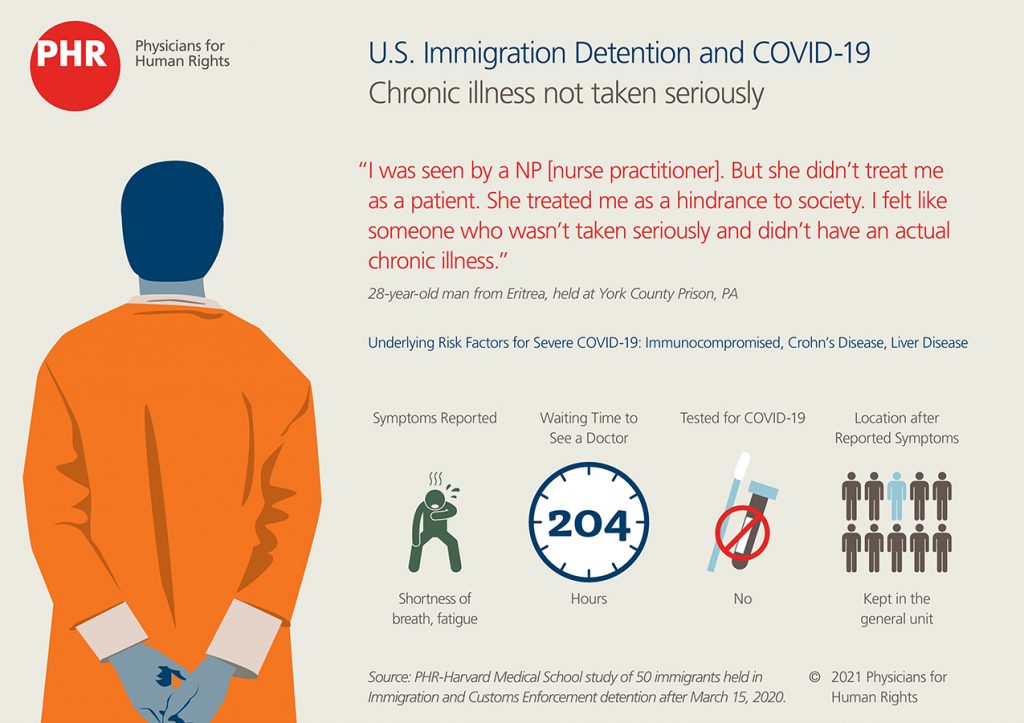
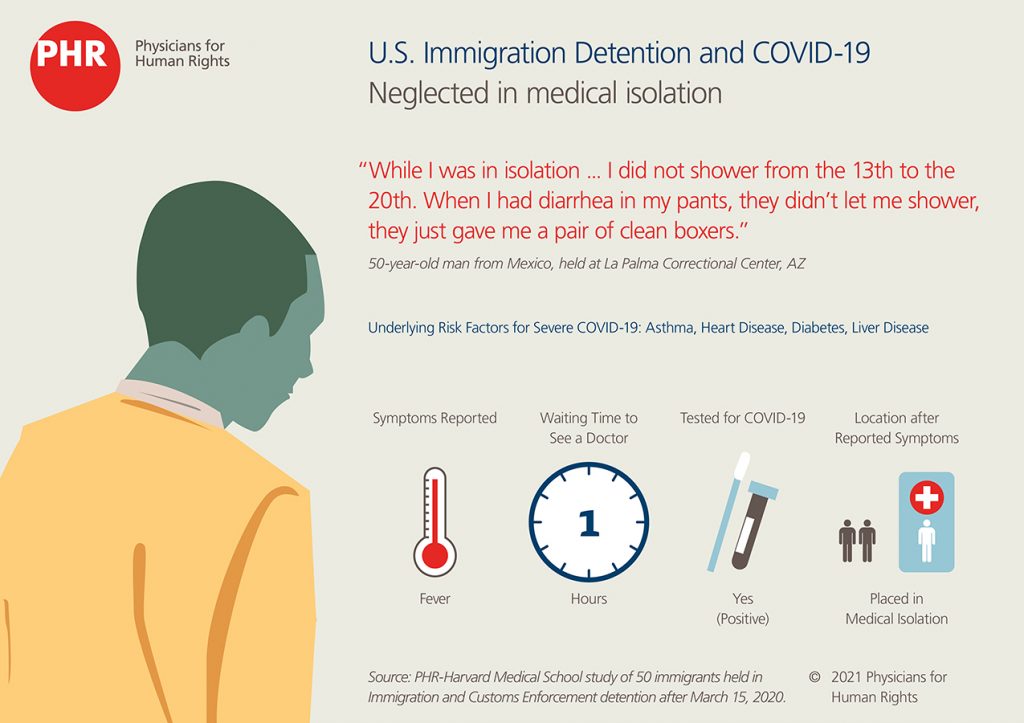
Overall, these interviewee reports provide evidence that ICE neglected to practice even the most basic measures necessary for identifying, treating, and mitigating the spread of COVID-19 within its detention centers. Symptomatic people were largely kept in the general population, where they might have potentially exposed others, were rarely tested, and were threatened with solitary confinement instead of being provided adequate medical care. The graphics on pages 26, 29, 30, and 34 highlight the experiences of four respondents after they developed symptoms indicating possible COVID-19 infection and their challenges receiving medical care. These results show that, in those circumstances, ICE was not adhering to its own PRR guidelines or complying with CDC guidance on best practices to contain infectious disease outbreaks and provide timely comprehensive medical care that is mandated by the NDS and PRR guidelines.[69]

High-risk People Were Not Provided with Special Accommodation

While 88 percent (44 people) of all participants had at least one comorbidity placing them at possible increased risk of severe COVID-19, only 56 percent (28 out of 50 people interviewed) reported these risk factors to detention staff. Of the 28 people who reported their comorbidities to detention staff, only four were told that they were at high risk of having a serious illness with COVID-19. None of those four were given the option to have an individual room. One was given the option to be placed in a group of other detainees at high risk of suffering severe COVID-19.

“I sent paperwork four times to the parole office … commenting on my chronic asthma that made me high risk for COVID. I asked them if they would release me… but they simply denied me until the end, when I was found to have lung cancer.”

34-year-old man, La Palma Correctional Center

Neglect and Denial

“I am asthmatic. When there were a lot of cases in my tank [detention union], I asked to be isolated from them because I have asthma. They did not pay attention to me until May 21, 2020, nearly one month after I started reporting feeling COVID-19 symptoms. But the doctor told me that it was nothing and returned me to my unit, where I stayed seven days in bed without being able to move because I was so tired.

They [medical staff from the detention center] then did blood tests because I felt so badly but still the doctors did not say anything more to me. It wasn’t until my asthma deteriorated and I told the doctor that I was fighting to breathe. The doctor saw me and noticed that my hand had become black and blue. She got very scared and called the ambulance. The doctor then told me that maybe I had previously had COVID-19 and that it had left me with a lot of blood clots in my lungs that now were blocking my arteries, causing my arm to lack oxygen. I reminded her that previously she had denied that I had COVID-19 and she told me that we should leave the past in the past and told me it was better to go to the emergency room.

In the emergency room, they did some tests and saw in my lungs something that looked like cancer, so they told me they had to do more tests. Afterwards, I came back to the detention center and they isolated me. And then, the next day, an official came and told me they were going to release me … because I had cancer.”

34-year-old man held in La Palma Correctional Center


Medical Isolation Was Not Safe

Instead of appropriate medical management of symptomatic patients, interviewees were sent to solitary confinement, a practice which has been shown to potentially cause serious physical and behavioral health effects.[70] Seven people described situations which seemed to indicate misuse of solitary confinement (“the hole”), poor conditions of medical isolation, or both. Medical isolation should provide the same or greater medical and mental health care for the individual, and still allow for the isolated person to have the same rights as detainees in the general population, such as telephone contact with family, friends, and legal counsel, visitation, outdoor recreation, television, access to commissary and legal resources, nutritious food, and hygiene.[71] One person described that staff members would walk around the unit with a stretcher, and “if you were really sick, they took you to the hole” (41-year-old man, Stewart Detention Center). People who were put in medical isolation or solitary confinement lived in dehumanizing and inhumane conditions, describing “spending 12 hours with no soap, no hand sanitizer, no toilet paper … not even a mattress pad to sleep on” (31-year-old man, Hudson County Correctional Center). One person reported that, while in isolation, he didn’t have a mattress for four days and couldn’t shower for a week, even after defecating in his own underwear. Another described that, “When in isolation, you had no communication, you couldn’t even tell your family” (36-year-old man, Tacoma Northwest Detention Center). These practices created an environment of fear so that people avoided reporting symptoms: “I think I got COVID because I had body pain and felt short of breath. But I never said anything to anybody because I was so scared that they were going to punish me” (33-year-old man, Otay Mesa Detention Center).

“I think I got COVID because I had body pain and felt short of breath. But I never said anything to anybody because I was so scared that they were going to punish me.”

33-year-old man, Otay Mesa Detention Center

Detainee Complaints Led to Retaliation

Forty-three study participants (86 percent) stated that they reported and/or protested issues related to COVID-19. Those who reported or protested pandemic-related issues often did so in more than one way. For those reporting issues, reporting mechanisms included verbally complaining to staff about unsanitary conditions or lack of personal protective equipment (91 percent), filing formal grievances (42 percent), going on hunger strikes (42 percent), reporting conditions to lawyers (77 percent), reporting conditions to the media (21 percent), and sending messages to family members with the hope they would be publicized (30 percent). Four respondents also stated that they wrote letters to ICE leadership, federal and state courts, and state departments of public health.

“One person who was Mexican and transgender helped me and they punished her and put her in ‘the hole’ … for like two weeks for helping me write to the news. I was very scared that the same thing was going to happen to me.”

33-year-old man, Otay Mesa Detention Center

Of these 43 participants who reported and/or protested COVID-19 issues, 56 percent (24 people) reported experiencing acts of intimidation and retaliation after their complaints. The acts of retaliation included verbal abuse by detention facility staff (54 percent), being pepper sprayed (17 percent), being placed in solitary confinement (29 percent), and experiencing threats or actions of limiting food, communication, or commissary access (12 percent). For those who did spend time in solitary confinement after reporting or protesting, the time spent in solitary confinement ranged from a few hours to two weeks. Other forms of intimidation and retaliation described by study participants included having one’s access to the legal library and recreational areas revoked and limiting one’s access to water for hand cleaning, as well as frequent threats of pepper spray, solitary confinement, and deportation.

“We were so scared to complain sometimes. We don’t know if it will affect our case or get us more in trouble. We were scared.”

32-year-old woman, Bristol County Detention Center

Fear and Punishment

“There was a rule that they shouldn’t bring in people from other jails, but they kept bringing in people from other facilities to my unit. One time, a new person came from outside and the CO [correctional officer] tried to assign this person to my bunk, but I didn’t want to be near that person because he was sneezing all the time. I told the CO how I felt, and he started cursing at me, so I told him that if I get sick, it will be his responsibility. They sent me to the hole and didn’t even want to hear my side of the story. I was in there for one week.

I used to be outspoken before that. I told my lawyer about what happened, and he gave me a number to call but I was scared to talk to anyone after that happened because I thought I would get punished.”

26-year-old man held in Bristol County Detention Center


Legal and Policy Framework

U.S. Government Must Ensure Health and Safety in Detention

As civil detainees, people in immigration detention are entitled to due process under the Fifth Amendment of the U.S. Constitution and cannot be held in punitive conditions.[72] Under the Fifth Amendment, the government cannot put people in danger or act with deliberate indifference to a foreseeable or obvious threat.[73] The government is required to provide for the reasonable health and safety of people in detention,[74] and must take reasonable measures to prevent serious harm.[75] Courts use the standard of “deliberate [indifference] to [objectively] serious medical needs,” which the Supreme Court developed for Eighth Amendment violations of the prohibition on cruel and unusual punishment.[76]

It is difficult to ensure accountability for detention conditions. Accountability is also made difficult by the fact that ICE has deported detainees who speak out about mistreatment.

There are no detailed, legally binding standards for U.S. immigration detention center conditions, resulting in little accountability and a morass of regulations.

Detention centers are ostensibly governed by agency guidelines, such as the Immigration and Customs Enforcement (ICE) 2019 National Detention Standards. This is the pared-down Trump administration revision of the Obama administration Performance-Based National Detention Standards,[77] but its observance varies from facility to facility; as a result, it is difficult to ensure accountability for detention conditions. The 2019 National Detention Standards require that each facility maintains contingency plans in the event of an infectious disease outbreak, but these plans are not publicly accessible. Accountability is also made difficult by the fact that ICE has deported detainees who speak out about mistreatment and that stakeholder visitation is limited by the pandemic.[78]

The Centers for Disease Control and Prevention (CDC) has issued guidance on measures to be taken to ensure safe conditions in correctional and detention settings, but the recommendations are not specific and contain caveats for individual facilities to adapt based on their “physical space, staffing, population, operations, and other resources and conditions,” rather than insisting on a high standard of precaution.[79] Similarly, the ICE COVID-19 Pandemic Response Requirements do not go into detail about clinical care, isolation measures, and transfer to offsite care for people who test positive.[80] Medical care in ICE facilities is quite fragmented, with the federal ICE Health Service Corps providing health care in 22 out of more than 200 detention centers, while others use private contractors.[81]

The lack of detailed U.S. legislative or internal policy guidance means that, in practice, often the only resort for immigrants who face unsafe conditions of confinement is to seek constitutional protections.

The United States has signed, though not ratified, the International Covenant on Economic, Social and Cultural Rights, whose Article 12 recognizes the “enjoyment of the highest attainable standard of physical and mental health” as a human right. Signatories are not bound to treaty obligations, but they are obligated to refrain from conduct which defeats the “object and purpose” of the treaty.[82] The UN Standard Minimum Rules for the Treatment of Prisoners, which apply in all detention settings, confirm that health care for people who are detained is the responsibility of the state, and that health care also must follow public health principles in regard to management of infectious disease, including treatment and clinical isolation.[83]

Solitary confinement or segregation is a harmful practice with grave health implications. Although the U.S. Supreme Court has not determined that solitary confinement is itself “cruel and unusual punishment,” it has ruled in support of procedural protections for prisoners transferred to long-term solitary confinement.[84] The UN Human Rights Committee has stated that prolonged solitary confinement in detention may constitute torture or cruel, inhuman, or degrading treatment or punishment, which is prohibited under Article 7 of the International Covenant on Civil and Political Rights (ICCPR).[85] After extensive study of global practices, former UN Special Rapporteur on Torture Juan Mendez concluded that solitary confinement should be banned in most cases and absolutely prohibited beyond 15 days, at which point it constitutes torture due to the harm inflicted by social and sensory isolation.[86] The UN Standard Minimum Rules for the Treatment of Prisoners also state that prolonged solitary confinement should be absolutely prohibited.[87]

Ultimately, the government cannot inflict punishment in immigration detention because civil detention is not punitive. If conditions of confinement are poor to the point of constituting punishment,[88] remedies should include consideration of alternatives to detention and avenues for release.

International Law Limits Use of Immigrant Detention and Prohibits Criminalizing Border Crossing for Asylum Seekers

The international legal framework discourages detention of asylum seekers and immigrants except for limited purposes and as a last resort. Article 31(2) of the UN Refugee Convention permits states to restrict refugee freedom of movement only when “necessary” and only until their legal status is “regularized” or they are admitted to another country. Detention or other restrictions of movement of asylum seekers must pass the Article 31(2) necessity test, otherwise it may amount to a “penalty,” which is prohibited under the Convention.[89] The UN High Commissioner for Refugees’ (UNHCR) Executive Committee considers detention of asylum seekers as meeting the necessity test only when the government detains people to verify their identity or issue travel or identity documents, to make a preliminary assessment about their asylum claim, or based on an individualized security assessment.[90]

International law also requires states to uphold the Article 9 ICCPR standards of reasonableness, necessity, and proportionality in detention, such as notification about the reason for detention and ensuring periodic judicial review. Arbitrary and unlawful detention are prohibited by Article 9; detention is arbitrary when it reflects “elements of inappropriateness, injustice, lack of predictability and due process of law,” or fails to be reasonable, necessary, and proportional.[91]

The UN Human Rights Committee (HRC) states that beyond very brief periods, any further detention of migrants must be based on an individualized risk and security assessment, taking into full consideration alternatives to detention, such as reporting requirements or bond, and giving consideration to the impact of detention on migrants’ health.[92] The HRC has stated that detention of asylum seekers must be subject to periodic review to ensure that the detention is not arbitrary.[93] International human rights law requires governments to proactively ensure “adequate medical care during detention.”[94]

U.S. Law Flouts International Law Limitations on Immigrant Detention

International standards consider immigration detention as a last resort and require periodic hearings for all types of detention in order to prevent arbitrary detention. U.S. law requires the government to imprison several categories of immigrants without a hearing to consider if they are a risk to public safety or a flight risk.[95] The majority of people in immigration detention, however, have no criminal record,[96] and 77 percent of people released from immigration detention complied with their appearance obligations in immigration court.[97] Both of these facts are inconsistent, then, with detaining so many immigrants.

In addition to mandatory detention laws, the Trump administration short-circuited the established channels of release, such as bond and parole for asylum seekers, resulting in de facto indefinite detention.[98] A federal judge later stated that the practice of denying parole requests without justification amounted to arbitrary detention and required ICE to follow its own policy to consider parole requests.[99] Ultimately, options for release – such as release on bond if people crossed the border between ports of entry, through parole, if they entered through a port,[100] or challenging their detention before a judge[101] – are vulnerable to rollback under political pressure.

Another driving factor in the growth of immigration detention, in addition to mandatory detention laws, is the criminalization of border crossing, which violates Article 31 of the UN Refugee Convention. According to Article 31(1), refugees are not to be penalized for illegal entry, if they are fleeing persecution, “present themselves without delay,” and “show good cause.” Presence in the United States without authorization is a civil offense, but in the 1920s, nativist laws also made illegal entry[102] and reentry[103] to the United States criminal offenses.[104] These laws were increasingly prosecuted starting in the 1990s, despite evidence showing that prosecutions did not deter border crossing.[105] These prosecutions were renewed under the Zero Tolerance policy used by the Trump administration to forcibly separate families in 2018.[106]

Release from Immigration Detention is the Most Appropriate COVID-19 Remedy

During the pandemic, questions about restrictions on state use of immigration detention and standards for adequate conditions and health care have collided. When detention system medical care and public health measures during a pandemic are inadequate, as has been documented in this report, release from detention is the most appropriate and safest remedy.

When detention system medical care and public health measures during a pandemic are inadequate … release from detention is the most appropriate and safest remedy.

This comports with the March 2020 advisory by the World Health Organization, the UN High Commissioner for Human Rights, and UNHCR stating that, given the risk of severe illness and death from COVID-19, people in immigration detention should be released “without delay.”[107] A number of countries, including Austria, Belgium, Luxembourg, Spain, Switzerland, and the United Kingdom, chose to release people from immigration detention and to halt new arrivals to closed facilities, in order to reduce the risk of contagion.[108] The Subcommittee on Prevention of Torture has also urged governments to ensure a “do no harm” approach to places of detention during the coronavirus pandemic in order to prevent torture and ill treatment. Due to the increased risk of virus transmission in custodial settings, the Subcommittee calls on states to “review the use of immigration detention and closed refugee camps with a view to reducing their populations to the lowest possible level.”[109]

Although ICE has the authority to release people from detention for “urgent humanitarian reasons” or “serious medical conditions,”[110] ICE voluntarily released very few people from detention as the coronavirus spread throughout the United States, waiting instead to be compelled by judicial orders. The federal government did not use its discretionary authority to release even people with underlying health conditions from immigration detention, insisting that its practices comply with CDC guidance.[111] The Department of Homeland Security insists that such conduct is justified by public safety, “to prevent unnecessary victimization by recidivist criminals”; however, ICE’s own statements accuse immigrants of being “charged or convicted” (meaning not all have even been proven under these charges) of such minor offenses as “driving without a license” and “the federal offense of illegal reentry after removal.”[112]

Changes benefiting people in immigration detention have only come after litigation was initiated

To date, releases or even changes in protocol have not taken place without judicial intervention on a facility-by-facility basis. For the most part, ICE has only acted when lawsuits were initiated, even while litigating nearly every case to the hilt, with proceedings taking many months to come to a resolution.[113] Much litigation is ongoing, as the courts consider the facts in each individual case in order to decide whether or not the facility is taking adequate measures and whether the risks to the health of people in detention outweigh the benefits of continuing to detain them. 

In one case, ICE refused to give masks or sanitizer to detainees released unless specifically ordered to do so by a federal judge.[114] A number of federal courts ordered release from immigration detention for people with underlying health conditions, such as diabetes or asthma, due to imminent threat of serious illness or death from the coronavirus.[115]

In April 2020, a federal court certified a nationwide class of individuals who are eligible for release from immigration detention due to the coronavirus, such as those suffering from heart disease, diabetes, and autoimmune disorders, requiring ICE to locate and provide a custody redetermination for class members.[116] In October, the same court found that ICE violated the order by failing to identify people with risk factors and meaningfully carry out review for release, and insisted on review for release even for those subject to mandatory detention.[117] The court also required ICE to issue comprehensive standards for preventative measures from coronavirus for people with risk factors, ensure widespread and regular testing, suspend transfers, not misuse solitary confinement for medical isolation, and only use safe cleaning products in a proper manner.[118]

Some courts have held that availability of testing is a critical factor in determining whether the state is showing deliberate indifference to serious medical conditions, with one federal judge finding that holding at-risk people in a facility without COVID-19 testing “likely imposes unconstitutional punishment,” because the public interest in immigration enforcement is significantly outweighed by people’s interest in avoiding illness and death.[119] Similarly, an appeals court confirmed the validity of a federal judge’s order that ICE take a range of precautionary measures, stating that the district court may remedy a constitutional violation by requiring measures such as isolation of people who tested positive and temporarily halting intake.[120] Other measures ordered by the judge include enforcing social distancing and mask wearing and providing appropriate sanitary and hygiene supplies.[121]

In June 2020, a federal judge ordered children released from family detention centers where people were already being infected with the coronavirus in order to ensure compliance with a settlement agreement governing conditions of confinement for migrant children, stating that an independent monitor had found that the facility was not taking adequate measures regarding social distancing, masking, and testing.[122]

Conclusion

Public health and correctional health experts warned from the beginning of the COVID-19 pandemic that immigration detention centers are “tinderboxes,” meaning that they are poorly ventilated, crowded facilities with constant movement of people in and out, where a highly infectious disease is, by definition, impossible to contain. Systemic poor conditions and inadequate medical care in U.S. immigration detention have been extensively documented, yet the government exhibited entrenched reluctance to release people into the community despite these risks. The findings of this report show that in many detention centers, social distancing was impossible and was not provided for people who were high risk, detainees often went without hand soap, surfaces were not adequately disinfected, and testing was often not available even for people who reported symptoms, while long delays were reported in accessing medical treatment. Troublingly, many said that the government retaliated and silenced them when they protested these harsh conditions.

In many detention centers, social distancing was impossible … detainees often went without hand soap, surfaces were not adequately disinfected, and testing was often not available even for people who reported symptoms…. Many said that the government retaliated and silenced them when they protested these harsh conditions.

Although the government has insisted in public statements that its practices comply with Centers for Disease Control and Prevention (CDC) guidance and are necessary to ensure public safety, the evidence argues otherwise. The harsh and punitive conditions reported in this study show that Immigration and Customs Enforcement (ICE) practices did not comply with CDC guidance or with ICE’s own Pandemic Response Requirements, creating unacceptable health risks which violated the constitutional and human rights of detainees. International law requires governments to limit their use of immigration detention only with due process protections and as a last resort, and the U.S. Constitution prohibits punitive conditions in civil detention, requiring the government to ensure safe and healthy conditions. As an urgent matter, the U.S. government should release all people from immigration detention to allow them to safely shelter in the community, absent a substantiated individual determination that the person represents a public security risk. Safely releasing people from immigration detention is in accordance with international human rights and U.S. constitutional standards and represents the best way to prevent further outbreaks of COVID-19.

Policy Recommendations

To the U.S. Department of Homeland Security:

  • Immigration and Customs Enforcement (ICE) should use its discretionary authority to release all people from immigration detention and allow them to safely shelter in place in non-custodial settings, unless there is a substantiated individualized determination that the person represents a public security risk. Release should start with those who are over the age of 65 or have underlying conditions which may increase their vulnerability to severe illness and death from COVID-19; safe medical release should be coordinated with community groups;[123]
  • End detention of children and families. Families and children held in ICE detention centers must be immediately released together, in the best interest of the child;
  • Scale up community-based alternatives to detention which are contracted to non-profit organizations;
  • Fully implement recommendations of medical expert consultants to the Department of Homeland Security (DHS), DHS Office of the Inspector General (OIG), and DHS Office for Civil Rights and Civil Liberties, and ensure sanctions for non-compliance, including facility closure. Make inspection reports available to the U.S. Congress and to the public within 60 days of inspection;
  • Fully comply with the 2009 Parole Directive by fully considering and granting parole and bond requests, absent an individualized assessment that the person presents a threat to public safety or a flight risk;
  • Establish an Ombudsman for Immigration Detention to investigate misconduct and inspect DHS facilities and to ensure that people in detention can file grievances without fear of retaliation, as required and funded by Congress;
  • Establish a mechanism for independent medical oversight through regular inspections by respected public health professionals in the context of a robust certification process;
  • Mandate ICE Health Service Corps to take responsibility for health care in all ICE detention facilities in order to end fragmentation of medical care;
  • Ensure a robust system to respond to internal complaints, whether by whistleblowers, including health professionals, or people in detention, without fear of retaliation; and
  • Absent preferred release, adopt measures specifically related to the coronavirus in order to mitigate spread:
    • Provide regular and transparent reporting regarding the total number of tests, infections, and deaths, including people in detention, ICE staff, and contracted staff, as well as numbers of deportations and transfers of people testing positive for COVID-19;
    • Increase COVID-19 screening and mass testing, including for those who are asymptomatic;
    • Ensure immediate and free access to personal protective equipment and to hygiene and sanitary supplies in all facilities;
    • Fully implement social distancing recommendations, including public health-appropriate eating and sleeping arrangements;
    • Ensure humane measures for medical isolation and quarantine that do not amount to solitary confinement, but rather ensure contact with family and legal counsel and access to library, recreation, and all other amenities;
    • Ensure rapid access to medical care outside of ICE facilities for COVID-19-positive detainees;
    • Cease the use of solitary confinement as a form of medical isolation;
    • Ensure easy access to public health information about COVID-19 in the languages understood by people in detention; and
    • Cease arrests, transfers, including through use of detainers,[124] and deportations, which accelerate spread of the coronavirus among immigrants, ICE staff and contractors, and local communities, and within the country of deportation.

To the U.S. Congress:

  • Reduce the number of people in immigration detention without delay by eliminating local bed count quotas (number of detention beds available for interior enforcement), rejecting funding requests to expand detention capacity, eliminating funding for private prison contracts, and increasing funding for community-based alternatives to detention which are contracted to non-profit organizations;
  • Adopt binding legislation codifying detention standards, including standards of medical care, so that DHS provision of medical care is not regulated by haphazard and inconsistent internal guidelines;
  • Exercise oversight (including funding penalties) regarding DHS’s establishment of the Ombudsman for Immigration Detention as a nonpartisan, impartial expert body to investigate misconduct, inspect facilities, and make recommendations;
  • Support legislative efforts, such as those which provide for release from immigration detention during a communicable disease-related national emergency,[125] and halt most arrests and apprehensions, as these only increase the detention population during the pandemic;[126]
  • Repeal the Anti-terrorism and Effective Death Penalty Act and the Illegal Immigration Reform and Immigrant Responsibility Act, which violate international legal standards limiting use of immigration detention; decriminalize unauthorized entry of asylum seekers, which is in violation of the Refugee Convention; and
  • Continue to uphold whistleblower protections and safeguard the ability of health professionals working in detention facilities to report concerns about conditions.

To State Governors and Local Public Health Authorities:

  • Require immigration detention facilities, including county and local jails under inter-governmental service agreements, to reduce their detention populations in order to comply with state and local public health and licensing laws and regulations;
  • Direct local and state law enforcement to cease compliance with detainers that facilitate spread of the virus between closed facilities; and
  • Coordinate with U.S. Congress representatives, as well as with DHS internal oversight bodies OIG and Office for Civil Rights and Civil Liberties, regarding facility oversight and monitoring, including unannounced inspections by independent, outside experts.

To the Centers for Disease Control and Prevention (CDC):

  • Issue clear guidance to local, state, and federal detention officials, judges, and law enforcement agencies on reducing immigration detention intake and population size to reduce the spread of COVID-19;[127]
  • CDC guidance on safe conditions in detention settings should require a high standard of precaution and eliminate caveats based on purely operational considerations;
  • Issue public health guidelines distinguishing “solitary confinement” from “quarantine” and “medical isolation” to prevent punitive conditions for those who are exposed to COVID-19;
  • Review and adopt recommendations by expert organizations such as the National Academies; and
  • Assemble a formal CDC working group on COVID-19 and detention settings.

To the UN Human Rights Committee:

  • Continue to issue guidance for states regarding their obligations to prevent arbitrary detention through procedural guarantees and to prevent cruel, inhuman, and degrading treatment through adequate conditions of confinement and medical care, and underscore human rights law limitations on state use of immigration detention.

Acknowledgements

This report was written by Katherine Peeler, MD, Division of Medical Critical Care, Boston Children’s Hospital, faculty member in the Department of Global Health and Social Medicine and instructor in pediatrics and global health and social medicine, Harvard Medical School, medical director of the asylum clinic for Harvard Medical School’s chapter of Physicians for Human Rights (PHR) known as the Harvard Student Human Rights Collaborative (HSHRC), and PHR medical expert, and students from HSHRC Parsa Erfani, Caroline H. Lee, coordinator of the Harvard Medical School asylum clinic, and Nishant Uppal; and by PHR staff Kathryn Hampton, MSt, senior asylum officer; Ranit Mishori MD, MHS, PHR senior medical advisor, professor of family medicine at the Georgetown University School of Medicine, director of the department’s Global Health Initiatives, and interim chief public health officer for Georgetown University; and Elsa Raker, PHR asylum program associate.

Interviews were conducted by students and faculty from HSHRC Parsa Erfani, Daniel Gonzalez, Caroline Lee, Nishant Uppal, Raquel Sofia Sandoval, and Katherine Peeler, MD. Hajar Habbach, MA, former PHR asylum coordinator, provided input to the research design.

The report benefitted from review by PHR staff, including DeDe Dunevant, director of communications; Michele Heisler MD, MPA, medical director; Karen Naimer, JD, LLM, MA, director of programs; Joanna Naples-Mitchell, JD, U.S. researcher; Michael Payne, senior advocacy officer; and Susannah Sirkin, MEd, director of policy.

The report also benefitted from external review by PHR former board member Adam Richards MD, MPH, PhD; by PHR Advisory Council Member Gerson Smoger, JD, PhD; and by Mark Rosenbaum, JD, director of Public Counsel Opportunity Under Law.

The report was edited and prepared for publication by Claudia Rader, MS, PHR senior communications manager, with assistance from Isa Berliner, communications intern. Hannah Dunphy, digital communications manager, prepared the digital presentation.

PHR is grateful for the funding support for this study provided by Harvard Medical School and Massachusetts Medical Society. Interpretation was graciously provided by Jeenie®.


Endnotes

[1] Emily Kassie, “DETAINED: How the US built the world’s largest immigrant detention system,” The Guardian, Sep. 24, 2019, theguardian.com/us-news/2019/sep/24/detained-us-largest-immigrant-detention-trump.

[2] “Justice-Free Zones: U.S. Immigration Detention Under the Trump Administration,” American Civil Liberties Union, April, 2020, p.14, aclu.org/sites/default/files/field_document/justice-free_zones_immigrant_detention_report_aclu_hrw_nijc_0.pdf.

[3] Drew Kann, “5 facts behind America’s high incarceration rate,” CNN, April 21, 2019, cnn.com/2018/06/28/us/mass-incarceration-five-key-facts/index.html.

[4] Justice Free Zones, aclu.org/sites/default/files/field_document/justice-free_zones_immigrant_detention_report_aclu_hrw_nijc_0.pdf, p.4.

[5] Priscilla Alvarez, “5,200 people in ICE custody quarantined for exposure to mumps or chicken pox,” CNN Politics, June 14, 2019, edition.cnn.com/2019/06/14/politics/mumps-chicken-pox-quarantine-ice/index.html; Jessica Leung et al, “Notes from the Field: Mumps in Detention Facilities that House Detained Migrants – United States, September 2018-August 2019,” Morbidity and Mortality Weekly Report, Centers for Disease Control and Prevention, cdc.gov/mmwr/volumes/68/wr/mm6834a4.htm; “Treatment of Detainees at ICE Detention Facilities,” Letters from ICE to Representative Jason Crow (Colorado), Jun. 18 and Jun. 28, 2019, Congressional Record (Jul. 9, 2019), Extensions of Remarks (at p. E877), congress.gov/116/crec/2019/07/09/CREC-2019-07-09-pt1-Pg-E877-2.pdf; “Systemic Indifference: Dangerous and Substandard Medical Care in US Immigration Detention”, Human Rights Watch, May 8, 2017, hrw.org/report/2017/05/08/systemic-indifference/dangerous-substandard-medical-care-us-immigration-detention#5555.

[6] N.C. Lo, S. Nyathi, L.A.C. Chapman, et al., “Influenza, Varicella, and Mumps Outbreaks in US Migrant Detention Centers,” JAMA, Oct. 29, 2020, doi:10.1001/jama.2020.20539, https://jamanetwork.com/journals/jama/fullarticle/10.1001/jama.2020.20539?guestAccessKey=94fbc6dd-0dd8-4218-babb-b203bd10a220&utm_source=twitter&utm_medium=social_jama&utm_term=4023163953&utm_campaign=article_alert&linkId=103174359.

[7] “Code Red: The Fatal Consequences of Dangerously Substandard Medical Care in Immigration Detention,” Human Rights Watch, June 20, 2018, p.15, hrw.org/report/2018/06/20/code-red/fatal-consequences-dangerously-substandard-medical-care-immigration; Kendall Taggart, Hamed Aleaziz, and Jason Leopold, “More Than 40 Immigrants Have Died In ICE Custody In The Past Four Years. Here Are Thousands Of Records About What Happened,” BuzzFeed News, Oct. 29, 2020, buzzfeednews.com/article/kendalltaggart/here-are-thousands-of-documents-about-immigrants-who-died.

[8] Jainie P. Meyer et al., COVID-19 and the coming epidemic in US immigration detention centres, The Lancet Infectious Diseases, Volume 20, Issue 6, 646 – 648, thelancet.com/journals/laninf/article/PIIS1473-3099%2820%2930295-4/fulltext.

[9] Katherine C. McKenzie MD, FACP and Ranit Mishori MD, MHS, FAAFP, “Releasing Migrants from Detention During the COVID-19 Pandemic,” Jun. 15, 2020, Journal of General Internal Medicine 35, p. 2765-2766, link.springer.com/article/10.1007/s11606-020-05954-4; B. Saloner, K. Parish, J.A. Ward, G. DiLaura, S. Dolovich, COVID-19 Cases and Deaths in Federal and State Prisons, JAMA, 2020;324(6):602–603. doi:10.1001/jama.2020.12528, jamanetwork.com/journals/jama/fullarticle/2768249.

[10] William D. Lopez, Nolan Kline, Alana M. W. LeBrón, Nicole L. Novak, Maria-Elena De Trinidad Young, Gregg Gonsalves, Ranit Mishori, Basil A. Safi, and Ian M. Kysel, “Preventing the Spread of COVID-19 in Immigration Detention Centers Requires the Release of Detainees,” American Journal of Public Health 0, e1_e5, ajph.aphapublications.org/doi/10.2105/AJPH.2020.305968.

[11] “Update to Amnesty International Report on COVID-19 in US Immigration Detention,” Amnesty International, Aug. 31, 2020, amnesty.org/download/Documents/AMR5129582020ENGLISH.PDF; “Enforcement and Removal Operations COVID-19 Pandemic Response Requirements,” U.S. Immigration and Customs Enforcement, Sep. 4, 2020, ice.gov/doclib/coronavirus/eroCOVID19responseReqsCleanFacilities.pdf.

[12] Liesl M. Hagan et al., “Mass Testing for SARS-CoV-2 in 16 Prisons and Jails — Six Jurisdictions, United States, April–May 2020,” U.S. Center for Disease Control and Prevention, cdc.gov/mmwr/volumes/69/wr/mm6933a3.htm; “ICE Guidance on COVID-19: ICE Detainee Statistics,” U.S. Immigration and Customs Enforcement, updated Jan. 4, 2021, ice.gov/coronavirus.

[13] Erfani P, Uppal N, Lee CH, Mishori R, Peeler KR, “COVID-19 Testing and Cases in Immigration Detention Centers, April-August 2020,” JAMA, Oct. 29, 2020, doi:10.1001/jama.2020.21473.

[14] Ibid.

[15] “ICE Guidance on COVID-19: ICE Detainee Statistics,” U.S. Immigration and Customs Enforcement, updated Jan 4, 2021, ice.gov/coronavirus.

[16] Erfani P, Uppal N, Lee CH, Mishori R, Peeler KR. COVID-19 Testing and Cases in Immigration Detention Centers, April-August 2020. JAMA. Published online October 29, 2020. doi:10.1001/jama.2020.21473.

[17] U.S. Immigration and Customs Enforcement, “ICE Statement Regarding Enforcement and Protocols Due to COVID-19,” Mar. 13, 2020, aila.org/infonet/ice-enforcement-and-protocols-due-to-covid-19.

[18] Ibid.

[19] Ranit Mishori, “Risk behind bars: Coronavirus and immigration detention,” The Hill, Mar. 17, 2020, thehill.com/opinion/immigration/487986-risk-behind-bars-coronavirus-and-immigration-detention; Josiah Rich, Scott Allen and Mavis Nimoh, “We must release prisoners to stop the spread of coronavirus,” The Washington Post, Mar. 17, 2020, washingtonpost.com/opinions/2020/03/17/we-must-release-prisoners-lessen-spread-coronavirus/.

[20] “Enforcement and Removal Operations COVID-19 Pandemic Response Requirements,” U.S. Immigration and Customs Enforcement, ice.gov/coronavirus/prr.

[21] U.S. Immigration and Customs Enforcement Enforcement and Removal Operations, “COVID-19 Pandemic Response Requirements,” Oct. 27, 2020, ice.gov/doclib/coronavirus/eroCOVID19responseReqsCleanFacilities.pdf.

[22] “Performance-Based National Detention Standards,” 2011 Operations Manual ICE Performance-Based National Detention Standards, Immigration and Customs Enforcement, ice.gov/doclib/detention-standards/2011/pbnds2011r2016.pdf.

[23] Ibid.

[24] United States Department of Homeland Security, “DHS Pandemic Planning Needs Better Oversight, Training, and Execution,” Office of Inspector General, Oct. 12, 2016, oig.dhs.gov/assets/Mgmt/2017/OIG-17-02-Oct16.pdf.

[25] Parsa Erfani, Caroline Lee, Nishant Uppal, Katherine Peeler, “A Systematic Approach to Mitigate the Spread of COVID-19 in Immigration Detention Facilities,” Health Affairs Blog, June 17, 2020, healthaffairs.org/do/10.1377/hblog20200616.357449/full/.

[26] Jude Joffe-Block and Valeria Fernandez, “ICE tactics to limit spread of COVID-19 in detention centers stir controversy,” April 16, 2020, Arizona Center for Investigative Reporting, azcir.org/news/2020/04/16/ice-cohorting-immigrant-detention/.

[27] United States Department of Homeland Security, “Early Experiences with COVID-19 at ICE Detention Facilities,” Office of Inspector General, Jun. 18, 2020, p. 8, oig.dhs.gov/sites/default/files/assets/2020-06/OIG-20-42-Jun20.pdf.

[28] Letter to Immigration and Customs Enforcement, Adelanto ICE Processing Center, and Department of Homeland Security Officer for Civil Rights and Civil Liberties from Inland Coalition for Immigrant Justice and Freedom for Immigrants, “RE: Toxic Exposure of People in ICE Detention at Adelanto to Hazardous Chemicals,” May 21, 2020, static1.squarespace.com/static/5a33042eb078691c386e7bce/t/5ecd29d03bbee218edf9a67d/1590503888290/Toxic+Exposure+of+People+in+ICE+Detention+at+Adelanto+to+Hazardous+Chemicals.pdf; Thomas Blecher, Ranit Mishori, and Kathryn Hampton, “In COVID-19 Response, ICE may be Misusing a Common Disinfectant in Detention Facilities,” The Medical Care Blog, Aug. 10, 2020, themedicalcareblog.com/in-covid-19-response-ice-may-be-misusing-a-common-disinfectant-in-detention-facilities/.

[29] “Enforcement and Removal Operations COVID-19 Pandemic Response Requirements,” U.S. Immigration and Customs Enforcement, Sep. 4, 2020, p. 8, ice.gov/doclib/coronavirus/eroCOVID19responseReqsCleanFacilities.pdf.

[30] Parsa Erfani et al., “A Systematic Approach to Mitigate the Spread of COVID-19 in Immigration Detention Facilities,” Health Affairs Blog, Jun. 17, 2020, healthaffairs.org/do/10.1377/hblog20200616.357449/full/.

[31] “Enforcement and Removal Operations COVID-19 Pandemic Response Requirements,” U.S. Immigration and Customs Enforcement, p. 12, ice.gov/coronavirus/prr.

[32] “Enforcement and Removal Operations COVID-19 Pandemic Response Requirements,” U.S. Immigration and Customs Enforcement, p. 20, ice.gov/doclib/coronavirus/eroCOVID19responseReqsCleanFacilities-v3.pdf.

[33] Barbara Marcolini, Emily Kassie, Dmitriy Khavin, and Drew Joran, “How ICE Helped Spread the Coronavirus,” The New York Times, Jul. 10, 2020, nytimes.com/video/us/100000007122997/ice-deportations-coronavirus-video.html.

[34] Monique O. Madan, “ICE admits to transferring detainees with COVID-19, says it can’t test everybody,” The Miami Herald, May 28, 2020, msn.com/en-us/news/us/ice-admits-to-transferring-detainees-with-covid-19-says-it-cant-test-everybody/ar-BB14GNzL.

[35] Dr. Amy Zeidan, “ICE is guilty of unsafe practices in detention centers causing COVID-19 to spread,” The Hill, Oct. 5, 2020, thehill.com/opinion/immigration/519589-ice-is-guilty-of-unsafe-practices-in-detention-centers-causing-covid-19; Samara Fox, Ellen Gallagher, and J. Wesley Boyd, “When the treatment is torture: ICE must stop using solitary confinement for Covid-19 quarantine,” Stat News, Aug. 7, 2020, statnews.com/2020/08/07/ice-must-stop-using-solitary-confinement-for-covid-19-quarantine/.

[36] Emily Kassie and Barbara Marcolini, “’It Was Like a Time Bomb’: How ICE Helped Spread the Coronavirus,” The New York Times, Jul. 10, 2020, nytimes.com/2020/07/10/us/ice-coronavirus-deportation.html.

[37] Jesse Franzblau, “New Documents Illuminate A Dark Pattern of Abuse in ICE-Farmville,” National Immigrant Justice Center,Aug. 17, 2020, immigrantjustice.org/staff/blog/new-documents-illuminate-dark-pattern-abuse-ica-farmville.

[38] “COVID-19 in Immigration Detention: Monthly Analysis and Update,” Freedom for Immigrants, Sep. 28, 2020, p. 28, static1.squarespace.com/static/5a33042eb078691c386e7bce/t/5f726099e7302c795fce84ac/1601331353377/COVID-19+September+28+update+FINAL.pdf.

[39] Letter to Executive Office for Immigration Review (EOIR), and U.S. Citizenship and Immigration Services, Department of Homeland Security, “Proposed Rule Bars Asylum Seekers on a False Public Health Basis,” August 10, 2020, phr.org/wp-content/uploads/2020/08/Physicians-for-Human-Rights-Public-Comment-on-Asylum-Rule-August-10-2020.pdf; Michael D. Shear and Zolan Kanno-Young, “Trump Administration Plans to Extend Virus Border Restrictions Indefinitely,” The New York Times, May 13, 2020, nytimes.com/2020/05/13/us/politics/trump-coronavirus-border-restrictions.html; Katherine R. Peeler and Scott H. Podolsky, “COVID-19, Asylum, and False Binaries of Detention,” Health and Human Rights Journal, Jun. 9, 2020, hhrjournal.org/2020/06/covid-19-asylum-and-false-binaries-of-detention/.

[40] “Update to Amnesty International Report on COVID-19 in US Immigration Detention,” Amnesty International, Aug. 31, 2020, amnesty.org/download/Documents/AMR5129582020ENGLISH.PDF.

[41] Camilo Montoya-Galvez, “ICE arrests 2,000 immigrants in largest sweep of the pandemic,” CBS News, Sep. 1, 2020, cbsnews.com/news/ice-arrests-2000-immigrants-largest-sweep-pandemic/.

[42] Jose Olivares and John Washington, “‘A SILENT PANDEMIC’: NURSE AT ICE FACILITY BLOWS THE WHISTLE ON CORONAVIRUS DANGERS,” The Intercept, Sep. 14, 2020, theintercept.com/2020/09/14/ice-detention-center-nurse-whistleblower/.

[43] Letter to DHS Inspector General Joseph Cuffari and DHS Officer for Civil Rights and Civil Liberties Cameron Quinn, “RE: Department of Homeland Security (DHS) Office of Inspector General (OIG) report, “Early Experiences with COVID-19 at ICE Detention Facilities,” June 18, 2020 OIG-20-42, July 22, 2020, phr.org/wp-content/uploads/2020/12/PHR_letter_to_DHS_OIG_on_ICE_coronavirus_response.pdf; “Concerns about ICE Detainee Treatment and Care at Four Detention Facilities,” Department of Homeland Security Office of the Inspector General, June 3, 2019, oig.dhs.gov/sites/default/files/assets/2019-06/OIG-19-47-Jun19.pdf.

[44] “Open Letter to ICE from Medical Professionals Regarding COVID-19,” New York Lawyers for the Public Interest Medical Providers Network and Doctors for Camp Closure, Mar. 2020, nylpi.org/wp-content/uploads/2020/03/FINAL-LETTER-Open-Letter-to-ICE-From-Medical-Professionals-Regarding-COVID-19.pdf.

[45] “What Happens When Individuals Are Released On Bond in Immigration Court Proceedings?” TRAC Immigration, Sep. 14, 2016, trac.syr.edu/immigration/reports/438/.

[46] David Secor, Heidi Altman, and Tara Tidwell Cullen, “A Better Way: Community-Based Programming as an Alternative to Immigrant Incarceration,” National Immigrant Justice Center, April 2019, p. 4, immigrantjustice.org/sites/default/files/uploaded-files/no-content-type/2019-04/A-Better-Way-report-April2019-FINAL-full.pdf.

[47] “Recommendations for Safe Release Procedures from Immigration Detention during the COVID-19 Pandemic,” Women’s Refugee Commission, Freedom for Immigrants, and Physicians for Human Rights, May 28, 2020, womensrefugeecommission.org/research-resources/recommendations-safe-release-procedures-immigration-detention-covid-19/.

[48] “ICE Guidance on COVID-19: ICE Detainee Statistics,” U.S. Immigration and Customs Enforcement, updated Jan 4, 2021, ice.gov/coronavirus.

[49] The White House, “Proclamation on Declaring a National Emergency Concerning the Novel Coronavirus Disease (COVID-19) Outbreak,” Mar. 13, 2020, whitehouse.gov/presidential-actions/proclamation-declaring-national-emergency-concerning-novel-coronavirus-disease-covid-19-outbreak/.

[50] “Enforcement and Removal Operations COVID-19 Pandemic Response Requirements,” U.S. Immigration and Customs Enforcement, Apr. 10, 2020, ice.gov/doclib/coronavirus/eroCOVID19responseReqsCleanFacilities-v1.pdf.

[51] “National Detention Standards For Non-Dedicated Facilities,” U.S. Immigration and Customs Enforcement, 2019, ice.gov/doclib/detention-standards/2019/nds2019.pdf.

[52] Catherine E. Shoichet, “Doctors warn of ‘tinderbox scenario’ if coronavirus spreads in ICE detention” CNN,Mar. 20, 2020, cnn.com/2020/03/20/health/doctors-ice-detention-coronavirus/index.html.

[53] “ICE Detention Facilities As Of November 2017,” National Immigrant Justice Center, Nov. 2017, immigrantjustice.org/ice-detention-facilities-november-2017.

[54] “People with Certain Medical Conditions,” U.S. Centers for Disease Control and Prevention, Dec. 1, 2020, cdc.gov/coronavirus/2019-ncov/need-extra-precautions/people-with-medical-conditions.html.

[55] Similar data was found regarding education when analyzing data for all 50 study participants: 85 percent first hearing about COVID-19 from television, 64 percent seeing signs about hand hygiene and 38 percent seeing signs about cough etiquette. Of those who saw signs, only 16 percent saw signs in languages other than English and Spanish. Forty percent of all individuals reported receiving education from ICE staff about COVID-19 symptoms.

[56] “Enforcement and Removal Operations COVID-19 Pandemic Response Requirements,” U.S. Immigration and Customs Enforcement, Apr. 10, 2020, ice.gov/doclib/coronavirus/eroCOVID19responseReqsCleanFacilities-v1.pdf.

[57] Ibid.

[58] Ibid.

[59] “Coronavirus Disease 2019 (COVID-19),” U.S. Centers for Disease Control and Prevention, Feb. 8, 2020, web.archive.org/web/20200301103002/https://www.cdc.gov/coronavirus/2019-ncov/php/risk-assessment.html.

[60] M. von Wethern et al., “The impact of immigration detention on mental health: a systematic review,” BMC Psychiatry, Dec. 6, 2018, bmcpsychiatry.biomedcentral.com/articles/10.1186/s12888-018-1945-y.

[61] “Enforcement and Removal Operations COVID-19 Pandemic Response Requirements,” U.S. Immigration and Customs Enforcement, Apr. 10, 2020, ice.gov/doclib/coronavirus/eroCOVID19responseReqsCleanFacilities-v1.pdf.

[62] Max Rivlin-Nadler, “First Death Of Detainee In An ICE Detention Center From COVID-19,” NPR, May 7, 2020, npr.org/sections/coronavirus-live-updates/2020/05/07/852475822/first-death-of-detainee-in-an-ice-detention-center-from-covid-19.

[63] Similar data was found regarding mask access when analyzing data for all 50 study participants, nine of whom were released before the mask mandate established by PRR on April 10, 2020. In total, 76 percent (38 people) were given a face covering during detention, and interviewees were given their first mask sometime between March and May 2020, depending on the facility. Of people given a mask, 61 percent were given cloth face coverings, while 47 percent were given a paper surgical mask.

[64] “Enforcement and Removal Operations COVID-19 Pandemic Response. Requirements,” U.S. Immigration and Customs Enforcement, Apr. 10, 2020, ice.gov/doclib/coronavirus/eroCOVID19responseReqsCleanFacilities-v1.pdf.

[65] “National Detention Standards For Non-Dedicated Facilities,” U.S. Immigration and Customs Enforcement, 2019, ice.gov/doclib/detention-standards/2019/nds2019.pdf.

[66] “National Detention Standards For Non-Dedicated Facilities,” U.S. Immigration and Customs Enforcement, 2019, ice.gov/doclib/detention-standards/2019/nds2019.pdf.

[67] “Enforcement and Removal Operations COVID-19 Pandemic Response Requirements,” U.S. Immigration and Customs Enforcement, Apr. 10, 2020, ice.gov/doclib/coronavirus/eroCOVID19responseReqsCleanFacilities-v1.pdf; “2019 National Detention Standards for Non-Dedicated Facilities,” U.S. Immigration and Customs Enforcement, Dec. 19, 2019, ice.gov/detention-standards/2019.

[68] “2019 National Detention Standards for Non-Dedicated Facilities,” U.S. Immigration and Customs Enforcement, Dec. 19, 2019, ice.gov/detention-standards/2019.

[69] “Enforcement and Removal Operations COVID-19 Pandemic Response Requirements,” U.S. Immigration and Customs Enforcement, Apr. 10, 2020, ice.gov/doclib/coronavirus/eroCOVID19responseReqsCleanFacilities-v1.pdf; “2019 National Detention Standards for Non-Dedicated Facilities,” U.S. Immigration and Customs Enforcement, Dec. 19, 2019, ice.gov/detention-standards/2019.

[70] Mike Corradini, Kristine Huskey, and Christy Fujio, “Buried Alive: Solitary Confinement in the US Detention System,” Physicians for Human Rights, Apr. 2013, phr.org/wp-content/uploads/2013/04/Solitary-Confinement-April-2013-full.pdf.

[71] The Raben Group, “Solitary Confinement is Never the Answer,” Unlock the Box, Jun. 2020, static1.squarespace.com/static/5a9446a89d5abbfa67013da7/t/5ee7c4f1860e0d57d0ce8195/1592247570889/June2020Report.pdf.

[72] Code Red, Wing Wong v. United States, 163 U.S. 228 (1896).

[73] Hernandez v. City of San Jose, 897 F.3d 1125, 1133 (9th Cir. 2018); Kennedy v. City of Ridgefield, 439 F.3d 1055, 1062 (9th Cir. 2006); Helling v. McKinney, 509 U.S. 25, 33 (1993).

[74] DeShaney v. Winnebago, 489 U.S. 189, 197 (1989); Gordon v. Cty. of Orange, 888 F.3d 1118, 1125 (9th Cir. 2018); Castro v. City of Los Angeles, 833 F.3d 1060, 1071 (9th Cir. 2016); Doe v. Kelly, 878 F.3d 710, 714 (9th Cir. 2017).

[75] DeShaney v. Winnebago, 489 U.S. 189, 197 (1989).

[76] Code Red, Eighth Amendment, Estelle v. Gamble, 429 U.S. 97 (1976), p. 104.

[77] “2011 Operations Manual ICE Performance-Based National Detention Standards,” U.S. Immigration and Customs Enforcement, Dec. 18, 2019, ice.gov/detention-standards/2011.

[78] Nicole Narea, “A woman in ICE detention says her fallopian tube was removed without her consent,” Vox, Sep. 17, 2020, vox.com/2020/9/17/21440001/ice-hysterectomies-whistleblower-irwin-fallopian.

[79] “Guidance for Correctional & Detention Facilities,” U.S. Centers for Disease Control and Prevention, Dec. 3, 2020, cdc.gov/coronavirus/2019-ncov/community/correction-detention/guidance-correctional-detention.html.

[80] “Enforcement and Removal Operations COVID-19 Pandemic Response Requirements,” U.S. Immigration and Customs Enforcement, Oct. 27, 2020, ice.gov/doclib/coronavirus/eroCOVID19responseReqsCleanFacilities.pdf.

[81] Parsa Erfani, Caroline Lee, Nishant Uppal, and Katherine Peeler, “A Systematic Approach To Mitigate The Spread Of COVID-19 In Immigration Detention Facilities,” Health Affairs, Jun. 17, 2020, healthaffairs.org/do/10.1377/hblog20200616.357449/full/.

[82] Arts.10 and 18, Vienna Convention on the Law of Treaties 1969.

[83] United Nations Standard Minimum Rules for the Treatment of Prisoners, https://undocs.org/A/RES/70/175https://undocs.org/A/RES/70/175, Rule 24 and Rule 30.

[84] Wilkinson v. Austin, 545 U.S. 209 (2005).

[85] Human Rights Committee, General Comment 20, Article 7, 44th Sess., U.N. Doc. HRI/GEN/1/Rev. 1 para 30 (1994).

[86] Interim Report of the Special Rapporteur on Torture and Other Cruel, Inhuman or Degrading Treatment or Punishment, 66th Sess., UN Doc. A/66/268 (August 5, 2011).

[87] United Nations Standard Minimum Rules for the Treatment of Prisoners, undocs.org/A/RES/70/175https://undocs.org/A/RES/70/175, Rule 43.

[88] Bell v. Wolfish, 441 U.S. 520, 535 (1979).

[89] Noll, G, Chapter: Article 31 in the 1951 convention relating to the status of refugees and its 1967 protocol, eds

Zimmermann, Andreas ; Dörschner, Jonas and Machts, Felix, pp 1243 – 1276, Oxford University Press 2011.

[90] UNHCR ExCom, Conclusion No. 44 (1986).

[91] UN Human Rights Committee (HRC), General comment no. 35, Article 9 (Liberty and security of person), 16 December 2014, CCPR/C/GC/35, para 12.

[92] UN HRC GC 35, para 18.

[93] Human Rights Committee, A v Australia, Views: Communication No 560/1993, 59th sess, UN Doc CCPR/C/59/D/560/1993 (30 April 1997) 9.3-9.4.

[94] Code Red, Pinto v. Trinidad and Tobago (Communication no. 232/1987), Report of the Human Rights Committee, vol. 2, U.N. Doc. A/45/40, p. 69.

[95] Michael Tan, “No One Should Be Detained Without a Hearing While Fighting Deportation,” American Civil Liberties Union, Oct. 2, 2018, aclu.org/blog/immigrants-rights/immigrants-rights-and-detention/no-one-should-be-detained-without-hearing.

[96] “Growth in ICE Detention Fueled by Immigrants with No Criminal Conviction,” TRAC Immigration, Nov. 26, 2019, trac.syr.edu/immigration/reports/583/.

[97] “What Happens When Individuals Are Released On Bond in Immigration Court Proceedings?” TRAC Immigration, Sep. 14, 2016, trac.syr.edu/immigration/reports/438/.

[98] The White House, “Executive Order: Border Security and Immigration Enforcement Improvements,” Jan. 25, 2017, whitehouse.gov/presidential-actions/executive-order-border-security-immigration-enforcement-improvements/.

[99] “Damus v. McAleenan,” American Civil Liberties Union, Jul 1, 2018, aclu.org/cases/damus-v-mcaleenan.

[100] “Parole vs. Bond in the Asylum System,” Human Rights First, Sep. 2018, humanrightsfirst.org/sites/default/files/PAROLE_BOND.pdf.

[101] “Seeking Release from Immigration Detention,” American Immigration Council, Sep. 13, 2019, americanimmigrationcouncil.org/research/release-immigration-detention.

[102] Aliens and Nationality, U.S. Code 8 (2020) § 1325, casetext.com/statute/united-states-code/title-8-aliens-and-nationality/chapter-12-immigration-and-nationality/subchapter-ii-immigration/part-viii-general-penalty-provisions/section-1325-improper-entry-by-alien.

[103] Reentry of Removed Aliens, U.S. Code 8 § 1326, law.cornell.edu/uscode/text/8/1326.

[104] Jesse Franzblau, “Decriminalizing Migration: Ending Prosecutions For Border Crossing Violations,” National Immigrant Justice Center, Jul. 30, 2019, immigrantjustice.org/staff/blog/decriminalizing-migration-ending-prosecutions-border-crossing-violations.

[105] Michael Corradini et al., “Operation Streamline: No Evidence that Criminal Prosecution Deters Migration,” Vera Institute of Justice, Jun. 2018, www.vera.org/downloads/publications/operation_streamline-report.pdf

[106] Jessica Zhang, Andrew Patterson, “The Most Prosecuted Federal Offense in America: A Primer on the Criminalization of Border Crossing,” Lawfare, Jul. 25, 2019, lawfareblog.com/most-prosecuted-federal-offense-america-primer-criminalization-border-crossing.

[107] “The rights and health of refugees, migrants and stateless must be protected in COVID-19 response,” UNHCR, IOM, OHCHR and WHO, Mar. 31, 2020, ohchr.org/EN/NewsEvents/Pages/DisplayNews.aspx?NewsID=25762&LangID=E.

[108] “Practical Recommendations and Good Practice to Address Protection Concerns in the Context of the COVID-19 Pandemic,” United Nations Refugee Agency, Apr. 2020, unhcr.org/cy/wp-content/uploads/sites/41/2020/04/Practical-Recommendations-and-Good-Practice-to-Address-Protection-Concerns-in-the-COVID-19-Context-April-2020.pdf.

[109] “Advice of the Subcommittee on Prevention of Torture to States Parties and National Preventive Mechanisms relating to the Coronavirus Pandemic,” United Nations Refugee Agency Subcommittee on Prevention of Torture and Other Cruel, Inhuman or Degrading Treatment or Punishment, Mar. 25, 2020, ohchr.org/Documents/HRBodies/OPCAT/AdviceStatePartiesCoronavirusPandemic2020.pdf.

[110] Parole of aliens into the United States, 8 CFR. §212.5(b)(1), law.cornell.edu/cfr/text/8/212.5.

[111] ICE Guidance on COVID-19, U.S. Immigration and Customs Enforcement, ice.gov/coronavirus, see previous statements.

[112] “California ruling forces ICE to release criminal aliens from detention in Adelanto,” U.S. Immigration and Customs Enforcement Newsroom, Oct. 27, 2020, ice.gov/news/releases/california-ruling-forces-ice-release-criminal-aliens-detention-adelanto.

[113] Felipe De La Hoz, “Amid Coronavirus Pandemic, ICE Has Life-Or-Death Power to Release Detainess,” The Intercept, Apr. 13, 2020, theintercept.com/2020/04/13/ice-coronavirus-immigrant-detainees/.

[114] Z.W. v. U.S. Department of Homeland Security.

[115] Favi v. Kolitwenzew, No. 20-2087, 2020 WL 2114566, at *3, *12 (C.D. Ill. May 4, 2020); Pimentel-Estrada v. Barr, No. 20-0495 RSM-BAT, 2020 WL 2092430, at *13, *19(W.D. Wash. Apr. 28, 2020); Perez v. Wolf, No. 19-5191 (EJD), 2020 WL 1865303, at *12, *13-14(N.D. Cal. Apr. 14, 2020); Malam v. Adducci, No. 20-10829, 2020 WL1672662, at *9, *14 (E.D. Mich. Apr. 5, 2020); Thakker v. Doll, No. 20-0480, 2020 WL 1671563, at *3, *10 (M.D. Pa. Mar. 31, 2020), Memorandum and Order of Justice Torres (dated 26 March 2020), US District Court for the Southern District of New York, Case of Basank et al. v. Wolf.

[116] Fraihat v. ICE, Case No. 5:19-cv-01546-JGB-SHK (C.D. Cal. Apr. 20, 2020), ECF No. 133.

[117] Fraihat v. ICE, Case No. 5:19-cv-01546-JGB-SHK (C.D. Cal. Oct. 7, 2020), ECF No. 240.

[118] Ibid.

[119] Correas v Bounds TRO, aclu.org/legal-document/coreas-v-bounds-order-granting-temporary-restraining-order.

[120] Rebecca Plevin, “Ninth Circuit: Judge can order ICE to take steps to stop outbreak at Adelanto facility,” The Desert Sun, Sep. 24, 2020, desertsun.com/story/news/2020/09/24/judge-can-order-ice-take-steps-stop-outbreak-adelanto-facility/3517546001/.

[121] “Federal Judge Orders Adelanto ICE Processing Center Reduce Population In Response To COVID-19 Outbreak,” CBS Los Angeles, Sep. 29, 2020, losangeles.cbslocal.com/2020/09/29/ice-detainees-immigration-adelanto-covid/.

[122] Jenny L. Flores, et al. v. William P. Barr, et al, CV 85-4544-DMG (AGRx), Jun. 26, 2020, courthousenews.com/wp-content/uploads/2020/06/Gee-Order.pdf.

[123] “Recommendations for Safe Release Procedures from Immigration Detention during the COVID-19 Pandemic,” Physicians for Human Rights, Freedom For Immigrants, and Women’s Refugee Commission, May 2020, phr.org/wp-content/uploads/2020/06/Post-Detention-Release-Guidance-1.pdf.

[124] Detainers, U.S. Immigration and Customs Enforcement, ice.gov/detainers.

[125] U.S. Congress, House, Federal Immigrant Release for Safety and security Together Act (FIRST Act), H.R. 6537, 116th Cong., introduced in House Apr. 17, 2020, congress.gov/bill/116th-congress/house-bill/6537?s=1&r=5.

[126] U.S. Congress, House, Immigration Enforcement Moratorium Act, H.R. 7569, 116th Cong., introduced in House Jul. 9, 2020,

congress.gov/bill/116th-congress/house-bill/7569?s=1&r=4.

[127] Letter to the CDC, Unlock the Box, Sep. 24, 2020, unlocktheboxcampaign.org/letter-to-cdc-092420.

Statements

PHR: Violent Political Insurrectionists Must be Held Accountable

In response to yesterday’s insurrection, where a mob breached the barriers and safety of the U.S. Capitol, Donna McKay, executive director of Physicians for Human Rights (PHR), issued the following statement: 

“We condemn this violent and abhorrent assault on the rule of law. These terrorizing acts incited by President Trump and perpetrated by a mob of insurrectionists are an assault on the right to free and fair elections. They are a brazen, criminal attack on the United States Capitol, the seat of its government, federal personnel, and duly elected officials attempting to exercise the rule of law. 

“Those who incited or perpetrated this violence, wanton destruction, and intimidation must be held accountable to the full extent of the law. As well, President Trump must be held accountable for his role in stoking and encouraging violence aimed at disrupting an electoral process and for his acts to subvert the peaceful and rightful transfer of power. President Trump’s utter lack of respect for the rule of law and shameless disregard for the safety of civilians cannot be tolerated. 

“Time and again, law enforcement has used extreme force to suppress overwhelmingly peaceful demonstrators speaking up for racial justice. Yet yesterday, with President Trump’s encouragement, a violent mob was allowed to rampage through the halls of the U.S. Congress. These appalling events expose the systemic racism, injustice, and inequality in the U.S. system of justice and law enforcement. This dichotomy and the inexcusable lack of preparedness for what many anticipated would be a violence-prone riot must be investigated. We must confront and reckon with the United States’ shameful history of racism, and of tolerance for and enabling of white supremacy in the corridors of power and in the public discourse.”

###

MEDIA CONTACT: 

Samantha Kupferman, West End Strategy Team
skupferman@westendstrategy.com; 202-215-9260

Physicians for Human Rights (PHR) is a New York-based advocacy organization that uses science and medicine to prevent mass atrocities and severe human rights violations. Learn more here.

Statements

Dr. H. Jack Geiger, Founding Member and a Past President of PHR

A Visionary Advocate for Health and Human Rights

Physicians for Human Rights (PHR) was deeply saddened to learn of the loss of H. Jack Geiger, MD, M Sci Hyg, founding member and a past president of PHR, who passed away on Monday at the age of 95.

Geiger was a visionary advocate for health and rights in every decade since the 1950s and a trailblazer in the field of social medicine.

“Jack became a physician so that he could have a powerful set of tools to address inequality and injustices, and he used these to inspire a movement of physicians for human rights,” said Donna McKay, PHR executive director. “His prior experience as a medical reporter and editor gave him a clarion voice and amplified his messages. He seeded and inspired tens of thousands of activists in the United States and around the world.”

Geiger was a rabble-rouser from his teenage years in New York City, when he left home to hang out with writers and musicians of the Harlem Renaissance, and onward. Over the course of his illustrious medical and public health career, Geiger focused on the social determinants of health: poverty, racial discrimination, and social inequalities that left people disenfranchised and sick.

Following his decades of leadership in the civil rights, anti-apartheid, and anti-nuclear movements, Geiger helped launch Physicians for Human Rights as a founding board member in 1986. He led or participated in numerous human rights investigations for PHR to the Israeli-occupied West Bank and Gaza, to the former Yugoslavia during the Balkan Wars, to Iraq and Iraqi Kurdistan during and after the Gulf War, to South Africa to help document the history of medicine under apartheid, and in the United States, where he led a PHR study on race disparities in medical care. Geiger, together with his colleague Dr. Count Gibson, founded the first two community health centers in the United States, in the Mississippi Delta and Columbia Point, Boston, with the mission of serving low-income and minority patients. Today, based on that model, a network of 1,300 community health centers serves more than 28 million patients.

Geiger saw his mission as finding a way to fuse his civil rights activism and social justice with being a physician, what he described as “caring for patients, but not being restricted only to caring for patients and sending them back into political, social, and economic environments that guaranteed they would become sick again.”

For years, Geiger mesmerized medical students at PHR’s annual student conferences, instilling in them a commitment to individual patient care combined with what he called a “dual responsibility” to take actions that go beyond the individual to address the underlying social inequities that cause so much illness. His all-time iconic anecdote related his “Rx for Food” message, in which he and colleagues in Mississippi used government-granted pharmacy funds for groceries. In response to a federal investigation into the doctors’ actions, Geiger responded disarmingly, “Last time I looked it up in my medical books, the treatment for malnutrition is food.” The story never failed to elicit a standing ovation from packed medical school amphitheaters.

Beginning his career as a science journalist after he was blackballed from schools for being a troublemaker, Geiger would eventually receive his MD from Case Western Reserve University School of Medicine in 1958 and earn a degree in epidemiology at the Harvard School of Public Health. He spent time as a physician in South Africa, which led to his decades-long commitment to ending apartheid and its consequences, including as a leader of the Committee for Health in Southern Africa (CHISA). He also helped launch and lead Physicians for Social Responsibility in the 1980s, warning of the monstrous health consequences of nuclear war. He served as professor and chairman of Community Medicine at SUNY Stonybrook School of Medicine and Tufts University Medical School, and later served as visiting professor of medicine at Harvard Medical School. His most recently held position was professor emeritus at the Sophie Davis School of Biomedical Education in New York City.

“Jack Geiger inspired so many of us to work as physicians and to understand the social injustices and oppressive structures that lead to the poor health of the people we treat. He was a beacon in guiding us to fight these inequities,” said Michele Heisler, MD, MPH, PHR’s medical director.

Geiger “kindled a light of understanding in generations of health professionals – of our duty to address the causes of human suffering … using the power and authority of science, medicine, and public health to end poverty and discrimination, to address basic human needs, and to ensure education, economic opportunity, and access to health care for all,” said Vincent Iacopino, MD, PhD, former PHR medical director and long-time colleague of Geiger’s.

For his exceptional contributions, Geiger was honored with awards too numerous to list in their entirety. He was a member of the Institute of Medicine, and was a recipient of that organization’s highest honor, the Lienhardt Award for “outstanding contributions to minority health.” In recognition of his work on racial and ethnic discrimination in health care, the Congressional Black, Hispanic and Asian American Caucuses have created the H. Jack Geiger Congressional Fellowships on Health Disparities for young minority scholars. He was awarded public health’s most prestigious honor, the Frank A. Calderone Prize, for his foundational work demonstrating the inextricable links between human rights and health in a career spanning more than five decades. Accepting the award, Geiger said, “Our task is to aggressively use all the ways we can find to tell the public the facts we know about the causes and processes that link poverty and health and, in multiple ways, damage our society.”

“Jack battled oppression with medical and public health knowledge, his mighty pen, and a voice of gravity mixed with wit,” said Susannah Sirkin, PHR director of policy, who worked with Geiger for more than 30 years. “The world has lost a great leader in the struggle for human rights, but his voice will live on for generations of medical students and others who engage with his message to take action for what is morally right.”

Geiger was a physician activist and literally embodied what it means to be a physician for human rights. His legacy lives on in the network of thousands of health professionals who work with PHR and bring the tools of medicine and science to the pursuit of justice.

Blog

Why We Hold the Line for Human Rights

Every year on International Human Rights Day, I sit down at my desk and take out my copy of the Universal Declaration of Human Rights (UDHR). As a primary source for the movement for human rights and global justice, the visionary 1948 Declaration serves as a guiding light for all we do at Physicians for Human Rights (PHR).

As I recite the document, the first of the 30 articles resonates as a reminder of these foundational principles: “All human beings are born free and equal in dignity and rights” (Article 1) and “Everyone is entitled to all the rights and freedoms set forth in this Declaration, without distinction of any kind” (Article 2).

Sadly, the failure to realize Article 5, “No one shall be subjected to torture or to cruel, inhuman or degrading treatment or punishment,” still compels us to work toward eradication of this crime as a core component of PHR’s mission.

In a year like 2020, when the devastating COVID-19 pandemic has spread in parallel to historic social movements for racial equality confronting rising authoritarian oppression, we continue to strive for the realization of the range of rights outlined in the UDHR decades ago:

Article 14: “Everyone has the right to seek and to enjoy in other countries asylum from persecution.”

Early in 2020, PHR equipped advocates and policymakers with incontrovertible evidence of the dire and tragic effect of the U.S. government’s family separation policy at the U.S. southern border. We showed how family separation constitutes cruel, inhuman, and degrading treatment, and, in all cases evaluated by PHR experts, rises to the level of torture. The research continues to be used by those on the front lines of the struggle to protect the legal rights of asylum-seekers.

Article 20: “Everyone has the right to freedom of peaceful assembly and association.”

When George Floyd was killed by police and protests broke out across the United States, PHR offered expert resources on the excessive use of force by police and security forces. We documented dangerous use of crowd-control weapons on protestors and medics in cities across the country, including through an in-depth investigation into abuses in Portland, Oregon. Drawing on our years of expertise documenting similar abuses in other countries, we provided guidance to protestors on protecting themselves against weapons like tear gas.

Article 25: “Everyone has the right to a standard of living adequate for the health and well-being of themselves and of their family, including food, clothing, housing and medical care and necessary social services.”

From the earliest days of the coronavirus crisis, PHR has elevated the voices of health workers around the world who reported unsafe working conditions and alarming shortages of personal protective equipment. We joined with medical and health worker associations across the country and around the world to protect front line workers, mobilizing our supporters to urge elected officials to prioritize public health over politics. And we are providing timely and science- and rights-based insights into the crisis through our ongoing webinar series.

If we have learned anything over this tumultuous year, it is that for human rights or public health, there is no “going it alone”: our rights and lives are inextricably linked to those of others.

In the words of Eleanor Roosevelt, the first U.S. representative to the United Nations and the driving force behind the creation and adoption of the UDHR:

“Freedom makes a huge requirement of every human being. With freedom comes responsibility.”

On this International Human Rights Day, we reflect on the extraordinary strides that have been made to confront injustice and uphold the dignity of all people. We honor the resilience of survivors with whom we have worked in solidarity. We cheer for the tireless advocates who have exposed the truth about human rights violations, often at great personal risk. This year, we especially express our solidarity with health workers around the world who have used their voices, expertise, and compassion to protect and care for the most vulnerable among us.

Thank you to each of you who support PHR. Whether struggling against injustices in Kenya, Myanmar, Syria, Türkiye, or in the United States and on its borders, the past year has shown us that despite impossible circumstances, together, we truly can and must hold the line for human rights.

Statements

Physicians for Human Rights Statement to the United Nations COVID-19 Special Session

The United Nations Special session of the General Assembly in response to the
coronavirus disease (COVID‑19) pandemic comes at a critically important time. It
provides an opportunity for all Member States to affirm that respect for and promotion
of human rights must be at the core of the global response to the COVID-19 pandemic.

Months ago, Secretary-General António Guterres pronounced the pandemic to be “the
greatest test that we have faced together since the formation of the United Nations.” To
date, this test has not been met. At the end of 2020, health systems are stretched to their
limits, economies are threatened, employment has plummeted, and education is stalled
due to new surges of infections. As humanitarian crises proliferate unchecked and
unattended, as health care workers remain under-supported and – in too many cases –
under attack, as deaths among the most vulnerable skyrocket, and as prominent leaders
peddle disinformation and denial of science, the pandemic has exposed glaring racial
and ethnic disparities, global inequalities, and challenges to the respect for human
rights everywhere.

Working at the intersection of medicine, science, and human rights, Physicians for
Human Rights (PHR) calls for states to adopt rights-based responses to COVID-19,
driven by science and respect for human rights and public health directives. We urge
states to adopt the following measures as areas of priority:

Respect and promote the rights and safety of all health workers

The inadequate supply of personal protective equipment (PPE), including basic surgical masks and N95 respirators, for health workers on the front lines of the COVID-19
emergency remains a global crisis. To ensure effective prevention and treatment, states
must ensure that health workers and facilities are adequately resourced – including
adequate training, PPE, and testing kits – to protect all health workers, ranging from
doctors and nurses to technicians and cleaning staff, who are exposed to SARS-CoV-2,
the virus which causes COVID-19.

In response to inadequate safety conditions, many health workers have spoken out
publicly and then faced threats and retaliation for having expressed their concerns.
States and health systems must actively protect the rights of health workers and offer
them a safe platform to raise concerns. In addition, PHR calls for all health workers to
have access to transparent and accurate information about the coronavirus threat level
and associated health impacts, both in their communities and their workplaces, and to
be guaranteed that they are able to perform their duties safe from physical attacks and
verbal abuse from any source that threatens their work, safety, and well-being.

As vaccine programs launch, it will be critical to monitor and denounce violence and
attacks against public health and all those involved with COVID-19 vaccination efforts.

Ensure that accessible, acceptable, quality health care is available to all, including safe, effective, trusted, and equitable roll-out of vaccines

To ensure an effective, rights-based response to the health threats of coronavirus, states
must ensure that health care and public health responses are available, accessible,
acceptable, and of sufficient quality, particularly for at-risk populations, in keeping with
international human rights standards. The Committee on Economic, Social and Cultural
Rights provides essential guidance on implementation of the right to the highest
attainable standard of health. States must recognize, measure, and actively work to
address disparities in access to health care. To this end, states must collect data
disaggregated by demographics such as gender, age, race, ethnicity, religion, and socioeconomic status. A human rights lens is essential to ensuring an equitable response to the pandemic, including adopting necessary steps to provide equitable access to
treatments, vaccines, and tests.

As safe and effective vaccines begin to be disseminated, it is vital that frontline essential
health care workers receive vaccinations. We must define such workers broadly to
include frontline doctors, nurses, and medical assistants who need to be vaccinated in
order to function safely – but also health care clerks, custodians, food workers, and
workers in social care, such as home health workers.

States must commit to multilateral cooperation, which is required to ensure vaccines are
provided to marginalized, at-risk populations, including migrants in detention,
undocumented workers, people in state custody, those at risk or displaced in conflicts
zones, stateless people, and those fleeing violence or seeking asylum from persecution.
To ensure public and clinician trust in any vaccine that is approved, rigorous scientific
review processes must be completed for all vaccines distributed. Transparency and
communication about the evidence underlying any approved vaccine will be critical.
Such public communication will only be effective with the engagement and full
participation of key community stakeholders and trusted representatives of all sectors of
society.

Abide by humanitarian principles and ensure a robust humanitarian response in conflict settings

A vast number of the world’s population live in conflict-affected areas, and a record 168
million people required humanitarian assistance and protection prior to the COVID-19
pandemic. In the light of the unique dangers to these populations, states, regional, and
multilateral bodies must ensure that their health and broader humanitarian needs are
met at this time. As an immediate priority, attacks on health care – which PHR
has documented across conflict zones – must cease immediately, and belligerents must
commit to abiding by the laws of armed conflict without reservation. All parties must
abide by international humanitarian law and cease all attacks on civilians and civilian
infrastructure. State and local actors must guarantee full, safe, immediate, and
unhindered access for humanitarian and medical personnel, their equipment, and
supplies to areas at high risk.

Recognize and mitigate the adverse impacts of COVID-19 responses on human rights

States have invoked “emergency powers” that can suppress basic human rights. These
include unnecessary use of force, excessive militarization of civilian spaces, draconian
and sweeping application of curfews and quarantines, suppression of freedom of
movement, and undermining of the right to seek asylum. The Siracusa Principles on the
Limitation and Derogation of Provisions in the International Covenant on Civil and
Political Rights (1984) provide essential standards by which states’ responses can be
assessed. When imposing any necessary restrictions on basic freedoms and services,
states must consider and mitigate any subsequent human rights impacts or human
rights violations committed against those at increased risk in this context. For example,
there is an alarming rise in sexual and gender-based violence across the world, including
intimate partner violence, and in violence used to “enforce” curfews and social
distancing measures. Such second order impacts, if unaddressed, may give rise to
serious violations of the human rights of especially marginalized populations.
Emergency situations, particularly in relation to public health, require both the
protection of basic human rights and an enhancement of state reliance on human rights
approaches and frameworks. For countries across the world, effective responses will rest
on commitments to accountability, public oversight, transparency, and cooperation.

Recommendations on COVID-19 in conflict areas

The magnitude of the COVID-19 spread among IDP and refugee camps around the
world, including where PHR and our partners work in Bangladesh, Iraq, Syria, Yemen,
and along the United Sates border, continues to be of tremendous concern. The virus
can exacerbate the existing vulnerabilities of displaced and conflict-affected populations
due to deteriorated health and the humanitarian, economic, and protection systems
available to them. In many of these contexts, the systems for health care provision are
already precarious; restrictions that are necessary to prevent the spread of COVID-19
can further hamper already limited provision of care. The international community
must put the needs of vulnerable populations at the center of any measures that seek to
respond to the outbreak. These populations must have equitable availability and access
to quality public health, humanitarian response measures to suppress and lessen the
impact of this pandemic, and affordable medical care to address COVID-19-related and
ongoing health needs.

It is also essential in post-conflict areas, such as the reconciled areas in Syria, that there
be equitable access to health care and vaccinations with no discrimination based on
political affiliation. A PHR investigation of the health and human rights situation in the
reconciled area of Daraa, Syria found that the right to health of the population has been
severely compromised through discrimination, neglect, failure to allow for humanitarian
assistance, and suppression of vital information about the pandemic. In these and other
such areas, governments must ensure the delivery of aid and the allocation of health
services so the World Health Organization, other UN agencies, international NGOs, and
local actors can reach populations in a neutral, effective, and equitable manner.
Although individual states and multilateral organizations have not yet met the test
posed by the COVID-19 pandemic, it is not too late. The current UN Special session
represents an important opportunity for all UN member states to work together to meet
the current challenges. Integral to these efforts must be the respect for and promotion of
human rights.

Report

Obstruction and Denial: Health System Disparities and COVID-19 in Daraa, Syria

Executive Summary

In March 2011, following the uprisings throughout the Middle East known as the Arab Spring, civilian protests against the government of Syrian President Bashar al-Assad broke out in Daraa City, the capital of Daraa governorate in southern Syria.[1] The popular uprisings that drove the revolution were triggered when Syrians nationwide witnessed video footage circulated online of the corpse of 13-year-old Hamza Ali al-Khateeb from rural Daraa – who was taken into government custody after attending a peaceful protest – showing clear evidence of torture, including genital mutilation. Peaceful protests throughout the country ensued, followed by a brutal government response and military crackdowns on protestors and other civilians.

In June 2018, the Syrian government and its Russian allies began a military offensive against opposition forces in Daraa that displaced more than 270,000 civilians from across southern Syria.[2] Health facilities were a primary target of airstrikes, reportedly in order to deprive local populations of essential services and to pressure opposition leaders to submit.[3] After fierce aerial bombing, the government and its Russian allies offered opposition leaders “reconciliation agreements,” negotiated truces that would allow for a return to life under government control and full access to public services, presumably including health care.[4] Daraa was retaken by the government over the next months, and the offensive ended in August 2018.[5] As the Syrian government has regained control of opposition-held territories like Daraa, the pattern of violence has shifted to include reprisals, willful neglect, denial of access for humanitarian services, suppression of information, and arbitrary withholding of aid. 

A human rights crisis lies at the origin of the humanitarian crisis in Syria. Physicians for Human Rights (PHR) has documented human rights violations, including attacks on health care facilities and personnel, and the arrest, detention, and torture of health care workers, since the beginning of the Syrian conflict in 2011. The Syrian government’s systematic destruction of health facility infrastructure, targeted assassinations and kidnappings of health care workers, and obstruction of population movement in opposition-held areas have led to a health system that fails to respond to basic health needs, let alone to the COVID-19 pandemic. By the end of December 2019, nearly 50 percent of hospitals in government-controlled areas had experienced partial or full damage of their facilities, and 19 percent were considered only partially accessible or inaccessible.[6]  

The Syrian government’s systematic destruction of health facility infrastructure, targeted assassinations and kidnappings of health care workers, and obstruction of population movement in opposition-held areas have led to a health system that fails to respond to basic health needs, let alone to the COVID-19 pandemic.

For this report, PHR researchers conducted 19 key informant interviews between August and October 2020 using remote communication methods. Key informants included humanitarian workers, research analysts, academics, and journalists, based in Jordan, Lebanon, Syria, Türkiye, the United Kingdom, and the United States.

Key informants had close contacts inside Daraa, a working knowledge of the health system in Daraa before and after reconciliation, and/or familiarity with COVID-19 in Daraa. The interviews were supplemented by a desk research review regarding COVID-19 and health system trends in Daraa and in southern Syria, more broadly. Despite limitations in the ability to conduct interviews with health care workers or other health stakeholders inside Daraa due to security reasons, this report corroborates accounts from multiple stakeholders with contacts inside Daraa which point to the systematic and intentional neglect by the Syrian government of the overall health system and COVID-19 response effort within the southern governorate.

This report examines factors contributing to the health system decline in Daraa since 2018, when the area was retaken by the Syrian government. As part of the reconciliation agreements, the government reportedly agreed to reinstate all dismissed government employees, including former Ministry of Health employees, and to rebuild civil government institutions such as the public health sector.[7] However, according to report findings, the Syrian government has done little to rebuild areas formerly under opposition control or to replace the essential health services that were provided by the humanitarian organizations that were forced to withdraw following the government takeover of the area. The Syrian government heavily regulates the handful of UN agencies and international non-governmental organizations (NGOs) who continue to support health programs in the south by limiting permissions for NGO registration and access, taking excessively long to approve projects, and restricting monitoring visits. As a result, Daraa’s health system remains largely destroyed and under-resourced; two years after reconciliation, most of Daraa’s population has no access to adequate health services, with estimates indicating that more than 446,000 civilians in Daraa are considered persons in need of humanitarian aid.[8] Further, interviewees indicated that the government routinely diverts aid through recipient lists that are given to the Syrian Arab Red Crescent only after security personnel have removed the families of people blacklisted by the regime. The government’s restriction of humanitarian aid to areas it deems disloyal and the illegal diversion of the humanitarian assistance that is permitted to enter violates established humanitarian principles.

The report also explores the impact of Syrian government control of access to health care in Daraa since reconciliation, including during the COVID-19 pandemic. Patients, especially those with chronic health conditions, were already struggling to receive necessary care before March 22, 2020, when the first cases of COVID-19 in Syria were acknowledged by the government. Facilities are now reportedly overwhelmed with the COVID-19 caseload. Although official reports indicate no more than 7,887 cases of COVID-19 (and 417 deaths) in government-controlled areas since reporting began in March, there is widespread consensus, even from within the Syrian government, that these numbers do not capture the true caseload.[9],[10],[11] The government has suppressed public information about the pandemic and testing capacity remains woefully inadequate; there are no laboratories capable of processing COVID-19 test samples in Daraa.[12]In short, Daraa’s health system is undersupplied, understaffed, and incapable of handling a more widespread COVID-19 outbreak.

Daraa’s health system has suffered from repeated attacks on its facilities and personnel throughout the years of conflict. In comparison to other parts of Syria, Daraa has lost the greatest proportion of hospital beds since the conflict began: in 2019, the in-patient capacity of its public hospitals was 310 beds, versus the pre-conflict capacity of 810 beds.[13]Of the eight “national” or public hospitals in Daraa, only one, in Daraa City, is fully functioning.[14]In addition to the physical damage to the health system in Daraa, the health care workforce has also suffered from years of government targeting and neglect and shortages of health care workers are a major impediment to civilian health care access. Significant displacements occurred in Daraa during the uptick in hostilities in 2018, and likely included qualified health care workers who worked for humanitarian aid organizations, who were particularly fearful of violence and retribution from government security forces.[15] Requirements that health care providers undergo individual reconciliation processes have exacerbated the shortages, as many were reportedly denied security clearance and have not been able to return to work in the public sector.[16] The health care worker shortage in Daraa serves as an example of how the government has handled the provision of health services in areas retaken from the opposition compared to loyalist areas; in 2019, the number of doctors per 10,000 residents in Daraa was 1.1, while in Damascus, it was 20.3 and in Latakia, 15.3.[17]

As the Syrian government has regained control of opposition-held territories like Daraa, the pattern of violence has shifted to include reprisals, willful neglect, denial of access for humanitarian services, suppression of information, and arbitrary withholding of aid. 

Mseifra Hospital in Daraa after being struck by air strikes in June 2018, during the Syrian government’s push to retake the opposition-held area. Of the eight “national” or public hospitals in Daraa, only one, in Daraa City, is fully functioning. Photo: Mohamad Abazeed/AFP/Getty Images

Findings from this study also warn of the risk COVID-19 poses to areas outside of Damascus, and particularly, recently reconciled areas such as Daraa, where health professionals and facilities have little access to personal protective equipment, testing kits, and the means to monitor and treat severe cases. Furthermore, the pandemic has struck Syria at a particularly challenging time for the economy; sanctions imposed by the European Union and the United States have contributed greatly to the currency devaluation.[18] The weakened economy has impacted access to health care in Daraa, where government-provided services are inadequate, and patients must pay for transportation to functioning public facilities or seek care in the costly private sector. As with most secondary health services since reconciliation, severe COVID-19 cases in Daraa require transfer to Damascus. In addition to being beyond the financial means of most Daraa residents, travel to Damascus, or even between some towns within the governorate, is not possible due to the volatile security situation. In addition to the general lawlessness and criminality that is reportedly on the rise, many people, particularly young men, fear being detained at checkpoints, which have increased in the COVID-19 era.[19]Young men may be apprehended at a checkpoint because their “reconciliation card” may not be accepted, they are wanted by the government for opposition involvement, or they have not completed the compulsory military service. Both the crumbling economy and the increasing physical insecurity for civilians have intensified patients’ inability to access care, including treatment for COVID-19, in Daraa.

Governments, the United Nations, and international humanitarian organizations with the ability to advocate, act, and influence the Syrian government to expand its COVID-19 response strategies must be well-informed by timely, reliable data from the Ministry of Health and the World Health Organization of the current health situation in reconciled areas. The government of Syria and humanitarian organizations must improve their COVID-19 preparedness and response efforts in southern Syria in order to prevent successive waves of COVID-19 within Syria, in surrounding countries (such as neighboring Jordan), and in the region, as well as future pandemics. While humanitarian assistance is badly needed, donors and agencies must also demand transparency and accountability for aid.

Daraa’s health system remains largely destroyed and under-resourced; two years after reconciliation, most of Daraa’s population has no access to adequate health services.

Given the deterioration of the security situation and profound economic pressures, governments, international humanitarian organizations, and the United Nations must urge the Syrian government both to expand its COVID-19 response strategies and to commit to an equitable distribution of health resources informed by transparent reporting of health data from reconciled areas. In particular, the health system in Daraa – a region adjacent to both Jordan and the Golan Heights, and whose population the government considers disloyal – is in dire need of supplies and personnel to prevent the spread of COVID-19 within Syria and to neighboring countries. The Syrian government’s failure to rebuild essential health system infrastructure and invest in the health care workforce, its withholding of access to humanitarian aid, and its restrictions on data collection and dissemination have all contributed to the failure of the health system in Daraa, which now struggles to respond to the COVID-19 pandemic.

Key Recommendations:

To the Syrian Arab Republic:

  • Lift barriers for reconciled health care workers seeking public sector employment;
  • Expand access for desperately needed humanitarian aid to areas retaken by the government, and those areas still held by the opposition;
  • Adopt transparent measures to prevent diversion of assistance and provide donors with accounts of aid distribution in reconciled areas, including COVID-19 testing and personal protective equipment distribution;
  • Verify that public sector services, as well as services provided by the Syrian Arab Red Crescent, are equitable and accessible to all civilians and not distributed based on discriminatory or preferential measures; and
  • Ensure that the Ministry of Health allows full access to World Health Organization field workers deployed to assess the situation in Daraa.

PHR recognizes that the Syrian government’s longstanding persecution of health care workers continues with impunity and reiterates these recommendations to the government:

  • Stop intimidating, threatening, arresting, disappearing, torturing, and killing health care workers.
  • Release all those arbitrarily detained or persecuted for carrying out their medical duties and exercising their basic human rights.

To Humanitarian Actors and Implementing Organizations:

  • Conduct independent needs assessments to ensure equitable service provision and inform coordination. Monitoring of medication and supplies will also provide local and international communities with information necessary to understand the health system’s preparedness in Daraa to respond to COVID-19 and other health needs.

To the UN Security Council and UN Member States:

  • Demand the distribution of timely, detailed epidemiological information about the extent of the COVID-19 pandemic consistent with the right to information.

To Jordan, Türkiye, and the United States, Guarantors of the Southern De-escalation Zone:

  • Exert pressure on the government of Syria to include the health system in any negotiated settlements and facilitate humanitarian access by increasing security, travel permits, independent data collection, and publication of health system data.

To Donors:

  • Address indications that the Daraa health system is near collapse. In Daraa and in other areas retaken by the Syrian government, where the government is unable or unwilling to provide funding and resources for the most basic health services, humanitarian assistance should be extended.

Introduction

Since the beginning of the Syrian conflict in 2011, Physicians for Human Rights (PHR) has documented human rights violations against the health system in Syria, using evidence-based research and field perspectives to advocate for protection and accountability. PHR’s ongoing documentation of attacks on health care facilities and personnel has revealed a systematic assault on health in Syria, and the arrest, detention, and torture of health care workers.[20] The Syrian conflict has led to the largest number of forcibly displaced people worldwide, with more than 5.5 million Syrians registered as refugees in neighboring countries and more than 6.2 million internally displaced people inside the country.[21] Nearly 11.7 million people in Syria are in need of humanitarian assistance. Estimates indicate that more than 400,000 Syrians have been killed since 2011, a number which has neither been confirmed nor updated since 2014.[22] Damage to physical infrastructure in Syria is significant, with losses in gross domestic product estimated to be $226 billion between 2011 and the end of 2016. According to a 2017 World Bank assessment, approximately 54 percent of all hospitals in 10 cities experienced some degree of damage.[23] More recent data indicates that by the end of December 2019, nearly 50 percent of hospitals in government-controlled areas had experienced partial or full damage of their facilities, and 19 percent were considered partially accessible or inaccessible.[24]

Health facilities were a primary target of airstrikes, a war strategy used to deprive local populations of essential services and to pressure opposition leaders to submit.

Before the onset of the Syrian conflict, Daraa governorate in southwestern Syria had a population of almost 844,000.[25] A governorate of 1,440 square miles,[26] Daraa was historically among the poorest of Syria’s 14 governorates, with a rural economy and a traditional social structure based on strong tribal networks.[27] By the end of 2010, the economy in southern and eastern Syria collapsed due to drought, lack of development, and the government’s mismanagement of resources.[28]

In March 2011, following the uprisings throughout the Middle East known as the Arab Spring, civilian protest against the government of Syrian President Bashar al-Assad broke out in Daraa City, the capital of Daraa governorate. Syrian intelligence officers detained and tortured adolescent boys for days after they were caught writing anti-Assad graffiti.[29] The popular uprisings that drove the revolution were triggered when Syrians nationwide witnessed video footage circulated online of the corpse of 13-year-old Hamza Ali al-Khateeb from rural Daraa – who was taken into government custody after attending a peaceful protest – showing clear evidence of torture, including genital mutilation.[30] Peaceful protests throughout the country ensued, followed by a brutal government response.

Military crackdowns on civilian protestors by the Syrian government mobilized the tight-knit population of Daraa into armed resistance and the governorate into an opposition stronghold, which it remained until 2018. Between 2012 and 2018, opposition forces maintained control of a large part of Daraa governorate, including Daraa al-Balad, the southern half of the capital, Daraa City. In addition to this legacy of defiance, Daraa’s strategic location bordering Jordan and the Israeli-occupied Golan Heights made it a priority for the Syrian government to reconquer.

People carry a wounded Syrian to the hospital in a pick-up truck in June 2018, during the Syrian
government’s campaign to retake Daraa governorate. Photo: Malik Abo Obida/Anadolu Agency/Getty Images

In June 2018, the Syrian government and its Russian allies began a military offensive that displaced more than 270,000 civilians from across southern Syria.[31] As of 2014, the Syrian Central Bureau of Statistics estimated that the population of Daraa was just over 680,000, but, given these displacements, the current population of Daraa could be smaller.[32] Health facilities were a primary target of airstrikes, a war strategy used to deprive local populations of essential services and to pressure opposition leaders to submit.[33] After fierce aerial bombing, the government offered opposition leaders reconciliation agreements, negotiated truces that would allow for a return to life under government control and full access to public services, presumably including health care. Daraa was retaken by the government over the next months, and the offensive ended in August 2018.[34]

Daraa’s struggling health system is the result of a decade of human rights abuses against the Syrian people by the government and its allies.

The COVID-19 pandemic has posed widespread health threats throughout Syria, including to health care workers caring for affected populations. Although official reports indicate no more than 6,684 cases of COVID-19 (and 345 deaths) in government-controlled areas since reporting began in March 2020, a recent Imperial College report (September 2020) estimated that only 1.25 percent of the COVID-19 deaths that have occurred in Damascus have been reported, making it likely the true number of total cases in Syria is significantly higher.[35], [36] COVID-19 poses a significant risk in areas outside of Damascus, including reconciled areas such as Daraa, where health professionals and facilities have little access to personal protective equipment, testing kits, and the means to monitor and treat severe cases. Furthermore, the pandemic has struck Syria at a particularly challenging time for the economy; sanctions imposed by the European Union and the United States have contributed greatly to the currency devaluation.[37] The weakened economy has impacted access to health care in Daraa, where government-provided services are inadequate, and patients must pay for transportation to functioning public facilities or seek care in the costly private sector.

This report provides insight into how Daraa’s health system has been affected by government recapture and demonstrates how the government is violating fundamental human rights to health and information, as well as humanitarian aid principles. Although access to health data in southern Syria is tightly controlled by the government, informed observers reported how local health authorities, in coordination with humanitarian actors, have responded to COVID-19. PHR researchers paid particular attention to the restriction of aid and human resources for health[38] for political purposes, as well as to threats to health care workers. Daraa’s struggling health system is the result of a decade of human rights abuses against the Syrian people by the government and its allies. The Syrian government’s intentional destruction of health facility infrastructure, targeted assassinations and kidnappings of health care workers, withholding of access to humanitarian aid,[39] and restrictions on data collection and dissemination have all contributed to the failure of the health system to meet basic population needs.

Methodology

The findings in this report are largely based on 19 key informant interviews conducted by Physicians for Human Rights (PHR) researchers between August and October 2020. The interviews were supplemented by a desk research review regarding COVID-19 and health system trends in Daraa and in southern Syria, more broadly.

Respondents interviewed by PHR included humanitarian workers, research analysts, academics, and journalists based in Jordan, Lebanon, Syria, Türkiye, the United Kingdom, and the United States. A purposive sample of respondents was selected, based on their contacts inside Daraa, working knowledge of the health system in Daraa before and after reconciliation, and familiarity with COVID-19 in Daraa. The PHR research team developed a semi-structured interview guide in English, which was translated into Arabic. A native speaker of both Syrian Arabic and English conducted interviews remotely via Zoom in the language requested by respondents. Researchers obtained oral informed consent, and all personally identifiable information was de-identified using codes to maintain respondent confidentiality and safety.[40] This study underwent review and was approved by PHR’s Ethics Review Board.

The team conducted interviews until thematic saturation was achieved. Primary data were transcribed and analyzed to extract key themes relating to potential violations of the right to health[41] in Daraa. Two members of the research team participated in the majority of the interviews. One conducted the interview while the other transcribed. Recordings were used as reference to ensure completeness of the original transcription. In rare cases where only one team member was interviewing, the recording was used for the full transcription. Additionally, PHR’s research team consulted surveys of current gaps conducted in September 2020 in Daraa by the Syrian Center for Media and Freedom of Expression via its Violation Documentation Center in Syria; four such surveys contained data relevant to this report.

This study has six main limitations. First, there was no publicly available and independently monitored data about the health system and health needs in Daraa (and generally in areas retaken by the government). This lack constrained the team’s ability to determine the extent of access and quality of health services to meet population needs. Second, respondents based in Syria faced security risks, which may have affected their willingness to speak openly with PHR and share information. Only one interview was conducted with a health care worker based in southern Syria due to security concerns. Third, the remote nature of the interviews may have constrained the amount of information shared about this politically sensitive topic. Fourth, while the data illustrates how informed observers view the situation, some findings may not be generalizable due to sample size and limited perspectives from inside Syria. Fifth, while the team sought to use multiple sources of data and cross-check accounts among those interviewed, it was impossible to independently verify some interviewee accounts. Finally, Daraa’s security situation remains volatile, and the COVID-19 outbreak continues to evolve rapidly across Syria. Therefore, this information should be considered a snapshot of Daraa’s current health care situation and may not be predictive of what will occur in the coming months.

Findings

Daraa’s Health System: A Cautionary Tale

Between 2012 and 2018, Daraa’s health system had an active, NGO-led health sector.[42] By 2014, the Health Directorate established in opposition-controlled Daraa engaged in local health system governance;[43] it helped coordinate aid and services, including in the divided capital, Daraa City.[44] While Daraa City was under both government and opposition control, there was limited cross-line[45] collaboration between officials at the opposition and government-controlled Health Directorates on work such as vaccination campaigns.[46]

“The regime wants to eliminate the memory of the opposition and any sign of things that came before.”

Syrian doctor active in the south before reconciliation

From 2012-2018, international donors provided opposition-controlled Daraa millions of dollars in humanitarian aid across the Jordanian border. NGOs, operating through the Amman-based Health Cluster,[47] supported health facilities with financial and in-kind assistance, including human resources, medications, and supplies. Dozens of international NGOs directly implemented programs or remotely supported Syrian NGOs running health facilities.[48] Free health services provided by humanitarian-supported facilities replaced the public services that most citizens of Daraa had relied on before the war. With the support of international donors, even clinics in some small towns had advanced medical equipment during this period.[49]

By 2014, an estimated 3,500 doctors had fled Daraa, leaving behind only 20 percent of the original doctor workforce.[50] Physicians for Human Rights’ (PHR) research indicates that hospitals in Daraa were deliberate targets of aerial attack by the Syrian government and its Russian ally as early as 2015, with a notable increase in attacks in June 2018.[51] In comparison to other parts of Syria, Daraa has lost the most hospital beds since the conflict began: as of 2019, only 38 percent of beds were available due to damage to the national hospitals in Jassem, Nawa, and Daraa City.[52] Daraa’s health system suffered from repeated attacks on its facilities and personnel throughout the years of conflict. The systematic attacks, which were a crucial component of a wider strategy of war employed by the Syrian government and its allies, were particularly heightened during the fighting in 2018, which resulted in the retaking of Daraa and the start of the reconciliation period. [53]

Mseifra Hospital in Daraa after being attacked during an escalation of air strikes in June 2018. In comparison to other parts of Syria, Daraa has lost the most hospital beds since the conflict began: as of 2019, only 38 percent of beds were available, due to damage to the national hospitals in Jassem, Nawa, and Daraa City. Photo: Ammar Al Ali/Anadolu Agency/Getty Images

Reconciliation: Promises Unfulfilled        

The Syrian government reclaimed Daraa through a series of battles that ended in multiple negotiated surrender settlements with local fighters, which the government terms reconciliation agreements.[54] In June 2016, Syrian President Bashar al-Assad had signed Legislative Decree 15, later extended in Decree 23, which provided the national legal basis for reconciliation agreements by allowing amnesty for armed opposition members in return for “turning themselves in and laying down arms.”[55]

On May 4, 2017, the Islamic Republic of Iran, the Russian Federation, and the Republic of Türkiye – guarantors of a putative ceasefire in Syria – signed a memorandum outlining the creation of “de-escalation areas,” the political framework in which the first campaigns to reconcile opposition-held territory took place.[56] The May 4 memorandum provided in relevant part that “rapid, safe and unhindered humanitarian access shall be provided”; “conditions to deliver medical aid to local population and to meet basic needs of civilians shall be created”; and “measures to restore basic infrastructure facilities, starting with water supply and electricity distribution networks, shall be taken.”[57] In July 2017, Jordan, Russia, and the United States separately negotiated the unpublished terms of a southern de-escalation zone, including Daraa and al-Quneitra in southern Syria.[58]

The reconciliation of Daraa was the result of a piecemeal approach in which a diversity of opposition leaders entered into separate local reconciliation agreements. The terms of agreements that ended the 2018 campaign to retake Daraa are contained in the July 1 and July 6, 2018 Busra al-Sham agreements,[59] and local agreements in other parts of Daraa reportedly used similar terms.[60] Some opposition leaders took advantage of the clause that those who did not want to go through the reconciliation process could “exit with their families to Idlib” (July 6, 2018 Agreement), although, reportedly, many remained due to their connection to their land and tribe. A humanitarian coordinator who used to oversee health activities in southern Syria explained that Daraa’s people are “connected to their land and would rather die there” than leave.[61]

In addition to referring to truces with local armed factions, the government of Syria also uses the term reconciliation to refer to the individual negotiated surrenders in which armed opposition members and civilians receive amnesty. This process involves interrogation by the intelligence services and swearing an oath of loyalty to the regime; in exchange, people theoretically receive a “security approval” card as confirmation of their reconciliation or settlement (taswiya) with the government.[62] People who had worked for health organizations during the period of opposition control were subject to these individual reconciliation agreements, whereby in exchange for information about colleagues and NGO activity, individual health care workers could receive the security approval necessary both for their safety and movement within and outside of Daraa and for any future work in the government health system.

The impact of reconciliation on the health system in Daraa illustrates the potential long-term effects on the right to health for populations in other areas that have also been retaken by the government.

Reconciliation agreement language that implied the health system would be maintained includes provisions to “work on the return of all employees to their government jobs” (July 1, 2018 Busra al-Sham agreement) and the assertion that “state institutions shall return to carry out their work in these cities and towns” (July 6, 2018 Busra al-Sham agreement). Before the war, the public sector was critical to the health system.[63] Respondents noted that, as part of the agreements, the government reportedly agreed to reinstate all dismissed government employees, including former Ministry of Health employees, and rebuild civil government institutions such as the public health sector.[64] One respondent, a Syrian security and humanitarian analyst based in Amman, reported that neither action has occurred two years after negotiation.[65] Thirty physicians who were former civil servants have been dismissed from their positions since reconciliation.[66] Much of the destruction caused by the fighting remains unrepaired since the government regained control of Daraa; as of October 2020, the government had not opened any new medical centers in the region since reconciliation.[67] Far from guaranteeing the protection and care of the local population, the reconciliation process was described by a Syrian civil society organization based in Amman as an “entrapment scheme that presented certain quite favorable terms to the population to encourage their surrender and then took these away.”[68] While each opposition-held territory in Syria is distinct, the impact of reconciliation on the health system in Daraa illustrates the potential long-term effects on the right to health for populations in other areas that have also been retaken by the government. 

After reconciliation, the government suspended cross-border humanitarian activities benefitting at least 568,000 civilians and triggered the withdrawal of national and international NGOs.

A man riding a motorcycle past destroyed buildings in the Syrian city of Daraa in August 2018. Much of the destruction caused by the fighting remains unrepaired since the government regained control of Daraa. Photo: Mohamad Abazeed/AFP/Getty Images

Humanitarian Health Activities Interrupted

After reconciliation, the government suspended cross-border humanitarian activities benefitting at least 568,000 civilians[69] and triggered the withdrawal of national and international NGOs present in Daraa since 2012.[70] Despite efforts by the UN Office of Coordination of Humanitarian Affairs (UNOCHA) to convince the parties to include provisions for humanitarian worker protections, these were not included in the reconciliation agreements, and no transition plan was enacted.[71] International and local humanitarian actors left Daraa on short notice, with many national staff hiding from Syrian security forces.[72] Because they had not registered in Damascus, all NGO and opposition-supported health facilities were considered by the government to be “illegal entities, according to an Amman-based human rights researcher.[73] Therefore, even the infrastructure supplied and maintained by NGOs, such as electricity generators and water and sanitation equipment, was dismantled. Leading up to this period, civilians relied on NGOs to support the health system in Daraa. A Syrian physician working with a humanitarian organization in Syria explained, “The regime wants to eliminate the memory of the opposition and any sign of things that came before.”[74] This policy has resulted in the destruction of the opposition-era health system and the concentration of health care services in urban centers, creating barriers to access for those in rural areas, which are made worse by the cost and danger of travel posed by looters on the road and by the government at security checkpoints.

Health Care Worker Shortage

Requirements that health care providers undergo reconciliation processes exacerbated the shortages of health care workers that are a major impediment to civilian health care access. Significant displacements occurred in Daraa during the uptick in hostilities in 2018, and likely included qualified health care providers who worked for humanitarian aid organizations, who were particularly fearful of violence and retribution from government security forces during the reconciliation process.[75] Those who had worked with NGOs or in opposition-controlled facilities had to “surrender themselves to authorities and be subject to interrogation and confession.”[76] Individual health care workers were technically allowed to return to work after undergoing these individual reconciliation agreements and being “cleared” by the security forces. In practice, many were reportedly denied clearance.[77] Despite the clear need for health care workers, many of those granted authorization reported difficulty finding public sector employment. Some who found employment have continued to be targeted by violence, including health care workers who went through individual reconciliation processes with the government and those who had treated fighters and were “specifically targeted as they left their clinics.”[78] Others were reportedly arrested even after the reconciliation process.[79], [80]

Health care providers who had worked with NGOs or in opposition-controlled facilities had to “surrender themselves to authorities and be subject to interrogation and confession.”

Respondents described the lack of qualified health providers as the biggest challenge to Daraa’s health system. COVID-19 will likely continue to drive this number down, as providers become ill and die after exposure or are too scared to practice without appropriate personal protective equipment (PPE). The table below demonstrates that, in 2019, the number of providers per unit population in public hospitals in Daraa is dramatically lower than in the loyalist areas of Damascus, Latakia, and Tartous.[81]

Table 1. The number of health care workers (doctors, nurses, and midwives) at public hospitals per 10,000 in population, by governorate.[82]
Governorate# of Midwives   # of Nurses# of Medical Doctors*
Damascus0.920.520.3
Daraa0.54.11.1
Latakia2.121.515.3
Tartous1.325.812.9
*Includes general practitioners, specialists, emergency physicians, resident doctors, and dentists.

In 2019, the number of doctors per 10,000 residents in Daraa was 1.1, while in Damascus, it was 20.3. Of the eight “national” or public hospitals in Daraa, only one is fully functioning.

A Syrian man receives treatment in an underground hospital in Daraa in April 2018. Requirements that health care providers undergo reconciliation processes after the government takeover exacerbated the shortages of health care workers that are a major impediment to civilian health care access in Daraa.
Photo: Mohamad Abazeed/AFP/Getty Images

Despite respondents’ reports of health care workers unable to find public sector employment in Daraa, the Ministry of Health has reportedly struggled to find a qualified health care workforce.[83] Reports indicate there are no psychiatrists, and those acting as mental health providers have not received proper clinical training.[84] Specialists such as endocrinologists, surgeons, or even gynecologists are in short supply. Nurses and midwives generally provide all reproductive and maternity health care. Medical residents and students have reportedly been hired as general practitioners before their training is complete, calling into question the quality of care they provide.[85] A few Ministry of Health providers rotate between public facilities outside of Daraa City, where limited services are available. [86] 

Of the eight “national” or public hospitals in Daraa, only one, in Daraa City, is defined by the World Health Organization (WHO) as fully functioning. PHR has documented a total of 30 attacks on health facilities in the Daraa governorate attributable to the Syrian government or Russian forces since 2011, and a total of six attacks on health care during the military takeover in June 2018.[87], [88] One public hospital, al-Hirak, no longer functions, due to damage sustained during the conflict. Six public hospitals are “partially functioning,” due to physical damage, which seriously limits the services provided.[89] For example, despite rehabilitation and equipment investments, Jassem National Hospital functions as little more than a medication dispensary, due to the small number of physicians.[90] Nawa National Hospital is reportedly limited mainly to labor and delivery services and radiology, and Tafas National Hospital can only treat basic cases.[91] There are no specialized clinics inside most hospitals, forcing community members to pay for private care or travel to Daraa City.[92]

COVID-19: Acceleration of the Health Crisis in Daraa

Cases of COVID-19 were first reported by the Syrian government on March 22, 2020. These early cases were likely due to a wave of religious pilgrims from Iran visiting Syria in late February, ongoing movement of militia fighters, and Syrian students returning from Wuhan, China, where COVID-19 cases first emerged.[93]Although reliable health data is extremely limited, credible reports indicate that COVID-19 continues to spread at an alarming rate across Syria, which observers describe as “woefully unprepared” for pandemic response.[94] Interviewees indicated that the Syrian government is doing little to contain the spread of COVID-19, particularly in Daraa.[95] A humanitarian worker based in Amman who oversees health programming in southern Syria noted, “I don’t know that we’ll ever know the true scale of it. The toll has got to be in the tens of thousands, if not higher. Every bed is full.”[96]

COVID-19 continues to spread at an alarming rate across Syria…. Interviewees indicated that the Syrian government is doing little to contain the spread, particularly in Daraa.

Early in the pandemic, the Syrian Ministry of Health began implementing triage measures in hospitals, selecting only patients demonstrating severe COVID-19 symptoms for further testing or treatment and requiring all others to quarantine themselves at home. Throughout government-controlled areas, public hospitals have reportedly enforced limitations on the number of days a patient can stay per week. Some patients choose to pay a bribe to the hospital administration to stay longer.[97]

According to multiple sources, there are about four quarantine or isolation centers in Daraa, which receive referrals from hospitals, primary health care providers, and security forces who conduct contact tracing.[98] Reportedly, conditions in these centers are deplorable, crowded, and unsanitary, with reports of people paying bribes to leave without completing the full quarantine period enforced by local authorities.[99] There are also reports of people fearing arrest or poor treatment in government-run quarantine centers, leading many in Daraa to self-quarantine or isolate at home rather than seek treatment.[100]

Health care facilities damaged during the fighting, along with a lack of supplies and health care providers, have hindered COVID-19 response efforts in Daraa. Daraa has experienced shortages of PPE, ventilators, and health care workers, limited testing capacity, challenges to drug procurement, and limited support for public hospitals.[101] While there is conflicting and scarce data regarding the number of intensive care unit beds with ventilators,[102] even the highest estimate of 31 is insufficient to treat a population last officially reported as 680,404.[103] Respondents noted a lack of ventilators in Daraa, and the relative availability of ventilation machines in areas considered loyal to the Syrian government.[104]

In the absence of government policies or significant humanitarian response, communities have attempted to address these service shortages through financial support to local hospitals and community awareness campaigns.[105] As a Syrian civil society organization described, the “burden has been shifted on the community to react to the virus.”[106] Busra al-Sham Hospital, one of the national hospitals in Daraa, held a grassroots fundraiser and raised $160,000 to procure medications, improve water quality for the area, and establish an isolation center in a nearby school.[107] Other examples provided by an interviewee included crowdsourcing in Tafas among local mosques and community leaders to increase COVID-19 health supplies in Daraa.[108] According to an American think tank report in October 2020, however, efforts to raise money and collect supplies are being closely monitored by security forces, with some instances of interference.[109]

“In comparison to other parts of Syria, Daraa is a black hole from the medical perspective; not much information is available regarding COVID-19.” [110]

U.S.-based Syrian medical doctor

As with most secondary health services since reconciliation, severe COVID-19 cases in Daraa require transfer to Damascus. Outpatient services across the Daraa governorate have reportedly been suspended, as have elective surgeries,[111] depriving people with chronic conditions of adequate care. In light of the lack of fully functioning health facilities, a surge in COVID-19 cases would mean few local health care options. As discussed in detail in Section E below, several interviewees reported instances where people tried but failed to access Damascus’s health services due to the prohibitive cost of transportation and treatment, danger at checkpoints, and a lack of capacity to admit patients with COVID-19 symptoms even in the capital. Several interviewees mentioned that the situation created by COVID-19, while serious, was not as significant as the pattern of health service discrimination overall in southern Syria.[112] A U.S.-based researcher explained that it is not “smart to compartmentalize COVID-19 as the reason why there is little access to health services, because there isn’t access to services in general. When you look at these areas, there has been a considerable downfall of services since reconciliation.”[113]

Daraa: A “Black Hole” of Data

There are credible reports that, in the first months of the COVID-19 crisis, the Ministry of Health worked with the intelligence services, or mukhabarat, to intimidate and detain both providers and patients across the country to suppress data collection and dissemination about COVID-19. Initially, the government tried to deny cases were occurring.[114] A Syrian researcher noted that “at the beginning, the mukhabarat really didn’t want the news of the number of cases to get out.”[115] He reported credible allegations that in the early months of the pandemic, security forces were in COVID-19 wards to monitor information shared by doctors and their patients; they also conducted contact tracing and patient monitoring.[116] A human rights researcher reported being told that the Ministry of Health releases information about new cases of COVID-19 to the WHO only after review by the Syrian Arab News Agency and government security forces.[117]

In addition to the suppression of data collection and dissemination by government security services, government restrictions on NGO monitoring of health activities, lack of data coming from the WHO, and insufficient testing capacity to inform Ministry of Health surveillance reports limit available information regarding COVID-19 in Daraa. Very little health information on the facility level is available directly to NGOs, rendering them dependent on the WHO and the Ministry of Health for morbidity data that could otherwise shed light on COVID-19 prevalence in the southern region.[118] The WHO’s Early Warning Alert and Response System (EWARS) is supposed to provide timely disease surveillance data for Syria. In a notable failure of this surveillance system, no EWARS report for government-controlled areas of Syria has been issued since early March 2020, before the Syrian government acknowledged any cases of COVID-19 within its borders.[119] Based on available information, the UN Humanitarian Needs Assessment Programme determined as of November 2020 that access to COVID-19 health services – such as testing provisions for COVID-19, quarantine spaces for diagnosed cases, isolation space in health centers for suspected cases, and provision of space in health facilities to monitor suspected cases – is insufficient across most of the Daraa governorate.[120], [121]

The Ministry of Health worked with the intelligence services to intimidate and detain both providers and patients across the country to suppress data collection and dissemination about COVID-19.

 Limited COVID-19 Testing and Processing

Although in September 2020, UNOCHA reported the government’s stated commitment to establish COVID-19 testing laboratories “in all 14 governorates,” including Daraa,[122] testing remains severely limited outside areas deemed loyal by the government. Disparities in access to testing have led to visibility of only severe cases of COVID-19 in Daraa and other parts of Syria, with one researcher claiming that up to 90 percent of cases in Syria are not diagnosed.[123] Even the Syrian Ministry of Health has, as one security analyst based in Amman explained, “hinted that their numbers might be inaccurate, realizing that there are not enough of PCR [polymerase chain reaction] tests in the country.”[124] According to the Humanitarian Needs Assessment Programme, no sub-districts in Daraa currently have testing provisions for COVID-19.[125]

In areas under Syrian government control, including Daraa, samples are reportedly collected and sent to Damascus for confirmed PCR lab testing. Interviewees indicated that Daraa National Hospital has the capacity to collect and store COVID-19 samples; however, processing of all laboratory testing is conducted in Damascus. A health care worker from Daraa noted major delays in receiving test results from Damascus, indicating their personal COVID-19 test result took nine days.[126] A related difficulty includes the physical transfer of samples from a lab in Daraa to Damascus’ central lab, which requires wasta, or power and connections. Alternatively, a patient can pay what a respondent called “a lot of money” for a specialized team to ship their sample safely and receive quick test results.[127]

Reportedly, tests have been reserved only for patients with severe symptoms and are provided after they receive abnormal chest X-ray results. Chest X-rays are in high demand and require a long wait.[128] Observers noted civilians are being charged more than $200 for COVID-19 tests.[129] A journalist who covers COVID-19 in Syria speculated, “Is it conceivable that people are having to pay for donated tests? The WHO has provided tests, Russia and China have also provided tests. Businessmen have tried to import tests, but they have been blocked, not by the sanctions, but blocked by the bureaucracy.”[130] If true, the above allegations could indicate the government’s intent to prevent access to testing materials, while diverting blame from itself and onto the sanctions for increasing prices of medical supplies and aid.[131]

Suppression of Information

While the grave economic and health impacts of the pandemic on the population are clear, physicians and prominent government officials who expressed concern about the spread of COVID-19 have received warnings or reprisals from the government.[132], [133] A security analyst based in Amman indicated that those who make public statements that run contrary to the Ministry of Health are likely “to get arrested by Syrian intelligence agencies,” resulting in “huge fear among health workers” of discussing COVID-19 with anyone.[134] A respondent related the story of a health care worker known to him in Syria who identified an early COVID-19 case.[135] After the health care worker alerted officials that he had a case with all the relevant symptoms, government security forces quickly arrived at the hospital. He was told not to send any more cases of COVID-19 to Damascus and to report future cases to the security forces so that they could “decide whether or not to transfer the case to Damascus.”

Active suppression of information by government security services about COVID-19 transmission makes it impossible to track the epidemic in Daraa, and for the population to understand how to assess risk in conducting daily activities. Daraa is largely rural, with only a few larger cities, with less risk of high COVID-19 transmission due to population density.[136] However, the Nasib border crossing between Syria and Jordan is one of only two for significant transportation of goods, and no COVID-19 screening measures were implemented there between March 2020 and mid-August 2020, while COVID-19 was spreading through Syria.[137] A respondent expressed concern that “Jordan is reporting high rates from Syria, and anyone who goes to Jordan has to pass through Daraa,” indicating potential implications for Jordan should COVID-19 cases increase significantly along the southern Syrian border.[138]

“[Syria] has lost 60, maybe 100 doctors…. I don’t understand why human capital is not the absolute priority. Save the doctors, at least.”

Journalist who researched COVID-19 in Syria
Syrian Arab Red Crescent (SARC) trucks carry humanitarian aid into Daraa in July 2018. Since the recapture of Daraa, the Syrian government has largely obstructed the delivery of humanitarian aid there; when aid does reach Daraa, according to one respondent, SARC directs it to areas more firmly under government control, withholding aid from areas that remain “opposition-minded.” Photo: Mohamad Abazeed/AFP/Getty Images

COVID-19 and Humanitarian Aid

COVID-19 interrupted humanitarian aid activity throughout Syria, forcing international staff to leave the country and suspend projects.[139] Interviewees noted that Syrian Arab Red Crescent (SARC) activities have not been significantly scaled up in response to COVID-19 in Daraa. Instead, its services have largely been limited to the distribution of soap and periodic transfers of patients to hospitals in Damascus.[140] In Daraa, unregistered local civil society organizations that receive support from informal community and diaspora networks have tried, and in some cases succeeded, to improve health system capacity to address COVID-19 in the absence of government or humanitarian aid.[141]

The preferential distribution of aid has intensified health care inequality during the COVID-19 response effort in Syria. The WHO reportedly distributed 4.4 million PPE items across government-controlled areas; however, health care workers, particularly in rural parts of the country like Daraa, experienced significant shortages.[142] A human rights researcher based in Amman noted that “There does not seem to be a strategy or desire from the Ministry of Health to respond in an equitable manner,” particularly in addressing shortages in PPE, drug procurement, and support to public hospitals in Daraa.[143] Qualified health care workers – already in short supply across Syria – have been exposed to COVID-19. In late September 2020, a list of 61 doctors in Syria who reportedly died from COVID-19 was shared on Facebook by fellow Syrian health care workers.[144] A journalist who researched COVID-19 in Syria emphasized the impact on doctors and nurses of the ineffective distribution of WHO aid: “WHO is saying they have access, but where is WHO in the COVID-19 wards?… [Syria] has lost 60, maybe 100 doctors. Syria cannot afford to lose 100 doctors…. I don’t understand why human capital is not the absolute priority. Save the doctors, at least.”[145]

Humanitarian access to Daraa has reportedly only become more challenging since the first reported COVID-19 case in Syria. Travel between Syria’s governorates was not allowed between March 23 and May 25, 2020,[146] and Damascus-based NGOs are hesitant for staff to travel to Daraa due to the COVID-19 and security situations.[147] Despite these challenges, in the fall of 2019, before the COVID-19 outbreak, UNOCHA solicited proposals for programming in southern Syria, which would allow Daraa to receive funding for health and other humanitarian activities.[148], [149] However, humanitarian workers reported that little has been done in terms of implementation of new activities since then, as increased vetting and bureaucratic procedures and regulation by the Ministry of Health have led most international NGOs to scale back their services significantly in Daraa or divert their programming to the SARC.[150] For example, the WHO has attempted to negotiate with the government to expand COVID-19 testing capacities but has not shared these details or challenges publicly.[151] 

“The government has kept UN and humanitarian actors very far away from southern Syria. It is a deliberate attempt to distance us. The South is being treated as enemy territory.”

Humanitarian worker

Government Restrictions on Humanitarian Access, Monitoring, and Aid Distribution

Throughout the conflict, the Syrian government has restricted both humanitarian access and aid, in violation of international humanitarian law and humanitarian principles.[152] Observers indicate this practice has continued in territories retaken by the government by limiting permissions for NGO registration and access,[153] taking excessively long to approve projects, and restricting monitoring visits.[154] A human rights researcher noted, In terms of service provision, it is problematic because you don’t know where the needs actually are.[155]  The Syrian government heavily regulates the handful of UN agencies and international NGOs who continue to support health programs in the south.[156] Some international organizations have continued to operate quietly or remotely in the south, but struggle to secure the required registration in Damascus. Rather than direct service delivery, their projects are often small-scale or limited to infrastructure rehabilitation.[157] SARC technically provides limited free health services in Daraa;[158] however, interviewees indicated that its activities since 2018 have been insufficient to meet population needs.[159]

The government granted approval to a small number of international and local organizations that had been operational in Damascus prior to reconciliation, including humanitarian agencies affiliated with Russia and selected faith-based organizations. SARC is tasked with providing health services in government-controlled areas and is authorized to coordinate local NGO activities, including NGOs that the government considers pro-regime.[160] Operational organizations in Daraa rely on government permissions for all aspects of their work, including local partner selection and permits for monitoring visits, and travel is highly restricted. A humanitarian worker explained, The government has kept UN and humanitarian actors very far away from southern Syria. It is a deliberate attempt to distance us. The south is being treated as enemy territory.”[161]

Respondents indicated that the government routinely diverts aid by releasing recipient lists to SARC only after security personnel have removed the families of people blacklisted by the regime.[162] A Syrian researcher specializing in Daraa noted this practice has resulted in aid for women-headed families of deceased combatants being restricted to those who “lost fighters on the regime side,” and indicated that wasta – personal connections – further skews distribution of aid.[163] He noted that while people suspected of past opposition activity are removed from the aid distribution list, “family members of the military, members of the Baath party, and mukhabarat [secret police]” benefit from the aid.

Civil society organizations reported concerns that the Syrian government “selectively supplies humanitarian provision to areas to reward them for support,” and expressed concern that the government was misdirecting aid.[164] A respondent reported that even when aid reaches Daraa, SARC has directed aid to areas within the governorate more firmly under government control, withholding aid from areas that remained “opposition-minded.”[165]

Poverty, Security, and Health Care Access

“Bashar al-Assad said people are either going to die of hunger or corona [virus].” [166]

Humanitarian worker in northwest Syria

Syria’s economy, depleted by years of conflict and destruction, is further suffering from international sanctions,[167] financial instability in neighboring Lebanon, and a global economic crisis, creating conditions in Daraa in which medication and health care services are largely unaffordable.[168] Daraa has long been one of the poorest governorates in Syria,[169] and its economy has worsened since reconciliation, with multiple gas and electricity shortages.[170] Health access disparities in Daraa were deepened by the lack of public health infrastructure development in the period following reconciliation.[171] A single prescription might cost $20-25, half of an average monthly salary, and prices are predicted to rise.[172] Specialist care requires a trip to Damascus, but private transportation to such facilities is expensive and beyond the budget of most families. Only patients with financial resources and connections may be able to access adequate facilities with medications and supplies in Daraa City or Busra al-Sham, the major cities in the area.[173]

Respondents noted a strong correlation between poverty and lack of health care access throughout Syria, which has increased with COVID-19.[174] In order to receive COVID-19 care, patients have had to pay bribes for hospital admission, as well as for their own oxygen supplies. COVID-19 patients treated at home must pay for nursing care, as well as for PPE and oxygen, which are already scarce.[175] Reportedly, patients without COVID-19 symptoms choose to pay for treatment at private hospitals because they fear exposure to the virus at the crowded and unsanitary public facilities.[176] Access to care may further depend on connections to armed groups, whose influence extends to hospitals.[177]

In order to receive COVID-19 care, patients have had to pay bribes for hospital admission, as well as for their own oxygen supplies.

Since reconciliation, physical insecurity for civilians has continued to expand, with increasing reports of targeted assassinations,[178] kidnappings, robberies, and overall volatility in Daraa.[179] According to a humanitarian worker operating in southern Syria, opportunistic violence in Daraa has increased, and health facilities have been looted. [180] In February 2020, two Syrian Oxfam aid workers were targeted and killed in their vehicles by unidentified gunmen.[181] Civilians have been stopped and harassed at government checkpoints, and experts predict the security situation in Daraa will continue to impact access to essential services, including health care.[182]

Security checkpoints have increased in the COVID-19 era. Young men may be apprehended at a checkpoint because their “reconciliation card” may not be accepted, they are wanted by the government for opposition involvement, or they have not completed the compulsory military service.[183] Staff of a Syria-focused human rights organization noted, “A lot of people in need of health services have to go to Damascus. But half of Daraa’s young men would be arrested.”[184]

Even patients who do not have to pass through checkpoints may face security risks if admitted to public hospitals. At Daraa National Hospital, detentions have been reported. For example, a male patient without proof of military service may have a credible fear of being arrested – while an inpatient – for having avoided conscription.[185] A security analyst based in Jordan explained, however, that security services “are not present in private hospitals,” worsening disparities in access to health services between those who can and cannot afford private care.[186]

A vehicle labeled “Health Center in Daraa City.” Government-caused destruction and neglect have made Daraa’s health system undersupplied, understaffed, and incapable of providing basic services, let alone handling a widespread COVID-19 outbreak. Photo: Courtesy of Syria Direct

Legal and Policy Implications

“The support only goes to the areas and individuals the regime wants.” [187]

Syrian researcher based in Türkiye

The civilian population of southern Syria has experienced a drastic rupture in its health system due to policies enacted after reconciliation that restrict information, goods, and services. With many parts of the formerly opposition-held territory now retaken by the government, a new set of concerns has emerged alongside the targeting of medical professionals and facilities: the arbitrary withholding of aid, diversion of humanitarian assistance, and restriction of data collection and distribution of information. This disturbing pattern represents a new challenge for humanitarian actors and human rights observers. In addition to state crimes of violence against medical personnel and infrastructure, the Syrian government has violated civilians’ right to health, diverted and withheld humanitarian assistance to vulnerable civilian populations, and actively suppressed the right to information in a pandemic.

Right to Health

Physicians for Human Rights (PHR) has long documented violations of international humanitarian and human rights law in Syria, including Common Article 3 of the Geneva Conventions and its Additional Protocols, which prohibit the targeting of those providing and receiving medical care.[188] No less important is the right to health, articulated in Article 22.2 of the 2012 Syrian Constitution. It provides that “The state shall protect the health of citizens and provide them with the means of prevention, treatment and medication.”[189] The right to health is further enshrined in Article 12 of the International Covenant on Economic, Social and Cultural Rights, to which Syria is a party.[190] The government systematically destroyed health care infrastructure in Daraa and targeted health care workers prior to reconciliation. Since 2018, the government has restricted humanitarian assistance and supplies designated for Daraa. The health system is understaffed to the point of denying access to care. By destroying the health care system and then allowing it to fail since 2018, the Syrian government has effectively deprived Daraa’s citizens of their right to health.

By destroying the health care system and then allowing it to fail since 2018, the Syrian government has effectively deprived Daraa’s citizens of their right to health.

Norms for Provision of Humanitarian Assistance

The Syrian government has had an established pattern of diverting aid, including medical supplies, as a weapon of war throughout the Syrian conflict, a tactic which it continues to use in recent months, including in areas that have been reconciled .[191], [192] A respondent observed that “the support only goes to the areas and individuals the regime wants.”[193] United Nations Resolution 2254 (2015) urges all parties to allow humanitarian agencies “rapid, safe and unhindered access throughout Syria by most direct routes, [and to] allow immediate, humanitarian assistance to reach all people in need, in particular in all besieged and hard-to-reach areas.”[194] The government has restricted access to reconciled areas like Daraa, preventing monitoring as well as aid distribution. Accountability for diversion of aid distribution and for the arbitrary withholding of such aid from civilian populations, including in Daraa, is critical for improving civilian health outcomes. 

PHR recognizes that multilateral institutions and NGOs must navigate a complex legal environment in areas where, as in Daraa, the government has retaken territory but is unable or unwilling to provide the requisite assistance to civilians. These difficulties do not relieve their duty to provide assistance in line with humanitarian principles, and to promote the right to health for populations in areas where health systems appear close to collapse.

Surveillance and dissemination of public health information has never been more critical than during the COVID-19 pandemic. The right to information derives from Article 19(2) of the International Covenant on Civil and Political Rights, which articulates the right to “seek, receive and impart information,”[195] and to which Syria is a party. The COVID-19 health emergency creates a positive obligation on states to provide citizens with reliable information about health risks, disease spread, and preventive measures, since this information is linked to both the right to life[196] and the right to health.[197] The UN Committee on Economic, Social and Cultural Rights has called on states to provide “access to information concerning the main health problems in the community, including methods of preventing and controlling them” as part of the core obligation to protect the right to health.[198] While the right to information during health emergencies is an emerging area of public international law, interest is likely to expand in reaction to the COVID-19 crisis. Article 5(c) of the Aarhus Convention on Access to Information, Public Participation in Decision-Making and Access to Justice in Environmental Matters states in relevant part that “In the event of any imminent threat to human health … all information which could enable the public to take measures to prevent or mitigate harm arising from the threat and is held by a public authority” should be disseminated immediately.[199] Although it is not yet binding customary international law – defined by the general and consistent practice of states following from a sense of legal obligation – the growing number of parties (25 percent of UN member states are parties, another 20 percent are signatories) indicates the significance of the link between the right to government information and the right to health.

The Syrian government has violated civilians’ right to health, diverted and withheld humanitarian assistance to vulnerable civilian populations, and actively suppressed the right to information in a pandemic.

While Daraa is relatively rural, its strategic location at the gateway to the Jordan border crossing means that it is exceptionally vulnerable to COVID-19 super spreader events, particularly due to the degradation of its health system since reconciliation. The Syrian government’s suppression of vital health information makes it impossible for its citizens to make informed choices to protect themselves and impacts people in other countries.

Conclusions

Through years of assault on medical infrastructure, the dismantling of humanitarian investment in the health system, underinvestment in health human resources, and unfulfilled promises made during the reconciliation process, the Syrian government has rendered Daraa’s health system extremely fragile. The country’s current economic and security crises have further complicated access to health care during the COVID-19 pandemic, making routine care difficult and COVID-19 care nearly impossible. Critically, the lack of independent data collection in Daraa and other reconciled areas, as well as the government’s suppression of information about the pandemic, means that neither population needs nor COVID-19 case counts are known.

The findings and analysis in this report demonstrate that the Syrian government has severely compromised the right to health of the population of Daraa through discrimination, neglect, failure to allow for humanitarian assistance, and suppression of vital information about the COVID-19 pandemic, on top of the crimes committed against health facilities and personnel during almost 10 years of conflict. Overt interference in humanitarian relief efforts and access to care for civilians, as well as government neglect of the Daraa health system, may presage what lies in store for other areas retaken by the government. Long-term implications of the overt neglect of health care service include severe and irreversible consequences of malnutrition, mismanagement of chronic diseases, and unaddressed mental health conditions. The current COVID-19 outbreak in Syria threatens civilian safety across the country, but particularly in reconciled areas with weakened health systems. COVID-19 has had a compounding effect on preexisting health disparities in former opposition-held areas like Daraa already impacted by a decade of conflict, a fragile economy, and the presence of armed actors limiting access to health care.

Humanitarian actors have faced significant moral and practical challenges to providing aid in Syria, with some organizations choosing to be based in Damascus and others working across the border in Türkiye or Jordan. Each organization must operate according to its mandate, internal policies, and risk tolerance. However, given the credible allegations of large-scale violations of humanitarian norms and the right to health and the dangers of COVID-19 spread within and from areas without functional health systems, organizations present in Syria must push for greater access and information to protect the lives and livelihoods of affected populations in reconciled areas.[200] 

A human rights crisis lies at the origin of the humanitarian crisis in Syria. Government suppression of the right to expression and information, especially in a pandemic, is emblematic of the violent state practices that contributed to the protests which precipitated nearly 10 years of conflict. Accountability and change will be critical for a post-conflict Syria that upholds human rights, which is key to peace, stability, and development. 

Recommendations

Considering the profound and ongoing civilian suffering in Daraa, there are concrete steps the Syrian government, international community, humanitarian organizations, and donors can take to support access to health care in Syria and improve the country’s COVID-19 response equitably for all residents, without discrimination. The international aid community, including donor governments and NGOs, must engage in a human rights-based approach to monitoring, surveillance, and assistance in Syria, particularly in areas now under government control.

PHR calls on the concerned parties to take the following actions:

To the Syrian Arab Republic:

  • Lift barriers for reconciled health care workers seeking public sector employment;
  • Expand access for desperately needed humanitarian aid to areas retaken by the government, and those areas still held by the opposition;
  • Adopt transparent measures to prevent diversion of assistance and provide donors with accounts of aid distribution in reconciled areas, including COVID-19 testing and personal protective equipment distribution;
  • Verify that public sector services, as well as services provided by the Syrian Arab Red Crescent, are equitable and accessible to all civilians and not distributed based on discriminatory or preferential measures; and
  • Ensure that the Ministry of Health allows full access to World Health Organization (WHO) field workers deployed to assess the situation in Daraa.

PHR recognizes that the Syrian government’s longstanding persecution of health care workers continues with impunity and reiterates these recommendations to the government:

  • Stop intimidating, threatening, arresting, disappearing, torturing, and killing health care workers; and
  • Release all those arbitrarily detained or persecuted for carrying out their medical duties and exercising their basic human rights.

To the UN Security Council and UN Member States:

  • Demand monitoring of violations of the right to health in areas that have been retaken by the Syrian government;
  • Place pressure on the government to ensure the delivery of aid and allocation of health services so that organizations such as the WHO and other UN agencies, international NGOs, and local actors can reach populations in a neutral, effective, and equitable manner;
  • Call on Russia to stop assaulting health care facilities in violation of international humanitarian law and human rights law;
  • Insist on accountability for previous and ongoing violations of civilians’ right to health across Syria, particularly in areas retaken by the government; and
  • Demand the distribution of timely, detailed epidemiological information about the extent of the COVID-19 pandemic consistent with the right to information.

To Jordan, Türkiye, and the United States, Guarantors of the Southern De-escalation Zone:

  • Exert pressure on Syria to include the health system in any negotiated settlements and facilitate humanitarian access by increasing security, travel permits, independent data collection, and publication of health system data.

To Humanitarian Actors and Implementing Organizations:

  • The WHO should release an updated Early Warning Alert and Response System report, to provide timely disease surveillance data for Syria with regional reporting, including on COVID-19; 
  • The WHO should urge ongoing and regular coordination with implementing health organizations to conduct data collection. UN agencies and NGOs with a presence in south Syria should scale up testing capacity, supplies, and medications based on this information about those most vulnerable;
  • Conduct independent needs assessments to ensure equitable service provision and inform coordination. Monitoring of medication and supplies will also provide local and international communities with information necessary to understand the health system’s preparedness in Daraa to respond to COVID-19 and other health needs;
  • To ensure the right to health in reconciled areas, the WHO and the international donor community should track the rebuilding and rehabilitation of facilities damaged by attacks since 2011;
  • Monitor government aid and data collection practices;
  • Ensure the right to access timely and transparent health information during a health emergency by pressuring the government to release relevant information;
  • International actors should promote health care worker protections, including through negotiations with the Syrian government. Providers should be guaranteed minimum standards of safety in hospitals to prevent further fatalities; and
  • Encourage international and local organizations to adopt COVID-19-friendly provider practices, including limiting house visits and using telemedicine and other remote health care initiatives, where internet access allows.

To Donors:

  • Actively press the WHO and international groups operating in Damascus to pressure the Syrian government to allow for decentralized testing and equitable distribution of protective equipment;
  • Monitor aid delivery and distribution carefully to avoid diversion and neglect of areas retaken by the government; and
  • Address indications that the Daraa health system is near collapse. In Daraa and in other areas retaken by the government, where the government is unable or unwilling to provide funding and resources for the most basic health services, humanitarian assistance should be extended.

Acknowledgments

This report was written by Justine McGowan, MSc and an anonymous author. Adrienne L. Fricke, JD, MA, senior research fellow, Harvard Humanitarian Initiative, and visiting scientist at the Harvard T.H. Chan School of Public Health, contributed to the research and writing.

Physicians for Human Rights (PHR) leadership and staff contributed to the writing and editing of this report, including DeDe Dunevant, director of communications; Michele Heisler, MD, MPA, medical director; Donna McKay, executive director; Karen Naimer, JD, LLM, MA, director of programs; Michael Payne, interim director of advocacy; and Susannah Sirkin, MEd, director of policy. Former PHR researchers Tamaryn Nelson, MPA and Rayan Koteiche, MA and former advocacy coordinator Lawrence Robinson, MA helped develop the research design and policy objectives.

The report benefited from review by PHR Board Member Emeritus Dr. Robert S. Lawrence, MD and by Dr. Samer Jabbour, MD, MPH, professor of public health practice, Faculty of Health Sciences, American University of Beirut, PHR Advisory Council. It was reviewed, edited, and prepared for publication by Claudia Rader, MS, senior communications manager, with assistance from Isa Berliner, communications intern, and Joseph Leone, research and investigations fellow. An anonymous MENA intern also contributed research. Hannah Dunphy, MA, digital communications manager, prepared the digital presentation.

PHR would also like to thank the Syrian Center for Media and Freedom of Expression for the data they shared from the Violations Documentation Center in Syria. PHR is grateful to Ali Barazi and his associates for translation services. PHR is especially indebted to all of the people inside and outside of Syria who agreed to be interviewed. 


Endnotes

[1] In this paper, Daraa refers to the governorate of Daraa, Syria. Daraa City will be used to refer to the capital city of the same name.

[2] Suleiman al-Khalidi, “Numbers of displaced in southern Syria climbs to 270,000: U.N.,” Reuters, July 2, 2018, https://www.reuters.com/article/us-mideast-crisis-syria-un-displaced-idUSKBN1JS11T.

[3] Fouad M. Fouad et al., “Health workers and the weaponisation of health care in Syria: a preliminary inquiry for The Lancet-American University of Beirut Commission on Syria,” The Lancet 390, 10111, (December 2018),   https://www.sciencedirect.com/science/article/abs/pii/S0140673617307419

[4] The terms “reconciliation” and “reconciled areas” are controversial in the Syrian context. Many interviewees stated that the process by which the government retook Daraa and its subsequent failure to fulfill its promises to return critical services to the area cannot be described as a true reconciliation in which both sides are implied to have recognized rights. Within the academic literature, scholars of the Syrian conflict use the term without quotation marks after noting that it euphemistically refers to local surrender agreements between the government and opposition forces in areas retaken by force. PHR follows academic convention in the use of the term without quotation marks but does not endorse the legitimacy of these agreements.

[5] Armenak Tokmajyan, “How Southern Syria Has Been Transformed Into a Regional Powder Keg,” Carnegie Middle East Center, July 14, 2020, https://carnegie-mec.org/2020/07/14/how-southern-syria-has-been-transformed-into-regional-powder-keg-pub-82202.

[6] World Health Organization, “HeRAMS Annual Report (January – December 2019): Public Hospitals in the Syria Arab Republic,” 2020, https://apps.who.int/iris/bitstream/handle/10665/333184/WHOEMSYR039E-eng.pdf?sequence=1&isAllowed=y.

[7] Interviews with JO07 on September 15, 2020 and JO08 on October 14, 2020.

[8] United Nations Office for the Coordination of Humanitarian Affairs, “Syrian Arab Republic: Humanitarian Needs Overview,” accessed November, 12, 2020, https://data.humdata.org/dataset/syrian-arab-republic-humanitarian-needs-overview.

[9] World Health Organization, “Syrian Arab Republic: WHO Coronavirus Disease (COVID-19) Dashboard,” accessed December 1, 2020, https://covid19.who.int/region/emro/country/sy.

[10] Oliver J. Watson, et al., “Estimating the burden of COVID-19 in Damascus, Syria: an analysis of novel data sources to infer mortality under-ascertainment,” Imperial College London COVID-19 Reports, no. 31, Sep. 15, 2019, https://www.imperial.ac.uk/mrc-global-infectious-disease-analysis/covid-19/report-31-syria/.

[11] Interview with JO03 on September 1, 2020.

[12] Ibid.

[13] World Health Organization, “HeRAMS Annual Report,” 2020, https://apps.who.int/iris/bitstream/handle/10665/333184/WHOEMSYR039E-eng.pdf?sequence=1&isAllowed=y.

[14] World Health Organization, “HeRAMS Annual Report.”

[15] Human Rights Watch, “Syria: Detention, Harassment in Retaken Areas,” May 21, 2019, https://www.hrw.org/news/2019/05/21/syria-detention-harassment-retaken-areas#:~:text=(Beirut)%20%E2%80%93%20Syrian%20intelligence%20branches,Human%20Rights%20Watch%20said%20today.&text=The%20government%20retook%20these%20areas,between%20February%20and%20August%202018; Abdullah al-Jabassini, “The Baath Party, Local Notables and Coronavirus Community Response Initiatives in Southern Syria,” Wartime and Post-Conflict in Syria (WPCS), May 4, 2020,
https://cadmus.eui.eu/bitstream/handle/1814/66968/RPR_2020_08.pdf?sequence=1&isAllowed=y; International Crisis Group, Lessons from the Syrian State’s Return to the South, no. 196, Feb. 28, 2019, https://d2071andvip0wj.cloudfront.net/196-lessons-from-syria_0.pdf.  

[16] Interview JO08 on October 14, 2020 and Abdullah al-Jabassini, “Festering Grievances and the Return to Arms in Southern Syria,” Wartime and Post-Conflict in Syria (WPCS), April 7, 2020, https://cadmus.eui.eu/bitstream/handle/1814/66786/Festering%20Grievances%20and%20the%20Return%20to%20Arms%20in%20Southern%20Syria-final.pdf?sequence=1&isAllowed=y.

[17] World Health Organization, “HeRAMS Annual Report.”

[18] France24, “Syria devalues currency as new US sanctions hit,” France24, June 17, 2020, https://www.france24.com/en/20200617-syria-devalues-currency-as-new-us-sanctions-hit.

[19] Interview with JO03 on September 1, 2020.

[20]Nearly 595 attacks on health care through February 2020 have occurred, and 923 health care professionals have been killed since the beginning of the conflict. The overwhelming majority of these attacks are attributed to the Syrian government and its allies, mostly occurring in opposition-controlled areas or conflict zones. Physicians for Human Rights, “Medical Personnel Are Targeted in Syria,” https://phr.org/our-work/resources/medical-personnel-are-targeted-in-syria/#:~:text=PHR%20has%20assessed%20that%20the,medical%20personnel%20throughout%20the%20conflict.&text=The%20targeting%20of%20medical%20personnel,responsible%20must%20be%20held%20accountable.

[21] Humanitarian Needs Overview, “2019 Humanitarian Needs Overview,” https://hno-syria.org/#home, and United Nations High Commissioner for Refugees, “Situation Syria Regional Refugee Response,” accessed November 11, 2020, https://data2.unhcr.org/en/situations/syria.

[22] Anne Barnard, “Death Toll From War in Syria now 470,000, Group Finds,” The New York Times, Feb. 11, 2016, https://www.nytimes.com/2016/02/12/world/middleeast/death-toll-from-war-in-syria-now-470000-group-finds.html?_r=1; Ian Black, “Report on Syria Conflict finds 11.5% of population killed or injured,” The Guardian, Feb. 11, 2016, https://www.theguardian.com/world/2016/feb/11/report-on-syria-conflict-finds-115-of-population-killed-or-injured

[23] The World Bank, The Toll of War: The Economic and Social Consequences of the Conflict in Syria, July 10, 2017, https://www.worldbank.org/en/country/syria/publication/the-toll-of-war-the-economic-and-social-consequences-of-the-conflict-in-syria.

[24] World Health Organization, “HeRAMS Annual Report (January – December 2019): Public Hospitals in the Syria Arab Republic,” 2020, https://apps.who.int/iris/bitstream/handle/10665/333184/WHOEMSYR039E-eng.pdf?sequence=1&isAllowed=y.

[25] Population numbers as of 2004. “Syrian Arab Republic Office of Prime Minister: Central Bureau of Statistics,” http://cbssyr.sy/index-EN.htm.

[26] Daraa governorate is slightly larger than the state of Rhode Island in the United States (1,212 square miles).

[27] Haian Dukhan, “Tribes and Tribalism in the Syrian Uprising,” Syria Studies 6, no. 2, (2014), https://ojs.st-andrews.ac.uk/index.php/syria/article/view/897/746.

[28] Ibid.

[29] Agence France-Presse, “Graffiti boys who sparked Syria uprising brace for regime attack,” N World, June 16, 2018, https://www.thenationalnews.com/world/mena/graffiti-boys-who-sparked-syria-uprising-brace-for-regime-attack-1.740678.

[30] Hugh Macleod and Annasofie Flamand, “Tortured and killed: Hamza al-Khateeb, age 13,” Al Jazeera, May 31, 2011, https://www.aljazeera.com/features/2011/5/31/tortured-and-killed-hamza-al-khateeb-age-13.

[31] Suleiman al-Khalidi, “Numbers of displaced in southern Syria climbs to 270,000: U.N.,” Reuters, July 2, 2018, https://www.reuters.com/article/us-mideast-crisis-syria-un-displaced-idUSKBN1JS11T; Fouad M. Fouad et al., “Health workers and the weaponisation of health care in Syria: a preliminary inquiry for The Lancet-American University of Beirut Commission on Syria,” The Lancet 390, 10111, (December 2018), https://www.sciencedirect.com/science/article/abs/pii/S0140673617307419.

[32] Population estimates as of 2014. Syrian Arab Republic: Central Bureau of Statistics, “Mashrou’ Taqreer Halat al Sukan 2014 [Project for the Status of the Population 2014],”  http://cbssyr.sy/population_statuse/%D9%85%D8%AD%D8%A7%D9%81%D8%B8%D8%A9_%D8%AF%D8%B1%D8%B9%D8%A7.pdf. The Central Bureau of Statistics has not published updated population figures for Daraa since 2014.

[33] Interview with JO07 on September 15, 2020, see also Fouad et al., “Weaponisation of health care,” 2516-2526. (Noting that a significant part of the government’s strategy to reclaim opposition areas was the destruction of civilian health services).

[34]Armenak Tokmajyan, “How Southern Syria Has Been Transformed Into a Regional Powder Keg,” Carnegie Middle East Center, July 14, 2020, https://carnegie-mec.org/2020/07/14/how-southern-syria-has-been-transformed-into-regional-powder-keg-pub-82202.

[35] World Health Organization, “Syrian Arab Republic: WHO Coronavirus Disease (COVID-19) Dashboard,” accessed November 16, 2020, https://covid19.who.int/region/emro/country/sy

[36] Oliver J. Watson, et al., “Estimating the burden of COVID-19 in Damascus, Syria: an analysis of novel data sources to infer mortality under-ascertainment,” Imperial College London COVID-19 Reports, no. 31, Sep. 15, 2019, https://www.imperial.ac.uk/mrc-global-infectious-disease-analysis/covid-19/report-31-syria/.

[37] The sanctions resulted in an immediate devaluation of the Syrian pound; the central bank raised the official exchange rate with the dollar from 704 to 1,256 within weeks of the Caesar Act coming into effect. France24, “Syria devalues currency as new US sanctions hit,” France24, June 17, 2020 https://www.france24.com/en/20200617-syria-devalues-currency-as-new-us-sanctions-hit, see also Sam Heller, “What are America’s Sanctions on Syria Good for?,” War on the Rocks, Sep. 29, 2020, https://warontherocks.com/2020/09/what-are-americas-sanctions-on-syria-good-for/.

[38] The World Health Organization (WHO) uses the term “human resources for health” to describe health care workers in different domains of health systems including in the private and public sectors. WHO, Human resources for health (HRH) tools and guidelines, available at World Health Organization, “Health workforce: Human resources for health (HRH) tools and guidelines,” accessed November 17, 2020,  https://www.who.int/hrh/tools/planning/en/.

[39] Sara Kayyali, Rigging the System: Government Policies Co-Opt Aid and Reconstruction Funding in Syria, June 28, 2019, https://www.hrw.org/report/2019/06/28/rigging-system/government-policies-co-opt-aid-and-reconstruction-funding-syria; Jesse Marks, “Humanitarian aid in Syria is being politicized – and too many civilians in need aren’t getting it,” Washington Post, August 6, 2019, https://www.washingtonpost.com/politics/2019/08/06/humanitarian-aid-syria-is-being-politicized-too-many-civilians-need-arent-getting-it/; Jacob Kurtzer, “Never more Necessary: Overcoming humanitarian access challenges,” Center for Strategic and International Studies,2019,https://www.csis.org/features/never-more-necessary-overcoming-humanitarian-access-challenges.

[40] The team assigned codes to each respondent based on their country of residence and participant number. (i.e., JO01 for the first participant in Jordan).

[41] The right to health is contained both in article 22(2) of the Syrian Arab Republic Constitution (2012) and in Article 12 of the ICESR. Section 4 of this report contains a discussion of legal and policy implications.

[42] Cross-border humanitarian activity from Jordan began prior to the passing of UNSCR2165 in mid-2014. Marcello, Tamara. Cross-border operations from Jordan to Syria under UN Security Council Resolution 2165 2014-2018. June 2019.

[43] Sumaira Akbarzada and Tim K. Mackey, “The Syrian public health and humanitarian crisis: A ‘displacement’ in global governance?,” Global Public Health, 13:7, (February 4, 2017): 914-930,  https://www.tandfonline.com/doi/abs/10.1080/17441692.2017.1285338?journalCode=rgph20.

[44] The capital of Daraa governorate, Daraa City, was divided between the opposition and the government 2012-18. The capital of Daraa governorate, Daraa City, was divided between the opposition and the government 2012-18. UN Habitat, City Profile Dara’a: Multi Sector Assessment, Jun. 2014, https://unhabitat.org/sites/default/files/download-manager-files/Daraa%20CP.pdf.

[45] There are two primary ways of delivering humanitarian aid into affected areas: either from other countries, such as Jordan or Türkiye, via “cross-border” convoys, or from within Syria, delivering supplies from government-held to opposition-held areas, referred to as “cross-line” convoys. For an overview, see Emma Beals and Nick Hopkins, Guardian briefing: the key questions around aid in Syria,” The Guardian, October 28, 2016, https://www.theguardian.com/world/2016/oct/28/syria-aid-relief-effort-key-questions-guardian-briefing.

[46] Interview with JO01 on August 25, 2020.

[47] Within the United Nations, the Cluster Approach is a way of organizing coordination and cooperation among humanitarian actors to facilitate joint strategic planning. WHO, Health Cluster Guide: A practical guide for country-level implementation of the Health Cluster, June 2009, available at World Health Organization, “Health Cluster Guide: A practical guide for country-level implementation of the Health Cluster,” June 2009, https://www.who.int/hac/network/global_health_cluster/health_cluster_guide_6apr2010_en_web.pdf.

[48] Interview with JO01 on August 25, 2020.

[49] Interview with US01 on August 26, 2020.

[50] Abdullah al-Jabassini, “From Rebel Rule to a Post-Capitulation Era in Daraa Southern Syria: The Impacts and Outcomes of Rebel Behaviour During Negotiations,” RSCAS 2019/06, January 2019, https://cadmus.eui.eu/bitstream/handle/1814/60664/RSCAS_2019_06.pdf.

[51] Physicians for Human Rights, “Physicians for Human Rights’ Findings of Attacks on Health Care in Syria,” accessed October 13, 2020, http://syriamap.phr.org/#/en/findings.

[52] Three hundred and ten beds versus the original inpatient capacity of 810 beds. World Health Organization, “HeRAMS Annual Report.” Note that only 50 percent of public hospitals across Syria were fully functional at the end of 2019, with an additional 25 percent reported partially functioning due to damage to the building or shortages of staff or supplies.

[53] For a visual database of attacks on facilities and personnel in Syria beginning in 2011, see Physicians for Human Rights, “Map of Attacks.”

[54] For the use of the term reconciliation in this report, see note 1 above. For a brief historical overview of reconciliation agreements before 2018 see Raymond Hinnebush, and Omar Imady, Syria’s Reconciliation Agreements,” The Day After: Post-uprising Realities and Challenges, 9:2, (2017), https://ojs.st-andrews.ac.uk/index.php/syria/article/view/1558. See also International Crisis Group, “Keeping the Calm in Southern Syria,” Middle East Report, no. 187, Jun. 21, 2018, https://www.crisisgroup.org/middle-east-north-africa/eastern-mediterranean/syria/187-keeping-calm-southern-syria

[55] Syrian Arab Republic, “Legislative Decree 15 and 23,” October 27, 2016, http://www.parliament.gov.sy/arabic/eindex.php?node=554&cat=17002&nid=17002&print=1&pm=1.

[56] Ministry of Foreign Affairs Russia, “Memorandum on the creation of de-escalation areas in the Syrian Arab Republic,” May 6, 2017, https://www.mid.ru/en/foreign_policy/news/-/asset_publisher/cKNonkJE02Bw/content/id/2746041.

[57] Other areas for de-escalation included Idlib governorate and certain parts of Aleppo, Hama, and Latakia governorates; northern Homs; and eastern Ghouta.

[58] Although that agreement remains unpublished, for details see “Press briefing on the President’s Meetings at the G20,” The White House, 7 July 2017, www.whitehouse.gov/briefings-statements/press-briefing-presidents-meetings-g20-070717/; “Background Briefing on the Ceasefire in Syria”, U.S. Department of State, 7 July 2017, www.state.gov/r/pa/prs/ps/2017/07/272433.htm.

[59] International Crisis Group, “Appendices,” Lessons from the Syrian State’s Return to the South, no. 196, Feb. 28, 2019, https://d2071andvip0wj.cloudfront.net/196-lessons-from-syria_0.pdf. These appear to be the only published agreements.

[60] Ibid., see also al-Modon, “Daraa ‘Iteefaqat Munfarida Bibunud Ghamida [Daraa: Individual Agreements with Unclear Clauses],” July 17, 2018, https://www.almodon.com/print/607ac4ab-1f1e-41e5-95e1-487ce7b405af/e3b61837-0690-4c37-924d-0ad690952b46.

[61] Interview with JO01 on August 25, 2020.

[62] WASL Campaign, “Facts on Syria,” https://wasl-network.eu/campaign/.

[63] Note that even though private providers increased by 41 percent since economic reforms beginning in 2005, 80 percent of Syria’s hospital beds were in the public sector prior to the war. Kasturi Sen, and Waleed al-Faisal, “Syria: Neoliberal Reforms in Health Sector Financing: Embedding Unequal Access?,” Social Medicine 6, no. 3, March 2012 https://www.socialmedicine.info/index.php/socialmedicine/article/view/572/1207. (“Current estimates suggest that more than two thirds of the population continue to use public inpatient facilities.”). According to Syrian health system experts, an estimated 60 percent of doctors (excluding dentists) had some form of employment with the public sector. Dr. Samer Jabbour, Personal Communication, November 17, 2020. 

[64] Interviews with JO07 on September 15, 2020 and JO08 on October 14, 2020.

[65] Interview with JO08 on October 14, 2020.

[66] Abdullah al-Jabassini, “Festering Grievances and the Return to Arms in Southern Syria,” Wartime and Post-Conflict in Syria (WPCS), April 7, 2020 https://cadmus.eui.eu/bitstream/handle/1814/66786/Festering%20Grievances%20and%20the%20Return%20to%20Arms%20in%20Southern%20Syria-final.pdf?sequence=1&isAllowed=y.

[67] For example, destroyed hospitals and clinics remain unused, and medical equipment looted from humanitarian-run clinics has not been replaced in public facilities. Interviews with TU04 on September 17, 2020 and JO08 on October 14, 2020.

[68] Interview with JO07 on September 15, 2020.

[69] United Nations Office for the Coordination of Humanitarian Affairs, “Syrian Arab Republic: United Nations cross-border operations from Jordan to Syria,” December 12, 2018, https://www.humanitarianresponse.info/sites/www.humanitarianresponse.info/files/documents/files/cnv_syr_xb_jordan_en_june2018_180705v4.pdf. Note that while some actors were allowed to run health facilities for a temporary period, by the end of 2018, almost all of the humanitarians active in the health sector since 2012 had to close.

[70] Syrian Association for Citizen’s Dignity, ““Reconciliation agreement” in Daraa: Insecurity, continued repression and collective punishment,” July 10, 2020, https://syacd.org/reconciliation-agreement-in-daraa-insecurity-continued-repression-and-collective-punishment/.

[71] Interview with JO05 on September 8, 2020.

[72] Interview with JO05 on September 8, 2020.

[73] Interview with JO04 on September 3, 2020.

[74] Interview with TU02 on August 26, 2020.

[75] Human Rights Watch, “Syria: Detention, Harassment in Retaken Areas,” May 21, 2019, https://www.hrw.org/news/2019/05/21/syria-detention-harassment-retaken-areas#:~:text=(Beirut)%20%E2%80%93%20Syrian%20intelligence%20branches,Human%20Rights%20Watch%20said%20today.&text=The%20government%20retook%20these%20areas,between%20February%20and%20August%202018; Abdullah al-Jabassini, “The Baath Party, Local Notables and Coronavirus Community Response Initiatives in Southern Syria,” Wartime and Post-Conflict in Syria (WPCS), May 4, 2020,
https://cadmus.eui.eu/bitstream/handle/1814/66968/RPR_2020_08.pdf?sequence=1&isAllowed=y; International Crisis Group, Lessons from the Syrian State’s Return to the South, no. 196, Feb. 28, 2019, https://d2071andvip0wj.cloudfront.net/196-lessons-from-syria_0.pdf.  

[76] Interviews with JO05 on September 8, 2020 and JO04 on September 3, 2020.

[77] Interview JO08 on October 14, 2020.

[78] “Report of the Independent International Commission of Inquiry on the Syrian Arab Republic,” United Nations Human Rights Council, August 14, 2020, A/HRC/45/31, https://undocs.org/A/HRC/45/31.

[79] Interview with JO07 on September 15, 2020.

[80] Interview with JO08 on October 14, 2020.

[81] World Health Organization, “HeRAMS Annual Report.”

[82] Population figures in Syria are a politically sensitive and complicated issue. The lack of clear official population data illustrates the significant data gap this report identifies. The HeRAMS report (2020) which is the source of this data provides this breakdown but no population figures, citing the Central Bureau of Statistics for the unpublished data. Note the most recent published official Central Bureau of Statistics report dates to 2014, estimating the population of Daraa was 680,404. In 2018, the UNOCHA estimated displacement of 270,00 during the 2018 fighting. There is no accurate, publicly available current population number for Daraa. Note that the Inter-Agency Standing Committee (IASC) standards for health staff per 10,000 people is 22. Daraa has only 5.7 HCWs per 10,000, compared to 41.7 per 10,000 in Damascus.

[83] Interview with SY01 on September 21, 2020.

[84] The lack of clinical training for psychologists is in part due to the educational system in Syria. Students of psychology in Syria receive theoretical instruction but no clinical training. Given the need for humanitarian psychosocial positions, some students of psychology and educational psychology have become case workers, providing one -on -one and group counseling as well as psychosocial activities, but these professionals do not have any formal clinical training.

[85] Interview with JO02 on September 16, 2020.

[86] Interview with SY01 on September 21, 2020.

[87] The HeRAMS report defines a hospital that is “fully functioning” as open, accessible, and provides healthcare services with full capacity (i.e., staffing, equipment, and infrastructure). WHO Regional Office for the Eastern Mediterranean. World Health Organization, “HeRAMS Annual Report.” For details about specific attacks by the Syrian government on hospitals in Daraa, see Physicians for Human Rights, Illegal Attacks on Health Care in Syria Map, http://syriamap.phr.org/#/en (accessed 20 November 2020).

[88] Interview with JO08 on October 14, 2020.

[89] Note that information about functioning private facilities in Daraa is not available.

[90] Data collected via a survey conducted in Daraa by the Syrian Center of Media and Freedom of Expression via its Violation Documentation Center in Syria in Spring 2020. See also Physicians for Human Rights “Map of Attacks,” (“Government forces occupied Jasim National Hospital and turned it into headquarters. In December 2013, opposition forces targeted the inoperative hospital and captured it on January 7, 2014.”).

[91] Data collected via a survey conducted in Daraa by the Syrian Center of Media and Freedom of Expression via its Violation Documentation Center in Syria in Spring 2020.

[92] Interview with JO08 on October 14, 2020.

[93] Interview with UK02 on September 11, 2020.

[94] Sarah Dadouch, “Coronavirus is out of control in Syria, no matter what the government says,” The Washington Post, Sept. 25, 2020, https://www.washingtonpost.com/world/middle_east/syria-coronavirus-outbreak-doctors/2020/09/24/95d9323a-fcea-11ea-b0e4-350e4e60cc91_story.html.

[95] Interviews with UK02, JO01, JO02, JO03, JO06, JO07, US01, TU02, TU04, and SY02. Note that multiple respondents indicated that, while serious, the focus on COVID -19 should not divert attention from the larger systemic problem of health service discrimination against Daraa post -reconciliation.

[96] Interview with JO02 on September 16, 2020.

[97] Interview with TU04 on September 17, 2020.

[98] Interview with SY02 on September 25, 2020 and JO07 on September 15, 2020.

[99] Interview with TU04 on September 17, 2020 and VDC, Respondent 3 and Respondent 4 (data collected via a survey conducted in Daraa by the Syrian Center of Media and Freedom of Expression via its Violation Documentation Center in Syria in Spring 2020)

[100] Interview with TU03 in September 9, 2020 and JO03 September 1, 2020.

[101] Interviews with JO03, JO04, SY01, and JO05.

[102] There is controversy among researchers regarding the number of ventilators available. A March 2020 London School of Economics (LSE) study estimated there were only three ICU beds with ventilators in Daraa, with capacity to support a maximum of 60 COVID-19 cases. In contrast, the same study estimated 96 ICU beds with ventilators are available in Damascus, followed by 77 in Latakia, 30 in Tartus, and 29 in Hama. The LSE authors’ calculations were based on data from the WHO, Central Bureau of Statistics, and Idlib Health Directorate. See Mazen Gharibah and Zaki Mehchy, Covid-19 Pandemic: Syria’s Response and Healthcare Capacity, Mar. 25, 2020, http://eprints.lse.ac.uk/103841/1/CRP_covid_19_in_Syria_policy_memo_published.pdf. But see al-Jabassini, “Response Initiatives in Southern Syria.” (“According to several interviews with medical staff at Daraa’s functioning public and private hospitals, there are a total of 31 intensive care unit (ICU) beds with ventilators in Daraa as of April 2020.”).

[103] Population estimate as of 2014. Central Bureau of Statistics “Mashrou’ Taqreer Halat al-Sukan 2014.” 

[104] Interview with TU04 on September 17, 2020 and NT01 on September 30, 2020.

[105] E.g. Busra al-Sham Hospital and the main hospital in Tafas. See Reem Salahi, “Syrians Respond to COVID-19 with Renewed Volunteer and Community Efforts,” MEI, June 17, 2020,
https://www.mei.edu/publications/syrians-respond-covid-19-renewed-volunteer-and-community-efforts, and al-Jabassini, “Response Initiatives in Southern Syria.”

[106] Interview with JO07 on September 15, 2020.

[107] Interview with TU04 on September 17, 2020.

[108] Interview with JO07 September 15, 2020.

[109] Qussai Jukhadar and Elizabeth Tsurkov, “How the Syrian Regime Undermines the Response to COVID-19,”
October 13, 2020, https://cgpolicy.org/articles/how-the-syrian-regime-undermines-the-response-to-covid-19/?s=08.

[110] Interview with US02 on October 16, 2020.

[111] Interview with TU01 on September 10, 2020.

[112] Interviews with NT01, US01, UK02, and JO01.

[113] Interview with US01 on August 26, 2020.

[114] Interview with JO06 on August 25, 2020.

[115] Note that after the first few months of the pandemic, the researcher confirmed that the government had reduced the use of intelligence services to monitor reports of COVID-19 in the country. Interview with TU04 on September 17, 2020.

[116] Interview with TU04 on September 17,2020.

[117] Interview with JO04 on September 3, 2020. See also, Okba Mohammed, “In Assad-controlled Syria, the official narrative is ‘no COVID-19 cases’,” trans. Mariam Abuadas, Global Voices, July 16, 2020,https://globalvoices.org/2020/07/16/in-assad-controlled-syria-the-official-narrative-is-no-covid-19-cases/.

[118] Interviews with JO02 on September 16, 2020 and with SY01 on September 21, 2020.

[119] Interviews with SY01 on September 21, 2020 and UK02 on September 11, 2020.

[120] Humanitarian Needs Assessment Programme, “Syrian Arab Republic: Regional COVID-19 Vulnerability Map,” November 10, 2020.

[121] Humanitarian Needs Assessment Programme, “COVID-19 Rapid Assessment: Government of Syria Controlled Area.” November 17, 2020.

[122] UN Office for the Coordination of Humanitarian Affairs (OCHA), “Syrian Arab Republic: COVID-19; Humanitarian Update No. 17,” September 1, 2020, https://reliefweb.int/sites/reliefweb.int/files/resources/Syria_COVID-19_Humanitarian%20Update_No%2017_1Sept2020_FINAL.pdf

[123] Interviews with TU04 on September 17, 2020

[124] Interview with JO03 on September 1, 2020.

[125] Humanitarian Needs Assessment Programme, “COVID-19 Rapid Assessment.”

[126] Interview with SY02 on September 25, 2020.

[127] Interview with JO04 on September 3, 2020.

[128] Interview with JO03 on September 1, 2020.

[129] Interviews with UK02 on September 11, 2020 and TU02 on August 26, 2020. See also Danny Makki, “Syria is facing a COVID-19 catastrophe,” MEI, August 6, 2020 https://www.mei.edu/publications/syria-facing-covid-19-catastrophe and Virgina Pietromarchi, “In COVID-hit Syria, people ‘prefer to die than come to hospital’,” Al Jazeera,October 5, 2020,https://www.aljazeera.com/features/2020/10/5/covid-19-syria-hospital.

[130] Interview with UK02 on September 11, 2020.

[131] Interview with TU01 on September 10, 2020.

[132] In a high-profile case, the dean of medicine of the University of Damascus was fired after he publicly disagreed with the government’s policy to reopen schools. See Dadouch, “Coronavirus in Syria.”

[133] Independent media reports have raised the concern that in the first months of the pandemic, the government may have endorsed violence to silence patients and their providers. See, e.g., Mohammed, “In Assad-controlled Syria;” March 15, 2020 (opposition website) Sawt al-Aasima, “Dimashq: ‘In Asubta bi Corona… Sataqtuluka Mashafi Alnizam [Damascus: If you are infected with Corona… hospital governments will kill you]” https://damascusv.com/archives/21676.

[134] Interview with JO03 on September 1, 2020.

[135] The case allegedly occurred in Damascus Countryside governorate. Interview with TU04 on September 17, 2020.

[136] Interview with SY02 on September 25, 2020.

[137] While the Jordanian government has regulated the closure, and recent reopening on September 27, 2020 of the border and measures to protect Jordanian custom officials from Syrian truck drivers, the Syrian government has not expressed any intent to regulate or monitor interactions at border crossings.Suleiman al-Khalidi, “Jordan Reopens Trade Gateway with Syria after Month-Long COVID Closure,” Reuters, September 27, 2020, https://www.reuters.com/article/us-health-coronavirus-jordan-syria/jordan-reopens-trade-gateway-with-syria-after-month-long-covid-closure-idUSKBN26I0W5.

[138] Interview with SY01 on September 21, 2020.

[139] Interview with JO02 on September 16, 2020.

[140] Interviews with UK02 on September 11, 2020 and JO05 on September 8,2020.

[141] Interviews with UK02 on September 11, 2020, NT01 on September 30, 2020, and JO07 on September 15, 2020.

[142] Human Rights Watch, “Syria: Health Workers Lack Protection in Pandemic,” September 2, 2020, https://www.hrw.org/news/2020/09/02/syria-health-workers-lack-protection-pandemic.

[143] Interview with JO04 on September 3, 2020.

[144]The New Arab, “COVID-19 Deaths Spike among Syria Medical Personnel,” Aug. 17, 2020, https://english.alaraby.co.uk/english/news/2020/8/17/covid-19-deaths-spike-among-syria-medical-personnel.

[145] Interview with UK02 on September 11, 2020.

[146] See Annex 1, World Food Programme, The Socio-Economic Impacts of the COVID-19 Pandemic in the Syrian Arab Republic (April – June 2020), October 2020, available at United Nations World Food Programme (WFP), “The Socio-economic impacts of the Covid-19 Pandemic in the Syrian Arab Republic April – June 2020,” October 2020, https://reliefweb.int/sites/reliefweb.int/files/resources/WFP-0000120093-compressed.pdf.

[147] Interviews with JO01 on August 25, 2020 and SY01 on September 21, 2020. Note that in an indication of the lack of health system data in Daraa, a full list of NGOs that operate there is not publicly available.

[148] This is funding put forth by the UN Office for the Coordination of Humanitarian Affairs (UNOCHA) as a part of the Syria Humanitarian Response Plan: UN Office for the Coordination of Humanitarian Affairs Financial Tracking Service, “Syrian Arab Republic 2019,” 2019, https://fts.unocha.org/countries/218/flows/2019?f%5B2%5D=destinationPlanIdName%3A924%3ASyria+Humanitarian+Response+Plan+2020.

[149] Interview with SY01 on September 21, 2020.

[150] Interview with SY01 on September 21, 2020 and JO02 on September 16, 2020.

[151] Interview with JO04 on September 3, 2020.

[152] For an overview of the regime’s violations of international humanitarian aid provision, see Vincent Bernard, “Conflict in Syria: Finding Hope amid the Ruins,” International Review of the Red Cross 99, no. 906 (2017), https://www-cambridge-org.ezproxy.cul.columbia.edu/core/journals/international-review-of-the-red-cross/article/conflict-in-syria-finding-hope-amid-the-ruins/1BB19C61B2BEA7F721D68BD39FBFC3F9; ICRC Customary IHL Database, “Practice Relating to Rule 55. Access for Humanitarian Relief to Civilians in Need,”https://ihl-databases.icrc.org/customary-ihl/eng/docs/v2_rul_rule55. In response, U.N. Security Council resolution 2165 (2014) authorized cross-border and cross-line access for the UN and its partners to deliver humanitarian aid in Syria without state consent. Opposition-held northern areas are dependent on cross-border and cross-line aid, which continue to be hotly contested. Resolution 2533 (2020) renewed the Bab al-Hawa border crossing (Syria/Türkiye) until 10 July 2021. Three Security Council members (China, the Dominican Republic and Russia) abstained. 

For a full list of relevant Security Council resolutions, see UN Documents for Syria: Security Council Resolutions, available at Security Council Report, “UN Documents for Syria: Security Council Resolutions,” https://www.securitycouncilreport.org/un_documents_type/security-council-resolutions/page/1?ctype=Syria&cbtype=syria#038;cbtype=syria.

[153] Interview with TU01 on September 10, 2020, JO04 on September 3, 2020 and SY01 on September 21, 2020.

[154] Interview with JO01 on August 25, 2020, and JO02 on September 16, 2020.

[155] Interview with JO04 on September 3, 2020.

[156] Interview with JO02 on September 16, 2020.

[157] Interview with JO02 on September 16, 2020.

[158] SARC activities include distribution of medications through a handful of static primary health clinics and mobile medical units. Interviews with SY01, TU04, TY02, and NT01.

[159] Interviews with NT01 on September 30, 2020 and UK02 on September 11, 2020.

[160] Interview with TU01 on September 10, 2020.

[161] Interview with JO01 on August 25, 2020.

[162] Interview with TU04 on September 17, 2020 and JO05 on September 8, 2020.

[163] Interview with TU04 on September 17, 2020. Regime -affiliated local charities reportedly also operate without adherence to humanitarian standards of neutrality. See also Human Rights Watch, “Syria: Aid Restrictions Hinder Covid-19 Response,” April 28, 2020, https://www.hrw.org/news/2020/04/28/syria-aid-restrictions-hinder-covid-19-response.

[164] Interview with JO07 on September 15, 2020.

[165] Interview with NT01 on September 30, 3030.

[166] Interview with TU02 on August 26, 2020. For a published article in which the Syrian President makes this statement, see al-Akhbar, “Al-Assad on easing the partial ban: There is no prevention of hunger except by action,” May 4, 2020, https://al-akhbar.com/Syria/288122.

[167] The role of sanctions lies outside the scope of this paper. However, many civilians attribute deteriorating economic conditions to the recently imposed sanctions from Western governments, including the U.S. Caesar Act and additional sanctions from the European Union. Qussai Jukhadar and Elizabeth Tsurkov, “Caesar Act: The Syrian People Are Sapped While Assad Grows Stronger,” September 18, 2020, https://www.atlanticcouncil.org/blogs/menasource/caesar-act-the-syrian-people-are-sapped-while-assad-grows-stronger/.

[168] Interview with UK01 on September 4, 2020 and SY01 on September 21, 2020. When the border with Lebanon closed because of COVID-19, medication shortages in Syria escalated. With this internal supply chain disrupted, people everywhere, including in Daraa, have struggled to find necessary medications at the pharmacy. Essential medications for hypertension and diabetes are mostly unavailable. 

[169] Samer Hamati, “Computing Pre-conflict Poverty Data in Syria,” IDEAS, September 2019, 3-18, https://ideas.repec.org/p/ipc/wpaper/185.html.

[170] Enab Baladi, “Severe Gas Crisis in Daraa: Syrians Resort to Firewood and Electricity,” June 2, 2020, https://english.enabbaladi.net/archives/2019/12/severe-gas-crisis-in-daraa-syrians-resort-to-firewood-and-electricity/.

[171] Interview with US01 on August 26, 2020.

[172] Interview with SY02 on September 25, 2020.

[173] Interview with SY02 on September 25, 2020.

[174] Interview with US01, UK01, TU04, and VDC, Respondent 4 (data collected via a survey conducted in Daraa by the Syrian Center of Media and Freedom of Expression via its Violation Documentation Center in Syria in Spring 2020).

[175] Interviews with UK01 on September 11, 2020 and TU04 on September 17,2020. Oxygen tanks on the black market were estimated by interviewees to cost 150,000-300,000 SYP (($293-585 USD).

[176] Interviews with JO01, JO03, TU02, SY01, and US01.

[177] Interview with US01 on August 26, 2020.

[178] Walid al-Nofal, “Assassinations Escalate in Daraa as 2nd Anniversary of ‘Reconciliation’ Nears,” July 27, 2020, https://syriadirect.org/news/assassinations-escalate-in-daraa-as-2nd-anniversary-of-%E2%80%9Creconciliation%E2%80%9D-nears/.

[179] Walid al-Nofal, “Will the Security Crisis in Southern Syria Spark a ‘New Revolution’?,” January 2020, https://syria.chathamhouse.org/research/will-the-security-crisis-in-southern-syria-spark-a-new-revolution. Since reconciliation, estimates indicate that more than 425 people have been killed in Daraa, including current and former aid workers, combatants, non-combatants, and political officials. See, e.g., Chloe Cornish, “Assassinations in Southern Syria Expose Limits of Assad’s Control,” April 28, 2020, https://www.ft.com/content/ea48ebb9-cde0-4856-b6a4-49d00c70067c.

[180] Interview with SY01 on September 21, 2020.

[181] Asharq al-Awsat, “Two Oxfam Workers Killed in Syria’s Daraa,” February 20, 2020, https://english.aawsat.com//home/article/2140506/two-oxfam-workers-killed-syrias-daraa.

[182] Tokmajyan, “Southern Syria Transformed.”

[183] Interview with JO03 on September 1, 2020.

[184] Interview with NT01 on September 30, 2020.

[185] Interview with JO07 on September 15, 2020.

[186] Interview with JO03 on September 1, 2020.

[187] Interview with TU04 on September 17, 2020.

[188] For a discussion of the relevant international humanitarian law, see Physicians for Human Rights, “Overview of Principles and Rules of International Humanitarian Law Applicable to Conduct of Hostilities with a Focus on Targeting of Hospitals and Medical Unites,” https://s3.amazonaws.com/PHR_syria_map/ihl-methodology-appendix.pdf. For a discussion of the attacks on medical personnel in Syria, see Rayan Koteiche, Serene Murad, and Michele Heisler, My Only Crime Was That I Was a Doctor, December 4 2019, https://phr.org/wp-content/uploads/2019/12/PHR-Detention-of-Syrian-Health-Workers-Full-Report-Dec-2019_English-1.pdf 

[189] Syrian Arab Republic, “Constitution of the Syrian Arab Republic,” 2012,  https://www.ilo.org/dyn/natlex/docs/ELECTRONIC/91436/106031/F-931434246/constitution2.pdf.

[190] International Covenant on Economic, Social and Cultural Rights, Syria acceded April 21, 1969. United Nations Treaty Collection “Human Rights: International Covenant on Economic, Social, and Cultural Rights,” https://treaties.un.org/pages/ViewDetails.aspx?src=IND&mtdsg_no=IV-3&chapter=4&clang=_en.

[191] Human Rights Watch, “Health Workers Lack Protection.”

[192] Matthew Parsons, Kathleen Fallon, and Natasha Kieval, Madaya: Portrait for a Syrian Town Under Siege, July 1, 2016, https://phr.org/our-work/resources/madaya-portrait-of-a-syrian-town-under-siege/.

[193] Interview with TU04 on September 17, 2020.

[194] Emphasis added. United Nations Security Council, “Resolution 2254 (2015),” December 18, 2015, https://www.securitycouncilreport.org/atf/cf/%7B65BFCF9B-6D27-4E9C-8CD3-CF6E4FF96FF9%7D/s_res_2254.pdf.

[195] International Covenant on Civil and Political Rights (ICCPR), Article 19 (“seek, receive and impart”), available at United Nations Office of the High Commissioner, “International Covenant on Civil and Political Rights,” December 16, 1966,  https://www.ohchr.org/en/professionalinterest/pages/ccpr.aspx; see also, Universal Declaration of Human Rights (UDHR), Article 19 (“seek, receive and impart”), available at United Nations, “Universal Declaration of Human Rights,” December 10, 1948 https://www.un.org/en/universal-declaration-human-rights/; African Charter on Human and Peoples’ Rights (ACHPR), Article 9 (“the right to receive information . . . the right to express and disseminate his opinions”), available at: African Commission on Human and Peoples’ Rights, “African Charter on Human and Peoples’ Rights,” July 1979,  https://www.achpr.org/legalinstruments/detail?id=49; European Convention on Human Rights (ECHR), Article 10 (“to receive and impart), available at: European Court of Human Rights. “European Convention on Human Rights,” 1950, https://www.echr.coe.int/Documents/Convention_ENG.pdf; and American Convention on Human Rights (ACHR), Article 13 (“seek, receive and impart”), available at: Organization of American States, “American Convention on Human Rights,” http://www.oas.org/dil/treaties_B-32_American_Convention_on_Human_Rights.htm. Note that restrictions on this right are permissible only by law and “for the protection of national security or of public order (ordre public), or of public health or morals.” Article 19(3)(b). See also, UN Human Rights Committee, General Comment No. 34, Article 19: Freedoms of opinion and expression, 12 September 2011, CCPR/G/GC/34, para. 18. Available at: United Nations Human Rights Committee, “General Comment No. 34,” September 12, 2011, http://undocs.org/ccpr/c/gc/34.

[196] The right to life is articulated in Article 3 of the United Nations, “Universal Declaration of Human Rights.”

[197] Centre for Law and Democracy, “Maintaining Human Rights during Health Emergencies: Brief on Standards Regarding the Right to Information,” May 2020, https://www.argentina.gob.ar/sites/default/files/rti-and-covid-19-briefing.20-05-27.final_.pdf. (“The UN Human Rights Committee, the Inter-American Commission on Human Rights and the special international mandates on freedom of expression at the UN, OSCE and OAS, have reaffirmed that freedom of expression and the right to information are critical at this time.”)

[198] United Nations Committee on Economic, Social and Cultural Rights, “General Comment No. 14,” August 11, 2000, The right to the highest attainable standard of health (article 12 of the International Covenant on Economic, Social and Cultural Rights), 11 August 2000, https://www.refworld.org/pdfid/4538838d0.pdf.

[199] United Nations Economic Commission for Europe, “Convention on Access to Information, Public Participation in Decision-Making and Access to Justice in Environmental Matters (Aarhus Convention),” 25 June 1998, https://www.unece.org/fileadmin/DAM/env/pp/documents/cep43e.pdf. The Aarhus convention currently has 39 signatories and 47 parties.

[200] The notion of “humanitarian governance” includes this language in the context of hostilities. See, e.g., Sue Lautze, et al., “Assistance, protection, and governance networks in complex emergencies,” The Lancet 364, 9451, December 2004, https://www-sciencedirect-com.ezproxy.cul.columbia.edu/science/article/pii/S0140673604175557?via%3Dihub

Open Letter

Letter to President Erdoğan: Drop Charges and Immediately Release Dr. Şeyhmus Gökalp

December 1, 2020

President of Türkiye Recep Tayyip Erdoğan

Mr. President,

I am writing on behalf of Physicians for Human Rights to respectfully request the immediate release and immediate and unconditional dismissal of all charges against Dr. Şeyhmus Gökalp. Dr. Gökalp is a volunteer with the Human Rights Foundation of Türkiye and a member of the Turkish Medical Association High Disciplinary Committee, as well as a former Executive Board member.

Dr. Gökalp, who is originally from Nusaybin, is dedicated to social service and has held a number of medical roles throughout his career.

On November 20, 2020, Dr. Gökalp was arbitrarily detained. After three days in detention, he was charged using anti-terrorism laws and “strong suspicion of a crime.” The Diyarbakır Second Criminal Court of Peace ordered the pre-trial detention of Dr. Gökalp in Diyarbakır prison.

The arrest and detention of Dr. Gökalp is distressingly emblematic of other arrests, detentions, and dismissals of hundreds of Turkish doctors, forensic experts, and other health professionals who seek to provide medical care without discrimination in accordance with their ethical obligations as professionals. Especially during the COVID-19 pandemic, medical professionals must be protected and allowed to speak freely without fear of retribution, and states must guarantee that they are able to perform their duties safe from attacks from any source that threatens their work, safety, and well-being.

We urge you to cease the arbitrary prosecution and detention of Dr. Gökalp, who remains a widely respected health professional for his provision of medical treatment without discrimination, as is required by medical ethics.

On all these grounds, we strongly urge the immediate and unconditional release of Dr. Şeyhmus Gökalp, and request that legal action against him be dropped.

Sincerely,

Donna McKay


CC:

1.  President of the Grand National Assembly of Türkiye Dr. Mustafa Şentop

2.  Presidency of the Grand National Assembly of Türkiye, Office of the Private Secretary, E Blok, Bakanlıklar/Ankara-Türkiye

3.  Minister of Justice Mr. Abdülhamit Gül

4.  Minister of Foreign Affairs Mr. Mevlüt Çavuşoğlu, Dr. Sadık Ahmet Cad

5.  Minister of Health Mr. Fahrettin Koca, Bilkent Yerleşkesi, Üniversiteler Mah. Dumlupınar Bulvarı

Blog

A Final Chance at Justice for Survivors of Post-election Sexual Violence in Kenya

Originally published on Citizen Digital

On December 10, the High Court in Nairobi is scheduled to finally deliver a decision on Petition 122 of 2013, which seeks to secure justice for survivors of sexual and gender-based violence during the 2007/2008 post-election violence.

This is a dramatic development in a case that has languished in the court for more than seven years and addresses grave violations which took place more than 13 years ago.

After all these years, the case is the last chance at justice for survivors of the sexual violence that roiled Kenya after the election.

It is the last remaining effort to hold the Kenyan government responsible for its failure to prevent or mitigate the violence, to investigate and prosecute the crimes, and to provide meaningful reparations for survivors.

The eight survivors who came forward for this case – six women and two men – have waited far too long.

According to a report jointly published by Physicians for Human Rights, the Office of the United Nations High Commissioner for Human Rights, and UN Women, sexual violence has been a significant feature of elections in Kenya since the early 1990s.

While historically there had been limited documentation of election-related sexual violence, that changed in the months following contested elections in December 2007.

The chaos and violence that ensued was horrific and marked by widespread gang rape, forced witnessing, forced circumcision, and other heinous acts that targeted women and men, girls and boys.

The Commission of Inquiry into Post-Election Violence (the Waki Commission) was subsequently established to document the numerous human rights violations and support a national reckoning.

The Commission documented more than 900 cases of sexual and gender-based violence during the 2007/2008 post-election period, but this number represents only the “tip of the iceberg,” as many survivors did not come forward to report their experiences – a result of stigma, fear of retaliation, and lack of access to health and psychological services.

Despite the ubiquity of sexual violence during and following the elections, the Government of Kenya has failed in its responsibility – under both domestic and international law – to safeguard the rights of survivors.

The Police Service failed to pursue genuine and prompt criminal investigations into sexual violence reports, and the government has conducted few if any prosecutions in connection with election-related sexual violence emanating from the 2007/2008 period.

The ongoing failure of the government to hold both state and non-state perpetrators – the security forces, gangs, and others who committed these crimes – accountable has caused a profound injustice to the survivors.

In 2013, Physicians for Human Rights – an international human rights organization whose Kenya office I lead – joined eight survivors of the post-election sexual violence and three Kenyan civil society organizations to file a landmark petition.

This constitutional suit seeks to hold Kenya’s attorney general, director of public prosecutions, inspector general of police, independent police oversight authority, and others to account for their failure to prevent, protect, and prosecute cases of sexual and gender-based violence from the 2007/2008 post-election violence period.

Given the overwhelming barriers and risks, it took enormous courage for these survivors to come forward to seek their day in court.

Every time I speak with the survivors – who must remain anonymous due to the risks of violence and retribution they face – I am in awe of their remarkable bravery, resilience, and grit.

On December 10, their trauma should be recognized, their dignity affirmed. The High Court in Nairobi must order reparations for their ordeals, and finally hold those responsible for these acts accountable.

Petition 122 of 2013 underscores the survivors’ plight, the gravity of sexual violence, and the effects of the terrible experiences they underwent. These women and men are still suffering the consequences and after-effects today, even as they seek justice.

The case emphasizes the survivors’ fundamental rights and freedoms that were violated, including the right to dignity, security of the person, equality before the law, and effective remedy due to the government’s inaction.

The petition is also an opportunity for the domestic courts to address systemic violations and crimes against humanity, like the widespread sexual violence cases that occurred during the post-election period, which rise to the level of international crimes under human rights law.

In the seven years since this petition was filed in the High Court in Nairobi, the case has experienced numerous setbacks, procedural delays, and five different presiding judges, all hampering a prompt resolution.

The excessively long period for this case to be heard and determined is in itself a violation of the survivors’ right to access justice. In the quest for accountability, survivors needs are paramount.

The continued wait for judgment is an affront to those survivors who filed this petition, exemplifying the maxim that justice delayed is justice denied.

The case reminds us of the singular role that the government should play to support proper planning and coordination among different actors to ensure people are safe from sexual violence, that survivors can access safe spaces, and that professionals like clinicians, police officers, lawyers, and judges can be trained to better respond to, investigate, prosecute, and adjudicate cases of sexual violence with survivor-centered, trauma-informed approaches.

With the 2022 presidential election looming, now is the time for the government to adopt concrete measures and plans to end Kenya’s vicious cycle of election-related sexual violence. That starts with a full accounting of what went wrong in 2007 and reparations for survivors of those crimes.

The High Court has finally scheduled the judgment day in this consequential case and, remarkably, it falls on December 10 — International Human Rights Day.

Our hope is that the judgment will offer meaningful validation and closure for the eight survivors. Their fundamental human rights should be upheld.

And may the case serve as a beacon of hope for other survivors, in Kenya and around the world, who seek justice and redress for what they’ve endured.

Webinar

Family Separation and Reunification Efforts

The parents of 666 children separated at the U.S.-Mexico border still haven’t been found. On Friday, December 4, at 12:00 p.m. EST, Physicians for Human Rights (PHR) held a discussion on the catastrophic human toll of the U.S. administration’s family separation policy and ongoing efforts to reunite families.

Panelists discussed the policy’s many implications, including the health of migrant parents and children, how the COVID-19 pandemic has slowed reunification and legal efforts on the ground, and what steps are being taken to reunite families and ensure these violations of basic human rights never happen again.

Panelists:

  • Jacob Soboroff is a correspondent for NBC News and MSNBC and one of the first journalists to report on the impacts of the family separation policy, for which he received the 2019 Walter Cronkite Award and the 2019 Hillman Prize. He is the author of the New York Times bestseller, Separated: Inside an American Tragedy (published July 2020).
  • Rebeca Sánchez Ralda, JD is a Guatemalan human rights lawyer and member of the Justice in Motion Defender Network, through which she conducts on-the-ground searches for parents separated from their children and helps them access legal representation. She maintains a private law practice in Guatemala City focused on family law and the rights of children and adolescents.
  • Lee Gelernt, JD, MSc is a civil rights lawyer at the American Civil Liberties Union, and is the lead attorney in the lawsuit that successfully challenged the Trump administration’s family separation practice, Ms. L. v. ICE. His work on the case is featured in the recent documentary, “The Fight.”
  • Kirandeep Kaur, DO is a psychiatrist who, through her participation in PHR’s Asylum Network, has provided psychiatric evaluations of separated and reunited mothers at the Dilley, Texas family detention center, as well as advocated with PHR at the Department of Homeland Security against family separation.

The conversation was moderated by Ranit Mishori, MD, MHS, PHR senior medical advisor and Asylum Network member and trainer, professor of family medicine at the Georgetown University School of Medicine, and interim chief public health officer at Georgetown University.

See all events on PHR’s COVID-19 Webinar Series.

Get Updates from PHR